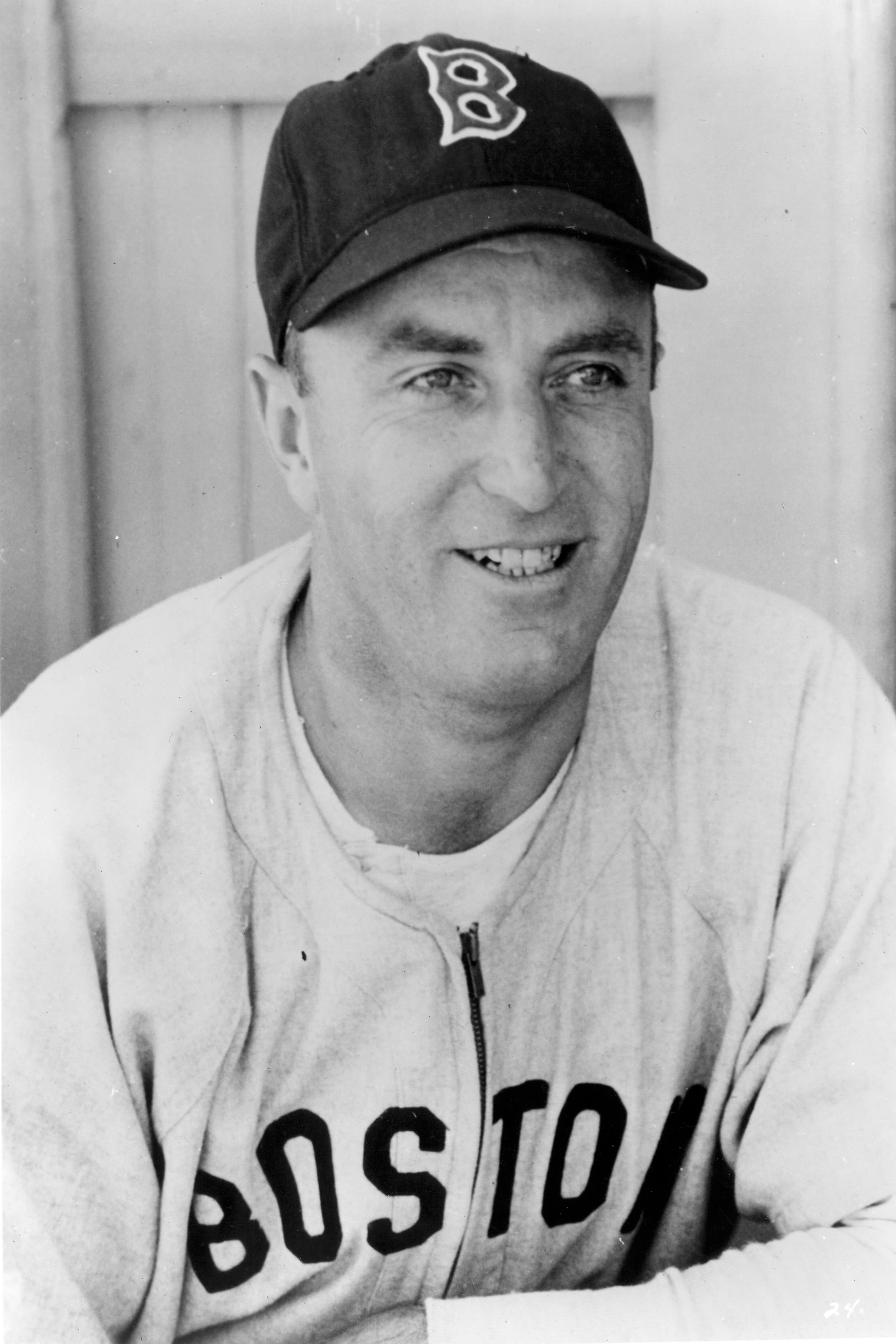
The Red Sox were managed by Joe McCarthy. Although he'd never played in the major leagues, he had led the Chicago Cubs to the 1929 National League Pennant. Fired after not repeating in 1930, the Yankees immediately hired him. He won the 1932 World Series, then missed 3 straight years, then won the American League Pennant in 7 of the next 8: 1936, '37, '38, '39, '41, '42 and '43, winning the World Series on each of those occasions but '42. Those 7 World Series wins remain a record, matched by Casey Stengel, but never surpassed.
He left the Yankees in the middle of the 1946 season, because he did not like the new owners, Dan Topping, Del Webb and Larry MacPhail. When Joe Cronin retired as Red Sox manager, team owner Tom Yawkey hired McCarthy, who seemed to still be the best manager in baseball.
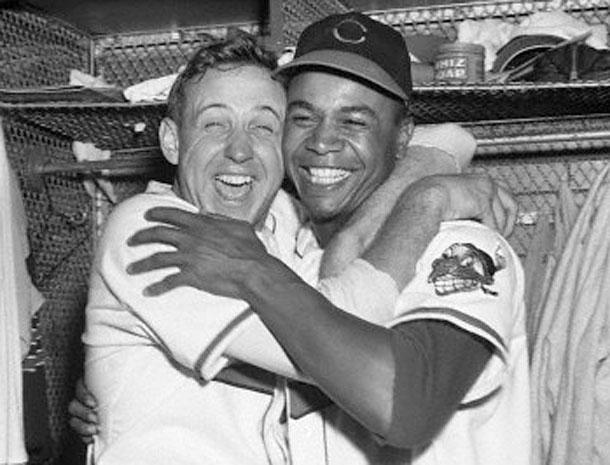
The Indians were managed by Lou Boudreau. A former pro basketball player (in the Midwest-based National Basketball League, before there was an NBA), he had been their regular shortstop since 1940. After the 1941 season, they needed a new manager. Having been Captain of the basketball team at Bradley University in Peoria, Illinois, he suggested himself.
But he was only 24 years old. Aside from Roger Peckinpaugh, who had been interim manager for the last 15 games of the 1914 Yankees' season at age 23, he would, by far, be the youngest manager in baseball history. (Ironically, he would be replacing Peckinpaugh, now 50, in Cleveland.)
He was named manager by team owner Alva Bradley. It didn't matter much during World War II. But when the veterans came back in 1946, one of them was Bill Veeck, who bought the team from Bradley. Veeck had been an executive with the Chicago Cubs, and had built the minor-league version of the Milwaukee Brewers into a Pennant winner. He believed Boudreau was the best shortstop in baseball, but didn't care for him as a manager. Boudreau fought to keep his job, and won. At 31, he had gotten the Indians closer to a Pennant than they'd ever been, except for their 1920 World Series win.
McCarthy picked Denny Galehouse as his starting pitcher. It's true that he was 36 years old, and left the game with an 8-8 record, an ERA of an even 4.00, and a WHIP of 1.445, and only pitched 2 more games in the major leagues.
But his ERA+ for the 1948 season was 110. For those of you unfamiliar with the stat, ERA-plus is earned run average in relation to the rest of the league. Meaning that an ERA+ of 100 means that a pitcher is exactly at the league average when it comes to preventing earned runs. An ERA+ of 110 meant that Galehouse was 10 percent better at preventing earned runs than the average American League pitcher in 1948, even after the game in question.
Denny Galehouse
In other words, Galehouse was not a bad pitcher. He was 109-118 lifetime, but most of that was for weak Indians and St. Louis Browns teams. And while he was only 9-10 for the Browns in 1944, his ERA of 3.12, and his ERA+ of 117, helped them win the Pennant that year, the only one they ever won.
Furthermore, Galehouse had pitched for the Indians, so he knew the tendencies of some of their players. Sometimes, a mental edge can make all the difference.
This time, it didn't. He got the 1st 2 outs in the top of the 1st inning. But Boudreau was the next hitter, and he hit a home run. 1-0 Cleveland.
Boudreau picked Gene Bearden as his starting pitcher. If anything, Boudreau gambled more than McCarthy did. Yes, Bearden was already 19-7 that season, and, at age 28, was in his prime. But he was a rookie, having faced just 4 batters in the major leagues prior to May 8 of that season. And he was a lefthander, pitching in Fenway. And he was a knuckleballer, adding the threat of passed balls, even for a very good-fielding catcher like Jim Hegan.
And, arm-easier knuckler or no, he was pitching on just 1 day's rest, having pitched a complete game victory just 2 days earlier. In fact, from September 6 to October 4, less than 1 full month, he pitched 71 innings. This included, counting the Playoff, 4 complete games in 10 days. Even by the standards of the Fighting Forties, that was insane.
He allowed a tying run. The score remained 1-1 through the end of the 3rd inning. In the top of the 4th, Boudreau and former Yankee 2nd baseman Joe Gordon singled, and 3rd baseman Ken Keltner hit a home run, making the score 4-1, and chasing Galehouse. McCarthy brought in Ellis Kinder, who allowed another run. Boudreau hit another homer in the 5th, to make it 6-1.
The Red Sox closed to within 6-3 on a 6th-inning home run by Bobby Doerr, but a dropped fly ball by the great Ted Williams in left field led to an 8-3 Indians lead. That was the final score, as Bearden went the distance.
The Boston Braves, playing just 1 mile to the west at Braves Field, had won the National League Pennant. This was the closest baseball ever got to an All-Boston World Series. Instead, the Indians stayed in Boston to play Games 1 and 2 of the World Series, and came back to clinch at Braves Field in Game 6.
Despite Pennants in 1954, 1995, 1997 and 2016, the Indians have never won another World Series. Their drought of 74 years is not only the current longest in Major League Baseball, it is now longer than the Red Sox' drought was when they blew the Series in 1986, and longer than the Cubs' drought was when they blew the National League Championship Series in 1984.
Which makes the Indians' heroes of 1948 all the larger: Bearden, Gordon, Keltner, and Hall-of-Famers Boudreau, Bob Feller, Larry Doby and Satchel Paige, the latter 2 having starred in the Negro Leagues.
Earlier in the year, on August 12, the Indians got hits from 14 different players, a record that still stands, as they beat the St. Louis Browns, 26-3 at Sportsman’s Park in St. Louis.
Hits: Gene Bearden (the starting pitcher!) and Hal Peck, 4; Lou Boudreau, Joe Gordon, Dale Mitchell and Jim Hegan, 3; Eddie Robinson, 2; Larry Doby, Wally Judnich, Thurman Tucker, Ken Keltner, Allie Clark, Joe Tipton and Bob Kennedy, 1. This included home runs by Bearden, Doby, Hegan and Judnich. RBIs: Bearden and Boudreau, 4; Peck, 3; Doby, Mitchell, Robinson and Keltner, 2; Gordon, Hegan, Judnich, Clark and Tipton, 1. Bob Feller closed the game out, but did not come to bat.
The Red Sox recovered from their Playoff defeat, and took the Yankees down to the wire in 1949. Again, McCarthy made a fateful pitching change: With the last game of the regular season deciding the Pennant, the Yankees led 1-0 in the bottom of the 8th, and McCarthy took Kinder out for a pinch-hitter. It didn't work, and the bullpen was awful, and the Yankees won the game 5-3. Ever since, he has been ripped for both decisions: Starting Galehouse in '48, and relieving Kinder in '49.
He managed the 1950 season, fell short, and retired. Ironically, his successor as Red Sox manager was Lou Boudreau: Veeck had sold the Indians after the 1949 season, and new owner Ellis Ryan had fired Boudreau.
The way Red Sox fans talked about McCarthy, you'd never know he had won 9 Pennants. Until his death in 1978, they never forgave him. Did they give him a bum rap? Maybe: After all, as I said, Galehouse was a decent pitcher, and Bearden was a big gamble for Boudreau.
In addition, Fenway Park's left-field wall, recently nicknamed The Green Monster, was listed as being 315 feet from home plate. Most people thought it was closer. It was eventually relabeled 310. Then as now, it was a tempting target for righthanded hitters.
And Mel Parnell, usually cited as the best other option for Boston in this game, was a lefthanded pitcher. Add the fact that he would have been pitching on 3 days' rest, and he wasn't that much better a choice to start the Playoff than Denny Galehouse.
What were McCarthy's other options? The day before, Joe Dobson had pitched 4 innings, Earl Johnson 2, and Dave "Boo" Ferriss 3. They would have been too tired to pitch. The day before, Jack Kramer, Galehouse's '44 Browns teammate (and no relation to the tennis star of the same name, who was then at the peak of his game), had gone the distance, so he wasn't ready for this game.
Not only did Boudreau's roll of the dice come up seven, but he was the game's hitting star, too. He went 4-for-4, hitting a solo home run off Galehouse in the 1st inning, and another off Kinder in the 5th. He also fielded 8 chances without an error: 3 putouts, 5 assists. He was named the AL's Most Valuable Player for the season.
At 31, the former "boy manager" had led his team to a Pennant. He remains the last player-manager to do so. And, in so doing, he outmanaged Joe McCarthy, the man then considered the best manager in baseball. Boudreau ended up in the Hall of Fame, although that was more for his playing than his managing.
Boudreau managed the Red Sox from 1952 to 1954, the Kansas City Athletics from 1955 to 1957, and the Chicago Cubs for most of 1960. He had broadcast for the Cubs in 1958 and '59, and did so again from 1961 to 1987. He died in 2001. His daughter Sharyn married Detroit Tigers pitcher Denny McLain.
October 4, 1948 was a Monday. There were no other baseball games that day. It was too early for the NBA and NHL seasons. Football was underway, but there would be no Monday Night Football until 1970. So there were no other scores on this historic day.