Showing posts with label oriole park at camden yards. Show all posts

Tuesday, September 6, 2022

September 6, 1995: Cal Ripken Becomes Baseball's All-Time "Iron Man"

September 6, 1995: The Baltimore Orioles beat the California Angels, 4-2 at Oriole Park at Camden Yards. Cal Ripken Jr. batted 5th and played shortstop. As the game's 5th inning concluded, making the game official, the game was interrupted for a ceremony honoring Ripken, because it was his 2,131st consecutive game with the Orioles.

This broke the record of 2,130, set by Lou Gehrig with the New York Yankees, from June 1, 1925 to April 30, 1939.

Ripken's streak began on May 30, 1982, at the Orioles' previous home park, Memorial Stadium. Then 20 years old, and the son of Oriole 3rd base coach Cal Ripken Sr., he played shortstop, and batted 8th, going 0-for-2, but did draw a walk. The Toronto Blue Jays beat the Orioles, 6-0, getting a 1-hit shutout from Jim Gott (6 innings) and Roy Lee Jackson (3). The only Oriole hit was a single by Rick Dempsey in the 5th inning.

Although he had been featured on the Orioles' "Future Stars" card in the 1982 Topps baseball card set -- along with shortstop Bob Bonner and pitcher Jeff Schneider -- he had, to this point, appeared in a grand total of 65 major league games. And the Orioles' most recent one hadn't been one of them.

He must have impressed manager Earl Weaver, because Earl put Cal in the next game as well. And the next. And so on. In 1982, he was named the American League's Rookie of the Year. In 1983, defying the "sophomore jinx" that had hit many Rookies of the Year, he became the only one, in either League, to win his League's Most Valuable Player award the following season. The Orioles won the World Series, beating the Philadelphia Phillies in 5 games, with Ripken catching a line drive from Garry Maddox for the last out.

Ripken became a perennial All-Star, and in 1991 was named AL MVP again, and also the MVP of the All-Star Game. He surpassed the various men ahead of him on the list of most consecutive games played: Stan Musial with 895, Billy Williams with 1,117, Steve Garvey with the National League record of 1,207, and Everett Scott with the pre-Gehrig record of 1,307.

When the Strike of '94 hit on August 12, 1994, with Ripken having played in 2,009 straight games, there was some question as to whether the next Orioles game, should he play in it, would count as part of the streak. Major League Baseball ruled that it would.

The Strike was ended, and Ripken and the Orioles resumed. On September 5, the Orioles beat the Angels, 8-0, having hit 7 home runs, 2 by Brady Anderson, 1 by Ripken as he tied Gehrig's record at 2,130.

On Gehrig's Monument in Monument Park at Yankee Stadium, the inscription includes the words, "A man, a gentleman and a great ball player whose amazing record of 2130 consecutive games should stand for all time." Whether it should have stood for all time was a separate debate. But it took 56 years after Gehrig's retirement, forced by a fatal illness, to fall.

With the Washington Senators having moved to the Dallas area after the 1971 season, becoming the Texas Rangers, the Orioles became the closest MLB team to the nation's capital, and many Washington insiders made the 45-mile trip up the Baltimore-Washington Parkway, took up the Orioles as their second team, and entertained prominent guests, first at Memorial Stadium, then, starting in 1992, at Camden Yards.

And because Ripken was the biggest star on the capital, he became a national figure, celebrated not for being spectacular, but for simply showing up and doing his job every day -- even though he had just come off the longest work stoppage in his industry's history. (Of course, the players were right and the team owners were wrong. But it does make the celebration of Ripken showing up every day a bit hypocritical.)

So when it was calculated, after the Strike's end, that September 6 would (barring a postponement) be Game Number 2,131, everybody who was anybody wanted to be there. This included President Bill Clinton and First Lady Hillary Clinton, who watched the game with MLB Acting Commissioner Bud Selig. ESPN broadcast the game nationally.

The teams traded home runs in the 1st inning: Tim Salmon for the Angels, and Rafael Palmeiro for the Orioles. Bobby Bonilla led off the bottom of the 4th with a home run. Up next was Ripken, who was a few days past his 35th birthday, and he made it back-to-back home runs, causing Oriole broadcaster Jon Miller to shout, "Oh my goodness, he's done it again!" That made it 3-1 Orioles.

After the 5th inning, as the game began official, people turned to the warehouse beyond the right field wall, where 4 banners hung, reading 2, 1, 3 and 0. A 1 banner was unfurled over the 0 banner, making it 2,131. A standing ovation began, and would not stop. For the moment, he was not just a national treasure, a man widely seen as having restored baseball's popularity after the Strike: He was one of their own, a native of Aberdeen, Maryland, 34 miles to the northeast.

He took what English soccer fans would call a "lap of honour," shaking hands around the field. The ovation lasted 22 minutes, and ESPN did not break for commercial.

Palmeiro hit a home run in the 7th, and the Orioles won, 4-2. Future Hall-of-Famer Mike Mussina was the winning pitcher.

In recognition of his achievement, Sports Illustrated named Ripken their Sportsman of the Year for 1995.

Ripken had once been an excellent defensive shortstop, but, in 1996, was moved to 3rd base, where he remained for the rest of his career. In 1996 and '97, he helped the Orioles reach the Playoffs, but their 1983 remained his only Pennant win. It had been suggested that he was hurting the team by not taking the occasional day off, but he kept going until September 20, 1998, at home against the Yankees, Gehrig's team. His streak ended at 2,632 in a row. He had surpassed Gehrig's record by 23 percent.

In taking the occasional day off, he 1999, he batted .340, the highest average of his career -- but also equal to Gehrig's career batting average. After the season, he was voted by fans onto the MLB All-Century Team. Early the next season, he collected his 3,000th career hit. He retired after the 2001 season, the Orioles retired his Number 8, and he was elected to the Baseball Hall of Fame in 2007.

Given what's now called "load management," the possibility of seriously approaching the streaks of Musial, Williams, Garvey, Scott and Gehrig, never mind Ripken's, is incredibly remote.

*

September 6, 1995 was a Wednesday. These other games were played in Major League Baseball that day:

* The New York Yankees beat the Seattle Mariners, 4-3 at Yankee Stadium. Jack McDowell went the distance for the win. Don Mattingly, in his last month as an active player, went 1-for-4. Ken Griffey Jr. went 1-for-3 with a walk. Tino Martinez hit a home run -- for the Mariners. The next season, he would be hitting them for the Yankees.

* The New York Mets lost to the San Diego Padres, 6-5 at Jack Murphy Stadium in San Diego. Todd Hundley hit a home run for the Mets, Ken Caminiti and Marc Newfield for the Padres. Tony Gwynn went 3-for-3 with a walk. Fernando Valenzuela started for the Padres, but only lasted 3 innings. Three straight singles in the bottom of the 9th, by Steve Finley, Scott Livingstone and Bip Roberts, won it for the Padres.

* The Boston Red Sox beat the Oakland Athletics, 8-2 at Fenway Park in Boston. Rickey Henderson went 1-for-2.

* The Atlanta Braves beat the St. Louis Cardinals, 6-1 at Atlanta-Fulton County Stadium.

* The Florida Marlins beat the Pittsburgh Pirates, 2-1 at Joe Robbie Stadium (now Hard Rock Stadium) in Miami Gardens, Florida.

* The Colorado Rockies beat the Chicago Cubs, 10-4 at Wrigley Field in Chicago.

* The Cleveland Indians beat the Milwaukee Brewers, 12-2 at Milwaukee County Stadium.

* The Minnesota Twins beat the Detroit Tigers, 9-1 at the Metrodome in Minneapolis.

* The Toronto Blue Jays beat the Kansas City Royals, 6-2 at Kauffman Stadium in Kansas City.

* The Chicago White Sox beat the Texas Rangers, 7-5 at The Ballpark (now Choctaw Stadium) in the Dallas suburb of Arlington, Texas.

* The Cincinnati Reds beat the Houston Astros, 7-3 at the Astrodome in Houston.

* The Philadelphia Phillies beat the Los Angeles Dodgers, 1-0 at Dodger Stadium in Los Angeles. Mike Grace (no relation to Mark Grace) pitched 7 innings of 2-hit shutout ball, and 2 relievers completed the 3-hit shutout.

* And the Montreal Expos beat the San Francisco Giants, 8-2 at Candlestick Park (then named 3Com Park at Candlestick Point) in San Francisco. Barry Bonds went 0-for-2 with 2 walks.

Wednesday, April 6, 2022

April 6, 1992: Camden Yards Rewrites the Rules

April 6, 1992: It is Opening Day of a new season in Major League Baseball. Oriole Park at Camden Yards opens, in the Inner Harbor section of Baltimore. The Baltimore Orioles move in, after 37 seasons at Memorial Stadium, and after a threat of moving down the Parkway to Washington.

Two days earlier, they had played in Washington, losing an exhibition game to the Boston Red Sox, 4-3 at Robert F. Kennedy Memorial Stadium. I was at that game, and had a horrible hot dog, the worst food I've ever had at a sporting event above the high school level. So I wasn't surprised to learn the next day that 6 Oriole players had gotten food poisoning that day -- including Rick Sutcliffe, the recently-acquired former Cy Young Award winner for the Chicago Cubs, who was scheduled to be the Camden Yards opener's starting pitcher.

From 1910 until 1969, it was a tradition for the President of the United States to throw out the ceremonial first ball at the Washington Senators' home opener. In 1979, with the Senators having moved, and the Orioles becoming the closest MLB team to the nation's capital, Jimmy Carter threw out the first ball before Game 7 of the World Series. In 1984, Ronald Reagan revived the annual tradition.

In 1991, George H.W. Bush, who had been an All-American 1st baseman at Yale University in 1948, couldn't make it to the final Oriole opener at Memorial Stadium, so he sent Vice President Dan Quayle, admittedly a bigger basketball fan (as one would expect from a man from Indiana), in his place. Quayle threw a strike.

In 1992, running for re-election with a recession raging, Bush threw out the first ball at the Camden Yards opener, and fell well short of the plate. He hid his head in his hands, and was badly booed. He lost, and, the following year, the new President, Bill Clinton, threw out the first ball, getting it to the catcher on the fly, if not over the plate.

The Orioles seemed to show no ill effects from their affliction. With 1 out in the bottom of the 5th, Sam Horn drew a walk, Leo Gomez singled, Chris Hoiles hit a ground-rule double to score Horn, and Billy Ripken, got Gomez home on a suicide squeeze bunt. (Billy's brother, Cal Ripken Jr., went 1-for-3.) That was all that Sutcliffe would need: The last of his 110 pitches was a strikeout of Paul Sorrento, and the Orioles won, 2-0.

Besides having one of the few names -- or shortening of names -- that made it sound like the name of an English soccer stadium -- sorry, forgot to speak English there, "football ground" -- Camden Yards had several interesting features. It was built next-door to Camden Station, former headquarters of the Baltimore & Ohio Railroad, whose warehouse, in between, was converted into the team's offices, including a team store.

Between the right-field fence and the Warehouse was a pedestrian walkway, an extension of Eutaw Street, which included the Orioles' team Hall of Fame, and a barbecue stand run by former slugging 1st baseman John "Boog" Powell -- a good guard against additional food poisonings.

At the center field gate, leading to that walkway, there was a statue of a teenage Babe Ruth, the Baltimore native who went on to revolutionize the game. Not only was Ruth born at a rowhouse, 4 blocks away, that had been converted into a museum, but his father, George Ruth Sr., had run a bar that was later torn down, and stood in what was now center field. Some of his plates and silverware were found when digging for the ballpark.

At the right field gate, leading to the other end of the walkway, was the lettering at the bottom of the home plate facade at Memorial Stadium, a dedicated to veterans of both World Wars: "TIME WILL NOT DIM THE GLORY OF THEIR DEEDS." The home plate and right field foul pole from Memorial Stadium were also transferred to Camden Yards.

With its construction designed to look like an old ballpark -- as if it had already been there since the early 20th Century -- Camden Yards started the "retro ballpark" craze that would come, over the next few years, to Cleveland, Dallas, Denver, Colorado, Atlanta, Seattle, San Francisco, Detroit, Houston, Pittsburgh, Cincinnati, Philadelphia, San Diego, St. Louis, a restored Washington, Minnesota, and both New York teams.

But it also had increased legroom, wider concourses, more concession stands, more bathrooms, and, considerably more important for the teams owning them -- a change from when city or county governments built and owned the stadiums -- more luxury boxes and office space.

Suddenly, the 3 MLB stadiums that had opened in the last 10 years -- the Metrodome in Minneapolis, the SkyDome (Rogers Centre) in Toronto, and the new Comiskey Park (now Rate Field) in Chicago, were hopelessly obsolete. If their teams' owners had waited just a little longer, they could have had similar retro designs, and not only made more money, but gotten better fan reviews.

The NBA and NHL arenas that opened in the 1980s also now seemed obsolete. Building a new arena that looked like an old one didn't happen very often -- what's now named Gainbridge Fieldhouse in Indianapolis is an exception -- but the teams that started building new arenas after 1992 were better off than those that did so in the decade before.

The design issue was most keenly felt in Italy. In the late 1980s, nearly every major stadium in the country was either modernized, or completely torn down and rebuilt, so as to be ready for the 1990 World Cup. Within 20 years, attendance dropped precipitously, as many fans decided that it was no longer worth it to go to stadiums that either were, or felt like they were, built in the 1930s. (Italy had first held the World Cup in 1934.)

Not every new MLB stadium followed the Camden Yards model. But no one wanted to follow the Toronto model. Some teams tried to have it both ways, with the old-time look and the retractable roof. It worked in Seattle and Houston. It did not work in Phoenix and Milwaukee. Tampa Bay was stuck with the fixed-roof stadium they'd opened in 1990.

Finally, in 2012, with the opening of Marlins Park (now LoanDepot Park), the Retro Age ended. After just 20 years, Atlanta replaced Turner Field with Truist Park, out in the suburbs but still retro. But the Dallas area's team, the Texas Rangers, opened Globe Life Field in 2020, with a retractable roof and no nods to yesterday.

*

April 6, 1992 was a Monday. This was also the day that the NCAA Tournament Final was played, with Duke beating Michigan, 71-51. I have a separate entry for that event, not because Duke went back-to-back, or because it featured Michigan's "Fab Five," but because it concluded a unique confluence of events: The Metrodome hosted the World Series, the Super Bowl, and the Final Four, all within a span of 160 days.

This was also the day that Barney & Friends premiered on PBS. I have a separate entry for that event.

And American soccer player Julie Ertz, a 2-time winner of the Women's World Cup, was born on this day.

The NBA didn't schedule any games for the night of the NCAA Final. The NHL was in the middle of its 1st players' strike, which ended up lasting 10 days. So there were no scores in that League.

And these other Major League Baseball games were played:

* The New York Mets beat the St. Louis Cardinals, 4-2 at Busch Memorial Stadium in St. Louis. Bobby Bonilla hit a home run in the top of the 10th inning. It would be the highlight of the season for the 1992 Mets, which local sportswriter Bob Klapisch would call, in the title of his book about them, The Worst Team Money Could Buy. Bonilla, in particular, did not appreciate it.

* The Pittsburgh Pirates beat the Montreal Expos, 2-0 at Three Rivers Stadium in Pittsburgh. Doug Drabek pitched 8 innings of 5-hit shutout ball, with Roger Mason completing a 6-hit shutout. Barry Bonds went 1-for-3.

* The San Diego Padres beat the Cincinnati Reds, 4-3 at Riverfront Stadium in Cincinnati. Tony Gwynn went 2-for-4 with an RBI.

* The Toronto Blue Jays beat the Detroit Tigers, 4-2 at Tiger Stadium in Detroit.

* The Minnesota Twins beat the Milwaukee Brewers, 4-2 at Milwaukee County Stadium. Kirby Puckett hit a home run. Chuck Knoblauch went 4-for-5 with an RBI. Robin Yount went 2-for-3 with a walk. Paul Molitor went 0-for-4.

* The San Francisco Giants beat their arch-rivals, the Los Angeles Dodgers, 8-1 at Dodger Stadium in Los Angeles.

* The Oakland Athletics beat the Kansas City Royals, 5-3 at the Oakland Coliseum. Rickey Henderson went 1-for-4 with a walk and a stolen base. George Brett did not play.

* And the Texas Rangers beat the Seattle Mariners, 12-10 at the Kingdome in Seattle. In spite of the big score, it was a bad day for legends, old and young. Nolan Ryan didn't make it out of the 5th inning, and Randy Johnson didn't get out of the 6th. Ken Griffey Jr. went 0-for-4. 

Monday, March 28, 2022

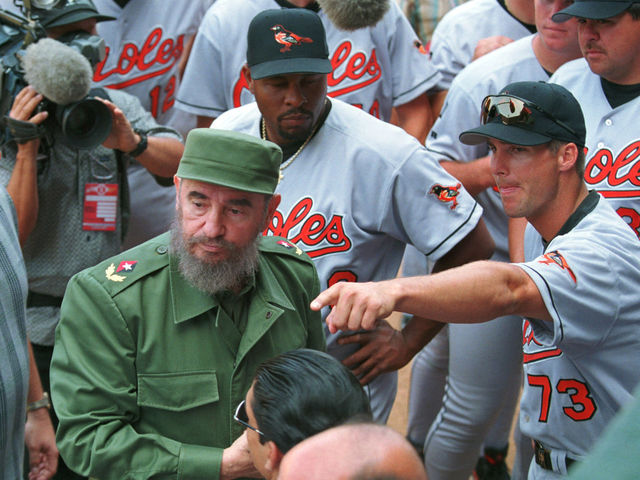
March 28, 1999: The Baltimore Orioles Go to Cuba

March 28, 1999: The Baltimore Orioles beat the Cuba national baseball team, 3-2 in 11 innings, in an exhibition game at Estadio Latinoamericano in Havana, Cuba. It was the 1st game played in Cuba by American major league players since 1959.

Baseball players from Cuba had long been a part of American baseball: White ones, starting in 1911; and black ones, starting in 1949. In 1961, 2 years after his successful revolution, dictator Fidel Castro banned professional sports in the country, leading to the loss of the one minor-league team on the island that was a part of America's "farm system," the Havana Sugar Kings, who had to move back to the American mainland.

Like the Soviet Union, Cuba had a national team that was amateur in name only. Castro, once a lefthanded pitcher (yes, a left wing), promoted this team, and gave it benefits that most citizens didn't have. They would win international tournaments, but their players wouldn't be allowed to play professional baseball in America, or any other country, even those in the Caribbean region with renowned leagues: Puerto Rico, the Dominican Republic, Mexico.

In the 1990s, Cuban players, mostly pitchers, began to defect, doing whatever it took to leave the island and get to America, or a nearby country, and then get to play in America. Castro figured that, if he threw his players a bone, they might be less likely to defect. So he arranged to have the national team play exhibition games against a Major League Baseball team.

On March 28, 1999, in Havana, Charles Johnson hit a home run to help the Orioles beat Cuba, 3-2. On May 3, at Oriole Park at Camden Yards in Baltimore, Andy Morales hit a home run to lead Cuba to a 12-6 win. Castro and Baseball Commissioner Bud Selig attended both games, and each was a sellout: Estadio Latinoamericano, 55,000; Camden Yards, 48,000.

After these 2 games, what changed? Not much: Cuba is still a Communist dictatorship, even after the death of Castro; its players are still defecting to America; and the old Cubans in South Florida are still too chicken to live up to their principles and try to topple that government, or even to fund people who will.

*

March 28, 1999 was a Monday. Baseball's regular season was about to begin. Football was out of season. There were 4 games played in the NBA:

* The Atlanta Hawks beat the Indiana Pacers, 83-82 at the Market Square Arena in Indianapolis.

* The Seattle SuperSonics beat the Dallas Mavericks, 109-101 at the Reunion Arena in Dallas.

* The Denver Nuggets beat the Los Angeles Clippers, 100-88 at the McNichols Arena in Denver.

* And the Los Angeles Lakers beat the Vancouver Grizzlies, 116-98 at The Forum outside Los Angeles in Inglewood, California.

And there were 9 games played in the NHL:

* The New Jersey Devils and the Florida Panthers played to a 2-2 tie at the National Car Rental Center (now the Amerant Bank Arena) in the Miami suburb of Sunrise, Florida.

* The Tampa Bay Lightning and the Carolina Hurricanes played to a 3-3 tie at the Greensboro Coliseum in Greensboro, North Carolina.

* The Dallas Stars beat the Nashville Predators, 3-0 at the Nashville Arena (now the Bridgestone Arena).

* The Buffalo Sabres beat the Pittsburgh Penguins, 4-3 at the Marine Midland Arena (now the KeyBank Center) in Buffalo. Dixon Ward scored the winning goal with 2:33 left in overtime.

* The Detroit Red Wings beat the Philadelphia Flyers, 3-2 at the Joe Louis Arena in Detroit. Wendel Clark scored the winning goal with 2:34 left in overtime.

* The Chicago Blackhawks beat the St. Louis Blues, 3-1 at the United Center in Chicago.

* The Colorado Avalanche beat the Los Angeles Kings, 7-2 at the McNichols Arena in Denver.

* The Edmonton Oilers beat the San Jose Sharks, 5-2 at the Northlands Coliseum (then named the Skyreach Centre).

* And the Mighty Ducks of Anaheim beat the Calgary Flames, 5-1 at the Arrowhead Pond of Anaheim (now the Honda Center).

December 31, 1999 & January 1, 2000: The Millennium

December 31, 1999:  The Millennium arrives. The people of planet Earth survived. At a terrible cost. But we hadn't destroyed ourselves. ...