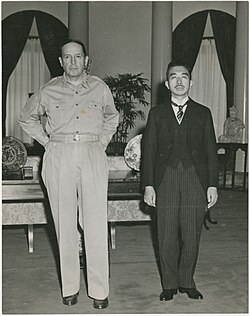
Admiral Jesse Oldendorf
October 25, 1944: The Battle of Surigao Strait is fought, as part of the larger battle to liberate the Philippines from the Empire of Japan. It was 1 of only 2 battleship-versus-battleship naval battles in the Pacific campaign of World War II (after one during the 1942-43 Battle of Guadalcanal), and it remains the last battleship-to-battleship action in history.
A battleship is defined as "a large, heavily armored warship with a main battery, consisting of large guns, designed to serve as a capital ship." A capital ship is defined as a navy's most important warships, generally the larger ships when compared to other warships in their respective fleet. From their advent in the late 1880s, battleships were among the largest and most formidable weapon systems ever built, until they were surpassed by aircraft carriers beginning in the 1940s.
As the Japanese Southern Force approached the Surigao Strait, it ran into a deadly trap set by Seventh Fleet. Rear Admiral Jesse Oldendorf had a substantial force comprising 4 heavy cruisers, including his flagship, the USS Louisville; 4 light cruisers, 28 destroyers, 39 motor torpedo boats (Patrol/Torpedo or "PT" boats, like the one John F. Kennedy had commanded); and 6 battleships: The California, the Maryland, the Mississippi, the Pennsylvania, the Tennessee and the West Virginia.
All but one had been in the attack on Pearl Harbor 3 years earlier: The Mississippi had been on convoy-escort duty in Iceland at the time. The California and the West Virginia had been repaired, while new versions of the Maryland, the Pennsylvania and the Tennessee had to be built.
At 22:36 on October 24, ship time, PT-131 sighted approaching Japanese ships. At about 03:00 on October 25, 2 Japanese battleships, the Yamashiro and the Fusō were torpedoed; the former got away, but the latter was sunk, along with 4 Japanese destroyer.
Jesse Oldendorf held the rank of Real Admiral, 2 stars, at the time of the battle. On December 15, 1944, he was promoted to Vice Admiral, given a 3rd star. He was wounded in 2 separate Japanese attacks on ships he was commanding in 1945. After The War, he commanded the San Diego Naval Base, and retired in 1948, upon which he was given the rank of full Admiral, 4 stars. He lived until 1974. In 1975, the destroyer USS Oldendorf (DD-972) was named for him and commissioned. It was in service until 2003.
In World War II, the U.S. Navy had 27 battleships, all named for States. The Arizona, the Oklahoma and the Utah were sunk at Pearl Harbor. The Arizona and the Utah became part of the official memorial to the battle. The Oklahoma was raised, and sunk under tow in 1947.
The Mississippi, the Colorado, the Iowa, the New Jersey, the Wisconsin, and the Missouri also saw service in the Korean War. The Iowa, the New Jersey, the Wisconsin and the Missouri all lasted through the Vietnam War era, and even into the Persian Gulf War before being retired, the Missouri being the last American battleship, on March 31, 1992. Most likely, the reason the "Mighty Mo" was kept in service the longest was symbolic, as it was on its deck that the Japanese signed the articles of surrender on September 2, 1945.
Four were sunk as target practice: The Arkansas in 1946; and the New York, the Nevada and the Pennsylvania in 1948. Most of the battleships were ultimately scrapped: The Idaho, the New Mexico and the Wyoming in 1947; the Mississippi in 1957; the California, the Colorado, the Maryland, the Tennessee and the West Virginia in 1959; the Washington in 1960; the South Dakota in 1962; and the Indiana in 1963.
Some were saved as "museum ships." The USS Texas, BB-35, the last surviving U.S. battleship from World War I, had its longtime home adjacent to the San Jacinto Monument in the Houston Ship Channel. As of October 25, 2022, it is undergoing repairs, with the intent of moving it to a new location in Galveston, on the Gulf of Mexico.
The USS North Carolina, BB-55, is in its namesake State, across the Cape Fear River from downtown Wilmington. Wilmington, North Carolina is known as the home city of TV newscaster David Brinkley, basketball icon Michael Jordan, and TV screenwriter and producer Kevin Williamson.
The USS Massachusetts, BB-59, is in its namesake State, at Battleship Cove, a maritime museum in Fall River, on Mount Hope Bay. Battleship Cove contains the largest collection of World War II-era naval vessels, anywhere in the world.
Fall River is famous for two other things: Being the location of the murders of Andrew and Abby Borden in 1892, with Andrew's daughter Lizzie being accused, but acquitted; and being one of the founding cities of American soccer, as its large Portuguese community led to the founding of one of the earliest great U.S. teams, the Ponta Delgada Soccer Club, which sometimes got around Massachusetts' "blue laws" by playing Sunday games a few miles away, across the State Line, in Tiverton, Rhode Island.
The USS Alabama, BB-60, is in its namesake State, on Mobile Bay.
The USS Iowa, BB-61, survived a 1989 explosion that killed 47 crewmen, was retired 2 years later, after service in the Persian Gulf War, and is now a museum ship at the Port of Los Angeles, which, with the USS California having long since been scrapped, couldn't have that ship.
The USS New Jersey, BB-62, is in its namesake State, on the Delaware River in Camden, across from Center City Philadelphia, upriver from the naval shipyard where it was constructed in 1943. (UPDATE: In 2024, it returned to the Philadelphia Naval Shipyard for renovations, which lasted a few weeks.)
The USS Missouri, BB-63, is at Pearl Harbor in Honolulu, Hawaii. As with keeping it in service the longest, the ship's final resting place is symbolic: Its bow is pointed at the USS Arizona Memorial, so that the ship where America's role in The War ended can "watch over" the ship where America's role in The War effectively began. The Missouri's bell was removed, and taken to the Missouri State Museum, in the State capital of Jefferson City, where it is on display.
And the USS Wisconsin, BB-64, is at its "birthplace," the Norfolk Naval Shipyard in Virginia.
*
October 25, 1944 was a Wednesday. Jon Anderson, lead singer of British rock band Yes, and political consultant James Carville were born. This was also the day that Nazi Germany began a crackdown on the resistance group known as the Edelweiss Pirates. I have a separate entry for that event.
Baseball season had ended 16 days earlier, when the St. Louis Cardinals won the World Series by beating the St. Louis Browns in 6 games. Football was in midweek. The NBA hadn't been founded yet. And the NHL season started 3 days later. So there were no scores on this historic day.