
October 20, 1944: Keeping the promise he made 2 1/2 years earlier, General Douglas MacArthur returns to the Philippines, landing at Leyte Gulf. It will take until April 13, 1945 to get all Japanese troops out of the country.
In February 1942, as Japanese forces tightened their grip on the Philippines in World War II, President Franklin D. Roosevelt ordered MacArthur to relocate to Australia. On the night of March 12, MacArthur and a select group that included his wife Jean, son Arthur, and members of his staff, left Corregidor. They traveled in PT boats through stormy seas patrolled by Japanese warships, and reached Del Monte Airfield on Minanao, where B-17s picked them up, and flew them to Australia.
MacArthur ultimately arrived in Melbourne by train on March 21. Speaking by radio, he told the people of the Philippines, "I came through, and I shall return."
In his prepared speech, he said:
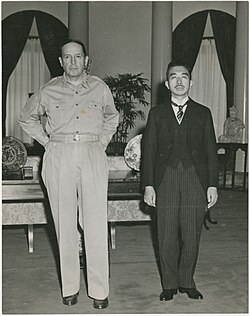
On September 27, 1945, a few weeks after V-J Day, Faillace took another famous photo of MacArthur, in uniform, but without his famous hat, sunglasses and pipe, standing next to Emperor Hirohito, in Western-style formal dress, to show the Japanese who was the bigger man: MacArthur was 6 feet even, while Hirohito was 5-foot-5.
MacArthur's lines, "I shall return" and "I have returned" would be homaged and parodied many times. Since the 1984 release of the Arnold Schwarzenegger film The Terminator, however, people no longer tend to say, "I shall return," instead using Arnold's line, "I'll be back."
Also on this day, in Europe, the Yugoslav capital of Belgrade is liberated from the Fascists by Yugoslav Partisans. The following year, a professional soccer team will be named for them: Football Klub Partizan Belgrade.
But it's not all a good day: A gas leak causes an explosion that destroys a square mile of the East Side of Cleveland, killing 131 people. I have a separate entry for that event.
*
October 20, 1944 was a Friday. Baseball season had ended 11 days earlier, with the St. Louis Cardinals defeating their landlords at Sportsman's Park, the St. Louis Browns. The NBA hadn't been founded yet. The NHL season wouldn't begin for another 8 days. And the NFL was in midweek. But there were 4 games in college football that night:
* In a rare college football version of the New York City vs. New England sports rivalry, Boston College beat New York University, 42-13 at Fenway Park. Until Alumni Stadium was built in 1957, BC played wherever they could get a playing date, and also played at Braves Field and Harvard Stadium, in addition to their on-campus Alumni Field, which Alumni Stadium would replace. NYU played its home games at Ohio Field in The Bronx, with games too big for that 12,000-seat facility moved across the Borough to Yankee Stadium.
* The University of Kentucky beat Virginia Military Institute, 26-9 at McLean Stadium in Lexington, Kentucky. Although VMI was (and is) a military school, this was not an example of a regular college football team struggling to find games due to the manpower drain of World War II, and settling for playing the college-age players on military bases. But there were many such games, in both World Wars, and these last 2 were among them:
* The team at the U.S. Army's Fort Pierce, in the town of the same name, north of Miami, beat the University of Miami, 38-0 at Burdine Stadium in Miami. In 1959, Burdine Stadium would be renamed for its biggest annual event: The Orange Bowl.
* And the University of Georgia beat Daniel Field, 57-6 at Sanford Stadium in Athens, Georgia. Daniel Field was a U.S. Army Air Forces base in Augusta, Georgia.


No comments:
Post a Comment