Showing posts with label 1929. Show all posts

Saturday, December 31, 2022

December 31, 1929: Guy Lombardo Becomes "Mr. New Year's Eve"

December 31, 1929: Guy Lombardo, conducts his orchestra, the Royal Canadians, in performing Robert Burns' "Auld Lang Syne" on New Year's Eve for the 1st time, at the Roosevelt Hotel in Midtown Manhattan.

He would do so 48 times, first on radio, then from 1956 onward on television, on CBS; first at the Roosevelt, and then from 1960 onward 4 blocks away, at the Waldorf Astoria.

Born on Gaetano Alberto Lombardo on June 19, 1902 in London, Ontario, Canada, he became a violin virtuoso, and formed the Royal Canadians in 1924, with his brothers Carmen, Lebert and Victor, and other musicians from London. They billed themselves as creating "the sweetest music this side of Heaven." The Lombardos are believed to have sold over 100 million records during their lifetimes, many featuring the band's lead singer from 1940 onward, Kenny Gardner, who married the Lombardo brothers' sister, Elaine. Lilibeth Glenn, whom Guy married in 1926, also sang with the band.

The band specialized in music that would already have been considered "oldies" at the time, late 19th Century and early 20th Century popular songs. While they did eventually embrace what they called "sweet jazz," and "show tunes" of the 1930s and '40s, they never adapted rock and roll songs to their style and added them to their repertoire.

Guy died on November 5, 1977, in Houston, on the road with his band. By this point, Dick Clark had already been doing his New Year's Rockin' Eve on ABC for 6 years, and he took over the role of "Mr. New Year's Eve" – not that my grandmother, who loved the kind of music that was already old hat to both her and Lombardo, would ever hear of anyone but Lombardo having that role. Like many others in her generation, she said, "It's just not New Year's Eve without Guy Lombardo."

Carmen Lombardo had already died in 1971. Lilibeth died in 1982, Lebert in 1993, Victor in 1994, Elaine in 1999, and Kenny Gardner in 2002.

Still, when the ball drops in Times Square, it’s the Royal Canadians' version of "Auld Lang Syne" that plays – followed by Frank Sinatra's version of "Theme from New York, New York," Louis Armstrong's version of "What a Wonderful World," Ray Charles' version of "America the Beautiful," and Israel Kamakawiwoʻole's version of "Over the Rainbow."

The Roosevelt Hotel is at 45 East 45th Street, between Madison and Park Avenues. The Waldorf is at 301 Park Avenue, between 49th and 50th Streets.

*

December 31, 1929 was a Tuesday. Baseball was out of season. The NBA hadn't been founded yet. Football season was over, except for 2 games the next day, New Year's Day, January 1, 1930. The University of Southern California beat the University of Pittsburgh, in the Rose Bowl, in the stadium of the same name, in the Los Angeles suburb of Pasadena, California: USC 47, Pitt 14. And, in a game that wasn't officially called a bowl game, Washington State beat Hawaii, 28-7 at Honolulu Stadium.

One game was played in the NHL: The New York Rangers and the Ottawa Senators played to a 1-1 tie at the building that would eventually be known as "the old Madison Square Garden," though it was then just 4 years old.

Wednesday, December 28, 2022

December 28, 1929: The 1st NHL Game In New Jersey

Boardwalk Hall

When was the 1st National Hockey League game in New Jersey? It was the Devils' opener in 1982, right? Actually, it goes back a lot further than you might think.

December 28, 1929: It was at the end of the Roaring Twenties, just 2 months after the stock market's Crash of 1929. No one had yet realized that the Great Depression had begun. The Shore resort of Atlantic City had just opened a new Convention Hall, a 17,000-seat amphitheater, with the round end of the horseshoe pointing to the beach and a stage at the inland end.

The New York Rangers had begun play in the 1926-27 season. In 1927-28, they won the Stanley Cup. In 1928-29, they reached the Stanley Cup Finals, but lost to the Boston Bruins. For reasons lost to time, they decided to play a "home game" of the 1929-30 season 120 miles away, at Convention Hall.

The Rangers were loaded, with a forward line of Frank Boucher centering the brothers Bill and Frederick "Bun" Cook. Their defense was led by Ivan Johnson, known as "Ching" because, in that much less politically correct era, some people, who clearly needed glasses, thought he looked Chinese. Their goalkeeper for this game, and for every game from 1928 to 1933, was John Ross Roach, picked up following a goalkeeping emergency that nearly cost them the '28 Cup.

The Ottawa Senators had won the Cup in 1920, '21, '23 and '27, but were now in decline. They were still led by forwards Frank Nighbor, Frank Finnigan, and the brothers Hector and Wally Kilrea. Their defense still had Frank "King" Clancy and Alex Smith, with Alex Connell in goal.

Boucher opened the scoring at 14:30 of the 1st period. Clancy tied the game at 5:11 of the 2nd. At 9:00, Paul Thompson, later to help the Chicago Black Hawks win the 1934 and '38 Stanley Cups, gave the Rangers the lead. With 2:24 left in regulation, Leroy Goldsworthy (no relation to 1970s hockey star Bill Goldsworthy) gave the Broadway Blueshirts an insurance goal. The Rangers won, 3-1.
Frank Boucher

Two more games would be played at Convention Hall that season. On January 25, 1930, the Chicago Black Hawks beat the Pittsburgh Pirates, 5-2. And on March 15, the Senators returned, and beat the New York Americans, 8-7. The next season, the hockey version of the Pirates became the Philadelphia Quakers, but went out of business after that one season. They played at the Philadelphia Arena, and did not play any games in Atlantic City.

The Rangers reached the Finals again in 1932, and won the Cup in 1933, before rebuilding, and reaching the Finals in 1937 and winning the Cup in 1940. World War II wrecked the franchise, and they have only won the Cup once since, in 1994. They're still better off than the Senators, who went out of business in 1934. A new Ottawa Senators franchise began in 1992, but has only reached the Finals once, in 2007.

Despite the World Hockey Association moving the New York Golden Blades (formerly the New York Raiders) to the Cherry Hill Arena in the Philadelphia suburbs, and renaming them the Jersey Knights, in the middle of the 1973-74 season, after which they folded, there would be no more NHL games in New Jersey for 52 years, until October 5, 1982, when the New Jersey Devils made their regular-season debut, tying the Pittsburgh Penguins, 3-3.

Convention Hall, renamed Boardwalk Hall in 2001, still stands. From 1940 to 1997, and again from 2013 to 2019, it hosted the Miss America Pageant. Within days in August 1964, it hosted both the Democratic National Convention and a concert by The Beatles. It hosted the Liberty Bowl football game in 1964, despite not quite being long enough for a standard football field. It's hosted many concerts, and some big prizefights, the most famous of them being Mike Tyson's 91-second knockout of Michael Spinks in 1988.

*

December 28, 1929 was a Saturday. One other NHL game was played that day: The Boston Bruins beat the Montreal Canadiens, 3-2 at the Montreal Forum. The Bruins had won the Stanley Cup the season before, but the Canadiens would win it this season.

Baseball was out of season. Football season had just ended. The NBA hadn't been founded yet.

One other sports note from this day: The English soccer team I have come to support, Arsenal F.C., went to Yorkshire, and lost to Leeds United, 2-0 at Elland Road. They went on to win their 1st major trophy that season, anyway, the 1930 FA Cup.

Friday, December 2, 2022

December 2, 1929: Irving Berlin Publishes “Puttin’ On the Ritz”

December 2, 1929: Irving Berlin first publishes his song "Puttin' On the Ritz." The title was an expression that Harlemites of the time coined, meaning to dress nice, and takes its name from the Ritz Hotel in London, which may also have produced the adjective "ritzy.: The following year, a film with the title was released, and Harry Richman sang it in front of Hollywood's 1st interracial ensemble.

It's also been sung in films by Clark Gable (complete with white tie and tails) in Idiot's Delight in 1939, Fred Astaire in Blue Skies in 1946, and, for comedic effect, Gene Wilder and Peter Boyle in Young Frankenstein in 1974.

In 1982, Indonesian-Dutch singer Taco Ockerse (using only his first name) released the most recent hit version. It reached Number 4 in the U.S. Irving Berlin was then 95 years old, making him the oldest living songwriter to have a song he wrote enter the Top 10. Unfortunately, Taco's original video for it had blackface performers, and had to be re-shot.

*

December 2, 1929 was a Monday. Sportswriter Dan Jenkins was born.

Baseball was out of season. Football was in midweek. The NBA hadn't been founded yet. And the NHL had a day off. So there were no scores on this historic day.

Monday, November 28, 2022

November 28, 1929: The Ernie Nevers Game

November 28, 1929: Ernie Nevers puts on a Thanksgiving performance that is a feast for football fans' eyes.

A native of Superior, Wisconsin, and an All-American two-way back at Stanford University, Nevers debuted in the NFL with the Duluth Eskimos in 1926, but they folded after the 1927 season. He also played in Major League Baseball, pitching for the St. Louis Browns in the 1926, '27 and '28 seasons, going 6-12.

He claimed a back injury had let him to retire as a football player, and he spent the 1928 season assisting his former coach, Glenn "Pop" Warner, at Stanford. But 3 things became clear: He wasn't going to make it as a baseball player, he missed playing football, and he needed money. So, in 1929, he signed with the Chicago Cardinals.

As a running back and a placekicker, he had frequently scored every point the Eskimos had scored in a game. He resumed doing that with the Cardinals. On November 6, in the 1st night game in NFL history, he led the Cards to a 16-0 win over the host Providence Steam Roller. Here's how the 16 Cardinal points broke down: He ran for a touchdown, passed for a touchdown, kicked an extra point (but missed the other), and kicked a field goal.

He was just getting warmed up. On November 24, he scored 3 touchdowns and kicked an extra point, scoring all the Cardinals' points in a 19-0 win over the Dayton Triangles.

Just 4 days later, the Cardinals played the Chicago Bears on Thanksgiving Day, as they had done each year since 1922. It was a nasty rivalry, between the Cardinals, who groundshared with the White Sox at Comiskey Park on the South Side, and the Bears, who groundshared with the Cubs at Wrigley Field on the North Side. That 1st game, in 1922, included a vicious brawl that included Bears end, head coach, general manager and owner George Halas.

This time, at Comiskey, there was no brawl. There was only the Ernie Nevers Show. In the 1st quarter, he ran for a touchdown, but missed the extra point. Then he ran for another, and made the extra point. 13-0 Cardinals. In the 2nd quarter, he ran for another touchdown, and kicked the extra point. At the half, 20-0 Cardinals.

The Bears got on the board in the 3rd quarter, when Garland "Gardie" Grange, younger brother of Red Grange, caught a touchdown pass from Walt Holmer. Gardie was the Bears' kicker that season, and missed the extra point. Nevers ran for a 4th touchdown, and made the extra point. After 3 quarters, 27-6 Cardinals.

In the 4th quarter, Nevers made it 5 touchdowns, but missed the extra point. Finally, he ran for a 6th touchdown, and made the extra point. He attempted no field goals. Final score: Cardinals 40, Bears 6. Nevers had scored 40 points in a single game. That remains an NFL record.

Six touchdowns in a single game? On November 25, 1951, also against the Bears, William "Dub" Jones of the Cleveland Browns ran for 4 and caught passes for 2, in a 42-21 win at Cleveland Municipal Stadium. On December 12, 1965, for the Bears, Gale Sayers ran for 4, caught a pass for 1, and returned a punt for 1, in a 61-20 win over the San Francisco 49ers at Wrigley Field.

Six rushing touchdowns in a single game? That wouldn't be done again until, appropriately enough, another holiday: Christmas, December 25, 2020, when Alvin Kamara of the New Orleans Saints did it in a 52-33 win over the Minnesota Vikings at the Superdome in New Orleans.

But from the 1960s onward, when placekickers tended to be specialists, not also players starting at another position, 40 points in a game has not been seriously threatened. There have been instances of 7 field goals in a game (21 points), plus extra points. But Jones, Sayers and Kamara are the only players to score 36 since Nevers, and none of them kicked anything.

All that playing, including on both offense and defense, finally caught up to Nevers and the Cardinals. Three days after the 40-point performance, the Cards lost to the New York Giants, 24-21 at the Polo Grounds. Still, never ran for a touchdown, threw a touchdown pass, and set up the other Cardinal touchdown when he intercepted a pass from Benny Friedman and took it to the 1-yard line. This time, though, while the Cardinals converted all 3 extra points, Nevers only kicked 1 of them.

Nevers continued to play for the Cardinals through the 1931 season, then went back into coaching, including as head coach of the Cardinals in the 1930, '31, and '39 seasons. He served in the U.S. Marine Corps during World War II, rising to the rank of Major, and serving as the athletic director at the Marine base in San Diego.

He was a charter inductee into the Pro Football Hall of Fame in 1963. Although Stanford retired his Number 1, the Cardinal franchise, now based in Arizona, has never retired the Number 4 he wore with them. However, he is 1 of 8 figures from their Chicago years who have been inducted into their Ring of Honor. He died in 1976. In 2010, the NFL Network ranked him 89th on their list of the 100 Greatest Players.

*

November 28, 1929 was a Thursday, and a Thanksgiving Day. Berry Gordy Jr., founder and operator of Motown Records, was born on this day.

There were 2 other NFL games played that day. The New York Giants beat their then-crosstown rivals, the Staten Island Stapletons, 21-7 at Thompson Stadium in Staten Island. And the Green Bay Packers and the Frankford Yellow Jackets played to a 0-0 tie at Frankford Stadium in Northeast Philadelphia.

And there were 25 college games:

* Carnegie Tech beat NYU, 20-0 at Yankee Stadium.

* Syracuse beat Columbia, 6-0 at Baker Field in Manhattan.

* The University of Pennsylvania beat Cornell, 17-7 at Franklin Field in Philadelphia.

* The University of Pittsburgh beat Penn State, 20-7 at Pitt Stadium in Pittsburgh.

* Maryland beat Johns Hopkins, 28-6 at Homewood Field in Baltimore. (That was, and remains, Hopkins' home field. They now compete in NCAA Division III.)

* Virginia Military Institute (VMI) beat Virginia Polytechnic Institute (VPI, now usually known as Virginia Tech), 14-0 at Maher Field in Roanoke, Virginia (neutral ground).

* West Virginia beat Washington & Jefferson, 6-0 at the old Mountaineer Field in Morgantown, West Virginia.

* Tennessee and Kentucky played to a 6-6 tie at Stoll Field in Lexington, Kentucky.

* North Carolina beat Virginia, 41-6 at Kenan Stadium in Chapel Hill, North Carolina.

* Wake Forest beat Mercer, 13-0 at Memorial Stadium in Asheville, North Carolina.

* Clemson beat Furman, 7-6 at Riggs Field in Clemson, South Carolina.

* Georgia Tech beat Auburn, 19-0 at Grant Field in Atlanta.

* Florida beat Washington & Lee, 25-7 at Fleming Field in Gainesville, Florida.

* Georgia beat Alabama, 12-0 at Legion Field in Birmingham, Alabama.

* The University of Mississippi (then as now, nicknamed Ole Miss) and Mississippi A&M (which became Mississippi State in 1932) played to a 7-7 tie at Hemingway Stadium (now Vaught-Hemingway Stadium), Ole Miss' home in Oxford.

* Tulane beat Louisiana State 21-0 at Tiger Stadium in Baton Rouge, Louisiana.

* Arkansas beat Oklahoma A&M, 32-6 at Lewis Field in Stillwater, Oklahoma. (A&M became Oklahoma State in 1958.)

* Texas A&M beat Texas, 13-0 at Kyle Field in College Station, Texas.

* Marquette beat Kansas State, 25-6 at Marquette Stadium in Milwaukee.

* Missouri beat Oklahoma, 13-0 at Memorial Stadium (now Faurot Field) in Columbia, Missouri.

* Nebraska beat Iowa State, 31-12 at Memorial Stadium in Lincoln, Nebraska.

* Colorado College beat Colorado Mines, 13-0 at Washburn Field in Colorado Springs. (Colorado College became an NCAA Division III school, and they discontinued their football program in 2008. Colorado School of Mines is located in Golden, and now plays in NCAA Division II. Neither should be confused with either the University of Colorado or Colorado State University.)

* Utah beat Utah State, 26-7 at Ute Stadium in Salt Lake City.

* UCLA beat Montana, 14-0 at the Los Angeles Memorial Coliseum.

* And St. Mary's beat Oregon, 31-6 at Kezar Stadium in San Francisco.

Baseball was out of season. And the NBA hadn't been founded yet. But there were 3 games played in the NHL:

* The New York Americans beat the Ottawa Senators, 4-3 at the old (then the new) Madison Square Garden. Normie Himes scored the winner, just 24 seconds into overtime. (The Senators folded in 1934, the Americans in 1942.)

* The New York Rangers beat the Chicago Black Hawks, 3-2 at the Chicago Coliseum.

* And the Detroit Cougars beat the Montreal Maroons, 7-6 at the Montreal Forum. (The Cougars became the Detroit Falcons in 1930, and the Detroit Red Wings in 1932. The Maroons folded in 1938.)

Tuesday, November 15, 2022

November 15, 1929: The Ambassador Bridge Opens

November 15, 1929: The Ambassador Bridge opens, connecting Detroit, Michigan, in the United States with Windsor, Ontario, Canada, over the Detroit River.

Detroit and Buffalo are the only major American cities on the border with Canada, our northern neighbor. Seattle is 111 miles away, Boston 220, Minneapolis 300, and New York 330. And because of the bend of the Detroit River, Detroit is the only place where you can go from north to south, and go from America to Canada.

The Bridge followed a ferry system, and a rail tunnel that opened in 1910. It was, itself, followed by the Detroit-Windsor Tunnel in 1930.

Since the establishment of the Interstate Highway System, going into Detroit, the road becomes Interstate 75 and Interstate 96. Going into Windsor, it becomes Ontario Highway 3.

The Bridge is privately owned: Even in the Roaring Twenties, neither the State of Michigan, nor the Province of Ontario, nor either country's federal government wanted to fund its construction. So Michigan automakers, including Henry Ford, put up the money.

In 1979, trucking executive Manuel "Matty" Moroun, like entertainer Danny Thomas a Detroit native of Lebanese descent, bought the Bridge, and maintained and operated it through his Detroit International Bridge Company for the rest of his life. It may have been personal: He claimed that his family moved from Windsor to Detroit when construction for the bridge on the Windsor side led to the demolition of the family home.

The Ambassador Bridge is the busiest international border crossing in North America in terms of trade volume, carrying more than 25 percent of all merchandise trade between the United States and Canada by value.

Because the Bridge's duty-free gasoline sales are so lucrative, Moroun fought tooth and nail against all attempts to build an additional bridge. He offered to spend his own money to build a parallel span to the Ambassador, as had been done with many other bridges, including the Delaware Memorial. He went so far as to build a base structure for an approach on the Detroit side.

He sued both the State of Michigan and the Canadian federal government to prevent a new bridge from being approved. For the last few years of his life, he also owned the Michigan Central Station, to keep rail traffic, passenger and freight alike, into and out of Detroit, to a minimum, raising the value of his Bridge.

Moroun died in 2020, clearing the way for the construction of the Gordie Howe International Bridge, which is scheduled to open in 2024. It also cleared the way for Ford Motor Company to buy the Station, and use it for corporate purposes. (UPDATE: The Howe Bridge is now set to open in 2025.)

*

November 15, 1929 was a Friday. Baseball was out of season. Football was in midweek. The NBA hadn't been founded yet. And while the NHL season had just started, no games were scheduled. So there were no scores on this historic day. 

Sunday, November 6, 2022

November 6, 1929: The NFL's 1st Night Game

The site of Kinsley Park, 2020

November 6, 1929With the field at the Cycledrome -- a 10,000-seat bicycle racing track with a football field almost fully squeezed into it -- so waterlogged that the referees will not permit play, the Providence Steam Roller, defending NFL Champions, move their scheduled game with the Chicago Cardinals to their former home, Kinsley Park. This 6,000-seat stadium has floodlights, and so, this becomes the 1st night game in NFL history.

The Cardinals win, 16-0, but the gate receipts from the sellout crowd count the same. And, with the stock market having crashed a few days ago, the Steam Roller -- that's how their name was always written, as 2 words, and no S on the end -- need all the help they can get.

As it turns out, it's not enough: The team gets through the 1930 and '31 NFL seasons, drops out, holds on in another league through 1933, and folds, a victim of the Great Depression. Kinsley Park was torn down in 1933, and no trace of it remains.

November 6, 1929 was a Wednesday. Why they were playing on a Wednesday, I don't know. But they had already played on November 5, a Tuesday; and would play on November 9, a Saturday, and November 10, a Sunday. No wonder the Steam Roller only went 4-6-2 that season: They were exhausted. They didn't win any games between October 13 and November 17, going 0-4-2 over that stretch.

At any rate, no other NFL games were played on that day. Baseball season was over. The NBA hadn't yet been founded. And the NHL season didn't start until November 14. So there were no other scores on this historic day.

Tuesday, November 1, 2022

November 1, 1929: “Happy Days Are Here Again” Is Recorded

Leo Reisman

November 1, 1929: "Happy Days Are Here Again" is recorded by Leo Reisman and His Orchestra. The timing is bad, within days of the stock market crash that caused the Great Depression.

It is saved by Franklin Roosevelt using it as his campaign theme song in 1932. And 1936. And 1940. And 1944. The song became identified with FDR and the recovery he launched, and with the Democratic Party in general.

However, at the 1968 Democratic Convention in Chicago, when delegates sang "We Shall Overcome" following the approval of the platform plank supporting the Vietnam War, Mayor Richard Daley ordered the band on hand to play "Happy Days Are Here Again" to drown it out. It didn't work.

Reisman lived until 1961. Jack Yellen wrote the lyrics, and lived until 1991. Milton Ager wrote the music, and lived until 1979. Together, they also wrote "Ain't She Sweet."

Barbra Streisand recorded a slow version of the normally uptempo "Happy Days Are Here Again" in 1962.

*

November 1, 1929 was a Friday. Baseball season was over. The NBA hadn't been founded yet. The NHL season was 13 days away.

There was 1 college football game that night: Drake University beat Creighton University, 34-12 at Drake Stadium in Des Moines, Iowa. Having installed lights at their stadium the season before, making them the 1st major college football team to do so, Drake went on to win the Missouri Valley Conference title that season.

Drake dropped its football program in 1986, only to bring it back the next year, at the level of NCAA Division I-AA, now the Football Championship Subdivision (FCS), where they remain. Creighton, of Omaha, Nebraska, dropped football after the 1942 season, due to the manpower drain of World War II, and have never restored it.


Saturday, October 29, 2022

October 29, 1929: Crash and Depression

October 29, 1929: Black Tuesday. The stock market completes the crash that began the preceding Thursday. The Roaring Twenties are over. The Dirty Thirties, and the Great Depression, have begun.

The incumbent Republican President, Herbert Hoover, gets blamed for it, when it was his Republican predecessors, Warren Harding and Calvin Coolidge, who set the table for it. Hoover shouldn't be blamed for the Depression. And he shouldn't be blamed for doing nothing: He tried a few things.
What he should be blamed for is giving up. Some of the things he tried worked a little, but not enough, and he abandoned his efforts. And in 1932, he lost in a landslide, to the Democratic Governor of New York, Franklin Delano Roosevelt.

Emptied pockets, to show that you had no money, became known as Hoover flags. Newspapers used as cover by homeless people became known as Hoover blankets. Shanty towns became Hoovervilles. And hitching a horse up to your car, because you couldn't afford gasoline but you didn't dare sell your car, earned the vehicles the nickname Hoover wagons. In Canada, where Richard Bennett rode the Depression to become Prime Minister in 1930, but was turned out in 1935 because he governed more like Hoover than Roosevelt, they were known as Bennett buggies.
Did you think I was making it up?

The happy, peppy songs of the Roaring Twenties -- including a song recorded just before, but released just after, the crash, which was saved by FDR making it his campaign theme song, "Happy Days Are Here Again" -- were gone. Songs of the Depression either spoke of hardship, like "Brother, Can You Spare a Dime?" (evoking both now-fallen industry and World War I), "Boulevard of Broken Dreams" (not the Green Day song of 2005), "Gloomy Sunday," and "Remember My Forgotten Man"; or tried to defy it, like "We're In the Money" and "Life Is Just a Bowl of Cherries."

Movies also reflected this. Monster movies abounded, with Dracula and Frankenstein both released in 1931, and King Kong and The Invisible Man in 1933, each inspiring many imitators. Gangster movies peaked then, with James Cagney's The Public Enemy, Edward G. Robinson's Little Caesar, and the original version of Scarface, starring Paul Muni, all made in 1931, the latter not released until 1932.

At the height of the stock boom in early September 1929, America's unemployment rate was 3.2 percent. By the end of 1930, it was 8.7. 1931, 15.9. At the 1932 election, 23.6. At the depth, on March 4, 1933, when FDR was inaugurated and the banking crisis was critical, the rate was 24.9 percent. Fully 1 out of 4 Americans who wanted to work couldn't get work. Some people have suggested the rate was considerably higher than that, as much as 31 percent, or nearly 1 in 3.

FDR ended up building on some of what worked under Hoover, and in New York State under his leadership there, and put it in overdrive. Banking reforms stopped the financial bleeding, securities reforms prevented much of the abuses that had been done (stopped it, that is, until deregulation in the 1980s), and his public works and other construction programs created millions of jobs.

His New Deal had worked very well, but the problems remained vast. When he was sworn in for a 2nd term on January 20, 1937, having gotten the unemployment rate down to 14 percent (either cut by a third or a half, depending on whose figures you believe), FDR said the work was far from done: "I see one-third of a nation ill-housed, ill-clad, ill-nourished." And it may have been more like two-fifths, or 40 percent, because that included what we would now call "the working poor."

That year, FDR did what conservatives have always suggested for economic hardship: Cut spending. It backfired, and unemployment went from a Depression-low of 14.3 percent to 19.0 percent by the time of the 1938 elections, resulting in the Republicans' best performance between 1928 and 1946, although not enough to gain control of either house.

But 1937 was the year Social Security began handing out checks, and 1938 was the year the 1st federal minimum wage took effect. By 1941, unemployment was back under 10 percent. It still didn't get back to tolerable levels until the U.S. entered World War II, and a lot of unemployed men went into the armed forces, and a lot of employed men did as well, their stateside jobs becoming available to unemployed men -- and women.

From the dawn of the American Civil War in 1860 to 1928, the Republican Party had gone 14-4 in Presidential elections. (Okay, they may have stolen those of 1876, 1880 and 1888.) And in the 4 that the Democratic Party won -- 1884, 1892, 1912 and 1916 -- they still didn't get a majority of the popular vote in any of them, not even with the 1912 split in the Republicans that led to an Electoral Vote landslide for Woodrow Wilson. The GOP also held both houses of Congress for most of a 70-year stretch from 1860 to 1930.

But when the Great Depression began, and turned out to be worse than previous depressions -- 1837-43, 1857-59, 1873-78, 1893-98, 1920-22 -- people took their anger out on the Republicans. Herbert Hoover went from winning 21.4 million votes in 1928 to 15.7 million in 1932. He went from a popular vote percentage of 58.2 percent in 1928 to 39.6 in 1932. He went from winning 40 States to 6, and only in Maine and Vermont did he get more than 51 percent. In the Electoral Vote, he went from 444 to 59. This was not so much an embrace of FDR and his as-yet vague New Deal as it was a firing of Hoover and the Republicans.

The Democrats won 7 of the next 9 elections. The 2 the Republicans won, 1952 and 1956, were by Dwight D. Eisenhower, and "Ike" basically won them because he was the commanding General of World War II. America was embracing him, not Republican principles. Even when Richard Nixon won in 1968, it was a 3-way race, in which he got 48 percent of the vote. Aside from Ike, no Republican got at least 50 percent between Hoover in 1928 and Nixon himself in 1972. 

Furthermore, in Congressional elections, the Republicans lost the House of Representatives in 1930, and held it only in 1947-48 and 1953-54, until 1994. They lost the Senate in 1932, and held it only in 1947-48, 1953-54, and 1981-86, until 1994.

Among the effects the Depression had on sports: Connie Mack lost everything he had aside from his stock in the Philadelphia Athletics, forcing him, by the end of the 1932 season, to break up his dynasty. The American Basketball League lost several teams, thus delaying pro basketball's rise to major league status until after World War II. And several NFL teams went under, putting the League's future in jeopardy.

In addition, when cartoonist Willard Mullin went to Ebbets Field , and heard a fan call his beloved Brooklyn Dodgers "you bums," he drew a bum, with a five o'clock shadow, just one tooth, and patches all over his clothes, and everyone in New York could identify with it, because they had all been seriously affected by poverty, or knew someone who had been.
The Dodgers were "Dem Bums" from then on, even including Mullin's drawing on the covers of their yearbooks, until Walter O'Malley moved them to Los Angeles after the 1957 season. As late as 1975, the Houston Astros had cartoon representations of the other National League teams on the cover of their yearbook, and the Dodgers, in their 18th season in Los Angeles, were still represented by a bum.

But the Great Depression of which the Crash of 1929 was the chief cause (but not the only cause, as is commonly believed) also led Americans to search for heroes wherever they could find them. As they so often do, they turned to sports. Babe Ruth, still a star up to his 1935 retirement, became even more popular. So did Lou Gehrig. Dizzy Dean, Hank Greenberg, Joe DiMaggio and Bob Feller would debut within the next 7 years, and would become legends. So would football stars Bronko Nagurski, Don Hutson and Slingin' Sammy Baugh, and the Heisman Trophy would be established.

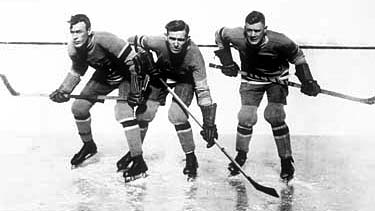
The New York Rangers' forward line of Frank Boucher and the brothers Bill and Frederick "Bun" Cook, previously known as the A Line for the Subway line that went to Madison Square Garden (the 50th Street stop used for the old Garden is now used by the C and the E, and is bypassed by the A), became known as the Bread Line. 
Left to right: Bill Cook, Frank Boucher, Bun Cook

Desperate for any paying customers, sports promoters would try anything, from the college basketball doubleheaders that began at the old Garden in 1934 to night games for outdoor events, which began in baseball's minor leagues and Negro Leagues in 1930, and in the majors in 1935.

The Depression also led, in 1933, to the repeal of Prohibition, which led to the booze industry being able to create jobs, as well as people once again legally being able to enjoy its products; and the repeal of Pennsylvania's "blue laws" prohibiting certain activities on Sunday, including sports.

That allowed for crowds that couldn't be gotten on any other day of the week, except Saturday, since there were no lighted stadiums in the big cities, which would also change soon. That may have kept the Athletics and the Philadelphia Phillies in business, and made the NFL's Philadelphia Eagles and Pittsburgh Pirates (changing their name to the Steelers in 1940), both founded in 1933, economically viable.

The Great Depression left scars on people that never went away. My grandmother grew up in Queens in that era, and knew how important it was to save money. She grew up in the Depression, so, due to her pinching pennies as an adult, my mother also "grew up in the Depression." And because of that, I "grew up in the Depression." Am I saying that I'm cheap? Yes, I am cheap, but not by choice.

In 1992, during another bad recession, I stayed with my grandmother over Thanksgiving Weekend. On the Saturday, I helped her with grocery shopping. We walked out of the car, and, crossing the parking lot, I saw a penny on the ground. I knew she was superstitious, and that a penny, heads-up, was good luck, but tails-up was not. This penny was tails-up, so I left it alone.

She saw it, stopped, pointed, and said, "Aren't you going to pick that up?"

I said, "It's tails-up, it's not good luck." I figured she would accept this answer.

I was wrong. After nearly 40 years of living in New Jersey, her N'Yawk accent kicked back in, and she said, "Whaaaat? It's money!"

I picked it up.


She died in 2006. Now, every time I see a coin on the ground, I presume that she left it there for me, pick it up, and say, "Thanks, Grandma."

But, as Mom pointed out, Grandma and her contemporaries never had a "Depression survivors group," the way war veterans have social clubs, and survivors of other forms of trauma have support groups. And t
here is no memorial specifically for them on the National Mall in Washington, although the FDR Memorial includes a tribute to them. They had their songs, and their movies, rather than tangible tributes.

We dare not forget them now. We have had hard recessions in 1973-76, 1980-83, 1990-93, 2001-03, 2007-10 and 2020-21. But not another Depression, because of the safeguards we put into place in the 1930s. If we fail to support these safeguards, then everything those people suffered through, and everything those who worked to help them did to do so, will have been in vain.

*

October 29, 1929 was, as stated, a Tuesday. Baseball season was over. The NBA hadn't yet been founded. And the NHL season didn't start until November 14. So there were no scores on this historic day.

But there was one score on this historic day, and it was in the NFL: The Boston Bulldogs beat the Orange Tornadoes, 6-0. Instead of at either team's home field, this game was played at Minersville Park in Minersville, Pennsylvania, home of the Pottsville Maroons, the perhaps unfairly-denied Champions of 1925.

The Depression doomed the Bulldogs, and they did not play the 1930 season. The Tornadoes, originally the Orange Athletic Club of Orange, Essex County, New Jersey, played home games at Knights of Columbus Stadium in East Orange. In 1930, they moved to nearby Newark City Schools Stadium, becoming the Newark Tornadoes. But they had to drop out of the NFL. They continued as a minor-league team until 1965, then, like aging New Yorkers and New Jerseyans tend to do, moved to Florida, and played as the Orlando Panthers from 1966 to 1970, before finally going out of business.

Friday, October 21, 2022

October 21, 1929: The Henry Ford Museum Opens

October 21, 1929: The Henry Ford Museum of American Innovation and Greenfield Village opens, outside Detroit in Dearborn, Michigan. The timing couldn't have been worse: The Great Depression was about to begin.

Ford, founder of the museum, as well as the founder and chairman of the Ford Motor Company, said:

I am collecting the history of our people as written into things their hands made and used... When we are through, we shall have reproduced American life as lived, and that, I think, is the best way of preserving at least a part of our history and tradition.

The centerpiece of the nation's foremost automotive-themed museum is a replica of Independence Hall in Philadelphia. It contains the fascinating, including early cars and bicycles, Ford's 1st car (his 1896 "Quadricycle"), Igor Sikorsky's prototype for the helicopter, the bus Rosa Parks was riding in when she refused to give up her seat to start the 1955-56 Montgomery Bus Boycott (Parks lived in Detroit from 1957 until her death in 2005), and a Buckminster Fuller "Dymaxion house."

It also contains the macabre, with the seat Abraham Lincoln was supposedly sitting in when he was assassinated at Ford's Theater in Washington (the theater owner was no relation to Henry); and the seat, and the rest of the car as well, that John F. Kennedy was definitely sitting in when he was assassinated, the 1961 Lincoln Continental convertible limousine he was riding in through downtown Dallas.

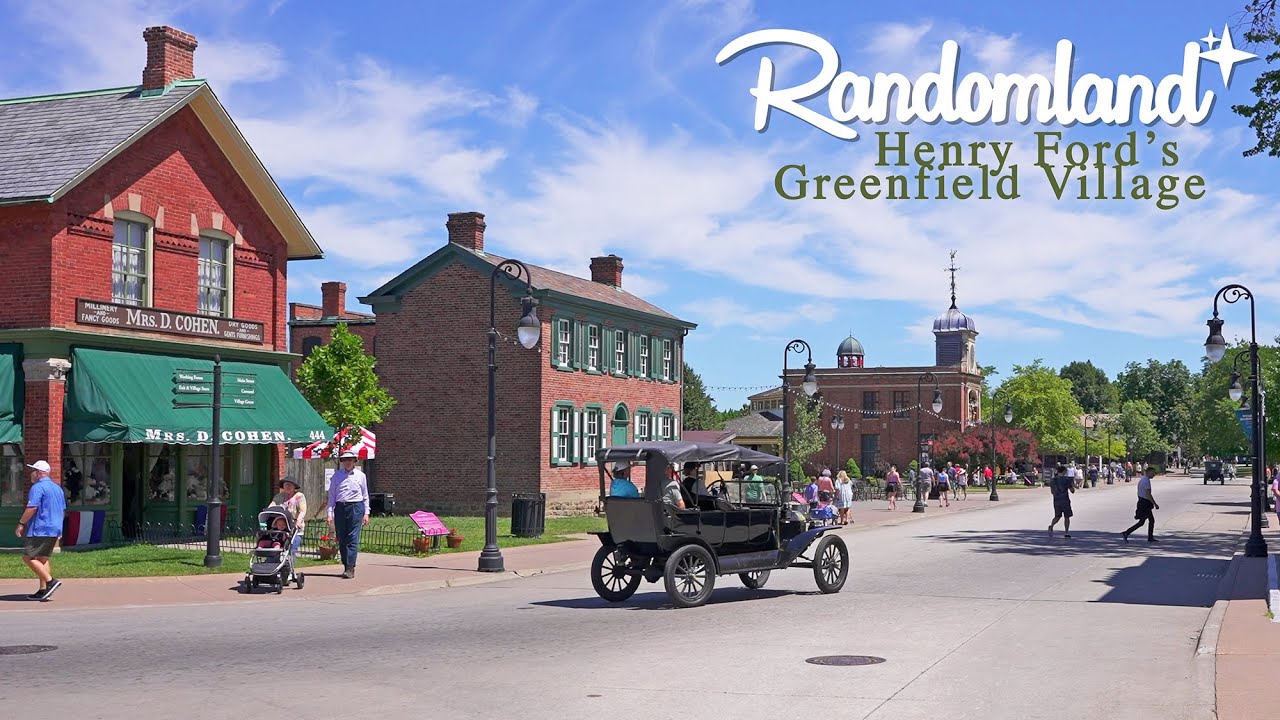
Next door to the museum is Greenfield Village, which Ford imagined as a kind of historical park, a more modern version of Colonial Williamsburg – that is, celebrating what was, in 1929 when it opened, considered modern American life, including a reconstruction of the Menlo Park, New Jersey laboratory of his good friend Thomas Edison. Ford and Edison were both friends of rubber magnate Henry Firestone (whose tires certainly made Ford's cars easier to make), and Firestone's family farm is reconstructed on the site.
The three men were such close friends that, in 1923, they invited the President at the time, Warren Harding, to go camping with them. A silent newsreel camera captured highlights.
Left to right: Ford, Edison, Harding, Firestone

Edison died in 1931. Firestone, definitely not to be confused with later playwright and actor Harvey Fierstein, died in 1938. Ford died in 1947.

I am not excusing Henry Ford's control-freak attitude toward his employees' private lives, nor his despicable anti-Semitism, nor his failed union-busting in the 1930s. To be fair, he did give his black auto workers the same pay and benefits as his white ones.

But I am recommending the museum. It's a tribute to the role of technology, including the automobile, in American life, not to the man himself. 

*

October 21, 1929 was a Monday. Baseball season had ended a week earlier, with the Philadelphia Athletics beating the Chicago Cubs in the World Series. Football was in midweek: Television was still mainly a concept at this point, and the NFL was certainly not big enough to stage Monday Night Football, not even on radio. The NBA hadn't been founded yet. And the NHL season was nearly a month away from starting. So there were no scores on this historic day. 

Wednesday, October 12, 2022

October 12, 1929: Sanford Stadium Opens In Georgia

October 12, 1929: Sanford Stadium opens, on the campus of the University of Georgia in Athens, 72 miles east of downtown Atlanta.

Named for Dr. Steadman Vincent Sanford, an English professor and an early supporter of the school's athletic program, the University of Georgia opens it with 15-0 win over Yale in front of 30,000 fans. Since UGa had been founded by missionaries from Yale, and had also borrowed Yale's team name of Bulldogs, they were the invited guests.

Known for the privet hedges that surround the field, and the end zone containing the crypts for the deceased Uga the Bulldog mascots, Sanford Stadium has seen several expansions and renovations that have put its current seating capacity at 92,746. It hosted the soccer games of the 1996 Olympics, even though Athens and Atlanta, despite being in the same State, are not all that close.
With stars like Frankie Sinkwich, Charlie Trippi, Theron Sapp, Fran Tarkenton, Jake Scott, Herschel Walker, Garrison Hearst, Champ Bailey, Knowshon Moreno and Brock Bowers, the Georgia Bulldogs have won 15 Southeastern Conference Championships since moving in, as well as the 1942, 1980 and 2021 National Championships. They've also had All-Americans named Johnny Carson (not the talk show host), Randy Johnson (not the baseball pitcher) and George Patton (not the general).

UPDATE: They were SEC and National Champions again in 2022, and SEC Champions again in 2024. So that's 17 SEC titles, and 4 National Championships.

*

October 12, 1929 was a Saturday. Napoleon "Nappy" Brown, the original singer of the rhythm & blues songs "Don't Be Angry" and "The Night Time Is the Right Time," was born on this day.

Game 4 of the World Series was played at Shibe Park in Philadelphia. Going into the bottom of the 7th inning, the Chicago Cubs led the Philadelphia Athletics, 8-0. The A's set a Series record by scoring 10 runs in the inning, and won the game, 10-8. Since playing professional sports was still illegal in Pennsylvania until 1933, the A's could not wrap up the Series the next day, so they wrapped it up the day after that, on Monday, October 14, in Game 5.

Pro basketball was still strictly minor-league. And the NHL season didn't begin until November 14. But there were other college football scores, including the following:

* The top team in the South that season, Tulane University, beat Mississippi A&M, 34-0 at Tulane Stadium in New Orleans. (A&M would rename itself Mississippi State in 1932.)

* Notre Dame beat Navy, 14-7 at Municipal Stadium in Baltimore. From 1950 to 1954, piece by piece, it was converted into Memorial Stadium, longtime home of the Orioles and Colts. Notre Dame went 9-0, and were retroactively declared National Champions.

* The University of Pittsburgh also claim a National Championship for this season. They went 9-1, including on this day, winning their annual "Backyard Brawl" with West Virginia, 27-7.

* Purdue beat Michigan, 30-16 at Ross-Ade Stadium in West Lafayette, Indiana. This game decided the Big Ten Conference title.

* The top team on the Pacific Coast, USC beat the University of Washington, 48-0 at Husky Stadium in Seattle.

* In New York City, Fordham beat New York University, 26-0 at the Polo Grounds.

* And City College of New York lost to St. Lawrence University, 22-0 at Weeks Field in Canton, New York.

* In New Jersey, Princeton lost to Brown, 13-12 at Palmer Stadium in Princeton.

* And Rutgers lost to Holy Cross, 20-3 at Fitton Field in Worcester, Massachusetts.

October 12, 1929: The Athletics' 10-Run Comeback

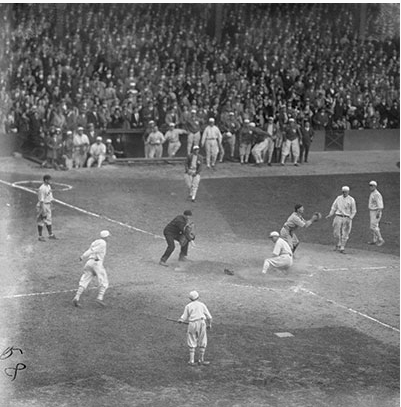
Haas scoring on his inside-the-park homer

October 12, 1929: Game 4 of the 1929 World Series, at Shibe Park in Philadelphia, remains one of the wildest in postseason history. Having started a seemingly washed-up Howard Ehmke in Game 1 and having it work, this time, Philadelphia Athletics owner-manager Connie Mack started 45-year-old Jack Quinn. (Already approaching his 67th birthday, Mack was not yet known as "The Grand Old Man of Baseball," but, apparently, he already had an affinity for veterans.)

This seemed to work, too, until the 6th inning, when the Chicago Cubs start scoring. By the time they stopped, they led, 7-0. Cub manager Joe McCarthy started Charlie Root, who would later become a victim of McCarthy's Yankees, including Babe Ruth’s "called shot," though this quirk of history/legend does not do Root justice, as he was a fine pitcher for many years. Root entered the bottom of the 7th with an 8-0 lead.

Then the A's came storming back. Slugging left fielder Al Simmons led off with a home run. Jimmie Foxx singled. Edmund "Bing" Miller singled. Jimmy Dykes singled Foxx home. Joe Boley singled Miller home. Mack sent George Burns (a former All-Star outfielder, not the comedian) up to pinch-hit for pitcher Eddie Rommel. He popped up, but Max Bishop singled Dykes home. It was 8-4 Cubs.

McCarthy took Root out, and brought in Art Nehf, the ace pitcher of the New York Giants' 1921 and '22 World Champions. Lewis "Hack" Wilson, a great slugger but not the best of outfielders even when not drunk or hungover, misjudged a fly ball from George "Mule" Haas, and it turned into a 3-run inside-the-park home run, making the score 8-7 Cubs.

Simmons began jumping around in the dugout, yelling, "We're back in the game, boys!" His momentum caused him to crash into Mack – as I said, nearly 67, if not the elderly figure some of us imagine him to have always been. Simmons apologized profusely, but Mack, a former big-league catcher and familiar with ballplayers crashing into him, was just as enthused, and told him, "That's all right, Al."

Mickey Cochrane drew a walk, and McCarthy brought in a 3rd pitcher, John "Sheriff" Blake. The A's had now batted around, and Simmons singled. Foxx singled Cochrane home, and the game was tied. McCarthy brought in a 4th pitcher, Pat Malone. Malone would later help McCarthy win 2 Pennants with the Yankees. This time, he hit with Miller with a pitch, and allowed a double to Dykes that scored Simmons and Foxx.

Malone finally ended the onslaught by striking out Boley and Burns, but 10 runs had scored, and that remains a Series record for a single inning. Mack brought in his ace Lefty Grove, to relieve and finish the Cubs off, and 10-8 remained the final score. The A's closed the shellshocked Cubs down 2 days later -- not being able to play the next day, because sports on Sunday were still illegal in Pennsylvania until 1933.

In 1981, baseball historian John Thorn published Baseball's 10 Greatest Games. He included this game as one of them.

The 1929 Philadelphia Athletics are remembered as one of the greatest teams in baseball history. They might have been the greatest non-Yankee team in American League history. They won the World Series again the next season, beating the St. Louis Cardinals. They won a 3rd straight Pennant in 1931, with 107 regular-season wins, but lost Game 7 of the World Series, to the Cardinals.

They finished a distant 2nd to the Yankees in 1932, and Mack then broke up his team due to the financial constraints of the Great Depression. The team would not win another Pennant until 1972, 41 years -- and two moves to other cities -- later.

In 1978, the Philadelphia Phillies established the Philadelphia Baseball Wall of Fame. From then until 2003, they elected an Athletics figure every year, starting with Mack. From the 1929-31 dynasty, they also elected Jimmie Foxx, Lefty Grove, Al Simmons, Mickey Cochrane, Jimmy Dykes, Eddie Rommel, Bing Miller, George Earnshaw and Rube Walberg. Mack, Foxx, Grove, Simmons, Cochrane and Dykes have also been elected to the Philadelphia Sports Hall of Fame.

UPDATE: The Cubs also have a team Hall of Fame. Inducted from their 1929 Pennant winners have been catcher Charles "Gabby" Hartnett, 1st baseman Charlie Grimm, 2nd baseman Rogers Hornsby, left fielder Riggs Stephenson, center fielder Lewis "Hack" Wilson, right fielder Hazen "Kiki" Cuyler, pitcher Charlie Root, manager Joe McCarthy, team owner William Wrigley Jr., executive Margaret Donahue, and public address announcer Pat Pieper.

*

October 12, 1929 was a Saturday. This was the only baseball game played that day. Pro football was in midweek. Pro basketball was still strictly minor-league. And the NHL season didn't begin until November 14.

But there were college football scores. Most notably, Sanford Stadium opened in Athens, Georgia. The University of Georgia opened it with a 15-0 win over Yale. I have a separate entry for this event. Other notable games played that day:

* The top team in the South, Tulane University, beat Mississippi A&M, 34-0 at Tulane Stadium in New Orleans. (A&M would rename itself Mississippi State in 1932.)

* Notre Dame beat Navy, 14-7 at Municipal Stadium in Baltimore. From 1950 to 1954, piece by piece, it was converted into Memorial Stadium, longtime home of the Orioles and Colts. Notre Dame went 9-0, and were retroactively declared National Champions.

* The University of Pittsburgh also claim a National Championship for this season. They went 9-1, including on this day, winning their annual "Backyard Brawl" with West Virginia, 27-7.

* Purdue beat Michigan, 30-16 at Ross-Ade Stadium in West Lafayette, Indiana. This game decided the Big Ten Conference title.

* The top team on the Pacific Coast, USC beat the University of Washington, 48-0 at Husky Stadium in Seattle.

* In New York City, Fordham beat New York University, 26-0 at the Polo Grounds.

* And City College of New York lost to St. Lawrence University, 22-0 at Weeks Field in Canton, New York.

* In New Jersey, Princeton lost to Brown, 13-12 at Palmer Stadium in Princeton.

* And Rutgers lost to Holy Cross, 20-3 at Fitton Field in Worcester, Massachusetts.

Saturday, October 8, 2022

October 8, 1929: Connie Mack's Gamble On Howard Ehmke

October 8, 1929: In front of 50,000 fans at Wrigley Field -- which now holds only about 41,000, and was around 38,000 from the reconstruction of its famed bleachers in 1938 until its recent renovation -- Philadelphia Athletics owner-manager Connie Mack fools everyone before Game 1 of the World Series, starting neither of his big fireballers, lefthander Robert "Lefty" Grove or righthander George Earnshaw.

He gambles that the sidearm slow stuff of former Red Sox star Howard Ehmke (the visiting starter for the Red Sox in the 1st game at the original Yankee Stadium) might frustrate the Cubs' big sluggers such as Rogers Hornsby, Hack Wilson and Riggs Stephenson.

Mack's gamble pays off, as Ehmke establishes a new World Series record, striking out 13 Cubs, en route to a 3-1 A's victory in Game 1 of the Fall Classic. The mark will last for 34 years, until Dodger hurler Carl Erskine fans 14 Yankees in 1953. The Cubs never recover, and the A's win the Series in 5.

October 8, 1929 was a Tuesday. This was the only baseball game played that day. Pro football was in midweek. Pro basketball was still strictly minor-league. And the NHL season didn't begin until November 14. So this was the only score on this historic day.

Tuesday, September 27, 2022

September 28, 1929: Bryant-Denny Stadium Opens

September 28, 1929: Denny Stadium opens on the campus of the University of Alabama. It is named for the man who got it built, George H. Denny, president of the University from 1912 to 1932. Having recently become both a regional and a national power under head coach Wallace Wade, 'Bama beat Mississippi College, 55-0.

Based in Clinton, Mississippi, Mississippi College now play in NCAA Division II, and should not be confused with the University of Mississippi (a.k.a. "Ole Miss"), Mississippi State, Southern Mississippi, or Mississippi Valley State, all of whom are in Division I.

Earlier in the year, a 115-foot-high bell tower was opened on the University's Quad, in memory of the University's victims of World War I. But it was named for the man who got it built as well: The Denny Chimes.

Wade left Alabama after the 1930 season, and was replaced by Frank Thomas. It was Thomas who would recruit two ends who would be among the greatest names in football: Don Hutson, who became professional football's 1st great receiver, leading the Green Bay Packers to 3 NFL Championships; and Paul Bryant, known as "Bear" because he allegedly wrestled one at age 12, who returned to 'Bama in 1958 after leading Texas A&M to a National Championship, and raised the Crimson Tide to new heights.

In 1975, the Alabama State legislature renamed the facility Bryant-Denny Stadium. It was a rare honor: Not only was Bryant still alive, but he was still coaching there. Wade would get a stadium named for him, at his next stop after Tuscaloosa: Duke University renamed Duke Stadium "Wallace Wade Stadium" in 1967.

'Bama had outgrown Denny Field, where they'd played since 1915. The new stadium opened with a capacity of 12,000. It was expanded to 24,000 in 1937, 31,000 in 1946, 43,000 in 1961, 60,000 in 1966, 70,000 in 1988, 83,000 in 1998, 92,000 in 2006, and 101.821 in 2010. Some tweaks, allowing for more accessible seating, reduced capacity slightly to 100,077 in 2020. The Bear had AstroTurf laid down in 1968, but real grass returned in 1991, and remains.

Before the stadium's opening, Alabama claimed National Championships for the 1925 and 1926 seasons. Since then, they've been awarded them for 1930 under Wade; 1934 and 1941 under Thomas; 1961, 1964, 1965, 1973, 1978 and 1979 under Bryant; 1992 under Gene Stallings; and 2009, 2011, 2012, 2015, 2017 and 2020 under Nick Saban. That's 16 while playing at Bryant-Denny Stadium, and 18 overall. No other school can match this.

In addition, they won 4 Southern Conference Championships, and the Southeastern Conference Championship 30 times since its founding in 1933: 1933, '34, '37, '45, '53, '61, '64, '65, '66, '71, '72, '73, '74, '75, '77, '78, '79, '81, '89, '92, '99, 2009, '12, '14, '15, '16, '18, '20 and '21. (UPDATE: They won again in 2023.)

Hard to believe, but Bryant only had 1 Heisman Trophy winner, and that was at Texas A&M: John David Crow in 1957. Alabama didn't get one until the 21st Century, but now, they've had 4: Running backs Mark Ingram II in 2009 and Derrick Henry in 2015, receiver DeVonta Smith in 2020 and quarterback Bryce Young in 2021.

Other 1929-onward 'Bama legends include Hutson, 1930s running back Dixie Howell, 1960s linebacker Lee Roy Jordan, 1970s running back Johnny Musso, 1970s guard John Hannah, 1970s tight end Ozzie Newsome, 1970s defensive tackle Marty Lyons, 1970s defensive end E.J. Junior, 1980s linebackers Derrick Thomas and Cornelius Bennett; and 2010s quarterbacks A.J. McCarron, Tua Tagovailoa and Jalen Hurts.

Auburn fans will argue that their Jordan-Hare Stadium is better. And Legion Field in Birmingham has hosted many historic games. But who's kidding who? Even more than the State Capitol in Montgomery, Bryant-Denny Stadium is the most famous structure in the State of Alabama.

*

September 28, 1929 was a Saturday. These other notable college football games were played that day:
* Army beat Boston University, 26-0 at Michie Stadium in West Point, New York.
* Navy beat Denison University, 47-0 at Thompson Stadium in Annapolis, Maryland.
* Fordham beat Westminster College of Pennsylvania, 43-0 at Fordham Field in The Bronx.
* New York University (NYU) beat Vermont, 47-0 at Ohio Field in The Bronx.
* Rutgers beat Providence, 17-0 at Neilson Field in New Brunswick, New Jersey. Princeton, New Jersey's other major football school at the time, opened their season the next week.
* The football teams at the University of Southern California and the University of California at Los Angeles play each other for the 1st time, at both teams' home field, the Los Angeles Memorial Coliseum. It is no contest, as USC beats UCLA 76-0.
There was 1 game played in the NFL: The Frankford Yellow Jackets beat the Dayton Triangles, 14-7 at Frankford Stadium in Northeast Philadelphia.
And the baseball regular season entered its final weekend. These games were played:
* The New York Yankees were swept in a doubleheader by the Washington Senators, 6-4 and 6-3 at Griffith Stadium in Washington. The Bronx Bombers were reeling in the wake of the death of their manager, Miller Huggins, 3 days earlier. Over the 2 games, Babe Ruth went 4-for-7 with a walk and 2 RBIs, and Lou Gehrig went 2-for-8 with 2 RBIs.
* The Brooklyn Dodgers -- or the Robins, as they were known while Wilbert Robinson was their manager from 1914 to 1931 -- swept a doubleheader from their arch-rivals, the New York Giants, 5-1 and 10-3 at the Polo Grounds, beating Fred Fitzsimmons and Carl Hubbell in the process. Over the 2 games, Bill Terry went 3-for-9, and Mel Ott went 1-for-7 with a walk.
* The Philadelphia Athletics beat the Boston Red Sox, 6-3 at Fenway Park in Boston. Jimmie Foxx had an unusual game: He went 0-for-1, but drew 3 walks, and stole home plate, a rare thing for a big slugger.
* The Philadelphia Phillies swept a doubleheader from the Boston Braves, 9-8 and 8-6 at Baker Bowl in Philadelphia.
* The Cleveland Indians beat the St. Louis Browns, 4-1 at League Park in Cleveland.
* The Detroit Tigers beat the Chicago White Sox, 11-10 at Navin Field in Detroit. (That ballpark was renamed Briggs Stadium in 1938, and Tiger Stadium in 1961.) This was a wild one. It was 3-0 Tigers after 1 inning, 8-3 White Sox going to the bottom of the 6th, and the Tigers tied it 8-8 in the bottom of the 9th. The White Sox scored 2 in the top of the 10th, but the Tigers scored 3 in the bottom of the 10th, with Charlie Gehringer singling George Uhle home with the winning run. Uhle was the winning pitcher, coming in to pitch the 10th, and future Hall-of-Famer Ted Lyons took the loss after pitching an inning and a third. Marty McManus hit a home run for the Bengals, and Clarence Hoffman hit one for the Pale Hose.
* The Cincinnati Reds beat the Chicago Cubs, 5-3 at Wrigley Field in Chicago. The Cubs won the Pennant, anyway, losing the World Series to the Athletics.
* And the Pittsburgh Pirates beat the St. Louis Cardinals, 8-5 at Sportsman's Park in St. Louis. Dick Bartell went 4-for-5 with 3 RBIs, Fred Brickell and Charlie Hargreaves each went 3-for-5 with an RBI, Earl Sheely went 3-for-4, Paul Waner went 1-for-5, and Lloyd Waner went 2-for-5 with an RBI. For the Cardinals, Ernie Orsatti went 3-for-4.

December 31, 1999 & January 1, 2000: The Millennium

December 31, 1999:  The Millennium arrives. The people of planet Earth survived. At a terrible cost. But we hadn't destroyed ourselves. ...