Showing posts with label japan. Show all posts

Thursday, December 29, 2022

December 29, 1989: Japan, Inc.

December 29, 1989: The Nikkei, Japan's main stock exchange, hits an all-time high: 38,915.87. It marks the peak of what had become known as "Japan, Inc."

The Nikkei, an abbreviation of The Nihon Keizai Shimbun, is the flagship publication of Nikkei, Inc. and the world's largest financial newspaper. The Nikkei 225, a stock market index for the Tokyo Stock Exchange, has been calculated by the newspaper since 1950. 

For the 1st 30 or so years after World War II, "Made in Japan" was a byword for "cheap" and "poorly made." Japanese companies got the hint, and made things better, and the company became a giant in electronics and automotive services. Brands like Sony and Toyota had become the biggest in the world in their respective fields.

South Korea fought to keep up with their regional rivals, and succeeded in some areas. So did British-controlled Hong Kong, off the coast of China, home to the next-biggest stock market in Asia. This led to the American cities of Los Angeles, San Francisco and Seattle stepping up their game: The term "Pacific Rim" no longer referred to just a danger zone for earthquakes, but to technological innovation.

The joke was turned back on America: Not only were American companies competing by cutting costs, by skimping on quality control, but Japanese companies began buying American real estate, including skyscrapers in major cities. A recession struck America in 1990, and the country seemed to be falling behind Japan, which looked strong enough to be recession-proof. In his "Carnac the Magnificent" sketch on The Tonight Show, in which he "divined the answers without ever having seen the questions," Johnny Carson came up with this gem:

A: Tokyo, Los Angeles, New York.
Q: Name the three largest Japanese cities.

On January 8, 1992, during a State dinner honoring Japan's Prime Minister Kiichi Miyazawa, President George H.W. Bush -- who was running for re-election during a recession, and really did not need for this to happen -- contracted food poisoning, and threw up on Miyazawa.

This led to the TV show Saturday Night Live parodying the American political show The McLaughlin Group, which often had over-the-top analysis of current events and predictions that started out silly and got sillier as they were proven untrue. (They had already parodied it a few times, and real-life host John McLaughlin had joined them the preceding October.)

In The Arakawa Group, a sketch that was too racist to be allowed to air today, the moderator, played by Mike Myers, asked his 4 panelists -- like him Japanese people being played by white American actors -- things like, "Who is more lazy, American worker or... " And the answers would be in broken English. And when the end of the show/sketch came, the moderator asked for predictions. One panelist said, "Within five years, all Americans addicted to crack!"

What most Americans didn't know was that the bubble had already burst: Japan was not recession-proof, the Nikkei went down in 1990, and, by mid-1992, it had lost 60 percent of its end-of-1989 value. The fall of the Japanese economy was every bit as remarkable as its rise. The 1990s became known as "Japan's Lost Decade," and it took them nearly 20 years to fully recover.

UPDATE: It took until February 22, 2024 for the Nikkei to exceed the 1989 peak: 39,098.68.

*

December 29, 1989 was a Friday. Actress Jane Levy was born.

There was 1 college football bowl game on this day. Number 18 Penn State beat Number 19 Brigham Young University (BYU), 50-39, in the Holiday Bowl at Jack Murphy Stadium in San Diego.

There were 8 games played in the NBA:

* The Milwaukee Bucks beat the Detroit Pistons, 99-85 at The Palace in the Detroit suburb of Auburn Hills, Michigan.

* The Indiana Pacers beat the Houston Rockets, 103-97 at the Market Square Arena in Indianapolis.

* The Chicago Bulls beat the San Antonio Spurs, 101-97 at the Chicago Stadium. Michael Jordan scored 34 points.

* The Phoenix Suns beat the Minnesota Timberwolves, 118-101 at the Metrodome in Minneapolis.

* The Portland Trail Blazers beat the Dallas Mavericks, 144-140 in triple overtime at the Reunion Arena in Dallas. Derek Harper scored 42 points.

* The Los Angeles Lakers beat the Golden State Warriors, 130-111 at The Forum outside Los Angeles in Inglewood, California. James Worthy scored 34 points.

* The Sacramento Kings beat the Philadelphia 76ers, 105-95 at the ARCO Arena in Sacramento. Danny Ainge scored 33 points for the Kings.

* And the Boston Celtics beat the Seattle SuperSonics, 96-89 at the Seattle Center Coliseum.

There were 5 games in the NHL:

* The New Jersey Devils beat their arch-rivals, the New York Rangers, 3-2 at the Brendan Byrne Arena at the Meadowlands. Sylvain Turgeon scored the winning goal with 9:06 left in regulation. You might laugh that I mentioned the winning goal, but, at the time, this was 1 of the Top 10 moments in Devils history.

* The Washington Capitals beat the Detroit Red Wings, 2-1 at the Capital Centre in the Washington suburb of Landover, Maryland.

* The Boston Bruins beat the Buffalo Sabres, 4-3 at the Buffalo Memorial Auditorium. Craig Janney scored the winning goal with 3:27 left in overtime.

* The Winnipeg Jets beat the Calgary Flames, 2-1 at the Saddledome in Calgary. Tomas Steen scored the winning goal with 2:11 left in overtime.

* And the Edmonton Oilers beat the Montreal Canadiens, 6-2 at the Northlands Coliseum in Edmonton.

Tuesday, December 13, 2022

December 13, 1937: The Nanjing Massacre

December 13, 1937: The Nanjing Massacre begins in the Chinese city of that name, then the capital of the Republic of China, known in the English-speaking world as Nanking. It was the Imperial Japanese follow-up to the brutal battle of Shanghai, which started the Second Sino-Japanese War, which is sometimes considered the start of the Pacific Theater of World War II.

Over 200,000 civilians were murdered, over a period of 6 weeks. There was also arson, looting, and mass rape of the city's women and girls, perhaps as many as 20,000 of those, leading to the actions being known as the time as "The Rape of Nanking."

Japan's actions in China were symbolized by a photograph taken by H.S. Wong on August 28, and appearing in the October 4, 1937 edition of Life magazine. Henry Luce, founder of LifeTime and Fortune (and, later, Sports Illustrated), had been born to Christian missionaries in China, and was obsessed with his birthplace, to the point where he tried to rally American support for its dictator, Generalissimo Chiang Kai-shek, first against the Japanese, and, after World War II, against the Communist revolution of Mao Zedong.

In an article about the ongoing war, the picture showed a baby sitting in a bombed-out Shanghai train station. The child was screaming, and alone. Just out of the camera's range was the child's mother, dead. A moment later, an adult, whom Wong presumed to be the child's father, ran over and picked up him and carried him away.

Wong never found out the child's name, or what happened to him. (If, somehow, he survived, he would be 85 years old on December 13, 2022.)

The photo struck a nerve in Americans, in a way that 6 previous years of Sino-Japanese conflict hadn't. In this case, truly, a picture was worth far more than a thousand words.

It was as far as Wong was willing to go with his photos. He later recalled, "It was a horrible sight. Dead and injured lay strewn across the tracks and platform. Limbs lay all over the place. I stopped to reload my camera. I noticed that my shoes were soaked with blood."
H.S. Wong

As with "The Falling Soldier," the photo that had become a symbol of the Spanish Civil War the previous year, there were accusations that the photo was staged for propaganda purposes. The Japanese government put a $50,000 bounty on Wong. (A little over $1 million in 2022 money.) In spite of this, Wong kept clicking away, survived the war, and lived until 1981, age 81.

The battle before and the massacre after were ordered by Prince Yasuhiko Asaka, He was a cousin of Emperor Hirohito. After the defeat of Japan, General Douglas MacArthur, as military governor, granted immunity to the entire imperial family. and so the Prince was never tried for war crimes, or what the Nuremberg Trials called "crimes against humanity." He lived until 1981.

*

December 13, 1937 was a Monday. Baseball was out of season. The NBA hadn't been founded yet. The NHL season was underway, but no games were scheduled. And the NFL Championship Game had been played the day before, with the Washington Redskins beating the Chicago Bears, 28-21 at Wrigley Field in Chicago. So there were on scores on this historic day.


Wednesday, December 7, 2022

December 7, 1941: The Japanese Bomb Pearl Harbor

December 7, 1941: As President Franklin D. Roosevelt said the next day, asking Congress for a Declaration of War against the Empire of Japan, and getting it, it is "a date which will live in infamy." Japanese planes attack the U.S. Naval base at Pearl Harbor in Honolulu, Hawaii.

American casualties and losses: 2 battleships totally lost, 2 battleships sunk and recovered, 3 battleships damaged, 1 battleship grounded, 2 other ships sunk, 3 cruisers damaged, 3 destroyers damaged, 3 other ships damaged, 188 aircraft destroyed, 159 aircraft damaged, 2,403 people killed, 1,178 wounded.

To put that in perspective: In 1941, the U.S. had about 130 million people, and we lost 2,400 in Honolulu that day. In 2001, we had about 300 million, and lost 3,000 on 9/11. Proportionately, we lost about twice as many people at Pearl Harbor as we did at the World Trade Center and the Pentagon combined 60 years later.

The 1970 film Tora! Tora! Tora! -- named for the code given that the attack was on -- is usually still considered the best film about the attack, more so than From Here to Eternity (1953, in which the attack is secondary to the story), The Final Countdown (1980, ditto), and Pearl Harbor (2001, in which the acting has been heavily criticized). Playing the Japanese commander, Admiral Isoroku Yamamoto, Japanese actor Sō Yamamura said, "I fear that all we have done is to awaken a sleeping giant, and fill him with a terrible resolve." Yamamoto may have believed this, but there is no record of him actually saying it.

But it was true: For Japan, the attack on Pearl Harbor was a "Pyrrhic victory." The phrase originates from a quote from Pyrrhus of Epirus, whose triumph against the Romans in the Battle of Asculum, in what is now Southern Italy, in 279 BC destroyed much of his forces, forcing the end of his campaign. According to legend, he said, "If we are victorious in one more battle with the Romans, we shall be utterly ruined." The more common translation is, "Another such victory, and I am undone."

About 18,000 people were stationed at Pearl Harbor at the time. In 2013, 2,000 to 2,500 survivors were thought to be still alive, according to Eileen Martinez, chief of interpretation for the USS Arizona Memorial. But I can find no definitive number of how many people who were there who are still alive, only that there are believed to be 3 still alive who served on the Arizona.

UPDATE: An obituary for Lou Conter, the 102-year-old last survivor of the Arizona, who died on April 1, 2024, said that there were only 21 overall survivors left. A CNN report on December 6, 2024 said that 16 were left. A report the next day by Voice of America confirmed that total, and said that only 2 of them made it to a memorial service at the site, 83 years after the attack. One was 104 years old; the other, 102.

A CNN story about the memorial ceremony held at Pearl Harbor on December 7, 2025 said that there were only 12 survivors left, and, for the 1st time, 84 years after the attack, none was able to attend.

*

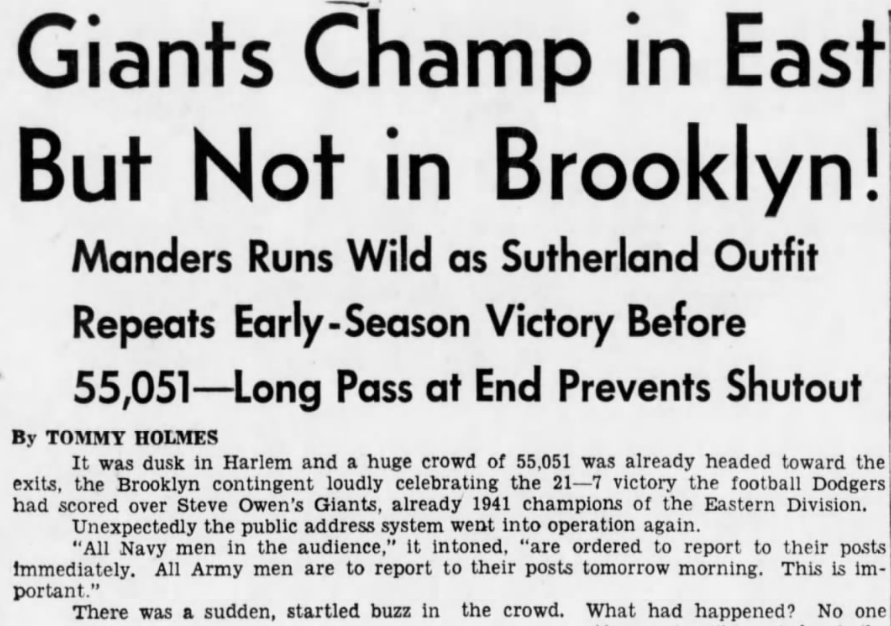
December 7, 1941 was a Sunday, and 3 games were played in the National Football League. The most notable was at the Polo Grounds in New York, between 2 teams that were named for established baseball teams: The New York Giants and the Brooklyn Dodgers.

The Giants had won the NFL's Eastern Division title, as they had previously done in 1933, 1934, 1935, 1938 and 1939, winning the NFL Championship Game in 1934 and 1938 -- Super Bowl -XXXIII and Super Bowl -XXIX, if you prefer. But before they could face the Chicago Bears in the 1941 edition (having beaten them in 1934 and lost to them in 1933), they had to face the football Dodgers, who, like their baseball namesakes, played home games at Ebbets Field.

It was Tuffy Leemans Day at the Polo Grounds. Alphonse Emil Leemans (1912-1979) was a native of Superior, Wisconsin, and had been an All-American back (offensive and defensive) at George Washington University in Washington, D.C. The Giants would later retire his Number 4, and he was elected to the Pro Football Hall of Fame.
The Dodgers didn't care. They were going for a season sweep of the Giants, and they got it, winning 21-7. The Giants may have been the official Division Champions, but the Dodgers were the unofficial City Champions.
The Brooklyn Eagle, December 8, 1941

The attack started at 7:48 AM Hawaii time, which was 1:48 PM East Coast time. During the 2nd half, word got to the press box, and announcements began to come over the public address system. In those days, it was rare for someone to get paged at a sporting event. Usually, it was a doctor, who had to go and attend to a medical emergency.

This time, with the draft already in place, and enlistments already well underway as well, military officers attending the game were paged, and told to report to their various bases in and around New York City.

At Comiskey Park in Chicago, home to the Great Lakes Naval Training Center on Lake Michigan, another crosstown battle was held. The Bears beat the host Cardinals 34-24. And at Griffith Stadium in Washington, in the capital so the number of government officials and military officers present was considerably larger than in New York and Chicago, the host Redskins beat the Philadelphia Eagles 20-14.

When the game in New York ended, Dodger fans could not openly celebrate, and Giant fans didn't care, either, because it was then announced to the crowd that Pearl Harbor had been attacked.

The NFL Championship Game was played as scheduled, at Wrigley Field in Chicago on December 21, and, despite a 9-9 deadlock in the 3rd quarter, the Bears went on to beat the Giants 37-9.

This was during Major League Baseball's offseason, so none of their games were played. This was 5 years before the founding of the NBA, so none of their games were played. There were 3 National Hockey League games played on the day that Pearl Harbor was attacked:

* At the old Madison Square Garden, the host New York Rangers beat the defending Stanley Cup Champions, the Boston Bruins, 5-4. Alex Shibicky scored 2 goals.

* At the Olympia Stadium, the host Detroit Red Wings beat the Montreal Canadiens, 3-2.

* And at the Chicago Stadium, the host Chicago Blackhawks beat the Brooklyn Americans, 5-4. Only in this, what turned out to be their last season, were the former New York Americans, or "Amerks," using the Brooklyn name, even though they still played all their home games at The Garden. A plan for a new arena in Brooklyn was proposed for after The War, but it never happened, and the franchise suspended at the conclusion of the 1941-42 season, was officially folded in 1946.

* The Toronto Maple Leafs were not scheduled to play that day.

Time magazine named Roosevelt its Man of the Year for the 3rd time, due to his efforts to aid Britain, France and the Soviet Union without getting Congress to declare war on the Axis Powers, until Pearl Harbor made it unavoidable.

Thursday, November 3, 2022

November 3, 1954: The Debut of Godzilla

The original Japanese version

November 3, 1954: The New York Yankees begin a tour or Japan, and draw a record crowd of 64‚000 when they play the 1st game against the All-Japan Stars at Nippon Life Stadium in Osaka.

On the 25-game tour, 3rd base prospect Andy Carey slugs 13 home runs‚ and catching prospect Elston Howard bats .468 on the 25-game tour. Each has thoroughly impressed the Yankee brass, and both get promoted to the Yankees for 1955 -- in Howard's case, making him the 1st black player for the Yankees in a regular-season game.

But the Yankees are not the biggest thing to hit Japan on this date. On the same day, the film Gojira premieres, directed by Ishirō Honda, and distributed by Toho Company, Limited. It is the debut of the creature known in the English-speaking world as Godzilla.

The name Godzilla is a romanization of the original Japanese name Gojira (ゴジラ), which is a combination of two Japanese words: gorira (ゴリラ), meaning "gorilla"; and kujira (クジラ), meaning "whale." The word alludes to the size, power and aquatic origin of the creature. As developed by Toho, the monster is an offshoot of the combination of radioactivity and ancient dinosaur-like creatures, indestructible and possessing special powers, including the ability to shoot a radioactive beam out of its mouth.

The Godzilla costume was worn by actor Haruo Nakajima. In the film, Godzilla is an ancient sea creature that has been mutated by atomic testing in the Pacific Ocean, and progresses to attacking fishing boats, threatening Japan's food supply and economy; to attacking islands, and finally the home islands themselves, including the capital of Tokyo.

Japanese authorities estimate him at 50 meters tall (about 164 feet, the size of a 20-story building). After depth charges, fighter jets, tanks and an electrified fence along the coast fail to stop the creature, an "oxygen destroyer" is used, cutting off its air supply, and, apparently, killing it.

This film was released in America in 1956, under the title Godzilla, King of the Monsters! (The exclamation point was the producers', not mine.) For American audiences, scenes were added with Raymond Burr as an American observer. In 1985, Godzilla 1985 was released, a sequel to the original, and Burr reprised the role.

The franchise has now reached 32 films in Japan, with a 33rd planned for a 2023 release. In 1962, King Kong vs. Godzilla was released, and the legendary giant ape beats the big lizard. Among the monsters, or kaiju (meaning "strange beast") that Godzilla later battles are Mothra, a giant moth, in 1964; Ghidorah, a 3-headed winged dinosaur, also in 1964; Rodan, a flying dinosaur, also in 1964; Ebirah, a giant lobster, in 1966; Hedorah, a "smog monster," in 1971; Megalon, a giant beetle, in 1973; and Mechagodzilla, a giant robot version of Godzilla, in 1974.

An all-American version came out in 1998, depicting Godzilla not as an upright dinosaur, but as a bent-over, "more realistic" creature, which attacks New York, rips the roof off Madison Square Garden, and lays eggs there. The eggs hatch, and the "baby Godzillas" are occupied eating all the concessions in the arena, buying the American military time, as the genderless, asexual Godzilla is lured into the Brooklyn Bridge, tangled in its cables, and destroyed along with the bridge. Finally, a jet drops a bomb on The Garden, killing all of the baby Godzillas. Except one last egg remains, and hatches as the film ends...

This film was seriously panned by the critics. But no legend stays off the big screen forever. A separate American franchise began in 2014, and has released 3 films, with a 4th planned for 2024. This is the Legendary Pictures "Monsterverse," and includes the 2021 film Godzilla vs. Kong. This time, to emphasize the studio's insistence that Godzilla, now 393 feet high, nearly 50 stories high, is the absolute "King of the Monsters," Godzilla won, but Kong, now 337 feet, still helped him beat the other monsters in the film.
The Monsterverse's Godzilla

Ishirō Honda and Raymond Burr both died in 1993. Haruo Nakajima died in 2017.

A 2024 episode of the YouTube series Epic Rap Battles of History featured "Nice" Peter Shukoff voicing Godzilla, and "Epic" Lloyd Ahlquist voicing King Kong.

*

November 3, 1954 was a Wednesday. Baseball season was over. Football was in midweek. The NBA season had begun, but no games were scheduled for this day. One game was played in the NHL: The Detroit Red Wings and the Toronto Maple Leafs played to a 1-1 tie at Maple Leaf Gardens in Toronto.

British rock singer Adam Ant was born on this day. So was Kathy Kinney, who played Mimi Bobek on The Drew Carey Show.

Wednesday, November 2, 2022

November 2, 1934: The Yankees vs. the Yankees of Japan

Eiji Swamura

November 2, 1934: Babe Ruth, Lou Gehrig, and several other baseball players, led by manager Connie Mack, step off the cruiseliner Empress of Japan at the port city of Yokohama, and begin a tour of Japan. This was the 1st time that American major leaguers faced Japanese professionals.

The American "besuboru" players were adored by the Japanese fans, especially "Babu Rusu." But as much as they loved their own players, the natives were under no illusions: No one was surprised when the Americans won 17 out of 18 games.

The big surprise occurred when 17-year-old Eiji Sawamura of the Tokyo Baseball Club struck Ruth, Gehrig, Jimmie Foxx and Charlie Gehringer out in succession in a game in Shizuoka. But Gehrig also hit a home run off him, and the Americans won 1-0.

The Tokyo BC was founded that season, and in 1947, they became known as the Yomiuri Giants. Unlike in North American sports, where sports teams merely sell the naming rights to their venues to corporations, in Asian sports leagues, corporations buy teams, and name them after themselves. (This has also been done by Red Bull of Austria, buying the New York Red Bulls and the former soccer teams of Salzubrg and Leipzig.) Yomiuri Shumbun started as a newspaper, and has grown to a massive media conglomerate.

The Giants have won 47 Pennants (38 of them in the Central League, including in 2021) and 22 Japan Series (the last in 2012). Because of this, despite bearing the name and colors of the New York (now San Francisco) Giants of the National League, they are known as "The Yankees of Japan."

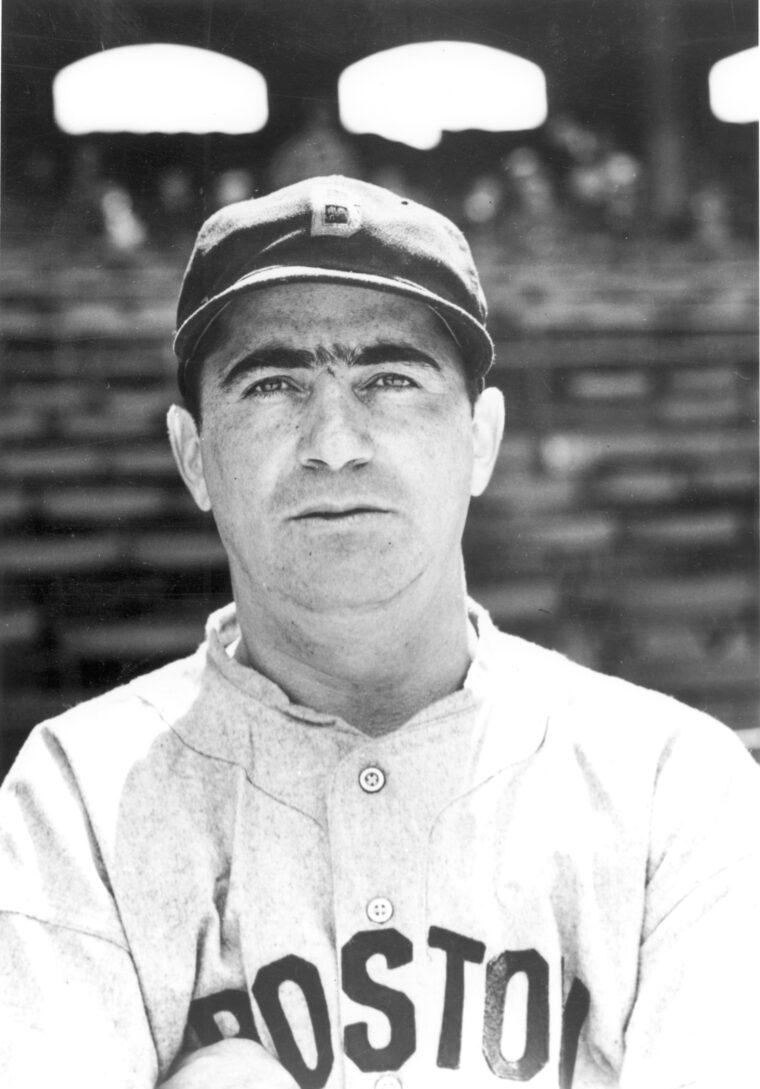
Among the American players on that tour was Moe Berg, a good catcher, and an intellectual from Newark. Dave Harris, a teammate on the Washington Senators, was told that Berg spoke 7 languages, responded, "Yeah, and he can't hit in any of them." He was right: Berg's lifetime batting average was .243.
Moe Berg

But his skill with languages, and with a camera, led the U.S. Department of State to include him on the roster. With the countries not yet at war, but with tensions between them rising, Berg was able, without suspicion, to go onto the rooftops of major buildings in Japan's various cities, and take pictures and home movies. These images aided the U.S. Department of War (which became the Department of Defense in 1947) to pick bombing targets once Japan's attack on Pearl Harbor in 1941 forced America into World War II.

That war cut Sawamura's career short: He ended up being killed in 1944, when his ship was sunk by an American ship. The Japanese leagues now give the Eiji Sawamura Award to their best pitcher, their equivalent of the Cy Young Award.

Berg last played in the major leagues in 1939, served with the Office of Strategic Services (OSS, forerunner of the CIA), and lived on until 1972.

*

November 2, 1934 was a Friday. Baseball season was over. Football was in midweek. The NBA hadn't been founded yet. And the NHL season wouldn't start until November 8. So there were no scores on this historic day. But Australian tennis legend Ken Rosewall was born on this day.

Thursday, October 20, 2022

October 20, 1944: General Douglas MacArthur Returns

October 20, 1944: Keeping the promise he made 2 1/2 years earlier, General Douglas MacArthur returns to the Philippines, landing at Leyte Gulf. It will take until April 13, 1945 to get all Japanese troops out of the country.

In February 1942, as Japanese forces tightened their grip on the Philippines in World War II, President Franklin D. Roosevelt ordered MacArthur to relocate to Australia. On the night of March 12, MacArthur and a select group that included his wife Jean, son Arthur, and members of his staff, left Corregidor. They traveled in PT boats through stormy seas patrolled by Japanese warships, and reached Del Monte Airfield on Minanao, where B-17s picked them up, and flew them to Australia.

MacArthur ultimately arrived in Melbourne by train on March 21. Speaking by radio, he told the people of the Philippines, "I came through, and I shall return."

It took a lot of "island-hopping," but U.S. troops got close enough to the Philippines to launch an assault against the Japanese forces there, on October 20, 1944. The famous photo of MacArthur wading ashore, by his personal photographer, Gaetano Faillace? It wasn't planned: A landing craft was unavailable, and "Big Mac" was furious. But when he saw the photo later, and how determined he and his men looked, he was glad it happened that way.

In his prepared speech, he said:

People of the Philippines: I have returned. By the grace of Almighty God, our forces stand again on Philippine soil, soil consecrated in the blood of our two peoples. We have come dedicated and committed to the task of destroying every vestige of enemy control over your daily lives, and of restoring upon a foundation of indestructible strength, the liberties of your people.

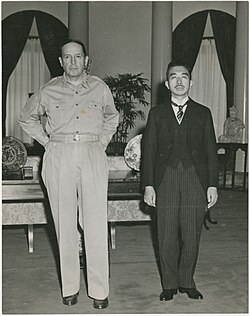
On September 27, 1945, a few weeks after V-J Day, Faillace took another famous photo of MacArthur, in uniform, but without his famous hat, sunglasses and pipe, standing next to Emperor Hirohito, in Western-style formal dress, to show the Japanese who was the bigger man: MacArthur was 6 feet even, while Hirohito was 5-foot-5.
MacArthur's lines, "I shall return" and "I have returned" would be homaged and parodied many times. Since the 1984 release of the Arnold Schwarzenegger film The Terminator, however, people no longer tend to say, "I shall return," instead using Arnold's line, "I'll be back."

Also on this day, in Europe, the Yugoslav capital of Belgrade is liberated from the Fascists by Yugoslav Partisans. The following year, a professional soccer team will be named for them: Football Klub Partizan Belgrade.

But it's not all a good day: A gas leak causes an explosion that destroys a square mile of the East Side of Cleveland, killing 131 people. I have a separate entry for that event.

*

October 20, 1944 was a Friday. Baseball season had ended 11 days earlier, with the St. Louis Cardinals defeating their landlords at Sportsman's Park, the St. Louis Browns. The NBA hadn't been founded yet. The NHL season wouldn't begin for another 8 days. And the NFL was in midweek. But there were 4 games in college football that night:

* In a rare college football version of the New York City vs. New England sports rivalry, Boston College beat New York University, 42-13 at Fenway Park. Until Alumni Stadium was built in 1957, BC played wherever they could get a playing date, and also played at Braves Field and Harvard Stadium, in addition to their on-campus Alumni Field, which Alumni Stadium would replace. NYU played its home games at Ohio Field in The Bronx, with games too big for that 12,000-seat facility moved across the Borough to Yankee Stadium.

* The University of Kentucky beat Virginia Military Institute, 26-9 at McLean Stadium in Lexington, Kentucky. Although VMI was (and is) a military school, this was not an example of a regular college football team struggling to find games due to the manpower drain of World War II, and settling for playing the college-age players on military bases. But there were many such games, in both World Wars, and these last 2 were among them:

* The team at the U.S. Army's Fort Pierce, in the town of the same name, north of Miami, beat the University of Miami, 38-0 at Burdine Stadium in Miami. In 1959, Burdine Stadium would be renamed for its biggest annual event: The Orange Bowl.

* And the University of Georgia beat Daniel Field, 57-6 at Sanford Stadium in Athens, Georgia. Daniel Field was a U.S. Army Air Forces base in Augusta, Georgia.

Thursday, September 29, 2022

September 29, 1972: Japan Apologizes to China for World War II

Premier Zhou Enlai of China (left)
and Prime Minister Kakuei Tanaka of Japan

September 29, 1972: The Joint Communique of the Government of Japan and the Government of the People's Republic of China is signed, in the Chinese capital of Beijing. The Communique established and normalized diplomatic relations between those two countries.

It also resulted in the severing of official relations between Japan and the Republic of China, in Taiwan. This would be followed by several other countries doing so, including the United States of America in 1978.

The document produced nine articles in a joint statement, showing compromises on previously ambiguous principles enunciated by both sides. Four points are worthy of attention:

1. Stating the desire for a peace treaty between Japan and China.

2. Japan "understands and respects (the People's Republic's) stance" that Taiwan is part of the PRC.

3. An Asia-Pacific anti-hegemony clause. And:

4. Japan's reversed relations with China and Taiwan.

In the end, the document ended the "abnormal relations between Japan and China," recognized the People's Republic of China as the "sole government of China," and renounced any claim for war reparations from World War II. In addition, it concluded various administrative agreements between the two countries in trade, fisheries, aviation, and navigation, amongst others. The document firmly maintains its stance under Article 8 of the Potsdam Declaration.

Furthermore, Japan's Prime Minister, Kakuei Tanaka, made this statement to the people of the People's Republic of China: "The Japanese side is keenly conscious of the responsibility for the serious damage that Japan caused in the past to the Chinese people through war, and deeply reproaches itself."

It had taken 27 years after V-J Day, 35 years after the raid on Shanghai, and 41 years after the invasion of Manchuria that began the war that was absorbed into what became known as the Pacific Theater of World War II. (Since the world is still Anglo-European aligned, we tend to think of World War II as beginning with the entry of the Western democracies in September 1939, but China and Japan fought longer before that than after it.)

This statement followed, by nearly 2 years, German Chancellor Willy Brandt's "Kneefall in Warsaw" as an act of apology for the harm that Germany caused during the war.

*

September 29, 1972 was a Friday. These Major League Baseball games were played:

* The New York Mets beat the Pittsburgh Pirates, 1-0 at Three Rivers Stadium in Pittsburgh. Tom Seaver pitched a 2-hit shutout, striking out 13 and outpitching Nelson Briles. The only run of the game came in the top of the 9th inning, when Tommie Agee singled home Wayne Garrett. Willie Mays did not play. Roberto Clemente and Willie Stargell both went 0-for-4. The next day, Clemente collected his 3,000th career hit, a double off the Mets' Jon Matlack.

* The Boston Red Sox beat the Baltimore Orioles, 4-2 at Memorial Stadium in Baltimore. Luis Tiant outpitched Jim Palmer. Carl Yastrzemski and, surprisingly, Luis Aparicio hit home runs for the Sox. Brooks Robinson went 1-for-4.

* The Cincinnati Reds beat the Los Angeles Dodgers, 4-1 at Riverfront Stadium in Cincinnati. Pete Rose went 0-for-2 with a walk. Johnny Bench went 2-for-4. Joe Morgan went 0-for-2 with 2 walks. Tony Pérez went 2-for-3 with 1 walk, a home run and 3 RBIs. Frank Robinson, in his only season with the Dodgers, appeared as a pinch-hitter, and did not reach base.

* The Detroit Tigers beat the Milwaukee Braves, 12-5 at Tiger Stadium in Detroit. Al Kaline went 2-for-5.

* The St. Louis Cardinals beat their arch-rivals, the Chicago Cubs, 4-1 at Wrigley Field in Chicago. Lou Brock went 1-for-3 with 2 walks and 2 stolen bases.

* The Kansas City Royals beat the Oakland Athletics, 9-2 at Kansas City Municipal Stadium. This would be the last week of play for that stadium: The following season, the Royals would move into Royals Stadium, which was renamed Kauffman Stadium in 1993. Reggie Jackson did not play.

* The Chicago White Sox beat the Texas Rangers, 5-1 at Arlington Stadium in the Dallas suburb of Arlington, Texas.

* The Houston Astros beat the San Diego Padres, 5-2 at San Diego Stadium (later Jack Murphy Stadium and Qualcomm Stadium).

* The California Angels beat the Minnesota Twins, 2-1 at Anaheim Stadium (now Angel Stadium of Anaheim). Harmon Killebrew hit a home run. Rod Carew appeared as a defensive replacement, and did not come to bat.

* The San Francisco Giants beat the Atlanta Braves, 14-3 at Candlestick Park in San Francisco. Hank Aaron went 1-for-4 with a walk.

* The Montreal Expos and the Philadelphia Phillies were rained out at Jarry Park in Montreal. The game was made up as part of a doubleheader the next day. The Phils won the opener, 6-0. Barry Lersch pitched a 2-hit shutout. The Expos won the nightcap, 8-4. 

* And the New York Yankees and the Cleveland Indians were rained out at Yankee Stadium. The game was never made up.

There were no NFL games played, but 2 college football games were. The University of Pennsylvania beat Lafayette, 55-12 at Franklin Field in Philadelphia. And UCLA, then ranked Number 15, beat Oregon, 65-20 at the Los Angeles Memorial Coliseum. 

Friday, September 23, 2022

September 24, 1877: The End of the Samurai

Saigō Takamori

September 24, 1877: The Satsuma Rebellion is crushed, ending the age of the samurai in Japan.

Samurai were soldiers who served as retainers to lords in Feudal Japan, starting in the late 12th Century. They were granted kiri-sute gomen: The right to kill anyone of a lower class in certain situations. Some important samurai and other figures in Japanese history wanted others to believe all of them engaged combatants using codes of martial virtues, called bushido, and followed various cultural ideals about how a samurai should act.

The American naval expedition of Commodore Matthew C. Perry in 1853 led to the opening of Japanese trade with the West, and to the modernization of the country under the Meiji Restoration in 1868.

But there was growing dissatisfaction with the direction the country was taking. The modernization of the country meant the abolition of the privileged social status of the samurai class, and had undermined their financial position. The very rapid and massive changes to Japanese culture, language, dress and society appeared to many samurai to be a betrayal of everything they stood for.

The Boshin War, sometimes known as the Japanese Revolution or Japanese Civil War, was fought from January 27, 1868 to June 27, 1869, between forces of the ruling Tokugawa shogunate and a coalition seeking to seize political power in the name of the Imperial Court. The Imperial coalition won, ending the shogunate that had been founded in 1603.

Saigō Takamori, one of the senior Satsuma leaders in the Meiji government, had initially supported the reforms. But he became concerned about growing political corruption: Popular prints depicted the rebel army with banners bearing the words shinsei-kōtoku: "New government, high morality."

Saigō was a strong proponent of war with Korea in 1873. At one point, he offered to visit Korea in person and to provide a casus belli by the likely outcome of his being assassinated by Korean nationalists. He expected both that a war would ultimately be successful for Japan, and also that the initial stages of it would offer a means by which the samurai whose cause he championed could find meaningful and beneficial death.

When the plan was rejected, Saigō resigned from all of his government positions in protest, and returned to his hometown of Kagoshima, as did many other Satsuma ex-samurai in the military and police forces. Support for Saigō was so strong that Satsuma had effectively seceded from the central government by the end of 1876.

Fearing a rebellion, on January 30, 1877, the Meiji government sent a warship to Kagoshima to remove the weapons that were stockpiled at the Kagoshima arsenal. This, accompanied by an elimination of samurai rice stipends, provoked open conflict. Outraged by the government's tactics, 50 students from Saigō's academy attacked the Somuta Arsenal and carried off weapons.

Over the next three days, more than 1,000 students staged raids on the naval yards and other arsenals. Presented with this sudden success, the greatly dismayed Saigō was reluctantly persuaded to come out of his semi-retirement to lead the rebellion against the central government.

It is widely presumed by modern Western culture that samurai, superbly trained in swordsmanship, would never use firearms, considering them to to be dishonorable. This was not the case at all, but they were outgunned by the Meiji forces, and, after some initial success, Saigō and his remaining samurai were pushed back to Kagoshima where, in the Battle of Shiroyama, Imperial Army troops under the command of General Yamagata Aritomo, and marines under the command of Admiral Kawamura Sumiyoshi, outnumbered Saigō 60-to-1.

After Saigō rejected a letter dated September 1 from Yamagata asking him to surrender, Yamagata ordered a full frontal assault on September 24, 1877. By 6:00 AM, only 40 rebels were still alive. Saigō was killed, and one of his followers, Beppu Shinsuke, had his head removed in order to preserve his dignity. Beppu and the last of the "ex-samurai" drew their swords and plunged downhill toward the Imperial positions and to their deaths. With these deaths, the Satsuma rebellion came to an end.

Financially, the cost of suppressing the Satsuma Rebellion forced Japan off the gold standard, and caused the government to print paper currency, and to reduce the land tax from 3 percent to 2.5 percent. The costs of pacifying the former samurai led to the Meiji government becoming virtually bankrupt. The government was forced to sell off state-owned enterprises such as factories and mines to politically-connected merchants and former officials at low prices, leading to the instant formation of large industrial firms.

Meanwhile, the remnants of the militaristic faction that supported Saigō's invasion proposal evolved into Japanese right-wing groups, which would become a problem for China in the 1930s, and the rest of the world in the 1940s.

The rebellion also effectively ended the samurai class, as the new Imperial Japanese Army, built on heimin conscripts, had proven itself in battle. More critically, the defeat of the samurai displayed the power of modern artillery and rifles, against which a banzai charge had no appreciable effect.

On February 22, 1889, Emperor Mutsuhito -- known after his death as Meiji -- pardoned Saigō posthumously. He has been labelled as a tragic hero by the people of Japan, and his actions were considered an honorable example of the samurai code of bushido.

The samurai are seen as a symbol of medieval Japan. Yet they lasted until 1877. Theoretically, a samurai could have made a telephone call to a teenaged Theodore Roosevelt.

*

September 24, 1877 was a Monday. Baseball's National League was the only professional sports league in North America at the time, and only one game was played that day: The Cincinnati Reds beat the St. Louis Brown Stockings, 5-1 at the Avenue Grounds in Cincinnati.

These Reds folded after the 1879 season, and were not the current team with the name, which did not debut until 1882. Nor were these Browns, who folded within days of this game, the team that became the St. Louis Cardinals of the NL, which also started in 1882; or the St. Louis Browns of the American League that started in 1902, and became the Baltimore Orioles in 1954.

Sunday, September 18, 2022

September 18, 1931: The Japanese Invasion of Manchuria

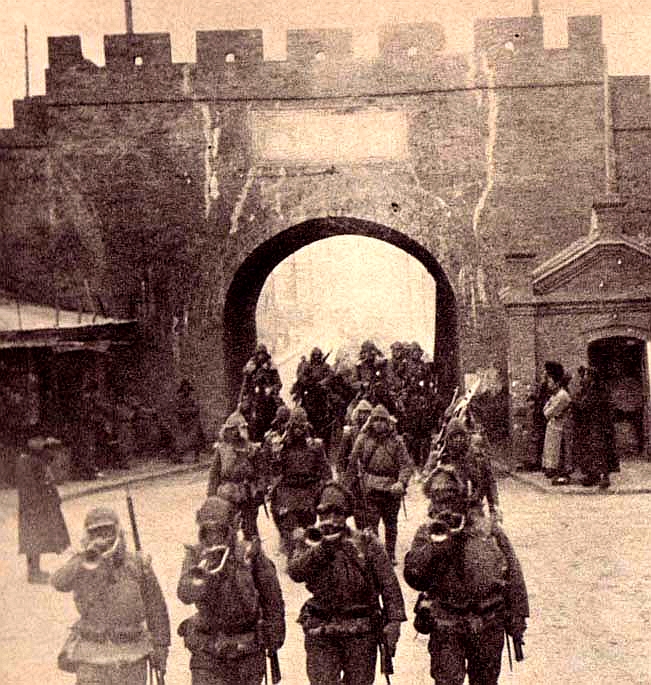
September 18, 1931: The Kwantung Army, representing Japan, invades the province of Manchuria in northeastern China, and sets up the "puppet state" of Manchukuo.

As with Nazi Germany and the Reichstag Fire a year and a half later, the invasion is based on a lie: "The Mukden Incident," the bombing of a Japanese-owned railway in Manchuria. Of course, the Japanese did it to themselves, to give themselves the seemingly-justified excuse to invade.

The incident led to a 14-year conflict that has been considered the start of the Pacific phase of World War II. It was also a factor in the destabilization of China that made Mao Zedong's Communist revolution possible.

*

September 18, 1931 was a Friday. These baseball games were played that day:

* The New York Yankees beat the St. Louis Browns, 14-4 at Yankee Stadium. Babe Ruth and Tony Lazzeri hit home runs, and Lou Gehrig went 3-for-4, in support of Herb Pennock.

* The New York Giants lost to the St. Louis Cardinals, 4-3 at Sportsman's Park in St. Louis. Bill Terry went 2-for-4, and Mel Ott went 1-for-2 before being taken out for a pinch-runner. Sparky Adams went 4-for-5 for the Cardinals, and Pepper Martin singled home Chick Hafey in the bottom of the 9th.

* The Brooklyn Robins beat the Chicago Cubs, 3-2 at Wrigley Field in Chicago. This was the Brooklyn team's final month under manager Wilbert Robinson, hence the name "Robins." The next season, they would again be the Brooklyn Dodgers.

* The Boston Red Sox swept a doubleheader from the Cleveland Indians, 6-1 and 6-4 at Fenway Park in Boston.

* The Philadelphia Athletics beat the Chicago White Sox, 3-1 at Shibe Park in Philadelphia. Jimmie Foxx and Mickey Cochrane did not play, but Al Simmons went 2-for-4 with 2 RBIs in support of Lefty Grove.

* The Washington Senators beat the Detroit Tigers, 4-3 at Griffith Stadium in Washington. Heinie Manush scored on a wild pitch by Earl Whitehill in the bottom of the 12th inning.

* A doubleheader was split at Forbes Field in Pittsburgh. The Boston Braves won the opener, 6-2. The Pittsburgh Pirates won the nightcap, 4-1. Between them, the Waner brothers, Paul and Lloyd, went 7-for-16 with an RBI, while Pie Traynor went 5-for-8 with a homer and 3 RBIs.

* And the day's game between the Philadelphia Phillies and the Cincinnati Reds at Crosley Field in Cincinnati was postponed to the next day, not because of bad weather, but because the Reds wanted a bigger crowd on a Saturday. It didn't work: Not only did just 1,700 fans come out, but the Phils swept, 3-2 and 5-3.

Monday, September 5, 2022

September 5, 1945: The Tragedy of "Tokyo Rose"

September 5, 1945: Iva Toguri D’Aquino is arrested in Yokohama, Japan, as "Tokyo Rose." In fact, that was a generic name that American troops gave to whatever propaganda "voice of Japan" they may have heard.

Toguri -- ironically, born on the 4th of July, in 1916 -- was a Los Angeles native, a UCLA graduate, a classmate of Jackie Robinson -- and was stranded in Japan because she was visiting her family when the war broke out. Her prominence saw her branded as one of the war's most notorious propagandists, but evidence shows that she was not a Japanese sympathizer. Indeed, she refused to give up her American citizenship, and broadcast against her will. Her program became conflated with more vicious propaganda, and she was arrested and convicted of treason after the Japanese surrender.

She was released from prison in 1956, after it was found that witnesses at her trial had lied under oath. It was not until 1977, as President Gerald Ford left office, following an exposé on the CBS News program 60 Minutes, that he gave her an official Presidential pardon. Her American citizenship was restored, and she lived quietly in Chicago until September 26, 2006, at age 90.

The "Tokyo Rose" broadcasters, and their European equivalent, "Axis Sally," would be parodied on the TV show M*A*S*H, set during the subsequent Korean War, as "Seoul City Sue."

*

September 5, 1945 was a Wednesday. Scottish singer Al Stewart was born on this day.

Due to wartime travel restrictions, with no knowledge that The War was going to end before the regular season was over, the baseball schedule had many more doubleheaders than usual. These games were played on this day:

* The New York Yankees split a doubleheader with the Detroit Tigers at Yankee Stadium. The Tigers won the opener, 10-7. The Tigers scored 5 runs in the top of the 9th, including home runs by Eddie Mayo and Hank Greenberg, the latter newly returned from serving in The War, to come from behind and win it. The Yankees won the nightcap, 5-1. George "Snuffy" Stirnweiss, on his was to winning the American League batting title, hit a home run.

* The New York Giants were swept by the Chicago Cubs, 5-2 and 10-2 at Wrigley Field in Chicago. Giant player-manager Mel Ott went 0-for-4 in the 1st game, then kept himself out of the 2nd game until becoming a pinch-hitter, and didn't reach base.

* The Brooklyn Dodgers beat the Pittsburgh Pirates, 5-3 at Forbes Field in Pittsburgh. Goody Rosen won it with a home run in the top of the 10th.

* A doubleheader was split at Fenway Park in Boston. The Boston Red Sox won the 1st game, 2-1. The Cleveland Indians won the 2nd game, 5-2.

* The Chicago White Sox swept the Philadelphia Athletics, 15-6 and 6-5 at Shibe Park in Philadelphia. In the 2nd game, the ChiSox scored 2 runs in the top of the 14th, but the A's could only score 1 in the bottom half.

* A doubleheader was split at Griffith Stadium in Washington, and both games went to extra innings. The Washington Senators won the 1st game, 2-1. Rick Ferrell singled Fred Vaughn home with the winning run in the bottom of the 11th inning. The St. Louis Browns won the 2nd game, 4-3. Mark Christman singled Vern Stephens home with the winning run in the top of the 10th.

* A doubleheader was split at Crosley Field in Cincinnati. The Cincinnati Reds won the 1st game, 1-0. Mike Modak allowed 9 hits, but kept the shutout. The Philadelphia Phillies won the 2nd game, 8-6.

* And the St. Louis Cardinals beat the Boston Braves, 4-2 at Sportsman's Park in St. Louis.

Friday, September 2, 2022

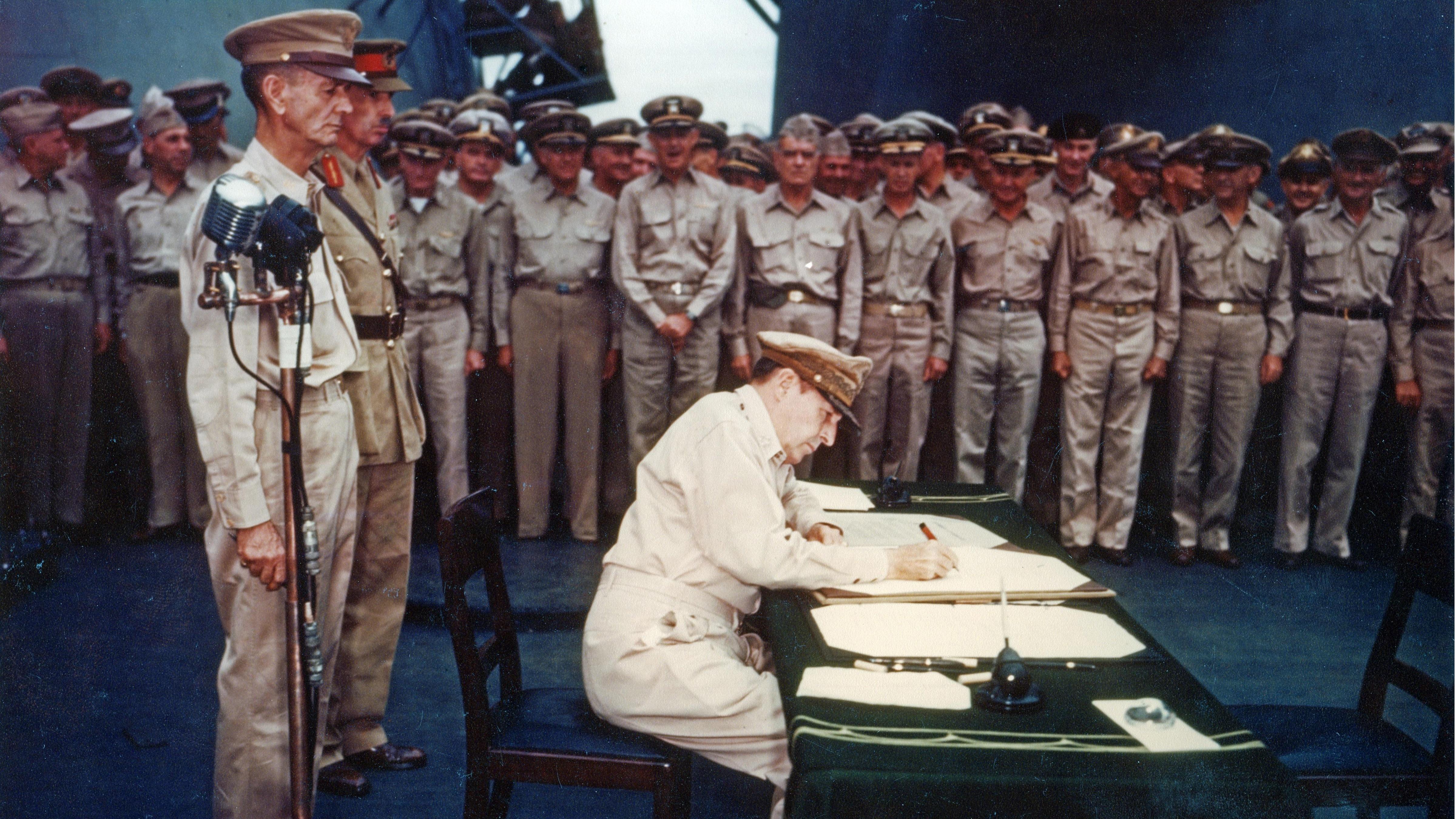
September 2, 1945: The Battleship Missouri Surrender

MacArthur signing, for the U.S. acknowledgement of the surrender

September 2, 1945: Foreign Minister Mamoru Shigemitsu, acting for the Empire of Japan, signs the Instrument of Surrender to end World War II, on the deck of the American battleship USS Missouri, anchored in Tokyo Bay. Shigemetsu later served as Deputy Prime Minister, and died in 1957.

The signing took place at 9:04 AM on September 2, Japan Standard Time -- 8:04 PM on September 1, U.S. Eastern. Representing the Allied Powers:

* The United States of America: General of the Army Douglas MacArthur, Fleet Admiral Chester Nimitz, and Admiral John S. McCain Sr., grandfather of the longtime Senator and Presidential candidate.

* The British Empire: British Admiral of the Fleet Sir Bruce Fraser, Canadian Colonel Lawrence Moore Cosgrave, Australian General Sir Thomas Blamey, and New Zealand Air Vice Marshall Sir Leonard Isitt.

* France: Général d'armée Philippe Leclerc.

* The Netherlands: Vice Admiral Conrad Helfrich.

* The Republic of China: General Xu Yongchang.

* The Union of Soviet Socialist Republics: Lieutenant General Kuzma Derevyanko.

Admiral Fraser was the last survivor of these men, living until 1981.

Among the sailors serving aboard the Missouri at the time, and thus a witness to the ceremony, was Bernard Schwartz, an aspiring actor from The Bronx, who was inspired to enlist in the Navy by Cary Grant and Tyrone Power, who had both appeared in films about submarine service. He took his stage name from the 1936 film Antony Adverse, and a name that had been in his mother's family: Kurtz. He anglicized the name to "Tony Curtis."

World War II was over, and the Allies had won. Now, the victorious nations had work to do, to set their own people free. The British Empire would get there first, mostly getting it done by 1960. France took a bit longer, due to a nasty war in Algeria. America took until the Voting Rights Act of 1965. The Soviet Union, and the countries formed when it broke apart? Some of those countries have never been free, to this day.
USS Missouri

The Missouri, built at the Brooklyn Navy Yard, was the last ship built by the U.S. Navy to be classified as a "battleship" and still be in active service. The "Mighty Mo" also served in the Korean War, the Vietnam War, and the Persian Gulf War, and was decommissioned in 1992. It is now a museum ship -- appropriately, docked at Pearl Harbor in Honolulu, Hawaii.

*

September 2, 1945 was a Sunday. Due to that fact, and the wartime travel restrictions that were still in place, not only was a full slate of baseball games played that day, but nearly every team was in a doubleheader:

* The New York Yankees split a doubleheader with the Washington Senators at Griffith Stadium in Washington. The Yankees won the opener, 4-2. Joe Page, later to be known as the best reliever in the game, started, and went 8 innings for the win. The Yankees scored all 4 runs in the 6th inning, including 3 on a bases-loaded triple by Nick Etten.

The Senators won the nightcap, 3-0. Roger Wolff almost pitched a 5-hit shutout, but he walked 2 batters in the bottom of the 9th, and Senators manager Ossie Bluege brought Mickey Haefner in to get the last out.

* The New York National League arch-rivals split a doubleheader at the Polo Grounds. The Brooklyn Dodgers won the 1st game, 7-4. The New York Giants won the 2nd game, 6-2. Dixie Walker singled home the winning run of the 1st game in the top of the 11th inning, and Tommy Brown singled home 2 more.

* A doubleheader was split at Braves Field in Boston. The Boston Braves won the 1st game, 6-3. The Philadelphia Phillies won the 2nd game, 5-4.

* The Philadelphia Athletics swept a doubleheader from the Boston Red Sox, 1-0 and 7-2 at Shibe Park in Philadelphia. Bobo Newsom pitched a 5-hit shutout in the 1st game. He would finish 8-20 with a 3.29 ERA for a team that finished 52-98.

* The Pittsburgh Pirates swept a doubleheader from the Cincinnati Reds, 4-2 and 7-3 at Crosley Field in Cincinnati.

* In a single game, the Cleveland Indians beat the Detroit Tigers, 3-2 at Briggs Stadium (later Tiger Stadium) in Detroit. Having already been discharged by the U.S. Army, Hank Greenberg went 1-for-3 with a walk and an RBI. At the end of the month, his grand slam on the last day of the regular season would win the Pennant for the Tigers.

* A doubleheader was split at Comiskey Park in Chicago. The Chicago White Sox won the 1st game, 6-0. Eddie Lopat, later to star with the Yankees, pitched a 5-hit shutout. The St. Louis Browns won the 2nd game, 3-2.

* And the NL's Midwestern arch-rivals split a doubleheader at Sportsman's Park in St. Louis. The Chicago Cubs won the 1st game, 4-1. Frank Secory hit a bases-loaded double in the top of the 10th inning.

The St. Louis Cardinals won the 2nd game, 4-0. Charles "Red" Barrett allowed only 1 hit, a single by Lennie Merullo in the 3rd inning. It was his 20th win of the season, and he finished 23-12. But his only full season with the Cards would be the one season between 1942 and 1946 in which they didn't win the Pennant. He did win one with the 1948 Boston Braves.

Thursday, September 1, 2022

September 1, 1978: "Battle of the Planets" Premieres

Left to right: Princess, Tiny, Keyop, Jason, Mark

September 1, 1978: Battle of the Planets -- sometimes incorrectly called G-Force, after the name of the team in it -- premieres in syndication on U.S. TV. It was a redubbing of Science Ninja Team Gatchaman, a Japanese cartoon that had premiered in 1972. Of the 105 episodes of that series, 85 were adapted and aired over the next year and a half.

Knowing where the money was, the American producers, led by Sandy Frank, chose a title that echoed that of Star Wars, and made it look as much like Star Wars as possible, including introducing 7-Zark-7, a robot expositioner who looked a lot like R2-D2, and sounded a lot like C-3PO.

G-Force were ordinary teenagers, all of them orphans, except for Keyop, an artificial lifeform. They were students by day, heroes by night. And if the later cartoons Captain Planet & the Planeteers, Mighty Morphin Power Rangers and Sailor Moon (the latter 2 also being Japanese imports) now sound like ripoffs, that's not my fault.

Some of the voices were familiar:

* Los Angeles disc jockey Casey Kasem, who voiced Shaggy in the Scooby-Doo franchise, Alex Cabot on Josie and the Pussycats, and the Super Friends' version of Robin, was Mark, the team leader and tactician. In his civilian guise, he wore a shirt with the number 1 on it. But, like all 5 of them, his costume resembled a bird, including a helmet with birds' eyes on the front. His was an eagle.

* Ronnie Schell, Duke Slater on Gomer Pyle, U.S.M.C., was Jason, the team's leading weapons expert. He was impulsive, a bit of a hothead, like Johnny Storm/the Human Torch in The Fantastic Four, but he respected the chain of command: Anderson, then Mark, then the rest of the team. He wore a shirt with the number 2 on it, and his bird was a condor.

* Janet Waldo, whose repertoire included Josie, Judy Jetson and Penelope Pitstop, was Princess. The only female member of the team, her expertise was electronics and demolition, making her similar to the later character of Nikki Franco on the TV show V.I.P.

"Princess" is clearly a nickname, and her real name is never revealed. Although it was never explicitly stated that she and Mark were in a relationship, the dialogue suggests that they were close, which, alone, was enough to contradict the Japanese original, where Ken, the Mark equivalent, was, to use an American expression, "married to the job." She wore a shirt with the number 3 on it, and her bird was a swan.

* Alan Young, Wilbur on Mister Ed, was both Keyop and 7-Zark-7. Keyop was an artificial lifeform, who appeared to be the youngest and the smallest of the kids, and also had the least self-confidence. He was the team's reconnaissance expert. He wore a shirt with the number 4 on it, and his bird was a swallow.

* Alan Dinehart was Tiny Harper, and also Security Chief Anderson. Dinehart had mainly been a writer and/or a producer of TV shows until this point, including with Young on The Alan Young Show. Tiny, the only 1 of the 5 whose last name was ever mentioned, was the tech wizard of the show, equivalent to Scotty on Star Trek, Barney Collier on Mission: Impossible, or Kato on The Green Hornet. But he also had a bit of a gruff demeanor, and yet was intelligent enough to be trusted to be the team's pilot, like Ben Grimm/The Thing of the Fantastic Four. He wore a shirt with the number 5 on it, and his bird was an owl.

Anderson was G-Force's boss, equivalent to M in the James Bond films, the unseen voice that gave Jim Phelps the missions in Mission: Impossible, the Chief of CONTROL on Get Smart, or Oscar Goldman on The Six Million Dollar Man and The Bionic Woman.

Mark and Jason are said to be 18 years old, Tiny 17, Princess 16 (making any relationship with Mark a little sketchy), and Keyop 11.

The G-Force members stay in contact through a wrist-band communicator device, which also serves as a way for them to change or "transmute" instantly from their civilian clothes into their G-Force uniforms, and back again. At one point, Princess, in civilian clothes, lost a shoe, and, in a nod to the Cinderella story, without the shoe, as part of a complete outfit, she could not transmute into her G-Force costume.

Other weapons seen displayed by various team members include Mark's sonic boomerang, a bird-shaped boomerang with razor-sharp wings; Jason's and Tiny's multi-purpose gadget guns, which can be outfitted with grappling hook and line, drill bits, etc.; and Keyop's and Princess's yo-yo bombs, which could be used as bolas, darts, and explosive devices. Other weapons include feathers with a sharpened steel quill that could be used as deadly throwing darts, and mini-grenades shaped like ball bearings with spike studs.

The G-Force team themselves would use a combination of martial arts skills, ninja-like weapons, and their "cerebonic" powers to dispatch hordes of enemy soldiers and overcome other obstacles. Their bird-like costumes include wing-like capes that could fan out and function nearly identically to parachutes and/or wingsuits, enabling the G-Force members to, if not quite "fly," then to drift or glide down to safety from heights that would otherwise prove fatal.

The main ship of the G-Force team was, in keeping with the bird theme, called the Phoenix, which could carry, transport, and deploy 4 smaller vehicles, each operated by one team member:

* A futuristic race car with various hidden weapons, driven by Jason, and concealed within the Phoenix's nosecone.
* The "galacti-cycle," a futuristic motorcycle ridden by Princess, stored within the left-wing capsule of the Phoenix.
* Keyop's "Space Bubble," an all-terrain, tank-like vehicle capable of vertical takeoff and landing (VTOL), as well as being a submersible craft, held in the right storage capsule of the Phoenix.
* And a futuristic jet fighter that Mark piloted, stored in the top rear section of the Phoenix command island structure, and which used its tail fin to make up the center tail fin of the Phoenix.
* Tiny was assigned to pilot the Phoenix rather than one of the detachable craft.
The Phoenix

A regularly featured plot device was the transformation of the Phoenix into a flaming bird-shaped craft able to handle virtually any exceptional situation for a brief period by essentially turning itself into pure energy, called the Fiery Phoenix. How the occupants were protected was never explained.

The Phoenix's primary weapon was a supply of rockets called "TBX missiles" in the series. It also occasionally flaunted a powerful solar-powered energy blaster, although the team had the misfortune of choosing very cloudy days to use it.

Keye Luke, who played all kinds of Asian roles in his long career, voiced Zoltar, who, like Darth Vader, turned out not to be in charge of the villainous activities, but most people (myself included) forgot this. Zoltar would receive his orders directly from a being he would refer to as the Luminous One. This being would appear as a ghost-like, disembodied, floating head. Who, or what, this being actually was, was never explained in any detail throughout the series.

There were significant differences from the Japanese original. A literal translation of the script would have led to showing more violence, and even deaths, than a U.S. children's show would have been allowed to show. The original version also included Japanese profanities, and these had to be edited out in English.

Indeed, there was a rumor that explained why Keyop, originally known in Japan as Jinpei, had a bizarre verbal tic of stuttering, chirping, and burbling every time he started to speak: Supposedly, it was done because the original character used a lot of profanity, and that Keyop's excess mouth motion would cover up deleting the words. This was not true: Jinpei rarely, if ever, used profanity. The in-story explanation for Keyop's unique manner of speech is that he is an artificial life form, with a speech impediment because of slightly defective genetic engineering.

Keye Luke died in 1991, Alan Dinehart in 1992, Casey Kasem in 2014, and Alan Young and Janet Waldo in 2016. As of September 1, 2022, Sandy Frank and Ronnie Schell are still alive.

A live-action Japanese version bombed in 2013. As of 2022, filmmaking brothers Joe and Anthony Russo were planning a new live-action version.

*

September 1, 1978 was a Friday. These Major League Baseball games were played:

* The New York Yankees lost to the Seattle Mariners, 3-0 at Yankee Stadium. Paul Mitchell outpitched Catfish Hunter, ending a streak of 6 straight decisions won for him, a big reason why the Yankees had closed the gap on the Red Sox. Mickey Rivers hit doubles, but the only other Yankee baserunners were Thurman Munson and Lou Piniella with singles, and Reggie Jackson and Chris Chambliss each with a walk.

* The New York Mets lost to the Los Angeles Dodgers, 4-3 at Dodger Stadium in Los Angeles. Dusty Baker singled Steve Garvey home with the winning run in the bottom of the 12th inning. This made a winning pitcher of Terry Forster in relief of Doug Rau, and a losing pitcher of Kevin Kobel, after Jerry Koosman pitched 11 innings.

* The Oakland Athletics beat the Boston Red Sox, 5-1 at Fenway Park in Boston. So the Yankees lost no ground in their attempt to come back from 14 games behind the Red Sox. Carl Yastrzemski went 0-for-4, but had an RBI on a groundout.

* The Baltimore Orioles swept a doubleheader from the Chicago White Sox, 3-0 and 9-3 at Memorial Stadium in Baltimore. Over the 2 games, Eddie Murray went 2-for-7 with a home run and 4 RBIs.

* The California Angels beat the Toronto Blue Jays, 6-4 at Exhibition Stadium in Toronto.

* The Pittsburgh Pirates swept a doubleheader from the Atlanta Braves, 8-3 and 3-0 at Three Rivers Stadium in Pittsburgh. Willie Stargell went 3-for-4 with a home run and 2 RBIs in the opener, then got the nightcap off. In that game, Bruce Kison (7 2/3rds innings) and Kent Tekulve combined on a 3-hit shutout.

* The Chicago Cubs beat the Houston Astros, 14-11 at Wrigley Field in Chicago. J.R. Richard started for the Astros, but didn't get out of the 4th inning, giving up 3 home runs, 1 to once and future Yankee Bobby Murcer. Mike Krukow didn't get out of the 2nd inning, but the Cubs won the game, anyway.

* The Texas Rangers beat the Milwaukee Brewers, 5-4 at Milwaukee County Stadium. Don Money hit 2 home runs. Robin Yount went 1-for-4 with an RBI. Rookie Paul Molitor went 0-for-3 with a walk.

* The Cleveland Indians beat the Minnesota Twins, 4-1 at Metropolitan Stadium in the Minneapolis suburb of Bloomington, Minnesota. Rod Carew drew a walk as a pinch-hitter.

* The Cincinnati Reds beat the St. Louis Cardinals, 5-2 at Busch Memorial Stadium in St. Louis. Pete Rose went 2-for-5. Johnny Bench went 1-for-3 with a walk and an RBI. Lou Brock went 1-for-4.

* The Detroit Tigers beat the Kansas City Royals, 6-2 at Royals Stadium (now Kauffman Stadium) in Kansas City. George Brett went 0-for-4.

* The Montreal Expos beat the San Diego Padres, 3-2 at San Diego Stadium (later renamed Jack Murphy Stadium and Qualcomm Stadium). Sam Mejías singled Larry Parrish home with the winning run in the top of the 12th inning, ruining a great complete game for Randy Jones, and making a winning pitcher of Mike Garman in relief of Ross Grimsley Jr.

* And the San Francisco Giants beat the Philadelphia Phillies, 4-3 at Candlestick Park in San Francisco. Steve Carlton used to tell his Phillies teammates, "It's Win Day" when he started. Not this time: He gave up a home run to Jack Clark in the 8th to lose it. Mike Schmidt went 0-for-3 with a walk.

December 31, 1999 & January 1, 2000: The Millennium

December 31, 1999:  The Millennium arrives. The people of planet Earth survived. At a terrible cost. But we hadn't destroyed ourselves. ...