Showing posts with label cleveland. Show all posts

Tuesday, December 27, 2022

December 27, 1964: The Cleveland Browns' Last Title -- So Far

Jim Brown (32) takes a handoff from Frank Ryan (13)

December 27, 1964: The NFL Championship Game is played, at Cleveland Municipal Stadium. The host Cleveland Browns had been a dominant team from their 1946 inception until 1957, and were back after a rebuild.

Controversially, that rebuild involved Art Modell buying the team, and firing the founding head coach and general manager, Paul Brown. Blanton Collier was put in charge, and he revamped the team, including installing Frank Ryan at quarterback. Ryan was working on a doctorate in mathematics, and would later teach at the university level.

Collier also gave Jim Brown a bit more leeway. In 1963, Collier's 1st season, Brown rushed for 1,863 yards, an NFL record that stood for another 10 years. In 1964, he ran for 1,446. The Browns had another Hall-of-Fame running back in Leroy Kelly. Paul Warfield, a rookie receiver, would also go to Canton. So would guard Gene Hickerson. And so would their one holdover from their 1950s titlists, placekicker Lou Groza.

The Browns went 10-3-1. The St. Louis Cardinals tied them 33-33 at Cleveland Municipal Stadium, and beat them 28-19 in St. Louis. The Browns also lost 23-7 at home to the Pittsburgh Steelers, and 28-21 to the Green Bay Packers in Milwaukee. The losses in Milwaukee and St. Louis were both late in the season. But a 52-20 demolition of the Giants at Yankee Stadium in the final regular-season game gave them the Eastern Division title by half a game over the Cardinals, who went 9-3-2.

They would host the NFL Championship Game against the Baltimore Colts, who were favored, having gone 12-2. With Johnny Unitas quarterbacking several holdovers from their 1958 and '59 NFL Champions, they lost their opener away tot he Minnesota Vikings, and their next-to-last game at home to the Detroit Lions. But they won the rest of their games. They did not play the Browns in the regular season. Despite the Browns having the home field, the Colts were favored by 7 points.
There was no scoring in the 1st half. The Browns began the 3rd quarter with the wind at their backs, and Groza's kickoff went beyond the end zone. The Browns' defense held the Colts, and Tom Gilburg had to punt into the wind. The Browns took over in Colt territory, but could only get a 43-yard field goal from Groza.

That seemed to break the ice, though: The Colts could do nothing on their ensuing drive, and an 18-yard run by Brown was followed by an 18-yard touchdown pass from Ryan to Gary Collins, and the Browns were up, 10-0.

The Colts could not recover. Tony Lorick ran Groza's kickoff out of the end zone, and was tackled at his own 11. A clipping penalty forced another punt into the wind, and the Browns got the ball back at the Colt 39. Another pass from Ryan to Collins made it 17-0. Unitas got the Colts into Browns territory on the next drive, but the usually reliable Lenny Moore fumbled a handoff, and the Browns recovered. The 3rd quarter closed with a 23-yard run by Jim Brown.

Never before had a single quarter so turned around an NFL championship game, and none would again for 23 years, until the 2nd quarter of Super Bowl XXII, when Denver led 10-0 at the start, and Washington led 35-10 at the end.

The Colts held the Browns to another Groza field goal, and it was 20-0. Unitas looked to have gotten the Colts to the Brown 15, by a wide-open Jimmy Orr dropped the pass, and the Colts had to punt. This time, they had the wind, but it made no difference, and a 3rd Ryan-to-Collins touchdown made the final score 27-0. Collins -- no relation to the actor and game-show host of the same name -- thus became the 1st player ever to catch 3 touchdown passes in an NFL title game.

In spite of the performances of Ryan, Brown and Collins, the Browns' defense was as much of a story. They held Unitas to 95 passing yards, and the team as a whole to 92 rushing yards.

This game had 5 officials: A referee, an umpire, a head linesman, a back judge and a field judge. And their penalty flags were white. The next season, a line judge was added, and penalty flags were changed to yellow, to show up better on color television. In 1978, the side judge brought the on-field officials' complement to their current 7.

This would prove to be Jim Brown's only title. The next season, the Browns got back into the NFL Championship Game, but lost to the Green Bay Packers. Jim then retired to focus on acting and civil rights activism. The Browns would reach the NFL Championship Game again in 1968, but lost to the Colts; and again in 1969, but lost to the Vikings. They reached the AFC Championship Game in the seasons of 1986, 1987 and 1989, but lost all 3. They have never won another NFL title, not since this game, which could be retroactively labeled "Super Bowl -II."

The Colts lost Super Bowl III to close the 1968-69 season, but won Super Bowl V. In 1984, they moved to Indianapolis. In 1995, angry that he couldn't get a new stadium, or at least a better lease at Municipal Stadium, Art Modell moved the Browns -- to Baltimore, where they became the Ravens. You would think that, having had their hearts broken 11 years earlier, Baltimore would have known better. They won Super Bowls XXXV and XLVII.

A new Browns franchise was established for 1999, but they have largely struggled: In their 1st 24 seasons, they've only made the Playoffs twice, winning just 1 game.

Along with the Detroit Lions, the Browns are 1 of 2 teams to have won an NFL Championship, but, through the 2021 season, never reached the Super Bowl. The Browns, the Lions, and the team now known as the Arizona Cardinals are the only 3 teams to have won an NFL Championship, but not won a Super Bowl. (The Cardinals have reached one, but lost it. I should say 4 teams, as the Minnesota Viking won the 1969 NFL Championship, but lost Super Bowl IV.)

The fact that the Browns' titles came before the advent of the Super Bowl means that they get discounted: Even before the distance of time became what it is now, NFL fans had come to regard any title won before the Super Bowl, NFL or AFL, as not a "real" championship.

What's more, the 1964 Browns are often considered, along with the 1963 Chicago Bears, to be an NFL Champion that would have lost to that season's AFL Champions. The day before this game, the AFL Championship Game was played at War Memorial Stadium in Buffalo, New York. The Buffalo Bills beat the San Diego Chargers, 20-7.

The Browns' 1964 NFL Championship would be the last title won by any Northern Ohio team for a long time, and many gut-wrenching close calls would come in the interim. The Browns would have "The Drive" in the 1986 AFC Championship Game, and "The Fumble" in the 1987 edition, before "The Move" and "The Return."

The Cleveland Indians, now known as the Cleveland Guardians, wouldn't even get close to the Playoffs until winning the American League Pennant in 1995, lost that year's World Series, and then lost the 1997 World Series despite leading in the bottom of the 9th inning of Game 7. And they blew a 3-games-to-1 lead in the 2007 AL Championship Series. The Cleveland Cavaliers were a hard-luck team, losing a 1989 NBA Playoff series to the Chicago Bulls on the last play, when Michael Jordan made "The Shot."

Finally, in 2016, the Cavaliers won the NBA Championship, ending Cleveland's overall title drought after 51 1/2 years. LeBron James and Jim Brown posed together with the NBA trophy.

*

December 27, 1964 was a Sunday. Baseball was out of season. There were 3 games in the NBA:

* The New York Knicks lost to the St. Louis Hawks, 99-89 at the old Madison Square Garden.

* The Boston Celtics beat the Detroit Pistons, 112-106 at the Boston Garden. Sam Jones scored 40 points.

* And the Baltimore Bullets beat the Cincinnati Royals, 126-119 at the Baltimore Civic Center (now the CFG Bank Arena). Walt Bellamy and Gus Johnson each scored 32 for the Bullets, while Oscar Robertson scored 48 for the Royals.

And There were 2 games in the NHL. The New York Rangers lost to the Detroit Red Wings, 3-1 at the Olympia Stadium in Detroit. And the Chicago Black Hawks beat the Boston Bruins, 6-2 at the Chicago Stadium. The Montreal Canadiens and the Toronto Maple Leafs were not scheduled.

Thursday, December 15, 2022

December 15, 1978: Cleveland Goes Into Default

December 15, 1978: The City of Cleveland goes into default, the largest American city ever to do so. Between this, the Cuyahoga River catching on fire in 1969, the industry falloff, and the nasty Winter weather, Cleveland became America's city of jokes.

Dennis Kucinich, a Democrat, had been elected the city's "Boy Mayor" at age 31 in 1977, but was in over his head. He relied heavily on confrontation politics, a style that, according to a book about his tenure, "alienated business and civic leaders, the news media, and, ultimately, even those neighborhood groups that had been his chief supporters."

The key was the sale of the city's electric company, Municipal Light, to the Cleveland Electric Illuminating Company (CEI). Kucinich opposed it, because it would have resulted in a monopoly on public power in the city. But without the money from the sale, the city would have defaulted. His stubbornness made that happen, and Cleveland remains the only American city to default since the Great Depression.

Kucinich had infuriated everybody, including the local Mafia. A contract was put out in him, and he was set to be assassinated at a public ceremony. It didn't happen because he missed the ceremony, due to being hospitalized for an ulcer. He was defeated for re-election in 1979, by Republican George Voinovich, and the contract was called off.

Kucinich's decision was later vindicated by both city officials and the U.S. Senate, whose investigations found that CEI and the banks had acted improperly. He later served in Congress, and ran a hard-left campaign for President in 2004. Voinovich later served as Governor and U.S. Senator.

In 1983 "Muny Light" became Cleveland Public Power. In 1997, CEI merged with Ohio Edison to become FirstEnergy.

The city's population peaked at 914,808 in 1950, making it, then, the 6th-largest in America, behind New York, Chicago, Los Angeles, Philadelphia and Detroit. It dropped to 876,000 in 1960, no big deal. But "white flight," especially after the East Side race riot of 1966, caused a drop to 751,000 in 1970.

And with the loss of industry and the financial crisis, it got worse, falling to 574,000 in 1980, 505,000 in 1990, 478,000 in 2000, 397,000 in 2010, and 372,000 in 2020. In 1970, the city was 59 percent white, 38 percent black, 2 percent Hispanic; by 2010, it was 52 black, 33 white, 10 Hispanic. The metropolitan area, however, is still home to 3.6 million people.

All the city's problems led to the rise of Cleveland jokes:

* Why do ducks fly over Cleveland upside-down? Because there's nothing worth crapping on.

* What's the only thing that grows in Cleveland? The crime rate.

* How much snow and sleet fell in Cleveland? So much that hookers are exchanging sex for Ice Melt.

* What does the average student from Cleveland get on his SAT? Drool.

* Why don't girls play hide and seek in Cleveland? Because no one would look for them.

* A radio host in rival city Cincinnati asked, "What's the difference between Cleveland and the Titanic?" His answer: "Well, at least Cleveland has a better orchestra." (The city is renowned for it, while, on the Titanic, to comfort the passengers who couldn't get off, the orchestra kept playing, their last song being "Nearer, My God, To Thee.")

* The sports teams haven't been spared. The NBA's Cavaliers have been known as the Cavalosers and the Cadavers.

* Where should Clevelanders go to avoid a tornado? The Browns' stadium. No chance of a touchdown there!

* On a flight to the city, to play the Indians, New York Yankees 3rd baseman Graig Nettles, who had played for them, got on the plane's speaker, and told his teammates, "We are now arriving in Cleveland. Please set your watches back 42 minutes."

* An earlier player, Richie Scheinblum, said, "Maybe we should change our name to the Cleveland Utility Company. All we have are utility players."

* When Len Barker of the Indians pitched a perfect game against the Toronto Blue Jays at Municipal Stadium on May 15, 1981, a sportswriter (whose name I've forgotten) said, "How cold it be perfect? It was in Cleveland."

* It was no surprise that the 1989 and 1994 Major League movies were set in Cleveland, to represent a city that never won.

* In 1989, Cincinnati Bengals fans threw snowballs onto the field to protest a bad call. Their coach, Sam Wyche, was given a house microphone to try to calm the crowd. He said, "Will the next person that sees anybody throw anything onto this field, point 'em out, and get 'em out of here. You don't live in Cleveland, you live in Cincinnati!" The crowd cheered, and no more snowballs were thrown.

* In 1995, The Drew Carey Show premiered on ABC. Cleveland native Carey, a successful comedian, played a struggling middle-manager in a struggling city he still loved. When the Indians won the American League Pennant that year, he said, "Finally, it's everybody else's team that sucks!" And then, as if to remind Northern Ohio not to get cocky, the Indians lost the World Series, and the original version of the Browns moved.

* Want to hear a joke about construction in Cleveland? Sorry, it's not finished yet.

*

December 15, 1978 was a Friday. This was also the day that Superman: The Movie, starring Christopher Reeve, premiered. I have a separate entry for that event.

Baseball was out of season. The NFL was in midweek, and there were no college football bowl games. There were 9 games played in the NBA that night. None of them were played in Metropolis:

* The New York Knicks beat the Chicago Bulls, 118-94 at the Chicago Stadium. Toby Knight scored 43 points for the Knicks. No, I don't remember him, either.

* The New Jersey Nets lost to the Atlanta Hawks, 121-104 at the Rutgers Athletic Center in Piscataway, New Jersey. (It was renamed the Louis Brown Athletic Center in 1986, after a generous University donor.)

* The Philadelphia 76ers beat the Houston Rockets, 91-84 at The Spectrum in Philadelphia.

* The Kansas City Kings beat the Boston Celtics, 105-101 at the Boston Garden.

* The Washington Bullets beat the Detroit Pistons, 116-114 at the Silverdome in the Detroit suburb of Pontiac, Michigan.

* The San Antonio Spurs beat the Indiana Pacers, 125-113 at the Market Square Arena in Indianapolis.

* The Cleveland Cavaliers beat the Milwaukee Bucks, 110-106 at the Milwaukee Exposition, Convention Center and Arena, or "The MECCA." Since 2014, it has been named the UW-Panther Arena.

* The Portland Trail Blazers beat the Denver Nuggets, 116-113 at the McNichols Arena in Denver. David Thompson scored 36 for the Nuggets, but for the Blazers, Maurice Lucas scored 32 with 23 rebounds.

* And the Los Angeles Lakers beat the Seattle SuperSonics, 100-98 at The Forum, outside Los Angeles in Inglewood, California.

Only 1 game was played in the NHL: The Minnesota North Stars beat the Washington Capitals, 6-1 at the Capital Centre in the Washington suburb of Landover, Maryland. And in this season, which turned out to be the last for the World Hockey Association, a Soviet All-Stars team was a member. And on this night, they played in the only WHA game scheduled, losing 5-3 to the Edmonton Oilers at the Northlands Coliseum in Edmonton.

Sunday, December 11, 2022

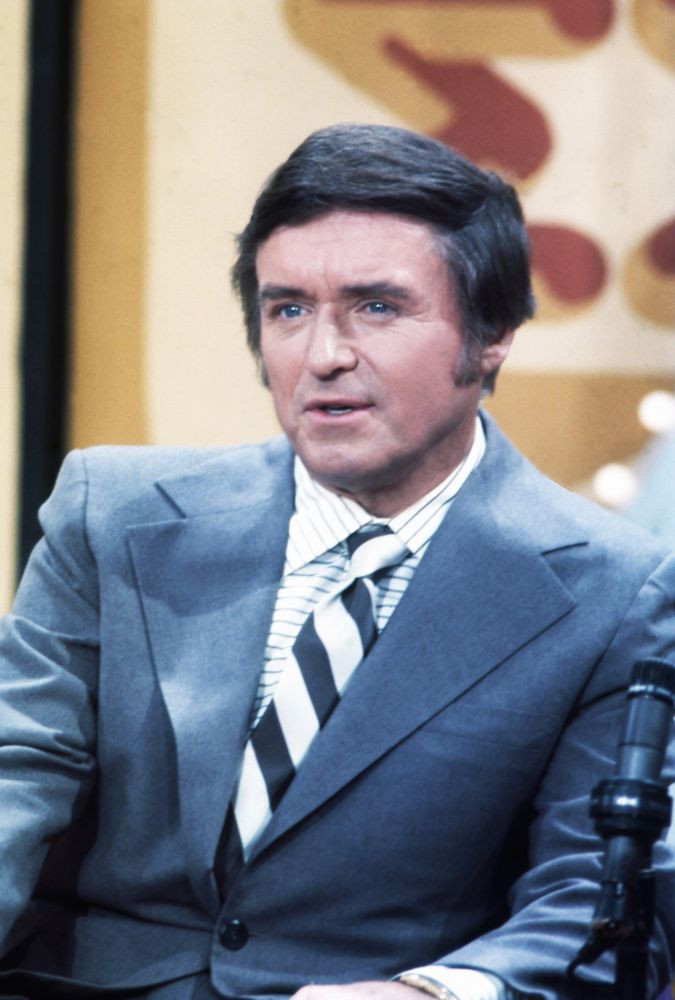
December 11, 1961: “The Mike Douglas Show” Premieres

December 11, 1961: The Mike Douglas Show premieres, at the studio of KYW-Channel 3 in Cleveland, owned by Westinghouse Broadcasting. It became one of America's top TV talk shows.

In September 1963, the show was syndicated to 4 other television stations owned by Westinghouse: WBZ-Channel 4 in Boston, WJZ-Channel 13 in Baltimore, KDKA-Channel 2 in Pittsburgh, and KPIX-Channel 5 in San Francisco. Less than 1 year later, the show had expanded to a total of 27 cities.

In August 1965, the show moved from Cleveland to Philadelphia to a small basement studio located in the KYW-TV building at 1619 Walnut Street in Center City Philadelphia. At that time, Westinghouse began syndicating the show nationally, bought Philadelphia's Channel 3, and gave it the KYW call letters. (Cleveland's Channel 3 became WKYC.) In July 1972, the show moved to a new studio in the newly constructed KYW-TV studios at 5th and Market Streets in Center City.

In 1978, the show was moved to CBS Television City in the Los Angeles suburb of Burbank, California. There, it ran until November 30, 1981.

Douglas would do a week's worth of shows with a different guest host every week. In early February 1972, his guest hosts for a week were John Lennon and Yoko Ono, and that's what The Mike Douglas Show is best known for today.

Mike Douglas' real name was Michael Delaney Dowd Jr. Michael Douglas, whose birth name was Michael Kirk Douglas but whose father was born Issur Danielovitch, appeared on the show 9 times from 1976 to 1980. And Michael Keaton, whose real name is Michael John Douglas, appeared on the show 5 times in 1979 and 1980. Early in his career, he told both Mike Douglas and Michael Douglas, "I had to change my name because of you!"

Douglas died in 2006, not long after publishing a memoir titled I'll Be Right Back, in which he wrote that the TV industry would like to dedicate a statue to the inventor of the infomercial: “Imagine: Half an hour of advertising, without all that pesky programming.”  

*

December 11, 1961 was a Monday. Steve Nichol, later to star in soccer for Liverpool Football Club, was born.

Baseball was out of season. Football was in midweek: There would be no Monday Night Football for another 9 years. And no games were scheduled for the NHL.

There were 2 games in the NBA. The Cincinnati Royals beat the Chicago Packers, 133-117 at the University of Dayton Fieldhouse in Dayton, Ohio, a "home game" for the Royals, who got 32 points from Oscar Robertson.

Yes, the Chicago Packers. I'm guessing the name didn't draw a lot of Bears fans. For the 1962-63 season, they became the Chicago Zephyrs. That didn't help. For the 1963-64 season, they became the Baltimore Bullets, and are now the Washington Wizards. The Royals are now the Sacramento Kings.

And the Los Angeles Lakers beat the St. Louis Hawks, 132-119 at the Los Angeles Memorial Sports Arena. Elgin Baylor scored 52 points.

Saturday, December 10, 2022

December 10, 1989: Sam Wyche Stands Up for Cincinnati

December 10, 1989: The Seattle Seahawks defeat the Cincinnati Bengals 24-17 at Riverfront Stadium. Bengals fans, in protest of what they perceived to be a bad call by the officials, began to throw snowballs onto the field at the referees and the Seahawks, who were at their own 4-yard line and an easy target from the bleachers. The Seahawks refused to continue until they stopped, and play was halted by the officials.

In order to stop the onslaught, Bengals coach Sam Wyche was given a house microphone to try to calm the crowd. The result was an epic rant, which also ramped up the nasty intrastate rivalry with the Cleveland Browns, famous (or infamous) for their rowdy bleacher fans, a.k.a. the Dawg Pound:

Will the next person that sees anybody throw anything onto this field, point 'em out, and get 'em out of here. You don't live in Cleveland, you live in Cincinnati!

The much-cheered comment had its roots in the traditional rivalry between Cleveland, in Northern Ohio, and Cincinnati, in Southern Ohio. The cities are in the same State, but they are not the same. As much as Cleveland is an NFL rival of Pittsburgh, those cities are much more alike than Cleveland and Pittsburgh.

Cleveland is a city that is based on steel, oil, shipping and labor unions, with a population that is more ethnically diverse and more Catholic. Cincinnati is more homogenous, with a strong German influence, with fans of baseball's Reds formerly described as "the gingery Germans of Zinzinatti." It's a more conservative city, home of the Taft political family, and not one given to innovation. In the late 19th Century, Mark Twain was quoted as saying, "When the end of the world comes, I want to be in Cincinnati because it's always 20 years behind the times."

The cities also seemingly defy regional status. Cleveland is unquestionably Midwestern. Cincinnatians call their hometown "the Queen City of the Midwest," but it's right across the Ohio River from Kentucky, and so there is a Southern influence.

(Buffalo, New York is "the Queen City of the Lakes." Charlotte, North Carolina, named for the wife of Britain's King George III, is "the Queen City of the Southeast." Springfield, Missouri is "the Queen City of the Ozarks." Seattle is "the Queen City of the Northwest.")

There is some sports overlap: Fans of the Reds, especially when the subject of their 1970s "Big Red Machine" comes up, tend to share an arrogance with fans of the University of Kentucky basketball program -- as Rupp Arena in Lexington is only 81 miles from Great American Ball Park in Cincinnati, as opposed to the 249 miles to the Cleveland Guardians' Progressive Field. If rural Pennsylvania is "Pennsyltucky," then Cincinnati can be "Cincitucky."

The comparison can be seen in the most famous TV shows ever set in each city. WKRP in Cincinnati, which had already wrapped up its run by this point, was about employees of a radio station trying to give it rock and roll's music and attitude despite the innate conservatism of the city, the station's owning family, and even some of its on-air talent. In contrast, The Drew Carey Show, which hadn't yet begun, was about working-class people trying to have a good time against all odds, and the people standing in their way weren't necessarily conservative. Some of them were equally rockish, but were jerks about it.

But Wyche's comment also had roots in his franchise's beginning. Paul Brown, long after his death, is Mr. Ohio Football. He coached State Championship teams at Massillon High School. He coached Ohio State to the 1942 National Championship. He was the 1st head coach and general manager of the Cleveland Browns, winning the All-America Football Conference title in 1946, 1947, 1948 and 1949. He then took them into the NFL, and won the NFL Championship in 1950, 1954 and 1955, losing the Championship Game in 1951, 1952, 1953 and 1957.

But he was fired by new owner Art Modell in 1963. In 1967, Brown got an expansion franchise in the American Football League. He named them the Cincinnati Bengals, a name used by a previous Cincinnati pro team. It just so happened to have the same initials as "Cleveland Browns." Brown gave them the same colors, too: Black and orange.

In their 1st 3 seasons, 1968 to 1970, the last of them being their 1st in the NFL after the merger, Sam Wyche was Brown's quarterback. Wyche was the last head coach Brown hired, in 1984. He got them to the 1988 AFC Championship, though they lost Super Bowl XXIII. Brown died in 1991, and that would be Wyche's last season as head coach, as Paul's son Mike Brown fired him. Wyche died in 2020.

*

December 10, 1989 was a Sunday. These other NFL games were played on that day:

* The New York Giants beat the Denver Broncos, 14-7 at Mile High Stadium in Denver.

* The New York Jets lost to the Pittsburgh Steelers, 13-0 at Three Rivers Stadium in Pittsburgh.

* The Philadelphia Eagles beat the Dallas Cowboys, 20-10 at Veterans Stadium in Philadelphia.

* The Washington Redskins beat the San Diego Chargers, 26-21 at Robert F. Kennedy Stadium in Washington.

* The Miami Dolphins beat the New England Patriots, 31-10 at Joe Robbie Stadium (now Hard Rock Stadium) in Miami Gardens, Florida.

* The New Orleans Saints beat the Buffalo Bills, 22-19 at Rich Stadium (later Ralph Wilson Stadium) in the Buffalo suburb of Orchard Park, New York.

* The Indianapolis Colts beat the Cleveland Browns, 23-17 at the Hoosier Dome in Indianapolis.

* The Detroit Lions beat the Chicago Bears, 27-17 at Soldier Field in Chicago.

* The Minnesota Vikings beat the Atlanta Falcons, 43-17 at the Metrodome in Minneapolis.

* The Kansas City Chiefs beat the Green Bay Packers, 21-3 at Lambeau Field in Green Bay.

* The Houston Oilers beat the Tampa Bay Buccaneers, 20-17 at the Astrodome in Houston.

* The Los Angeles Raiders beat the Phoenix Cardinals, 16-14 at the Los Angeles Memorial Coliseum.

* And the next night, on ABC Monday Night Football, the San Francisco 49ers beat their arch-rivals, the Los Angeles Rams, 30-27 at Anaheim Stadium (now Angel Stadium of Anaheim).

There were 2 games played in the NBA. The expansion Orlando Magic defeated the defending Western Conference Champion Los Angeles Lakers, 108-103 at the Orlando Arena. And the Milwaukee Bucks beat the Portland Trail Blazers, 107-104 at the Bradley Center in Milwaukee. Clyde "the Glide" Drexler scored 36 points in defeat for the Blazers.

And there were 5 games played in the NHL:

* The New York Rangers lost to the Philadelphia Flyers, 4-2 at Madison Square Garden.

* The Los Angeles Kings beat the Quebec Nordiques, 8-4 at the Colisée de Québec.

* The Buffalo Sabres beat the Washington Capitals, 4-3 at the Buffalo Memorial Auditorium.

* The Chicago Blackhawks beat the Vancouver Canucks, 7-1 at the Chicago Stadium.

* And the Winnipeg Jets beat the Calgary Flames, 4-1 at the Winnipeg Arena.

Wednesday, November 16, 2022

November 16, 1966: Sam Sheppard Is Finally Exonerated

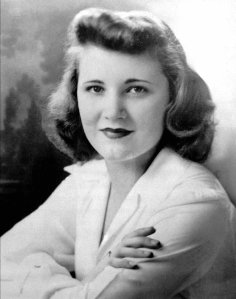
November 16, 1966: Dr. Sam Sheppard is finally acquitted of murdering his wife Marilyn in their home in the Cleveland suburbs in 1954. His defense attorney was F. Lee Bailey.

Sam was a 30-year-old osteopathic surgeon, living in Bay Village, Ohio with his wife, Marilyn, 31. They had a 7-year-old son, also named Samuel, and Marilyn was pregnant. On July 4, 1954, early in the morning, Marilyn was bludgeoned to death in an apparent robbery. The evidence pointed to Sam, and, after what seemed like a witch-hunt campaign by the local newspapers, he was arrested on July 30.
Marilyn Sheppard

He was convicted on December 21, and sentenced to life in prison. Just 17 days later, on January 7, 1955, Sheppard's mother shot and killed herself. Just 11 days after that, his father died of cancer, and perhaps of a broken heart. His father-in-law would also be a suicide, in 1963, while the appeals process was underway.

On June 6, 1966, Bailey's efforts to get a new trial paid off, and his conviction was thrown out, based on apparent bias by the original trial's judge. The new trial began on October 24, and on November 16, after deliberating for 12 hours, the jury found him not guilty. He had served 10 years in prison for a murder he did not commit.

Sheppard didn't exactly help himself in the whole process, including having had an affair before the murder, which was cited as his motive in the original trial, and remarrying while in prison. He lived barely 3 more years before drinking himself to death in 1970.

The actual killer, whom Sheppard described as "a bushy-haired man"? Most likely, it was Richard Eberling, who was imprisoned for another woman's death. He died in prison in 1998.

Despite the denial of the series' creator, Roy Huggins, the Sheppard case is believed to have inspired the 1963-67 ABC TV show The Fugitive.

*

November 16, 1966 was a Wednesday. Baseball was out of season. Football was in midweek. There were 3 games in the NBA:

* The New York Knicks lost to the Philadelphia 76ers, 117-108 at the Philadelphia Civic Center. Hal Greer scored 35 points. Wilt Chamberlain had 28 points and 30 rebounds.

* The Los Angeles Lakers beat the Cincinnati Royals, 124-112 at the Cincinnati Gardens. Jerry West and Rudy LaRusso each scored 36 points for the Lakers. Oscar Robertson and Happy Hairston co-led the Royals with 24 points.

* And the St. Louis Hawks beat the Detroit Pistons, 104-101 at Cobo Hall (now Huntington Place) in Detroit.

And there was 1 game in the NHL: The New York Rangers and the Chicago Black Hawks played to a 2-2 tie at the old Madison Square Garden.

Sunday, November 6, 2022

November 6, 1995: The Cleveland Browns Are Moved

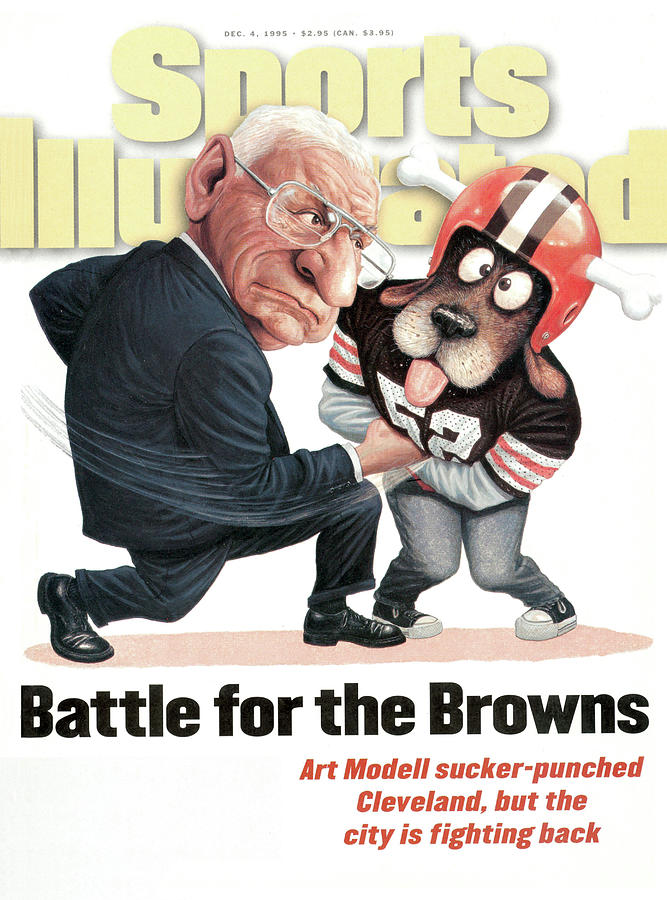
November 6, 1995: Art Modell announces that he's moving the NFL's Cleveland Browns to Baltimore, where they later announced that they will become the Baltimore Ravens.

He does so because the City of Cleveland, the County of Cuyahoga and the State of Ohio refused to listen to his pleas to either build him a new stadium, or at least give him a better lease at the existing Cleveland Municipal Stadium.

Modell owned the Browns/Ravens franchise from 1961 to 2004, then maintaining a minority ownership until his death in 2012. His ownership produced 2 NFL Championships: In Cleveland in 1964, and in Baltimore in the 2000-01 season. The former title is the last World Championship won by a Cleveland-area football team, a drought now reaching 57 years; and was the last won by a Cleveland-based team in any sport until the 2016 Cavaliers, a drought that reached 52 years.

In between, the Browns had lots of close calls, losing the NFL Championship Game to the Baltimore Colts in 1968 and the Minnesota Vikings in 1969; losing a 1980-81 AFC Playoff Game at home that they probably should have won, to the Oakland Raiders; and the AFC Championship Games for the 1986, 1987 and 1989 seasons, all to the Denver Broncos, the 1st at home, and the 1st 2 in traumatic fashion: "The Drive" and "The Fumble."

The Browns and their fans also had to endure their last coach, Bill Belichick, prove, why, yes, he could coach, winning 6 Super Bowls with the New England Patriots... until it was revealed that he'd cheated, suggesting that the Cleveland Belichick may have been the real one, not the Foxborough Belichick.

Modell had been deeply involved in charities in Northern Ohio, and had struggled for years to get a new stadium for his team, or to at least get a better lease on Cleveland Municipal Stadium, which was right on Lake Erie and subject to nasty weather, and was then 64 years old and not in good shape. A mile inland and still susceptible to Great Lakes weather, but a bit less so, right next-door to each other, new buildings were built for baseball's Indians and basketball's Cavaliers.

The City, the County and the State were not willing to build, or to help him build, a new stadium for the Browns. The Maryland Stadium Authority, which had recently built Oriole Park at Camden Yards to prevent the Orioles from moving (most likely down the Parkway to Washington, D.C.), was willing to build a stadium at the Camden Yards site. It did: The facility now known as M&T Bank Stadium opened in 1998, after the Ravens spent 2 years at the old Memorial Stadium, and is generally regarded as one of the best stadiums in the NFL.

There were people to blame for the move, other than Modell. The local authorities could have listened to his calls to help with the stadium situation. Baltimore, which had its Colts taken from them by a greedy owner in 1984, should have known better: Yes, they had been shafted by the NFL expansion of 1993 (for the 1995 season), but stealing another city's team, when your own had been stolen just a few years earlier? That was not right.

And Modell's fellow NFL team owners, who normally roll over for each other, could have stood up and said, "Not this time: The history and the fan base of the Browns needs to be respected." But Art was too good a friend to most of them, and they were all too happy to allow the move.

And the owners did rule that, while the business that ran the team and all its contracts -- players, coaches, executives, etc. -- could be moved to Baltimore, an expansion franchise would be established in 1999, and it would carry the Cleveland Browns name, and that team's trademarks (including its uniforms) and history. Municipal Stadium would be torn down, and a new stadium built on the site.

The name of the stadium was established as Cleveland Browns Stadium, not a corporate name. Sadly, that ended in 2013, when it became FirstEnergy Stadium. And while there were 3 seasons without a team, and the team was horrible at first, it did make the Playoffs in 2002, year 4. Of course, they didn't make the Playoffs again until 2020, 18 years.

In 2005, ESPN used their series The Top 5 Reasons You Can't Blame... to explain why Modell should not be blamed for moving the team. Here were their reasons:

5. Bill Belichick. Suggesting that, if he'd coached the Browns better, Modell would have kept the team there.

4. Al Davis and Bob Irsay. Or, more accurately, The Other NFL Team Owners. Davis moved the Oakland Raiders to Los Angeles in 1982 and back to Oakland in 1995, just before Modell's move. And Irsay moved the Colts from Baltimore to Indianapolis in 1984. The NFL tried to stop Davis the first time, but not hard enough. They didn't lift a finger to stop Irsay, or Davis the second time (although that second time was righting a wrong). Since these moves had established the precedent, the NFL owners bear some responsibility for the Modell move.

3. The Cleveland Indians. Or, more accurately, The Government of the City of Cleveland. The Indians' new ballpark and their new success starting in 1994 turned Cleveland into a baseball town. Modell wondered why the far less successful team, which had nearly moved a few times due to desperate finances, and the even less successful basketball team, the Cleveland Cavaliers, both got new venues, while the Browns weren't getting one.

2. Modell's Finances. He was going broke.

1. Rock and Roll. Or, more accurate, the city's building of things like the Rock and Roll Hall of Fame, the Great Lakes Science Center, the International Women's Air & Space Museum -- all of these within a 10-minute walk of Municipal Stadium. As well as, as previously mentioned, Jacobs Field (now Progressive Field) and Gund Arena (now Rocket Arena).

Makes sense, doesn't it? There was a problem: That ESPN series ran with the intention of making sports fans see controversial actions and in-game blunders in a new light, but had the air of an exoneration project. And it shouldn't have been. It should have been like a trial, with a verdict at the end: Yes, you can still blame the person or franchise in question, at least first and foremost, while the others you blamed were secondary causes at best; or, no, you're right, we should let the accused off the hook.

Letting Modell off the hook for the Browns' move is wrong. The man was guilty as sin.

Belichick winning with the Browns wouldn't have mattered. That franchise took the place of the Cleveland Rams, who won the NFL Championship in 1945, and moved to Los Angeles the next season anyway. The Raiders won the Super Bowl in the 1980-81 season, but Davis moved the team a year later anyway.

This also holds for other sports: Walter O'Malley moved the Brooklyn Dodgers just 1 year after Walter Alston led them to a Pennant and 2 years after he led them to win the World Series. In 1968, former Knicks All-Star Richie Guerin coached the St. Louis Hawks to the NBA's regular-season Western Division title, but new owner Tom Cousins moved them to Atlanta anyway. In 1973, Gene Shue coached the Baltimore Bullets to an NBA Central Division title, just 2 years after coaching them into the NBA Finals, but owner Abe Pollin moved them to Washington anyway.

And earlier in 1995, Marc Crawford led the Quebec Nordiques to a regular-season division title, and Terry Simpson led the Winnipeg Jets to the Playoffs the next year. Yet both of those teams were moved.

As for Davis and Irsay, you'd think the NFL would have learned: Two wrongs -- or three -- don't make a right. And using the Indians as an excuse is weak: Like Baltimore itself, Cleveland is a football town first and a baseball town second.

Modell's finances? This excuse is a joke. The NFL has revenue sharing. It has better licensing than any of the other North American sports leagues. It has higher TV ratings than any of the other leagues. And it has better attendance than any of the other leagues: While Municipal Stadium held 85,703 for football at its peak, and still held over 80,000 at the time, it wasn't hitting that mark for every home game. But, despite going 5-11, the Browns were averaging 66,772 for their home games before the November 6 announcement. It all should have been enough to cover Modell's expenses.

And even if it wasn't, where were Modell's good friends to help him out with the stadium issue? A few NFL owners are also lawyers. At the very least, they all know great lawyers and great accountants. All Modell had to do was go up to Wellington Mara of the New York Giants, or Jerry Jones of the Dallas Cowboys, or even Dan Rooney of the Pittsburgh Steelers, the Browns' arch-rivals, and say, "Hey, old buddy, old pal, I could use some help here. Can you give me a hand?" As far as we know, he didn't do it.

Put these factors together, and you've got to come to an unpalatable conclusion: You've got to be a damn fool to lose money operating a National Football League team. And yet, we're supposed to believe that Art Modell was losing money operating a National Football League team.

And if the City, or the County, or the State had the money for those other building projects, how much harder would it have been to add one more? Remember, this was 1995, the Clinton years. The economy was booming. And after years of "Cleveland jokes," and "the Cleveland Comeback" being one of them, the comeback was real: The city was doing better than ever.

"I had no choice," Art Modell said about moving the Browns. That is complete and utter bullshit. He had a choice. Hell, the likeliest scenario that would have helped him is the one that sports team owners had already been using since at least O'Malley in the mid-1950s: "Build me a new stadium, or I'll move my team."

He never even seriously threatened to move before he actually announced that he was doing it. Unlike O'Malley, Davis, Irsay, and many others, he never put the gun to their head. But if he had, and they'd caved in, he would still have been more honorable than he was when he moved the team.

Like Davis, Irsay, O'Malley, Bob Short, Jeffrey Loria, Marcel Aubut, Peter Karmanos and Clayton Bennett, all the good Modell did -- including restoring the NFL to Baltimore, which was clearly going to happen anyway -- is secondary to his despicable act.

He had a choice. The people of Northern Ohio no longer have that particular knife in their back, but the wound is still bleeding.

UPDATE: FirstEnergy Stadium again became Cleveland Browns Stadium in 2023, then was renamed Huntington Bank Field in 2024. In 2025, Browns owner Jimmy Haslam managed to do what Modell couldn't do, and got the State of Ohio to build him a new stadium, in suburban Brook Park, adjacent to Hopkins International Airport. It will keep the Huntington Bank Field name, with the intent on opening in the 2029 season. The Browns will give the City money to tear down the current stadium and make infrastructure improvements around the airport.

Haslam made a deal to keep the Browns in the Cleveland metropolitan area, if not in the city, because he would have looked like a bit of a hypocrite if he hadn't: He had bought Major League Soccer's Columbus Crew to keep them from moving to Austin, Texas. His brother, Bill Haslam, owns the NHL's Nashville Predators.

*

November 6, 1995 was a Monday. The baseball season was over. But on ABC Monday Night Football, the Dallas Cowboys beat the Philadelphia Eagles, 34-12 at Texas Stadium in the Dallas suburb of Irving, Texas.

There were 2 games played in the NBA: The Orlando Magic beat the Washington Bullets, 105-95 at the Orlando Arena; and the Utah Jazz beat the Atlanta Hawks, 105-96 at the Delta Center in Salt Lake City.

And 1 game was played in the NHL: The New York Rangers beat the Calgary Flames, 4-2 at Madison Square Garden. Mark Messier scored a hat trick, including his 500th career goal, with Adam Graves getting the other Blueshirt goal. 

Friday, October 28, 2022

October 28, 1980: Ronald Reagan Debates His Way to the Presidency

October 28, 1980: The only debate between the 2 major-party nominees in this election is held at Public Hall in Cleveland. The Democratic incumbent, President Jimmy Carter, was struggling with the Iran Hostage Crisis, the Cold War, and inflation and interest rates running out of control -- but not, yet, high unemployment.
The Republican challenger, former Governor Ronald Reagan of California, had been hammering Carter on the stump, using his skills honed as an actor and, before that, as a remote announcer (using telegraphed-in plays) for the Chicago Cubs at a radio station in Des Moines, Iowa.
Carter said that, if elected, Reagan and the Republicans in Congress would cut spending on Medicare. Reagan laughed, and said, "There you go again." Translation: "Oh, no we won't. You Democrats are always saying that, and it's never true."
Reagan used his closing argument to ask, "Are you better off than you were four years ago?" More Americans could truthfully answer that question "No" than "Yes," and Reagan won in a landslide a week later, taking 44 States.
Four years later, his opponent, conveniently, was Carter's Vice President, Walter Mondale. Mondale said the Democrats would never cut Medicare. Reagan said, "You know, I wasn't going to say this, but... There you go again!" Big cheers from the audience. And Mondale correctly pointed out that, four years earlier, Carter was right: Reagan and the Republicans did cut spending on Medicare. And that got a bigger round of applause from the audience. Mondale had called Reagan a liar, right to his face.
But at the end, Reagan asked the question again" Are you better off than you were four years ago?" This time, enough Americans could say "Yes," despite a lot of evidence that millions of others were not better off -- the national unemployment rate was actually higher in November 1984 than in November 1980, although inflation and interest rates had been tamed -- that Reagan won 49 out of 50 States, despite Mondale beating him badly in both debates. Sometimes, Americans would rather feel good than admit the truth.
Ever since Reagan, the "better off" line has usually told the story of the Presidential election -- but not always:
* 1988: More Americans could say they were better off than couldn't. Republican George H.W. Bush beat Democrat Michael Dukakis.
* 1992: More Americans could not say it than could. Democrat Bill Clinton beat Bush.
* 1996: More Americans could say it than not. Clinton beat Republican Bob Dole.
* 2000: More Americans could say it than not. Democrat Al Gore won the popular vote over Republican George W. Bush. But Bush won the Electoral Vote, by stealing Florida.
* 2004: It was a close call, but Bush scared voters about what they could expect from Democrat John Kerry. Bush won the popular vote, but may again have won the Electoral Vote by stealing a big State, in this case Ohio.
* 2008: More Americans could not say it than could. Democrat Barack Obama beat Republican John McCain.
* 2012: More Americans could say it than not. Obama beat Republican Mitt Romney.
* 2016: More Americans could say it than not. Democrat Hillary Clinton won the popular vote over Republican Donald Trump. But Trump scared enough people that the States of Pennsylvania, Michigan and Wisconsin became close enough to steal, and he won the Electoral Vote.
* 2020: Over 231,000 Americans -- 77 "9/11s" -- were dead from the COVID-19 epidemic by the time of Election Day. Over 11 million jobs had been net lost under Trump. Police brutality was every bit as epidemic as COVID-19. Until the epidemic, it seemed as though there was a mass shooting every day of the Trump Administration.
Anybody who said he was better off in November 2020 than he was 4 years earlier was either super-rich or a liar. And Joe Biden beat Trump.
Remember: The old line, "Don't change horses in midstream" doesn't apply when the current has knocked you off your horse, your horse has been swept away, and there's a man with a lifeline on the other side.
*
October 28, 1980 was a Tuesday. The baseball season had ended the week before, with the Philadelphia Phillies beating the Kansas City Royals in the World Series. Football was in midweek. There were 7 games played in the NBA that night:
* The Atlanta Hawks beat the Kansas City Kings, 119-109 at The Omni in Atlanta. Despite the Kings' loss, their Scott Wedman led all scorers on the night with 34 points.
* The Philadelphia 76ers beat the Cleveland Cavaliers, 119-101 at The Coliseum in the Cleveland suburb of Richfield, Ohio.
* The Milwaukee Bucks beat the Chicago Bulls, 106-99 at the Chicago Stadium.
* The Utah Jazz beat the expansion Dallas Mavericks, 104-96 at the Reunion Arena in Dallas.
* The San Antonio Spurs beat the Portland Trail Blazers, 120-112 at the HemisFair Arena in San Antonio.
* The Los Angeles Lakers beat the San Diego Clippers, 131-101 at the San Diego Sports Arena (now named the Pechanga Arena).
* And the Seattle SuperSonics beat the Golden State Warriors, 119-102 at the Seattle Center Coliseum.
And there were 5 games played in the NHL:
* The New York Rangers lost to the St. Louis Blues, 5-4 at the St. Louis Arena. Rookie Jörgen Pettersson had a hat trick for the Blues.
* The New York Islanders beat the Montreal Canadiens, 6-4 at the Nassau Coliseum. The guard had bene changed: The Canadiens won 4 straight Stanley Cups from 1976 to 1979, but the Islanders were now in the process of winning the next 4.
* The Philadelphia Flyers beat the Calgary Flames, 8-0 at The Spectrum in Philadelphia. The Flyers got 2 goals each from Behn Wilson and Bill Barber.
* The Chicago Black Hawks and their arch-rivals, the Detroit Red Wings, played to a 2-2 tie at the Joe Louis Arena in Detroit.
* And the Los Angeles Kings beat the Colorado Rockies, 8-4 at the McNichols Arena in Denver. It was actually 4-4, 7 minutes into the 3rd period, but the Kings broke out. Dave Taylor scored a hat trick.

Thursday, October 27, 2022

October 27, 1906: The 1st Professional Forward Pass

October 25, 1906: For the 1st time, a legal forward pass is thrown in a professional football game. George Watson "Peggy" Parratt, a 23-year-old quarterback who had graduated from the Cleveland school now known as Case Western Reserve University, throws it to Bullet Riley (a good name for a receiver), for the Massillon Tigers in an Ohio League game against the Benwood-Moundsville team. Massillon won, 60-0, at the Hospital Grounds Stadium in Massillon.
Ironically, it would be by intercepting 2 passes in the championship game, against the Canton Bulldogs, that Parratt would be best remembered in his own time. He would help Massillon win the Ohio League title in 1906, 1911, 1913 and 1914. He later served on the NFL Rules Committee, and lived until 1959.
October 27, 1906 was a Saturday. Baseball season ended 13 days earlier, when the Chicago White Sox beat the Chicago Cubs in the World Series. Professional basketball didn't exist, and if professional hockey did, it was by paying players "under the table."
Records of pro football teams from this era are sketchy. Thankfully, the Massillon Tigers were better than most at it. But there is a list of college football games from the day available, including the following:
* Harvard beat Army, 5-0 on The Plain in West Point, New York.
* Navy and Bucknell played to a 0-0 tie at Worden Field in Annapolis, Maryland.
* Yale beat Amherst, 12-0 at Yale Field in New Haven, Connecticut. Yale went 9-0-1.
* Vanderbilt beat Texas, 45-0 at the original Dudley Field in Nashville. Vandy was the best team in the South that year, going 8-0-1.
* Wisconsin won the title in the Western Conference, the league that became the Big Ten, and went 5-0 on the season, but did not play this week.
* In New York City, New York University lost to Stevens Institute of Hoboken, New Jersey, 6-0 at Ohio Field in The Bronx.
* And among New Jersey teams, Rutgers lost to the University of Delaware, 4-0 in Newark, Delaware; and Princeton beat Cornell, 14-5 at University Field in Princeton. Princeton went 9-0-1.

Thursday, October 20, 2022

October 20, 1944: The East Cleveland Gas Explosion

October 20, 1944: Keeping the promise he made 2 1/2 years earlier, General Douglas MacArthur returns to the Philippines, landing at Leyte Gulf. It will take until April 13, 1945 to get all Japanese troops out of the country. I have a separate entry for that event.

Also on this day, in Europe, the Yugoslav capital of Belgrade is liberated from the Fascists by Yugoslav Partisans. The following year, a professional soccer team will be named for them: Football Klub Partizan Belgrade.

But it's not all a good day: A gas leak causes an explosion that destroys a square mile of the East Side of Cleveland, killing 131 people.

The East Ohio Gas Company built a full-scale commercial liquid natural gas (LNG) plant in Cleveland in 1940, just after a successful pilot plant was built by its sister company, Hope Natural Gas Company of West Virginia. The stored liquid was regasified, and put into the mains when cold snaps hit and extra capacity was needed. Formerly, some customers' gas service was curtailed during a cold snap.

At 2:30 PM, the cylindrical above-ground storage tank Number 4 began to emit a vapor that poured from a seam on the side of the tank, near Lake Erie on East 61st Street, and winds from the lake pushed the vapor into a mixed-use section of Cleveland, where it dropped into the sewer lines via the catch basins located in the street gutters.

As the gas mixture flowed and mixed with air and sewer gas, the mixture ignited. In the ensuing explosion, manhole covers launched skyward as jets of fire erupted from depths of the sewer lines. One cover was found several miles east, in the Cleveland neighborhood of Glenville.

At first it was thought that the disaster was contained, and spectators returned home thinking that the matter was being taken care of by the fire department. But at 3:00, another above-ground tank exploded, leveling the tank farm. The explosions and fires continued to occur, trapping many who had returned to what they thought was the safety of their own homes. Housewives who were at home suddenly found their homes engulfed in flame as the explosion traveled through the sewers and up through drains.

The toll could have been significantly higher had the event occurred after local schools had let out and working parents returned to their homes for the evening. In all, 225 persons were injured; over 700 people were left homeless, and 79 homes, two factories, numerous cars, and miles of underground infrastructure were destroyed.

Following the disaster, utility companies and communities began to rethink their natural gas storage systems, and below-ground storage of natural gas grew in popularity.

*

October 20, 1944 was a Friday. Baseball season had ended 11 days earlier, with the St. Louis Cardinals defeating their landlords at Sportsman's Park, the St. Louis Browns. The NBA hadn't been founded yet. The NHL season wouldn't begin for another 8 days. And the NFL was in midweek. But there were 4 games in college football that night:

* In a rare college football version of the New York City vs. New England sports rivalry, Boston College beat New York University, 42-13 at Fenway Park. Until Alumni Stadium was built in 1957, BC played wherever they could get a playing date, and also played at Braves Field and Harvard Stadium, in addition to their on-campus Alumni Field, which Alumni Stadium would replace. NYU played its home games at Ohio Field in The Bronx, with games too big for that 12,000-seat facility moved across the Borough to Yankee Stadium.

* The University of Kentucky beat Virginia Military Institute, 26-9 at McLean Stadium in Lexington, Kentucky. Although VMI was (and is) a military school, this was not an example of a regular college football team struggling to find games due to the manpower drain of World War II, and settling for playing the college-age players on military bases. But there were many such games, in both World Wars, and these last 2 were among them:

* The team at the U.S. Army's Fort Pierce, in the town of the same name, north of Miami, beat the University of Miami, 38-0 at Burdine Stadium in Miami. In 1959, Burdine Stadium would be renamed for its biggest annual event: The Orange Bowl.

* And the University of Georgia beat Daniel Field, 57-6 at Sanford Stadium in Athens, Georgia. Daniel Field was a U.S. Army Air Forces base in Augusta, Georgia. 

October 20, 1944: General Douglas MacArthur Returns

October 20, 1944: Keeping the promise he made 2 1/2 years earlier, General Douglas MacArthur returns to the Philippines, landing at Leyte Gulf. It will take until April 13, 1945 to get all Japanese troops out of the country.

In February 1942, as Japanese forces tightened their grip on the Philippines in World War II, President Franklin D. Roosevelt ordered MacArthur to relocate to Australia. On the night of March 12, MacArthur and a select group that included his wife Jean, son Arthur, and members of his staff, left Corregidor. They traveled in PT boats through stormy seas patrolled by Japanese warships, and reached Del Monte Airfield on Minanao, where B-17s picked them up, and flew them to Australia.

MacArthur ultimately arrived in Melbourne by train on March 21. Speaking by radio, he told the people of the Philippines, "I came through, and I shall return."

It took a lot of "island-hopping," but U.S. troops got close enough to the Philippines to launch an assault against the Japanese forces there, on October 20, 1944. The famous photo of MacArthur wading ashore, by his personal photographer, Gaetano Faillace? It wasn't planned: A landing craft was unavailable, and "Big Mac" was furious. But when he saw the photo later, and how determined he and his men looked, he was glad it happened that way.

In his prepared speech, he said:

People of the Philippines: I have returned. By the grace of Almighty God, our forces stand again on Philippine soil, soil consecrated in the blood of our two peoples. We have come dedicated and committed to the task of destroying every vestige of enemy control over your daily lives, and of restoring upon a foundation of indestructible strength, the liberties of your people.

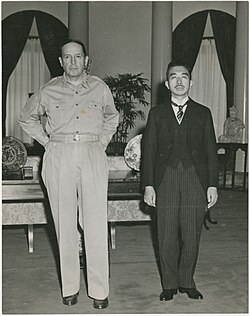
On September 27, 1945, a few weeks after V-J Day, Faillace took another famous photo of MacArthur, in uniform, but without his famous hat, sunglasses and pipe, standing next to Emperor Hirohito, in Western-style formal dress, to show the Japanese who was the bigger man: MacArthur was 6 feet even, while Hirohito was 5-foot-5.
MacArthur's lines, "I shall return" and "I have returned" would be homaged and parodied many times. Since the 1984 release of the Arnold Schwarzenegger film The Terminator, however, people no longer tend to say, "I shall return," instead using Arnold's line, "I'll be back."

Also on this day, in Europe, the Yugoslav capital of Belgrade is liberated from the Fascists by Yugoslav Partisans. The following year, a professional soccer team will be named for them: Football Klub Partizan Belgrade.

But it's not all a good day: A gas leak causes an explosion that destroys a square mile of the East Side of Cleveland, killing 131 people. I have a separate entry for that event.

*

October 20, 1944 was a Friday. Baseball season had ended 11 days earlier, with the St. Louis Cardinals defeating their landlords at Sportsman's Park, the St. Louis Browns. The NBA hadn't been founded yet. The NHL season wouldn't begin for another 8 days. And the NFL was in midweek. But there were 4 games in college football that night:

* In a rare college football version of the New York City vs. New England sports rivalry, Boston College beat New York University, 42-13 at Fenway Park. Until Alumni Stadium was built in 1957, BC played wherever they could get a playing date, and also played at Braves Field and Harvard Stadium, in addition to their on-campus Alumni Field, which Alumni Stadium would replace. NYU played its home games at Ohio Field in The Bronx, with games too big for that 12,000-seat facility moved across the Borough to Yankee Stadium.

* The University of Kentucky beat Virginia Military Institute, 26-9 at McLean Stadium in Lexington, Kentucky. Although VMI was (and is) a military school, this was not an example of a regular college football team struggling to find games due to the manpower drain of World War II, and settling for playing the college-age players on military bases. But there were many such games, in both World Wars, and these last 2 were among them:

* The team at the U.S. Army's Fort Pierce, in the town of the same name, north of Miami, beat the University of Miami, 38-0 at Burdine Stadium in Miami. In 1959, Burdine Stadium would be renamed for its biggest annual event: The Orange Bowl.

* And the University of Georgia beat Daniel Field, 57-6 at Sanford Stadium in Athens, Georgia. Daniel Field was a U.S. Army Air Forces base in Augusta, Georgia.

December 31, 1999 & January 1, 2000: The Millennium

December 31, 1999:  The Millennium arrives. The people of planet Earth survived. At a terrible cost. But we hadn't destroyed ourselves. ...