Showing posts with label adolph rupp. Show all posts

Wednesday, March 23, 2022

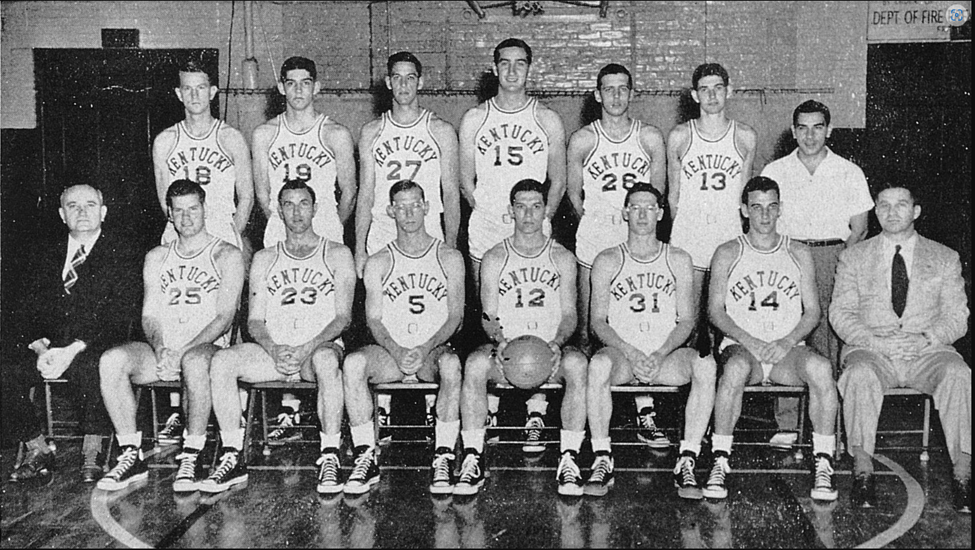
March 23, 1948: Kentucky's "Fabulous Five"

March 23, 1948: The University of Kentucky win the NCAA Basketball Tournament for the 1st time, defeating Baylor University, 58-42 at the old Madison Square Garden in New York.

Baylor had a player named Jackie Robinson -- a white man who would play with some of the Kentucky players on the 1948 U.S. Olympic Team in London, and became a minister. That's the most interesting thing about the Baylor squad.

But the Kentucky team was perhaps the best college basketball team ever assembled to this point. Their head coach, Adolph Rupp, called them "The Fabulous Five": Guards Ralph Beard and Kenny Rollins, forwards Wallace "Wah Wah" Jones and Cliff Barker, and center Alex Groza. They went 34-2, with the only losses being by 1 point to Temple in Philadelphia, a loss they avenged by 20 points in a rematch in Lexington; and 9 away to Notre Dame.

Rupp had been born in 1901 in Kansas, and had played at the University of Kansas under Forrest "Phog" Allen, while Allen's mentor, Dr. James Naismith, the literal inventor of basketball, was still alive and teaching there. After coaching in high school, Kentucky named him head coach in 1930, and he would lead them to 27 Southeastern Conference titles, 13 SEC Tournament wins, and 876 wins, more than any coach before him. He became known as "the Baron of the Bluegrass."

Rollins graduated in 1948, but the other four of the returned for the 1948-49 season. Dale Barnstable took Rollins' place in the starting lineup, and the Wildcats went 32-2, losing by 2 away to Saint Louis University, and by 11 against Loyola of Chicago, knocking UK out of the NIT at The Garden. But they won the NCAA, beating Oklahoma A&M (who became Oklahoma State in 1958) in the Final at Seattle.

After the 1949 NCAA Tournament, Coach Rupp then retired the uniform numbers of Beard, 12; Groza, 15; Barker, 23; Rollins, 26; and Jones, 27. Barnstable's 18 has never been retired.

It was these back-to-back National Championships that established Kentucky as an elite team. Fans of the "Bluegrass Boys" are sometimes mocked as the "Blue Bloods," and are said to be as arrogant as fans of the New York Yankees, the Dallas Cowboys, the Boston Celtics, the basketball team at Duke University, and the football team at the University of Notre Dame. (The Yankees, the Cowboys and Duke also wear blue and white; Notre Dame, blue but with gold.)

In 1948, Rollins was selected by the Fort Wayne Pistons in the NBA Draft, but they traded him to the Chicago Stags. In 1949, a new team in the NBA, the Indianapolis Olympians, tried to reassemble the U.S. Olympic Team. They selected Groza in the 1st round of the NBA Draft, Beard in the 2nd round. Barker was drafted by the Washington Capitols, but the Olympians acquired him in a trade. Barnstable was drafted by the Boston Celtics in 1950, but instead took a teaching and coaching job at a Louisville high school.

With Barker as player-coach, the Olympians won the NBA Western Division in 1950, and beat the Sheboygan Red Skins in the 1st round of the Playoffs, before losing the Division Finals to the Anderson Packers. In 1951, they just made the Playoffs, and lost to the Minneapolis Lakers in the 1st round.

But at the start of the 1951-52 season, Groza, Beard and Barnstable were arrested for taking bribes from gamblers to "shave points" while they were at Kentucky. When the dust settled in 1952, they were banned from the NBA for life. UK got its 1952-53 season canceled, and was banned from competing in the NCAA Tournament and the NIT in 1954.

Barker, Rollins and Jones were not implicated, and were allowed to play the 1951-52 season. But Barker and Jones left Olympians after that season, and never played professionally again. Rollins last played in 1953, with the Celtics. After that season, the Olympians folded, having lost to the Lakers again in the Playoffs in 1952 and '53.

Kentucky, still banned from the postseason at that point, went 25-0 in 1954, and the Helms Foundation declared them -- not NCAA Champion LaSalle or NIT Champion Holy Cross -- the National Champions.

Kentucky would win another title in 1958, with a bunch of players that Rupp said were "just fiddling around." Thus, they became known as the Fiddlin' Five. They made the Final again in 1966, with a team lacking much height, and thus known as "Rupp's Runts," but famously lost to the school now known as Texas-El Paso. This would lead to Rupp finally racially integrating his team.

After his retirement, Joe B. Hall, a reserve on the 1949 and 1951 title teams, led Kentucky to the National Championship in 1978, a few months after Rupp's death. Rick Pitino did so in 1996, Tubby Smith in 1998, and John Calipari in 2012. Baylor made what would later be called the Final Four again in 1950, but did not do so again until 2021, when they won the whole thing. By that point, they had become better known for their successful women's basketball program.

Groza, brother of Pro Football Hall-of-Famer Lou Groza, would later coach in college and in the ABA. Beard tried to play professional baseball, but his gambling connection got him banned from that sport as well. He became a scout for the ABA's Kentucky Colonels, and worked in the pharmaceutical industry. Barnstable wasn't playing in the pros anyway, but had gotten a job as a high school coach in Louisville, and was fired from that job as a result of the scandal. He later became a successful seller of air filters, and won senior golf tournaments. But none of the 3 were were ever involved in the NBA again, as their bans were never lifted.

Groza died in 1995, Barker in 1998, Beard in 2007, Rollins in 2012, Jones in 2014, Barnstable in 2019. None of them has ever been elected to the Basketball Hall of Fame. They were, however, all allowed to keep their Olympic Gold Medals.

*

March 23, 1948 was a Tuesday. Baseball was in Spring Training. Football was out of season. And the NHL was between the end of the regular season and the start of the Stanley Cup Playoffs.

There were 2 games in the NBA. The Chicago Stags beat the Washington Capitols, 74-70 at the Chicago Stadium. And the St. Louis Bombers beat the Philadelphia Warriors, 60-58 at the St. Louis Arena.

Saturday, March 19, 2022

March 19, 1966: Texas Western vs. Kentucky

March 19, 1966: The NCAA hosts the Final of its University Division Men's Basketball Tournament, at Cole Field House, on the campus of the University of Maryland, in College Park, outside Washington, D.C.

The University of Kentucky went into the game 27-1, having lost only to the University of Tennessee. Their players included Louie Dampier, who would team with later Kentucky star Dan Issel to lead the Kentucky Colonels to the 1975 ABA Championship; and Pat Riley, who would play for the Los Angeles Lakers' 1972 NBA Champions, and then coach the Lakers to 4 titles and the Miami Heat to 1.

The Wildcats were coached by Adolph Rupp, known as the Baron of the Bluegrass. He was 64 years old, looked older, and had been their head coach since 1930. He had already coached them to 22 Southeastern Conference (SEC) regular-season Championships, 13 SEC Tournament wins, 6 berths in what would now be known as the Final Four, and 4 National Championships: 1948, 1949, 1951 and 1958. That did not include the 1954 season, when they were undefeated, but chose not to play in the NCAA Tournament, because 2 players were declared ineligible for having already graduated -- a rule since overturned.

Rupp was from Kansas, and was not known to be personally racist. However, Kentucky was a Southern State, and, while the Wildcats' arch-rivals, the University of Louisville, had racially integrated, UK had not.

But the writing was on the wall. The Civil Rights Movement had made great gains. And a black man from Louisville, Muhammad Ali -- born Cassius Clay, and that Sports Illustrated cover shown above still listed him as such, 2 years after he changed his name -- was the Heavyweight Champion of the World.

Rupp had asked University President John W. Oswald to take the program out of the SEC, so that he could recruit black players. At one point during the 1965-66 season, Rupp did some writing of his own. He wrote the top 3 teams in the Associated Press poll on his blackboard at practice:

1. KENTUCKY
2. DUKE
3. VANDERBILT

Duke University is in Durham, North Carolina. Vanderbilt University is in Nashville, Tennessee. Rupp told his players, "Look at that. The top three teams in the country. All Southern. All white. You'll never see that again." He knew that Southern teams that integrated would be able to compete for national honors, and those that were slow to do so would get left in the dust. Not just in basketball, but in football, and in every other sport.

Previous Rupp teams had had nicknames: His 1948 National Champions were the "Fabulous Five." His 1958 team didn't look so good at first, and he complained to the press that they were "just fiddling around." So they were known as the "Fiddlin' Five," but won the title, anyway. His 1966 team was short, and were known as "Rupp's Runts."

At the time, the NCAA Tournament had 24 teams, with only conference champions and a few independents invited. Kentucky were SEC Champions, and got a bye into the round of 16, the Regional Semifinals, where they beat the University of Dayton. They beat Michigan to make the Final Four at Cole Field House. In the National Semifinal, they beat Number 2 Duke 83-79. They figured that was "the real final," because they underestimated their Final opponents.

That team was Texas Western University, based in El Paso, Texas, on the State Line with New Mexico and the national border with Ciudad Juarez, Mexico. Their head coach was Don Haskins, only 36, and despite Texas being a segregated State, he fielded an integrated team. They finished the regular season ranked Number 3, and also entered the Final at 27-1. Their only loss was 74-72 against Seattle University, then famous as the Alma Mater of Laker superstar Elgin Baylor, who led them to the NCAA Final in 1958, but downgraded to the NAIA in 1980, before being restored to NCAA Division I in 2008.

The Miners entered the NCAA Tournament with an all-black starting lineup: Guards Bobby Joe Hill from Detroit and Orsten Artis from Gary, Indiana, outside Chicago; forwards Dave Lattin from Houston and Harry Flournoy from Gary; and center Willie Cager from New York. Willie Worsley and Nevil Shed were also black players from New York.

In the 1st Round of the tournament, Texas Western beat Oklahoma City University. They needed overtime to beat the University of Cincinnati. They needed double overtime against the University of Kansas to make the Final Four. And they beat the University of Utah in the Semifinal.

The Final began at 10:00 PM Eastern Time, and was not broadcast on national television. While Loyola University of Chicago had won the 1963 NCAA Final with a majority-black starting lineup, four out of five, Texas Western was the first team that had dared to start an all-black starting lineup. Kentucky, of course, was all-white.
Cole Field House. It would host the Final Four again in 1970.

Haskins told Lattin to dunk the ball early if he got the chance, to "send a message" to Kentucky. He did, twice. Hill made steals on back-to-back Wildcat plays, putting the Miners up 16-11. They led at halftime, 34-31.

Curry Kirkpatrick covered the game for Sports Illustrated, and said it was "slow, tedious, almost flat." Disagreeing was Gary Williams, then a junior at the host school, the University of Maryland. He was impressed by the Miners' ball movement, recalling, "There were possessions where Texas Western passed it 10 times before taking a shot." He would be Maryland's captain the next season, and coach them to the National Championship in 2002.

Kentucky continually fouled Texas Western, with 2 players fouling out and 2 relegated to the bench after receiving 4 fouls each. Over a stretch of 37 minutes, the Miners went 26-for-27 on free throws. This made the difference: Had they made 2/3rds of their free throws, they would have lost. Instead, they made 96 percent of them. Final score, Texas Western 72, Kentucky 65.

Point totals: For Texas Western: Hill 20, Lattin 16, Artis 15, Worsley 8, Cager 8, Shed 3, Flournoy 2; for Kentucky: Dampier 19, Riley 19, Larry Conley 10, Thad Jaracz 7, Tom Kron 6, Cliff Berger 4; and Bob Tallent, Jim LeMaster and Gary Gamble played without scoring.
On March 13, 1967, just short of 1 full year later, Texas Western University changed its name to the University of Texas at El-Paso, a.k.a. "Texas-El Paso" or "UTEP," though keeping the team name of Miners.

The Miners were less successful in the pro game than the Wildcats. Bobby Joe Hill, Orsten Artis, Harry Flournoy and Willie Worsley went undrafted. Cager was drafted by the Baltimore Bullets, but a heart condition prevented him from playing. Nevil Shed was drafted by the Boston Celtics, but was injured in his 1st training camp, and never played a professional game.

Dave Lattin played the 1967-68 season with the San Francisco Warriors, 1968-69 as an original member of the Phoenix Suns, 1970-71 and 1971-72 with the ABA's Pittsburgh Condors, and 1972-73 with the ABA's Memphis Tams.

Indeed, despite the team's great achievement, the man who turned out to be the most famous athlete at the school at the time was Bob Beamon, who set a stunning world record in the long jump at the 1968 Olympics.

Rupp finally recruited a black player for the 1970-71 season, Tom Payne. But he became a disciplinary issue. He played 1 season in the NBA, 1971-72, for the Atlanta Hawks. Three times, he would be convicted and imprisoned for rape.

Rupp retired in 1972, having won 876 games, more than any college basketball coach before him. He died in 1977, a few months before his former assistant and successor, Joe B. Hall, took Kentucky to its 1st National Championship in 20 years.

Both head coaches now have their names on their respective schools' buildings: Rupp Arena at Central Bank Center opened in downtown Lexington, Kentucky in 1976; and the Special Events Center opened on the UTEP campus in 1977, renamed the Don Haskins Center in 1998.

Haskins never got past the NCAA Tournament's Sweet Sixteen again, but remained at UTEP through the 1999 season. He won 7 regular season titles and 4 Tournaments in the Western Athletic Conference. His career record was 719-353. He was elected to the Basketball Hall of Fame in 1997. In 2006, on the 40th Anniversary of the title, the entire team was elected to the Hall as a unit.

Among the other players Haskins coached at TWU/UTEP were Nolan Richardson, who coached the University of Arkansas to the 1994 National Championship; and Nate "Tiny" Archibald and Tim Hardaway Sr., who have joined Haskins, Richardson and the entire 1965-66 TWU Miners team in the Hall of Fame.

Hill died in 2002, Haskins in 2008, Flournoy in 2016. Artis in 2017. As of March 19, 2022, the rest are still alive, including Cager, despite his heart condition.

TWU/UTEP were the only team from Texas to win the NCAA Tournament until Baylor University did it in 2021.

UPDATE: Cager died on March 19, 2023, the 57th Anniversary of the epochal game. 

*

March 19, 1966 was a Saturday. Baseball was in Spring Training. Football was out of season. There were 4 games in the NBA that day:

* The New York Knicks lost to the Boston Celtics, 126-113 at the old Madison Square Garden.

* The Philadelphia 76ers beat the Cincinnati Royals, 127-121 at the Convention Hall of the Philadelphia Civic Center. Wilt Chamberlain had 39 points and 28 rebounds.

* The St. Louis Hawks beat the Detroit Pistons, 115-12 at the Kiel Auditorium in St. Louis.

* And the San Francisco Warriors beat the Los Angeles Lakers, 125-119 at the Cow Palace outside San Francisco in Daly City, California. Rick Barry had 43 points and 16 rebounds.

There were 2 games played in the NHL. The New York Rangers lost to the Montreal Canadiens, 6-2 at the Montreal Forum. And the Toronto Maple Leafs lost to the Chicago Black Hawks, 4-2 at Maple Leaf Gardens in Toronto. The Boston Bruins and the Detroit Red Wings were not scheduled.

Also, Arsenal lost 2-0 to Manchester United at Old Trafford. Times were good for United, bad for Arsenal. Arsenal would soon turn it around.

December 31, 1999 & January 1, 2000: The Millennium

December 31, 1999:  The Millennium arrives. The people of planet Earth survived. At a terrible cost. But we hadn't destroyed ourselves. ...