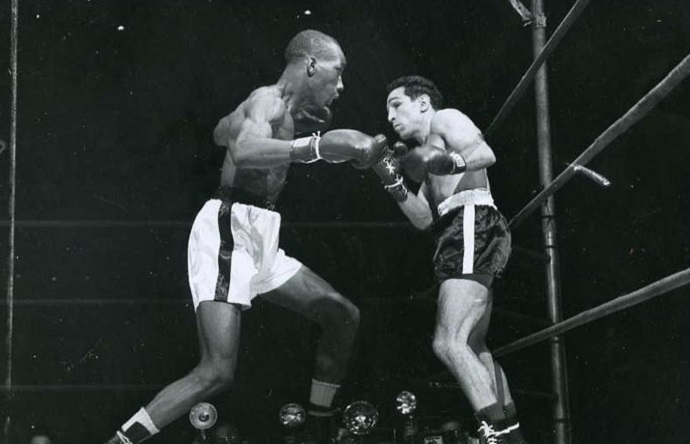
Sandy Saddler (left) and Willie Pep
September 26, 1951: For a matchup in boxing to be a true rivalry, there has to be at least one rematch. Some rivalries have the fighters face each other 3 times. On this night, Willie Pep and Sandy Saddler fight for the Featherweight Championship of the World for the 4th time.
Guglielmo Papaleo was born on September 19, 1922 in Middletown, Connecticut. At the age of 15, he was a shoeshine boy in nearby Hartford, and began boxing, anglicizing his name to William, and using the name Willie Pep. He won his 1st 62 professional fights, before losing in 1943 to Sammy Angott, who had 2 brief reigns as Lightweight Champion. That was a non-title bout: Getting title bouts sanctioned was difficult during World War II.
The 54th of those 62 fights was on November 20, 1942, at the old Madison Square Garden in New York, a unanimous decision over Albert "Chalky" Wright (who, in spite of his nickname, was black), recognized by the New York State Athletic Commission and The Ring magazine (a.k.a. "The Bible of Boxing") as the Featherweight Champion of the World. Pep won a rematch with Wright in 1944. In 1945, The Ring named him Fighter of the Year.
Pep fought Sal Bartolo 3 times, the last on June 7, 1946, at The Garden, a 12th round knockout, winning him the National Boxing Association's recognition, and making him the undisputed Featherweight Champion. Later in the year, he beat Wright for a 3rd time.
On October 12, 1948, he won a decision over Chuck Burton. Just 7 days later, he won another decision, over Johnny LaRusso. And just 10 days after that, he stepped into the Garden ring, with a career record of 134-1-1, to face his toughest opponent yet.
Joseph Saddler was also a New Englander, born on June 23, 1926 in Boston. His rise to the top proved more difficult, as his 1st 10 pro fights included 2 losses and a draw, before he won 38 in a row. In 1946, he lost to former Featherweight Champion Phil Terranova, then won 15 straight.
He was 86-6-2 before he got his title shot at Pep, and had fought 18 days before, so he hadn't had much more rest than Pep. But in a stunning result, Saddler knocked Pep out in the 4th round, taking the undisputed Featherweight Championship.
Pep was Italian, Saddler was black. The dynamic seemed ideal, not just for New England, but for most American cities of the time. And, since a boxing ring is much smaller than a baseball or football field, a hockey rink, or even a basketball court, it made the sport perfect for the burgeoning medium of television. The 1950s would be considered the golden age of boxing, and with great fights and controversial results nearly always meaning rematches -- or, to coin a phrase, "threematches" -- the personalities became every bit as well-known as the top baseball players.
So a 2nd Pep-Saddler fight was inevitable. They fought at The Garden again, on February 11, 1949. It was a much more even fight, going the distance, and Pep was judged the winner by a unanimous decision. Both fighters kept going before a 3rd fight was set up: Saddler fought 24 times in the interim, Pep 19. On September 8, 1950, they were set up against each other at Yankee Stadium. Saddler regained the title with an 8th round knockout.
A 4th fight between big fighters -- big in popularity, if not in physical size -- is unusual, but was not unheard of: Sugar Ray Robinson fought Jake LaMotta 6 times, winning 5, the last of these in 1951. On September 26 of that year, Pep and Saddler fought for a 4th time, at the Polo Grounds, then home to both the baseball and the football versions of the New York Giants. The baseball version had trailed the Brooklyn Dodgers, their intracity arch-rivals, by 13 1/2 games on August 11, but had come back, and were now only 1 game behind. (As you'll see, both teams were on the road on this night.)
Writing in The Ring, Nat Fleischer called Saddler-Pep IV "an extremely dirty fight," with "wrestling, heeling, eye gouging, tripping, thumbing -- in fact every dirty trick known to the old timers." He said that referee Ray Miller "let the bout get out of hand," and that "Pep wouldn't make a fight of it and Sandy couldn't."
Saddler opened a cut over Pep's right eye, and it proved very painful. He was leading on all cards after 8 rounds. But in the 9th round, he decided he couldn't continue, and the fight was stopped. Saddler had retained the title.
With an ending like that, a 5th fight must have seemed inevitable to fight fans. But it didn't happen. The rivals remained friends, and both kept fighting, eventually, after their official retirements, fighting exhibition matches against each other for charity.
Saddler was still Featherweight Champion on April 14, 1956, when he lost to Larry Boardman at the Boston Garden in a non-title fight. He decided to retire, and, unlike most big boxers, stayed retired. He became a trainer, and was one of George Foreman's trainers in his 1st run to the Heavyweight Championship. Saddler died on September 18, 2001. His nephew, Joseph Robert Saddler, is rap pioneer Grandmaster Flash.
Pep went on until 1966, at age 44, retiring with a record of 229-11-1. That's right: He had two hundred and forty-one professional fights. Not surprisingly, he had to retire from his job as a referee and an inspector due to dementia pugilistica -- now usually called chronic traumatic encephalopathy or CTE -- and died on November 23, 2006, at 84.
In 1984, sports historian Bert Randolph Sugar, who knew more about boxing than anyone outside of fighters and trainers, listed his 100 Greatest Boxers of All Time, listing Pep 3rd and Saddler 39th -- lower probably due to his shorter career.
In 1990, Pep and Saddler were both charter inductees into the International Boxing Hall of Fame. In 2002, The Ring named the 80 Best Fighters of the Last 80 Years, listing Pep 6th and Saddler 15th. In 2003, The Ring named the 100 Greatest Punchers of All Time, listing Saddler 5th, but not listing Pep at all. In 2007, ESPN named the 50 Greatest Boxers of All Time, listing Pep 5th and Saddler 29th.
*
September 26, 1951 was a Wednesday. There were 5 baseball games played that day:
* The New York Yankees lost to the Philadelphia Athletics, 4-1 at Yankee Stadium. Bobby Shantz was the winning pitcher, and Bob Kuzava couldn't get out of the 3rd inning. Joe DiMaggio, in his last 2 weeks as an active player, went 1-for-4. So did rookie Mickey Mantle.
* The New York Giants beat the Philadelphia Phillies, 10-1 at Shibe Park in Philadelphia. The Giants knocked Ken Johnson out of the box without getting an out. Monte Irvin hit a home run. Rookie Willie Mays went 1-for-4 with a walk.
* The Brooklyn Dodgers beat the Boston Braves, 15-5 at Braves Field in Boston. Don Newcombe went the distance for the win. In spite of collecting 14 hits, the Dodgers did not hit any home runs. Jackie Robinson went 1-for-4 with a walk, a stolen base, and 2 RBIs. Roy Campanella went 3-for-5 with 5 RBIs.
* The Washington Senators beat the Boston Red Sox, 7-3 at Griffith Stadium in Washington. Ted Williams went 1-for-4.
* And the St. Louis Browns beat the Detroit Tigers, 7-1 at Sportsman's Park in St. Louis.


