Showing posts with label route 66. Show all posts

Friday, December 30, 2022

December 30, 1940: Los Angeles' 1st Freeway Opens

December 30, 1940: The Arroyo Seco Parkway opens, along the seasonal river of the same name, running 8 miles northeast from downtown Los Angeles to Pasadena. It is the 1st of many freeways in the Los Angeles metropolitan area.

It became part of the historic U.S. Route 66, but is no longer designated as such. Rather, it is California Route 110. In 1954, it was renamed the Pasadena Freeway. In 2010, its original name was restored.

In the 1988 film Who Framed Roger Rabbit?, Judge Doom (played by Christopher Lloyd) lays out his plan for such a road: "Eight lanes of shimmering cement, running from here to Pasadena. Smooth, safe, fast. Traffic jams will be a thing of the past." (Yeah, surrre! He continued.) "I see a place where people get on and off the freeway, on and off, off and on, all day, all night! Soon, where Toontown once stood will be a string of gas stations, inexpensive motels, restaurants that serve rapidly prepared food, tire salons, automobile dealerships, and wonderful, wonderful billboards, reaching as far as the eye can see! My God, it'll be beautiful!"

In other words, he foresaw freeway exits, and the shopping centers that sprang up around them, serving as the new "downtown shopping districts" in what became suburban America after World War II. Except that the film took place in 1947, when said 8 lanes were already in place in real life. (But then, that entire film requires a major suspension of disbelief.)

Those 8 lanes would be the first of many, strangling Southern California in asphalt, and choking it in smog, because all those cars would be producing carbon dioxide, drifting east until the gas smacked into the San Gabriel Mountains, which would push it back, causing it, with nowhere else to go, to settle dangerously over what had become America's 3rd-largest city after World War II, and by 1970, the 2nd-largest.

Not until 1990 would Los Angeles open its 1st subway line.

*

December 30, 1940 was a Monday. TV sitcom writer, director and producer James Burrows was born.

Baseball and football were out of season. The NBA hadn't been founded yet. And no games were scheduled for the NHL. Therefore, there were no scores on this historic day.

Friday, November 11, 2022

November 11, 1933: The Beginning of the Dust Bowl

November 11, 1933: As if the Great Depression wasn't already bad, and hitting farm country harder than the cities, on came the Dust Bowl. For those of you who are sports fans: No, this was not a college football game.

On this day, a very strong dust storm stripped topsoil from desiccated South Dakota farmlands in one of a series of severe dust storms that year.

Such storms had been periodic since 1931, but this was when the Dust Bowl kicked into high gear. Beginning on May 9, 1934, a strong, two-day dust storm removed massive amounts of Great Plains topsoil. The dust clouds blew all the way to Chicago. Two days later, the same storm reached cities to the east, such as Cleveland, Buffalo, Boston, New York and Washington, Over the Winter of 1934-35, red snow fell on New England.

On April 14, 1935, known as "Black Sunday," 20 of the worst "black blizzards" occurred across the entire sweep of the Great Plains, from Canada south to Texas. The dust storms caused extensive damage and appeared to turn the day to night. Witnesses reported that they could not see 5 feet in front of them at certain points.

Denver-based Associated Press reporter Robert E. Geiger was in Boise City, Oklahoma that day. His story about Black Sunday marked the first appearance of the term "Dust Bowl," coined by Edward Stanley, Kansas City news editor of the AP.

Dust Bowl conditions fomented an exodus of the displaced from the Texas Panhandle, the adjoining Oklahoma Panhandle, and the surrounding Great Plains to adjacent regions. More than 500,000 Americans were left homeless. More than 350 houses had to be torn down after one storm alone. The severe drought and dust storms had left many homeless; others had their mortgages foreclosed by banks, or felt they had no choice but to abandon their farms in search of work.

Many Americans migrated west looking for work. Parents packed up "jalopies" with their families and a few personal belongings, and headed west in search of work. In particular, residents of Oklahoma and Arkansas -- "Okies" and "Arkies" -- headed west on U.S. Route 66, which became known as "The Mother Road," for California, "the land of milk and honey," hearing of jobs available picking fruits and vegetables. These jobs proved to be worse than farming, as they were no longer their own bosses, and the bosses were brutal until the labor unions came in.

The Plains States lost about 3.5 million people in the 1930s. More migrants arrived in California in 1936 than in any other year, including the Gold Rush year of 1849. Many of them brought their Southern mindsets with them, and were every bit as biased against the black and Hispanic people of California as they were against the black people of their home States. Ray Manzarek, keyboard player for rock band The Doors, said that, in the 1960s, a big chunk of the Los Angeles Police Department was the sons of Southerners who had come from the Dust Bowl, and they enjoyed practicing police brutality on minorities and hippies.

What did the federal government do about the Dust Bowl? President Franklin D. Roosevelt quickly set the New Deal to work on the problem. The Soil Conservation Service, forerunner of the Natural Resources Conservation Service, was founded. He also created the Civilian Conservation Corps (CCC), which created the Great Plains Shelterbelt: A line of 200 million trees from Canada to Abilene, Texas, to block the wind and cut the giant dust storms off.

In 1939, John Steinbeck published The Grapes of Wrath, about a family that escaped the Dust Bowl, only to find life in California just as hard as life in Oklahoma. The following year, it was made into a film. That same year, Woody Guthrie recorded one of the earliest "concept albums," Dust Bowl Ballads, making himself a legend of folksinging.

*

November 11, 1933 was a Saturday. Actor James Boyd, who played J. Arthur Crank and Paul the Gorilla on the 1970s PBS kids show The Electric Company, was born on this day.

Among the college football games played that day were these:

* Alabama beat Virginia Tech, 27-0 at Denny Stadium (now Bryant-Denny Stadium) in Tuscaloosa, Alabama. This was the 1st season of the Southeastern Conference, and Alabama won the title.

* Duke beat Maryland, 38-7 at Byrd Stadium in the Washington suburb of College Park, Maryland. Duke won the Championship of the Southern Conference, which, 20 years later, would sort-of evolve into the Atlanta Coast Conference.

* Michigan beat Iowa, 10-6 at Michigan Stadium in Ann Arbor. Michigan won the Big Ten Conference.

* Nebraska beat Kansas, 12-0 at Memorial Stadium in Lincoln, Nebraska. Nebraska won the Big Six Conference, the league that would become the Big Eight, and, later, the Big Twelve.

* Rice beat Arkansas, 7-6 at Rice Field in Houston. Nevertheless, Arkansas went on to win the title in the Southwest Conference.

* Purdue beat Notre Dame, 19-0 at Notre Dame Stadium in South Bend, Indiana.

* Among the service academies, Army beat Harvard, 27-0 at Harvard Stadium in Boston; and Navy lost to Columbia, 14-7 at Baker Field in Manhattan.

* In the other major game played in New York City that day, Fordham beat New York University (NYU), 20-12 at Yankee Stadium.

* And among New Jersey's teams, Princeton beat Dartmouth, 7-0 at Palmer Stadium in Princeton; and Rutgers beat Lafayette, 20-13 at Fisher Field in Easton, Pennsylvania.

* Stanford beat the University of Southern California (USC), 13-7 at the Los Angeles Memorial Coliseum. Stanford won the Pacific Coast Conference, the league that would become the AAWU, the Pac-8, the Pac-10 and the Pac-12.

Baseball was out of season. The NBA hadn't yet been founded. There were 3 games played in the NHL:

* The Montreal Maroons beat the Boston Bruins, 3-2 at the Montreal Forum.

* The Ottawa Senators beat the Montreal Canadiens, 2-0 at the Ottawa Auditorium.

* The Toronto Maple Leafs beat the New York Rangers, 4-3 at Maple Leaf Gardens in Toronto.

* And the New York Americans, the Detroit Red Wings and the Chicago Black Hawks were not scheduled.

And in English soccer, defending Champions Arsenal, of North London, beat Wolverhampton Wanderers, a.k.a. Wolves, 1-0 at Molineux Stadium in Wolverhampton, outside Birmingham.

Friday, October 7, 2022

October 7, 1960: "Spartacus" and "Route 66" Premiere

October 7, 1960: The film Spartacus premieres, a dramatization of the story of the Thracian gladiator who led a slave revolt in Rome in 71 BC. The film was based on the 1951 novel by Howard Fast, was directed by Stanley Kubrick, and was written by Dalton Trumbo, one of the Hollywood Ten. All were selected by the film's star, Kirk Douglas, who wanted to break the Hollywood Blacklist for once and for all. He did.
Among the film's other stars: Jean Simmons, Laurence Olivier, Charles Laughton, Peter Ustinov, Tony Curtis, Nina Foch, John Ireland, Herbert Lom, John Hoyt, and Woody Strode, who had previously broken a different barrier: He was 1 of the 4 black players who broke professional football's color barrier in 1946, before becoming an actor, working mainly in Westerns.
The film is best remembered for a scene near the end, where the Roman commander Crassus (Olivier), having surrounded Spartacus' army, offers a pardon (and return to enslavement) if the men will identify Spartacus, living or dead. But this would mean a return to slavery, and they would rather die. So every surviving man responds by shouting "I'm Spartacus!" (Most people trying to quote the movie get that wrong, saying, "I am Spartacus!")
History suggests that Spartacus died in battle, and no marriage or children have been ascribed to him. The film shows the character crucified, but living long enough for his wife to show him his infant son.
In modern times, Spartacus became an icon for the Communist movement. The most popular sports team in the Soviet Union was the soccer team run by Spartak Moscow, ironically because it turned the Spartacus ideal back on the Communist government, and became "the people's team." It remains the most popular sports team in the Russian Federation. Many other teams in former Soviet countries have the Spartak name.
*
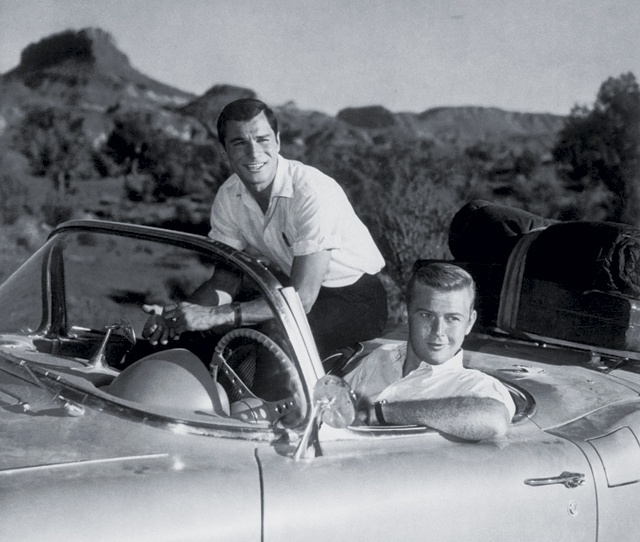
Also on this day, Route 66 premieres on CBS. It stars Martin Milner as Tod Stiles, and George Maharis as Buz Murdock, who travel around the country in a Chevrolet Corvette convertible, helping people wherever they can, because they were no longer needed or wanted where they were.
Maharis (left) and Milner
Tod grew up rich in Rye, Westchester County, New York, the son of a wealthy businessman. When his father died, he learned that his father's company was virtually bankrupt. The only thing his father had to leave him was the Corvette.
In contrast, Buz was a working-class orphan, who worked for the eldery Mr. Stiles in a New York shipyard. He talked Tod into going around the country together in the 'Vette.
U.S. Route 66 was commissioned in 1926. It started on Chicago's Loop, went down through Illinois, crossed the Mississippi River into St. Louis, went southwest across Missouri, briefly across the southeastern corner of Kansas, into Oklahoma through Tulsa to Oklahoma City. Then, it turned west, crossed the Texas Panhandle, and went through New Mexico, Arizona and California, including Los Angeles, before terminating at the Santa Monica Pier.
The federal government decommissioned the highway in 1985, as it had been mostly replaced by Interstate highways that bypassed some of the smaller towns along the route: I-55 in Illinois, I-44 from St. Louis to Oklahoma City, I-40 from there to Barstow, California, and I-15 and I-10 in California. Nevertheless, many of those small towns still call the remaining street "Route 66." For many of those towns, it served as their Main Street, and the road is still remembered as "America's Main Street."
But the show didn't exclusively stick to 66: Many of its adventures took place further east, even showing Tod and Buz working with lobstermen in Maine, and the series finale took place in Florida. 
Maharis came down with hepatitis, and decided to leave the show to focus on his health, saying, "Even if you have $4 million in the bank, you can't buy another liver." This soon proved to be incorrect, as liver transplants were becoming more common.
So, late in the show's 3rd season, with no explanation for what happened to Buz, Tod encountered Lincoln Case, played by Glenn Corbett. (Star Trek fans will recognize his name, as the first actor to play warp-drive inventor Zefram Cochrane.) "Linc" was a former U.S. Army Ranger and prisoner of war in Vietnam. This episode aired on March 22, 1963, so it was the 1st TV series featuring a character who was a Vietnam War veteran, and the earliest pop-culture representation of a Vietnam vet with post-traumatic stress disorder. After a difficult opening encounter, Tod invited Linc to join him on his travels.
Route 66 may have been the 1st regular TV series to have a planned series finale: On March 20, 1964, with the action in Tampa, far from the actual highway for which the show was named, Tod met Margo Tiffin, a commodities trader from Houston, played by Barbara Eden. They got married, and, since Linc was also from Texas, that's where Tod and Linc both ended up.
This show inspired many imitators, including The Fugitive and Run For Your Life in the 1960s, The Incredible Hulk in the 1970s, and Knight Rider and Hot Pursuit in the 1980s.
Despite having to leave the show due to illness, Maharis recovered. As of October 7, 2022, he is still alive, age 93. Milner died in 2015, Corbett in 1993. (UPDATE: Maharis died on May 24, 2023.)

In 1993, NBC tried a reboot, starring James Wilder as Nick Lewis, whose estranged father has recently died. It turns out, his father was Buz Murdock, who left him the Corvette, which suggests that Tod gave it to him at some point between 1964 and 1993. He then picks up Dan Cortese as hitchhiker Arthur Clark, and they start off on their own adventures together. But not many: Fans of the original series hated it, especially the suggestion that the orphaned Buz would gain and then abandon a family; and viewers not old enough to remember the original series didn't like it, either. Only 4 episodes aired.

*

October 7, 1960 was a Friday. So there was neither collegiate nor professional football played. The World Series was in a travel day. The NBA season hadn't started yet. And, while the NHL season had, 2 days earlier, no games were played on this day.

But there was one score, in the Canadian Football League: The Toronto Argonauts beat the Hamilton Tiger-Cats, 24-14 at Varsity Stadium in Toronto.

Tuesday, June 21, 2022

June 21, 1974: The Cadillac Ranch Opens

Photo taken shortly after installation, 1974

June 21, 1974: The Cadillac Ranch opens, off U.S. Route 66, 10 miles west of downtown Amarillo, Texas. It was created by Chip Lord, Hudson Marquez and Doug Michels. It consists of 10 Cadillacs, model years 1949 to 1963, buried nose-first in the ground. The cars are inclined at the same angle as the Pyramids of Giza.

The "Ranch" became one of the tourist attractions along Route 66, along with the various motels, stores, gas stations and restaurants that, with the rise of neon signs, began displaying artwork that reflected the Wild West and Native American themes of the Western States the road went through: Illinois, Missouri, a small corner of Kansas, Oklahoma, the Texas Panhandle, New Mexico, Arizona and California. The cars have been stricken with graffiti, painted in pop art style, and repainted several times.
Photo taken March 14, 2022.
The Dallas Tigers, painted on the 2nd car,
are a youth baseball team.

Most sections of Route 66 between California and Oklahoma were replaced by Interstate 40. The "ranch" was moved 2 miles in 1997, but is still accessible from I-40.

Bruce Springsteen had a song titled "Cadillac Ranch" on his 1980 album The River, using the ranch, and Cadillacs themselves, as emblems of death, since Cadillacs have often been converted into hearses. In 1985, James Brown included the "Ranch" in the video for his song "Living in America."

*

June 21, 1974 was a Friday. These Major League Baseball games were played:

* The New York Yankees lost to the Detroit Tigers, 3-2 at Shea Stadium, where the Yankees groundshared with the Mets while the original Yankee Stadium was renovated. Mickey Lolich outpitched Cecil Upshaw. Al Kaline, in his final season, went 2-for-4. Bill Sudakis hit a home run for the Yankees.

* The New York Mets beat the Philadelphia Phillies, 3-1 at Veterans Stadium in Philadelphia. Tom Seaver outpitched Steve Carlton, although these 2 "strikeout artists" only had 7 strikeouts between them. The Mets' runs came on 2 home runs by John Milner, and 1 by Rusty Staub. Mike Schmidt went 1-for-4.

* The Atlanta Braves beat the Cincinnati Reds, 1-0 at Riverfront Stadium in Cincinnati. Carl Morton allowed 9 hits and 3 walks, and Tom House had to get the last out, but they completed a shutout, to outpitch Jack Billingham, who allowed just 5 hits and 3 walks. Hank Aaron went 1-for-3. Pete Rose went 2-for-5, Johnny Bench went 0-for-5, and César Gerónimo went 4-for-4.

* The Milwaukee Brewers beat the Baltimore Orioles, 8-6 at Milwaukee County Stadium. Rookie Robin Yount went 0-for-3 with a walk. Brooks Robinson went 1-for-4 with an RBI.

* The Chicago Cubs beat the Pittsburgh Pirates, 3-2 at Wrigley Field in Chicago. Willie Stargell hit a home run.

* The Chicago White Sox beat the Minnesota Twins, 11-7 at Metropolitan Stadium in the Minneapolis suburb of Bloomington, Minnesota. Ken Henderson went 3-for-4 with 2 home runs and 6 RBIs. For the Twins, Tony Oliva hit a home run, and Harmon Killebrew hit a pinch-hit RBI single, but Rod Carew, uncharacteristically, went 0-for-5.

* The St. Louis Cardinals beat the Montreal Expos, 5-1 at Busch Memorial Stadium in St. Louis. Lou Brock went 2-for-3 with a walk and an RBI. This was the season he set a major league record (and a National League record that still stands) with 118 stolen bases, but he was caught in his only attempt in this game.

* The Texas Rangers swept a doubleheader from the California Angels, 12-3 and 6-2 at Arlington Stadium in the Dallas suburb of Arlington, Texas.

* The Houston Astros beat the San Diego Padres, 2-0 at the Astrodome in Houston. Larry Dierker took a 4-hit shutout into the 9th, but Fred Scherman had to get the last 2 outs for him.

* The Los Angeles Dodgers beat their arch-rivals, the San Francisco Giants, 4-3 at Dodger Stadium in Los Angeles. Bill Buckner led off the bottom of the 10th inning with a home run.

* The Oakland Athletics beat the Kansas City Royals, 5-4 at the Oakland Coliseum. Reggie Jackson went 1-for-2 with a walk. Rookie George Brett went 3-for-4 with an RBI.

* And the Boston Red Sox and the Cleveland Indians were rained out at Fenway Park in Boston. The game was made up as part of a doubleheader the next day. The Tribe won the opener, 11-0. Gaylord Perry pitched a 4-hit shutout, will Bill Lee didn't get out of the 4th inning. Future Red Sock Frank Duffy went 4-for-5 with a home run and 5 RBIs.

The BoSox won the nightcap, 8-3. The ironically-named Reggie Cleveland, who pitched 13 seasons in the major leagues without ever throwing a pitch for the Indians, outpitched Gaylor's brother, Jim Perry, who didn't get out of the 3rd inning. This time, Duffy went 0-for-4. Over the 2 games, Carl Yastrzemski went 3-for-6 with 2 walks.

December 31, 1999 & January 1, 2000: The Millennium

December 31, 1999:  The Millennium arrives. The people of planet Earth survived. At a terrible cost. But we hadn't destroyed ourselves. ...