Showing posts with label joe mccarthy. Show all posts

Tuesday, October 4, 2022

October 4, 1948: The Gene Bearden Game


Gene Bearden

October 4, 1948: A Playoff for the American League Pennant is played at Fenway Park in Boston. The Boston Red Sox and the Cleveland Indians had both finished 1 game ahead of the New York Yankees in the AL race.

The Red Sox were managed by Joe McCarthy. Although he'd never played in the major leagues, he had led the Chicago Cubs to the 1929 National League Pennant. Fired after not repeating in 1930, the Yankees immediately hired him. He won the 1932 World Series, then missed 3 straight years, then won the American League Pennant in 7 of the next 8: 1936, '37, '38, '39, '41, '42 and '43, winning the World Series on each of those occasions but '42. Those 7 World Series wins remain a record, matched by Casey Stengel, but never surpassed.

He left the Yankees in the middle of the 1946 season, because he did not like the new owners, Dan Topping, Del Webb and Larry MacPhail. When Joe Cronin retired as Red Sox manager, team owner Tom Yawkey hired McCarthy, who seemed to still be the best manager in baseball.

The Indians were managed by Lou Boudreau. A former pro basketball player (in the Midwest-based National Basketball League, before there was an NBA), he had been their regular shortstop since 1940. After the 1941 season, they needed a new manager. Having been Captain of the basketball team at Bradley University in Peoria, Illinois, he suggested himself.

But he was only 24 years old. Aside from Roger Peckinpaugh, who had been interim manager for the last 15 games of the 1914 Yankees' season at age 23, he would, by far, be the youngest manager in baseball history. (Ironically, he would be replacing Peckinpaugh, now 50, in Cleveland.)

He was named manager by team owner Alva Bradley. It didn't matter much during World War II. But when the veterans came back in 1946, one of them was Bill Veeck, who bought the team from Bradley. Veeck had been an executive with the Chicago Cubs, and had built the minor-league version of the Milwaukee Brewers into a Pennant winner. He believed Boudreau was the best shortstop in baseball, but didn't care for him as a manager. Boudreau fought to keep his job, and won. At 31, he had gotten the Indians closer to a Pennant than they'd ever been, except for their 1920 World Series win.

McCarthy picked Denny Galehouse as his starting pitcher. It's true that he was 36 years old, and left the game with an 8-8 record, an ERA of an even 4.00, and a WHIP of 1.445, and only pitched 2 more games in the major leagues.

But his ERA+ for the 1948 season was 110. For those of you unfamiliar with the stat, ERA-plus is earned run average in relation to the rest of the league. Meaning that an ERA+ of 100 means that a pitcher is exactly at the league average when it comes to preventing earned runs. An ERA+ of 110 meant that Galehouse was 10 percent better at preventing earned runs than the average American League pitcher in 1948, even after the game in question.
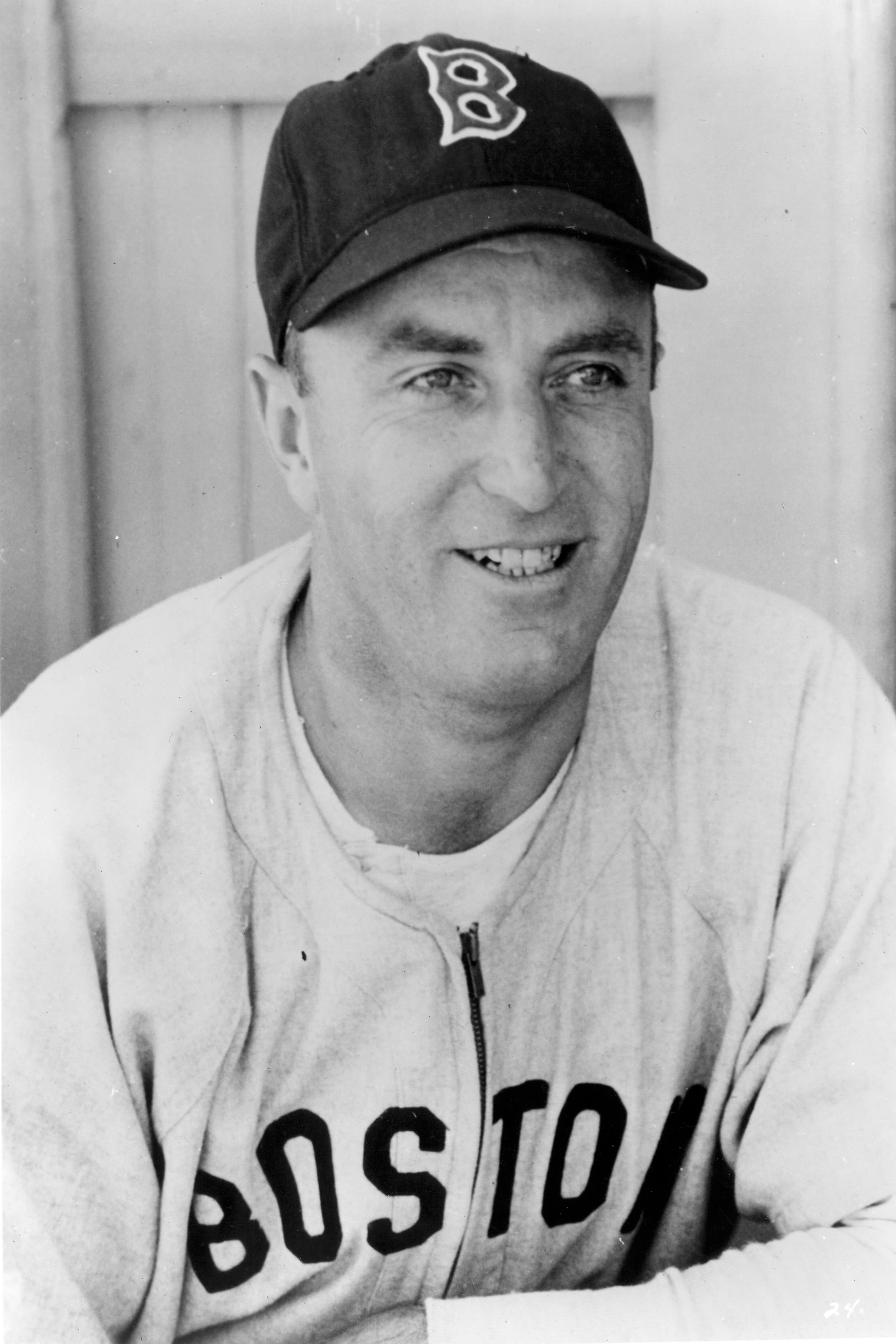
Denny Galehouse

In other words, Galehouse was not a bad pitcher. He was 109-118 lifetime, but most of that was for weak Indians and St. Louis Browns teams. And while he was only 9-10 for the Browns in 1944, his ERA of 3.12, and his ERA+ of 117, helped them win the Pennant that year, the only one they ever won.

Furthermore, Galehouse had pitched for the Indians, so he knew the tendencies of some of their players. Sometimes, a mental edge can make all the difference.

This time, it didn't. He got the 1st 2 outs in the top of the 1st inning. But Boudreau was the next hitter, and he hit a home run. 1-0 Cleveland.

Boudreau picked Gene Bearden as his starting pitcher. If anything, Boudreau gambled more than McCarthy did. Yes, Bearden was already 19-7 that season, and, at age 28, was in his prime. But he was a rookie, having faced just 4 batters in the major leagues prior to May 8 of that season. And he was a lefthander, pitching in Fenway. And he was a knuckleballer, adding the threat of passed balls, even for a very good-fielding catcher like Jim Hegan.

And, arm-easier knuckler or no, he was pitching on just 1 day's rest, having pitched a complete game victory just 2 days earlier. In fact, from September 6 to October 4, less than 1 full month, he pitched 71 innings. This included, counting the Playoff, 4 complete games in 10 days. Even by the standards of the Fighting Forties, that was insane.

He allowed a tying run. The score remained 1-1 through the end of the 3rd inning. In the top of the 4th, Boudreau and former Yankee 2nd baseman Joe Gordon singled, and 3rd baseman Ken Keltner hit a home run, making the score 4-1, and chasing Galehouse. McCarthy brought in Ellis Kinder, who allowed another run. Boudreau hit another homer in the 5th, to make it 6-1.

The Red Sox closed to within 6-3 on a 6th-inning home run by Bobby Doerr, but a dropped fly ball by the great Ted Williams in left field led to an 8-3 Indians lead. That was the final score, as Bearden went the distance.

The Boston Braves, playing just 1 mile to the west at Braves Field, had won the National League Pennant. This was the closest baseball ever got to an All-Boston World Series. Instead, the Indians stayed in Boston to play Games 1 and 2 of the World Series, and came back to clinch at Braves Field in Game 6.

Despite Pennants in 1954, 1995, 1997 and 2016, the Indians have never won another World Series. Their drought of 74 years is not only the current longest in Major League Baseball, it is now longer than the Red Sox' drought was when they blew the Series in 1986, and longer than the Cubs' drought was when they blew the National League Championship Series in 1984.

Which makes the Indians' heroes of 1948 all the larger: Bearden, Gordon, Keltner, and Hall-of-Famers Boudreau, Bob Feller, Larry Doby and Satchel Paige, the latter 2 having starred in the Negro Leagues.

Earlier in the year, on August 12, the Indians got hits from 14 different players, a record that still stands, as they beat the St. Louis Browns, 26-3 at Sportsman’s Park in St. Louis.

Hits: Gene Bearden (the starting pitcher!) and Hal Peck, 4; Lou Boudreau, Joe Gordon, Dale Mitchell and Jim Hegan, 3; Eddie Robinson, 2; Larry Doby, Wally Judnich, Thurman Tucker, Ken Keltner, Allie Clark, Joe Tipton and Bob Kennedy, 1. This included home runs by Bearden, Doby, Hegan and Judnich. RBIs: Bearden and Boudreau, 4; Peck, 3; Doby, Mitchell, Robinson and Keltner, 2; Gordon, Hegan, Judnich, Clark and Tipton, 1. Bob Feller closed the game out, but did not come to bat. 

The Red Sox recovered from their Playoff defeat, and took the Yankees down to the wire in 1949. Again, McCarthy made a fateful pitching change: With the last game of the regular season deciding the Pennant, the Yankees led 1-0 in the bottom of the 8th, and McCarthy took Kinder out for a pinch-hitter. It didn't work, and the bullpen was awful, and the Yankees won the game 5-3. Ever since, he has been ripped for both decisions: Starting Galehouse in '48, and relieving Kinder in '49.

He managed the 1950 season, fell short, and retired. Ironically, his successor as Red Sox manager was Lou Boudreau: Veeck had sold the Indians after the 1949 season, and new owner Ellis Ryan had fired Boudreau. 

The way Red Sox fans talked about McCarthy, you'd never know he had won 9 Pennants. Until his death in 1978, they never forgave him. Did they give him a bum rap? Maybe: After all, as I said, Galehouse was a decent pitcher, and Bearden was a big gamble for Boudreau.

In addition, Fenway Park's left-field wall, recently nicknamed The Green Monster, was listed as being 315 feet from home plate. Most people thought it was closer. It was eventually relabeled 310. Then as now, it was a tempting target for righthanded hitters. 

And Mel Parnell, usually cited as the best other option for Boston in this game, was a lefthanded pitcher. Add the fact that he would have been pitching on 3 days' rest, and he wasn't that much better a choice to start the Playoff than Denny Galehouse.

What were McCarthy's other options? The day before, Joe Dobson had pitched 4 innings, Earl Johnson 2, and Dave "Boo" Ferriss 3. They would have been too tired to pitch. The day before, Jack Kramer, Galehouse's '44 Browns teammate (and no relation to the tennis star of the same name, who was then at the peak of his game), had gone the distance, so he wasn't ready for this game.

The day before that was a day off. The day before that, Parnell had gone into the 7th inning, and, as I said, would have been on 3 days' rest. The day before that, Kinder had pitched a complete-game victory, had won his last 5 decisions, and hadn't been the losing pitcher since August 4 -- 2 months.

Except McCarthy did bring Kinder into this game, to pitch in relief of Galehouse, allowing 4 runs, 3 of them earned, on 4 hits and 2 walks. Stretch that over 9 innings, and it becomes 6 runs, 6 hits and 3 walks. He was not appreciably more effective than Galehouse. Would he have been, had he started the game? We can't know for sure. What we do know is that, counting only the runs scored while he was the Sox pitcher, it was Indians 4, Red Sox 2. That's closer than Indians 8, Red Sox 3, but it's still a loss.

Bearden then pitched in 2 games of the World Series, throwing 10 2/3rds innings without allowing a run. He was never so effective again, going just 25-31 in a career that ended only 5 seasons later. But he came through for his manager on this day.
Lou Boudreau

Not only did Boudreau's roll of the dice come up seven, but he was the game's hitting star, too. He went 4-for-4, hitting a solo home run off Galehouse in the 1st inning, and another off Kinder in the 5th. He also fielded 8 chances without an error: 3 putouts, 5 assists. He was named the AL's Most Valuable Player for the season.

At 31, the former "boy manager" had led his team to a Pennant. He remains the last player-manager to do so. And, in so doing, he outmanaged Joe McCarthy, the man then considered the best manager in baseball. Boudreau ended up in the Hall of Fame, although that was more for his playing than his managing.

Boudreau managed the Red Sox from 1952 to 1954, the Kansas City Athletics from 1955 to 1957, and the Chicago Cubs for most of 1960. He had broadcast for the Cubs in 1958 and '59, and did so again from 1961 to 1987. He died in 2001. His daughter Sharyn married Detroit Tigers pitcher Denny McLain.

Bearden returned to his native Arkansas, managed a radio station, owned a restaurant and an auto dealership, and coached youth baseball. He died in 2004, at 83. Eddie Robinson, who pinch-hit, and then took over at 1st base, for Allie Clark, turned out to be the last survivor of this game, living until 2021, 100 years old.

*

October 4, 1948 was a Monday. There were no other baseball games that day. It was too early for the NBA and NHL seasons. Football was underway, but there would be no Monday Night Football until 1970. So there were no other scores on this historic day.

Sunday, October 2, 2022

October 2, 1949: Both Leagues' Pennants Decided On the Final Day

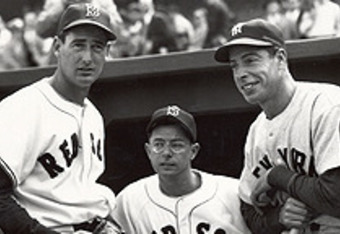
Left to right: Ted Williams, Dom DiMaggio, Joe DiMaggio.

October 2, 1949: Yankee Stadium, Bronx, New York. Regular-season finale. Winner takes the American League Pennant.

On the last day of the 1948 regular season, the Boston Red Sox beat the New York Yankees at Fenway Park in Boston, clinching at least a tie for the AL Pennant, and knocking the Yanks out of a chance for it. Ted Williams went 2-for-4 with 2 RBI doubles. Sox center fielder Dom DiMaggio went 3-for-4, including a solo home run. His brother, Yankee center fielder Joe DiMaggio, went went 4-for-5 with 2 doubles and 3 RBIs -- meaning that, between them, the DiMaggios go 7-for-9 with 3 extra-base hits and 4 RBIs. And brother Vince, who also reached the majors, wasn't even in this game! Although he was there, as were their parents.

The next day, also at Fenway, the Sox lost a playoff for the Pennant to the Cleveland Indians, 8-3, as Tribe shortstop-and-manager Lou Boudreau hit 2 home runs. They went on to beat the Boston Braves in the World Series.

In the off-season, the Yankees Bucky Harris, who had managed them to the 1947 World Series, and hired Casey Stengel, who had just won the Pacific Coast League Pennant with the Oakland Oaks, but had failed as manager of the Brooklyn Dodgers and the Boston Braves. The Sox were managed by Joe McCarthy, who had managed the Yankees from 1931 to 1946, winning 8 Pennants and 7 World Series.

Joe DiMaggio, the best player in baseball since he arrived in the major leagues in 1936, missed the 1st 2 months of the season with a heel spur. In late June, the pain vanished. In a 3-game series at Fenway on June 28, 29 and 30, he went 5-for-9, with 4 home runs and 9 RBIs. The Yankees swept, winning 5-4, 9-7 and 6-3. During the 3rd game, a fan flew a plane over Fenway, trailing a banner reading "THE GREAT DIMAGGIO." The joke was that it had to be for Joe, since Dom was only a very good DiMaggio.

The Yankees jumped out to a 12-game lead, but blew it, mainly due to injuries that kept several players out of the lineup for long stretches. They trailed the Sox by 1 game with 2 to play -- and these 2 were against the Sox at The Stadium.

For the 1st time, the Pennant would come down to the Yankees and the Red Sox. Yes, there was 1904, but that was between the New York Highlanders and the Boston Americans. Not only had the teams not yet adopted their familiar names, but the rivalry tailed off, sparked again by the Red Sox' sale of Babe Ruth and practically their entire starting rotation to the Yankees in the early 1920s.

On October 1, the Yanks held Joe DiMaggio Day, since his brother Dom played for the Sox, and thus the whole family could attend. Joe had been ill with pneumonia, but had kept playing, and says, "I'd like to thank the Good Lord for making me a Yankee." (I guess he didn't have an agent back in 1934.) In the game that followed, the Sox, acting like more recent Red Sox teams, blew a 4-0 lead, Johnny Lindell hit an 8th-inning homer, and the race was tied. Yankees 5, Red Sox 4.

In fact, in the 1901 to 1968 era of 2 single-division leagues, 1949 was the only season in which both leagues' races were unresolved as the final day of the regular season dawned. On the last day of the season, the Brooklyn Dodgers needed a win or a St. Louis Cardinals loss to win the National League Pennant. If they'd gotten neither, there would have been a Playoff.

The Dodgers needed 10 innings, but they got their win, 9-7 over the Philadelphia Phillies at Shibe Park (later renamed Connie Mack Stadium) in Philadelphia. Pee Wee Reese led off the inning with a single. Eddie Miksis sacrificed him to 2nd base. Duke Snider singled him home. Jackie Robinson was intentionally walked to set up the inning-ending double play. But Luis Olmo, one of the earliest Puerto Rican players in the major leagues -- and considered "white" enough to make it before Robinson desegregated the game -- singled Snider home. Jack Banta held the Phils off in the bottom of the 10th, and got the win in relief of Don Newcombe.
1949 Dodger photos. Top row, left to right: Ralph Branca,
Jackie Robinson, Gil Hodges, Roy Campanella.
Bottom row, left to right: Pee Wee Reese,
Duke Snider, a 2nd photo of Hodges, Don Newcombe.

October 2, 1949, Yankee Stadium. This was for the Pennant. A crowd of 68,055 was on hand. Phil Rizzuto led off the bottom of the 1st inning with a triple to left field. Tommy Henrich grounded to 2nd, and "The Scooter" scored. It was 1-0 Yankees.

The Yanks still led 1-0 with 1 out in the top of the 8th, when McCarthy sent Tom Wright up to pinch-hit for his starting pitcher, Ellis Kinder. Big mistake. Wright drew a walk, but Dom DiMaggio grounded into a double play.

Henrich led off the bottom of the 8th with a home run off Mel Parnell, ordinarily the Boston ace. McCarthy removed him, and brought in Tex Hughson, the ace of the Sox' 1946 American League Pennant winners. Yogi Berra, who came into his own this season as both a hitter and a catcher, singled to left. Joe DiMaggio grounded into a double play. But Lindell singled to center, with Hank Bauer pinch-running for him. Billy Johnson singled to left. Hughson, unintentionally, walked Cliff Mapes to load the bases. Jerry Coleman sent a drive down the right field line, clearing the bases, although he was out trying to stretch it from a double to a triple. It was 5-0 Yankees.

Yankee starter Vic Raschi had allowed only 2 hits over the 1st 8 innings, and got the 1st out in the 9th. Then he faltered: He walked Williams, threw a wild pitch, and allowed a single to Vern Stephens. Bobby Doerr lifted a drive to center field. Joe DiMaggio, still sick, dropped an easy fly ball, scoring both runners. Normally so good out there, Joe walked off the field, taking himself out of the game for the good of the team. Stengel moved Bauer from left field to right, moved Mapes from right to center, and put Gene Woodling in left.

Raschi got Al Zarilla to fly to center, where the newly-installed Mapes caught it. But Billy Goodman singled to center, scoring Doerr. It was now 5-3, the tying runs were on, and the run that could win the Pennant was at the plate, in the person of Sox catcher George "Birdie" Tebbetts.

Berra went out to talk to Raschi. "The Springfield Rifle" angrily said, "Gimme the goddamned ball, and get the hell out of here!" Yogi did as he was told, and Raschi got the final out, as Tebbetts popped up to 1st base, where Henrich, normally a right fielder, caught it. Final score: Yankees 5, Red Sox 3. The Yankees had won their 16th American League Pennant.

The Yanks beat the Dodgers in the World Series. In the last 2 seasons, the Sox had won 192 games, and didn't even win a Pennant.

"I won one," a jubilant Stengel said in the locker room. Later, in his weird way of talking that became known as "Stengelese," he said, "I couldn't a-done it without my players."

The following season, the Yankees won it again; while the Dodgers and Phillies again needed 10 innings to settle the race, this time against each other, with no scoreboard-watching. Dick Sisler hit a home run to win it.

UPDATE: The Red Sox have a team Hall of Fame. From their 1948 and 1949 near-misses, they have inductedleft fielder Ted Williams, center fielder Dom DiMaggio, 2nd baseman Bobby Doerr, shortstops Johnny Pesky and Vern Stephens, infielder Billy Goodman; pitchers Tex Hughson, Joe Dobson, Boo Ferris, Mel Parnell and Ellis Kinder; team owner Tom Yawkey, general manager Joe Cronin, scout George Digby, executive Edward F. Kenney, and longtime vendor Arthur D'Angelo.

But from between the 1949 near-miss and the 1967 Pennant, only broadcaster Curt Gowdy, 1st baseman Pete Runnels, 3rd baseman Frank Malzone, center fielder Jimmy Piersall, right fielder Jackie Jensen, and pitchers Frank Sullivan, Bill Monbouquette and Dick Radatz. That should show you how bad the Sox were in the 1950s and most of the 1960s.

*

October 2, 1949 was a Sunday. These other baseball games were played that day:

* The 3rd team in New York -- and, since the Dodgers' 1941 Pennant, they were unquestionably 3rd -- the New York Giants, lost to the Boston Braves, 2-1 at Braves Field in Boston.

* The St. Louis Cardinals beat the Chicago Cubs, 13-5 at Wrigley Field in Chicago. Stan Musial went 3-for-5 with 2 home runs, a walk and 4 RBIs. Once again, Stan was "The Man." But the Dodgers also won, so there would be no Playoff for the Pennant between the teams, as there was in 1946, and there would be between the Dodgers and the Giants in 1951.

* The Washington Senators beat the Philadelphia Athletics, 3-0 at Griffith Stadium in Washington. Dick Weik allowed just 1 hit over the 1st 4 innings, then was replaced by Lloyd Hittle. No indication is given as to why. Hittle allowed only 1 hit over the last 5 innings.

* A doubleheader was split at Forbes Field in Pittsburgh. The Pittsburgh Pirates won the opener, 4-2. The Cincinnati Reds won the nightcap, 6-5.

* The Cleveland Indians beat the Detroit Tigers, 8-4 at Briggs Stadium (later Tiger Stadium) in Detroit. The Tigers scored 4 runs in the 6th to take the lead away from Bob Feller, but the Indians scored 4 in the 8th, to make Feller the winning pitcher.

This would be Bill Veeck's last game as Indians owner. Although he had made the acquisitions necessary to win them the 1948 World Series, he went broke, and had to sell them. Before the last home game of this season, he had a "funeral" for the team's 1948 Pennant, burying it in center field. (Presumably, it was eventually dug up and salvaged.) He would recover, buy and sell the St. Louis Browns, and then later buy and sell the Chicago White Sox -- twice.

* And a doubleheader was split at Sportsman's Park in St. Louis. The White Sox won the 1st game, 4-3. The Browns won the 2nd game, 5-3.

Since it was Sunday, there was NFL action, but only 2 games were played. The Chicago Bears beat the Chicago Cardinals, 17-7 at Comiskey Park in Chicago. And the Los Angeles Rams beat the Green Bay Packers, 48-7 at City Stadium in Green Bay, Wisconsin.

Although Monday Night Football didn't arrive until 1970, there were 2 games the next day, October 3. With Briggs Stadium available, the Detroit Lions lost to the Philadelphia Eagles, 22-14. And with Forbes Field available, the Pittsburgh Steelers lost to the Washington Redskins, 27-14.

The preceding Friday, September 30, at the Polo Grounds, the football version of the New York Giants beat the New York Bulldogs, 38-14. The Bulldogs had been the Boston Yanks (yes, there was actually a team with that name) from 1944 to 1948, playing at Fenway Park, of all places. In 1950, they moved to Yankee Stadium, and used the name "New York Yanks" that year and in 1951. In 1952, they became the original Dallas Texans. In 1953, they became the 2nd, and most familiar version, of the Baltimore Colts.

This was the 4th and final season of the All-America Football Conference. On October 2, the Cleveland Browns, the only Champions the AAFC would ever know, beat the Los Angeles Dons, 42-7 at Cleveland Municipal Stadium; and the original version of the Colts beat the original version of the Buffalo Bills, 35-28 at Civic Stadium (later renamed War Memorial Stadium) in Buffalo.

The preceding Friday, the San Francisco 49ers beat the Chicago Hornets, 42-24 at Soldier Field in Chicago. One AAFC team had the week off, and it was named the New York Yankees. After the season, the Browns, the 49ers and the Colts were admitted to the NFL, but the original Colts flopped and folded, allowing for the newer version in 1953.

Thursday, June 9, 2022

June 9, 1954: The Fall of Senator Joe McCarthy

Senator Joseph R. McCarthy (left) and Roy Cohn

June 9, 1954: Senator Joseph McCarthy, Republican of Wisconsin, goes too far, and the country sees it, and sees him for what he really is: A liar and a bully.

McCarthy was a Marine tail-gunner in World War II, although stories of his heroism appear to have been exaggerated, including by himself. In 1946, he was elected to the U.S. Senate, and the 1st 3 years of his term (1947, 1948 and 1949) were unremarkable.

But at a "Lincoln Day" speech in Wheeling, West Virginia early in 1950, he held up a piece of paper he claimed was a list of employees of the U.S. Department of State who were active members of the Communist Party. He would repeat this charge many times, but the number would change: Sometimes, it was 205; others, it would be 57; sometimes, another number.

It made McCarthy a national celebrity, at a time when most U.S. Senators were not well-known outside their respective home States. This was before 24-hour news networks, before C-SPAN, before social media.

Conservatives jumped to his support. Liberals said he was wrong, even lying. Washington Post cartoonist Herbert Block, who signed his cartoons "Herblock," created the term "McCarthyism," in his "tower of tarbuckets" drawing. It shows a Republican elephant, pushed and pulled on by Guy Gabrielson, then Chairman of the Republican National Committee, and a former Speaker of the New Jersey Assembly; and Senators Kenneth Wherry of Nebraska, the Minority Leader; Robert Taft of Ohio, the man so conservative he was known as "Mr. Republican," and later to be Majority Leader; and Styles Bridges of New Hampshire.
(By the time McCarthy fell, it was over for 3 of the 4: Wherry died of surgical complications in 1951; Gabrielson stepped down as Chairman after the 1952 Republican Convention, and lived until 1976; and Taft died of cancer in 1953. Styles remained in the Senate until his death in 1961.)

But that was in The Washington Post, a liberal newspaper in those days. Most of the media of the time, dominated by newspapers, was overwhelmingly conservative, pro-business and anti-Communist. McCarthy was exactly what they were looking for, and they promoted him and his efforts. The new "Red Scare," following the earlier one of 1919 and 1920, was on.

The Republicans made big gains in both houses of Congress in 1950, and won control of both houses in 1952, as General Dwight D. Eisenhower was elected President in a landslide. But even Eisenhower had to take a back seat during the '52 campaign: He had heard McCarthy make a false charge against General George C. Marshall, and ripped McCarthy for it face-to-face.

But a Republican official told "Ike" not to defend Marshall in his speech in Milwaukee, because it would make McCarthy look bad in his bid for a 2nd term. Ike dropped the mention of Marshall, McCarthy was re-elected, and Wisconsin, not really in doubt for the Republicans that year, was won by Ike.

After his Inauguration, though, Ike was determined to keep an eye on McCarthy. And when McCarthy convinced Karl Mundt of South Dakota, another "Red-baiter" and the Chairman of the Senate's Subcommittee on Investigations, to hold hearings on Communist influence in the U.S. Army, the Army's greatest living ex-officer, Eisenhower, was furious, and invoked executive privilege when McCarthy demanded documents from the U.S. Department of Defense. But, as it turned out, Ike would not be directly involved in McCarthy's downfall.

On March 9, 1954, CBS News broadcast See It Now, hosted by Edward R. Murrow, who decided to expose McCarthy by broadcasting film footage of him telling bald-faced lies, and then exposing said lies. It was devastating, and it began McCarthy's fall.
Edward R. Murrow

In 2005, the film Good Night, and Good Luck (titled after Murrow's signoff) dramatized the broadcast and the events leading up to it. After an early screening, some people said the actor playing Senator McCarthy seemed too mean, like too much of a bully. There was no actor: They used actual footage of McCarthy, to better make the point of how bad McCarthy was -- just as Murrow did.

One week later, on March 16, 1954, what became known as "the Army-McCarthy Hearings" convened. Starting on April 22, 2 American TV networks began broadcasting gavel-to-gavel coverage. One, the DuMont Network, was already in financial trouble. The other, ABC, the American Broadcasting Company, had begun as a radio subsidiary of NBC, and broadcasting these hearings made them a major network for the first time. DuMont was probably doomed anyway, and ABC took their place in the "Big Three" alongside NBC and CBS.

Throughout the hearings, McCarthy issued charge after charge, and so did the man hired as legal counsel for the Committee, Roy Cohn. A whiz kid with a keen mind and a nasty disposition, he had graduated from law school at Columbia University when he was only 20 years old, and had to wait until his 21st birthday to be admitted to the New York State bar. He was appointed to the U.S. Attorney's office in New York, and served as the main prosecutor for atomic spies Julius and Ethel Rosenberg.

That got the attention of FBI Director J. Edgar Hoover, who recommended him to McCarthy. Now, only 27 years old, Cohn was the most famous lawyer in the country, and could have had a big career ahead of him had he not been Jewish. (Jacob Javits was in the House of Representatives for New York at the time, and was elected a U.S. Senator in 1956, but was never seriously considered for the Presidency.) But, unknown to the general public, Cohn was gay, and had this been exposed at the time, it would have destroyed him.

Despite working for McCarthy, and his views on most issues were considered staunchly conservative, then and now, Cohn was registered as a member of the Democratic Party. Unlike McCarthy, who attacked Harry S Truman during his Presidency (and Truman returned some fire), Cohn praised Truman, saying he "led the war against domestic and international Communism.” Cohn considered McCarthy’s investigations to be a continuation of that logic, rather than a break from it.

Things came to a head on June 9. Joseph N. Welch, a prominent attorney from Boston (and, it should be noted, a Republican), was senior counsel for the Army. McCarthy claimed to have a list of 130 "subversives" working in defense plants. Welch challenged McCarthy to give that list to the Defense Department and the FBI "before the Sun goes down."

McCarthy knew that his list was bullshit. And Welch knew it. And McCarthy knew that Welch knew it. So McCarthy went on the attack, saying that Welch should check on Fred Fisher, a young lawyer in Welch's firm. Fisher had once belonged to the National Lawyers Guild, a group that Attorney General Herbert Brownell had called "the legal bulwark of the Communist Party" in America.

Welch had wanted Fisher on his team for these hearings, but asked him if there was anything in his background that McCarthy could exploit. Fisher came clean, and admitted that he had once belonged to the NLG. Welch knew this would be bad, and kept Fisher in Boston.

Welch responded to McCarthy's invocation of Fisher:

Little did I dream you could be so reckless, and so cruel, as to do an injury to that lad. It is true he is still with Hale and Dorr. It is true that he will continue to be with Hale and Dorr. It is, I regret to say, equally true that I fear he shall always bear a scar, needlessly inflicted by you. Were it within my power to forgive you, I would. But your forgiveness will have to come from someone other than me.

McCarthy kept up the attack, but Welch shut him down: 

Let us not assassinate this lad further, Senator. You've done enough. Have you no sense of decency, sir? At long last, have you left no sense of decency?

Joseph N. Welch

Welch decided that he had had enough, and told Mundt, "Mr. Chairman, you may, if you wish, call the next witness," got up, and left the Senate Caucus Room, which burst into applause.

McCarthy was damaged, perhaps beyond repair. But it wasn't over. Another member of the Committee was Stuart Symington, Democrat of Missouri. He knew the Pentagon, because he had been Assistant Secretary of the Army during World War II, and was named the 1st Secretary of the Air Force when it was split off from the Army in 1947.

Elected to the Senate in 1952, he already had ambitions. His name was placed in nomination for President at the Democratic Conventions in 1956 and 1960, but he didn't get very far either time. As a sports note, despite being from St. Louis, he was a vocal proponent for getting a new baseball team for Kansas City, the Royals, after the Athletics moved in 1967.
But all that was yet to come. At the June 9, 1954 hearing, after Welch so deftly damaged McCarthy, Symington suggested that maybe some members of McCarthy's staff might be subversive. McCarthy called him "Sanctimonious Stu," and said, "You're not fooling anyone!"

Symington came back, and said, "Senator, the American people have had a look at you now for six weeks. You're not fooling anyone, either."

Symington was right: In January 1954, the Gallup polling organization had McCarthy with a 50 percent approval rating, with 29 percent disapproving; but when the hearings concluded on June 17, it was 45 to 34 disapproving -- a 16-point shift. And the hearings didn't expose one single Communist or other subversive. On December 2, 1954, the Senate voted 67-22 to censure McCarthy.

For those of you who are Yankee Fans: A man named Joe McCarthy managed the Yankees from 1931 to 1946, winning 8 American League Pennants and 7 World Series. However, he and the Senator appear not to have been related.

Aside from the name, the only thing that manager Joseph Vincent McCarthy and Senator Joseph Raymond McCarthy seem to have had in common is heavy drinking. And even that didn't affect them the same way: The Senator died from cirrhosis on May 2, 1957, less than 3 years after this confrontation, at the age of 48; while the manager lived to be 90, long enough to see the Reggie Jackson Game.

Joseph Welch was cast in the 1959 film Anatomy of a Murder, saying, "it looked like that was the only way I'd ever get to be a judge." He took the role on the condition that his wife Agnes also appear, and she was cast as a juror. Welch died the next year.

Stuart Symington retired from the Senate for the 1976 election, saw his son James elected to Congress, and lived until 1988.

Fred Fisher eventually became a partner at Hale and Dorr, served a year as President of the Massachusetts Bar Association, and lived until 1989.

Roy Cohn survived the hearings with his legal reputation mostly intact, and went on to become perhaps the biggest lawyer in New York City, representing such disparate clients as the Roman Catholic Archdiocese of New York; shipping tycoons Aristotle Onassis and George Steinbrenner, who also owned the New York Yankees; Studio 54 owners Steve Rubell and Ian Schrager; and organized crime figures Tony Salerno (boss of the Genovese crime family), Carmine Galante (boss of the Bonanno family), Paul Castellano (boss of the Gambino crime family) and John Gotti (Castellano's successor and kill-orderer).

He remained a registered Democrat, and was close to New York Mayor Ed Koch; but also continued to support conservative causes, and advised Presidents Richard Nixon and Ronald Reagan. In 1986, despite support from liberals like former Mayor Abe Beame, conservatives like publisher William F. Buckley Jr., and even ABC News journalist Barbara Walters, who had dated him in the 1950s, not knowing he was gay, he was disbarred for misconduct.

He died only 39 days later, having told people he had liver cancer. The truth was that he had AIDS, contracting the virus through a gay relationship, possibly from his assistant, Russell Eldridge, who had died from AIDS in 1984. But he had never come out of the closet, and had always publicly opposed gay activism. He was given a panel on the AIDS Quilt, but, along with his name, it contains the words, "Bully," "Coward" and "Victim."

His lasting legacy is his representation, and mentorship, of Donald Trump, who not only engaged in what could be called "McCarthyism," but, with the growth of media in the 21st Century, especially social media, took it to levels that were unimaginable in the 1950s -- and were no more honest than when McCarthy and his cohorts used it.

It was Cohn, as much as Trump's father, real estate tycoon Fred Trump, who taught him to never show signs of weakness, never surrender, publicly define every result you get as a victory, no matter how ridiculous the facts might show that to be, and always attack, attack, attack.

Cohn called Trump his best friend, and according to Christine Seymour, Cohn's longtime switchboard operation, Trump was the last person Cohn spoke to on the phone before he died. Journalist, and film and TV director, Ivy Meeropol directed a documentary about the man who put her grandparents, Julius and Ethel Rosenberg, in prison and in the electric chair. She said, "Cohn really paved the way for Trump, and set him up with the right people, introduced him to Paul Manafort and Roger Stone, the people who helped him get to the White House."

Cohn died 30 years before Trump got in, and even before Trump became a national figure with his publication of The Art of the Deal. But Cohn does bear some responsibility for Trump getting in. For this, alone, to paraphrase Joseph Welch, Cohn's forgiveness will have to come from someone other than me.

*

June 9, 1954 was a Wednesday. It was the off-season for the NFL, the NBA and the NHL. But a full slate of Major League Baseball games was played:

* The New York Yankees beat the Detroit Tigers, 5-1 at Yankee Stadium. Whitey Ford got hurt, and had to leave the game after 2 innings. Tom Morgan pitched the rest of the way, and got the win. Eddie Robinson hit a home run. Mickey Mantle went 0-for-3.

* The New York Giants beat the Milwaukee Braves, 4-0 at Milwaukee County Stadium. Johnny Antonelli allowed 7 hits, including 2 by rookie Hank Aaron, but kept the shutout. The Giants hit no home runs, but Alvin Dark went 4-for-4. Willie Mays went 0-for-2, but had a sacrifice fly for an RBI.

* The Brooklyn Dodgers lost to the St. Louis Cardinals, 3-0 at the original Busch Stadium in St. Louis. (It had been Sportsman's Park until the previous year.) Harvey Haddix pitched a 3-hit shutout. Oddly, 1 of the hits came from the Dodgers' starting pitcher, Johnny Podres. Unusually, Jackie Robinson played left field, and went 0-for-4.

* The Boston Red Sox beat the Baltimore Orioles, 7-6 at Fenway Park. Ted Williams did not play.

* The Chicago White Sox beat the Philadelphia Athletics, 9-4 at Connie Mack Stadium in Philadelphia.

* The Cleveland Indians beat the Washington Senators, 1-0 at Griffith Stadium in Washington. Mike Garcia pitched a 5-hit shutout.

* The Cincinnati Reds beat the Pittsburgh Pirates, 4-3 at Crosley Field in Cincinnati. I should say, "the Cincinnati Redlegs," because, from 1953 to 1958, the team bowed to the pressure of this stupid Red Scare, and changed their name. It did bring a few laughs the next time the Reds won the Pennant, in 1961, because the World Series turned out to be "Yanks vs. Reds."

* And the Philadelphia Phillies swept a doubleheader from the Chicago Cubs at Wrigley Field in Chicago. In the opener, Murry Dickson allowed 10 hits, but still kept the Cubs off the board, and the Phils won, 4-0. The Phils won the nightcap, 14-6. 

Wednesday, March 9, 2022

March 9, 1954: Edward R. Murrow vs. Joseph R. McCarthy

March 9, 1954: On CBS Reports, Edward R. Murrow, America’s greatest journalist, exposes Senator Joseph R. McCarthy, Republican of Wisconsin, America’s greatest domestic enemy.

McCarthy was a Marine tail-gunner in World War II, although stories of his heroism appear to have been exaggerated, including by himself. In 1946, he was elected to the U.S. Senate, and the 1st 3 years of his term (1947, 1948 and 1949) were unremarkable.

But at a "Lincoln Day" speech in Wheeling, West Virginia early in 1950, he held up a piece of paper he claimed was a list of employees of the U.S. Department of State who were active members of the Communist Party. He would repeat this charge many times, but the number would change: Sometimes, it was 205; others, it would be 57; sometimes, another number.

It made McCarthy a national celebrity, at a time when most U.S. Senators were not well-known outside their respective home States. This was before 24-hour news networks, before C-SPAN, before social media. Conservatives jumped to his support. Liberals said he was wrong, even lying. Washington Post cartoonist Herbert Block, who signed his cartoons "Herblock," created the term "McCarthyism," to describe the Senator's reckless smears.

But that was in The Washington Post, a liberal newspaper in those days. Most of the media of the time, dominated by newspapers, was overwhelmingly conservative, pro-business and anti-Communist. McCarthy was exactly what they were looking for. The new "Red Scare," following the earlier one of 1919 and 1920, was on.

The Republicans made big gains in both houses of Congress in 1950, and won control of both houses in 1952, as General Dwight D. Eisenhower was elected President in a landslide. But even Eisenhower had to take a back seat during the '52 campaign: He had heard McCarthy make a false charge against General George C. Marshall, and ripped McCarthy for it face-to-face.

But a Republican official told "Ike" not to defend Marshall in his speech in Milwaukee, because it would make McCarthy look bad in his bid for a 2nd term. Ike dropped the mention of Marshall, McCarthy was re-elected, and Wisconsin, not really in doubt for the Republicans that year, was won by Ike.

After his Inauguration, though, Ike was determined to keep an eye on McCarthy. And when McCarthy convinced Karl Mundt of South Dakota, another "Red-baiter" and the Chairman of the Senate's Subcommittee on Investigations, to hold hearings on Communist influence in the U.S. Army, the Army's greatest living ex-officer, Eisenhower, was furious, and invoked executive privilege when McCarthy demanded documents from the U.S. Department of Defense. But, as it turned out, Ike would not be directly involved in McCarthy's downfall.

Since 1951, CBS had been broadcasting See It Now, a news program hosted by Edward R. Murrow. For the March 9, 1954 installment, Murrow and his producer and director, Fred W. Friendly, decided to expose McCarthy, by broadcasting film footage of him telling bald-faced lies, and then exposing said lies.

For example, they showed McCarthy chairing his Senate Subcommittee, and saying that the U.S. Attorney General -- not specifying whether it was the current holder of the post, Herbert Brownell, or a predecessor -- had declared the American Civil Liberties Union to be "subversive." Murrow delivered the truth:

Twice, he said the American Civil Liberties Union was listed as a subversive front. The Attorney General’s list does not, and has never, listed the ACLU as subversive. Nor does the FBI, or any other federal government agency. And the American Civil Liberties Union holds in its files letters of commendation from President Truman, President Eisenhower and General MacArthur.

Even the most conservative of Republicans, who might not have fully trusted Eisenhower, being that, in 1952, he was the candidate of the more moderate "Eastern establishment" wing of the Party, could not question the opinion of the far more conservative MacArthur.

Murrow closed by quoting McCarthy, quoting William Shakespeare’s play Julius Caesar:

Earlier, the Senator asked, "Upon what meat does this, our Caesar, feed?" Had he looked three lines earlier in Shakespeare's Caesar, he would have found this line, which is not altogether inappropriate: "The fault, dear Brutus, is not in our stars, but in ourselves."

No one familiar with the history of this country can deny that Congressional Committees are useful. It is necessary to investigate before legislating. But the line between investigating and persecuting is a very fine one, and the junior Senator from Wisconsin has stepped over it repeatedly.

His primary achievement has been in confusing the public mind, as between the internal and the external threats of Communism. We must not confuse dissent with disloyalty. We must remember always that accusation is not proof, and that conviction depends upon evidence and due process of law.

We will not walk in fear, one of another. We will not be driven by fear into an age of unreason, if we dig deep in our history and our doctrine, and remember that we are not descended from fearful men, not from men who feared to write, to speak, to associate, and to defend causes that were, for the moment, unpopular.

This is no time for men who oppose Senator McCarthy’s methods to keep silent, or for those who approve. We can deny our heritage and our history, but we cannot escape responsibility for the result. There is no way for a citizen of a republic to abdicate his responsibilities. As a nation, we have come into our full inheritance at a tender age. We proclaim ourselves, as indeed we are, the defenders of freedom, wherever it continues to exist in the world. But we cannot defend freedom abroad by deserting it at home.

The actions of the junior Senator from Wisconsin have caused alarm and dismay amongst our allies abroad, and given considerable comfort to our enemies.

And whose fault is that? Not really his. He didn’t create this situation of fear. He merely exploited it, and rather successfully. Cassius was right: "The fault, dear Brutus, is not in our stars, but in ourselves."

Good night, and good luck.

That was Murrow's usual signoff. Half a century later, on MSNBC, Countdown with Keith Olbermann would end with Olbermann using the same signoff.

Essentially, Murrow was telling America, "You let this happen. Now, you know better. So, don't let it happen again." It was a warning that America did not remember, because Richard Nixon happened, then Ronald Reagan, then George W. Bush, and then Donald Trump.

In 1994, in a 40th Anniversary interview, for the documentary series CBS Reports, Ed's widow, Janet Murrow, a Mayflower descendant, and herself a former CBS radio broadcaster, recalled that the phone calls, the telegrams, and the mail came in 15-1 in favor of the broadcast: For every 15 saying, "Well done," she said, there was 1 that said, "You're all a bunch of Commie pinks!" Friendly was interviewed for the piece as well. He and Janet Murrow both died in 1998.

The broadcast was devastating, and it began McCarthy's fall. One week later, on March 16, what became known as "the Army-McCarthy Hearings" convened. Murrow offered McCarthy the chance to respond to the criticism with a full half-hour on See It Now. McCarthy accepted the invitation, and appeared on April 6, 1954, 4 weeks after Murrow's initial foray on the subject.

In his response, McCarthy rejected Murrow's criticism, and accused him of being a Communist sympathizer. McCarthy also accused Murrow of being a member of the Industrial Workers of the World (IWW), which Murrow denied. McCarthy also made an appeal to the public by attacking his detractors, stating:

Ordinarily, I would not take time out from the important work at hand to answer Murrow. However, in this case, I feel justified in doing so, because Murrow is a symbol, a leader, and the cleverest of the jackal pack which is always found at the throat of anyone who dares to expose individual Communists and traitors.

Following McCarthy's appearance, Murrow commented that the Senator had "made no reference to any statements of fact that we made." He concluded:

When the record is finally written, as it will be one day, it will answer the question: Who has helped the Communist cause, and who has served his country better, Senator McCarthy or I? I would like to be remembered by the answer to that question.

Starting on April 22, 2 American TV networks began broadcasting gavel-to-gavel coverage of the Army-McCarthy Hearings. One, the DuMont Network, was already in financial trouble. The other, ABC, the American Broadcasting Company, had begun as a radio subsidiary of NBC, and broadcasting these hearings made them a major network for the first time. DuMont was probably doomed anyway, and ABC took their place in the "Big Three" alongside NBC and CBS. The hearings exposed McCarthy to an even bigger audience, and his support crumbled.

There was a casualty. After the McCarthy piece, CBS aired news announcer Don Hollenbeck, saying he wanted "to associate myself with what Ed Murrow has just said, and say I have never been prouder of CBS." Jack O'Brian, nationally-syndicated television critic for the archconservative Hearst newspaper chain, including the flagship New York Journal-American, wrote a column on March 10 that ripped Hollenbeck for his past leftist affiliations. On June 22, Hollenbeck, only 49 years old, turned on the gas in his Manhattan apartment, and allowed it to kill him. O'Brian remained with the Hearst chain, and lived until the year 2000.
Don Hollenbeck

Joseph R. McCarthy and former New York Yankees manager Joseph V. McCarthy, both widely known as "Joe McCarthy," were both Irish, and both drank too much. Other than that, they had nothing in common. The manager was widely respected until his death in 1978, at age 90. The Senator was censured by his Senate colleagues in late 1954. In 1957, while preparing to run for re-election, died of liver failure, only 48. Ironically, Murrow, like McCarthy born in 1908, also died of substance abuse, in his case, cigarettes, in 1965.

In 2005, the film Good Night, and Good Luck dramatized the broadcast and the events leading up to it. David Strathairn played Murrow. George Clooney, who also directed, played Murrow's producer and director, Fred Friendly. Ray Wise played Don Hollenbeck. Janet Murrow was not shown as a character.

After an early screening, some people said the actor playing Senator McCarthy seemed too mean, like too much of a bully. What they didn't know was, Clooney had done exactly what Murrow had done: Use actual footage of the real McCarthy, lying through his teeth and smearing patriotic Americans. They did this to better make the point of how bad McCarthy was -- just as Murrow did.

America needed another Edward R. Murrow in 2015, to take on Donald Trump. Instead, the American media chose money, therefore ratings, therefore favorable coverage of Trump, over country and truth.

UPDATE: In 2025, Clooney played Murrow in a brief Broadway adaptation of the film Good Night, and Good Luck. Glenn Fleschler played Friendly. Clark Gregg played Hollenbeck. Again, the actual footage of McCarthy was used.

*

March 9, 1954 was a Tuesday. Irish activist Bobby Sands was born. So was Jimmy Haslam, retail mogul, and owner of 3 American sports teams: The NFL's Cleveland Browns, MLS' Columbus Crew, and a minority stakeholder in the NBA's Milwaukee Bucks.

Baseball was in Spring Training. Football was out of season. And there were no games scheduled in the NHL. There were 2 games in the NBA. The New York Knicks beat the Milwaukee Hawks, 72-65 at the Milwaukee Arena. In 1974, it was renamed the Milwaukee Exposition, Convention Center and Arena, or "The MECCA." Since 2014, it has been named the UW-Panther Arena.

And the Rochester Royals beat the Minneapolis Lakers, 70-61 -- in a game, for some reason, played not in Rochester, not in Minneapolis, but in Indianapolis, and the Indiana State Fair Coliseum (which is now named the Indiana Farmers Coliseum.)

December 31, 1999 & January 1, 2000: The Millennium

December 31, 1999:  The Millennium arrives. The people of planet Earth survived. At a terrible cost. But we hadn't destroyed ourselves. ...