Showing posts with label louisiana. Show all posts

Wednesday, November 23, 2022

November 23, 1974: The 1st Bayou Classic

November 23, 1974: The 1st Bayou Classic is held, at Tulane Stadium in New Orleans. Grambling State University defeats Southern University, 21-0.

Northern Louisiana and Southern Louisiana is a cultural intrastate rivalry, and this extends even to what have come to be called Historically Black Colleges and Universities (HBCUs). These were often placed in the same cities as major white schools. Southern University is in Baton Rouge, the capital city of Louisiana, which is also where Louisiana State University (LSU) is. Grambling State University (or just "Grambling") is in the town of the same name, not far from Ruston, home of Louisiana Tech.

Grambling and Southern -- and I am listing them that way only due to alphabetical order -- began playing each other in football in 1932. Arnett "Ace" Mumford coached SU from 1936 to 1961 (except for 1943, during World War II), while Eddie Robinson coached GSU from 1941 to 1997 (except for 1943 and 1944). Each man's school named its respective stadium after him.

As early as 1948, the game was being called a "classic." But it was an unfortunate event that led it to becoming the extravaganza it's become: In 1972, there was political unrest on Southern's campus, and 2 students, Denver Smith and Leonard Brown, were shot and killed, presumably by white sheriff's deputies. I say, "presumably" because, officially, the murders have never been solved. Governor Edwin Edwards ordered the campus closed, and, since SU were hosting the game that season, they had to forfeit.

For the 1973 season, the game was moved to presumably neutral territory, although the site, what's now named Independence Stadium, in Shreveport, was considerably closer to Grambling, which was due to host that season, anyway. A crowd of 40,000 sold the place out.

When the schools realized just how many people wanted the game back, they decided to make a bigger deal out of it. So they moved the 1974 game to New Orleans, on the Saturday after Thanksgiving. And that's how it's been done ever since, first at Tulane Stadium and then, from the 2nd one onward, at the Superdome.

The only exceptions have been in 2005, when the damage from Hurricane Katrina forced the game to be moved to what's now named NRG Stadium in Houston -- which, appropriately enough, is known as the Bayou City; and in 2020, when, due to COVID restrictions, it was again played at Independence Stadium in Shreveport.

The Bayou Classic is, beyond any question, the biggest game of the year in the NCAA's Football Championship Subdivision, formerly known as Division I-AA, bigger even than its Playoffs. The winner almost always clinches -- or has already clinched -- the West Division of the Southwestern Athletic Conference (SWAC).

The game has been called "Black America's Family Reunion." Black-themed college fraternities, whether they have houses on either school's campus or not, have reunions in New Orleans that weekend. There's concerts, a black business showcase, a college recruitment fair (not just for the schools playing), and a charity golf tournament.

And, of course, there's the Battle of the Bands, at halftime, between Grambling's "World Famed" Tiger Marching Band, which famously performed at Super Bowl I, and Southern's Marching Band from Jaguarland, a.k.a. "the Human Jukebox."
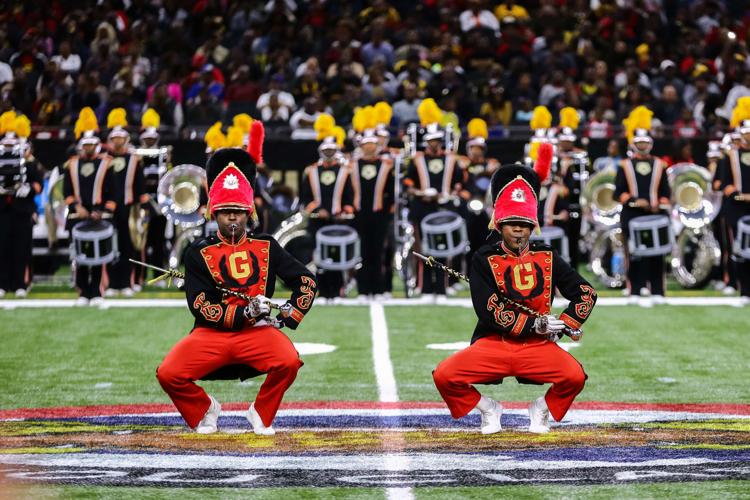
Each band's high-stepping, horn-swinging moves are accompanied by dancing girls in glittering outfits. It has been suggested that the Battle of the Bands is more important to the schools' bragging rights than the football game.
The Battle of the Bands was the main reason NBC began televising the game in 1991. Aside from Notre Dame home games and some bowl games, it's the Peacock Network's only college football broadcast, usually at 1:30 PM Central Time (2:30 Eastern).

*

November 23, 1974 was a Saturday. These other notable college football games, including some major rivalries, were played that day:

* Rivalry: Number 1 Oklahoma beat Number 6 Nebraska, 28-14 at Memorial Stadium in Lincoln, Nebraska. Oklahoma were on probation, so, while they were eligible to be ranked Number 1, and eligible to be awarded the National Championship, they were ineligible for a bowl game.

* Number 2 Alabama were idle, preparing for their rivalry with Number 7 Auburn the next week. 'Bama won, 17-13 at Legion Field in Birmingham. 

* Rivalry: Number 4 Ohio State beat Number 3 Michigan, 12-10 at Ohio Stadium in Columbus. This clinched the Big Ten Conference title for Ohio State.

* Number 5 Notre Dame beat Air Force, 38-0 at Notre Dame Stadium in South Bend, Indiana. Army and Navy had the week off, preparing for their game against each other, the following week at John F. Kennedy Stadium in Philadelphia. Navy won, 19-0.

Since Big Eight Conference Champion Oklahoma were ineligible for a bowl game, the Orange Bowl offered its bids to Notre Dame and to Southeastern Conference Champion Alabama. Notre Dame won. The Sugar Bowl offered its Southeastern Conference bid to the University of Florida, which lost to Nebraska.

* Rivalry: Number 8 University of Southern California (USC) beat the University of California at Los Angeles (UCLA), 34-9 at the Los Angeles Memorial Coliseum. USC won the Pacific-Eight Conference title, and beat Ohio State in the Rose Bowl.

* Number 10 Penn State were idle. They were preparing for their rivalry game next week, with the University of Pittsburgh. Penn State won, 31-10 at Three Rivers Stadium in Pittsburgh.

* Rivalry: Number 11 Maryland beat Virginia, 10-0 at Scott Stadium in Charlottesville, Virginia.

* One ranked team was upset, and it was by their arch-rivals: Number 19 California lost to Stanford, 22-20 at California Memorial Stadium in Berkeley.

* Baylor beat Southern Methodist University (SMU), 31-14 at the Cotton Bowl in Dallas. When Texas A&M beat Texas, that threw the Southwest Conference title to Baylor, and they went back to the Cotton Bowl, to play the game of the same name. Penn State beat them.

* Rivalry: Harvard beat Yale, 21-16 at Harvard Stadium in Boston.

* In New Jersey, Rutgers beat Colgate, 62-21 at Rutgers Stadium in Piscataway; and Princeton beat Cornell, 41-20 at Palmer Stadium in Princeton.

* Rivalry: Temple beat Villanova, 17-7 at Veterans Stadium in Philadelphia.

* Rivalry: William & Mary beat Richmond, 54-12 at City Stadium in Richmond, Virginia.

* Rivalry: North Carolina beat Duke, 14-13 at Kenan Stadium in Chapel Hill, North Carolina.

* Rivalry: Clemson beat South Carolina, 39-21 at Memorial Stadium in Clemson, South Carolina.

* Rivalry: Tennessee beat Kentucky, 24-7 at Neyland Stadium in Knoxville, Tennessee.

* Rivalry: Mississippi State beat Mississippi (Ole Miss) at Mississippi Veterans Memorial Stadium in Jackson.

* Rivalry: Louisiana State (LSU) beat Tulane, 34-22 at Tiger Stadium in Baton Rouge, Louisiana.

* Rivalry: Purdue beat Indiana, 38-17 at Ross-Ade Stadium in West Lafayette, Indiana.

* Rivalry: Illinois beat Northwestern, 28-14 at Memorial Stadium in Champaign, Illinois.

* Rivalry: Wisconsin beat Minnesota, 49-14 at Camp Randall Stadium in Madison, Wisconsin.

* Rivalry: Missouri beat Kansas, 27-3 at Faurot Field in Columbia, Missouri.

* Rivalry: Brigham Young beat Utah, 48-20 at what's now LaVell Edwards Stadium in Provo, Utah.

* Rivalry: Oregon State beat Oregon, 35-16 at what's now named Reser Stadium in Corvallis, Oregon.

* Rivalry: Washington beat Washington State, 24-17 at Martin Stadium in Pullman, Washington.

There were 7 games played in the NBA:

* The New York Knicks lost to the Milwaukee Bucks, 90-72 at Madison Square Garden.

* The Philadelphia 76ers beat their arch-rivals, the Boston Celtics, 98-96 at The Spectrum in Philadelphia. Don Nelson scored 35 points in defeat.

* The Kansas City-Omaha Kings beat the Atlanta Hawks, 103-100 at The Omni in Atlanta.

* The Buffalo Braves beat the Phoenix Suns, 117-104 at the Buffalo Memorial Auditorium. Bob McAdoo scored 33 points for the Braves.

* The Cleveland Cavaliers beat the New Orleans Jazz, 121-100 at The Coliseum in the Cleveland suburb of Richfield, Ohio.

* The Golden State Warriors beat the Detroit Pistons, 110-98 at Cobo Hall (now Huntington Place) in Detroit. Rick Barry scored 45 points for the Warriors.

* And the Seattle SuperSonics beat their arch-rivals, the Portland Trail Blazers, 117-110 at the Portland Memorial Coliseum. Fred Brown scored 40 points for the Sonics.

There were 4 games in the American Basketball Association:

* The New York Nets lost to the Indiana Pacers, 104-95 at the Market Square Arena in Indianapolis.

* The Denver Nuggets beat the Virginia Squires, 122-110 at the Hampton Coliseum outside Norfolk in Hampton, Virginia.

* The San Antonio Spurs beat the Spirits of St. Louis, 127-114 at the HemisFair Arena in San Antonio.

* And the Utah Stars beat the Kentucky Colonels, 111-110 in overtime at the Salt Palace in Salt Lake City.

There were 7 games played in the NHL:

* The New York Rangers lost to the Boston Bruins, 5-2 at Madison Square Garden.

* The New York Islanders and the Vancouver Canucks played to a tie, 3-3 at the Nassau Coliseum.

* The Philadelphia Flyers beat the Toronto Maple Leafs, 6-3 at Maple Leaf Gardens in Toronto.

* The Pittsburgh Penguins and the Los Angeles Kings played to a tie, 0-0 at the Civic Arena in Pittsburgh.

* The Chicago Black Hawks beat the Kansas City Scouts, 6-0 at the Chicago Stadium.

* The Minnesota North Stars beat the California Golden Seals, 3-1 at the Metropolitan Sports Center in the Minneapolis suburb of Bloomington, Minnesota.

* The St. Louis Blues beat the Detroit Red Wings, 4-2 at the St. Louis Arena.

* And the Montreal Canadiens, the Buffalo Sabres, the Atlanta Flames and the Washington Capitals were not scheduled.

And there were 4 games in the World Hockey Association:

* The Toronto Toros beat the Quebec Nordiques, 9-2 at the Colisée de Québec in Quebec City.

* The New England Whalers beat the Chicago Cougars, 3-2 at the Big E Coliseum in West Springfield, Massachusetts.

* The San Diego Mariners beat the Minnesota Fighting Saints, 5-3 at the St. Paul Civic Center in St. Paul, Minnesota.

* And the Houston Aeros beat the Vancouver Blazers, 4-2 at the Pacific Coliseum in Vancouver.

And in English soccer, the North London soccer team I would one day root for, Arsenal F.C., lost to Coventry City, 3-0 at Highfield Road in Coventry, West Midlands.

Monday, November 14, 2022

November 14, 1960: The Ruby Bridges Story

November 14, 1960: New Orleans, Louisiana is hailed as one of the great American cities. Not for its black residents in 1960, it wasn't.

In 1960 New Orleans, Ruby Bridges was 6 years old. And she wanted to go to school. She required police protection to do so, because she was going to a previously all-white school, and there were threats of violence.

That day, two schools were desegregated in the city. Three girls went to McDonough No. 19 Elementary, and Ruby Bridges attended William Frantz Elementary. All four were escorted by U.S. Marshals. White parents boycotted the schools, refusing to allow their children to attend the same school as Black children.

Bridges and "The McDonough Three" had to pass a test to prove they were "worthy" to attend the white schools. God only knows -- Ruby, as I said, was 6, and probably didn't remember, and the white men who made the test are almost certainly all dead now -- what "worthy" meant. We're not talking about wielding the power of Thor in a hammer here. We're talking about being allowed to attend a school the law previously said that you couldn't.

As Ruby entered the school with her armed escort, a crowd of ignorant buffoons used the kind of language that they would be appalled to hear their own children hearing. They threw rocks and rotten fruit at her. One of the Marshals escorting Ruby that day, Charles Burks, later said, "She showed a lot of courage. She never cried. She didn't whimper. She just marched along, like a little soldier."

Only one teacher at the school, Barbara Henry, agreed to teach Ruby. Ruby went to her classroom and the only other person in the room was Mrs. Henry. Ruby would remain the only student in the class for over a year.

Her father hadn't wanted Ruby to attend the school, but her mother saw it as an important "step forward" for all Black children in their community. Eventually, the white boycott of the school subsided, but the Bridges family still experienced horrors from the community. Every morning as she walked to school, a woman called out threats to Ruby, saying she was going to poison the girl. Another woman held up a Black doll in a little coffin. Her father was fired from his job. Ad their local grocery store refused to let them shop there any longer.

In New Orleans. A city that celebrates its outlaw, even piratical, past. A city which once had a higher percentage of its black people free, rather than enslaved, of any major city in the South.

In 1964, Norman Rockwell painted The Problem We All Live With, depicting what Ruby was up against. At the age of six years old. It appeared on the cover of the January 14, 1964 issue of Look magazine.
Ruby Bridges later became a civil rights activist, married a man named Malcolm Hall, and had 4 sons. At her suggestion, President Barack Obama had Norman Rockwell's painting of her hung outside the Oval Office for several months in 2011. While looking at the painting with Bridges, the President told her, "If it hadn't been for you, I might not be here."
Ruby Bridges Hall in 2020

As of November 14, 2022, Ruby Bridges Hall is still alive, and living in New Orleans. She is 68 years old. That's not that old. This garbage didn't happen all that long ago. Or, to put that into additional perspective: Ruby Bridges is 3 months younger than Jerry Seinfeld, 14 days younger than Elvis Costello, 1 day younger than Corbin Bernsen (a.k.a. Arnie Becker of L.A. Law), 22 days older than Barry Williams (a.k.a. Greg Brady of The Brady Bunch), 31 days older than Scott Bakula (who starred on NCIS: New Orleans), and 32 days older than David Lee Roth.


*

November 14, 1960 was a Monday. Baseball was out of season. Football was in midweek: Monday Night Football was still 10 years away. And neither the NBA nor the NHL had any games scheduled. So there were no scores on this historic day.

Sunday, October 23, 2022

October 23, 1926: Tulane Stadium Opens

October 23, 1926: Tulane Stadium opens in New Orleans. Hosts Tulane University lose to Auburn, 2-0. Auburn scored a safety, one of the rare instances of the expression "Defense wins games" actually being true.
The Tulane Green Wave would continue to play in the 80,000-seat rounded horseshoe until the 1974 season. They had already won the Southern Conference title in 1925, and would win it again in 1929, 1930 and 1931. They would win the Southeastern Conference title in 1934, 1939 and 1949, before downgrading their program after the 1965 season.
From 1935 to 1975, usually on New Year's Day, the stadium would also host the Sugar Bowl, which became the stadium's nickname as well, usually with the Southeastern Conference Champions, often going for the National Championship. They were won in the Sugar Bowls of 1939, by Texas Christian University (TCU); 1940, by Texas A&M; 1952, by Maryland; 1953, by Georgia Tech; 1958, by Louisiana State (LSU), Tulane's arch-rivals; 1960, 1961 and 1963, by Mississippi (Ole Miss); 1961, by Alabama; and 1973, by Notre Dame.
The NFL's New Orleans Saints played there from their 1967 inception through 1974. Tom Dempsey set an NFL record there by kicking a last-play 63-yard field goal to give the Saints a win over the Detroit Lions in 1970.
It also hosted Super Bowl IV in 1970: Kansas City Chiefs 32, Minnesota Vikings 14; Super Bowl VI in 1972: Dallas Cowboys 24, Miami Dolphins 3; and Super Bowl IX in 1975: Pittsburgh Steelers 16, Vikings 6. In each case, it was the 1st World Championship won by each team.
Tulane Stadium was replaced by the Louisiana Superdome in 1975, and demolished in 1979. Yulman Stadium, Tulane's 30,000-seat stadium starting in 2014, was built on the site.
*
October 23, 1926 was a Saturday. These other notable college football games were played:
* Alabama beat Sewanee, 2-0 at Rickwood Field in Birmingham.
* Stanford beat Oregon, 29-12 at Hayward Field in Eugene, Oregon. Alabama and Stanford would play each other to a 7-7 tie in the Rose Bowl on January 1, 1927, and share the National Championship.
* Army beat Boston University, 41-0 at Michie Stadium in West Point, New York; and Navy beat Colgate, 13-7 at Thompson Stadium in Annapolis, Maryland.
* Among New York City teams, Columbia beat Duke, 24-0 at Baker Field; and Fordham lost to Washington & Jefferson, 28-13 at the Polo Grounds. Both stadiums were in Upper Manhattan. And New York University (NYU) beat Rutgers, 30-0 at Yankee Stadium in The Bronx. The other major New Jersey team, Princeton, beat Lehigh, 7-6 at Palmer Stadium in Princeton.
* Notre Dame beat Northwestern 6-0 at Dyche Stadium outside Chicago in Evanston, Illinois. Dyche Stadium had just opened 3 weeks earlier. In 1997, it was renamed Ryan Field.
* In rivalry games, Carnegie Tech (now Carnegie-Mellon) beat their neighbors, the University of Pittsburgh, 14-0 at Pitt Stadium; Virginia Tech beat Virginia, 6-0 at Miles Stadium in Blacksburg, Virginia; and Washington State beat Washington, 9-6 at Husky Stadium in Seattle.

Tuesday, September 20, 2022

September 20, 1973: Jim Croce Is Killed

September 20, 1973: Jim Croce is killed in a plane crash in Natchitoches, Louisiana. He was only 30 years old.

This was also the day of the "Battle of the Sexes" tennis match between Billie Jean King and Bobby Riggs. I have a separate entry for that.

James Joseph Croce was born on January 10, 1943 in Philadelphia, and grew up in adjoining Upper Darby, Pennsylvania. In 1965, he graduated from nearby Villanova University, where he was a student disc jockey at their radio station. Like so many other DJs before and since, he thought he could make records as good as the ones he was playing. He was one of the few who turned out to be right.

In 1966, he recorded his 1st album, Facets. His parents hoped that he would give up music after the album failed. It didn't fail. He and his wife, Ingrid Jacobson, moved to suburban South Jersey, and he enlisted in the New Jersey National Guard, in the hope of avoiding being sent to Vietnam. It worked, although he was an undistinguished soldier: He later said he would be prepared if "there's ever a war where we have to defend ourselves with mops."

But his subsequent releases did fail, and he had to get "real jobs." He hated them: "I'd worked construction crews, and I'd been a welder while I was in college. But I'd rather do other things than get burned." This led to songs like "Workin' at the Car Wash Blues." In 1972, Jim got a contract with ABC Records, leading to the album You Don’t Mess Around with Jim.

There have been a few famous men named James Walker. There was Jimmy, a.k.a. Beau James, the convention-flouting Mayor of New York in the 1920s; there was Jimmy, an NBA star at the time of the album; there was Jimmie, who stared as James Evans Jr., a.k.a. J.J., on the sitcom Good Times, a few years after the album; and there was Big Jim Walker, the title character of Croce's title track, "a pool-shootin' son of a gun" and "The King of 42nd Street."

Spoiler Alert for a song half a century old: Jim hustles a kid from South Alabama: "I am a pool-shootin' boy, my name is Willie McCoy, but, down home, folks call me Slim." He comes into the pool hall where Big Jim holds court, says he's come to get his money back, and everyone tells him:

You don't tug on Superman's cape.
You don't spit into the wind.
You don't pull the mask off the old Lone Ranger.
And you don't mess around with Jim.

Well, "Jimmy come boppin' in off that street," and there's a knife fight, and when it's over, the line becomes, "You don't mess around with Slim."

Another song on the album was "Time In a Bottle," a love song tinged with sadness. But it wasn't released as a single at the time.

But the album was a smash. Within 3 days in August 1972, Croce appeared on both American Bandstand and The Tonight Show Starring Johnny Carson, followed a month later by The Dick Cavett Show.

His next album, Life and Times, was released on July 1, 1973. It included "Bad, Bad Leroy Brown," the song by which he remains best known. The song is largely a ripoff: The piano opening is nearly identical to that of "Queen of the Hop" by Bobby Darin, and the story is basically a rewrite of "You Don't Mess Around With Jim."

In this case, the action moves to the Windy City: "Now, the South Side of Chicago is the baddest part of town." The similarities between Leroy Brown and Big Jim Walker are many. Both are big men, compared to animals: Jim is "stronger than a country hoss," while Leroy is "badder than old King Kong, and meaner than a junkyard dog." Both drive Cadillacs: Jim has a drop-top, while Leroy has an Eldorado. Both men use blades. Both men gamble. And messing with either one of them is, at least at the beginnings of their songs, considered a very bad idea.

There are, of course, differences, in addition to their respective hometowns. In addition to his Eldorado, Leroy also has a custom Lincoln Continental. Jim is not said to use a gun, although that can't be ruled out. And their blades are different: Jim apparently uses a switchblade, while Leroy "got a .32 gun in his pocket for fun, he got a razor in his shoe."

Jim's fashion sense is never mentioned, while Leroy "likes his fancy clothes," and wears a big diamond ring. Jim is a pool hustler, and while Leroy is said to be a gambler, the only game he is mentioned as playing is shooting dice. (Of course, this doesn't rule out hustling pool, or any other game.) Also, while neither man's race is explicitly mentioned, it's likely that Jim is white and Leroy is black.

And the way these men come to their respective climactic fights is different: Jim had cheated Slim, while Leroy put the moves on a woman he immediately finds out has a jealous husband. But here's where it gets weird: At the end of the song, Croce still says that Leroy is "the baddest man in the whole damn town," despite the fact that he "looked like a jigsaw puzzle with a couple of pieces gone." Croce never said what the other guy looked like, so maybe Leroy still won the fight. Certainly, taking the beating of your life and still winning would be worth certifying you as "the baddest man in the whole damn town."

The song hit Number 1, and a clip of him playing it on The Midnight Special on June 15, 1973 can be seen on YouTube. He appeared on The Helen Reddy Show on July 19: Australian singer Reddy would soon have her own Number 1 hit with her cover of the country song "Delta Dawn." In July, Croce and his band went to London, and performed on The Old Grey Whistle Test, basically Britain's version of The Midnight Special.

He had just come back from London and recorded a new album, titled I Got a Name, when he went on another tour. Having finished a show at the Prather Coliseum, the arena of Northwestern State University in Natchitoches, Louisiana, his plane took off from the Natchitoches airport in a Beechcraft E18S, a propeller-driven model known as the Twin Beech, heading for Sherman, Texas, site of Austin College, where the next night's show was to be.

The plane barely got off the ground before it hit a tree. All 6 people on board were killed: Croce, bandmate Maury Muehleisen, warmup comedian George Stevens, their manager Kenneth Cortese, their road manager Dennis Rast, and pilot Robert N. Elliott.

Jim Croce was buried at Haym Salomon Memorial Park in the Philadelphia suburb of Frazer, Pennsylvania. He was survived by his wife Ingrid (for whom he converted to Judaism), who resumed her recording career; and their son Adrian James, who was 8 days short of his 2nd birthday. As of September 20, 2022, both are still alive. "A.J." also became a recording artist, and looks just like his father, minus the prominent mustache.

Someone at ABC Records remembered "Time In a Bottle," with its themes of love and lost time, and it was posthumously released. It hit Number 1 on December 29, 1973.

In 2006, the TV series Life On Mars aired on British television. It was about Sam Tyler (Jon Simm), a detective in present-day Manchester, who was in an accident, and woke up in 1973. At a nightclub, he sees soccer stars Bobby Charlton and Denis Law of Manchester United and Francis Lee of Manchester City. He also meets Marc Bolan of T. Rex, and warns him, "Drive carefully, especially in Minis!" (In fact, it was his girlfriend, Gloria Jones, singer of the original version of "Tainted Love," who drove the car in his fatal crash, although she survived.)

An American version of the show premiered in 2008, set in New York, and, in the nightclub scene, Sam (played here by Irish actor Jason O'Mara) sees New York Jets superstar Joe Namath, and meets Jim Croce (Don Puglisi), and warns him to be careful of small planes. Although some things Sam does turn out to have changed history, it appears that this version of Croce thought he was nuts (or maybe high), and did not take him seriously. (T. Rex's "Bang a Gong" then plays.)

Buddy Holly, Jim Reeves, Otis Redding, Jim Croce: All died in the crashes of Beechcraft planes. To make matters worse, Reeves' Beechcraft had been built in 1959, the year of Holly's crash.

*

September 20, 1973 was a Thursday. It was early in the NFL season, but midweek, and no games were played that night. The NBA, the ABA, the NHL and the WHA were working their way up to starting new seasons. But there were Major League Baseball games played:

* The Houston Astros and the San Diego Padres, meant to play at the Astrodome on this day, instead had their game moved up as part of a doubleheader the day before, September 19 -- because the promoters of the Battle of the Sexes wanted the Dome for their event. The Astros won the 1st game 8-5, and the Padres won the 2nd game 6-3.

* The New York Yankees, the Boston Red Sox, the Cleveland Indians and the Milwaukee Brewers were not scheduled. I checked: There was no notation in any of the teams' remaining schedules saying that a game scheduled for this date was made up later, due to rain or any other reason.

* The New York Mets beat the Pittsburgh Pirates, 4-3 at Shea Stadium. This was "The Ball Off the Wall Game." There was a 5-way dogfight for the National League Eastern Division title. Going into the game, the Pirates were in 1st place, the Montreal Expos were 1 game back, the Mets and the St. Louis Cardinals both a game and a half back, and the Chicago Cubs 4 games back. Even so, the Pirates, winners of the 1971 World Series and the last 3 NL East titles, struggling all year after the death of Roberto Clemente in a plane crash the previous New Year's Eve, were the only team above .500, at 75-74. It seemed like no one wanted to win that Division.

But the Metropolitans and the Buccos sure played this game like they both wanted to win it. The game's only home run was hit by Pirate (and future Met) Richie Hebner in the 7th inning, but the Mets tied it 2-2 in the 8th. Both teams scored in the 9th to make it 3-3, and send it to extra innings.

It went to the top of the 13th inning. With 1 out, Richie Zisk singled off Ray Sadecki. Manny Sanguillen flew to right for the 2nd out. Dave Augustine, a 23-year-old center fielder from West Virginia in only his 5th major league game, hit one deep to left. It looked like a home run.

Except it hit the top of the fence, and, instead of bouncing over for a homer, it bounced back, right into Cleon Jones' glove. That's a hit. But Jones pivoted, and fired to Wayne Garrett (playing shortstop instead of his usual 3rd base). Garrett saw that Zisk was trying to score, and threw home to catcher Ron Hodges. Zisk was out at the plate.

The bottom of the 13th began with walks drawn by John Milner and Ken Boswell. Don Hahn popped up to 1st base. But Hodges singled to left, scoring Milner with the winning run. The Mets went on to win the Division, by a game and a half over the Cardinals, 2 1/2 over the Pirates, 3 1/2 over the Expos and 5 over the Cubs. (Although he was on the Mets roster for this game, Willie Mays, soon to announce his retirement, did not play. Willie Stargell went 0-for-5 for the Pirates, although he did draw a walk.)

* The Philadelphia Phillies beat the Cardinals, 6-5 at Veterans Stadium in Philadelphia.

* The Baltimore Orioles beat the Detroit Tigers, 9-0 at Tiger Stadium in Detroit. Jim Palmer pitched a 5-hit shutout.

* The Cubs beat the Expos, 5-4 at Wrigley Field in Chicago.

* A doubleheader was split at Arlington Stadium in the Dallas suburb of Arlington, Texas. The California Angels won the 1st game, 6-4. Richie Scheinblum won it with a single in the top of the 11th inning. The Texas Rangers won the 2nd game, 8-3. Closing in on a new record for strikeouts in a season, with 383, Nolan Ryan did not pitch in either game for the Angels.

* The Kansas City Royals beat the Chicago White Sox, 10-3 at the new Royals Stadium in Kansas City. (It was renamed Kauffman Stadium in 1993.)

* The Minnesota Twins swept a doubleheader from the Oakland Athletics at Metropolitan Stadium in the Minneapolis suburb of Bloomington, Minnesota. The Twins won the opener, 4-3. Steve Brye hit a walkoff single in the bottom of the 9th. The Twins also won the nightcap, 5-4. Reggie Jackson appeared only once in the twinbill, as a pinch-hitter in the 1st game, and did not get on base. The A's bounced back from this, and from a hundred other indignities, and won the World Series anyway.

* The Los Angeles Dodgers beat the Atlanta Braves, 5-3 at Dodger Stadium in Los Angeles. Davey Lopes won it with a home run in the bottom of the 12th inning. Hank Aaron went 3-for-5 with 2 RBIs, but while he hit 2 doubles, he did not hit any home runs. With 5 games left in the season, he had 711 career home runs, 3 behind the record held by Babe Ruth.

* And the San Francisco Giants beat the Cincinnati Reds, 7-5 at Candlestick Park in San Francisco.

Thursday, September 8, 2022

September 8, 1935: The Assassination of Huey Long

September 8, 1935: Senator Huey Long of Louisiana is shot at the State Capitol building in Baton Rouge, which he had gotten built while he was Governor. He died 2 days later. He was 42 years old.

He started out as a lawyer representing poor plaintiffs, and built a "man of the people" image. That got him elected to the Louisiana Public Service Commission. He even got to argue before the highest court in the land. William Howard Taft, former President and by this point Chief Justice, called him "the most brilliant lawyer who ever practiced before the United States Supreme Court."

He ran for Governor in 1924, but lost. He ran again in 1928, and won. He instituted what he called a "Share the Wealth" program, saying, "Every man a king, but no man wears a crown." He also built the tallest State Capitol building in the country, 450 feet tall.
Unlike most major Southern politicians of the 100 years between the Civil War and the Voting Rights Act, he did not make open appeals to racism. He wasn't exactly progressive on race, but, according to historian and Louisiana State University professor T. Harry Williams, he was "the first Southern mass leader to leave aside race baiting and appeals to the Southern tradition and the Southern past and address himself to the social and economic problems of the present."

In 1929, he was impeached for abuse of power by the State House of Representatives, but the State Senate acquitted him. In 1932, the year the new State Capitol opened, he was elected to the U.S. Senate.

That year, he supported Governor Franklin D. Roosevelt of New York for President. But, once in office, Long thought that FDR didn't go far enough. He especially didn't like the National Recovery Act. On May 27, 1935, the Supreme Court struck it down. So an amendment to it was put before the Senate, and on June 12, Long launched a filibuster to try to stop it.

He kept talking and talking, about pretty much anything to get the Senate to kill the bill. He recited poetry. He quoted Shakespeare. He recited recipes from a cookbook he had written, drawing some laughter from his colleagues when he said, "Now, I come to pot likker." (That's the liquid that is left behind after boiling collard greens, mustard greens, turnip greens or beans.) Finally, after 15 hours and 30 minutes -- then the 2nd-longest filibuster in Senate history, and it still ranks 7th -- the bill was killed.

Long was preparing to run challenge FDR for the Democratic nomination in 1936 -- or, failing that, by launching a 3rd-party run. "I can take him," he said. "He's scared of me. I can out-promise him, and he knows it." He even published a book titled My First Days in the White House.

Was FDR worried? He was concerned enough that he asked the Chairman of the Democratic National Committee, James A. Farley -- also the Postmaster General, and holding both a party chairmanship and a Cabinet post is now illegal -- to put a poll in the field.

The poll suggested that a 3rd-party Long campaign would win 10 percent of the national vote, not enough to win, but enough to split the liberal vote between himself and Roosevelt, and elect the Republican nominee. The theory was, the Republicans would undo all of FDR's New Deal, thus deepening the Great Depression, and by 1940, things would be so bad, the people would flock to Long, and not only vote for him, but allow him to do whatever he wanted, effectively making him America's dictator.

Long would never get to make a 1940, or even a 1936, campaign. On September 8, 1935, he went back to Baton Rouge, going to the State Capitol to lobby for the passage of a bill that would gerrymander the district of an opponent, Judge Benjamin Pavy, who had held his position for 28 years.

At 9:20 PM, just after passage of the bill, effectively removing Pavy from his seat, Pavy's son-in-law, Dr. Carl Weiss, approached Long, and fired a single shot with a .32-caliber FN Model 1910 semiautomatic pistol from 4 feet away, striking him in the torso. Long's bodyguards pulled their guns and shot Weiss with at least 60 bullets, killing him instantly. He had been hit with more bullets than either Bonnie Parker or Clyde Barrow had in Louisiana the year before.

Long did not die immediately. He ran down a flight of stairs and across the Capitol grounds, hailing a car to take him to Our Lady of the Lake Hospital. He was rushed to the operating room, and surgery closed perforations in his intestines, but failed to stop the internal bleeding. He died at 4:10 AM on September 10, 31 hours after being shot. His last words were, "God, don't let me die. I have so much to do." He was buried under a huge monument on the Capitol grounds.


His widow, Rose Long, was appointed to serve the remainder of his Senate term. His brother, Earl Long, was Governor 3 separate times: 1939-40, 1948-52 and 1956-60. Another brother, George Long, served in the U.S. House of Representatives, 1953-58. Huey and Rose's son, Russell Long, served in the U.S. Senate, 1948-87.

A cousin, Gillis Long, served in the U.S. House, 1963-65 and 1973-85. His widow, Catherine Long, was elected to his House seat, and served the remainder of his 1985-87 term. Another cousin, Speedy Oteria Long -- that was the name he was born with -- took a more segregationist line and beat him in 1964, and served in the seat until he retired in 1972, and Gillis regained it.

In 1946, Robert Penn Warren published All the King's Men, which won the Pulitzer Prize for literature. The character of Governor Willie Stark was based on Long. It has been filmed twice, in 1949 with Broderick Crawford as Long/Stark, winning the Academy Award for Best Picture; and in 2006 with Sean Penn.

Huey Long remains the South's defining populist politician -- or its most famous non-segregationist demagogue.

*

September 8, 1935 was a Sunday. The NFL didn't start until the next week. Basketball and hockey were out of season. These baseball games were played that day:

* The New York Yankees swept a doubleheader from the Cleveland Indians at Yankee Stadium, 3-2 and 5-4. Jesse Hill won the opener with a single in the bottom of the 10th inning. George Selkirk won the nightcap with a sacrifice fly in the bottom of the 9th. Lou Gehrig went 3-for-8 with an RBI, including a home run in the 2nd game.

* The New York Giants beat the Pittsburgh Pirates, 3-1 at Forbes Field in Pittsburgh. Bill Terry, the Giants' 1st baseman and manager, went 4-for-4 with an RBI. Mel Ott went 0-for-4, but had an RBI on a sacrifice fly. Carl Hubbell went the distance for the win.

* The Brooklyn Dodgers swept a doubleheader from the Cincinnati Reds at Crosley Field in Cincinnati, 8-4 and 6-4.

* The Boston Red Sox swept a doubleheader from the Chicago White Sox at Fenway Park in Boston, 6-2 and 5-2.

* The St. Louis Browns swept a doubleheader from the Philadelphia Athletics at Shibe Park in Philadelphia, 9-4 and 7-5. Jimmie Foxx went 4-for-7 with 2 walks. Sam West of the Browns went 4-for-7 with 4 RBIs.

* The Washington Senators beat the Detroit Tigers, 4-3 at Griffith Stadium in Washington. Hank Greenberg went 2-for-4 with a walk and an RBI.

* A doubleheader was split at Sportsman's Park in St. Louis. The St. Louis Cardinals won the 1st game, 11-0. Dizzy Dean pitched a 4-hit shutout. The Philadelphia Phillies won the 2nd game, 4-2.

* And the Boston Braves and the Chicago Cubs were rained out at Wrigley Field in Chicago. It was made up as part of a doubleheader the next day. The Braves swept, 5-1 and 2-1.

Thursday, September 1, 2022

September 1, 2021: Hurricane Ida Floods the Northeast

September 1, 2021: Hurricane Ida strikes the Northeastern United States. New York City and many other places were flooded. It forced the shutdown of the New York Subway system.

It had hit Louisiana 3 days earlier, on the 16th anniversary of Hurricane Katrina hitting the State, and devastating New Orleans. Ida's clobbering of the Pelican State wasn't nearly as bad as Katrina's was, but it was bad enough to kill several people.

Unlike Katrina, Ida did not then dissipate over the American Southeast. It kept moving northeast, until reaching the major cities. The death toll was 107, and the damage toll was $75 billion. It was the 4th-costliest Atlantic hurricane. 

*

September 1, 2021 was a Wednesday. Football, basketball and hockey were out of season. And the hurricane caused some postponements:

* The New York Mets were supposed to play the Miami Marlins at Citi Field. It was made up as part of a doubleheader on September 28. The Mets swept, 5-2 and 2-1. James McCann won the nightcap with a fielder's choice in the bottom of the 9th inning.

* And the Philadelphia Phillies were supposed to play the Washington Nationals at Citizens Bank Park in Philadelphia. It was made up the next day, and the Phils won, 7-6.

These Major League Baseball games were played:

* The New York Yankees beat the Los Angeles Angels, 4-1 at Angel Stadium of Anaheim. Aaron Judge hit a home run in support of Gerrit Cole.

* The Boston Red Sox beat the Tampa Bay Rays, 3-2 at Tropicana Field in St. Petersburg.

* The Toronto Blue Jays beat the Baltimore Orioles, 5-4 at the Rogers Centre in Toronto.

* A doubleheader, with each game shortened to be 7 innings, was played at Great American Ballpark in Cincinnati, including the makeup of a game that was rained out the day before. The St. Louis Cardinals won the opener, 5-4. The Cincinnati Reds won the nightcap, 12-2.

* The Detroit Tigers beat the Oakland Athletics, 8-6 at Comerica Park in Detroit.

* The Chicago White Sox beat the Pittsburgh Pirates, 6-3 at Guaranteed Rate Field (now Rate Field) in Chicago.

* The Chicago Cubs beat the Minnesota Twins, 3-0 at Target Field in Minneapolis. Justin Steele allowed 1 hit in 5 innings, and Adbert Alzolay allowed 1 hit over 4, to complete a 2-hit shutout.

* The Cleveland Indians beat the Kansas City Royals, 5-3 at Kauffman Stadium in Kansas City. Austin Hedges won the game with a single in the top of the 11th inning.

* The Colorado Rockies beat the Texas Rangers, 9-5 at Globe Life Field in the Dallas suburb of Arlington, Texas.

* The Arizona Diamondbacks beat the San Diego Padres, 8-3 at Chase Field in Phoenix.

* The Los Angeles Dodgers beat the Atlanta Braves, 4-3 at Dodger Stadium in Los Angeles.

* The Milwaukee Brewers beat the San Francisco Giants, 5-4 at Oracle Park in San Francisco.

* And the Seattle Mariners beat the Houston Astros, 1-0 at T-Mobile Park in Seattle.

Monday, August 29, 2022

August 29, 2005: Hurricane Katrina

August 29, 2005: Hurricane Katrina hits New Orleans, Louisiana, resulting in a broken levee that flooded the city, which was already below sea level. By nightfall, 80 percent of the Crescent City, and parts of neighboring areas, were flooded. Over 1,800 people were killed, and thousands were left homeless.

The Louisiana Superdome, home of the NFL's New Orleans Saints, was used as a shelter, topping out at 26,000 people. But because of the nature of the emergency, getting relief supplies into the city was incredibly difficult.

Although there had been devastating fires in Chicago and Boston in the 19th Century, and Baltimore and San Francisco in the early 20th Century, an earthquake in San Francisco in 1989 and Miami clobbered by Hurricane Andrew in 1992, Katrina was the first natural disaster that made Americans think that a great American city might actually be lost, ruined to the point where there would be no choice but to abandon it.

President George W. Bush was at his ranch outside Crawford, Texas, on vacation. He should have immediately flown back to Washington and coordinated the federal government's response. Instead, he stayed at his ranch for 5 days, doing nothing -- except for 1 trip to San Diego for a Republican Party fundraiser.

As a result, most of the goodwill he'd generated with his response to the 9/11 attacks and the early part of the Iraq War was gone. One political magazine showed a cover with a cartoon of Bush being poked with a fork, with the headline, "HE'S DONE," and a caption that he might have still been in office, "but the 9/11 Presidency is over."

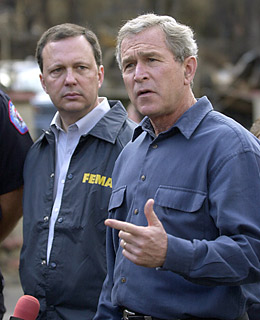
That was the day that Michael D. Brown resigned as Administrator of the Federal Emergency Management Agency (FEMA), which is in charge of responding to natural disasters. Bush was caught on camera telling him, "Heck of a job, Brownie." It wasn't sarcastic: Bush really believed that Brown was doing a good job.
"Brownie" and "Dubya"

At his best, Bush was a genial idiot. At his worst, he was a nasty right-winger. He was never competent enough to be President, and he appointed people he liked to posts for which they were not qualified and ill-suited, and Brown was one of them.

As late as 1950, New Orleans' population was 660,000, putting it in America's top 20 cities. White flight led to a drop to about 484,000 people within the city limits in the 2000 Census. After Hurricane Katrina, it dropped to 230,000, losing over half its people in one fell swoop. According to a recent estimate, it's back up to about 391,000, making it larger than such NFL cities as Tampa, St. Louis, Pittsburgh, Cincinnati and Buffalo (and, of course, Green Bay).

But the metropolitan area has just 1.27 million people, making it the smallest metro area in the NFL, ahead of only Buffalo (if Green Bay is included with Milwaukee and Niagara Falls is included with Buffalo). And the poverty issue, so pervasive before the hurricane, is worse. And crime is definitely an issue.

In 1940, the city was 70 percent white. As late as 1970, it was 51 percent white. By 1990, it was 62 percent black, and the proportions are roughly the same today: 61 percent black, 31 percent white, 5 percent Hispanic and 3 percent Asian. The further east you go, the greater the black percentage; the further west, the more white.

Both the dome and the arena were nearly ruined by Hurricane Katrina. Whatever had gone wrong on the inside of the Superdome, more noticeable was the outside, as the hurricane's winds had stripped the top of the dome, making it look like it had been sandblasted.

The Saints played their entire 2005 season on the road while the dome was refurbished. Next door, the Smoothie King Center, home of the NBA's New Orleans Hornets (since rebranded as the Pelicans), needed work, so the Hornets played most of the 2005-06 season in Oklahoma City, thus opening the door to a team for that city: In 2008, the Seattle SuperSonics became the Oklahoma City Thunder.

A relief concert was held at Madison Square Garden, "The Big Apple to the Big Easy," featuring performers from New Orleans, and others whose work was inspired by them. In 2012, the favor was returned after Hurricane Sandy became the 2nd-most-damaging storm in American history, behind Katrina.

The Superdome reopened for the 2006 season, and the Saints provided a lift to the devastated city. On February 7, 2010, the Saints won Super Bowl XLIV, beating the Indianapolis Colts 31-17 at Sun Life Stadium (now Hard Rock Stadium) in the Miami suburbs, for their 1st NFL Championship. It had been a little over 4 years since the hurricane, and it resulted in the biggest party in the history of America's greatest party city.
The Superdome was restored. But the city still needs help. Having lost so many former residents, whose houses could not be rebuilt, hurt its tax base. It's the same with businesses that never came back. In New Orleans, "back" is a relative term.

*

August 29, 2005 was a Monday. This was also the day the TV series Prison Break premiered on Fox.

The NFL season was soon to begin, with the NBA and NHL seasons to follow. But baseball and its Playoff races were heating up, and 10 games were played in Major League Baseball: 

* The New York Yankees beat the Seattle Mariners, 7-4 at Safeco Field in Seattle. (Now named T-Mobile Park.) The Bronx Bombers got 2 home runs from Jason Giambi, and 1 each by Alex Rodriguez and Matt Lawton. (A 2-time All-Star with Minnesota, with 138 career home runs, he was only a Yankee for 21 games.) Mike Mussina left the game after allowing 4 runs in 3 innings. Aaron Small got the win in relief.

* The Boston Red Sox beat the Tampa Bay Devil Rays, 10-6 at Fenway Park in Boston.

* The Oakland Athletics beat the Baltimore Orioles, 10-5 at Camden Yards in Baltimore. The A's beat the O's with 5 runs in the top of the 12th inning, including home runs by Nick Swisher (future Yankee) and Mark Ellis.

* The St. Louis Cardinals beat the Florida Marlins, 6-1 at what was then named Dolphins Stadium in the suburb of Miami Gardens, Florida. (It's now Hard Rock Stadium.)

* The Cleveland Indians beat the Detroit Tigers, 10-8 at Progressive Field in Cleveland.

* The Los Angeles Dodgers beat the Chicago Cubs, 9-6 at Wrigley Field in Chicago.

* The Minnesota Twins beat the Kansas City Royals, 3-1 at Kauffman Stadium in Kansas City. Cliche Alert: Walks can kill you, and the Royals' Shawn Camp walked 2 batters in the top of the 10th before allowing a 2-run double to Nick Punto.

* The Texas Rangers beat the Chicago White Sox, 7-5 at Ameriquest Field in the Dallas suburb of Arlington, Texas. (It's now named Choctaw Stadium.)

* The Arizona Diamondbacks beat the San Diego Padres, 7-5 at Qualcomm Stadium in San Diego.

* The Colorado Rockies beat the San Francisco Giants, 2-1 at SBC Park in San Francisco. (It's now named Oracle Park.)

* And the New York Mets, the Atlanta Braves, the Cincinnati Reds, the Houston Astros, the Los Angeles Angels, the Milwaukee Brewers, the Philadelphia Phillies, the Pittsburgh Pirates, the Toronto Blue Jays and the Washington Nationals were not scheduled. 

Wednesday, August 17, 2022

August 17, 1969: Hurricane Camille

August 17, 1969: Hurricane Camille makes landfall on the coast of the Gulf of Mexico. Its wind speed reached 175 miles per hour, making it a "Category 5 hurricane," the most dangerous kind. As of August 17, 2022, it is 1 of only 4 Category 5s to make an American landfall.

At a time when the American Southeast was not looked upon favorably by the rest of the country, due to its backward feelings on race, the State of Mississippi received more of this scorn than any other State. But it gained some sympathy on this occasion, since it took the worst of Camille's damage.

The storm produced the highest wave surge ever recorded in an American hurricane, 24 feet. It flattened the Mississippi coast; caused grave damage in Louisiana, Alabama and Florida as well; and had enough strength to move inland into the Appalachian Mountains of the Virginia Panhandle, and kill some people there. A total of 259 deaths are attributed to it.

The 1974 film Hurricane was inspired by Camille. It starred Larry Hagman, then known for playing the decent Major Tony Nelson on I Dream of Jeannie, and not yet the indecent J.R. Ewing on Dallas.

*

August 17, 1969 was a Sunday. It was also the 3rd and, officially, final day of Woodstock, and the 1st time New York's football teams, the Giants and the Jets, played each other. I have separate entries for those events. Also, basketball star Christian Laettner and New Kids On The Block singer turned actor Donnie Wahlberg were born on this day.

And these Major League Baseball games played:

* New York Yankees 5, Chicago White Sox 2 at Comiskey Park in Chicago. Jimmie Hall hit a home run for the Bronx Bombers. Stan Bahnsen started, and Mike Kekich won it in relief.

* Another doubleheader at Shea Stadium: The New York Mets beat the San Diego Padres 3-2 in each game. Duffy Dyer hit a home run in support of Jerry Koosman in the opener, and Ed Kranepool and Bud Harrelson each got 2 hits in support of Don Cardwell in the nightcap.

* Houston Astros 3, Philadelphia Phillies 2 at Connie Mack Stadium in Philadelphia.

* Minnesota Twins 4, Washington Senators 3 at Robert F. Kennedy Stadium in Washington. Tony Oliva's RBI single won it in the top of the 13th inning.

* Los Angeles Dodgers 9, Montreal Expos 3 at Jarry Park in Montreal.

* St. Louis Cardinals 5, Atlanta Braves 3 at Atlanta Stadium (later Atlanta-Fulton County Stadium). Hank Aaron, Bob Tillman and Rico Carty hit home runs for the Braves, but all were solo blasts, and Steve Carlton was the winning pitcher for the Cards, as Lou Brock went 2-for-5, and Joe Torre went 1-for-4 with an RBI.

* Pittsburgh Pirates 8, Cincinnati Reds 5 at Crosley Field in Cincinnati. Gene Alley, Al Oliver and Willie Stargell hit home runs. Roberto Clemente went 2-for-5. The Reds got homers from Pete Rose, Bobby Tolan, Johnny Bench and Tony Perez, but it wasn't enough.

* Boston Red Sox 1, Kansas City Royals 0 at Kansas City Municipal Stadium. Carl Yastrzemski went 0-for-4, but Vicente Romo, Sparky Lyle and Sonny Siebert combined for a 4-hit shutout.

* California Angels 7, Cleveland Indians 6 at Anaheim (now Angel) Stadium.

* Detroit Tigers 9, Oakland Athletics 4 at the Oakland Coliseum. Catfish Hunter was knocked out of the box in the 4th inning, as the Tigers got 2 homers from Al Kaline, and 1 each from Jim Northrup, Don Wert, former Yankee Tom Tresh and Mickey Stanley. Denny McLain went the distance, despite giving up a home run to Reggie Jackson.

* Doubleheader at Candlestick Park in San Francisco. 1st game: San Francisco Giants 5, Chicago Cubs 3. 2nd game, Cubs 3, Giants 1. Over the 2 games, Willie Mays went 2-for-4 with a home run and 3 RBIs. Ernie Banks only appeared in this game as a pinch-hitter, and did not reach base.

* Baltimore Orioles 4, Seattle Pilots 1 at Sick's Stadium in Seattle. Dave May (filling in at right field for Frank Robinson, who got the day off), Don Buford and Brooks Robinson homered for the O's, while Don Mincher hit one for the Pilots. Tom Phoebus won it, Fred Talbot lost it. Jim Bouton did not get into the game. A sweep for the Birds over the Pilots.

As Pilot manager Joe Schultz no doubt said, "Ah, shitfuck. Let's get 'em tomorrow, and then go pound some Budweiser." If Jim Bouton and his book Ball Four are to be believed, Joe Schultz would not have fit in well at Woodstock. 

Wednesday, August 3, 2022

August 3, 1975: The Superdome Opens

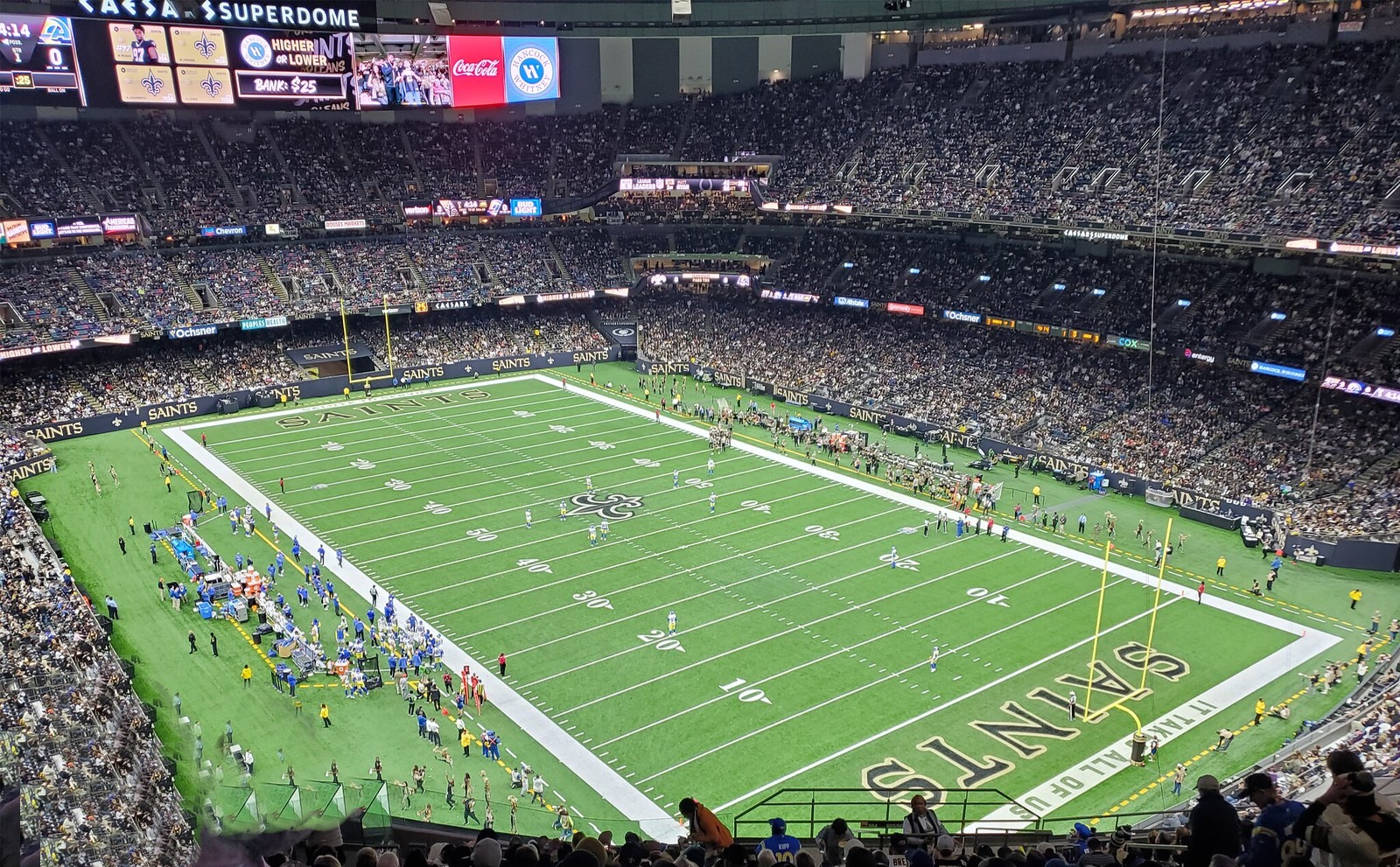
August 3, 1975: The Louisiana Superdome opens in downtown New Orleans. Trumpeter Al Hirt and clarinetist Pete Fountain, both based in that city known as the birthplace of jazz, perform at the opening concert.

The "Big Mushroom" was designed to take the place of Tulane Stadium, on the campus of Tulane University, as the home of the school's football team, and of the NFL's New Orleans Saints, and of 2 of college football's most popular games, the Sugar Bowl and the historically black schools' Bayou Classic. On the very day of the Superdome's dedication, Tulane Stadium was condemned. It was demolished in 1979.

Between August 28 and September 14, 1975, the Superdome continued to celebrate its grand opening, with appearances by Bob Hope, Telly Savalas, Dorothy Lamour, Karen Valentine, and Raquel Welch. The Allman Brothers, The Marshall Tucker Band, Wet Willie, The Charlie Daniels Band, The O'Jays, The Isley Brothers, The Temptations, Donald Byrd and the Blackbyrds, and the Ringling Brothers and Barnum & Bailey Circus also performed. On October 3, Johnny Cash led a concert that included his wife June Carter, Waylon Jennings and his wife Jessi Colter, and Merle Haggard.

The 1st football game in the Superdome was on August 6, an exhibition game in which the Saints lost to the Houston Oilers, 13-7. Their 1st regular-season game in the building was on September 28, a 21-0 loss to the Cincinnati Bengals. Tulane's dome debut was better, a 14-3 win over the University of Mississippi.
On November 29, the Bayou Classic was played there for the 1st time. The Grambling State University Tigers defeated the Southern University Jaguars, 33-20. And on December 31, New Year's Eve, the Sugar Bowl was first held there. Alabama beat Penn State, 13-6. 'Bama coach Paul "Bear" Bryant was not wearing his famous houndstooth hat. When asked why, he said, "My mama told me never to wear a hat indoors." He had never coached a game under a dome before.

With the closing (but not, as of this writing, the demolition) of the Astrodome in Houston, the Superdome is the oldest actively used domed stadium in the United States. It has hosted the Super Bowl more times than any other venue:

1. 1978, Super Bowl XII: Dallas Cowboys 27, Denver Broncos 10.
2. 1981, Super Bowl XV: Oakland Raiders 27, Philadelphia Eagles 10.
3. 1986, Super Bowl XX: Chicago Bears 46, New England Patriots 10.
4. 1990, Super Bowl XXIV: San Francisco 49ers 55, Denver Broncos 10.
5. 1997, Super Bowl XXXI: Green Bay Packers 35, New England Patriots 21.
6. 2002, Super Bowl XXXVI: New England Patriots 20, St. Louis Rams 17.
7. 2013, Super Bowl XLVII: Baltimore Ravens 34, San Francisco 49ers 31.

It is scheduled to host for an 8th time, Super Bowl LIX, to conclude the 2024 NFL season. (UPDATE: The Philadelphia Eagles beat the Kansas City Chiefs, 40-22.)

It has hosted 6 NCAA Final Fours:

1. 1982, North Carolina over Georgetown.
2. 1987, Indiana over Syracuse.
3. 1993, North Carolina over Michigan.
4. 2003, Syracuse over Kansas.
5. 2012, Kentucky over Kansas.
6. 2022, Kansas over North Carolina.
The NBA's New Orleans Jazz played there from 1975 until their 1979 move to Salt Lake City, as the Utah Jazz. Muhammad Ali regained the Heavyweight Championship of the World from Leon Spinks there in 1978, and Sugar Ray Leonard regained the Welterweight Championship from Roberto Duran there in 1980.

It also hosted some preseason baseball games: Minnesota vs. Houston in 1976; the New York Yankees vs. Baltimore in 1980; the Yankees vs. the New York Mets, Philadelphia and Pittsburgh in 1981; the Yankees vs. Montreal and Texas in 1982; the Yankees vs. Montreal and Toronto in 1983; Philadelphia vs. St. Louis in 1984; San Francisco vs. Oakland in 1989; Los Angeles vs. Oakland in 1991; the Mets vs. Oakland in 1993; the Yankees vs. Boston in 1994; and the Chicago Cubs vs. Minnesota in 1999.
Baseball doesn't look right in the Superdome, does it?

The Class AAA New Orleans Pelicans played their home games there in 1977. New Orleans tried to get the Oakland Athletics to move there in 1979, and the Pittsburgh Pirates for 1982, but were unsuccessful.

It has also hosted a Mass by Pope John Paul II in 1987, and the 1988 Republican National Convention, which nominated George H.W. Bush for President.

In 2005, Hurricane Katrina nearly ruined New Orleans, including causing serious damage to the Superdome. It was used as a shelter for those who had lost their homes, with disastrous results. The Saints split their home games that season between Tiger Stadium on the Louisiana State campus in Baton Rouge and the Alamodome in San Antonio; Tulane used 5 different smaller college stadiums in Louisiana; the Bayou Classic was moved to what's now named NRG Stadium in Houston; and the Sugar Bowl to the Georgia Dome in Atlanta. The Superdome reopened the following September 25.

Current seating capacity is 73,208. The post-Katrina renovation of 2005-06 was designed solely to make it usable again. Another renovation was undertaken in 2011, to do some modernization -- which also ended the building's baseball capability. There has been talk of a new domed stadium to replace it, but no plans are underway.

Naming rights were sold in 2011, making it the Mercedes-Benz Superdome. The 2017 move of the Saints' arch-rivals, the Atlanta Falcons, to the new Mercedes-Benz Stadium confused matters, and Mercedes-Benz allowed their naming rights on the Superdome to lapse. In 2021, it became the Caesars Superdome, with the rights bought by the Caesars casino company.

The New Orleans Arena opened next-door in 1999. Since 2014, it has been named the Smoothie King Center. Since 2002, it has been home to the NBA team known as the New Orleans Hornets until 2013, and the New Orleans Pelicans ever since.

*

August 3, 1975 was a Sunday. These baseball games were played that day:

* The New York Yankees split a doubleheader with the Cleveland Indians at Shea Stadium, where they groundshared with the Mets while Yankee Stadium was being renovated. The Yankees won the opener, 12-1. George "Doc" Medich went the distance as the winning pitcher. Bobby Bonds, in perhaps his best game in his lone season as a Yankee, went 3-for-5 with 2 RBIs.

The Indians won the nightcap, 3-2. Larry Gura went 7 strong innings, but Dick Tidrow blew the game in the 8th inning. Rico Carty, who always seemed to hit the Yankees well, went 4-for-4 with a home run and 2 RBIs. Frank Robinson, in his 1st season as Major League Baseball's 1st black manager, was not yet retired as a player, but did not put himself into either game.

* The New York Mets were swept by the Pittsburgh Pirates, 5-4 and 4-3 at Three Rivers Stadium in Pittsburgh. The 1st game went 15 innings, when ex-Met Duffy Dyer hit a home run off Bob Apodaca, who pitched 4 innings in relief of Tom Seaver. Willie Stargell went 1-for-5 with 2 walks in the 1st game, and did not play in the 2nd game.

* The Philadelphia Phillies beat the Montreal Expos, 5-4 at the Olympic Stadium in Montreal. Tommy Hutton singled Mike Schmidt home with the winning run in the top of the 10th inning. Schmidt went 3-for-5 with a home run. Tug McGraw was the winning pitcher, in relief of Steve Carlton.

* The Boston Red Sox beat the Detroit Tigers, 6-4 at Fenway Park in Boston. Carl Yastrzemski went 0-for-4 with a walk, but Denny Doyle, Rick Burleson and Cecil Cooper hit home runs.

* The Milwaukee Brewers beat the Baltimore Orioles, 4-1 at Memorial Stadium in Baltimore. Hank Aaron went 1-for-4 with an RBI. Robin Yount went 1-for-3 with an RBI. Brooks Robinson went 0-for-3.

* A doubleheader between arch-rivals was split at Wrigley Field in Chicago. The Chicago Cubs won the 1st game, 6-3. The St. Louis Cardinals won the 2nd game, 7-4.

* The Minnesota Twins swept a doubleheader from the Chicago White Sox, 7-4 and 12-9 at Metropolitan Stadium in the Minneapolis suburb of Bloomington, Minnesota. Over the 2 games, Rod Carew went 3-for-7 with 2 walks and 3 RBIs.

* The Kansas City Royals beat the Oakland Athletics, 5-0 at Royals Stadium (now Kauffman Stadium) in Kansas City. Paul Splittorff allowed only 1 hit, a single by Claudell Washington in the 1st inning. George Brett went 2-for-4 with 3 RBIs. Reggie Jackson went 0-for-3.

* The California Angels beat the Texas Rangers, 6-4 at Arlington Stadium in the Dallas suburb of Arlington, Texas. Nolan Ryan started for the Angels, but pitched only 5 innings. The Angels' bullpen blew the lead, but they scored 2 runs in the top of the 9th to win it.

* The Atlanta Braves beat the San Diego Padres, 5-1 at San Diego Stadium (later renamed Jack Murphy Stadium and Qualcomm Stadium).

* The Cincinnati Reds beat the Los Angeles Dodgers, 3-1 at Dodger Stadium in Los Angeles. Pete Rose went 0-for-4. Johnny Bench did not play.

* And a doubleheader was split at Candlestick Park in San Francisco. The San Francisco Giants won the 1st game, 5-4. The Houston Astros won the 2nd game, 10-9.

December 31, 1999 & January 1, 2000: The Millennium

December 31, 1999:  The Millennium arrives. The people of planet Earth survived. At a terrible cost. But we hadn't destroyed ourselves. ...