Showing posts with label 1992. Show all posts

Sunday, December 11, 2022

December 11, 1992: "A Few Good Men" Premieres

December 11, 1992: The film version of Aaron Sorkin's play A Few Good Men premieres. The title comes from a recruiting slogan for the U.S. Marine Corps: "We're looking for a few good men." Rob Reiner directed. By this point, he had become better known for the films he directed than for playing Mike Stivic on All in the Family.

The play had debuted on Broadway at the Music Box Theatre on November 15, 1989. Tom Hulce, better known as Mozart in the film version of Amadeus, played the U.S. Navy defense attorney, Lieutenant Junior Grade Daniel Kaffee; Megan Gallagher, known for her role on Hill Street Blues, as his commanding officer in the Judge Advocate General's office, Lieutenant Commander Joanne Galloway; and Stephen Lang as Marine Colonel Nathan R. Jessep.

The film starred Tom Cruise as Kaffee; Demi Moore as Galloway; Jack Nicholson as Jessep; Kevin Bacon as the Marine prosecutor, Captain Jack Ross; Kiefer Sutherland as Ross' adjutant, Lieutenant Jonathan Kendrick; Kevin Pollak as another Navy JAG officer, Lieutenant Junior Grade Sam Weinberg; J.A. Preston as the presiding Judge,  Marine Colonel Julius Alexander; Michael DeLorenzo in flashback sequences as the victim, Marine Private 1st Class William Santiago; Wolfgang Bodison as Lance Corporal Harold Dawson and James Marshall as Private 1st Class Louden Downey, the defendants; future ER star Noah Wyle as Marine Corporal Jeffrey Barnes; Cuba Gooding Jr. as Marine Corporal Carl Hammaker; and Joshua Malina, an actor Sorkin would later use on the TV shows Sports Night and The West Wing, as Tom, Jessep's clerk.

The scene where Kaffee examines Jessep has become legend, Kaffee yelling, "I want the truth!" and Jessep yelling back, "You can't handle the truth!" and launching into a monologue about how the world needs walls, and people like Kaffee need men like Jessep to guard those walls, before Kaffee gets Jessep to admit that he ordered the "code red" that led to Santiago's death.

Both actors are from New Jersey: Nicholson, from Manasquan on the Jersey Shore; and Cruise, from Glen Ridge. Nicholson is known for playing crazy men, but Cruise may be one in real life. (Who's gonna dispute that? You? You, Lieutenant Weinberg?) I used to live in Bloomfield, and our next-door neighbors moved to the adjoining town of Glen Ridge. One of them was a freshman at Glen Ridge High School in 1980, when Cruise was a senior there. She remembered him as "weird, but quiet." I asked her, "What happened to quiet?" She says she doesn't know.

The Music Box Theatre, where the play premiered, still stands, at 239 West 45th Street.

*

December 11, 1992 was a Friday. This was also the day that New York radio station WNEW went off the air, a symbolic end to the era of "Big Band" music. I have a separate entry for that event.

Baseball was out of season. Football was in midweek. There were 8 games played in the NBA:

* The Seattle SuperSonics beat the Boston Celtics, 100-90 at the Boston Garden.

* The Los Angeles Clippers beat the Philadelphia 76ers, 125-110 at The Spectrum in Philadelphia. Jeff Hornacek led all scorers on the night with 36 in defeat for the Sixers.

* The Atlanta Hawks beat the Denver Nuggets, 112-107 in overtime at The Omni in Atlanta. Dominique Wilkins scored 33 points.

* The Phoenix Suns beat the Orlando Magic, 108-107 at the Orlando Arena.

* The Detroit Pistons beat the Cleveland Cavaliers, 107-103 at The Palace in the Detroit suburb of Auburn Hills, Michigan.

* The Houston Rockets beat the Chicago Bulls, 110-96 at the Chicago Stadium.

* The Los Angeles Lakers beat the Washington Bullets, 118-93 at The Forum outside Los Angeles in Inglewood, California.

* And the Indiana Pacers beat the Portland Trail Blazers, 134-124 in double overtime at the Veterans Memorial Coliseum in Portland. Detlef Schrempf scored 32 for the Pacers.

And there were 6 games in the NHL:

* The New York Rangers beat the Tampa Bay Lightning, 5-4 at the ThunderDome (now Tropicana Field) in St. Petersburg, Florida.

* The New Jersey Devils beat the Pittsburgh Penguins, 2-1 at the Brendan Byrne Arena at the Meadowlands.

* The Washington Capitals beat the Winnipeg Jets, 8-6 at the Capital Centre in the Washington suburb of Landover, Maryland. Teemu Selänne scored a hat trick in defeat for the Jets.

* The Calgary Flames beat the Toronto Maple Leafs, 6-3 at Maple Leaf Gardens in Toronto.

* The Buffalo Sabres beat the Hartford Whalers, 9-3 at the Buffalo Memorial Auditorium.

* And the Detroit Red Wings beat the Philadelphia Flyers, 4-2 at the Joe Louis Arena in Detroit.

December 11, 1992: The End of the Big Band Era

William B. Williams

December 11, 1992: Perhaps it was fitting that the end of the era of "Big Band" music came while George H.W. Bush, the last President who served in World War II, was a "lame duck," and Bill Clinton, the 1st President born after The War, and the 1st President to grow up in the Rock and Roll Era, was President-elect.

Radio station WNEW debuted February 13, 1934, as "New York's newest radio station," at 1280 on the AM dial, and with new call letters representing its city of license: "NEWark, NEW Jersey."

In 1935, WNEW moved into a new studio in New York, at 501 Madison Avenue at 53rd Street. That year, pioneered the concept of a disc jockey when staff announcer Martin Block needed to fill time between news bulletins during his coverage of the trial of Bruno Hauptmann, accused (and eventually convicted) of kidnapping Charles Lindbergh Jr., a.k.a. "The Lindbergh Baby." Block did not have access to a live orchestra to play music during the breaks, as most network stations did, so he played records instead.

Soon afterward, he piloted a 15-minute experimental show called the Make Believe Ballroom, during which he played records from popular bands and singers, posed as a live performance in an imaginary ballroom. During Block's tenure as host of Make Believe Ballroom, the show attracted 25 percent of the listening audience in New York City.
Martin Block

Thus did WNEW -- its call letters eventually redefined, with retroactive irony, as "the NEWest thing in radio" -- become known for its popular adult music selection, as well as its staff of radio personalities including Block, Dee Finch, Gene Klavan, Al "Jazzbo" Collins, Ted Brown, William B. Williams, and, from 1948 to 1952, future TV game show host Gene Rayburn. From 1935 to 1959, its general manager was a woman, a rarity for that era: Bernice Judis.

In addition to its music and entertainment programming, WNEW featured an award-winning news staff and became "The Voice of New York Sports," for broadcasting games of the NFL's New York Giants, the NBA's New York Knicks, and the NHL's New York Rangers.

As an independent radio station, WNEW lacked the funds larger networks like NBC, CBS and Mutual Broadcasting System used to produce daily programming, such as comedy shows, soap operas, game shows and dramatic programs. However, Judis was not discouraged, and welcomed the opportunity to develop her own schedule of innovative programming that included creating the first all-night radio show, dubbed Stan Shaw's Milkman's Matinee, and cultivating a line-up of popular morning radio show personalities.

On November 12, 1941, WNEW moved to 1130 on the AM dial, where it remained. In 1957, the DuMont Broadcasting Company, having given up the ghost on television, tried to expand its radio base, and bought WNEW, making it a sister station of their TV station, WADB (named for founder Allen B. DuMont) on Channel 5. In 1958, DuMont was bought out by Metromedia, and Channel 5's call letters were changed to reflect the flagship radio station, WNEW.

The rise of rock and roll in the mid-1950s led some stations to change their formats, including New York's WINS, WMCA and WABC. Not WNEW: They continued to play popular adult standards, or softer hits from the current charts. People called them "Middle of the Road," or "MOR for short -- and while young rock and roll fans considered this an insult, grownups and the WNEW staff and executives did not. Martin Block kept playing it until his death in 1967.

By 1972, some radio stations, like WCBS-FM, were treating early rock and roll, from the mid-1950s to the early 1960s, essentially the pre-Beatles era, as "oldies." But WNEW kept on playing songs from the Big Band Era, the late 1920s (when it replaced "Tin Pan Alley") to the late 1950s (when rock and roll fully took over).

I remember a TV commercial with a woman dressed like a showgirl, complete with top hat and cane, dancing around a stage, with names of old-time bandleaders hung on a stage behind her. Nearly all of them were already dead. The refrain of her song was "Where the music is king!" (As if it wasn't on other stations?")

One of my grandmothers, who grew up on that kind of music, kept her radio on in her house, always tuned to 1130, no matter what, until her death. (The other grandmother was younger, but she liked music even older than that, the kind that Guy Lombardo and Mitch Miller played.)

But, as that story suggests, the core audience for WNEW was dying of old age. Symbolizing this, William B. Williams, who was to Big Band what "Cousin" Brucie Morrow was to early rock and roll, and appeared in some of the station's commercials, died in 1986. They began a "Sundays with Sinatra" show, trying to get the people who may have listened to both early rock and Frank Sinatra's peak music in the 1950s, hoping to peel off some people now in their 50s and 60s.

But Williams wasn't the only departure in 1986: Fox Broadcasting Company bought WNEW-Channel 5, converting it into a Fox Network station and switching the call letters to WNYW. In 1988, Metromedia sold WNEW 1130 to Westwood One. They convinced Larry King to do an overnight show, since he grew up on the Big Band music. This didn't work, so they went back to their 1960s format of playing softer songs current to that era. That alienated both those artists' fans and the station's aging fans, and they backed off from it in 1991.

Finally, on August 15, 1992, Westwood One sold the station to Michael Bloomberg's company, Bloomberg L.P. As a fan of that kind of music, but more a fan of business-themed programming on both radio and television, Bloomberg gave them a chance to say goodbye. On December 11, 1992, at 8:15 PM, with several former WNEW personalities by his side, Mark Simone played the last song: Sinatra's version of the World War II song "We'll Meet Again."

The station became WBBR, and remains at 1130 AM, broadcasting business news and business-themed talk shows.

A few Big Band Era performers outlived the station. Sinatra lived until 1998. The last of the old Big Band leaders, Artie Shaw, lived until 2004, having lived long enough to sit for an interview with Ken Burns for his 2001 documentary miniseries Jazz.

*

December 11, 1992 was a Friday. This was also the day the film version of Aaron Sorkin's play A Few Good Men premiered. I have a separate entry for that event.

Baseball was out of season. Football was in midweek. There were 8 games played in the NBA:

* The Seattle SuperSonics beat the Boston Celtics, 100-90 at the Boston Garden.

* The Los Angeles Clippers beat the Philadelphia 76ers, 125-110 at The Spectrum in Philadelphia. Jeff Hornacek led all scorers on the night with 36 in defeat for the Sixers.

* The Atlanta Hawks beat the Denver Nuggets, 112-107 in overtime at The Omni in Atlanta. Dominique Wilkins scored 33 points.

* The Phoenix Suns beat the Orlando Magic, 108-107 at the Orlando Arena.

* The Detroit Pistons beat the Cleveland Cavaliers, 107-103 at The Palace in the Detroit suburb of Auburn Hills, Michigan.

* The Houston Rockets beat the Chicago Bulls, 110-96 at the Chicago Stadium.

* The Los Angeles Lakers beat the Washington Bullets, 118-93 at The Forum outside Los Angeles in Inglewood, California.

* And the Indiana Pacers beat the Portland Trail Blazers, 134-124 in double overtime at the Veterans Memorial Coliseum in Portland. Detlef Schrempf scored 32 for the Pacers.

And there were 6 games in the NHL:

* The New York Rangers beat the Tampa Bay Lightning, 5-4 at the ThunderDome (now Tropicana Field) in St. Petersburg, Florida.

* The New Jersey Devils beat the Pittsburgh Penguins, 2-1 at the Brendan Byrne Arena at the Meadowlands.

* The Washington Capitals beat the Winnipeg Jets, 8-6 at the Capital Centre in the Washington suburb of Landover, Maryland. Teemu Selänne scored a hat trick in defeat for the Jets.

* The Calgary Flames beat the Toronto Maple Leafs, 6-3 at Maple Leaf Gardens in Toronto.

* The Buffalo Sabres beat the Hartford Whalers, 9-3 at the Buffalo Memorial Auditorium.

* And the Detroit Red Wings beat the Philadelphia Flyers, 4-2 at the Joe Louis Arena in Detroit.

Tuesday, November 29, 2022

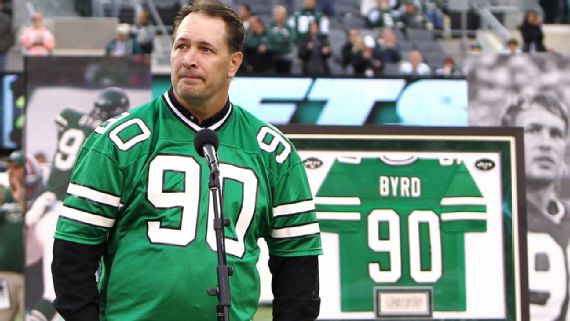
November 29, 1992: The Dennis Byrd Game

November 29, 1992: The New York Jets lose 23-7 to the Kansas City Chiefs at Giants Stadium – and nobody cares. The reason is the injury to Jet defensive tackle Dennis Byrd, the result of a freak accident on the field.

Dennis DeWayne Byrd was born on October 5, 1966 in Oklahoma City, Oklahoma. He grew up in Mustang, Oklahoma, played defensive end at the University of Tulsa (the Golden Hurricane), and was drafted by the New York Jets in the 2nd round of the 1989 NFL Draft.

On November 29, 1992, Byrd was enjoying a modest, not particularly noteworthy career when he took the field against the Kansas City Chiefs at Giants Stadium. Byrd and teammate Scott Mersereau attempted to sack Chiefs quarterback Dave Krieg, but Krieg got away, resulting in a collision between the Jet defenders. Byrd's helmet hit Mersereau straight in the chest, compressing Byrd's neck and breaking a bone in his neck the C-5 veretbra.

This was 1 year and 1 day after Detroit Lions guard Mike Utley had broken his neck in a game, and just 3 days after an emotional Thanksgiving Day game in which Utley guided his wheelchair out to midfield and served as the Lions' Honorary Captain.

Like Utley, Byrd was paralyzed from the neck down as a result of his injury. Utley took years before he could even take a few steps unaided, and, essentially, remained in a wheelchair, although he didn't let that stop him from getting around and raising money for spinal cord research.

Byrd was considerably luckier: With intense physical therapy, he was able to walk to midfield for the Jets' season opener on September 5, 1993, and serve as Honorary Captain. In the meantime, every Jet helmet had a sticker with his uniform number, 90 over an ichthys -- a "Jesus fish," indicative of Byrd's faith. The 1st game after his injury was against the Buffalo Bills, and some of their players wore the logo on their helmets as well.

The Jets announced an annual Most Inspirational Player Award, to be named for him. They also announced that his Number 90 would never be reissued, and on October 28, 2012, it was formally retired.

Byrd was married to Angela Hales, and they had 4 children. He wrote Rise and Walk: The Trial and Triumph of Dennis Byrd. It was made into a TV-movie starring Peter Berg. He coached on high school football staffs in Oklahoma, at Owasso High School and Lincoln Christian School in Tulsa, the latter naming its football stadium for him. He also became a motivational speaker. 

On October 15, 2016, Byrd was driving his 2004 Hummer H2 southbound on Oklahoma State Route 88, between Claremore and Oologah. A 17-year-old kid (whose name, legally, could not be released) from Claremore was driving a 2000 Ford Explorer, and it veered into the oncoming lane, and hit Byrd's Hummer head-on. Byrd was dead on the scene, just past his 50th birthday.

*

November 29, 1992 was a Sunday. These other NFL games were played that day:

* The Washington Redskins beat the Phoenix Cardinals, 41-3 at Robert F. Kennedy Stadium in Washington.

* The Atlanta Falcons beat the New England Patriots, 34-0 at the Georgia Dome in Atlanta.

* The New Orleans Saints beat the Miami Dolphins, 24-13 at the Superdome in New Orleans.

* The Cleveland Browns beat the Chicago Bears, 27-14 at Cleveland Municipal Stadium.

* The Pittsburgh Steelers beat the Cincinnati Bengals, 21-9 at Riverfront Stadium in Cincinnati.

* The Indianapolis Colts beat the Buffalo Bills, 16-13 at the Hoosier Dome in Indianapolis.

* The Green Bay Packers beat the Tampa Bay Buccaneers, 19-14 at Lambeau Field in Green Bay, Wisconsin.

* The San Diego Chargers beat the Los Angeles Raiders, 27-3 at Jack Murphy Stadium in San Diego.

* The Minnesota Vikings beat the Los Angeles Rams, 31-17 at Anaheim Stadium (now Angel Stadium of Anaheim).

* The San Francisco 49ers bear the Philadelphia Eagles, 20-14 at Candlestick Park in San Francisco.

* Three days earlier, on Thanksgiving, the Dallas Cowboys beat the New York Giants, 30-3 at Texas Stadium in the Dallas suburb of Irving, Texas.

* Also on Thanksgiving, the Houston Oilers beat the Detroit Lions, 24-21 at the Silverdome in the Detroit suburb of Pontiac, Michigan.

* And the night after this, on ABC Monday Night Football, the Seattle Seahawks beat the Denver Broncos, 16-13 at the Kingdome in Seattle.

Baseball was out of season. There were 7 games played in the NBA:

* The New York Knicks lost to the Los Angeles Clippers, 101-91 at the Los Angeles Memorial Sports Arena.

* The New Jersey Nets beat the Atlanta Hawks, 108-101 at The Omni in Atlanta.

* The Orlando Magic beat the Golden State Warriors, 126-102 at the Orlando Arena.

* The Houston Rockets beat the Cleveland Cavaliers, 99-92 at The Summit in Houston. (It's now the Central Campus of televangelist Joel Osteen's Lakewood Church.)

* The San Antonio Spurs beat the Dallas Mavericks, 123-95 at the HemisFair Arena in San Antonio.

* The Denver Nuggets beat the Detroit Pistons, 99-87 at the McNichols Arena in Denver.

* And the Chicago Bulls beat the Seattle SuperSonics, 108-99 at the Seattle Center Coliseum. Michael Jordan led all scorers on the day with 35 points.

There was 1 game in the NHL: The Buffalo Sabres beat the Ottawa Senators, 5-2 at the Ottawa Civic Center (now the TD Place Arena).

Friday, November 18, 2022

November 18, 1992: "Seinfeld" Airs the Episode "The Contest"

Top: Michael Richards (left) and Jerry Seinfeld.
Bottom: Jason Alexander (left) and Julia Louis-Dreyfus.

November 18, 1992: The NBC sitcom Seinfeld airs its most famous (or infamous) episode, "The Contest."

Jerry Seinfeld (playing a fictionalized version of himself), his ex-girlfriend and still-friend Elaine Benes (Julia Louis-Dreyfus), and his across-the-hall neighbor Cosmo Kramer (Michael Richards) are having lunch at Monk's Café, near their apartments on the Upper West Side of Manhattan. Jerry's longtime best friend, George Costanza (Jason Alexander), walks in, and confesses that, while visiting his parents in Queens, he used the bathroom, found a magazine with some pictures of beautiful women in it, and, how shall I put this... took matters into his own hands. And his mother caught him.

Why George would mention this while the others were eating, only he knew. But he said he would never do it again. The others don't believe him. Jerry says he can go longer without doing it than George. George says, "Care to make it interesting?" In other words, bet money on it. All four of them get in on it, although George, taking note that it's different for a woman, tells Elaine, "You gotta give us odds!" She offers to put up $150, to the $100 for the guys. ($100 then would be about $210 in 2022 money.)

Jerry had told Kramer, "You'll be out before we get the check!" Sure enough, Kramer is the first to plunk his money down on Jerry's kitchen counter, having seen a naked woman walking around in an apartment across the street from Jerry's. For Jerry, the situation is complicated by this, and also by the fact that he's dating a woman named Marla (played by a pre-Frasier Jane Leeves) who claims to be a virgin. It's never stated whether actually having sex violates the term of the agreement.

In George's case, the situation is complicated by the fact that, after she saw him doing it, his mother was so shocked that she fell, hurt her back, had to be hospitalized, and was given a room alongside a younger woman, who received a daily sponge-bath from a nice-looking nurse. George could only see the silhouettes through a curtain, but he couldn't take his eyes off them.

(This would be lampooned 3 months later, in "The Outing," when a reporter mistakenly believed that Jerry and George were a gay couple, George's mother saw the story in the newspaper, threw her back out again, and, this time, in the bed next-door, there was a buff young man getting a sponge-bath from a buff young male nurse. Again, George could only see the silhouettes through a curtain, but it was bad enough.)

In Elaine's case, the situation is complicated by the fact that John F. Kennedy Jr. is working out at the same gym she goes to. And complicated further by the fact that they start dating, and that JFK Jr. had a reputation for womanizing similar to that of his father. (The actor playing him is not credited, and his face is not shown.)

But, other than Kramer, they all claim that they haven't "caved." The expression "Master of Your Domain" was entered into the American pop-culture lexicon. At Monk's, George claims, "I am King of the County," Jerry claims, "Lord of the Manor," and Elaine claims, "I'm Queen of the Castle."

Well, Elaine caves next, and Jerry says, "Oh, my God, the Queen is dead! I thought you'd make it at least into the Spring!" And one thing leads to another, and, as the show so often did, the strings of the plots run together. Marla is about to let Jerry have sex with her, and he tells her she has no idea of what a relief this is, and that proves to be a mistake, because he has to tell her why. She leaves him, and as she walks out of the building, she runs into JFK Jr., who has gotten tired of waiting for Elaine (who had told him that was her building, which it wasn't), and they end up in bed.

Oddly, the episode ends without revealing whether Jerry or George won. The implication is that, after watching the naked woman across the street together, George went home, and he and Jerry "caved" at the same time. Ten months later, the episode "The Puffy Shirt" aired, and George claimed to have won The Contest. But in the show's finale, when everybody thinks the plane is going to crash, George doesn't want it on his conscience anymore, and confesses to Jerry: "I cheated in The Contest!"

It should be noted that this episode and the 1996 episode "The Abstinence" can't both be canon. In the latter episode, George says, "I can do six weeks while standing on my head. I'm like a sexual camel." Furthermore, in that episode, not getting any action, even on his own, made George stop thinking about sex, and allowed his true brainpower to flourish, and made him smarter almost immediately. In "The Contest," George was just as dumb, and just as obsessed with sex, in the first couple of days. Unless, of course, he had already "cheated."

"The Contest" is one of several "Seinfeld" episodes that’s hard to watch now -- but not, in this case, because of the subject matter. Rather, it's because John F. Kennedy Jr. is a character in it, and he died young, a little more than a year after the show's finale.

*

November 18, 1992 was a Wednesday. This was also the day that DC Comics released Superman #75, featuring the story "The Death of Superman." I have a separate entry for this event. The fact that Jerry Seinfeld is a major Superman fan, with a Superman magnet visible on his refrigerator and other memorabilia in his apartment, makes it even weirder.

Baseball season was over. Football was in midweek. But there were 3 games played in the NBA. The Orlando Magic beat the Philadelphia 76ers, 120-110 at The Spectrum in Philadelphia. The Utah Jazz beat the Boston Celtics, 92-91 at the Boston Garden. The Phoenix Suns beat the Sacramento Kings, 127-111 at the new AmericaWest Arena. (It's now named the Mortgage Matchup Center.)

There were 4 games played in the NHL. The New Jersey Devils beat the Buffalo Sabres, 3-2 at the Brendan Byrne Arena at the Meadowlands. Valeri Zelepukin, Tom Chorske and Alexander Semak scored the goals for New Jersey.

The Minnesota North Stars beat the Washington Capitals, 5-4 at the Capital Centre in the Washington suburb of Landover, Maryland. The Hartford Whalers beat the St. Louis Blues, 5-2 at the Hartford Civic Center. (It's now named the PeoplesBank Arena.) The Edmonton Oilers beat the Vancouver Canucks, 4-2 at the Northlands Coliseum in Edmonton.

None of these games held a moment of silence in memory of Superman before they started. 

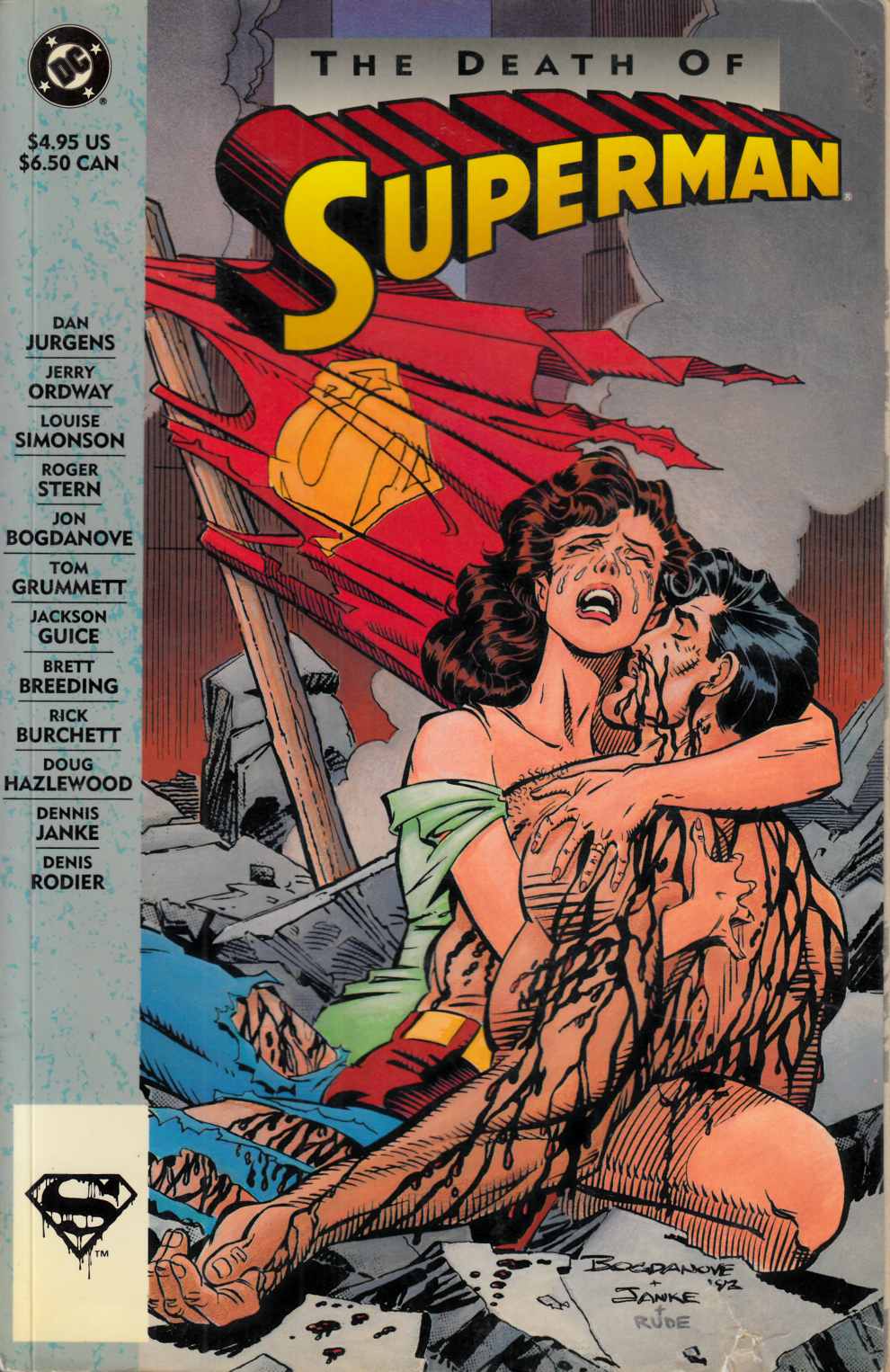
November 18, 1992: The (Temporary) Death of Superman

November 18, 1992: DC Comics publishes Superman #75, titled "The Death of Superman." It was a desperate measure to sell more comic books, and it worked: It remains the biggest-selling single issue in comics history.

For the story, a new character was created. This was a creature from ancient times on Superman's home planet of Krypton, who had somehow come to Earth, and had begun wrecking towns across the Midwest, and moves east toward Metropolis. The Justice League -- without Superman -- collectively takes him on, and he knocks them all out.

That catches Superman's attention, and he tries to stop the creature, whom the media had dubbed "Doomsday." There was a final battle between them at the foot of the Daily Planet Building, where Superman, in his civilian identity of Clark Kent, worked. They beat each other senseless and bloody, their respective Kryptonian strengths overwhelming their respective Kryptonian invulnerabilities, until, at last, each lands a blow to the other's head, and they drop dead. Superman dies in the arms of Lois Lane.
Within the DC Universe, everyone mourns. Dignitaries from all over Earth attend his funeral. So do the Green Lantern Corps. So do representatives of many planets whose people Superman had saved. Apparently, despite the release date, his death took place after the Inauguration of President Bill Clinton on January 20, 1993, because he and First Lady Hillary Clinton were both depicted as speaking at the funeral, rather than the lame-duck President George H.W. Bush and his wife Barbara. But it must still have been in Winter, because snow was falling.

Of course, no one in the real world believed that DC would let Superman stay dead. After all, there had been Jesus and resurrection metaphors for the character before. And plenty of comic book characters, good and evil alike, had been presumed dead, only to return in one form or another.

Sure enough, after a Reign of the Supermen storyline featuring 4 imposters -- one of which became the superhero Steel and another the Teen Titans member Superboy -- Clark's Earth father, Jonathan Kent, had a heart attack, and met Clark in the afterlife, and they convinced each other to come back.

In The Adventures of Superman #505, published in October 1993 -- coinciding with the premiere of the ABC series Lois & Clark: The New Adventures of Superman -- it was confirmed that Superman was alive and back.
Of course, Doomsday didn't stay dead, either. And the story has been adapted, in animated form, in the 2016 film Batman v. Superman: Dawn of Justice, and alluded to in the 2019 CW Arrowverse production of Crisis On Infinite Earths. (UPDATE: In 2024, it was adapted in the 2024 CW Arrowverse show Superman and Lois.)

*

November 18, 1992 was a Wednesday. This was also the day that the NBC sitcom Seinfeld aired its most famous (or infamous) episode, "The Contest." I have a separate entry for this event. The fact that Jerry Seinfeld is a major Superman fan, with a Superman magnet visible on his refrigerator and other memorabilia in his apartment, makes it even weirder.

Baseball season was over. Football was in midweek. But there were 3 games played in the NBA. The Orlando Magic beat the Philadelphia 76ers, 120-110 at The Spectrum in Philadelphia. The Utah Jazz beat the Boston Celtics, 92-91 at the Boston Garden. The Phoenix Suns beat the Sacramento Kings, 127-111 at the new AmericaWest Arena. (It's now named the Mortgage Matchup Center.)

There were 4 games played in the NHL. The New Jersey Devils beat the Buffalo Sabres, 3-2 at the Brendan Byrne Arena at the Meadowlands. Valeri Zelepukin, Tom Chorske and Alexander Semak scored the goals for New Jersey.

The Minnesota North Stars beat the Washington Capitals, 5-4 at the Capital Centre in the Washington suburb of Landover, Maryland. The Hartford Whalers beat the St. Louis Blues, 5-2 at the Hartford Civic Center. (It's now named the PeoplesBank Arena.) The Edmonton Oilers beat the Vancouver Canucks, 4-2 at the Northlands Coliseum in Edmonton.

None of these games held a moment of silence in memory of Superman before they started.

Thursday, November 3, 2022

November 3, 1992: The O'Neill-Kelly Trade

November 3, 1992: The New York Yankees trade center fielder Roberto Kelly and 1st baseman Joe DeBerry to the Cincinnati Reds, in exchange for right fielder Paul O'Neill.
At the time, I thought this was a great trade for both teams. O'Neill was a good hitter and a good fielder, who had done well in Cincinnati, the team he grew up rooting for in Columbus, Ohio. In Cincinnati, he had played for an equally fiery right fielder, his manager, Yankee Legend Lou Piniella. (Sweet Lou doesn't have his Number 14 retired or a Plaque in Monument Park, but he helped the Yankees win 4 Pennants and the YES Network gave him a Yankeeography, so I'm calling him a Yankee Legend -- capital Y, capital L.)
Playing in Yankee Stadium, with the short porch in right field, I figured O'Neill would hit more home runs than in the more neutral confines of Cincinnati's Riverfront Stadium, and that Yankee Fans would love his intense personality.
I was right on both counts, as Paulie was our right fielder for the next 9 years, effectively taking the spot that many fans thought that Jay Buhner should have still had. In those 9 years, the Yankees made the Playoffs 7 times, winning 5 Pennants and 4 World Series. (He also won the Series with the Reds in 1990.) His Number 21 has been retired, and he's been given a Plaque in Yankee Stadium's  Monument Park. He is now a broadcaster for the Yankees' YES Network.
Jay Buhner for Ken Phelps has been mocked as a lousy trade. Think of it, instead, as Jay Buhner for Paul O'Neill: 5 Pennants for New York, none for Seattle.
I also figured that Kelly, a native of Panama and an All-Star in 1992, would find the Reds a better fit. He'd been held back by being a righthanded hitter in Yankee Stadium, where left-center and center fields, while not as pronounced as in the pre-renovation era, was known as Death Valley. Riverfront was not only friendlier to righthanders, but had artificial turf, accommodating his speed. I thought the Reds were getting a great player.
As it turned out, I was wrong on this count. Although he made another All-Star Team with the Reds in 1993, injuries plagued him, and while he was on postseason teams with the 1995 Los Angeles Dodgers, the 1997 Seattle Mariners, and the 1998 and 1999 Texas Rangers, he never played on a Pennant winner. In 2000, the Yankees brought him back, but released him in April, and he never played in the majors again.

A sad story? Not so fast. He managed in the minor leagues, and from 2008 to 2016, he was the 1st base coach and hitting instructor for the San Francisco Giants. With them, he won 3 World Series rings, only 2 fewer than O'Neill. Also on manager Bruce Bochy's staff were former Yankees Dave Righetti, Hensley "Bam Bam" Meulens and Joe Lefebvre. How about that? Kelly now manages the Sultanes de Monterrey in the Mexican League, a team whose 
home uniforms are white with navy blue pinstripes, just like the Yankees. He managed them to a Pennant in 2018.

Not that this gives the Reds any comfort: They still haven't won a Pennant, or even a National League Championship Series game, since 1990. "Curse of Paul O'Neill," Ohio Valley?

*

November 3, 1992 was a Tuesday. It was Election Day, and the Democratic nominee for President, Governor Bill Clinton of Arkansas, defeated the Republican incumbent, President George H.W. Bush. This was also the day that Bill Clinton was elected President. I have a separate entry for that event.


The baseball season was over. Football was in midweek. And there were no NBA games played that day. But there were 5 NHL games:

* The only team from the New York Tri-State Area in action was the New York Islanders, and they lost to the Pittsburgh Penguins, 2-0 at the Civic Arena in Pittsburgh.

* The Quebec Nordiques and the Hartford Whalers played to a tie, 3-3 at the Hartford Civic Center (now the PeoplesBank Arena).

* The Washington Capitals beat the Chicago Blackhawks, 4-1. This was one of the NHL's early-1990s experiments with neutral-site games. It was played at the Market Square Arena in Indianapolis, formerly home to the World Hockey Association's Indianapolis Racers. This made it a lot closer to a home game for the Hawks than it was for the Caps, but the Caps won.

* The expansion Tampa Bay Lightning beat the St. Louis Blues, 6-4 at the Florida State Fairgrounds Expo Hall in Tampa.

* And the Edmonton Oilers beat the expansion Ottawa Senators, 5-2 at the Northlands Coliseum in Edmonton.

November 3, 1992: Bill Clinton Is Elected President

November 3, 1992: Governor Bill Clinton of Arkansas is elected President of the United States, defeating incumbent President George H.W. Bush and computer billionaire H. Ross Perot, who ran an independent campaign.

The popular vote: Clinton, 44.9 million, Bush 39.1 million, Perot 19.7 million. This was the 1st time that over 100 million people voted in a Presidential election. Clinton won 43.0 percent of the vote, Bush 37.4, Perot 18.9. States: Clinton 32, Bush 18, Perot none. Electoral Votes: Clinton 370, Bush 168, Perot none.

At 10:47 PM, Eastern Time, CBS called Ohio for Clinton. That put him over 270 Electoral Votes giving him the win.

It had once been a longshot that things would reach this point. In April 1991, after winning the Persian Gulf War, Bush had an approval rating of 91 percent. And some of the biggest names in the Democratic Party got scared out of running: Senator Bill Bradley of New Jersey, Senator and former Governor Bob Graham of Florida, Representative Pat Schroeder of Colorado; 1988 candidates like the Rev. Jesse Jackson, Representative Dick Gephardt of Missouri, and former Gov. Bruce Babbitt of Arizona; even the 1988 Vice Presidential nominee, Senator Lloyd Bentsen of Texas. Certainly, the defeated 1988 Presidential nominee, former Governor Michael Dukakis of Massachusetts, wasn't going to try again.

Others had good excuses for not running. Senator Ted Kennedy of Massachusetts found his personal life in a mess at that point; Senator Al Gore of Tennessee (a candidate in '88) had to deal with a family emergency at the time his candidacy would have had to start; and Governor Mario Cuomo of New York was facing a budget crisis in his home State, interfering with his ability to file as a candidate, as the deadlines coincided.

That left a comparatively weak field. Senator and former Governor Bob Kerrey of Nebraska, a wounded veteran of the Vietnam War, seemed like a great candidate. But he won only the Primary in neighboring South Dakota, and ran out of money. Doug Wilder of Virginia, the 1st black Governor of a Southern State, didn't get anywhere. Senator Tom Harkin won the Caucuses in his home State of Iowa, but since he had them locked up anyway, nobody else ran there, and so that victory, so meaningful to Jimmy Carter in 1976, may have ended up hurting him.

The Governor of California was a Republican, Pete Wilson, who ended up running in 1996. One of the State's former Governors, Jerry Brown ran, but his image as a flake -- his nickname was "Governor Moonbeam" -- hurt him. By the time campaigning in the New Hampshire Primary got serious, there were only 2 candidates with any traction.

And one of them was Paul Tsongas, a former Congressman from a neighboring State, Massachusetts. Anything he got in New Hampshire could be attributed to proximity. And his location and his Greek ancestry, and his "face made for radio" all evoked Dukakis' failed campaign. At least Dukakis didn't have a speech impediment: Tsongas did.

That left Clinton, who'd been elected Governor of Arkansas in 1978, lost in 1980, regained the office in 1982, and was re-elected in 1984, 1986 (then it became a 4-year term) and 1990. He was young (45), and a good-looking guy whose Southern accent seemed charming. He certainly wasn't a "dumb Southerner": He was a Rhodes scholar at Oxford, with degrees from Georgetown and Yale Law. He seemed like just the guy to break the Republicans' hammerlock on the South, and like just the guy to appeal to young people.

But his youth led to problems. He was the 1st Presidential candidate from the "Baby Boom" generation to be taken this seriously. (Gore tried to be, 4 years earlier, but he didn't get very far, through little fault of his own.) Every President going back to Franklin Roosevelt had some sort of role in World War II. Clinton wasn't even born until after that war. He was the 1st serious candidate where serving in Vietnam, or not, would be a serious issue. And he didn't serve. The way he avoided it was legal, but it was sketchy, and a lot of people who served, or loved someone who served, held that against him.

He was also the 1st Presidential candidate taken this seriously for whom the use of marijuana and other drugs associated with 1960s youth culture were an issue. By his own admission, he handled it badly. But what really threatened to derail him was his lack of marital fidelity. His wife, the former Hillary Rodham, whom he'd met at Yale Law, defended him a joint interview on 60 Minutes, broadcast on CBS after that network broadcast the Super Bowl, so millions were still watching. Her angry defense of him ended up polarizing more people than he did.

But it worked: He finished 2nd to Tsongas in New Hampshire, and the nickname "The Comeback Kid," first used on him when he regained the Governorship 10 years earlier, was revived. The questions about his lovelife, drug use and war avoidance didn't go away, though: It took until June 2, when he won the California Primary, before he clinched the Democratic nomination. (It didn't help that Brown made a big effort to win his home State, but failed.)

But Bush wasn't running away with the race, either. The American economy was in tatters. And a race riot had broken out in Los Angeles on April 29. There was little confidence in him. The conservative wing of the Republican Party had never fully trusted him. When, in June 1990, he saw the recession deepening and the federal budget deficit skyrocketing, he broke his 1988 Republican Convention promise of "Read my lips: No new taxes." Reasonable people realized that he had to do it. But conservatives, as has usually been the case since the Barry Goldwater campaign of 1964, were not interested in being reasonable people.

Pat Buchanan, a journalist who had worked in the Administrations of Richard Nixon (as a speechwriter, with a brief holdover under Gerald Ford) and Ronald Reagan (as White House Director of Communications), had some credibility with the hard right wing, and challenged Bush in the Primaries, gaining 38 percent of the vote in New Hampshire. This pushed Bush to the right for the rest of the campaign: Buchanan "lost the nomination, but won the nominee."

But that pushed moderates, and independents, people who didn't belong to any party, away. So Perot, a Dallas businessman who became a billionaire through early investing in the computer industry, and, years earlier, a household name when he worked to bring prisoners of war back from Vietnam, ran as an independent candidate.

For a while, he was ahead of Clinton in the polls, and not that far behind Bush. People were actually willing to trust a struggling economy, and a quickly-changing "world chessboard," to a completely unqualified, and apparently "nutty" (to use one of Bush's favorite words), businessman, because they no longer trusted the establishments of either major party. Oh yes: Perot also had odd hair.

Sound familiar? Not quite: Unlike Donald Trump, Ross Perot was (as far as we know) faithful to his wife, wasn't obsessed with golf, never acted like he had to be the center of attention, and had never expressed appreciation for foreign dictators. (He did seem to be obsessed with Fidel Castro of Cuba, but in a negative way, which helped feed his paranoia.)

So there it was: Three major candidates for President, and it didn't look like any of them could win -- or should win. Had a more qualified candidate than Buchanan -- say, 1988 Republican candidates Bob Dole or Jack Kemp -- challenged Bush from the right, that candidate might have won the whole thing.

But the night after the California Primary, Clinton stuck around in the Golden State, and appeared as a guest on The Arsenio Hall Show. Hall was the 1st black person to succeed as a late-night talk show host, and had more credibility with young people than did the retiring Johnny Carson, Carson's replacement Jay Leno, or even David Letterman. It is hard to explain to today's kids just how big Arsenio was at that point. After all, he did something neither Carson, nor Leno, nor Letterman ever did: He made a man President. (As much as any man, including the candidate himself, did.)

The show began with Clinton, wearing sunglasses, jamming with The Posse, Arsenio's band, playing "Heartbreak Hotel" by Elvis Presley on the saxophone he'd played since he was a kid. This was considerably hipper than the classical piano playing that Presidents Harry Truman and Nixon had done: This was a President who appreciated rock and roll, which Jimmy Carter and Bush had accepted, but that was about it.

After a careful examination of what Hall called "the smokin' the joint thing," in which Clinton admitted he should've just answered the original question, "Yes," they got serious, talking about job creation and educational opportunities, especially in the inner cities. Hall's Hollywood studio was just a short bus ride from the epicenter of the riot, and Clinton's comments really resonated with his studio audience. Hall brought Hillary on as well, and the appearance helped to humanize her as much as it did him.

At the Democratic Convention at Madison Square Garden in New York, Clinton took Gore, whose family emergency had been resolved, as his Vice Presidential nominee. It was a very inclusive Convention, with Cuomo, Kennedy and Jackson all giving good speeches for Clinton. And then, the morning of the last day of the Convention, Perot dropped out of the race. Suddenly, Clinton had all of the energy, and all of the momentum -- or, as Bush called it in a previous campaign, "The Big Mo."

So the Republican Convention, at the Astrodome in Houston, Bush's adopted hometown, became the nastiest major-party convention ever. (At least, until 2016.) Buchanan gave a speech with the most reluctant of endorsements of Bush, and saying, "There is a religious war going on in our country, for the soul of America." Speaker after speaker ripped the Democrats for favoring civil rights, gay rights, single mothers and public schools -- to the detriment of, respectively, white people, straight people, "traditional families" and religious schools.

It seemed like a Nuremberg rally in 1930s Germany. The Texas-based newspaper columnist Molly Ivins said of Buchanan's speech, and could have said it of others, "It probably sounded better in the original German."

The Republican attacks on Clinton got worse. They even attacked him for a trip he took to the Soviet Union -- in 1969, when he was 23 and a Rhodes scholar at Oxford, 5 years before he ran his 1st campaign for public office. And things got more complicated when Perot got back in the race, resulting in the 1st-ever 3-way Presidential debate.

That happened on October 11, which just happened to be the Clintons' 17th wedding anniversary, at Washington University in St. Louis. In the debate, citing his experience, Bush mentioned the '69 Soviet trip. But, remembering how Bush had done similar things to Dukakis 4 years earlier, Clinton was ready, and he ended Bush's campaign, right there:

When Joe McCarthy went around this country, questioning people's patriotism, he was wrong. He was wrong. And a Senator from Connecticut stood up to him, named Prescott Bush. Your father was right to stand up to Joe McCarthy. You were wrong to attack my patriotism.

If Clinton could stand up to Bush, people realized, he could stand up to nations and terrorist groups that would attack America. 

The 2nd Presidential debate, at Robbins Field House, at the University of Richmond in Virginia, deepened Bush's problems. As moderator Carole Simpson of ABC News solicited a question from the audience in the "town hall" format used for this debate, Bush stood up and looked at his watch. By doing this, he made it look like the debate, facing those undecided voters, wasn’t worth his time.

The question that Simpson received, to be fair, was poorly worded. She had to clarify that the questioner, asking, “How has the national debt personally affected each of your lives?” probably meant, “How has the recession affected you?” Perot answered by saying it made him interrupt what he said was a pretty good life to take on the campaign.

Bush fumbled with his answer, saying, "I think the national debt affects everybody. Obviously, it has a lot to do with interest rates," and then asked, "Are you saying that if a person has means, he can't understand hardship?" When Simpson clarified that the question was really about the recession, Bush went off on a tangent about a visit to a black church, seeming to find his bearings, but still not convincing anyone.

In contrast, when it was his turn, Clinton stood up, and said to the questioner, "Tell me again how it's affected you?" She said she knew people who had lost their jobs. He said that, as Governor, when a business in Arkansas went under, chances were he knew the people who ran it. All the Republican mockery of him being "Governor of a small State" -- according to the 1990 Census, Arkansas was home to 2.35 million people -- paid off at that moment. It was another example of a line Clinton had used in other forums: "I feel your pain."

(The 3rd debate, at Michigan State University in East Lansing, was inconclusive: It was Bush's best performance, but the other two were also judged to have done well.)

The Republican campaign continued to get nastier, but it had little effect. The Republicans made slight gains in each house of Congress, but Clinton won solidly in the popular vote, and overwhelmingly in the Electoral Vote, largely because young people, who hadn't really had a candidate to back since the assassination of Robert Kennedy in 1968, finally had someone who seemed to understand their needs.

To this day, many conservatives blame Perot, with his big spending on October half-hour infomercials full of charts, and his overly folksy manner, for throwing the election to Clinton. This is a stupid idea, mainly because exit polls taken on Election Night showed that about half of Perot's voters wouldn't have voted at all, and the other half were pretty much evenly split between Bush and Clinton.

What's more, those very conservatives pushed Bush too far to the right, making him seem as crazy as they were, when he wasn't. Bush himself ran a bad campaign, looking in his speeches like he'd rather be anywhere else on the planet but at that podium; whereas Clinton looked like he was happy to be among the voters at his rallies. And the economy, though slightly better in the 2nd half of 1992 than it was in the 1st half, was still working against an incumbent; 

Perot finished 2nd in 2 States: Utah, ahead of Clinton; and, surprisingly, Maine, ahead of Bush, who had a family home there. It is possible that Perot siphoned off enough conservative (or, at least, non-liberal) votes to throw the following States to Clinton: Georgia, Kentucky, Montana, Nevada, New Hampshire, possibly New Jersey, and Ohio. That's a shift of 68 Electoral Votes, which would have turned a 370-168 Clinton win into a 302-236 Clinton win. And it could be just as easily argued that Perot siphoned enough votes to swing Arizona, Florida, North Carolina, South Dakota and Texas to Bush. That's 82 EVs: Clinton could have won 452-86.

Perot ran again in 1996, and in the last days, told his audiences that Clinton would have pending criminal charges against him. This turned out not to be true. Perot didn't do nearly as well, but still did well enough to deny Clinton a majority.

He never ran for office again, and endorsed Bush's son, George W. Bush in 2000. He supported Mitt Romney in 2008 (Romney didn't get the Republican nomination for President) and 2012 (he did, but lost to Barack Obama). He did not endorse anyone in 2016, and died in 2019.

George Herbert Walker Bush told his audience in his concession announcement, "I intend to get fully involved in the grandchild business." He certainly did, and kind of became America's Grandpa. Oddly, his son George W. Bush's Presidency, 2001-09, resembled Nixon's and Reagan's -- right down to the international swagger and the domestic corruption -- much more than his father's. Every mistake he made seemed to be the opposite of a decision his father got right. As Dubya's reputation tumbled, his father's rose. Clinton worked with both George Bushes on disaster relief in the 2000s and 2010s. The elder George Bush died in 2018, and was remembered fondly.

In 1990, Time magazine got creative with its Man of the Year distinction: "Men of the Year: The Two George Bushes." The idea was that Bush, working through Operation Desert Shield, the leadup to the Gulf War, which became Operation Desert Storm, was having success; but, also working through the recession, and having to raise taxes, was struggling, so it was as if 2 different men were President. Clinton ran against the "second George Bush," and won, and Time named him Man of the Year for 1992.

In spite of Clinton's win, the Democrats only broke even in the U.S. Senate, and the Republicans gained 9 seats in the House of Representatives. Following the treatment of Dr. Anita Hill in the Senate confirmation hearings for Supreme Court Justice Clarence Thomas, Democrats called 1992 "The Year of the Woman," and among the new Senators elected were Dianne Feinstein (special election) and Barbara Boxer (regularly-scheduled election) in California, Carol Moseley Braun of Illinois, and Patty Murray of Washington.

Bill Clinton's 2 terms were full of controversy, but, in terms of accomplishments and leaving the country better off when he arrived, he was the most successful President since Lyndon Johnson. He fully supported his wife Hillary's political career, and seemed more hurt than she was when the 2016 election was stolen from her.

The 1992 campaign was a very nasty one, or so it seemed by the standards of the time. This built an odd friendship, to the point where both preferred Bill's wife Hillary for President in 2016 -- though that could also be due to how Donald Trump treated Jeb Bush in that year's campaign.

Clinton's Presidential Library opened on November 18, 2004 in Little Rock, Arkansas. And the city's main airport is named Bill and Hillary Clinton National Airport. The headquarters of the Environmental Protection Agency, in Washington, is named the William Jefferson Clinton Federal Building. Clinton remains the only President born in Arkansas, or to represent it in politics.

Aside from the "Presidential City" in Rapid City, South Dakota, the only known statue of Bill Clinton is in Pristina, the capital of Kosovo, a country he helped liberate.
On Saturday Night Live, he was played by Phil Hartman from 1992 to 1994, Michael McKean in the 1994-95 season, and Darrell Hammond has played him ever since. Dennis Quaid played him in The Special Relationship in 2010 -- not about Bill's relationship with Hillary, or with Monica Lewinsky, but about America's relationship with Britain, with Michael Sheen playing Prime Minister Tony Blair.

*

November 3, 1992 was, like all modern Election Days in U.S. history, a Tuesday. This was also the day that the New York Yankees traded Roberto Kelly to the Cincinnati Reds for Paul O'Neill, a major transaction in the Yankees' 1990s restoration. I have a separate entry for that event.

The baseball season was over. Football was in midweek. And there were no NBA games played that day. But there were 5 NHL games:

* The only team from the New York Tri-State Area in action was the New York Islanders, and they lost to the Pittsburgh Penguins, 2-0 at the Civic Arena in Pittsburgh.

* The Quebec Nordiques and the Hartford Whalers played to a tie, 3-3 at the Hartford Civic Center (now the PeoplesBank Arena).

* The Washington Capitals beat the Chicago Blackhawks, 4-1. This was one of the NHL's early-1990s experiments with neutral-site games. It was played at the Market Square Arena in Indianapolis, formerly home to the World Hockey Association's Indianapolis Racers. This made it a lot closer to a home game for the Hawks than it was for the Caps, but the Caps won.

* The expansion Tampa Bay Lightning beat the St. Louis Blues, 6-4 at the Florida State Fairgrounds Expo Hall in Tampa.

* And the Edmonton Oilers beat the expansion Ottawa Senators, 5-2 at the Northlands Coliseum in Edmonton.

Monday, October 31, 2022

October 31, 1992: Rutgers' Halloween Homecoming Thriller

October 31, 1992: Rutgers University plays Virginia Tech in a Halloween Homecoming thriller, in the next-to-last game at the old Rutgers Stadium. The stars of this game, all from New Jersey, were quarterback Bryan Fortay of East Brunswick, running back Bruce Presley of Highland Park, tight end Jim Guarantano of Lodi, and receiver Chris Brantley of Teaneck.

RU fell behind 42-23 in the 3rd quarter, before launching a comeback. With 1:32 left, and Tech leading 49-44, the Scarlet Knights got the ball on their own 22. Among the plays on this drive was a 46-yard pass from Fortay to Mario Henry with 7 seconds left. RU won on the final play, the 4th Fortay-to-Brantley touchdown pass of the game, 50-49. Yes, that score is in football, not basketball.

The shootout featured a combined 1,164 yards of total offense, on 167 plays, with 54 first downs, 10 interceptions and 14 touchdowns.

Rutgers played in the 1st college football game, in 1869. So they have, literally, been playing football longer than anybody in America. This may not be their greatest game in their history, and it certainly isn't the most important (or even the most important one since 1869). But it is the wildest.

RU advanced to 5-3 on the season, and had a shot at winning the Big East Conference title, having already beaten then-Number 15 Syracuse 3 weeks earlier.

But the next week, they lost away to the University of Cincinnati, 26-24, before closing the old Rutgers Stadium the following week with a 13-9 win over West Virginia. The closed the season by beating Temple at Veterans Stadium in Philadelphia. After playing all their home games at the Meadowlands in 1993, the old stadium was demolished, and the new Rutgers Stadium, now named SHI Stadium, opened on the site in 1994.

RU finished 7-4, and were not invited to go to a bowl game. After they lost their season opener, to Boston College, their quarterback, Glenn Foley -- a New Jersey native they let get away, from the Philadelphia suburb of Cherry Hill -- told the media, "The only bowl Rutgers is going to is the one I just got off of." Big talk from a guy whose biggest achievement as a pro was starting 8 games at quarterback for the New York Jets.

*

October 31, 1992 was a Saturday. Among the other college football games played on that Halloween were these:

* Number 1 Miami beat West Virginia, 35-23 at the Orange Bowl in Miami. Miami won the Big East Conference title.

* Number 2 Washington beat Number 15 Stanford, 41-7 at Husky Stadium in Seattle. Washington won the Pacific-Ten title.

* Number 3 Michigan beat Purdue, 24-17 at Ross-Ade Stadium in West Lafayette, Indiana. Michigan won the Big Ten title, but lost the Rose Bowl to Washington.

* Number 4 Alabama had the week off. They went on to win the Southeastern Conference title, rising to Number 2, then beat Alabama in the Sugar Bowl for the National Championship.

* Number 5 Texas A&M beat Southern Methodist (SMU), 41-7 at the Cotton Bowl in Dallas. A&M won the Southwest Conference title.

* Number 6 Florida State beat Number 23 Virginia, 13-3 at Scott Stadium in Charlottesville, Virginia. Florida State won the Atlantic Coast Conference title.

* Number 7 Georgia were upset by Number 20 Florida, 26-24 at the Gator Bowl in Jacksonville. Florida won the SEC Eastern Division title, but lost the SEC Championship Game to Alabama. They returned to the Gator Bowl stadium to play the game of the same name, and beat North Carolina State. Georgia beat Ohio State in the Florida Citrus Bowl.

* Number 8 Nebraska beat Number 9 Colorado, 52-7 at Memorial Stadium in Lincoln, Nebraska. Nebraska won the Big Eight Conference title, but lost the Orange Bowl to Florida State. Colorado went to the Fiesta Bowl, where they lost to Syracuse.

* Number 10 Notre Dame beat Navy, 38-7 at Giants Stadium in the Meadowlands. Notre Dame went to the Cotton Bowl, and beat Texas A&M.

* Number 14 Penn State were upset by Brigham Young University (BYU), 30-17 at Cougar Stadium (now LaVell Edwards Stadium) in Provo, Utah.

* Number 16 Tennessee were upset by South Carolina, 24-23 at Williams-Brice Stadium in Columbia, South Carolina.

* Number 19 Washington State were upset by Oregon, 34-17 at Martin Stadium in Pullman, Washington.

* Army beat Eastern Michigan, 57-17 at Michie Stadium in West Point, New York.

Baseball season was over. The NBA season started 6 days later. There were 10 games played in the NHL:

* In an "Original Six" matchup, the New York Rangers lost to the Montreal Canadiens, 4-3 at the Montreal Forum.

* The New Jersey Devils beat the New York Islanders, 5-3 at the Nassau Coliseum.

* The Quebec Nordiques beat the Winnipeg Jets, 3-2 at the Colisée de Québec.

* In another "Original Six" matchup, the Chicago Blackhawks beat the Boston Bruins, 3-2 at the Boston Garden.

* The Los Angeles Kings beat the Hartford Whalers, 7-1 at the Hartford Civic Center (now the PeoplesBank Arena).

* The Buffalo Sabres and the Ottawa Senators played to a tie, 2-2 at the Ottawa Civic Centre (now the TD Place Arena).

* The 2 remaining "Original Six" teams also played each other, as the Toronto Maple Leafs beat the Detroit Red Wings, 3-1 at Maple Leaf Gardens in Toronto.

* The St. Louis Blues beat the Philadelphia Flyers, 6-4 at the St. Louis Arena.

* The Calgary Flames beat the Minnesota North Stars, 5-3 at the Saddledome in Calgary.

* And the Edmonton Oilers beat the Washington Capitals, 4-2 at the Northlands Coliseum in Edmonton.
December 31, 1999 & January 1, 2000: The Millennium

December 31, 1999:  The Millennium arrives. The people of planet Earth survived. At a terrible cost. But we hadn't destroyed ourselves. ...