Showing posts with label muhammad ali. Show all posts

Sunday, October 30, 2022

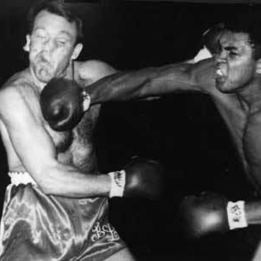
October 30, 1974: The Rumble In the Jungle

October 30, 1974: "The Rumble in the Jungle" is held in Kinshasa, in the former colony of Belgian Congo, at this point called Zaire, and since 1997 called the Democratic Republic of the Congo.

George Foreman was the undefeated, undisputed Heavyweight Champion of the World, 40-0,  and heavily favored to defeat former champion Muhammad Ali, 44-2. Ali was talking his usual trash, but most people thought Ali would lose. Indeed, there were some who feared that Ali would be killed in the ring.
The referee was Zack Clayton, who had played in baseball's Negro Leagues, and for one of the great pre-NBA all-black teams, the New York Renaissance Five.
Ali fooled them all. People who say Ali just leaned against the ropes in his "rope-a-dope" strategy and let Foreman tire himself out with punches are fools. I've seen the tape of the fight: Ali got in a lot of punches, enough to win every round except for the 2nd and the 6th.

Foreman would later tell an interviewer that, at the end of the 6th, Ali yelled at him, "Is that all you got, George?" And Foreman had to admit, "Yup, that's about it."

Through a months-long psychological campaign, including practically the entire black population of the continent of Africa in his favor and against the equally black Foreman – he had done something similar to Joe Frazier, who was puzzled by it: "I'm darker than he is!" – Ali had gotten into Foreman's head, just as he had done to Sonny Liston, Floyd Patterson, and just about everybody else he'd ever fought.

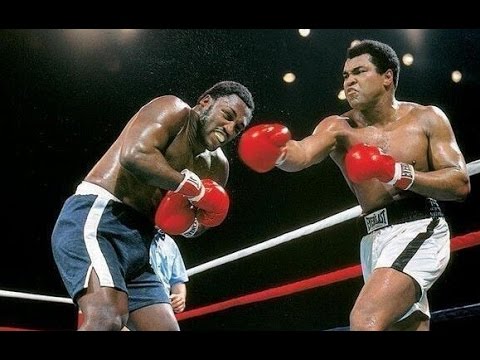
In the 8th round, backed up against the ropes, Ali managed to turn an exhausted Foreman around, toss a few jabs, and knock him on his can. Foreman tried to get up, but he ran out of time, and Ali was the winner by a knockout.

When David Frost went to interview him for the BBC after the fight, he pointed at the camera and said, "Is this thing on? I told you all that I was the greatest of all time when I beat Sonny Liston! I am still the greatest of all time! Never again doubt me! Never again make me an underdog until I'm about 50 years old!"

He was off a bit, as he probably should have quit at 36, after losing the title to Leon Spinks and then regaining it from him. But, by far more than his boxing prowess, by the force of his personality, and by the example he set as a man of (at least, in America) a minority race and a minority religion, making him, somewhat contradictorily, the champion of the underdog, he proved that he really was The Greatest... Of All Tiiiiiiiime!
He still is. He appeared on the cover of Sports Illustrated 40 times, more than any person before him, including its 1974 Sportsman of the Year issue. Only Michael Jordan, with 50 covers, has surpassed him as of October 30, 2022. No, not Tom Brady, not LeBron James, not even Tiger Woods. And "The Dreaded SI Cover Jinx" never seemed to affect him, until his 1980 comeback attempt against Larry Holmes. Given every factor that was against Ali, it's hard to say the jinx mattered.
Built in 1952 under Belgian rule as the Stade Roi Baudouin, the site of the fight was renamed Stade du 20 Mai (for May 20, the anniversary of the founding of Zaire's ruling party) in 1967, and Stade Tata Raphaël (Father Raphael Stadium) in 1997, after the death of dictator Mobutu Sese Seko.
*

October 30, 1974 was a Wednesday. The baseball season had been over for 2 weeks, as the Oakland Athletics had beaten the Los Angeles Dodgers in the World Series. And it was the middle of the wee, so there were no NFL games played.

But there were 7 games played in the NBA that night:

* The New York Knicks lost to the Washington Bullets, 94-86 at the Capital Centre in the Washington suburb of Landover, Maryland. Walt Frazier scored 24 points, but it wasn't enough for the Knickerbockers.

* The Chicago Bulls beat the Boston Celtics, 105-104 at the Boston Garden.

* The Phoenix Suns beat the Philadelphia 76ers, 104-99 at The Spectrum in Philadelphia.

* The Atlanta Hawks beat the Detroit Pistons, 104-96 at Cobo Hall in Detroit.

* The Houston Rockets beat the New Orleans Jazz, 113-100 at the Municipal Auditorium in New Orleans.

* The Kansas City-Omaha Kings beat the Milwaukee Bucks, 99-97 at the Kemper Arena in Kansas City.

* And the Seattle SuperSonics beat the Los Angeles Lakers, 117-97 at the Seattle Center Coliseum.

There were also 5 games played that night in the American Basketball Association:

* The New York Nets beat the Utah Stars, 95-91 at the Salt Palace in Salt Lake City. Julius "Dr. J" Erving scored 36 for the Nets.

* The Virginia Squires beat the Indiana Pacers, 114-111 at the Scope in Norfolk, Virginia.

* The Kentucky Colonels beat the San Diego Conquistadors, 97-94 at Freedom Hall in Louisville.

* The Denver Nuggets beat the Memphis Sounds, 105-95 at the Mid-South Coliseum in Memphis.

* And the San Antonio Spurs beat the Spirits of St. Louis, 135-98 at the HemisFair Arena in San Antonio.

There were 4 games played in the NHL that night:

* The New York Rangers and the New York Islanders played to a tie, 1-1 at Madison Square Garden. 

* The Chicago Black Hawks and the Montreal Canadiens played to a tie, 4-4 at the Montreal Forum.

* The Atlanta Flames beat the California Golden Seals, 4-1 at The Omni in Atlanta.

* The Boston Bruins and the Minnesota North Stars played to a tie, 3-3 at the Metropolitan Sports Center in the Minneapolis suburb of Bloomington, Minnesota.

And there were 4 games played in the World Hockey Association:

* The New England Whalers beat the Toronto Toros, 5-2 at the Eastern States Coliseum, a.k.a. the Big E Coliseum, in Springfield, Massachusetts.

* The Houston Aeros beat the Chicago Cougars, 1-0 at the Sam Houston Coliseum in Houston.

* The Winnipeg Jets beat the Phoenix Roadrunners, 6-5 in overtime at the Winnipeg Arena.

* And the Vancouver Blazers beat the Edmonton Oilers, 8-6 at the Pacific Coliseum in Vancouver. 

Saturday, October 29, 2022

October 29, 1960: The Cal Poly Plane Crash & Ali's Pro Debut

October 29, 1960: A C-46 plane crashes during takeoff near Toledo, Ohio, killing 22 people, including 16 players for the football team at California Polytechnic State University of San Luis Obispo. The school popularly known as "Cal Poly" should not be confused with the California Institute of Technology, a.k.a. "Caltech," in Pasadena.

They had just lost 50-6 to a Bowling Green team that featured future actor Bernie Casey. An investigation revealed that the plane was overloaded, weighing over 2,000 pounds more than it should have. Fog was also a factor: It was so bad that the City of Toledo suspended taxi service for the night.

Amazingly, 26 people on board survived, including quarterback Ted Tollner, who went on to coach USC from 1983 to 1986. "I was the cutoff for who lived and died," Tollner said in a 2006 interview. "Everyone in front of me died. Everyone behind me survived." Of the 26 survivors, 13 attended a 50th Anniversary memorial service in 2010.
Cal Poly, then an NCAA Division II school, was 1-5, and it canceled the rest of its season. The Mustangs would bounce back in 1961, going 5-3. As recently as 1957 and '58, they had gone 17-2, with a team that included an offensive tackle who would make his mark in pro football, not as a player, but as a coach, broadcaster and video game impresario: John Madden.
The school won the Division II National Championship in 1980, and is now in the Football Championship Subdivision (FCS), formerly known as Division I-AA, having most recently made the Playoffs in 2016.
*
October 29, 1960 was a Saturday. The next-biggest sporting event occurring that day would not be thought of as such for a few more years. Cassius Clay, coming off his Olympic Gold Medal in Rome, has his 1st professional fight, in his hometown of Louisville, Kentucky. He fights Tunney Hunsaker, the fight goes the maximum 6 rounds, and Clay wins a unanimous decision. He later admitted that he wasn't prepared to face a professional fighter, and that Hunsaker gave him one of the hardest body blows he would ever receive.
Not an especially interesting beginning for the man who will become Muhammad Ali, one of the most interesting people who has ever lived. Hunsaker, a U.S. Air Force veteran, returned to his native West Virginia, and was named a police chief at age 27, serving for 38 years. He and Ali stayed in touch and became friends. Hunsaker disagreed with Ali's decision to refuse being drafted, but he respected Ali's dedication to principle. Hunsaker died in 2005.
Among the other college football games played that day:
* Number 1 Iowa beat Number 19 Kansas, 21-7 at Iowa Stadium (renamed Kinnick Stadium in 1972).
* Number 2 Mississippi (Ole Miss) and Louisiana State (LSU) played to a tie, 6-6 at Hemingway Stadium (renamed Vaught-Hemingway Stadium in 1982) in Oxford, Mississippi.
* Number 3 Syracuse were upset by the University of Pittsburgh, 10-0 at Archbold Stadium in Syracuse, New York.
* Number 4 Navy beat Notre Dame, 14-7 at Philadelphia Municipal Stadium (renamed John F. Kennedy Stadium in 1964). Also among the service academies, Army beat Miami University of Ohio, 30-7 at Michie Stadium in West Point, New York; and Air Force lost to George Washington University, 20-6 at Falcon Stadium in Colorado Springs, Colorado. 
* Number 5 Missouri beat Nebraska, 28-0 at Memorial Stadium in Lincoln, Nebraska.
* Number 6 Minnesota beat Kansas State, 48-7 at Memorial Stadium in Minneapolis.
* Number 7 Baylor were upset by Texas Christian University (TCU), 14-6 at Amon G. Carter Stadium in Fort Worth, Texas.
* Number 8 Ohio State beat Number 10 Michigan State, 21-10 at Spartan Stadium in East Lansing, Michigan.
* Number 9 Washington beat Oregon, 7-6 at Husky Stadium in Seattle.
* In a crosstown rivalry that no longer plays football, but is still a nasty one in basketball, Xavier beat the University of Cincinnati, 5-0 at Nippert Stadium in Cincinnati.
* And in New Jersey, Princeton beat Brown, 54-21 at Palmer Stadium in Princeton; and Rutgers lost to Villanova, 14-12 at Rutgers Stadium in Piscataway.
There were 4 NBA games played that day:
* The New York Knicks lost to the Detroit Pistons, 115-110 at the Olympia Stadium in Detroit.
* The Philadelphia Warriors beat the Boston Celtics, 1341-103 at the Boston Garden.
* The Syracuse Nationals beat the Los Angeles Lakers, 125-118 at the Onondaga County War Memorial (now the Upstate Medical University Arena) in Syracuse, New York.
* And the St. Louis Hawks beat the Cincinnati Royals, 113-97 at the Kiel Auditorium in St. Louis.
Two games were played in the NHL. The Montreal Canadiens beat the Boston Bruins, 3-2 at the Montreal Forum. And the Toronto Maple Leafs beat the Chicago Black Hawks, 8-4 at Maple Leaf Gardens in Toronto. The New York Rangers and the Detroit Red Wings were not scheduled.
And Michael Carter was born that day, becoming a defensive tackle who won 3 Super Bowls with the San Francisco 49ers.

Sunday, October 2, 2022

October 2, 1980: Muhammad Ali's Last Stand

Even in defeat, Ali was the main story,
not the man who actually won the fight.

October 2, 1980: Muhammad Ali, 38 years old, tries to win the Heavyweight Championship of the World for the 4th time.
Sugar Ray Robinson and Archie Moore had been champion boxers in their 40s, but it was a mistake for Ali to even think about getting back in the ring. He is already beginning to show signs of Parkinson's disease, from the poundings he had taken in the ring from 1975 to 1978.
He hadn't fought in 2 years. He has gotten his weight down to 217 1/2 pounds, his lowest since he won the title for the 2nd time, from George Foreman in 1974. But, at the same time, he'd lost too much weight too fast, and it had drained him, as it had Jim Jeffries against Jack Johnson in 1910, and Joe Louis against Rocky Marciano in 1951.
And he was facing Larry Holmes, who was 30, and 35-0, with 26 knockouts. The native of Easton, in northeastern Pennsylvania, was already known as "The Easton Assassin," and had beaten Earnie Shavers, who nearly beat Ali in 1977, twice; Ken Norton, who beat Ali in 1973, lost to him later that year, and nearly beat him in 1976; Alfredo Evangelista, whom Ali beat in 1977; and Mike Weaver, who would later win a share of the Heavyweight Championship.
The fight was held at the outdoor boxing stadium at Caesar's Palace, outside Las Vegas in Paradise, Nevada. It was a mismatch: Holmes won each of the 1st 10 rounds, and Ali looked like, in boxing terms, a very old man. His trainer, Angelo Dundee, stopped the fight. It was the only time in his 61 professional fights that The Greatest neither won nor at least went the distance.
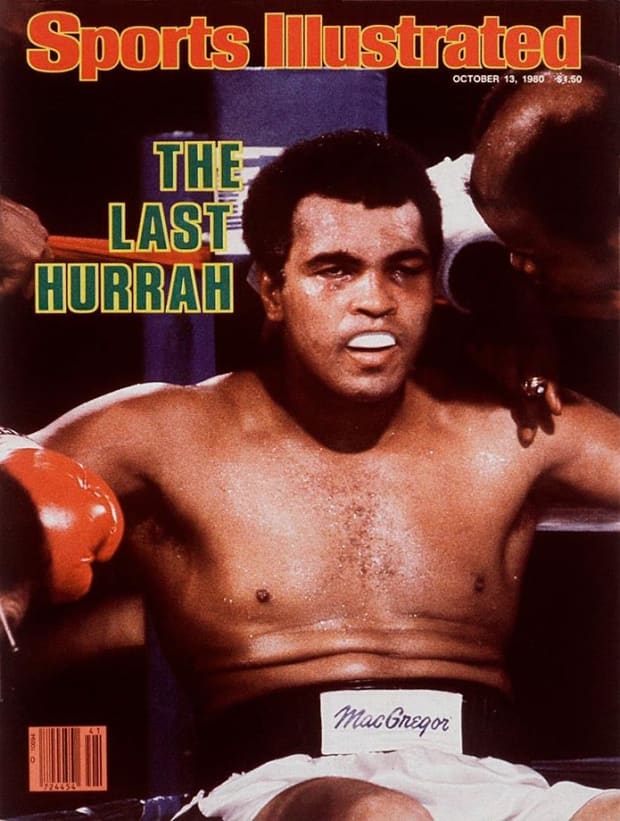
For the only time in its history, Sports Illustrated put the loser, but not the winner, of a prizefight on its cover, with the headline "THE LAST HURRAH," invoking Edwin O'Connor's 1956 novel about an aging politician in his last campaign. Ali had lost 3 times before, but this was the first time he had truly looked like a beaten man. The expression on his face in the cover photo shows that he knew it. For its article on the fight, SI titled it "Doom In the Desert."
Like the rising Marciano, when he inflicted a similar punishment on the aging Louis in 1951, Holmes was seen crying after his victory. He gained very little from the win, and may even have lost respect from many of Ali's fans. This was unfair: If there's anybody with whom they should have been angry, it should have been Ali, for even trying this fight.
Father Time doesn't always win, but he always wins the rematch. Watching this was like watching Elvis in Omaha in the last TV special.
And still, Ali fought once more, on December 11, 1981, losing to Trevor Berbick in Nassau. It became known as "The Trauma in Bahama." That fight may have damaged him even further. He did as much good as he could in the last 34 years of his life, but Parkinson's severely limited this. He really should have quit after the 3rd fight with Joe Frazier in 1975, "The Thrilla in Manila."
*
October 2, 1980 was a Thursday. Football was in midweek, and the NBA and the NHL were in their preseasons. These Major League Baseball games were played:
* The New York Yankees beat the Detroit Tigers, 3-2 at Yankee Stadium. Ron Guidry outpitched Jack Morris, and was supported by home runs from Reggie Jackson and Oscar Gamble.
* The Boston Red Sox beat the Toronto Blue Jays, 4-1 at Fenway Park in Boston. Carl Yastrzemski did not play.
* The Philadelphia Phillies beat the Chicago Cubs, 4-2 at Veterans Stadium in Philadelphia.
* The Chicago White Sox beat the Oakland Athletics, 9-4 at Comiskey Park in Chicago. Rookie Rickey Henderson went 2-for-5 with a home run and 3 RBIs, but no stolen bases.
* The Kansas City Royals beat the Seattel Mariners, 6-2 at Royals Stadium (later Kauffman Stadium) in Kansas City. George Brett went 0-for-2 with a walk, and an RBI on a sacrifice fly. His batting average, which had been up to .401 in early September, dropped to .389, and he would finish at .390.
* The Minnesota Twins swept a doubleheader from the Texas Rangers, 6-3 and 4-1 at Arlington Stadium in the Dallas suburb of Arlington, Texas.
* The Houston Astros beat the Atlanta Braves, 3-2 at the Astrodome in Houston.
* The San Francisco Giants beat the Los Angeles Dodgers, 3-2 at Candlestick Park in San Francisco.
* And the New York Mets, the Baltimore Orioles, the California Angels, the Cincinnati Reds, the Cleveland Indians, the Milwaukee Brewers, the Montreal Expos and the San Diego Padres were not scheduled.

Saturday, October 1, 2022

October 1, 1977: Pelé's Testimonial

October 1, 1977: Edson Arantes do Nascimento, a.k.a. Pelé, the greatest soccer player who ever lived, plays his last game at a sold-out Giants Stadium in East Rutherford, New Jersey. It is his testimonial, and he plays the 1st half for the New York Cosmos, with whom he recently won the North American Soccer League Championship, and scores a goal; and the 2nd half for Santos, for whom he starred so long in Brazil's São Paulo State. The Cosmos win, 2-1.

When it's over, he stands at midfield with a microphone, and asks the crowd, "Please, say with me, three times: Love! Love! Love!" They do.

President Jimmy Carter attended. So did Muhammad Ali, the Heavyweight Champion of the World, who frequently called himself "the Greatest of All Time." This time, he says, "Now, I understand: He is greater than me."

*

October 1, 1977 was a Saturday. These Major League Baseball games were played that day:

* The New York Yankees lost to the Detroit Tigers, 10-7 at Yankee Stadium. Elrod Hendricks, briefly a Yankee in a long career mostly with the Baltimore Orioles, hit his only home run in Pinstripes. Reggie Jackson drew a walk in his only plate appearances, and was taken out for a pinch-runner.

The rain that fell on Pelé's testimonial at the Meadowlands comes down much harder on The Bronx, as the Yankees sit through a 2-hour, 42-minute rain delay. But the Yankees clinched the American League Eastern Division title anyway, because...

* The Baltimore Orioles beat the Boston Red Sox, 8-7 at Fenway Park in Boston. The Sox had eliminated the O's from the race the night before, and the Birds returned the favor on this day. Both teams would end up 2 1/2 games behind the Yankees.

* A doubleheader was split at Busch Memorial Stadium in St. Louis. The New York Mets won the 1st game, 8-4. The St. Louis Cardinals won the 2nd game, 4-2. Lou Brock went 2-for-8 with an RBI over the 2 games.

* The Montreal Expos beat the Philadelphia Phillies, 6-5 at Veterans Stadium in Philadelphia. The Expos scored 3 runs in the top of the 12th inning, and the Phillies could only come back with 2 in the bottom of the 12th. Mike Schmidt went 0-for-2 with a walk.

* The Cincinnati Reds beat the Atlanta Braves, 6-2 at Riverfront Stadium in Cincinnati. Pete Rose went 1-for-3, and did not finish the game. Johnny Bench did not start the game, and went 0-for-2.

* A doubleheader was split at Comiskey Park in Chicago. The expansion Seattle Mariners won the opener, 5-3. The Chicago White Sox won the nightcap, 6-1.

* The Minnesota Twins beat the Milwaukee Brewers, 9-1 at Milwaukee County Stadium. Rod Carew went 3-for-5 with an RBI, to raise his batting average to .386. He would finish the next day at .388, after having been above .400 in early September. Robin Yount went 1-for-4 with an RBI.

* The California Angels beat the Kansas City Royals, 4-1 at Royals Stadium (now Kauffman Stadium) in Kansas City. George Brett went 1-for-2 with a walk before being replaced by a pinch-runner. The Yankees would beat the Royals for the AL Pennant.

* The Texas Rangers beat the Oakland Athletics, 6-5 at Arlington Stadium in the Dallas suburb of Arlington, Texas.

* The Los Angeles Dodgers beat the Houston Astros, 4-3 at Dodger Stadium in Los Angeles. The Dodgers would beat the Phillies for the National League Pennant, but lose the World Series to the Yankees.

* The San Francisco Giants beat the San Diego Padres, 13-4 at Candlestick Park in San Francisco.

* The Cleveland Indians and the expansion Toronto Blue Jays were rained out at Exhibition Stadium in Toronto. They played a doubleheader the next day. The Jays won the 1st game, 2-1 in 11 innings. The Indians won the 2nd game, 5-4.

* The Chicago Cubs and the Pittsburgh Pirates were rained out at Three Rivers Stadium in Pittsburgh. They played a doubleheader the next day. The Pirates swept, 5-1 and 3-2.

There were also college football games played on this day, including the following:

* Number 1 Oklahoma beat Kansas, 24-9 at Owen Field in Norman, Oklahoma. Oklahoma won the Big Eight title. 

* The night before, Number 2 Southern California beat Washington State, 41-7 at the Los Angeles Memorial Coliseum.

* Number 3 Michigan beat Number 5 Texas A&M, 41-3 at Michigan Stadium in Ann Arbor.

* Number 4 Penn State were upset by Kentucky, 24-20 at Beaver Stadium in State College, Pennsylvania.

* Number 6 Ohio State beat Southern Methodist (SMU), 35-7 at the Cotton Bowl in Dallas.

* Number 7 Colorado beat Army, 31-0 at Michie Stadium in West Point, New York.

* Number 8 Texas beat Rice, 72-15 at Memorial Stadium in Austin. While the Longhorns had running back Earl Campbell, who went on to win the Heisman Trophy, the big story in this game was placekicker and punter Russell Erxleben, who set a record with a 67-yard field goal. The record would be tied twice within the next year and change, but never broken, partly because kicking tees have been banned.

Erxleben remains the only punter to be a 3-time All-American, and played 5 seasons for the New Orleans Saints, plus 1 as a "scab" for the Detroit Lions during the 1987 strike. He went into the securities business, and has twice served time in prison for fraud. His son, Ryan Erxleben, went into the family business -- punting, that is, not securities (fraudulent or otherwise), at Texas Tech, although he didn't make it to the NFL. 

* Number 9 Florida were upset by Louisiana State, 36-14 at Tiger Stadium in Baton Rouge, Louisiana.

* Number 10 Alabama beat Georgia, 18-10 at Bryant-Denny Stadium in Tuscaloosa, Alabama. 'Bama won the Southeastern Conference title, and beat Ohio State in the Sugar Bowl.

* Number 11 Nebraska beat Indiana, 31-13 at Memorial Stadium in Lincoln, Nebraska.

* Number 12 Arkansas beat Texas Christian (TCU), 42-6 at Amon G. Carter Stadium in Fort Worth, Texas. Arkansas went on to lose to Texas, costing them the Southwest Conference title, but beat Oklahoma in the Orange Bowl.

* Number 14 Notre Dame beat Michigan State, 16-6 at Notre Dame Stadium in South Bend, Indiana.

* Number 20 Arizona State were upset by Missouri, 15-0 at Sun Devil Stadium in the Phoenix suburb of Tempe, Arizona.

* The University of Washington lost to Minnesota, 19-17 at Memorial Stadium in Minneapolis. But Washington rebounded to win the Pacific-8 title, and beat Michigan in the Rose Bowl.

* Duke beat Navy, 28-16 at Wallace Wade Stadium in Durham, North Carolina.

* Columbia beat Pennsylvania, 30-18 at Baker Field in Manhattan.

* Among New Jersey's teams, Rutgers beat Cornell, 30-14 at Schoellkopf Field in Ithaca, New York. And Princeton lost to Brown, 10-7 at Brown Stadium in Providence, Thode Island.

Also on this day, the St. Louis Blues retired the Number 3 of Bob Gassoff, a defenseman who'd been with them since 1973. The preceding May 27, he was killed in a motorcycle accident in Gray Summit, Missouri. He'd been racing motorcycles with friends at a barbecue at the home of teammate Garry Unger, but had driven off the property, wasn't wearing a helmet, and was hit by a car. The native of Quesnel, British Columbia was only 26.

In high school football, my Alma Mater, East Brunswick High School in Central New Jersey, beat Madison Central, 28-0 at Vince Lombardi Field in Old Bridge. Madison Central is now named Old Bridge.

And in English soccer, Arsenal of North London beat West Ham United of East London, 3-0 at Highbury in North London.

October 1, 1975: The Thrilla In Manila

October 1, 1975: Heavyweight Champion Muhammad Ali fights former Heavyweight Champion Joe Frazier for the 3rd time, at the Araneta Coliseum in Quezon City, the capital of the Philippines. Quezon City is the national capital, and the arena is located about 5 miles east of the country's largest city, Manila.

Ali, under his birth name Cassius Clay, was an Olympic Gold Medalist in boxing, in 1960 in Rome. Frazier was as well, in 1964 in Tokyo. A man they would both memorably fight, George Foreman, followed them, in 1968 in Mexico City.

Ali first won the title in 1964 by knocking out Sonny Liston. He held it until he was stripped of it in 1967, for refusing to accept the U.S. military draft. Foreman won what was essentially a tournament for the title, ending in 1970 with a win over top contender Jimmy Ellis.

Ali got his conviction overturned by the Supreme Court, and his boxing license restored -- but not his title. That, he would have to win back. When he and Frazier met for "The Fight of the Century" at Madison Square Garden in 1971, it was the 1st time 2 undefeated Heavyweight Champions had ever met in the ring. It was a hard, even fight until the 15th and final round, when a classic Philly left hook floored the Louisvillian, and Ali received his first-ever knockdown, from which he got up to finish the fight, and his first-ever professional loss.

Ali got revenge in 1974, also at The Garden, although neither man was champion at the time. Frazier had lost the title in 1973 to Foreman, whom Ali subsequently beat to regain the title in Kinshasa, Zaire (now the Democratic Republic of the Congo), the fight known as "The Rumble In the Jungle."

Ali mocked Frazier for his fighting ability and his looks, saying, "It'll be a thrilla and a chilla and a killa, when I get the Gorilla in Manila!"

But it was intensely hot inside the Coliseum when "The Thrilla In Manila" was fought. Still, like the other 2 Ali-Frazier fights, it lived up to the hype. Ali led in the early rounds, but in the 5th round, Frazier began to turn the tide. At the end of the 6th, Ali, who'd been trash-talking (as we would say today) all the way, yelled, "They told me Joe Frazier was washed up!" Frazier yelled back, "They lied!"

Ali won the 8th round, but Frazier clobbered him in the 9th, leading him to go back to his corner and tell his trainer, Angelo Dundee, "Man, this is the closest I've ever been to dying." But Ali had landed so many punches that Frazier's face was swelling, and he was having trouble seeing.

Early in the 13th round, Ali hit Frazier in the jaw with a thunderous right hook, sending Frazier's mouthpiece flying out of his mouth and out of the ring. Ali dominated the 14th as well, because Frazier was too tired and having too much difficulty seeing. Ali was hitting Frazier with the same kind of punches that knocked out Foreman a year earlier. Except, when Ali knocked Foreman out, it took just a few seconds. He had been throwing these things at Frazier for the last 2 rounds, and Frazier simply would not go down.

Frazier had more courage and endurance than sense, and refused to go down, and refused to quit. As the 15th and final round approached, Frazier wanted to continue. His trainer, Eddie Futch, told him that he was going to stop the fight. Frazier said no: "I want him, boss." He was unable to talk Futch out of it: "The fight's over, Joe. No one will forget what you did here today." And he told the referee, Carlos Padilla, to stop the fight. Padilla did so.

Ali retained the crown, the belt, the title, whatever you want to call it. He got up off his stool, raised his right arm in victory... and collapsed. He had nothing left to give. If Futch had let Frazier fight the 15th round, he would have knocked Ali out.

It's been called the greatest prizefight in history. Today, most people know the name Manila for 3 things: The brown office folders that bear its name, its role in the Pacific Theater of World War II, and Ali-Frazier III.

Howard Cosell, who covered the fight for ABC Wide World of Sports, later said, "A big piece of Ali remained in that ring." Indeed, at age 33, with nothing left to prove, Ali probably should have retired right there. Instead, he kept fighting for 6 more years. So did Frazier. Both men would have their moments, but neither was ever so good again.
"The Greatest of All Time" developed Parkinson's disease as a result of his taking so many blows to the head. The big mouth that got him the early nickname "The Louisville Lip" was rendered mostly silent by the turn of the 21st Century. He died on June 3, 2016, at age 74.

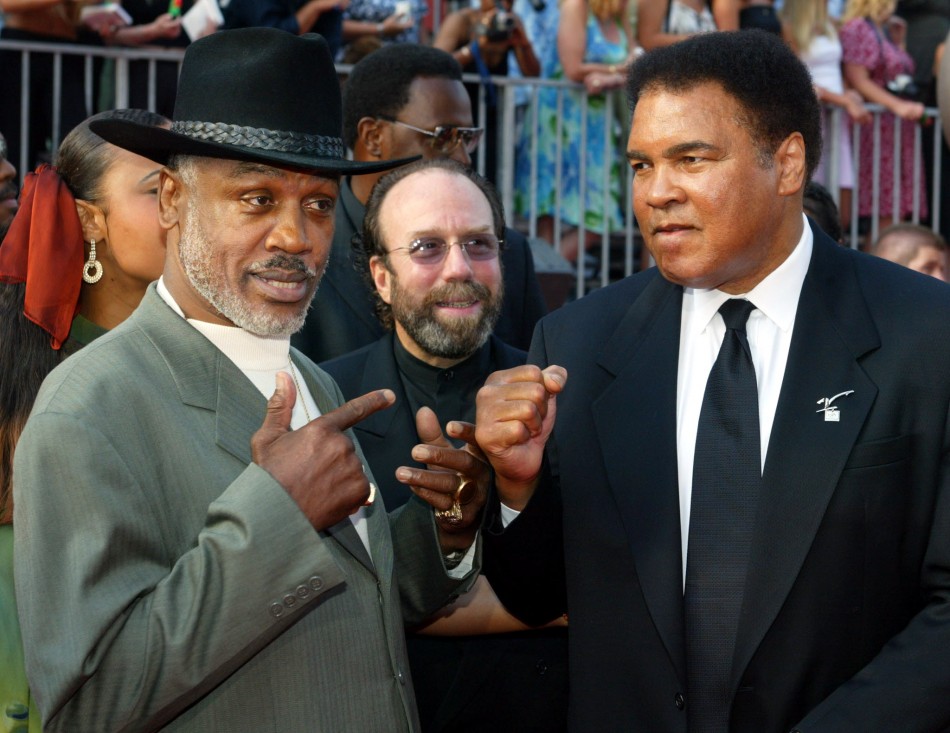
"Smokin' Joe" would continue to alternately feud with Ali and reconcile with him, restart the feud, and reconcile again. Joe died of liver cancer on November 7, 2011, at age 67, after 30 years of training fighters at his gym in North Philadelphia.

One of the fighters he trained was his son Marvis, who, like Ali on that awful night in 1980, would get slaughtered by Larry Holmes in Las Vegas. His daughter Jackie Frazier-Lyde also fought professionally, as has Ali's daughter Laila Ali. (She went 24-0 with 21 knockouts, and won a majority decision against Frazier-Lyde in Verona, New York in 2001.) Another daughter of Ali's, Maryum, is a rapper using the name May May.

Opened in 1960, the Araneta Coliseum is still used for sporting events and concerts. A shopping center 2 blocks away is named Ali Mall.

*

October 1, 1975 was a Wednesday. Baseball was between the regular season and the Playoffs. The 1975-76 basketball and hockey seasons hadn't started yet. And the NFL was in midweek. But there was one score on this historic day, in the Canadian Football League: The Ottawa Rough Riders beat the Hamilton Tiger-Cats, 16-11 at Ivor Wynne Stadium in Hamilton, Ontario.


Friday, September 23, 2022

September 23, 1955: The Murderers of Emmett Till Are Acquitted

September 23, 1955: Two men are found not guilty of murder. They went on to brag about how they got away with it.

Emmett Louis Till was born on July 25, 1941 in Chicago. His father, Louis, would enter the U.S. Army after his mother, Mamie, kicked him out of the house for being abusive. He would be executed in Italy following a 1945 court-martial for the murder of a local woman.

Mamie was born in Mississippi, and, as a small child, moved north with her family in what has become known as the Great Migration of African-Americans in search of better civil rights and working conditions. They lived on the South Side of Chicago, in a sub-neighborhood called Argo, a.k.a. Little Mississippi. When Emmett was 6 years old, he contracted polio, leaving him with a stutter. He and his mother moved to Detroit, where she married a man named Pink Bradley. The marriage didn't last, and they moved back to Chicago, although she kept the name Mamie Till Bradley.

Statistics on lynchings began to be collected in 1882. Between then and 1955, more than 500 African-Americans had been killed by extrajudicial violence in Mississippi alone, and more than 3,000 across the South. Most of the incidents took place between 1876 and 1930. Though far less common by the mid-1950s, these racially motivated murders still occurred.
Flag flown outside NAACP headquarters in New York,
1936 to 1938. They stopped when the owner of the building
threatened them with eviction.

Throughout the South, interracial relationships were prohibited, as a means to maintain white supremacy and "purity." Even the suggestion of sexual contact between black men and white women could carry severe penalties for black men. 

In 1955, Mamie's uncle, 64-year-old Mose Wright, visited her and Emmett in Chicago during the Summer, and told stories about living in the Mississippi Delta. Emmett wanted to see for himself. Wright planned to accompany Till with a cousin, Wheeler Parker; another cousin, Curtis Jones, would join them soon after.

Wright was a sharecropper and part-time minister who was often called "Preacher." He lived in Money, a small town in the Delta that consisted of three stores, a school, a post office, a cotton gin, and a few hundred residents, 8 miles north of Greenwood. Before Emmett departed for the Delta, his mother cautioned him that Chicago and Mississippi were two different worlds, and he should know how to behave in front of whites in the South. He assured her he understood.

Emmett took the Illinois Central Railroad down, and arrived in Money on August 21, 1955. On August 24, a cousin, Maurice Wright, drove Emmett and some other black boys, relatives and neighbors, to Bryant's Grocery and Meat Market, to buy candy. The Market was owned by Roy Bryant, 24, and his wife, Carolyn, 21. Carolyn was in the front of the store. Her sister-in-law, Juanita Milan, was in the back, watching some white children.

What happened next is in dispute. One witness said that one of the boys dared Emmett to flirt with Carolyn. Another said that this did not happen. Emmett's cousins Simeon Wright and Wheeler Parker both said that Emmett "wolf-whistled" at Carolyn. His mother would later tell a reporter that, because of his stutter, Emmett had trouble pronouncing the letter B, and that whistling sometimes helped. This backs up the suggestion that he had tried to order bubble gum. 

At the trial, Carolyn testified that Emmett grabbed her hand and said, "How about a date, baby?" She said she got away, and that he then grabbed her waist and said, "What's the matter baby, can't you take it?" And then one of the other boys grabbed Emmett and got him out of there.

In 2008, 53 years later, Bryant admitted that she had made this up, and said, "Nothing that boy did could ever justify what happened to him." Supposedly, there was a white man in the store, who confirmed that Emmett said nothing inappropriate to her. There was a checkers game going on out front, and one of the white men involved said that Emmett did whistle, but at an impressive move made in the game, a completely harmless gesture.

Roy Bryant was on a hunting trip, and did not return until August 27. He heard about what happened from one of the checkers players, and was angry at Carolyn for not telling him herself. In the middle of the night on August 28, Roy and his half-brother, John William Milam, broke into Mose Wright's house with a gun, and kidnapped Emmett.

Emmett was found 3 days later, by boys fishing in the Tallahatchie River. Emmett's face had been beaten beyond recognition, and his body had been weighted down with an electric fan whose cord was tied around it. He had just turned 14 years old.

Mamie Till Bradley demanded an open-casket funeral in Chicago: She wanted people to see what was done to him. Gruesome postmortem photos appeared in Jet magazine.

This time, the rednecks had gone too far. Governor Hugh White sent a telegram to the NAACP, saying, "Mississippi does not condone such conduct," and saying that local authorities should pursue a "vigorous prosecution." Leflore County Deputy Sheriff John Cothran stated, "The white people around here feel pretty mad about the way that poor little boy was treated, and they won't stand for this." Letters to the editor appeared in local newspapers, admitting that white actions like these did more damage to the South than any black actions did.

The bigots, naturally, fought back. They falsely reported riots in the funeral home in Chicago. Roy Bryant and J.W. Milam appeared in photos smiling and wearing military uniforms, and Carolyn Bryant's beauty and virtue were extolled.

Bryant and Milan were indicted for murder on September 3. The trial was held at the Tallahatchie County Courthouse in Sumner, Mississippi. District Attorney Gerald Chatham was the prosecutor, and he was pessimistic about getting a conviction from an all-white jury. The jury was all-white because jurors are selected from voter rolls, and black people were not permitted to vote in Mississippi, despite the 15th Amendment to the Constitution of the United States officially guaranteeing them that right.

County Sheriff Clarence Strider served as the defense attorney. He said, "The last thing I wanted to do was to defend those peckerwoods. But I just had no choice about it."

The main defense argument was that the body pulled from the river could not be definitively identified, and that Emmett Till might be still alive and missing, perhaps in hiding, to set up the good white people of Mississippi.

Sheriff Strider was told that there were 2 black witnesses who could back up the prosecution's case. He had them found, and kept them in jail for the duration of the trial, to keep them from testifying. This should have not only produced a mistrial, but gotten Strider disbarred. In contrast, Judge Curtis Swango was hailed for his even-handedness, and no one has ever alleged any misconduct on his part.

Mose Wright did not see the murder, but he did identify Milam as one of the kidnappers. It was said to be the first time in the South that a black man had testified to the guilt of a white man in court and lived.

On September 23, the all-white, all-male jury acquitted both defendants, after a deliberation of 1 hour and 7 minutes. One juror said, "If we hadn't stopped to drink pop, it wouldn't have taken that long." Basically, they took just enough time to make it look like they had to give it some thought, when they didn't: They were never going to vote to convict, no matter what the evidence said.

Protected against double jeopardy, Bryant and Milam struck a deal with Look magazine in 1956, to tell their story to journalist William Bradford Huie for between $3,600 and $4,000. The interview took place in the law firm of the attorneys who had defended Bryant and Milam. Huie did not ask the questions; Bryant and Milam's own attorneys did. Neither attorney had heard their clients' accounts of the murder before.

According to Huie, the older Milam was more articulate and sure of himself than the younger Bryant. Milam admitted to shooting Till, and neither of them believed they were guilty or that they had done anything wrong. Milam said, "What else could I do? He thought he was as good as any white man."

Emmett Till was as good as any white man. Certainly, he was better than the two white men who premeditatedly murdered him in cold blood.

D.A. Chatham's health suffered as a result of the trial, and he died a little over a year later, only 50 years old. His son, Gerald Chatham Jr., who was 11 years old at the time of the trial, would later serve two terms as District Attorney in the same district. Judge Swango died in 1968.

Unrepentant to the end, Clarence Strider died in 1970; J.W. Milam, in 1981; Roy Bryant, in 1994. Carolyn Bryant divorced Roy in 1981, remarried, and became known as Carolyn Bryant Donham. As of September 23, 2022, she is still alive. None of these 4 guilty people ever spent a day in prison. A historical marker now stands outside the remnants of the grocery store, which has yet to be torn down. 

Mose Wright left Mississippi for Chicago, never to return. He lived until 1977. Mamie Till-Mobley, having remarried, lived until January 6, 2003, at the age of 81.

The treatment of Emmett Till by the State of Mississippi, both before and after his death, inspired 2 young black men to become civil rights activists. You might know their birth names: Malcolm Little and Cassius Clay. You surely know the names they chose for themselves, the names by which they became better known: Malcolm X and Muhammad Ali.

One more analogy: Trent Lott was born on October 9, 1941 in Grenada, Mississippi. In 1972, he was elected to Congress. In 1989, he was elected to the Senate. In 1996, he became the U.S. Senate's Majority Leader.

In 2002, Lott spoke at a dinner in celebration of the 100th birthday of Strom Thurmond, the longtime Senator who, in 1948, as Governor of South Carolina, led a 3rd-party campaign for President on an anti-civil rights platform. Lott said, "Let me say something about my home State: When Strom Thurmond ran for President, we voted for him. We're proud of it. And if the rest of the country had followed our lead, we wouldn't have had all these problems over the years, either." The backlash was such that Lott had to step down as Majority Leader, although he served in the Senate for another 4 years.

Trent Lott was elected to Congress at age 31, to the Senate at 47, and Majority Leader at 55. As of September 23, 2022, he is approaching his 81st birthday.

Emmett Till would be the same age. It is possible he could have died at any time in the interim. He could have served in Vietnam and been killed there. He could have fallen victim to illness or accident. Or, some other bigot could have taken matters into his own hands. But it would hardly be out of the ordinary for him to still be alive in 2022.

He should have had a full life. Instead, he was murdered as a boy of 14 -- not because he thought he was as good as a white man, but because an evil white man believed he wasn't.

The historical marker marker for Emmett Till's murder is a short walk from a bridge over the Tallahatchee River. But this is not the bridge that country singer Bobbie Gentry would later write about in her 1967 Number 1 hit "Ode to Billie Joe." That bridge, which collapsed in 1972 and was replaced, is 9 miles downstream.

The historical markers marking the locations of the murders of Emmett Till and of civil rights workers Andrew Goodman, Michael Schwerner and James Chaney, 9 years later, are 117 miles apart.

UPDATE: In 2022, Carolyn Bryant Donham gave a 99-page memoir, titled I Am More Than a Wolf Whistle, to the Southern Historical Collection at the University of North Carolina, with an agreement that UNC would hold it privately until the year 2036. She died on April 25, 2023. As far as is known, she was the last surviving person who knew what really happened.

*

September 23, 1955 was a Friday. These baseball games were played that day:

* The New York Yankees played a doubleheader against their arch-rivals, the Boston Red Sox, at Fenway Park in Boston. The Red Sox won the opener, 8-4. Bob Cerv hit a home run. The Yanks won the nightcap, 3-2. Gil McDougald hit a home run. Mickey Mantle was injured, and did not play in either game. Over the 2 games, Ted Williams went 2-for-7 with a walk. Jackie Jensen homered in both games for the Sox.

* The New York Giants lost to the Philadelphia Phillies, 5-1 at the Polo Grounds. Willie Mays went 0-for-4.

* The Washington Senators swept a doubleheader from the Baltimore Orioles, 6-4 and 7-3 at Griffith Stadium in Washington.

* The Chicago White Sox beat the Kansas City Athletics, 12-4 at Comiskey Park in Chicago.

* The Milwaukee Braves beat the St. Louis Cardinals, 4-2 at the first Busch Stadium (formerly the last Sportsman's Park) in St. Louis. Warren Spahn was the winning pitcher, and hit a home run. So did Eddie Mathews, and George Crowe hit 2. Hank Aaron, however, went 0-for-4. Stan Musial went 1-for-3 with a walk.

* The Brooklyn Dodgers and the Pittsburgh Pirates were rained out at Forbes Field in Pittsburgh. The game was made up as part of a doubleheader the next day. The Pirates swept, 4-3 and 6-1. It didn't matter, as the Dodgers had already clinched the National League Pennant.

In the opener, Dick Hall went the distance for the win. Carl Erskine started for the Brooks, and was shaky. The Dodgers blew a 3-0 lead, and Gene Freese hit what turned out to be a game-winning home run off Don Bessent in the bottom of the 8th inning. Jackie Robinson went 1-for-4, and then did not play in the nightcap.

In that game, Bob Friend went the distance for the win. Billy Loes started for Dem Bums, but it would be a rookie named Sandy Koufax who turned out to be the losing pitcher.

* The Cleveland Indians and the Detroit Tigers were rained out at Briggs Stadium in Detroit. (The ballpark was renamed Tiger Stadium in 1961.) The game was made up as part of a doubleheader the next day. The Indians swept, 8-2 and 7-0. In the 1st game, American League Rookie of the Year Herb Score outpitched Frank Lary. Hank Aguirre had an unusual shutout in the 2nd game: He allowed only 3 hits, but walked 10 batters, and only struck out 3. Al Kaline went 2-for-7 over the 2 games.

* And the Chicago Cubs and the Cincinnati Redlegs (as the Reds were known from 1954 to 1958) were not scheduled.

Wednesday, May 25, 2022

May 25, 1965: Ali-Liston II: The Phantom Punch

May 25, 1965: A fight is held for the Heavyweight Championship of the World. It's not the greatest such fight. But it might be the most controversial. Certainly, it is the strangest.

Writing this entry enabled me to have one set in the State of Maine -- and thus at least one entry in each of the 50 States.

Arguably, the most significant sports building in Maine is the Androscoggin Bank Colisée in Lewiston, about 36 miles north of Portland. Not because it was home to the Maine Nordiques, a farm team of hockey's Quebec Nordiques, from 1973 to 1977. Not because it hosted the Lewiston Maineiacs of the Quebec Major Junior Hockey League from 2003 to 2011, before they moved to Sherbrooke from whence they came. Not because it hosted the Portland Pirates in the 2013-14 season while the Cross Insurance Arena in Portland was being renovated. Not because it is now home to another team named the Maine Nordiques, of the North American Hockey League.
No, it's because, after the Boston Garden balked at holding it due to both men's controversies, the rematch between Heavyweight Champion Muhammad Ali and former Champion Charles "Sonny" Liston as held at this arena, then known as the Central Maine Civic Center, on May 25, 1965. Built in 1958, it is the smallest building to host a Heavyweight Title fight: 3,677 seats.

Ali, born Cassius Clay, had taken the title from Liston on February 25, 1964 in Miami Beach. Shortly thereafter, he announced his name change and his conversion to Islam. Both men were shrouded in controversy: Ali due to his association with the Nation of Islam, Liston due to his status as an ex-convict and his suspected ties to organized crime. Lewiston was chosen as a site because boxing's governing bodies were committed to a New England venue, but nobody else in the 6-State region (Maine, New Hampshire, Vermont, Massachusetts, Rhode Island and Connecticut) seemed to want it.

To make matters worse, the fight, originally scheduled for November 16, 1964, had to be delayed, as Ali needed surgery due to a hernia. So it was delayed to May 25, 1965, allowing all the simmering resentments to come to a near boil. There was even talk that the fight was fixed -- though both men's fans were suggesting it was fixed for the other.

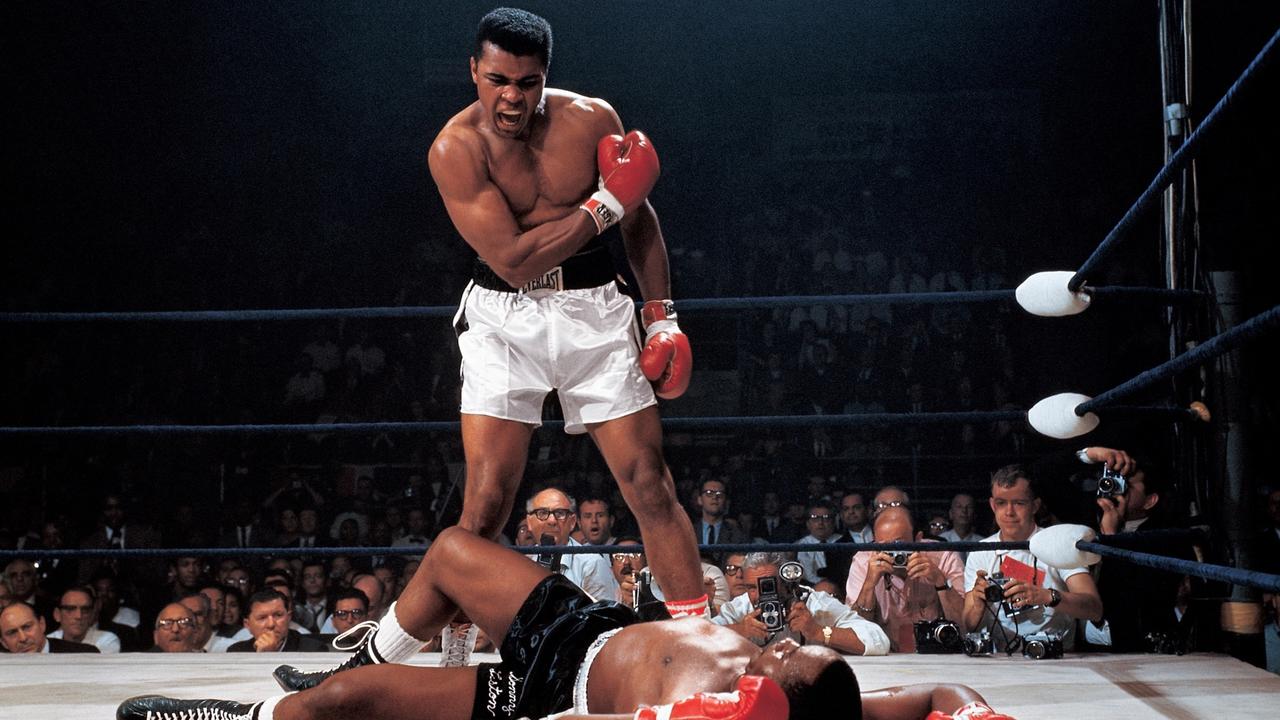
The referee was former Champion Jersey Joe Walcott. Both fighters were booed upon their introductions. Midway through the 1st round, Liston threw a left jab, and Ali went over it with a fast right, knocking the former Champion flat on his back. Liston rolled over, got to his right knee, and then fell on his back again.

Walcott had a hard time getting Ali to go to a neutral corner. Ali initially stood over Liston, yelling, "Get up, sucker!" At this point, Neil Leifer of Sports Illustrated took the picture above, one of the most famous photographs in sports history.

When Walcott got back to Liston, and looked at the knockdown timekeeper, Francis McDonough, to pick up the count, Liston had fallen back on the canvas. Walcott never did pick up the count. He said he could not hear McDonough, who did not have a microphone. Also, McDonough did not bang on the canvas or motion a number count with his fingers. McDonough, however, claimed Walcott was looking at the crowd and never at him.

After Liston arose, Walcott wiped off his gloves. He then left the fighters to go over to McDonough. Waltcott later said McDonough had told him, "I counted him out. The fight is over." Nat Fleischer, editor of The Ring magazine, had no authority over the fight, but he backed McDonough up, saying the fight should be over. Walcott then rushed back to the fighters, who had resumed boxing, and stopped the fight, awarding Ali a knockout victory.

It remains one of the quickest heavyweight title knockouts in history. Many in the small crowd had not even settled in their seats when the fight was stopped. The official time of the stoppage was announced as 1:00 into the first round, which was wrong. Liston went down at 1:44, got up at 1:56, and Walcott stopped the fight at 2:12.

McDonough and Fleischer were wrong in their interpretation of how the rule should have been applied. Under the rule, the timekeeper is supposed to start the count at the time of a knockdown. The referee's duty is to get the boxer scoring the knockdown to a neutral corner, pick up the count from the timekeeper. and continue it aloud for the knocked down boxer.

Nevertheless, Liston was down for 12 seconds -- 2 seconds fewer than Gene Tunney was down in his "Long Count" fight with Jack Dempsey in 1927. But Liston was no Tunney. He was more like the Mike Tyson of his era: Show him that you're not afraid of him, and that you can hit him, and he would fold, or even start cheating. In his 1st fight with Ali, he tainted his gloves to try to blind Ali. In the 2nd fight, he never got the chance to cheat.

Some people wondered if Ali had even hit Liston, or if Liston had gone down on his own, quitting the way he'd quit on his stool between the 6th and 7th rounds of their 1st fight. The suggestion was that he lost on purpose for more money from gamblers -- in ring parlance, "took a dive." The film shows this not to be the case: It clearly shows that Ali's punch was no "Phantom Punch." Instead, it had lifted Liston off the canvas entirely. Liston didn't dive: He fell, from being hit.

James Braddock was Heavyweight Champion from 1935 to 1937. He said of Ali, "I have a feeling that this guy is a lot better than any of us gave him credit for. It isn't the knockout punch that sticks in my mind as much as a punch he let go earlier... It was a right to Liston's jaw, and it shook him to his shoetops. For all we know, it could have been the one that set up the knockout."

Rocky Marciano was Heavyweight Champion from 1952 to 1955. After seeing the replay, he said, "I didn't think it was a powerful punch when I saw the fight from ringside. Now, I think Clay, seeing the opening, snapped the punch the last six inches." But he still didn't think the punch was hard enough to be a knockout, only a knockdown.

Liston had 16 more fights, winning 15 of them, 14 by knockout. So the suggestion that "He was never the same fighter" is ridiculous. But he never got another shot at the title, not even after Ali was stripped of it in 1967, following his refusal to accept being drafted into the U.S. Army. Of course, by then, Liston was officially 35 years old -- but Walcott had been 37 when he won the title. Liston died in 1970, also under mysterious circumstances.

McDonough died in 1968, Fleischer in 1972, Walcott in 1994.

*

May 25, 1965 was a Tuesday.  These baseball games were played that day:

* The New York Yankees lost to the Cleveland Indians, 5-1 at Yankee Stadium. The Indians scored 4 runs in the top of the 6th inning, including 1 of the 2 home runs hit by Vic Davalillo, knocking Jim Bouton out. Sonny Siebert was the winning pitcher. Mickey Mantle and Roger Maris each went 0-for-3, with Mantle adding a walk.

* The New York Mets lost to the Philadelphia Phillies, 10-3 at Connie Mack Stadium in Philadelphia.

* The Minnesota Twins beat the Boston Red Sox, 17-5 at Fenway Park in Boston. Harmon Killebrew went 3-for-6. Carl Yastrzemski went 1-for-3.

* The Baltimore Orioles beat the Kansas City Athletics, 6-3 at Memorial Stadium in Baltimore. Brooks Robinson did not play.

* The Washington Senators swept a doubleheader from the California Angels, 7-3 and 6-5 at District of Columbia Stadium in Washington. (It was renamed Robert F. Kennedy Memorial Stadium in 1969).

* The Pittsburgh Pirates beat the Chicago Cubs, 7-6 at Forbes Field in Pittsburgh. Ernie Banks, Billy Williams and Len Gabrielson hit home runs. For the Pirates, Roberto Clemente went 1-for-6, but Donn Clendenon went 4-for-5 with an RBI, and Andre Rogers went 3-for-5 with 3 RBIs, including a single that scored Clendenon in the bottom of the 12th inning to win it.

* The Detroit Tigers beat the Chicago White Sox, 7-5 at Comiskey Park in Chicago. Al Kaline went 3-for-5 with 2 RBIs.

* The Cincinnati Reds beat the Houston Astros, 7-4 at the Astrodome in Houston. Frank Robinson went 2-for-5 with a RBI. Pete Rose went 1-for-4 with a walk.

* The Los Angeles Dodgers beat the St. Louis Cardinals, 2-0 at Dodger Stadium in Los Angeles. Curt Flood led off the game with a single, and then Don Drysdale didn't allow another hit, outpitching Bob Gibson. In fact, except for Dick Groat reaching on an error in the 5th, Drysdale didn't allow another baserunner.

* And the Milwaukee Braves beat the San Francisco Giants, 14-1 at Candlestick Park in San Francisco.

Friday, May 6, 2022

May 6, 1995: Classic Sports Network Goes On the Air

May 6, 1995: This was one of the best days of my life, although I wouldn't know it for over a year. Because this was the day that Classic Sports Network debuted.

New York City established WUHF on Channel 31 as an experiment to determine the viability of UHF broadcasts within an urban environment. Some of the early programming on WUHF included simulcasts of New York's existing commercial VHF stations; educational films produced by the Television Film Unit, established in 1949, of WNYC, which since 1924 had broadcast on 820 AM, and since 1943 at 93.9 FM, as the City's municipal radio station; college-level distance education telecourses; and, reportedly, a nightly rundown of the New York Police Department's "wanted" criminals list.

The experiment was carried out through the installation of UHF receivers in several hundred test homes, public schools and businesses, with reception monitored by FCC and City engineers. This was successful, and on November 5, 1962, the call letters of New York's Channel 31 were changed to WNYC, to match those of the radio stations.

But in 1995, Mayor Rudy Giuliani, seeing the growth of cable television, and noting that WNYC, both AM and FM, were still successful, decided to sell the station. On June 30, 1996, WNYC-Channel 31 was sold to ITT-Dow Jones. It was replaced by WBIS, showing what was then named Classic Sports Network. Within days, while "flipping channels," I discovered it by accident. I didn't have cable TV at the time, so the picture was fuzzy. But what it showed was a feast for the sports fan's heart.

Classic Sports Network was run by Steve Greenberg, son of Baseball Hall-of-Famer Han Greenberg. I was worried that, given a Baby Boom target audience, it would be one long tribute to Mickey Mantle, the 1969 New York Mets, Joe Namath, the early 1970s New York Knicks, and Muhammad Ali. Indeed, when it debuted on May 6, 1995, it did so with a 15-hour documentary: Muhammad Ali: His Life and Times, hosted by sportswriter Dick Schaap.

And there was a lot of content around Mantle, Namath, the '69 Mets and the Willis Reed and Walt "Clyde" Frazier 1970s Knicks. This included a block of programming centered around "The Miracle of '69," including the '70 Knicks title with Namath leading the Jets to the great upset victory in Super Bowl III and the Mets' run to, and performance in, the 1969 World Series.

But they also showed a lot of special things, including World Series highlight films that hadn't been widely seen in years, and weren't yet available on video; legendary prizefights, including some on The Main Event, a half-hour show hosted by Rocky Marciano, with the 1950s Heavyweight Champion hosting, interviewing guests, and narrating the fights, lasting 14 episodes in 1961; the entire library of the TV shows Greatest Sports Legends and Curt Gowdy's 1974-77 PBS show The Way It Was. They also made a deal with NFL Films to broadcast a lot of vintage stuff. I videotaped as much of it as I could, and those tapes took up a lot of space.

In 1997, ESPN decided it didn't want the competition, but it did want the content: They bought Classic Sports Network from Steve Greenberg and his investors, and rebranded it as ESPN Classic. They kept the logo of an athlete with fists raised, known as "Vic" for "Victory," inside a letter C.

But the beginning of the end was already there, even before the beginning. (Yes, I know: That sounds like a Yogi Berra line.) The Golf Channel began broadcasting on January 17, 1995, nearly 4 months before Classic Sport Network. Speed, a network devoted to auto racing, debuted at the end of that year. The NBA Network was launched in 1999, the NFL Network and The Tennis Channel in 2003, the NHL Network in 2007, the MLB Network in 2009.

By the 2010s, due to the increasing number of sport-, league-, and college conference-specific networks that had assumed rights to the archival and live content that was historically aired by ESPN Classic, a larger amount of programming was devoted to archive content whose rights were owned by ESPN outright, reruns of recent events from ESPN's networks, as well as ESPN original documentaries and overflow coverage of events from other ESPN networks. And much of the footage was also now available on YouTube, so a fan wanting to see a specific broadcast no longer had to wait for ESPN to show it.

So ESPN folded ESPN Classic on December 31, 2021. It's funny: I didn't know it was "born" at the time that it was, and I didn't know that it "died" at the time that it did. But I'm still glad it was "alive."

*

May 6, 1995 was a Friday. Football was out of season. There was 1 game in the NBA Playoffs that day: The San Antonio Spurs beat the Los Angeles Lakers, 110-94 at the Alamodome in San Antonio, Texas. David Robinson scored 33 points.

The Stanley Cup Playoffs began, with 2 games. The New York Rangers lost to the Quebec Nordiques, 5-4 at the Colisée de Québec. And the Washington Capitals beat the Pittsburgh Penguins, 5-4 at the Civic Arena in Pittsburgh.

And these games were played in Major League Baseball:

* The New York Yankees lost to the Milwaukee Brewers, 5-2 at Yankee Stadium. Ricky Bones outpitched Jimmy Key. Greg Vaughn hit a home run for the Brew Crew. Jim Leyritz, playing 1st base in place of the idle Don Mattingly, hit one for the Bronx Bombers. Wade Boggs went 3-for-4. But the rest of the Yankees combined only got 4 hits.

* The New York Mets lost to the Cincinnati Reds, 13-11 at Riverfront Stadium in Cincinnati. This was a game that could have been shown on Classic Sports: The Mets led 11-2 going into the bottom of the 8th inning, but the Reds scored 6 in the 8th and 3 in the 9th to win it. The winning runs came on a home run by Hal Morris. Deion Sanders, Ron Gant and Jerome Walton also homered for this later edition of the Big Red Machine. For the Mets, Rico Brogna and Edgardo Alfonzo each had 3 hits including a home run.

* The Florida Marlins beat the Montreal Expos, 10-3 at the Olympic Stadium in Montreal.

* The Toronto Blue Jays beat the Baltimore Orioles, 7-3 at Camden Yards in Baltimore. Cal Ripken went 1-for-5.

* The Philadelphia Phillies beat the Atlanta Braves, 3-1 at Atlanta-Fulton County Stadium.

* The Chicago Cubs beat the Pittsburgh Pirates, 13-5 at Three Rivers Stadium in Pittsburgh.

* The Minnesota Twins beat the Cleveland Indians, 5-2 at Jacobs Field (now Progressive Field) in Cleveland.

* The Boston Red Sox beat the Detroit Tigers, 5-3 at Tiger Stadium in Detroit.

* The Chicago White Sox beat the Kansas City Royals, 7-4 at the new Comiskey Park (now Rate Field) in Chicago.

* The St. Louis Cardinals beat the Houston Astros, 7-5 at Busch Memorial Stadium in St. Louis.

* The Los Angeles Dodgers beat the Colorado Rockies, 17-11 at Coors Field in Denver. This was also a game that could have been shown on Classic Sports. Being in "the Mile High City," Coors Field, like the facility it had just replaced as the Rockies' home, Mile High Stadium, was a hitter's haven. Tom Candiotti started for Los Angeles, and Juan Acevedo for Colorado, and both only lasted 2 innings.

For the Dodgers: Mike Piazza went 3-for-6 with a home run and 3 RBIs; Mitch Webster entered the game as a pinch-hitter, and went 1-for-3 with a home run and 2 RBI; Henry Rodríguez went 4-for-6 with 2 RBI, and Gary Ingram pinch-hit for him, and went 2-for-3 with a walk and an RBI; and Eric Karros went 3-for-5 with a walk and 3 RBIs.

For the Rockies: Dante Bichette went 4-for-5 with a home run and 3 RBIs; Roberto Mejía went 1-for-4 with a solo homer; Jorge Brito went 2-for-4 with 3 RBIs; Larry Walker, Walt Weiss and Jason Bates also had 2 hits each; and, pinch-hitting for pitchers, John Vander Wal hit a 3-run homer; and Mike Kingery hit a solo homer.

* The San Francisco Giants beat the San Diego Padres, 13-6 at Jack Murphy Stadium in San Diego. Glenallen Hill went 2-for-3 with a solo home run and 2 walks. Jeff Reed went 4-for-4 with a walk and 2 RBIs. Royce Clayton went 2-for-5 with 3 RBIs. Barry Bonds went 2-for-4 with a walk and 2 RBIs. For the Padres, Ken Caminiti went 3-for-5 with a solo homer, and Tony Gwynn went 1-for-5 with an RBI.

* The California Angels beat the Seattle Mariners, 7-5 at Anaheim Stadium (now Angel Stadium of Anaheim). Ken Griffey Jr., Edgar Martínez and Luis Sojo homered for the M's. J.T. Snow and Greg Myers did so for the Halos.

* And the Texas Rangers beat the Oakland Athletics, 4-2 at the Oakland Coliseum. Rickey Henderson was with the A's at the time, but did not play in this game.

December 31, 1999 & January 1, 2000: The Millennium

December 31, 1999:  The Millennium arrives. The people of planet Earth survived. At a terrible cost. But we hadn't destroyed ourselves. ...