Showing posts with label lionel barrymore. Show all posts

Tuesday, December 20, 2022

December 20, 1946: "It's a Wonderful Life" Premieres

December 20, 1946: It's a Wonderful Life premieres. Like many of the films directed by Frank Capra, it's homey, and corny, earning those films the nickname "Capra Corn." But it is one of the most beloved films ever made.

It wasn't a success at first. Indeed, it turned out to be the only motion picture that Liberty Films ever made, dragging the studio into bankruptcy. But a legal loophole put it into the public domain in 1974, and allowed anyone who wanted to show it on television to do so, as it was cheap to do so. That made it a Christmas classic.

George Bailey lives in Bedford Falls, somewhere in New York State. In 1919, when they are boys, he saves the life of his brother, Harry, but loses the hearing in one ear in the process. A girl named Mary Hatch has a childhood crush on him that doesn't go away once they grow up (with adult George played by James Stewart -- that's how he was billed in every movie, but everybody tended to call him "Jimmy Stewart" -- and adult Mary by Donna Reed).

George's father Peter (Samuel S. Hinds) and his uncle Billy (Thomas Mitchell) run the Bailey Brothers Building & Loan. The father dies right after George graduates from high school in 1928, and the Building & Loan's board of directors votes to make George, despite his youth, the new chairman, as Uncle Billy is an alcoholic, and not all that bright when he's sober.

George refuses, and is told by the board that if he refuses, the board will elect Henry Potter (Lionel Barrymore) the new chairman. Potter is the richest and meanest man in town, and if he runs the Building & Loan, he'll close it, meaning that the entire town will be at his mercy. George hates Potter, so he accepts. This means that he has to stay in town, and the money that was going to send him to college instead sends brother Harry to college.

The Great Depression soon follows, and there's a run on the banks on the day in 1932 that George and Mary get married. They use the $2,000 that they were going to spend on their honeymoon to save their customers, as Potter's bank is offering only 50 cents on the dollar. They just barely make it. (In the sequence, $242 then would be $5,169 in 2022; $20 would be $427.23; $17.50 would be $373.83; and the $2.00 the Baileys ended up with would be $42.72.

George and Mary become well-respected in town, and the parents of 4 children. When World War II arrives, Harry enlists in the U.S. Navy, and, as a pilot, shoots down planes attacking a troop ship, saving hundreds of lives. (The movie doesn't say whether the enemy planes were German or Japanese). But because of his bad ear, George is classified 4-F, and "fights the Battle of Bedford Falls," running drives for things the war effort needs, like scrap metal, rubber, and food.

On Christmas Eve, December 24, 1945, a party is being set up for the returning hero Harry. But, at the bank, Uncle Billy loses $8,000 meant for the firm's accounts -- about $171,000 in today's money. Unable to come up with the money, George runs into one awful occurrence after another (and, let's be honest, behaves very badly in response to them), and wishes he'd never been born.

All this is told by the angel Joseph (voiced by Joseph Granby), who has been hearing the prayers for George by the people of Bedford Falls. Joseph assigns George's case to an angel named Clarence Goodbody (Henry Travers), so that Clarence can finally "earn his wings." Clarence shows George  what the world would have been like if he had never been born. The results are shocking:

* Potter became the director of the Building & Loan, and closed it down. Now, he owned everything in town, and he changed its name to Pottersville.

* The major businesses in town low-class joints: Dive bars, burlesque houses, casinos that the Potter-controlled police looked the other way on.

* Without George, Bailey Park, the housing development he built through the Building & Loan, was never built, so people living in town had no alternative but to live in "Potter's slums."

* Mr. Gower (H.B. Warner), the pharmacist, spent time in prison, because George wasn't there to stop him from making a mistake with pills in 1919, which led to a local boy's death. He's now a homeless alcoholic.

* Giuseppe Martini (Bill Edmunds), operator of Martini's bar, a nice establishment, and a resident of Bailey Park, is neither. He isn't even in the alternate sequence: There is no Bailey Park, and Nick (Sheldon Leonard), who had been the head bartender at Martini's, now owns the place, naming it Nick's, and isn't nearly as friendly without Martini's influence.

* Mary is "an old maid," never married (at age 38, that was a big deal at the time), and works in the local library -- which, surprisingly, Potter didn't have shut down. Still, she's better off than most people in town.

* Worst of all, while Billy was born on time in 1911, none of the other kids who were with George that day in 1919 was able to save him from falling into the ice, and he died. So he wasn't there to save that troop transport during The War, and every American serviceman on that ship died. Clarence never says whether this affects the outcome of the war: For all we know, at Christmas '45, the war could still be going on, and the Allies could even be losing.

George changes his mind, and wants to live again. He gets his wish, goes home to face the music, and finds that all the people he'd selflessly helped over the years have come to pay him back. There's a big basket of cash, which ends up being more than the $8,000 he needs. They show him that, in the way that matters, he's "the richest man in town."

As of December 20, 2022, there are 4 surviving castmembers from It's a Wonderful Life: Ronnie Ralph, who played George's friend Sam Wainwright as a child; Carol Coombs, George & Mary's daughter Janie Bailey; Karolyn Grimes, George & Mary's daughter Zuzu Bailey; and Jimmy Hawkins, George & Mary's son Tommy Bailey.

*

December 20, 1946 was a Friday. Several celebrities were born on this day: Illusionist Uri Geller, TV producer Dick Wolf, actor John Spencer, and Sonny Perdue, who was elected Governor of Georgia as a Republican, and then served as Secretary of Agriculture under Donald Trump.

Baseball was out of season. The NFL Championship Game had been played 5 days earlier, with the Chicago Bears beating the New York Giants, 24-14 at the Polo Grounds in New York. And no games were scheduled in the NHL.

There was one score on this historic day. The NBA was in its 1st season, under the name of the Basketball Association of America. One game was played that night: The Toronto Huskies beat the New York Knicks, 74-70 at Maple Leaf Gardens in Toronto. On the preceding November 1, the league's 1st-ever game was played between the same teams in the same arena, but the Knicks won it.

Wednesday, December 14, 2022

December 14, 1936: “You Can’t Take It With You” Premieres

Scene from the 1938 film version

December 14, 1936: You Can't Take It With You, a play by George S. Kaufman and Moss Hart, premieres at the Booth Theatre, which still stands at 222 West 45th Street. It is directed by Kaufman, and stars Henry Travers as Martin Vanderhof, a.k.a. Grandpa, and becomes one of the biggest comedies in Broadway history.

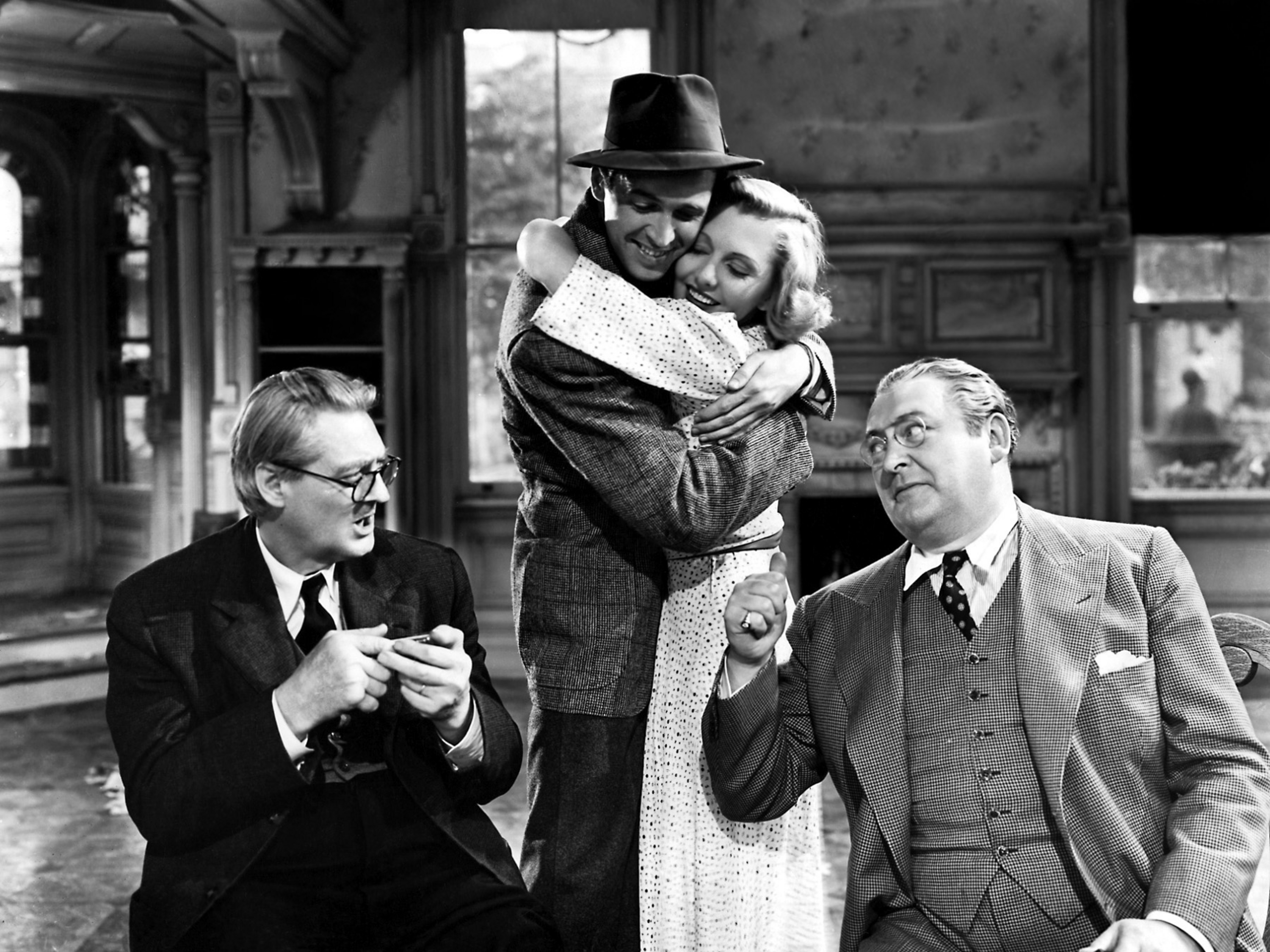
It was filmed in 1938, with Lionel Barrymore, Jimmy Stewart, Jean Arthur, Spring Byington, Ann Miller, Mischa Auer, Eddie Anderson (Jack Benny's "Rochester"), and, uncredited, dance icon Arthur Murray. It won Best Picture, and Best Director for Frank Capra, who in 1945 would direct It's a Wonderful Life, including Stewart, Barrymore and Travers (Clarence the angel -- and who also appeared in "The Bells of St. Mary's," which was showing at the Bedford Falls Bijou in IAWL).

I saw a version on CBS in 1979, with several veterans of the network: Art Carney, Jean Stapleton, Blythe Danner, Harry Morgan, Robert Mandan, Barry Bostwick, Howard Hesseman, and Alice castmembers Polly Holliday (Flo) and Beth Howland (Vera). CBS tried to make it a series in 1987, with Morgan as Grandpa, but set it in the present day, so that, instead of never having paid income taxes (the 16th Amendment had only passed 23 years before the play's debut), he hadn't paid any since 1962.

*

December 14, 1936 was a Monday. Baseball was out of season. Football season was over, except for the New Year's Day bowl games. The NBA hadn't been founded yet. And the NHL had no games scheduled. So there were no scores on this historic day.

Wednesday, August 17, 2022

August 17, 1934: “Treasure Island” Premieres

Wallace Beery (left) and Jackie Cooper

August 17, 1934: The film Treasure Island premieres, based on the 1883 novel by Robert Louis Stevenson. It stars Jackie Cooper (then 11 years old, a child star long before he was Perry White in the Chris Reeve Superman movies or a M*A*S*H director), Lionel Barrymore, and Wallace Beery as Long John Silver.

The story is set in the mid-18th Century. Jim Hawkins (Cooper) and his mother (Dorothy Peterson) run the Admiral Benbow, a tavern near Bristol, in the West Country of England. One dark and stormy night, during a birthday celebration, the mysterious Billy Bones (Barrymore) arrives, and drunkenly talks about treasure. Soon after, Bones is visited by Black Dog (Charles McNaughton), then Pew (William V. Mong), and drops dead, leaving a chest, which he bragged contained gold and jewels.

Instead of money, Jim finds a map that his friend Dr. Livesey (Otto Kruger) realizes will lead them to the famous Flint treasure. Squire Trelawney (Nigel Bruce, later to play Dr. Watson in Sherlock Holmes films) raises money for a voyage to the treasure island, and they set sail on the Hispaniola, commanded by Captain Alexander Smollett (Lewis Stone). Also on board is the one-legged Long John Silver (Wallace Beery) and his cronies. Even though Bones had warned Jim about a sailor with one leg, he and Silver become friends.

During the voyage, several fatal "accidents" happen to sailors who disapprove of Silver and his cohorts. Then, the night before landing on the island, Jim overhears Silver plotting to take the treasure and kill Smollett's men. Jim goes ashore with the men, and encounters an old hermit named Ben Gunn (Chic Sale), who tells him that he has found Flint's treasure.

Smollett and his loyal men flee to Flint's stockade on the island for safety. Silver's men then attack the stockade when Smollett refuses to give them the treasure map. While the situation looks hopeless, Jim secretly goes back to the Hispaniola at night, sails it to a safe location and shoots one of the pirates in self-defense. When he returns to the stockade, Silver's men are there, and Silver tells them that a treaty has been signed. The pirates want to kill Jim, but Silver protects him. Dr. Livesey comes for Jim, but the boy refuses to break his word to Silver not to run away.

The next day, the pirates search for the treasure hold, but, when they find it, it is empty. When some of the pirates mutiny against Silver, Livesey and Gunn join him in the fight. Smollett then sails home with the treasure, which Gunn had hidden in his cave, and with Silver as his prisoner. Silver tells Jim a horror story of a slow death by hanging due to his one leg, causing Jim to be unable to stand by and let his friend be hanged, and he frees Silver. As he sails away, Silver promises to hunt treasure with Jim again some day, as "Honest John" Silver.

So many of the clichés we developed about pirates come from this film: The big hat, the peg leg, the parrot on the shoulder, the exclamation "Arrrrgh!" and the calling of friends "Matey," the burying of treasure in chests on deserted desert islands, usually in the South Pacific, and the marking of the locations of such treasures on a map with an X. However, the pirate exclamation "Shiver me timbers!" meaning, "May my ship's timbers break," appeared in the original novel, and maybe have been around long before that.

A lot of our pop-culture clichés came from the films of the early Thirties, which is why people were shocked when later Tarzans had better vocabularies than Johnny Weissmuller's, and when Gary Oldman didn't look like Bela Lugosi's take on the vampire Count in Bram Stoker's Dracula.

Treasure Island would be remade in color in 1950, with Robert Newton as Long John Silver. He popularized the pirate exclamation "Blow me down!" meaning, "May the wind blow me down." As a native of Shaftesbury, in Dorset, his West Country accent became the familiar "pirate accent," although the most famous real-life pirate, Edward "Blackbeard" Teach, was also from the West Country, which Newton, who played him in a movie, likely knew.

*

August 17, 1934 was a Friday. Ron Henry, the left back on Tottenham Hotspur's "Double"-winning side of 1961, was born. And these baseball games were played:

* A doubleheader was split at Yankee Stadium. The New York Yankees beat the Detroit Tigers, 5-0 in the opener. Lefty Gomez pitched an 8-hit shutout. Tony Lazzeri hit a home run. The Tigers won the nightcap, 2-0. Lynwood "Schoolboy" Rowe pitched a 3-hit shutout, striking out 11, outpitching Jimmie DeShong. Over the 2 games, Babe Ruth went 1-for-5, Lou Gehrig went 1-for-7 with an RBI, Hank Greenberg went 1-for-8, and Marv Owen went 4-for-7.

* The New York Giants swept a doubleheader from the Pittsburgh Pirates, 7-3 and 8-3 at Forbes Field in Pittsburgh. Carl Hubbell went the distance in the 2nd game. Over the 2 games, Giants player-manager Bill Terry went 6-for-10 with an RBI, Mel Ott went 6-for-9 with a home run in each game, a walk and 6 RBIs, Paul Waner went 2-for-8, and Lloyd Waner went 2-for-6 with 2 walks and 2 RBIs.

* A doubleheader was split at Fenway Park in Boston. The Boston Red Sox won the 1st game, 6-0. Wes Ferrell pitched a 2-hit shutout, outpitching Bobo Newsom. The St. Louis Browns won the 2nd game, 5-2.

* A doubleheader was split at Shibe Park in Philadelphia. The Philadelphia Athletics beat the Chicago White Sox in the 1st game, 9-8. This was a wild game: Each team scored 2 runs in the 7th inning, 2 in the 8th, and 1 in the 9th. Ed Coleman hit 3 home runs and had 5 RBIs. Edwin "Dib" Williams doubled Bill Dietrich home with the winning run in the bottom of the 10th. Dietrich was also the winning pitcher, in relief of Al Benton. George Earnshaw went the distance for the A's. 

The White Sox won the 2nd game, 3-2. Ted Lyons went the distance for the win. Over the 2 games, Jimmie Foxx went 1-for-7 with a home run, a walk and an RBI. For the White Sox, former A's star Al Simmons went 4-for-9 with 5 RBIs, and Luke Appling went 2-for-8.

* The Washington Senators swept a doubleheader from the Cleveland Indians, 4-3 and 1-0 at Griffith Stadium in Washington. In the 1st game, the Indians scored a run in the top of the 9th, but the Senators tied it with 2 in the bottom of the 9, and won it in the 10th with Cliff Bolton singling Cecil Travis home. In the 2nd game, Bobby Burke pitched a 3-hit shutout, outpitching future Yankee Monte Pearson. The only run came in the bottom of the 2nd, when Pearson threw a wild pitch to Dave Harris, allowing Buddy Myer to score.

* The Brooklyn Dodgers beat the Cincinnati Reds, 12-4 at Crosley Field in Cincinnati. Sam Leslie and Tony Cuccinello each went 3-for-5 with 3 RBIs.

* The Boston Braves beat the Chicago Cubs, 5-2 at Wrigley Field in Chicago.

* And the St. Louis Cardinals beat the Philadelphia Phillies, 12-2 at Sportsman's Park in St. Louis. James "Ripper" Collins went 4-for-4 with a home run, a walk and 3 RBIs.

Sunday, May 29, 2022

May 29, 1942: The Death of John Barrymore

May 29, 1942: John Barrymore, perhaps the finest American actor of his generation, dies as a result of the damage that alcoholism had done to him. He was 60.

A member of the Drew and Barrymore theatrical families, he initially tried to avoid the stage, and briefly attempted a career as an artist. But he appeared on stage together with his father, Maurice, in 1900, and then his sister Ethel the following year. He began his career in 1903, and first gained attention as a stage actor in light comedy, then high drama, culminating in productions of Justice in 1916, Richard III in 1920, and Hamlet in 1922. His portrayal of Hamlet, among other roles of William Shakespeare, led to him being called the "greatest living American tragedian."

After a success as Hamlet in London in 1925, Barrymore left the stage for 14 years, and instead focused entirely on films. In the silent film era, he starred in Dr. Jekyll and Mr. Hyde in 1920, and Sherlock Holmes in 1922. During this period, he gained his nickname, the Great Profile. His stage-trained voice proved an asset when sound films were introduced, and he starred in Grand Hotel in 1932, Dinner at Eight in 1933, and Twentieth Century in 1934.

Barrymore's personal life has been the subject of much attention before and since his death. He struggled with alcohol abuse from the age of 14, was married and divorced four times, and declared bankruptcy later in life. Barrymore's biographer, Martin Norden, considers him to be "perhaps the most influential and idolized actor of his day."

Supposedly, his last words were, "Die? I should say not, dear fellow. No Barrymore would allow such a conventional thing to happen to him."

His siblings Lionel (who lived until 1954) and Ethel (who lived until 1959) were also great actors. His son John Drew Barrymore (1932-2004), less so. But John Drew's daughter, Drew Barrymore, has upheld the family legacy: Though it looked for years like she might follow her grandfather's path to destruction, she's now fully recovered, and producing more than acting.

*

May 29, 1942 was a Friday. This was also the day the movie Yankee Doodle Dandy premiered. I have a separate entry for that event. And hockey player Pierre Bourque and actor Kevin Conway were born.

These baseball games were played:

* The New York Yankees beat the Washington Senators, 16-1 at Yankee Stadium. Lefty Gomez went the distance for the win. Joe DiMaggio, Joe Gordon and Buddy Hassett hit home runs.

* The New York Giants beat their arch-rivals, the Brooklyn Dodgers, 3-1 at Ebbets Field. Babe Young batted in the top of the 10th inning, hitting a ground ball to shortstop Pee Wee Reese, who makes a bad throw, allowing 2 runs to score.

* The Philadelphia Phillies beat the Boston Braves, 2-1 at Braves Field in Boston.

* The Boston Red Sox beat the Philadelphia Athletics, 14-2 at Shibe Park in Philadelphia. Ted Williams went 3-for-4 with 2 home runs, a walk, and 7 RBIs.

* The Detroit Tigers beat the Cleveland Indians, 14-3 at Briggs Stadium (later renamed Tiger Stadium) in Detroit.

* The Chicago Cubs beat the Cincinnati Reds, 6-5 at Wrigley Field in Chicago. Joe Beggs walked Dom Dallesandro with the bases loaded in the bottom of the 10th inning.

* The Chicago White Sox beat the St. Louis Browns, 12-8 at Sportsman's Park in St. Louis.

* And the Pittsburgh Pirates and the St. Louis Cardinals were not scheduled.

December 31, 1999 & January 1, 2000: The Millennium

December 31, 1999:  The Millennium arrives. The people of planet Earth survived. At a terrible cost. But we hadn't destroyed ourselves. ...