Showing posts with label leo durocher. Show all posts

Wednesday, October 5, 2022

October 5, 1941: The Mickey Owen Game

October 5, 1941: Game 4 of the World Series at Ebbets Field in Brooklyn. It made the home fans shudder. I read an interview once, with a Brooklyn Dodger fan, whose name I've forgotten, citing a far more important, and more traumatic, event that happened just 63 days (9 weeks) later: "I was there. I remember that like I remember Pearl Harbor."

The Dodgers had opened the season with a lot of hope. They hadn't won a National League Pennant since 1920, and hadn't been in a Pennant race since 1924. But they had been rebuilt, under the auspices of team president Larry MacPhail. He had renovated Ebbets Field, hired Walter "Red" Barber as radio broadcaster, traded for shortstop Leo Durocher, made Durocher the manager, and made other key transactions, including trading for Durocher's replacement as shortstop, Harold "Pee Wee" Reese.

After going 62-91 in the last pre-MacPhail season, 1937, the Dodgers improved to 69-80 in 1938. In 1939, they improved to 84-69, 3rd place, but still 12 1/2 games behind the Pennant-winning Cincinnati Reds. In 1940, they were 88-65, 2nd place, but still 12 games behind the Pennant-winning Reds.

Still, hopes were high for 1941. From April 18 to 30, the Dodgers went 13-1. They ended the month in 1st place by 1 game. From May 6 to 14, they rattled off a 7-game winning streak. From May 23 through June 1, they won 9 straight. They were tied for 1st with the St. Louis Cardinals, with the next-closest team, the Giants, being 8 games behind. From June 19 to July 11, they won 15 out of 19 decisions (plus a game that was called due to rain while tied) through July 11.

They went 9-1 from July 31 through August 11. But the Cards stayed hot, too, so, by that date, the teams were tied for 1st. As late as September 3, the teams were tied for 1st. The Dodgers got hot one more time, going 13-6 from September 6 to 24. This run included a 10-inning win at home to the Giants on the 7th, an 11-inning win away to the Cards on the 11th, and 4 runs in the top of the 17th to beat the defending World Champion Reds.

On September 25, the Dodgers clinched the Pennant when Whitlow Wyatt pitched a shutout for his 22nd win of the season, and was backed by a home run by Pete Reiser. The Dodgers won, 6-0.

The Dodgers and their fans were feeling particularly potent. They were convinced that they would beat the New York Yankees in the World Series and take over New York.

*

October 1, 1941, a Wednesday: Game 1 of the World Series was played at Yankee Stadium. Durocher surprised everyone by choosing Curt Davis as his starting pitcher. He later admitted he messed up the Dodgers' rotation for the Series, one of the few times Leo the Lip admitteda mistake, rather than blaming someone else.

In hindsight, while the rotation was all out of whack, Davis pitched fairly well. But a home run by Joe Gordon and the pitching of Charles "Red" Ruffing gave the Yankees a 3-2 win.

October 2, 1941, a Thursday: Game 2 at Yankee Stadium. The Yankees took a 2-0 lead in the 3rd, but the Dodgers tied the game in the 5th, and Dolph Camilli's single in the 6th won it, 3-2.

October 3, 1941, a Friday: The Maltese Falcon premieres, starring Humphrey Bogart as San Francisco private investigator Sam Spade. If "Bogie" wasn't already a legend, he certainly became one with this film. It was the 3rd film version of Dashiell Hammett's mystery novel, following the 1931 film of the same title (with Ricardo Cortez as Spade) and the 1936 film Satan Met a Lady (Warren William). 

Ernest Evans was born. He would become known as Chubby Checker, the man who popularized (though did not create, nor write the song about) the dance craze The Twist.

Given the proximity of the teams, a travel day wasn't necessary for the World Series, but it got one, anyway.

October 4, 1941, a Saturday: This was the birthdate of journalist Roy Blount Jr., horror novelist Anne Rice, and Elizabeth Eckford of the Little Rock Nine, and Anne Rice.

Game 3 of the World Series is played at Ebbets Field. The game is scoreless in the 7th inning, with Fred Fitzsimmons throwing goose eggs for the Brooklyn team, and Marius Russo doing so for the Bronx outfit. Russo comes to bat, and launches a line drive off Fat Freddie's kneecap. The ball caroms to shortstop Reese, who throws Russo out to the end inning.

On the official World Series highlight film, it's not clear how bad the injury is. Fitzsimmons is shown limping off the field under his own power -- probably a good thing, since he would have been pretty hard to carry off with all that weight. But the film is misleading: It turns out that the kneecap is broken.

Once an All-Star for the Giants, Fitzsimmons seemed to specialize in beating the Dodgers. But in 1937, a slow start led the Giants to trade him to the Dodgers, a big mistake. He was welcomed by the Flatbush Faithful, and they wouldn't have won the Pennant without him. Durocher said, "I wish we had 9 guys like Fitz. We'd never lose."

But now, he was permanently injured. At age 41, he would pitch just 1 game in 1942, and 9 more in 1943, before accepting his injury and retiring to the coaching ranks. He also ran a popular bowling alley in Brooklyn for many years.

Durocher was forced to bring Hugh Casey in to pitch the top of the 8th. The 1st relief pitcher to be called "The Fireman," because he "put out fires," he got the 1st out, but allowed 4 straight singles, scoring 2 runs. Russo allowed a double to Fred "Dixie" Walker and a single to Reese, but hung on to for a complete-game 2-1 win. The Yankees now led, 2 games to 1.

October 5, 1941, a Sunday. This was also the day of the Berdychiv Massacre, when Nazi Germany's Gestapo killed 38,000 Jews in Ukraine. I have a separate entry for that event.

Arnold Malcolm Owen -- sometimes incorrectly listed as "Mickey Owens," but there was never an S on the end -- was a 4-time National League All-Star as catcher for the Dodgers, was elected a County Sheriff, and ran the Mickey Owen Baseball School. For the last 64 years of his life, he was decent enough to field questions about the one part of his life that everyone seems to remember.
In Game 4 of the World Series at Ebbets Field, Charlie Keller of the Yankees singled home a run off Kirby Higbe of the Dodgers in the 1st inning. In the top of the 4th, Johnny Sturm singled home 2 runs to make it 3-0 Yankees.

But in the bottom of the 4th, the Dodgers closed to within 3-2 when Jimmy Wasdell doubled home 2 men that Atley Donald had walked. In the 5th, Reiser hit a home run to give the Dodgers a 4-3 lead.

Reiser was the NL's batting champion that season. The Cardinals had been scouting him since he was 12 years old. He was so talented that Durocher, later to manage the Giants and thus manager Willie Mays, said that Reiser might have been better. But he ended up crashing into outfield walls to make catches, much like Lenny Dykstra in the 1980s and '90s. And when Reiser did it, those walls were not padded. Injuries caught up with him, and he was never able to live up to his Hall of Fame-level talent.

The 4-3 Dodger lead held up until the top of the 9th. Casey got the 1st 2 outs. Tommy Henrich came to the plate as the Yankees' last hope. Casey got 2 strikes on him. Then he threw…

Casey told the press it was a curveball. Owen also said it was a curve, which was what he had signaled for. Henrich called it "the sharpest-breaking curveball that Hugh Casey ever threw." But many observers, including DiMaggio, and the Yankees' rookie shortstop, Phil Rizzuto, said that they thought it was a spitball.

Henrich swung and missed. Strike 3. Ballgame over. Dodgers win, and the World Series is tied at 2 games apiece.

Except… Owen didn't catch the 3rd strike! The ball tailed away from him, as spitballs have been known to do, and he couldn't hold onto it. It rolled all the way to the screen. Henrich saw this, and ran to 1st, and Owen didn't even have time to get off a throw.

He later recalled: "It wasn't a strike. It was a low inside curve that I should have had. But I guess the ball struck my glove, and by the time I got hold of it, I couldn't have thrown anybody out at first. It was an error."

It is the most famous passed ball in baseball history, but if it was a spitball, which was and remains an illegal pitch anyway, then it should, instead, have been credited as a wild pitch, and be the most famous one of those, and Casey, rather than Owen, should be faulted.


No matter. Casey only needed to get 1 more out. Even if Henrich represented the tying run and the next batter represented the winning run. Just 1 more out.

The batter was DiMaggio. Uh-oh, you don't give the Yankee Clipper a written invitation to keep a game alive. Especially not in 1941, when he had become the most celebrated athlete in America, ahead of Ted Williams; ahead of football stars Sammy Baugh, Sid Luckman and Don Hutson; ahead of even the Heavyweight Champion of the World, Joe Louis.

DiMaggio singled to left. Now the tying run was on 2nd, the potential winning run on 1st. But there were still 2 outs. If Casey could get the next batter, the game would still end, however precariously, with a Dodger victory.

The batter was Keller. At this point in his career, before a back injury curtailed it, he looked like he was headed to the Hall of Fame. And he did nothing to dispel that in this at-bat: He rocketed a Casey delivery off the right-field wall, and Henrich and DiMaggio scored.

Keller would later say, "When I got to 2nd base, you could have heard a pin drop in Ebbets Field." The noisiest, most raucous ballpark of his time had been stunned into silence.

The Yankees scored 2 more runs in the inning, and won 7-4. They now led 3 games to 1.

*

As I said, October 5, 1941 was a Sunday. There were NFL "Scores On This Historic Day":

* The football version of the New York Giants beat the Pittsburgh Steelers, 37-10 at Forbes Field in Pittsburgh.

* The football version of the Brooklyn Dodgers lost to the Washington Redskins, 3-0 at Griffith Stadium in Washington.

* The Chicago Bears beat the Cleveland Rams, 48-21 at Cleveland Municipal Stadium. (The Rams moved to Los Angeles in 1946.)

* The Green Bay Packers beat the Chicago Cardinals, 14-13 at the Dairy Bowl in the Milwaukee suburb of West Allis, Wisconsin. The Dairy Bowl was a football stadium built in the infield of a speedway, now known as the Milwaukee Mile, at the Wisconsin State Fair Park.

* And the Philadelphia Eagles and the Detroit Lions had the week off.

October 6, 1941, a Monday. Were the Dodgers rattled by their 9th inning collapse of the day before? Maybe. In the top of the 2nd, Wyatt walked Keller, gave up a single to Bill Dickey that got Keller to 3rd, uncorked a wild pitch that scored Keller and got Dickey to 3rd, and gave up a single to Joe Gordon that scored Dickey.

Dem Bums did have their chances to bounce back. In the bottom of the 3rd, Wyatt helped his own cause with a double down the left-field line off his opposite number, Ernie "Tiny" Bonham. After getting Walker to fly out, Bonham gave up a hit to Lew Riggs, and Reiser hit a sacrifice fly to get Wyatt home. The next batter was Dolph Camilli, who would be named the NL's Most Valuable Player. But Bonham struck him out to end the threat. It was still 2-1 Yankees.

Henrich, who would be nicknamed "Old Reliable" by Yankee broadcaster Mel Allen, hit a home run in the top of the 5th, and that would be all the scoring in the ballgame. Bonham went the distance for the Bronx Bombers, getting the last out when Wasdell flied out to DiMaggio in center field. Yankees 3, Dodgers 1. The Yankees had won their 9th World Series, already more than any other team. It was the 1st time, though, that they had faced the Dodgers in a World Series. There would be more.

The Brooklyn Eagle newspaper printed a big headline, reading, "WAIT TILL NEXT YEAR." The next year, the Dodgers won 104 games, but the Cardinals won 106. The Dodgers would lose the World Series to the Yankees again in 1947, 1949, 1952 and 1953, before finally winning it in 1955. The Eagle had closed earlier that year, so it was up to the New York Daily News to print the obvious headline on October 5, 1955, the day after the great triumph: "THIS IS NEXT YEAR!"

Despite America's entry into World War II, Owen never went into the service. I wonder if some Dodger fans said, "Mickey Owen is such a bum, even the Army don't want him!"

The Dodgers didn't win the Pennant again until 1947, the rookie year of Jackie Robinson. It was a last gasp for the holdovers from 1941, including Dixie Walker, who led the Southerner faction of the team that had initially opposed Robinson's signing. After the clincher, he said that Robinson had more to do with the team winning than anyone, "with the exception of Bruce Edwards." Edwards had succeeded Owen as the Dodgers' starting catcher. He wasn't a great player, but he was reliable, never committing the kind of passed ball that Owen did.

Edwards was succeeded the next year by Negro League star Roy Campanella, who became a Hall-of-Famer and a 3-time Most Valuable Player. And yet, I wonder if a lot of the accolades that would later come his way were due to what became known as "Mickey Owen's Muff." That Campy might have been cheered not just for what he was, a fantastic player and a good guy, but for what he wasn't: Owen.

It's not fair to Owen. He was widely respected prior to the '41 Series, and most Dodger fans didn't go on to hate him. Certainly, he escaped the scorn that was heaped on Ralph Branca after 1951. And neither one of them got the kind of treatment that Bill Buckner got from Boston fans after 1986.

Which is a good thing. Nobody deserves that. Well, maybe not nobody… But certainly not Buckner, nor Branca, nor Owen.

If Owen had hung onto the ball, and the Dodgers had won, tying the Series, what kind of difference would it have made? Probably not much: The Yankees won Game 5 anyway, and would've needed to win Game 6 or Game 7 at Yankee Stadium. They still would have won. Pretty much the only things that would have changed would have been the reputations of Owen and Casey, for the better.

Owen died on July 13, 2005, in his home town of Mount Vernon, Missouri. He was 89. It's a little ironic that he and Branca both came from towns named Mount Vernon, in Branca's case the one in Westchester County, New York.

Henrich died on December 1, 2009, as the last survivor of this game. He was also the last surviving person who had been a teammate of Lou Gehrig. Herman Franks, who later helped steal a Pennant from the Dodgers as a 1951 New York Giant, had died earlier in 2009 as the last surviving '41 Dodger.

Today, the Sandlot Baseball Camp, formerly the Mickey Owen Baseball School, is still open on State Highway 96 in Miller, Missouri, in the southwestern part of the State, in the Ozark Mountains, about halfway between Joplin and Springfield -- 238 miles southwest of St. Louis, 171 miles southeast of Kansas City, 64 miles northwest of Branson (the "Redneck Vegas"), and 80 miles northeast of Mickey Mantle's hometown of Commerce, Oklahoma.

Sunday, September 25, 2022

September 25, 1941: The Brooklyn Dodgers' Wild Ride

September 25, 1941: The Dodgers can clinch their 1st Pennant in 21 years today, if they beat the Boston Braves at Braves Field in Boston. If not, there are 2 games left, both at home to the woeful Philadelphia Phillies.

They had opened the season on April 15, with a lot of hope. They hadn't won a National League Pennant since 1920, and hadn't been in a Pennant race since 1924. But they had been rebuilt, under the auspices of team president Larry MacPhail. He had renovated Ebbets Field, hired Walter "Red" Barber as radio broadcaster, traded for shortstop Leo Durocher, made Durocher the manager, and made other key transactions, including trading for Durocher's replacement as shortstop, Harold "Pee Wee" Reese.

After going 62-91 in the last pre-MacPhail season, 1937, the Dodgers improved to 69-80 in 1938. In 1939, they improved to 84-69, 3rd place, but still 12 1/2 games behind the Pennant-winning Cincinnati Reds. In 1940, they were 88-65, 2nd place, but still 12 games behind the Pennant-winning Reds.

Still, hopes were high for 1941. But their opening series, at home to their arch-rivals, the New York Giants, was a flop: They were swept 3 straight, 6-4, 3-1 and 7-5. It wasn't that surprising: The Giants still had some of the players that had won Pennants in 1933 (also winning the World Series that year), 1936 and 1937. Then the Dodgers went up to Boston and turned it around, sweeping a 3-game series from the Braves.

The same teams started a new series on April 20. It was the Giants' home opener at the Polo Grounds, with a full house of 56,314 on hand. Remembering that Joe Medwick, the former St. Louis Cardinal slugger had been beaned shortly after MacPhail had traded for him, the Dodgers came to bat with metal inserts inside their caps. This was the 1st step toward baseball teams wearing batting helmets. The Dodgers won the game, 10-9, and ended up taking 2 out of 3 in the series.

From April 18 to 30, the Dodgers went 13-1. They ended the month in 1st place by 1 game. From May 6 to 14, they rattled off a 7-game winning streak. Then, through May 22, they lost 6 straight. Then, through June 1, they won 9 straight. They were tied for 1st with the Cardinals, with the next-closest team, the Giants, being 8 games behind.

But after June 1, they went downhill again. From June 2 to 18, they went 6-8. Then they got going again, winning 15 out of 19 decisions (plus a game that was called due to rain while tied) through July 11. They were 3 1/2 games ahead of the Cardinals. After losing 2, they won another 4, to go 4 games up.

This streaky team then took another downturn, going 2-10, including going 0-4 against the Cards, plus a game that was called due to darkness after 12 innings, as the Cards' Sportsman's Park didn't yet have lights. At the close of business on July 30, the Dodgers trailed the Cards by 3 games. They were playing like "Dem Bums" of old.

But they closed July by taking the finale of their series in St. Louis, 9-5. That started another hot streak, going 9-1 through August 11. But the Cards stayed hot, too, so, by that date, the teams were tied for 1st. The Dodgers won 5 straight: A doubleheader in Boston on August 17, a single game at home to the Pittsburgh Pirates on August 18, and a doubleheader against the Pirates on August 19. But no matter what the Dodgers did, they couldn't shake the Cards: As late as September 3, the teams were tied for 1st.

The Dodgers got hot one more time, going 13-6 from September 6 to 24. This run included a 10-inning win at home to the Giants on the 7th, an 11-inning win away to the Cards on the 11th, and 4 runs in the top of the 17th to beat the defending World Champion Reds.

On September 25, they played the Boston Braves at Braves Field. They need not have worried. Their ace, Whitlow Wyatt, pitched a shutout for his 22nd win of the season, and was backed by a home run by Pete Reiser. The Dodgers won, 6-0.

Listening on the radio back at Ebbets Field, MacPhail called the New York Central Railroad office at Grand Central Terminal. He wanted the Dodgers' train back from Boston's Back Bay Station stopped at 125th Street, the last stop before Grand Central, so he can get on, and then get off with them to enjoy the party on arrival.

On the train, already a party every bit as chaotic as the plane flight that the New York Mets would have back from Houston 45 years later, Durocher is told this, and he tells the conductor to forget the order, and plow right on through to Grand Central. Why should their fans wait any longer to celebrate, just because MacPhail's massive ego wanted some validation? And so, the train barreled right on through 125th Street, leaving MacPhail fuming on the platform.

The next day, MacPhail called Durocher into his office, and fired him on the spot. Durocher appealed to the team's various owners, including the young lawyer operating the Brooklyn Trust bank's 1/4 share of the team, Walter O'Malley. MacPhail was overruled.

It was a difficult time for the world. World War II was on, and Nazi Germany was still pounding Great Britain with bombs, but the Royal Air Force rendered them unable to make a crossing of the English Channel for a land invasion. Every country in Western Europe had been either conquered by the Nazis or, as in the case with the already-fascist-ruled nations of Italy, Spain and Portugal, and the neutral nations of Switzerland and Sweden, taken into their diplomatic orbit. And they had invaded the Soviet Union, and were besieging Leningrad, and were knocking on the door of Moscow itself. The Red Army was digging in.

And in the Pacific region, the Empire of Japan was truly a rising Sun, having effectively taken over Korea, Japan, and the Dutch East Indies (the eventual Indonesia). They were threatening British and French interests in Southeast Asia, and even Australia. As would soon be seen, even American possessions in the Pacific Ocean were not safe.

But baseball had been America's distraction from the threat of being dragging into this horrible war. The Dodgers had that great Pennant race. The Yankees ran away with the American League Pennant, due largely to the 56-game hitting streak that Joe DiMaggio had from May 15 to July 16. And Ted Williams of the Boston Red Sox had batted .406, clinching the .400 batting average on the season's last day, September 28.

The Dodgers and their fans were feeling particularly potent at this moment. They were convinced that they would beat the New York Yankees in the World Series, and take over New York.

It didn't happen. How was a stunning story. The Dodgers would have a near-miss for the Pennant in 1942, fall short during World War II, had another near-miss in 1946, and won the Pennant in 1947. That year and 1948 were transition seasons, and in 1949, they began a run of success with a new group of players, some of whom had debuted in 1947, including Jackie Robinson and Duke Snider. Included in that was, finally, a World Series win.

Then came something much worse for their fans than losing a World Series: They lost their team.

*

September 25, 1941 was a Thursday. There were 3 other bas* eball games were played that day:

* The New York Giants beat the Philadelphia Phillies, 3-2 at Shibe Park in Philadelphia. Mel Ott went 0-for-3 with a walk. Bob Carpenter went the distance to win the game for the Giants. Two years later, a different Bob Carpenter would buy the Phillies, and restore them to glory.

* The Pittsburgh Pirates beat the St. Louis Cardinals, 3-1 at Forbes Field in Pittsburgh. Rookie Stan Musial, who'd made his major league debut just 8 days earlier, went 2-for-4.

* And the Cincinnati Reds beat the Chicago Cubs, 6-0 at Crosley Field in Cincinnati.

Friday, September 9, 2022

September 9, 1969: Rod Laver's Grand Slam & The Black Cat Game

September 9, 1969: Two big events in sports happen in Queens, in New York City.

In tennis, the Grand Slam is winning all 4 majors: In chronological order, the Australian Open, the French Open, Wimbledon (the British championship) and the U.S. Open. From 1905, when the Australian Open, the newest of them, was first staged until 1961, it was achieved only once, in 1938, by Don Budge.

One big reason was that, early on, the distance from Australia to, well, pretty much anywhere else in the world meant that a lot of the best players simply didn't go to compete in it. As a result, Australian men and women won it more often than even home-court advantage would suggest they would. Another reason is that, due to the French Open having a clay court, players who are used to that surface have an advantage over those who aren't used to it, and upsets are common there. Another reason is that these tournaments weren't as "open" as their names suggest: Only amateur players were eligible, and some of the best players turned professional early.

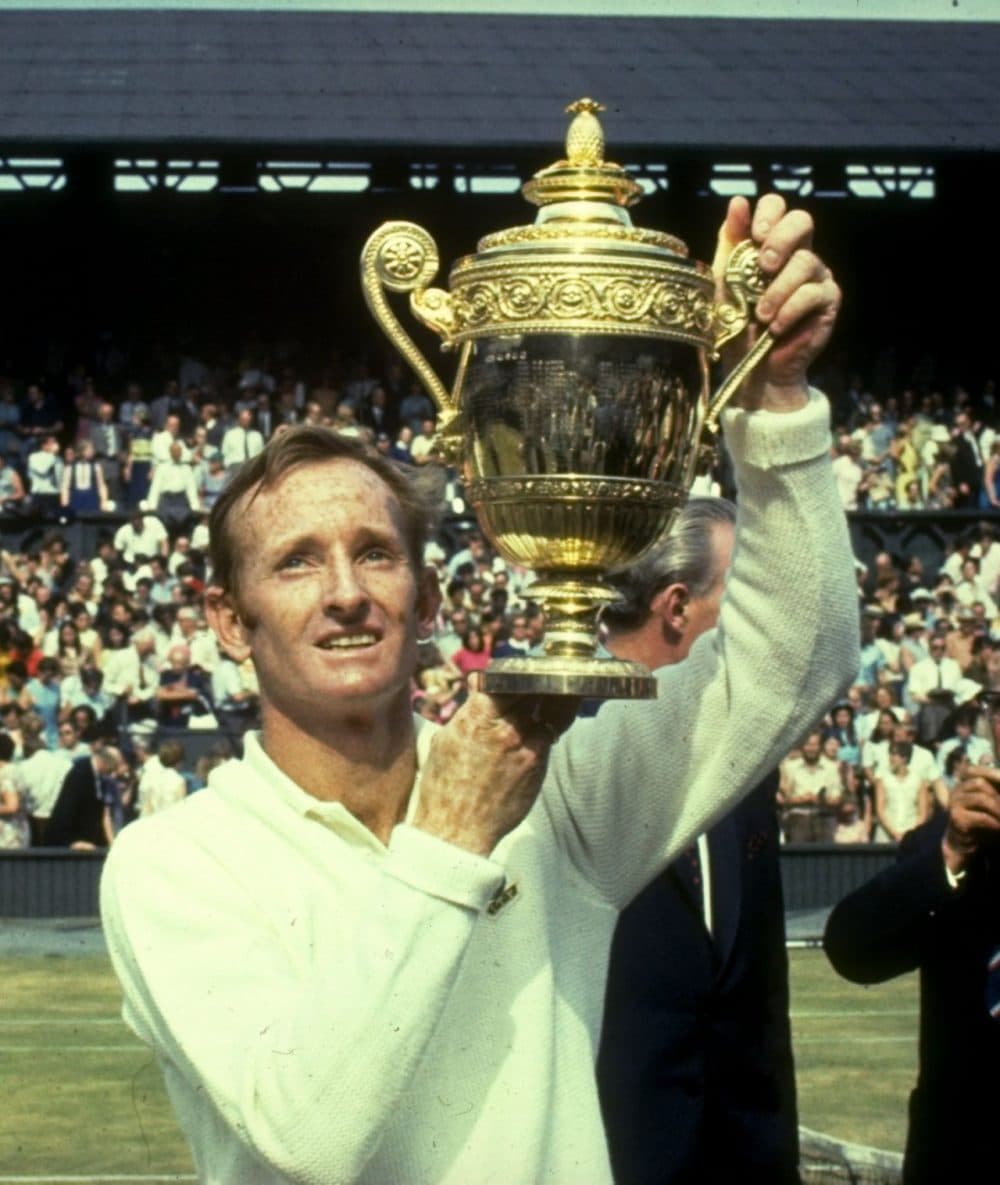
One of those best players was Rod Laver. In 1962, at the age of 24, the Rockland, Queensland, Australia won all 4, and it was a big deal. Then, having nothing left to prove as an amateur, he turned professional.

But in 1968, the rules changed, and the majors allowed professionals. So now, truly, the best of the best were playing in the biggest tournaments. On January 27, 1969, at the Milton Courts in Brisbane, Queensland, Laver beat Spanish player Andrés Gimeno6–3, 6–4, 7–5, to win the Australian Open. On June 8, at Stade Roland Garros in Paris, he beat fellow Australian Ken Rosewall, 6–4, 6–3, 6–4, to win the French Open. On July 5, at Centre Court in London, he beat another Australian, John Newcombe, 6–4, 5–7, 6–4, 6–4, to win Wimbledon.

When the U.S. Open began at the Forest Hills Stadium in the neighborhood of the same name in Queens, it became the biggest event in tennis history at the time: In only the 2nd year of everybody-eligible, there was a chance at a fully legitimate Grand Slam, which neither Laver in '62 nor Budge in '38 had really won. And the growth of television sports coverage meant that anybody who wanted to see it didn't have to travel to the site and hope that tickets were available. (The Forest Hills Stadium, built in 1923 and still standing, only seats 14,0000 people.) They could turn on the tube and watch.

In the 1st Round, Laver beat Luis-Agusto Garcia of Mexico, 6-2, 6-4, 6-2. In the 2nd Round, he beat Jaime Pinto-Bravo of Chile, 6-4, 7-5, 6-2. In the 3rd Round, he beat another Chilean, Jaime Fillol, 8-6, 6-1, 6-2. He had a serious challenge in the 4th Round, by American player Daniel Ralston. He won the 1st set, 6-4; then dropped the next 2, 6-4, 6-4; but came back to win the last 2, 6-2 and 6-3.

In the Quarterfinals, he was seriously pushed again, by fellow Australian Roy Emerson. Emerson won the 1st set, 6-4. The next 2 sets went to tiebreakers, and Laver won them, 8-6 and 13-11. Laver won the 4th set, 6-4. In the Semifinal, he faced Arthur Ashe. A year earlier, Ashe became the 1st black man to win the U.S. Open. Laver won in straight sets, but 2 of the sets went to tie breakers: 8-6, 6-3 and 14-12.

(Althea Gibson became the 1st black person to win it the U.S. Open, and also the 1st to win Wimbledon, in 1957, and again in 1958. Ashe would go on to become the 1st black man to win Wimbledon, in 1975.)

The Final was against Tony Roche, yet another Australian. This was the golden age of Australian tennis, and they haven't reached those heights since. Roche won the 1st set, 9-7. But Laver took control from there, going 6-1, 6-2, 6-2.

He had won the Grand Slam. It was the 1st ever won against full competition, and there has never been another. Jimmy Connors never did it: He won all but the French in 1974. Nor did Björn Borg: He won 5 straight Wimbledons and 6 French Opens in 8 years, but never won the U.S. or the Australian. Nor did John McEnroe: He never won the French or the Australian. Nor did Ivan Lendl: He never won the French. Nor did Andre Agassi: He won all 4, but never more than 2 in the same year. Nor did Pete Sampras: He never won the French, either. Nor did Roger Federer: He won all but the French in 2004 and again in 2006; and his only French win came in 2009, and he won Wimbledon that year, too, but not the other 2. Nor did Rafael Nadal: He won all but the Australian in 2010.

In 2016, Novak Djokovic, having already won that year's Australian and the previous year's Wimbledon and U.S., won the French, making him the 1st man since Laver to hold all 4 titles at once. But that's not the Grand Slam: He didn't do all 4 in the same calendar year. He did win all but the French in 2011 and 2015. He won the French after winning the Australian in 2016, but didn't win Wimbledon or the U.S. He won the Australian, the French, and Wimbledon in 2021, but lost the U.S. in the Semifinal. That's the closest anyone has come since Laver.

Three women have achieved a single-calendar-year Grand slam: Maureen Connolly in 1953, Margaret Court in 1970, and Steffi Graf in 1988.

In 1988, a new main stadium for the Australian Open opened in Melbourne. It is named the Rod Laver Arena. The Milton Courts were demolished in 2002.

*

The U.S. Open has been held in Queens since 1915. In 1978, it was moved from Forest Hills. the neighborhood whose name had come to mean "the U.S. Open," to Flushing Meadow-Corona Park, site of the 1939-40 and 1964-65 New York World's Fairs, across Roosevelt Avenue from Shea Stadium, home of baseball's New York Mets from 1964 to 2008 and football's New York Jets from 1964 to 1983.

And on September 9, 1969, an iconic moment took place at Shea. But let's take a step back, to set this moment up:

In 1969, the 1st season of Divisional Play, the Chicago Cubs won 11 of their 1st 12 games. They had a 5-game winning streak in May, a 7-game winning streak in June, and another 7-game winning streak in August. On August 16, they beat the San Francisco Giants, 3-0 at Candlestick Park in San Francisco. They led the National League Eastern Division by 9 games, with 42 games to go. The Division title was hardly wrapped up, but they were in great shape.

But they slipped. Not much at first: On September 3, they were still 5 games up with 24 games to go. The problem was, the New York Mets, who had lost an average of 108 games over their 1st 6 seasons before improving to 73-89 in 1968, went on a tear. On September 7, with the Cubs having lost 4 straight, the Mets had closed to within 2 1/2 games of the Cubs, with a 2-game series between the teams set for Shea.

On Monday, September 8, Tommie Agee put the Mets up 2-0 with a home run off Bill Hands in the bottom of the 3rd inning. The Cubs tied the game against Jerry Koosman in the top of the 6th. But Agee led off the bottom of the 6th with a double, and Wayne Garrett singled. Agee tried to score, and the instant replay clearly showed that he was out. But Satch Davidson, the home plate umpire, ruled him safe.

Cub catcher Randy Hundley, whose son Todd would eventually catch for both of these teams, knew Agee was out, and was furious at the blown call, enough to jump higher in the air than any man loaded down with catcher's equipment could be expected to. Leo Durocher, formerly manager in New York with first the Brooklyn Dodgers, then the New York Giants, was now managing the Cubs, and he ran out of the dugout to argue. Davidson held his call, and the Mets' 3-2 lead held up. The Mets were now within a game and a half of the Cubs.

The September 9 game was started by a pair of future Hall-of-Famers: Tom Seaver of New York was 20-7, and Ferguson "Fergie" Jenkins of Chicago was 19-12. The Mets led 4-0 in the top of the 4th, thanks in part to a home run by Donn Clendenon. With 1 out, Glenn Beckert on 2nd base, and Billy Williams at the plate, Ron Santo was in the on-deck circle.

And then, a black cat, often thought of as a symbol of bad luck, ran into the field. It ran in front of Santo. Then it stopped in front of the Cub dugout, and looked right at Durocher.
The men in the Cub dugout overheard Santo saying, "Oh, man, we're fucked now." Durocher, a baseball lifer, superstitious as hell, and one of the great practitioners of baseball profanity, yelled, "Somebody get that fucking cat out of here! Get him away from me!"

The cat then ran away, and disappeared under the stands. To this day, no one knows for sure whether the cat got out there on its own, or if someone had it and released it. (If anyone did know, they have never spoken up.) The most likely explanation was given by the Mets' Ed Kranepool: Like many stadiums, Shea had rats, cats were brought in to eat the rats, and this was probably one of those cats. Unless someone kept a record of those cats, there's no way to tell how long this cat lived.

In this case, the legend far exceeds the truth: The cat had absolutely no effect on either the game or the Pennant race. What became known as the Cubs' "September Swoon" was already well underway. Santo got a hit to drive Beckert home. But that only got the Cubs to within 4-1, and the Mets won, 7-1, to get within half a game.

The next day, the Mets swept a doubleheader from the expansion Montreal Expos at Shea, and the Cubs lost away to the Philadelphia Phillies. For the 1st time in their history, the Mets were in 1st place, and the cat didn't have anything to do with it: It was a convenient symbol, not the cause.

The Cubs' losing streak reached 8 games the day after that. On September 24, despite the Cubs beating the Expos at Wrigley Field, the Mets beat the St. Louis Cardinals at Shea, and clinched the NL East title. It was the first time a National League team from New York had finished 1st since the 1956 Dodgers. The Mets ended up winning the Division by 8 games over the Cubs.

The Mets went on to win the World Series, while the '69 Cubs have had to live with words like "September Swoon," "choke," "black cat" and "curse" ever since. Whie Ernie Banks (who didn't even play in the Black Cat Game) was a member of the 500 Home Run Club, and was elected to the Baseball Hall of Fame in his 1st year of eligibility, it took a long time for their other stars to make it: Jenkins was elected in his 3rd year, Williams was elected in his 6th, and Durocher (whose true Hall credentials came well before he arrived on the North Side of Chicago) and Santo didn't get in until after they died.

Then again, only 2 members of the '69 Mets are in the Hall of Fame: Seaver, and Nolan Ryan, who, despite being a key figure in on the Mets' pitching staff in the postseason, hadn't yet found his control, and so his true Hall credentials came after he was traded away. Manager Gil Hodges has finally been elected to the Hall, but that was for what he did as a player. Agee and Cleon Jones had very good careers, but not at Hall of Fame level.

In 1969, the Chicago Cubs had the better collection of players, but the New York Mets had, if not the better team, then, certainly, the better team performance.

As did the performances of the 1951 Brooklyn Dodgers and the 1964 Philadelphia Phillies before this, and the 1978 Boston Red Sox after this, the 1969 Chicago Cubs left their fans mentally scarred to the point that a later World Championship -- 1955 in Brooklyn, 1980 and 2008 in Philadelphia, 2004 and 3 more since in Boston, and 2016 in Chicago -- couldn't fully ease the pain.

Mike Royko, the great newspaper columnist who was with the Chicago Daily News in 1969, and turned 37 a few days after the Black Cat Game, would one day write, "New York didn't need that 1969 Pennant. It should have been ours. All we wanted was the one lousy Pennant. It would have kept us happy for the rest of the century. But New York took that from us, and I can never forgive them for that."

Royko died in 1997, having lived to see another Cub disaster in 1984. Michael Wilbon, co-host of Pardon the Interruption on ESPN, grew up in Chicago, remains a Cub fan, and says he still hates the Mets. Which is funny, because his co-host is Tony Kornheiser, who grew up on Long Island as a Met fan. (They were colleagues at The Washington Post when ESPN hired them, and remain close friends despite their baseball and geographic divides.)

An interesting side note: The cat got pretty close to the Cubs' batboy, Jim Flood, and he even got into a photograph taken of the incident. He became a lawyer, and, when the Cubs finally won another Pennant in 2016, people told him to stay away from cats and goats, bringing up another piece of Cub lore, "the Curse of the Billy Goat." The Cubs won the World Series, anyway. In a 50th Anniversary interview in 2019, Flood said he had 4 cats, and 1 of them was black. He named that cat Fergie, after Jenkins, an African-Canadian.

UPDATE: The Cubs have a team Hall of Fame. Inducted from their 1969 near-miss team team were shortstop Ernie Banks, left fielder Billy Williams, 3rd baseman Ron Santo, shortstop Don Kessinger, 2nd baseman Glenn Beckert, catcher Randy Hundley; pitchers Ferguson Jenkins and Ken Holtzman; manager Leo Durocher; coach and scout John "Buck" O'Neil, owner Philip K. Wrigley, clubhouse manager Yosh Kawano, public address announcer Pat Pieper; and broadcasters Jack Brickhouse, Lou Boudreau and Vince Lloyd.

From between the 1969 near-miss and the 1984 Playoff berth, they have inducted outfielder José Cardenal, 1st baseman Bill Buckner, and pitchers Rick Reuschel and Bruce Sutter.

*

September 9, 1969 was a Tuesday. These other games were played in Major League Baseball that day:

* The New York Yankees lost to the Detroit Tigers, 2-0 at Tiger Stadium in Detroit. And it wasn't either Denny McLain or Mickey Lolich who pitched the shutout, either: It was Mike Kilkenny, outpitching Fritz Peterson. Roy White and rookie Thurman Munson each had 2 of the Yankees' 8 hits.

* The Montreal Expos beat the Pittsburgh Pirates, 4-2 at Jarry Park in Montreal. Roberto Clemente went 0-for-4, and Willie Stargell went 1-for-4.

* The St. Louis Cardinals beat the Philadelphia Phillies, 6-2 at Connie Mack Stadium in Philadelphia. Lou Brock went 2-for-4 with a walk, a stolen base, and an RBI. Joe Torre went 1-for-2 with 3 walks and an RBI.

* The Baltimore Orioles swept a doubleheader from the Washington Senators at Memorial Stadium in Baltimore, 6-1 and 3-2. Frank Howard homered in the opener, but that was the only run that Mike Cuellar allowed. Tom Phoebus won the nightcap, despite a home run from Mike Epstein, a slugger who apparently didn't mind being called "Superjew." Over the 2 games, Brooks Robinson went 2-for-6 with 2 walks and 4 RBIs, while Frank Robinson went 0-for-3 with a walk in the 1st game and didn't play in the 2nd.

* The Atlanta Braves beat the Los Angeles Dodgers, 2-1 at Atlanta (later Atlanta-Fulton County) Stadium. Hank Aaron went 1-for-3 with a walk. Ralph Garr singled home the winning run in the bottom of the 10th inning. Phil Niekro went all 10 innings for the win.

* The Boston Red Sox beat the Cleveland Indians, 3-1 at Cleveland Municipal Stadium. Carl Yastrzemski went 1-for-5 with an RBI.

* The San Francisco Giants beat the Cincinnati Reds, 7-4 at Crosley Field in Cincinnati. Dick Dietz and Willie McCovey hit home runs for the Giants. (In spite of the Giants finishing 2nd to the Braves in the NL West, and Seaver's Cy Young Award season, it was McCovey who was named the NL's Most Valuable Player that year.) Willie Mays went 2-for-5. For the Reds, Pete Rose went 0-for-1 before leaving the game due to an injury, and Johnny Bench went 1-for-4.

* The Houston Astros beat the expansion San Diego Padres, 9-2 at the Astrodome in Houston. Larry Dierker outpitched Phil Niekro. Jim Bouton, in the process of writing Ball Four and having been traded from the Pilots to the Astros, did not get into the game, since Dierker went the distance.

But it was a noteworthy day in the book. Tommy Davis, the former NL batting champion who had been traded from Seattle to Houston a week after Bouton was, confirmed Bouton's suspicions that most of the Pilot players thought he was "weird," and that manager Joe Schultz, instead of acknowledging that Bouton was, at the least, working hard and always thinking, egged them on by making fun of Bouton in front of the other players.

This was also the night when, after the game, the postgame spread included a big pot of chicken a la king. The players hated it. And they went on a 6-game losing streak. After the 5th loss, Bouton wrote, "Has anybody noticed that we haven't won a game since we ate that chicken a la king?"

* The Minnesota Twins beat the California Angels, 11-7 at Anaheim Stadium (now Angel Stadium of Anaheim). Harmon Killebrew went 2-for-4 with an RBI. Rod Carew went 1-for-5.

* The expansion Kansas City Royals beat the team that had abandoned Kansas City after the 1967 season, the now-Oakland Athletics, 2-1 at the Oakland Coliseum. Reggie Jackson went 0-for-4.

* And the Chicago White Sox and the expansion Seattle Pilots were not scheduled to play.

Also, New Zealand supermodel Rachel Hunter was born on this day.

Monday, July 18, 2022

July 18, 1939: The Trade of Pee Wee Reese

July 18, 1939: Once upon a time, there were 2 shortstops, who were also their teams' managers. One had accepted that his time as a player was coming to an end, and that his replacement needed to be found. The other refused to accept this.

The Boston Red Sox had Joe Cronin, who had managed the Washington Senators to the 1933 American League Pennant, despite being only 27 years old and being the best shortstop in baseball. He was also the owner's son-in-law, having married Mildred Robertson, the niece and adopted daughter of Senators owner Clark Griffith. Just 1 year later, Tom Yawkey, owner of the Boston Red Sox, made Griffith an offer he couldn't refuse, and brought Griffith to Boston.

Yawkey tried to buy a championship, he really did. He bought Jimmie Foxx, the great slugging 1st baseman, and Lefty Grove, the great lefthanded pitcher, both from the Philadelphia Athletics. He was also one of the earliest team owners to bring in good players from the Pacific Coast League, probably due to the influence of Cronin, a San Francisco native. Among these players were Dom DiMaggio, the younger and pretty good brother of New York Yankees superstar Joe DiMaggio, both from San Francisco; and the man who would, eventually, succeed Cronin as the Red Sox' starting shortstop, Johnny Pesky of Portland, Oregon.

The Red Sox finished 2nd in the American League in 1938, their best finish in 20 years, although far behind the Yankees. This was repeated in 1939. Until the end of that season, Cronin was 32 years old. He batted .308, hit 19 home runs, and had 107 RBIs. Baseball held its All-Star Game for the 7th time, and he was named to it for the 6th. He was still one of the best players, never mind shortstops, in the game. There was no reason to believe that his productive service was coming to an end.

The Brooklyn Dodgers had Leo Durocher, who had been a reserve rookie infielder on the Yankees' 1928 World Series winners, and the starting shortstop on another World Series winner, the 1934 St. Louis Cardinals, the scrappy bunch known as "The Gashouse Gang." Durocher took that mentality with him to the Brooklyn Dodgers, who traded for him in 1938, and made him their manager. In 1939, he guided them to a 3rd-place finish, their best in 15 years.

Durocher was only a year and a half older than Cronin, and, like Cronin, was still a good fielder. But he was never as good a hitter, and, having a big ego, he knew that winning as a manager would be more satisfying than losing as a player. So he and the team's general manager, Larry MacPhail, began to look for the next good Dodger shortstop.

Harold Henry Reese was from Louisville, Kentucky, and was nicknamed "Pee Wee," not because he was small (hardly, he was 5-foot-10), but because he was a champion marbles player, and marbles were often called "pee wees" back then. He was playing for his hometown team, the Louisville Colonels. They were the top farm team for the Red Sox, and it looked like Reese, then 21, was ready for the major leagues. But Cronin, thinking he was still the Boston shortstop of, at the least, the immediate future, refused to promote him.

So, on July 18, 1939, he convinced Yawkey to trade Reese to the Dodgers for 4 players and $35,000. Those 4 players didn't amount to much. Reese did: In 1940, Durocher made him the starting shortstop. In 1941, the Dodgers won their 1st Pennant in 21 years, as Durocher could concentrate on managing while Reese became the best shortstop in the National League.

Cronin put together strong seasons in 1940 and '41. But while he could still hit, his defensive skills eroded. In 1942, Pesky was called up, and, as a rookie, led the AL in hits with 205. World War II intervened, the Red Sox' main shortstop was Lamar "Skeeter" Newsome, a decent hitter for contact but with no power, and not as good a shortstop as Pesky was or Cronin used to be. And Cronin was no longer even that good.

Having Reese on the roster wouldn't have mattered, anyway, as he also served in The War. And in 1946, while the Dodgers just missed the Pennant, the Red Sox, with Cronin as manager and Pesky as shortstop, won their 1st Pennant in 28 years. But a key play in Game 7 of the World Series against the St. Louis Cardinals made Sox fans blame Pesky for the defeat. They didn't win another Pennant for 21 years.

In contrast, from 1947 to 1956, with Reese as shortstop and team Captain, the Dodgers won 6 Pennants and just missed 2 others; while the Yankees won 8 Pennants, and the Red Sox lost out on the last day of the season in 1948, thanks to a player-manager shortstop in Lou Boudreau of the Cleveland Indians, who won the AL's Most Valuable Player; and '49, with Yankee shortstop Phil Rizzuto probably deserving the MVP more than the Sox' Ted Williams, who got it. The Yankees also won the World Series in 1950, with Rizzuto deservedly winning the MVP.

Pesky was a very good player. But Williams said, "If we'd had Rizzuto at shortstop, we would have won all those Pennants, not the Yankees." Williams never said that Yawkey and Cronin should have held onto Reese. But, as a member of the Baseball Hall of Fame's Committee on Veterans, he advocated for both Reese and Rizzuto to get elected to the Hall. Reese made it in 1984, Rizzuto in 1994. Pesky has never been elected.

It's also worth noting that, as a Southerner, Reese was instrumental in his Dodger teammates accepting Jackie Robinson as the 1st black player in modern baseball. In contrast, Cronin, first as manager, then as general manager, may have been part of the reason why the Red Sox were the last MLB team to integrate, not doing so until 1959, the year Cronin left the Boston GM job to become President of the AL, a post he hendl until 1973.

Cronin was elected to the Hall in 1956, and died in 1984. Durocher managed the New York Giants to a Pennant in 1951 and the World Series in 1954, but was so controversial that he wasn't elected to the Hall until 1994, 3 years after he died. It has been speculated that no one wanted to elect him while he was still alive because they didn't want to hear a self-serving acceptance speech.

Nevertheless, when the time came to admit that his successor needed to be found, before it was too later, Durocher admitted it, and Cronin didn't. The Dodgers benefited tremendously from this, while the Red Sox did not.

*

July 18, 1939 was a Tuesday. This was the day that Dion DiMucci was born in The Bronx. He became the king of rock and roll's doo-wop singers in the late 1950s and the early 1960s, with hits like "I Wonder Why," "A Teenager In Love," "Runaround Sue" and "The Wanderer." In 1968, he returned to the high reaches of the charts with "Abraham, Martin and John," before turning to Christian music and the occasional rock and roll comeback. Still alive and occasionally performing as of July 18, 2022, and living in Miami, Dion remains an unabashed Yankee fan.

These baseball games were played that day:

* The New York Yankees swept a doubleheader from the St. Louis Browns, 9-0 and 4-3 at Sportsman's Park in St. Louis. In the opener, Atley Donald pitched a 3-hit shutout, backed by a home run from Joe Gordon.

In the nightcap, Oral Hildebrand outpitched Jack Kramer (no relation to the tennis star of the same name, who was a contemporary). Hildebrand was backed by home runs from George Selkirk (who had replaced Babe Ruth as the Yankees' starting right fielder in 1935) and Babe Dahlgren (who had replaced Lou Gehrig as the Yankees' starting 1st baseman earlier in 1939). Over the 2 games, Joe DiMaggio went 3-for-6 with 2 walks and 2 RBIs.

* The New York Giants lost to the St. Louis Cardinals, 5-3 at the Polo Grounds. Mel Ott hit a solo home run for the Jints.

* The Brooklyn Dodgers lost to the Chicago Cubs, 4-2 at Ebbets Field. Leo Durocher went 1-for-4.

* The Cincinnati Reds beat the Boston Bees, 12-3 at National League Park in Boston. After a disastrous 1935 season, the Boston Braves "rebranded" (as we would say today), changing their name to the Bees, and renaming Braves Field "National League Park." The changes were never accepted, and in 1941, the names were switched back.

* The Philadelphia Phillies beat the Pittsburgh Pirates, 8-3 at Shibe Park in Philadelphia. Lloyd Waner went 1-for-4, and Paul Waner only appeared as a pinch-hitter, not reaching base.

* The Cleveland Indians beat the Philadelphia Athletics, 6-3 at Cleveland Municipal Stadium.

* The Washington Senators beat the Detroit Tigers, 10-2 at Briggs Stadium in Detroit (renamed Tiger Stadium in 1961). Senators right fielder Taft Shedron "Taffy" Wright went 5-for-5 with an RBI. Tigers 1st baseman Hank Greenberg went 1-for-4 with 2 RBIs.

* A doubleheader was split at Comiskey Park in Chicago. The Boston Red Sox won the 1st game, 13-10. The Chicago White Sox won the 2nd game, 8-5. Over the 2 games, Joe Cronin went 2-for-7 with a walk and an RBI, Jimmie Foxx went 4-for-9 with a home run, a walk and 3 RBIs, and rookie Ted Williams went 6-for-10 with a home run and 4 RBIs.

Saturday, July 16, 2022

July 16, 1948: The Durocher Switch

July 16, 1948: Leo Durocher is named manager of the New York Giants -- after having been manager of their arch-rivals, the Brooklyn Dodgers, for 9 of the previous 10 seasons. This shocks fans of both teams: Now, Dodger fans hate a man they had previously loved; and Giant fans, having hated him before, welcome him with open arms.

Durocher had been a good-field-no-hit shortstop, who played on the New York Yankees' 1928 World Series winners (but hadn't yet been promoted for their 1927 "greatest team ever"). In 1929, when the Yankees introduced uniform numbers, based on their batting order, Durocher became the 1st Yankee to wear the Number 7 that would later become legend on Mickey Mantle. But after the 1929 season, the Yankees got rid of him, and he was never employed by another American League team. Legend has it that Babe Ruth accused Durocher of stealing his watch.

He also played for the 1934 World Series winners, the St. Louis Cardinals, a scrappy bunch known as the Gashouse Gang. This team's style of getting runs any way you can would influence his later managing.

In 1938, he was traded to the Dodgers, and was named their manager in 1939. He ceded the shortstop position to Harold "Pee Wee" Reese in 1940, and in 1941, he managed them to their 1st Pennant in 21 years. They lost the World Series to the New York Yankees.

When Spring Training came in 1947, he had to contend with the arrival of Jackie Robinson, the 1st black player in modern baseball. Durocher had grown up in West Springfield, Massachusetts, of French-Canadian descent and Roman Catholic faith, and had been discriminated against for both reasons. So when he learned that some Southerners on the Dodger roster had circulated a petition against Robinson's presence on the team, he stood up for Robinson.

Of course, Durocher was also concerned about winning. And, as a poor kid who became a rich man, and also became a compulsive gambler, he was also concerned about money. So this is what he told them:

You know what you can do with that petition? You can wipe your ass with it. I do not care if the guy is yellow or black, or if he has stripes like a fucking zebra. I’m the manager of this team, and I say he plays. He's gonna win a lot of games for us, and he's gonna make a lot of money for us. And he's only the first. There's a lot more coming.

But Durocher would not be the manager in that critical first season of 1947. He had been connected with mobsters and gamblers. The City's Catholic Youth Organization was also upset over Leo's affair with the woman who would become the 3rd of his 4 wives, actress Laraine Day, and promised a boycott of Ebbets Field if something weren't done.

Baseball Commissioner Albert "Happy" Chandler took the decision out of Dodger president Branch Rickey's hands, and suspended Durocher for the entire season. With Burt Shotton as manager, and Robinson playing superbly under the greatest pressure any American athlete has ever known, the Dodgers won the Pennant -- but, again, lost the World Series to the Yankees.

In the next year's Spring Training, the Dodgers' 1st at the "Dodgertown" complex at Vero Beach, Florida, where they could control things and keep the racists out, Robinson showed up showing the effects of the off-season after-dinner-speaking circuit. Durocher, now eligible to manage again, said, "Jackie Robinson had gotten fat, just for me." Once supportive, Durocher now belittled Robinson, to the point where Robinson called him "a cologne-soaked bully."

Durocher also didn't like Mel Ott. Once the greatest slugger the National League had ever seen, he was now the manager of the Giants, and not a good one. Durocher was once quoted as saying, "Look at Ott. He's a nice guy, and he's gonna finish 8th. All nice guys, and they'll finish 8th with him."

The implication was that, in the 8-team National League, 8th place was last, and that they didn't have enough of a mean streak to win some of the games they could have won. This got turned into "Nice guys finish last," and while it's not Durocher's exact words, he used it as the title of his 1975 autobiography.

Giants owner Horace Stoneham was looking to fire Ott for his lack of success. Rickey, a one-quarter owner of the Dodgers, was looking for a way to get rid of Durocher. It's not clear who made the phone call, but they decided that the easy thing to do was to "trade" Durocher. Ott was bought out of his contract, Durocher was hired by the Giants, and Rickey brought Shotton back, and he remained Dodger manager through the end of the 1950 season.

Leo Durocher, the embodiment of the tough, scrappy, underdogs-for-the-underdogs Brooklyn Dodgers -- managing the aristocratic New York Giants? It was a shock. Sure, Louis Armstrong had played Carnegie Hall, but this was like Frank Sinatra singing at The Met, with his bobby-soxers mixing with the the big donors. Horrors!

Dodger fans, who valued loyalty, now hated him. They said they were betrayed. They called their once-beloved Leo the Lip a traitor and a sellout. They had no idea that it wasn't his idea to make the move. It was Rickey's and Stoneham's. On the other hand, Giant fans who hated him quickly realized that he was just the kick in the pants their team needed, and embraced him. 

What's more, it worked -- for both teams. Without Durocher, the Dodgers won Pennants under Shotton in 1949, under Charlie Dressen in 1952 and 1953, and under Walter Alston in 1955 and 1956. With Durocher, the Giants won an amazing Pennant race with the Dodgers in 1951 (See: "Thomson, Bobby"), and another Pennant in 1954. Durocher led the Giants to win the World Series in 1954, and Alston led the Dodgers to win it in 1955.

Both teams moved to California after the 1957 season. In Hollywood, where he spent his off-seasons, Durocher was re-hired by Walter O'Malley, who had bought out Rickey and the other Dodger partners after the 1950 season, and didn't care that Leo was friends with mobsters and gamblers. Durocher later managed the Chicago Cubs, blowing a sure National League Eastern Division title in 1969; and was still managing in the majors as late as 1973, with the Houston Astros.

He died in 1991, without having been elected to the Baseball Hall of Fame -- the rumored reason being that no one wanted to hear his acceptance speech. He was posthumously elected in 1994.

*

July 16, 1948 was a Friday. Two very different musical legends were born that day: Israeli classical violinist Pinchas Zukerman, and Panamanian singer Rubén Blades.

These baseball games were played that day:

* The Giants were supposed to play the Pittsburgh Pirates at Forbes Field in Pittsburgh, but got rained out. The game was rescheduled for September 2, and the Giants won, 5-4. Walker Cooper and Jack Lohrke hit home runs in support of Larry Jansen.

* The Dodgers beat the Cincinnati Reds, 4-2 at Crosley Field in Cincinnati. Gene Hermanski hit a home run. Robinson went 0-for-4. Joe Hatten outpitched Ewell Blackwell.

* The New York Yankees lost to the St. Louis Browns, 10-4 at Yankee Stadium. Allie Reynolds did not have good stuff. Joe DiMaggio went 0-for-3, although he did draw a walk. The Yankees did get a home run, from Phil Rizzuto.

* The Boston Red Sox beat the Detroit Tigers, 5-3 at Fenway Park in Boston. Ted Williams did not play in this game.

* The Philadelphia Athletics beat the Cleveland Indians, 10-5 at Shibe Park in Philadelphia.

* The Chicago White Sox beat the Washington Senators, 3-2 at Griffith Stadium in Washington.

* The Boston Braves beat the Chicago Cubs, 12-10 at Wrigley Field in Chicago. The wind was blowing out: Home runs were hit for the Braves by Earl Torgeson and Phil Masi, and for the Cubs by Andy Pafko and Bob Scheffing.

* And the St. Louis Cardinals beat the Philadelphia Phillies, 8-2 at Sportsman's Park in St. Louis. Stan Musial went 0-for-2, but had 2 walks and 2 RBIs.

Saturday, May 28, 2022

May 28, 1951: Willie Mays Says Hello

May 28, 1951: Willie Mays makes his real major league debut.

Not his actual major league debut. Depending on how you measure it, that was either sometime in 1948, or on May 25, 1951. It was 3 days after that latter date that he began to show the wider world what he could do.

Willie Howard Mays Jr. was born on May 6, 1951 in Westfield, Alabama, and grew up in nearby Fairfield, both outside Birmingham. His father, Willie Sr., nicknamed Kitty-Kat, had played semi-pro baseball, though not officially in what became known as the Negro Leagues. Willie Jr. was signed to play in those, in 1948, by the Birmingham Black Barons. He was just 17, but was good enough to help them win the Pennant, before losing the Negro World Series to the Pittsburgh-based Homestead Grays.

While playing with the Black Barons in 1949, he was pursued by several teams. He could have ended up with the Brooklyn Dodgers, on the same team with Jackie Robinson and Roy Campanella. He would have played center field, and the Dodgers would have solved their left field problem by moving Duke Snider over.

But the Dodgers didn't make the deal, because an official in their front office, Wid Matthews, had seen him play, and told team president Branch Rickey that he could not hit a curveball. Matthews was a former outfielder, who had played all of 192 games in the major leagues in the 1920s. Who couldn't hit a curveball? Well, maybe we shouldn't be too hard on Wid: It was he who told Branch Rickey, president of the Dodgers, in 1945 that Robinson had a good ability to "protect the strike zone."

Mays could have ended up with the Boston Red Sox, because they had offered him a tryout, because they had offered his manager in Birmingham, Piper Davis, a contract. But a Sox scout told team owner Tom Yawkey the same thing that Matthews had told Rickey: That Mays "couldn't hit a curveball."

He was 18 years old, and had never yet attempted to hit a white man's curveball. And Davis was too old to keep, and was released. And that's why the Red Sox became the last major league team to integrate, in 1959. And that's also how the Red Sox could have ended up with Ted Williams in left field and Willie Mays in center field, but didn't.

The Boston Braves were also interested in Mays. But they had a quota on the number of black players in their system, and they'd already hit it. So they could have had Willie Mays in center field and Hank Aaron in right field -- perhaps not soon enough to save them from moving to Milwaukee in 1953, but the Braves could have dominated the National League for years to come.

Or, the New York Giants could have. Because their scout, Ed Montague, signed Willie, and they were also interested in Hank. "I had the Giants' contract in my hand," Aaron would later say, "but the Braves offered $50 a month more. That's the only thing that kept Willie Mays and me from being teammates: Fifty dollars." $50 in 1952, with inflation, is about $552 in 2022 money. Doesn't sound like much, does it? On such hinge moments does the history of a sport sometimes hang in the balance.

For 1950, the Giants assigned Mays to their Class A team, the Trenton Giants. This was the end of the line for minor-league baseball in New Jersey: The Giants moved both their Trenton and their Jersey City farm teams after the season, while the New York Yankees moved their Newark Bears farm team a year earlier. The Negro Leagues' Newark Eagles folded after 1951.

Negro League stars being picked up by the white majors hurt them, but what really killed the Negro Leagues and many of the minor-league teams, and in some cases entire minor leagues, was television: Why should a fan get in his car and drive 20 miles, and then pay to get in, to watch a minor-league team when he could stay home, and watch the closest major league team for free, on a TV set he'd already paid for, with food and drinks he'd already paid for and didn't have to stand on line for?

Mays did well enough with Trenton that he was promoted to the Giants' top farm team for 1951, the Class AAA Minneapolis Millers. He was batting .477, and had just turned 20. Clearly, he could hit a major league white man's curveball. So, on May 25, 1951, he made his debut with the Giants. Wearing Number 14, playing center field and batting 3rd, he went 0-for-5 against the Philadelphia Phillies at Shibe Park in Philadelphia. The Giants won, anyway, 8-5.

The next day, against Phils ace Robin Roberts, he went 0-for-3 with 2 walks. The Giants won, anyway, 2-0. The next day, he went 0-for-4. The Giants won, anyway, again 2-0. He had played flawlessly in center field. But at the plate, he was 0-for-12. His batting average was .000. His slugging percentage was .000. Counting the 2 walks, his on-base percentage was .143.

He told Giant manager Leo Durocher that he didn't think he was ready. Leo showed confidence in him, saying, "I don't care if you go 0-for-50. I'm the manager, and you're my center fielder."

The next night, May 28, was Mays' 1st home game, at the Polo Grounds at 157th Street and 8th Avenue in Upper Manhattan, with Harlem to the south, Washington Heights to the west, and the Harlem River and The Bronx to the north and east -- including Yankee Stadium, one mile due east. The Giants were starting a series with the Boston Braves. For this game, Mays was given a new uniform number, 24.

In the 1st inning, the Braves -- who did not yet have Aaron, or their other Hall of Fame hitter of the era, Eddie Mathews -- tagged Sheldon Jones for 3 runs in the top of the 1st inning. In the bottom of the 1st, batting 3rd for the 4th game in a row, was Mays. The Braves' starting pitcher was Warren Spahn, also a future Hall-of-Famer.

The distance from the middle of the pitching rubber to the middle of home plate is 60 feet 6 inches. Spahn threw Mays a fastball, and, after the game, told the press, "For the 1st 60 feet, that was a hell of a pitch." Mays hit it over the left field roof. It was the 1st of 3,283 career hits, the 1st of 660 home runs, and the 1st of 1,903 runs batted in. But it was the only run Spahn allowed, as the Braves won, 4-1.

Mays finished the game 1-for-4. He was now batting .063, on-base .261, slugging .250. Many years later, years in which Mays had terrorized the National League with his hitting, running and fielding, at an All-Star Game, with Mays within earshot, Stan Musial of the St. Louis Cardinals jokingly told Spahn, "If you'd just struck him out, we might have been rid of him forever!"

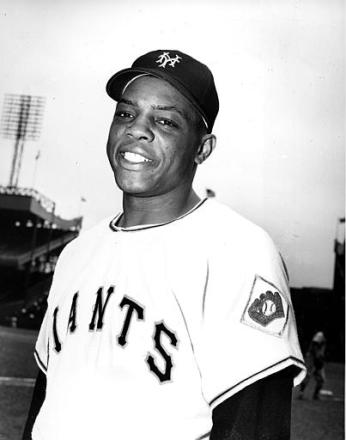
Mays' performance in the field had led to the moving of Bobby Thomson from center field to 3rd base. When Thomson hit "The Shot Heard 'Round the World" to give the Giants the Pennant, a little more than 4 months later, Mays was on deck. He had finished a season in which he batted .274 with 20 home runs, 61 runs batted in, and some sensational catches, which led to him telling his teammates, "Say, hey, didn't you see that play?" Which led to him being nicknamed "The Say Hey Kid." He was named the NL's Rookie of the Year.

Willie Mays had said hello to America. When he announced his retirement 22 years later, he told the crowd that he had realized that the time had come to tell himself, "Willie, say goodbye to America."

*

May 28, 1951 was a Monday. Had today's law been in effect, it would have been Memorial Day. But, until 1970, it was held on May 30 every year. Starting in 1971, it's been the last Monday in May. Memorial Day has traditionally meant doubleheaders in baseball. But on this last Monday in May, there wasn't even a full slate of games. These other games were played:

* The New York Yankees lost to the Boston Red Sox, 3-2 at Fenway Park in Boston. Joe DiMaggio went 1-for-4. Ted Williams went 0-for-4. Mel Parnell outpitched Allie Reynolds. Four months later, the Yankees swept a doubleheader from the Red Sox at Yankee Stadium. In the opener, Reynolds pitched a no-hitter, getting Williams to pop up for the last out. In the nightcap, the Yankees clinched the Pennant.

* The Brooklyn Dodgers beat the Philadelphia Phillies, 4-3 at Shibe Park in Philadelphia. Ralph Branca outpitched Ken Heintzelman. Gil Hodges and Carl Furillo hit home runs. Jackie Robinson went 2-for-4.

* The Cleveland Indians beat the Detroit Tigers, 9-0 at Briggs Stadium (later Tiger Stadium) in Detroit. Bob Feller pitched a 6-hit shutout.

* The Chicago White Sox beat the St. Louis Browns, 4-2 at Comiskey Park in Chicago.

* The St. Louis Cardinals beat the Pittsburgh Pirates, 6-5 at Sportsman's Park in St. Louis. Stan Musial went 2-for-4 with a home run and 3 RBIs. Red Schoendienst singled Del Rice home with the winning run in the bottom of the 10th inning.

* The Philadelphia Athletics and the Washington Senators were rained out at Griffith Stadium in Washington. The game was made up as part of a doubleheader on July 8. The Senators swept, 3-1 and 8-2.

* And the Chicago Cubs and the Cincinnati Reds were rained out at Crosley Field in Cincinnati. The game was made up on August 16. The Cubs won, 8-4. The Reds' bullpen collapsed in the top of the 10th inning.

Saturday, April 9, 2022

April 9, 1947: Brooklyn Dodger Manager Leo Durocher Is Suspended

April 9, 1947: Brooklyn Dodgers manager Leo Durocher is suspended for the entire season, for what Commissioner Albert B. "Happy" Chandler calls "conduct detrimental to the game" -- 6 days before Opening Day.

He was accused of consorting with gamblers, including organized crime figures. And gambling was the thing that scared the baseball establishment the most. He was also accused of a different kind of consorting, marrying actress Laraine Day, with both of them being previously divorced.

Both accusations were true. Brooklyn's Catholic Youth Organization threatened to cancel its ticket buys if Durocher were not removed. They seemed to care more about the fooling around with Day than with the connections with the Mob.

Team president Branch Rickey was a Methodist and a moralist, and didn't like Durocher on a personal basis. He knew that Durocher fooled around, that he drank heavily, and that he bet on racehorses. But Rickey tolerated Durocher, because he won. Well, once; A former shortstop, he managed the Dodgers to the National League Pennant in 1941, and lost Playoffs for the Pennant in 1942 and 1946. In other words, in the last 3 seasons that were not affected by the manpower drain of World War II, Durocher had put the team in position to win the Pennant all 3 times.

Rickey also knew that he did not need a distraction, 6 days before Opening Day, the day when his project, Jackie Robinson, was to become the 1st black player in modern baseball. Before his suspension, though, Durocher stood up for Jackie. Having faced anti-Catholic bigotry in his youth, he told the Dodger players who didn't want Jackie on the team that he was going to play, and that any player who wouldn't play with him would be traded. And Rickey was willing to back Durocher up on that.
Branch Rickey

But now, Durocher had been suspended for a full year, the longest suspension in baseball history to that point, short of a permanent ban. Rickey didn't want the fuss over Durocher to detract or distract from Jackie's debut. So on this issue, he did not stick up for Durocher. He chose not to fight the suspension.

He turned to Burt Shotton, one of his scouts. A former outfielder, Shotton had played for both the St. Louis Browns and the St. Louis Cardinals, and had coached the Cardinals, while Rickey was the general manager of those teams. Shotton had also managed the Philadelphia Phillies and the Cincinnati Reds. Rickey wanted Shotton to manage the Dodgers.

Shotton had promised his wife that he would never wear another major league uniform. Rickey reminded him that Connie Mack, owner and manager of the Philadelphia Athletics, wore a suit in the dugout, rather than a uniform. So Shotton wore a suit, a team jacket, and a Dodger cap.
Burt Shotton

He managed the Dodgers for the 1947 season. Durocher came back in 1948, but a deal between Rickey and New York Giants owner Horace Stoneham allowed Durocher to switch teams. Rickey brought Shotton back, and he managed the Dodgers through the end of the 1950 season. He led the Dodgers to the Pennant in 1947 and 1949, and nearly did so again in 1950. He and Mack were the last 2 managers to wear suits instead of uniforms.

*

April 9, 1947 was a Wednesday. Baseball was in Spring Training. Football was out of season. The Stanley Cup Playoffs were between the Semifinals and the Finals. The Toronto Maple Leafs went on to beat the Montreal Canadiens in 6 games.

There was 1 score on this historic day: The Basketball Association of America, in its 1st season, 1 of 3 before it merged with the National Basketball League to form the National Basketball Association, played a 1st round Playoff game at the old Madison Square Garden. The New York Knicks beat the Cleveland Rebels, 93-71.

December 31, 1999 & January 1, 2000: The Millennium

December 31, 1999:  The Millennium arrives. The people of planet Earth survived. At a terrible cost. But we hadn't destroyed ourselves. ...