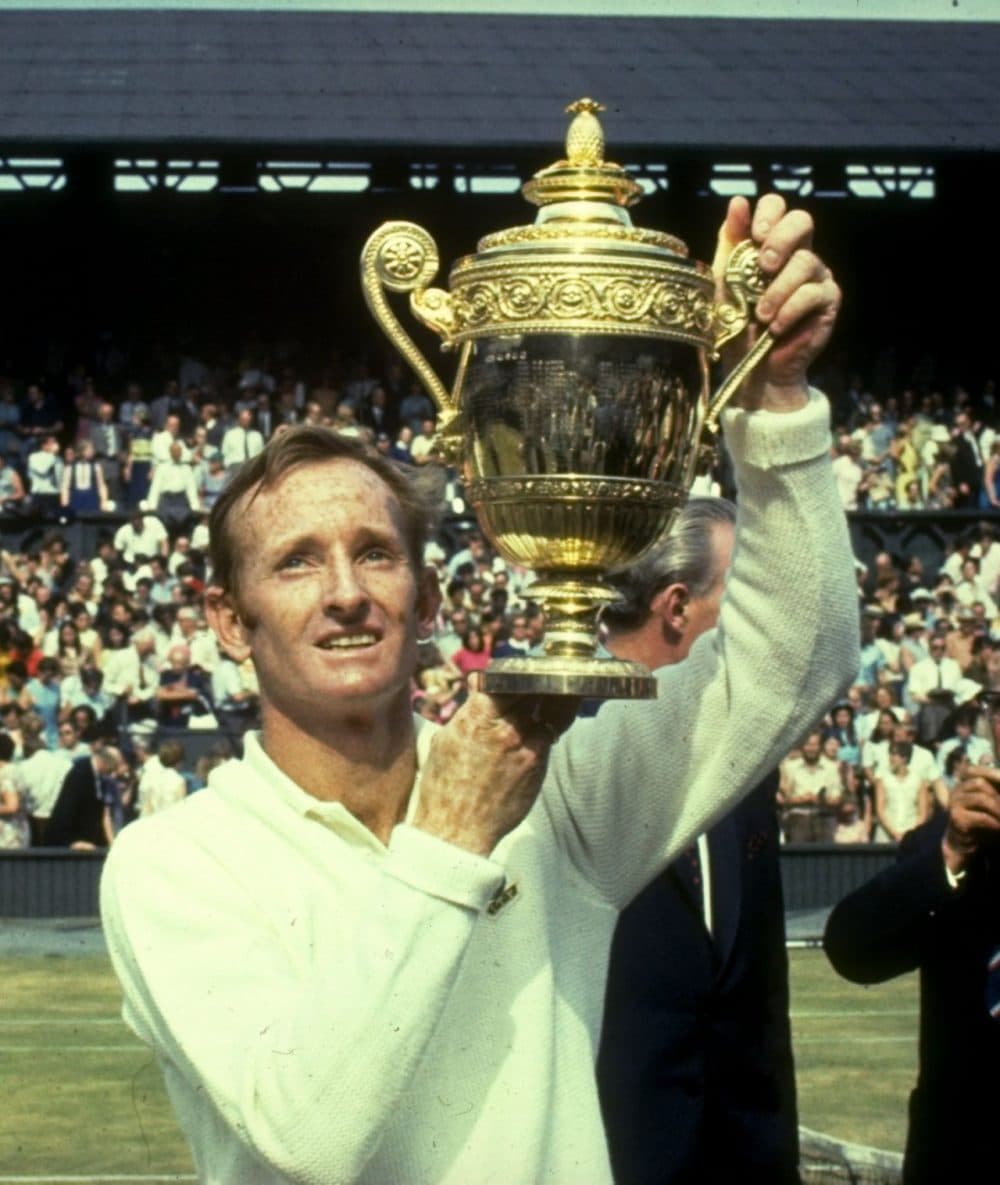
September 9, 1969: Two big events in sports happen in Queens, in New York City.
In tennis, the Grand Slam is winning all 4 majors: In chronological order, the Australian Open, the French Open, Wimbledon (the British championship) and the U.S. Open. From 1905, when the Australian Open, the newest of them, was first staged until 1961, it was achieved only once, in 1938, by Don Budge.
One big reason was that, early on, the distance from Australia to, well, pretty much anywhere else in the world meant that a lot of the best players simply didn't go to compete in it. As a result, Australian men and women won it more often than even home-court advantage would suggest they would. Another reason is that, due to the French Open having a clay court, players who are used to that surface have an advantage over those who aren't used to it, and upsets are common there. Another reason is that these tournaments weren't as "open" as their names suggest: Only amateur players were eligible, and some of the best players turned professional early.
One of those best players was Rod Laver. In 1962, at the age of 24, the Rockland, Queensland, Australia won all 4, and it was a big deal. Then, having nothing left to prove as an amateur, he turned professional.
But in 1968, the rules changed, and the majors allowed professionals. So now, truly, the best of the best were playing in the biggest tournaments. On January 27, 1969, at the Milton Courts in Brisbane, Queensland, Laver beat Spanish player Andrés Gimeno, 6–3, 6–4, 7–5, to win the Australian Open. On June 8, at Stade Roland Garros in Paris, he beat fellow Australian Ken Rosewall, 6–4, 6–3, 6–4, to win the French Open. On July 5, at Centre Court in London, he beat another Australian, John Newcombe, 6–4, 5–7, 6–4, 6–4, to win Wimbledon.
When the U.S. Open began at the Forest Hills Stadium in the neighborhood of the same name in Queens, it became the biggest event in tennis history at the time: In only the 2nd year of everybody-eligible, there was a chance at a fully legitimate Grand Slam, which neither Laver in '62 nor Budge in '38 had really won. And the growth of television sports coverage meant that anybody who wanted to see it didn't have to travel to the site and hope that tickets were available. (The Forest Hills Stadium, built in 1923 and still standing, only seats 14,0000 people.) They could turn on the tube and watch.
In the 1st Round, Laver beat Luis-Agusto Garcia of Mexico, 6-2, 6-4, 6-2. In the 2nd Round, he beat Jaime Pinto-Bravo of Chile, 6-4, 7-5, 6-2. In the 3rd Round, he beat another Chilean, Jaime Fillol, 8-6, 6-1, 6-2. He had a serious challenge in the 4th Round, by American player Daniel Ralston. He won the 1st set, 6-4; then dropped the next 2, 6-4, 6-4; but came back to win the last 2, 6-2 and 6-3.
In the Quarterfinals, he was seriously pushed again, by fellow Australian Roy Emerson. Emerson won the 1st set, 6-4. The next 2 sets went to tiebreakers, and Laver won them, 8-6 and 13-11. Laver won the 4th set, 6-4. In the Semifinal, he faced Arthur Ashe. A year earlier, Ashe became the 1st black man to win the U.S. Open. Laver won in straight sets, but 2 of the sets went to tie breakers: 8-6, 6-3 and 14-12.
(Althea Gibson became the 1st black person to win it the U.S. Open, and also the 1st to win Wimbledon, in 1957, and again in 1958. Ashe would go on to become the 1st black man to win Wimbledon, in 1975.)
The Final was against Tony Roche, yet another Australian. This was the golden age of Australian tennis, and they haven't reached those heights since. Roche won the 1st set, 9-7. But Laver took control from there, going 6-1, 6-2, 6-2.
He had won the Grand Slam. It was the 1st ever won against full competition, and there has never been another. Jimmy Connors never did it: He won all but the French in 1974. Nor did Björn Borg: He won 5 straight Wimbledons and 6 French Opens in 8 years, but never won the U.S. or the Australian. Nor did John McEnroe: He never won the French or the Australian. Nor did Ivan Lendl: He never won the French. Nor did Andre Agassi: He won all 4, but never more than 2 in the same year. Nor did Pete Sampras: He never won the French, either. Nor did Roger Federer: He won all but the French in 2004 and again in 2006; and his only French win came in 2009, and he won Wimbledon that year, too, but not the other 2. Nor did Rafael Nadal: He won all but the Australian in 2010.
In 2016, Novak Djokovic, having already won that year's Australian and the previous year's Wimbledon and U.S., won the French, making him the 1st man since Laver to hold all 4 titles at once. But that's not the Grand Slam: He didn't do all 4 in the same calendar year. He did win all but the French in 2011 and 2015. He won the French after winning the Australian in 2016, but didn't win Wimbledon or the U.S. He won the Australian, the French, and Wimbledon in 2021, but lost the U.S. in the Semifinal. That's the closest anyone has come since Laver.
Three women have achieved a single-calendar-year Grand slam: Maureen Connolly in 1953, Margaret Court in 1970, and Steffi Graf in 1988.
In 1988, a new main stadium for the Australian Open opened in Melbourne. It is named the Rod Laver Arena. The Milton Courts were demolished in 2002.
*
The U.S. Open has been held in Queens since 1915. In 1978, it was moved from Forest Hills. the neighborhood whose name had come to mean "the U.S. Open," to Flushing Meadow-Corona Park, site of the 1939-40 and 1964-65 New York World's Fairs, across Roosevelt Avenue from Shea Stadium, home of baseball's New York Mets from 1964 to 2008 and football's New York Jets from 1964 to 1983.
And on September 9, 1969, an iconic moment took place at Shea. But let's take a step back, to set this moment up:
In 1969, the 1st season of Divisional Play, the Chicago Cubs won 11 of their 1st 12 games. They had a 5-game winning streak in May, a 7-game winning streak in June, and another 7-game winning streak in August. On August 16, they beat the San Francisco Giants, 3-0 at Candlestick Park in San Francisco. They led the National League Eastern Division by 9 games, with 42 games to go. The Division title was hardly wrapped up, but they were in great shape.
But they slipped. Not much at first: On September 3, they were still 5 games up with 24 games to go. The problem was, the New York Mets, who had lost an average of 108 games over their 1st 6 seasons before improving to 73-89 in 1968, went on a tear. On September 7, with the Cubs having lost 4 straight, the Mets had closed to within 2 1/2 games of the Cubs, with a 2-game series between the teams set for Shea.
On Monday, September 8, Tommie Agee put the Mets up 2-0 with a home run off Bill Hands in the bottom of the 3rd inning. The Cubs tied the game against Jerry Koosman in the top of the 6th. But Agee led off the bottom of the 6th with a double, and Wayne Garrett singled. Agee tried to score, and the instant replay clearly showed that he was out. But Satch Davidson, the home plate umpire, ruled him safe.
Cub catcher Randy Hundley, whose son Todd would eventually catch for both of these teams, knew Agee was out, and was furious at the blown call, enough to jump higher in the air than any man loaded down with catcher's equipment could be expected to. Leo Durocher, formerly manager in New York with first the Brooklyn Dodgers, then the New York Giants, was now managing the Cubs, and he ran out of the dugout to argue. Davidson held his call, and the Mets' 3-2 lead held up. The Mets were now within a game and a half of the Cubs.
The September 9 game was started by a pair of future Hall-of-Famers: Tom Seaver of New York was 20-7, and Ferguson "Fergie" Jenkins of Chicago was 19-12. The Mets led 4-0 in the top of the 4th, thanks in part to a home run by Donn Clendenon. With 1 out, Glenn Beckert on 2nd base, and Billy Williams at the plate, Ron Santo was in the on-deck circle.
And then, a black cat, often thought of as a symbol of bad luck, ran into the field. It ran in front of Santo. Then it stopped in front of the Cub dugout, and looked right at Durocher.

The men in the Cub dugout overheard Santo saying, "Oh, man, we're fucked now." Durocher, a baseball lifer, superstitious as hell, and one of the great practitioners of baseball profanity, yelled, "Somebody get that fucking cat out of here! Get him away from me!"
The cat then ran away, and disappeared under the stands. To this day, no one knows for sure whether the cat got out there on its own, or if someone had it and released it. (If anyone did know, they have never spoken up.) The most likely explanation was given by the Mets' Ed Kranepool: Like many stadiums, Shea had rats, cats were brought in to eat the rats, and this was probably one of those cats. Unless someone kept a record of those cats, there's no way to tell how long this cat lived.
In this case, the legend far exceeds the truth: The cat had absolutely no effect on either the game or the Pennant race. What became known as the Cubs' "September Swoon" was already well underway. Santo got a hit to drive Beckert home. But that only got the Cubs to within 4-1, and the Mets won, 7-1, to get within half a game.
The next day, the Mets swept a doubleheader from the expansion Montreal Expos at Shea, and the Cubs lost away to the Philadelphia Phillies. For the 1st time in their history, the Mets were in 1st place, and the cat didn't have anything to do with it: It was a convenient symbol, not the cause.
The Cubs' losing streak reached 8 games the day after that. On September 24, despite the Cubs beating the Expos at Wrigley Field, the Mets beat the St. Louis Cardinals at Shea, and clinched the NL East title. It was the first time a National League team from New York had finished 1st since the 1956 Dodgers. The Mets ended up winning the Division by 8 games over the Cubs.
The Mets went on to win the World Series, while the '69 Cubs have had to live with words like "September Swoon," "choke," "black cat" and "curse" ever since. Whie Ernie Banks (who didn't even play in the Black Cat Game) was a member of the 500 Home Run Club, and was elected to the Baseball Hall of Fame in his 1st year of eligibility, it took a long time for their other stars to make it: Jenkins was elected in his 3rd year, Williams was elected in his 6th, and Durocher (whose true Hall credentials came well before he arrived on the North Side of Chicago) and Santo didn't get in until after they died.
Then again, only 2 members of the '69 Mets are in the Hall of Fame: Seaver, and Nolan Ryan, who, despite being a key figure in on the Mets' pitching staff in the postseason, hadn't yet found his control, and so his true Hall credentials came after he was traded away. Manager Gil Hodges has finally been elected to the Hall, but that was for what he did as a player. Agee and Cleon Jones had very good careers, but not at Hall of Fame level.
In 1969, the Chicago Cubs had the better collection of players, but the New York Mets had, if not the better team, then, certainly, the better team performance.
As did the performances of the 1951 Brooklyn Dodgers and the 1964 Philadelphia Phillies before this, and the 1978 Boston Red Sox after this, the 1969 Chicago Cubs left their fans mentally scarred to the point that a later World Championship -- 1955 in Brooklyn, 1980 and 2008 in Philadelphia, 2004 and 3 more since in Boston, and 2016 in Chicago -- couldn't fully ease the pain.
Mike Royko, the great newspaper columnist who was with the Chicago Daily News in 1969, and turned 37 a few days after the Black Cat Game, would one day write, "New York didn't need that 1969 Pennant. It should have been ours. All we wanted was the one lousy Pennant. It would have kept us happy for the rest of the century. But New York took that from us, and I can never forgive them for that."
Royko died in 1997, having lived to see another Cub disaster in 1984. Michael Wilbon, co-host of Pardon the Interruption on ESPN, grew up in Chicago, remains a Cub fan, and says he still hates the Mets. Which is funny, because his co-host is Tony Kornheiser, who grew up on Long Island as a Met fan. (They were colleagues at The Washington Post when ESPN hired them, and remain close friends despite their baseball and geographic divides.)
An interesting side note: The cat got pretty close to the Cubs' batboy, Jim Flood, and he even got into a photograph taken of the incident. He became a lawyer, and, when the Cubs finally won another Pennant in 2016, people told him to stay away from cats and goats, bringing up another piece of Cub lore, "the Curse of the Billy Goat." The Cubs won the World Series, anyway. In a 50th Anniversary interview in 2019, Flood said he had 4 cats, and 1 of them was black. He named that cat Fergie, after Jenkins, an African-Canadian.
UPDATE: The Cubs have a team Hall of Fame. Inducted from their 1969 near-miss team team were shortstop Ernie Banks, left fielder Billy Williams, 3rd baseman Ron Santo, shortstop Don Kessinger, 2nd baseman Glenn Beckert, catcher Randy Hundley; pitchers Ferguson Jenkins and Ken Holtzman; manager Leo Durocher; coach and scout John "Buck" O'Neil, owner Philip K. Wrigley, clubhouse manager Yosh Kawano, public address announcer Pat Pieper; and broadcasters Jack Brickhouse, Lou Boudreau and Vince Lloyd.
From between the 1969 near-miss and the 1984 Playoff berth, they have inducted outfielder José Cardenal, 1st baseman Bill Buckner, and pitchers Rick Reuschel and Bruce Sutter.
*
September 9, 1969 was a Tuesday. These other games were played in Major League Baseball that day:
* The New York Yankees lost to the Detroit Tigers, 2-0 at Tiger Stadium in Detroit. And it wasn't either Denny McLain or Mickey Lolich who pitched the shutout, either: It was Mike Kilkenny, outpitching Fritz Peterson. Roy White and rookie Thurman Munson each had 2 of the Yankees' 8 hits.
* The Montreal Expos beat the Pittsburgh Pirates, 4-2 at Jarry Park in Montreal. Roberto Clemente went 0-for-4, and Willie Stargell went 1-for-4.
* The St. Louis Cardinals beat the Philadelphia Phillies, 6-2 at Connie Mack Stadium in Philadelphia. Lou Brock went 2-for-4 with a walk, a stolen base, and an RBI. Joe Torre went 1-for-2 with 3 walks and an RBI.
* The Baltimore Orioles swept a doubleheader from the Washington Senators at Memorial Stadium in Baltimore, 6-1 and 3-2. Frank Howard homered in the opener, but that was the only run that Mike Cuellar allowed. Tom Phoebus won the nightcap, despite a home run from Mike Epstein, a slugger who apparently didn't mind being called "Superjew." Over the 2 games, Brooks Robinson went 2-for-6 with 2 walks and 4 RBIs, while Frank Robinson went 0-for-3 with a walk in the 1st game and didn't play in the 2nd.
* The Atlanta Braves beat the Los Angeles Dodgers, 2-1 at Atlanta (later Atlanta-Fulton County) Stadium. Hank Aaron went 1-for-3 with a walk. Ralph Garr singled home the winning run in the bottom of the 10th inning. Phil Niekro went all 10 innings for the win.
* The Boston Red Sox beat the Cleveland Indians, 3-1 at Cleveland Municipal Stadium. Carl Yastrzemski went 1-for-5 with an RBI.
* The San Francisco Giants beat the Cincinnati Reds, 7-4 at Crosley Field in Cincinnati. Dick Dietz and Willie McCovey hit home runs for the Giants. (In spite of the Giants finishing 2nd to the Braves in the NL West, and Seaver's Cy Young Award season, it was McCovey who was named the NL's Most Valuable Player that year.) Willie Mays went 2-for-5. For the Reds, Pete Rose went 0-for-1 before leaving the game due to an injury, and Johnny Bench went 1-for-4.
* The Houston Astros beat the expansion San Diego Padres, 9-2 at the Astrodome in Houston. Larry Dierker outpitched Phil Niekro. Jim Bouton, in the process of writing Ball Four and having been traded from the Pilots to the Astros, did not get into the game, since Dierker went the distance.
But it was a noteworthy day in the book. Tommy Davis, the former NL batting champion who had been traded from Seattle to Houston a week after Bouton was, confirmed Bouton's suspicions that most of the Pilot players thought he was "weird," and that manager Joe Schultz, instead of acknowledging that Bouton was, at the least, working hard and always thinking, egged them on by making fun of Bouton in front of the other players.
This was also the night when, after the game, the postgame spread included a big pot of chicken a la king. The players hated it. And they went on a 6-game losing streak. After the 5th loss, Bouton wrote, "Has anybody noticed that we haven't won a game since we ate that chicken a la king?"
* The Minnesota Twins beat the California Angels, 11-7 at Anaheim Stadium (now Angel Stadium of Anaheim). Harmon Killebrew went 2-for-4 with an RBI. Rod Carew went 1-for-5.
* The expansion Kansas City Royals beat the team that had abandoned Kansas City after the 1967 season, the now-Oakland Athletics, 2-1 at the Oakland Coliseum. Reggie Jackson went 0-for-4.
* And the Chicago White Sox and the expansion Seattle Pilots were not scheduled to play.
Also, New Zealand supermodel Rachel Hunter was born on this day.


No comments:
Post a Comment