Showing posts with label university of texas. Show all posts

Sunday, December 4, 2022

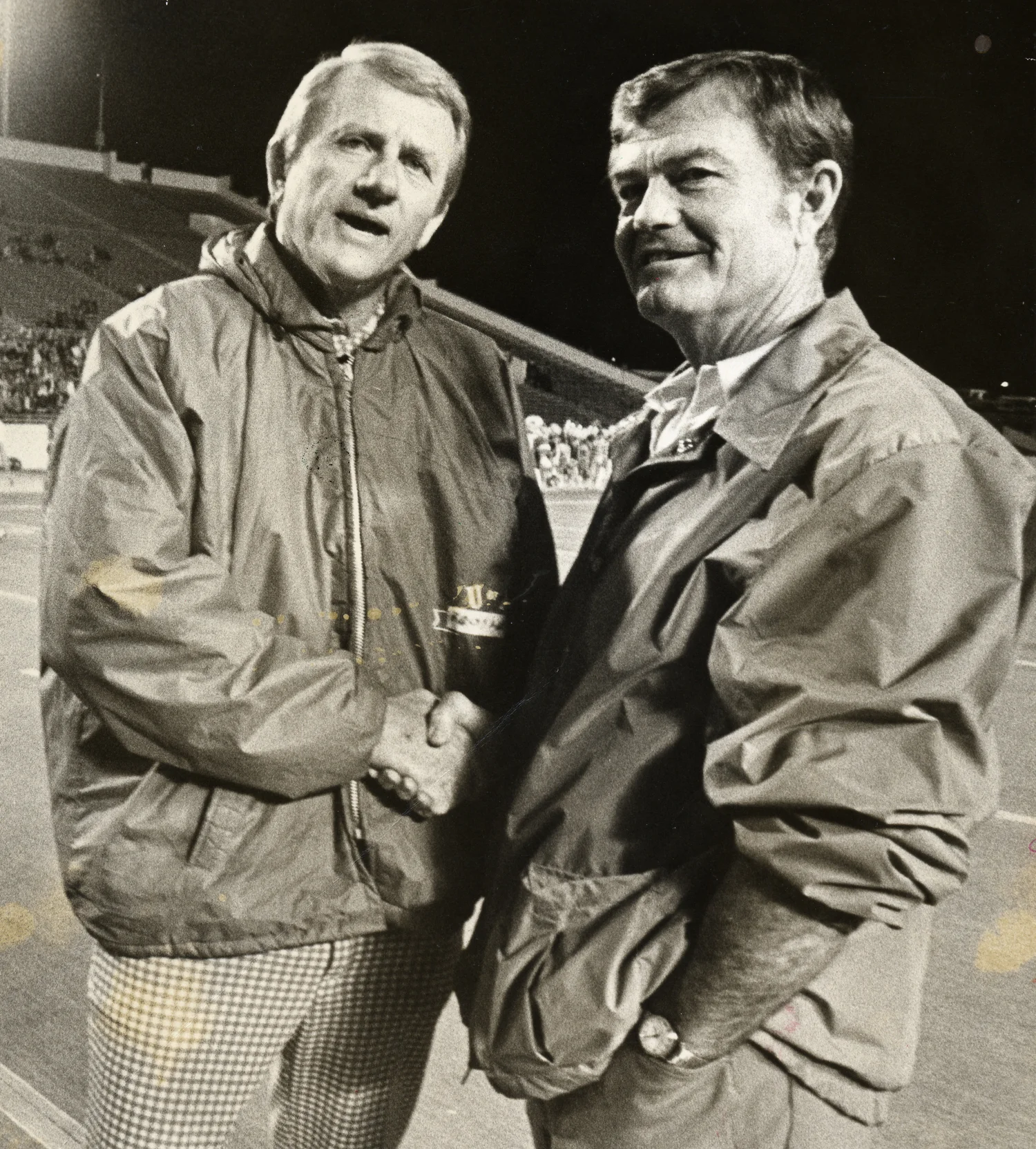
December 4, 1976: Royal & Broyles Hang Up Their Whistles

Frank Broyles (left) and Darrell Royal,
Memorial Stadium, Austin, 1976

December 4, 1976: In front of a national television audience on ABC, the University of Texas football team defeats the University of Arkansas, 29-12 at Memorial Stadium in Austin, Texas. The stadium will later be renamed for Texas' head coach, Darrell Royal.

It was the last game for Royal as the Longhorns' coach. Hired in 1957, he had won National Championships for them in 1963 and 1969, and 11 Southwest Conference Championships. But they finished the season 5-5-1, and it felt like other teams were catching up to his. Even though he was just 52 years old, he felt it was time to move on -- and a lot of Longhorn fans came to that conclusion before he did.

It was also the last game for Frank Broyles as head coach at Arkansas. Hired in 1958, he had won a share of the National Championship in 1964, and 7 Southwest Conference titles. Officially, Broyles led the Razorbacks to the SWC title outright in 1960, 1964 and 1965; Royal led the Longhorns to i outright in 1962, 1969, 1970, 1971, 1972 and 1973; they shared the SWC title in 1959, 1961, 1968 and 1975.

Razorback Stadium in Fayetteville, seat of the UA system, is 525 miles northeast of what's now named Darrell K Royal-Memorial Stadium in Austin, UT's seat. (Like President Harry S Truman, Royal's middle name was just an initial, without a period after it.) Texas won the game between them in 1959, 1961, 1962, 1963, 1967, 1968, 1969, 1970, 1972, 1973, 1974, 1975 and 1976. Arkansas won in 1960, 1964, 1965, 1966 and 1971, giving Royal a 13-5 advantage. Overall, through the 2022 season, Texas leads, 56-23. (UPDATE: Through 2025, the Longhorns lead, 58-23.)

Despite their on-field rivalry, Royal and Broyles were close friends, probably due to their similarities. They were born 6 months apart in 1924. Both were Southerners, but not from the State where they would do their most famous coaching: Royal from Hollis, Oklahoma, Broyles from Decatur, Georgia. Both were quarterbacks in college, themselves trained by a Hall of Fame coach, but not at a school they would later coach: Royal by Bud Wilkinson at Oklahoma (another major rival for Texas, along with Texas A&M), Broyles by Bobby Dodd at Georgia Tech.

They famously agreed to move their 1969 game to the last week of the regular season, to get a national audience on ABC. When Number 1 Ohio State were upset by Michigan 2 weeks earlier, that made Texas Number 1 and Arkansas Number 2, and their game, for the SWC title, a berth in the Cotton Bowl, and the inside track to the National Championship, became one of a few college football games to gain the headline "Game of the Century." Texas came from 14-0 down to win, 15-14, and beat Notre Dame in the Cotton Bowl to win the National Championship.

Both men continued to serve as their school's athletic director for a while: Royal until 1980, Broyles until 2007. Royal lived until 2012, Broyles until 2017.
Frank Broyles (left) and Darrell Royal,
Darrel K Royal Memorial Stadium, Austin, 2008

Arkansas left the Southwest Conference for the Southeastern Conference in 1990. In 1996, the SWC folded, and Texas joined the Big 12 Conference. In 2021, Texas made a deal to join the SEC for the 2024 season.

*

December 4, 1976 was a Saturday. Betty Lennox, the basketball player known as "Betty Big Buckets" for her baskets that helped the Seattle Storm win the 2004 WNBA Championship, was born.

There were 3 other college football games that day. Unlike Texas vs. Arkansas, where, unusually, neither team was nationally ranked, at least 1 team was in each of the other games, including 3 other Texas teams then in the SWC:

* Number 6 University of Houston beat the University of Miami, 21-16 at the Astrodome in Houston. UH had lost to Arkansas, but beaten Texas, and won the SWC title. Despite this, only 20,849 fans came to see this game. Coach Bill Yeoman's Cougars stayed Number 6, and beat Number 4 Maryland in the Cotton Bowl, to finish 10-2 and ranked Number 4.

* Number 9 Texas Tech beat Number 18 Baylor, 24-21 at Clifford B. and Audrey Jones Stadium (now Galaxy Stadium) in Lubbock, Texas. Officially, Tech tied Houston for the SWC title, Technically (pun intended, UH won it by beating Tech in Lubbock 2 weeks earlier.

* And Number 13 Nebraska beat Hawaii, 68-3 at Aloha Stadium in Honolulu. Only 33,737 saw that game, unlike in 1982, when Nebraska brought 16,000 fans to Aloha Stadium, and boosted the attendance to 46,876. Nebraska went on to beat Texas Tech in the Bluebonnet Bowl at the Astrodome. (It's 539 miles from the Tech campus to the Astrodome, so it's not like being in the same State gave Tech any real home-field advantage.)

There were 2 NFL games on the day. The football version of the St. Louis Cardinals beat the Baltimore Colts, 24-17 at Busch Memorial Stadium in St. Louis. And the Los Angeles Rams beat the Atlanta Falcons, 59-0 at the Los Angeles Memorial Coliseum. The Falcons finished 4-10, fired head coach Marion Campbell, then hired Leeman Bennett. With his "Gritz Blitz" defense, they improved to 7-7 in 1977, and made the Playoffs in 3 of the next 5 years.

Baseball was out of season. There were 7 games in the NBA:

* The New York Knicks beat the Seattle SuperSonics, 103-96 at Madison Square Garden.

* The New York Nets beat the Atlanta Hawks, 107-105 at The Omni in Atlanta.

* The Washington Bullets beat the Denver Nuggets, 100-95 at the Capital Centre in the Washington suburb of Landover, Maryland.

* The Houston Rockets beat the Indiana Pacers, 120-108 at The Summit in Houston. It's now the Central Campus of televangelist Joel Osteen's Lakewood Church.

* The Chicago Bulls beat the New Orleans Jazz, 107-99 at the Chicago Stadium. As usual, the Jazz were a one-man show: "Pistol" Pete Maravich scored 34 points, but no other player scored more than 16.

* The Golden State Warriors beat their arch-rivals, the Los Angeles Lakers, 116-114 at the Oakland Coliseum Arena. Jamaal Wilkes scored 31 points. Having already won an NBA Championship with the Warriors, he would win 3 more with the Lakers.

* And the Portland Trail Blazers beat the Milwaukee Bucks, 112-108 at the Veterans Memorial Coliseum in Portland.

There were 6 games in the NHL:

* The New York Rangers beat the Minnesota North Stars, 11-4 at the Metropolitan Sports Center in the Minneapolis suburb of Bloomington, Minnesota. It was actually only 2-2 until 5:13 left in the 1st period, but the Broadway Blues took off from there. Rod Gilbert had 2 goals and 3 assists. Don Murdoch had 2 goals and 2 assists. Ken Hodge had a goal and 3 assists. Wayne Dillon had 3 assists. Even North Star legend Bill Goldsworthy had a goal for the Rangers.

* The New York Islanders beat the Buffalo Sabres, 3-0 at the Nassau Coliseum.

* The Montreal Canadiens beat the Pittsburgh Penguins, 3-1 at the Montreal Forum.

* The Chicago Black Hawks and the Toronto Maple Leafs played to a tie, 2-2 at Maple Leaf Gardens in Toronto.

* The Atlanta Flames beat the St. Louis Blues, 1-0 at the St. Louis Arena.

* And the Los Angeles Kings beat the Detroit Red Wings, 4-1 at The Forum outside Los Angeles in Inglewood, California.

There were 3 games in the World Hockey Association:

* The Winnipeg Jets beat the New England Whalers, 6-2 at the Hartford Civic Center (now the PeoplesBank Arena) in Hartford, Connecticut.

* The Indianapolis Racers beat the Edmonton Oilers, 5-3 at the Market Square Arena in Indianapolis.

* And the San Diego Mariners beat the Phoenix Roadrunners, 4-3 at the Arizona Veterans Memorial Coliseum in Phoenix.

And in English soccer, Arsenal defeated Newcastle United, 5-3 at the Arsenal Stadium, nicknamed Highbury for its North London neighborhood. Arsenal had just signed Malcolm Macdonald from Newcastle, and on a frozen field following a snowstorm that week, he scored 3 goals against his former team. He hadn't wanted to leave, and Newcastle fans knew that, so when he ran over to their traveling support after the game, they cheered him as much as the Arsenal fans did. 

Friday, December 2, 2022

December 2, 1995: The End of the Southwest Conference

December 2, 1995: The University of Texas, the nation's Number 9-ranked college football team, defeats their arch-rivals, Texas A&M University, ranked Number 16. The score is Longhorns 16, Aggies 6, at A&M's home, Kyle Field in College Station.

Elsewhere in Texas, the University of Houston beat crosstown rival Rice University, 18-17 at Rice Stadium. These would be the last 2 football games ever played in the Southwest Conference.

It was appropriate that the SWC's finale was between the two biggest teams in its now one-and-only State. Someone once said that, if football is a religion in Texas, then Longhorns vs. Aggies is a holy war.

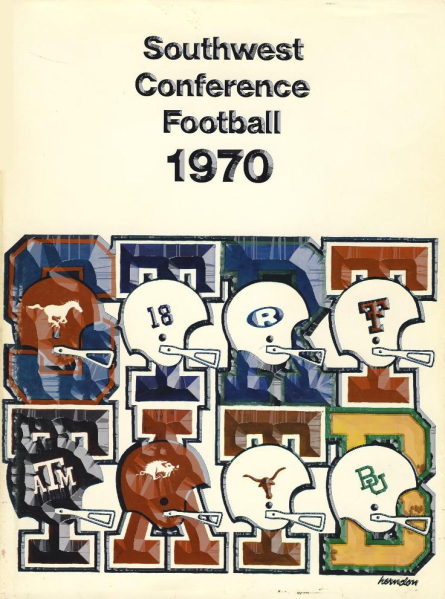
The SWC was founded in 1914, and played its 1st football season in 1915, with these founding members: The University of Arkansas, Baylor University, the University of Oklahoma, Oklahoma A&M University, Rice University, Southwestern University, the University of Texas, and Texas A&M University.

Southwestern University, in Georgetown, Texas, left after only 2 seasons. Oklahoma left after the 1919 season. Oklahoma A&M left after 1925, and changed their name to Oklahoma State in 1958.

Southern Methodist University (SMU), in Dallas, joined in 1918. Their Fort Worth rivals, Texas Christian University (TCU), joined in 1923. Texas Tech University joined in 1956, and the University of Houston joined in 1972. 

Arkansas left after the 1991 season, leaving the SWC as a Texas-only league. They joined the Southeastern Conference, in what turned out to be a foreshadowing of the SWC's end.

In 1994, Texas, Texas A&M, Texas Tech and Baylor reached a deal to join the Big Eight Conference, to form the Big Twelver Conference. Oklahoma and Oklahoma State would join them in a South Division, while the remaining Big Eight teams would form the North Division: Nebraska, Kansas, Kansas State, Missouri, Iowa State and Colorado. The remaining SWC teams -- SMU, TCU, Houston and Rice -- joined other leagues.

Texas A&M left the Big 12 for the SEC in 2011. Texas no longer had the revenue from that rivalry, but didn't want to give up the revenue from their rivalry with Oklahoma. So the Longhorns talked the Sooners into joining the SEC with them, and they will do so for the 2024 season.

*

December 2, 1995 was a Saturday. These other college football games were played that day:

* Number 2 Florida beat Number 23 Arkansas, 34-3, at the Georgia Dome in Atlanta, in the Southeastern Conference Championship Game.

* Army beat Navy, 14-13 at Veterans Stadium in Philadelphia.

* And Oklahoma State beat the University of Hawaii, 24-20 at Aloha Stadium in Honolulu.

Nebraska won the National Championship defeating Florida in the Fiesta Bowl. Texas lost the Sugar Bowl to Virginia Tech. Texas A&M beat Michigan in the Alamo Bowl in San Antonio. The last Cotton Bowl of the SWC era had no Texas-based team: Colorado beat Oregon, 38-6. Southern California beat Northwestern in the Rose Bowl, and Florida State beat Notre Dame in the Orange Bowl.

Baseball was out of season. There were 10 NBA games on this day:

* The New York Knicks beat the Philadelphia 76ers, 94-85 at Madison Square Garden.

* The New Jersey Nets beat the Cleveland Cavaliers, 79-78 at the Brendan Byrne Arena at the Meadowlands.

* The Washington Bullets beat the Boston Celtics, 135-107 at the USAir Arena (formerly the Capital Centre) in the Washington suburb of Landover, Maryland.

* The Detroit Pistons beat the Atlanta Hawks, 104-96 at The Palace in the Detroit suburb of Auburn Hills, Michigan.

* The Houston Rockets beat the Charlotte Hornets, 113-98 at The Summit in Houston. (The arena has since been converted into the Central Campus of the Lakewood Church, Dr. Joel Osteen's "megachurch.") Clyde Drexler scored 41 points. 

* The San Antonio Spurs beat the Phoenix Suns, 101-93 at the Alamodome in San Antonio. David Robinson scored 37 points.

* The Denver Nuggets beat the Minnesota Timberwolves, 109-105 at the McNichols Area in Denver.

* The Chicago Bulls beat the Los Angeles Clippers, 104-98 at the Los Angeles Memorial Sports Arena. Michael Jordan scored 37 points.

* The Golden State Warriors beat the Indiana Pacers, 100-97 at the Oakland Coliseum Arena.

* The Sacramento Kings beat the Orlando Magic, 109-106 at the Arco Arena in Sacramento.

There were 10 games played in the NHL:

* The New York Rangers beat the Ottawa Senators, 4-2 at the Ottawa Civic Centre (now the TD Place Arena).

* The New York Islanders beat the New Jersey Devils, 4-1 at the Nassau Coliseum.

* In an "Original Six" matchup, the Detroit Red Wings beat the Montreal Canadiens, 11-1 at the Montreal Forum. Vyacheslav Kozlov scored 4 of those Detroit goals. Mark Recchi had the lone tally for the Habs.

This was the game in which Canadiens' goalie Patrick Roy was infamously hung out to dry by Canadiens management, leading to him being traded 4 days later, leading to "The Curse of St. Patrick.," I have a separate entry for that event.

* The Boston Bruins beat the Buffalo Sabres, 6-4 at the FleetCenter (now the TD Garden) in Boston.

* The Florida Panthers beat the Hartford Whalers, 5-3 at the Hartford Civic Center (now the PeoplesBank Arena).

* The Toronto Maple Leafs and the Mighty Ducks of Anaheim played to a tie, 4-4 at Maple Leaf Gardens in Toronto.

* The Chicago Blackhawks and the Winnipeg Jets played to a tie, 2-2 at the Winnipeg Arena.

* The St. Louis Blues beat the Edmonton Oilers, 7-3 at the Edmonton Coliseum (formerly the Northlands Coliseum).

* The Dallas Stars and the Los Angeles Kings played to a tie, 2-2 at The Forum outside Los Angeles in Inglewood, California.

* The San Jose Sharks beat the Washington Capitals, 5-3 at the San Jose Arena (now the SAP Center).

* And the Philadelphia Flyers, the Pittsburgh Penguins, the Vancouver Canucks, the Calgary Flames, the Colorado Avalanche and the Tampa Bay Lightning were not scheduled.

And in English soccer, North London team Arsenal went to Birmingham, and played Aston Villa to a 1-1 draw at Villa Park.

Friday, November 18, 2022

November 18, 1999: The Aggie Bonfire Collapse

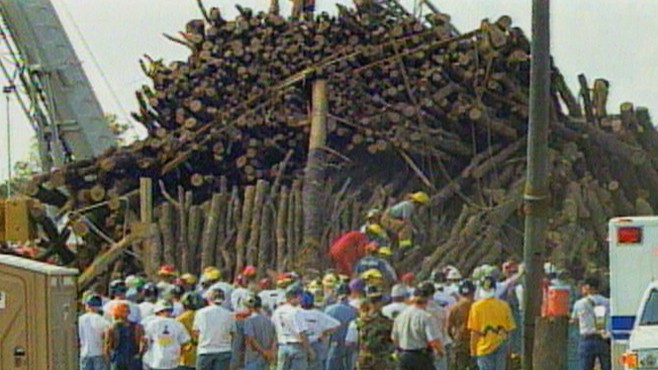
November 18, 1999: The annual Aggie Bonfire, under construction at Texas A&M University in College Station, Texas, collapses, killing 12 people and injuring 27 others.

The Bonfire was a long-standing tradition at A&M, as part of their rivalry with the University of Texas. They started it in 1907, and, since the Texas Longhorns and the Texas A&M Aggies have played each other every year since 1915, they've done it every year since 1915, regardless of whether the game is at home in College Station or away in Austin. The game has been played on Thanksgiving Day in 1901, '02, '04, '07, '09, 1918-21, 1924-27, 1929-32, 1935-38, 1940-43, 1946-49, 1952-55, 1957-73, 1976, 1981-82, 1985-88, 1991-3, and 2008-11.

In the musical The Best Little Whorehouse in Texas, and in its 1982 film adaptation with Burt Reynolds and Dolly Parton, the titular, or so to speak, establishment gives freebies to the players on the game's winning team. This doesn't happen in real life -- as far as I know. In the show, it's A&M that wins, and the results produce the story's main conflict.

In 1942, the Bonfire took on a form similar to a teepee: Logs placed at an angle between 23 and 30 degrees, allowing it to grow to a cone over 50 feet high. It symbolizes their "burning desire to beat the hell outta T.U." It's been said that, in Texas, football is a religion, and 'Horns vs. Aggies is its holy war. So the Bonfire is A&M's ritual sacrifice.

It was never a safe idea. Bonfires have been banned in many places, including some entire States. But not Texas. In 1955, a student carrying one of the logs was killed -- not by getting hit with another log, or by a premature burning of a log, but by getting hit by a car. In 1957, the structure collapsed 2 days before it was supposed to be lit. Fortunately, that time, no one was injured, and they were able to rebuild it in time for its scheduled lighting.

In 1978, the design was changed again, to a "wedding-cake" style: Smaller stacks of logs on top of bigger stacks, with a fortified center pole. The design was intended to collapse on itself in a twisting motion, making it safer to remove.

According to tradition, the bonfire would be lit on the night before the game, which would usually be on Thanksgiving Day (to get a national TV audience), and if it burned without falling past midnight, A&M would win. However, the wedding-cake design ended up reducing the time it burned without falling, sometimes for as little as half an hour. But the tradition turned out to be mere superstition: From 1942 to 1977, with the teepee design, 30-5-1. But from 1978 to 1997, with the wedding-cake design, A&M led, 12-7, including an 11-1 stretch from 1984 to 1994.

It was probably largely about coaching and recruiting: Darrell Royal, who led the Longhorns to the National Championship in 1963, 1969 and 1970, retired after the 1976 season; and Fred Akers kept the winning going for a while, nearly winning the National Championship in 1977 and 1983; but R.C. Slocum led the Aggies to 3 straight Southwest Conference titles in 1991, '92 and '93, and, after the death of the SWC and both schools' 1996 move to the Big Eight, making it the Big Twelve, winning that in 1998.

The 1999 game, with the Longhorns 9-2, ranked Number 7, and already Champions of the Big 12 West Division, and the Aggies 7-3 and ranked Number 24, was set for November 26, the day after Thanksgiving. So the intention was to light the Bonfire on the night of Thanksgiving Day, November 25.

But a week before, on November 18, at 2:42 AM, already 59 feet high, the stack collapsed. Remember: It wasn't yet on fire, it was just a lot of heavy wood. But of the 58 people working on it, students and former students, some with previous Bonfire-building experience, 39 were injured, and 12 of those ultimately died. The fact that A&M is known for its "12th Man" tradition made the number of deaths even more poignant.

Upon learning of the disaster, A&M players rushed to the site, and helped remove the debris to look for survivors. Slocum suspended practice for 2 days. In solidarity, the Longhorn football staff held a blood drive to benefit the victims. UT officials also canceled their own annual pregame tradition, the "Hex Rally," in favor of a unity rally that also included hundreds of A&M students. A&M receiver Greg Porter told a sportswriter, "It was a weird time, you know? You're getting ready to play a football game, and the team on the other side is actually being nice."

And when the game was played at A&M's Kyle Field, it attracted a crowd of 86,128, the largest ever to attend a football game in the State of Texas to that point. (Both Kyle Field and Memorial Stadium, and also the Cotton Bowl, now exceed that capacity by thousands.) Thousands of maroon balloons filled the sky, followed by the pregame release of 12 white doves, one for each of the 12 current and former A&M students who were killed in the bonfire collapse. Four F-16 fighters flew overhead in the "missing man formation," a tribute usually saved for pilots killed in the line of duty.

The Longhorns, quarterbacked by freshman Chris Simms, son of New York Giants legend Phil Simms, because usual starter Marshall Applewhite had a stomach ailment, led 16-6 at the half. In another gesture of unity, both bands played together, and at the end of "Amazing Grace," both bands removed their hats, remained silent for a moment, and then marched off the field in silence.

The show seemed to inspire the Aggie crowd, who seemed to inspire the Aggie players, who mounted a comeback. With 5:02 left in regulation, and the ball on the Longhorn 14-yard-line, Randy McCown threw a pass into the end zone. It was caught by his roommate, Matt Bumgardner, and the Aggies won, 20-16.
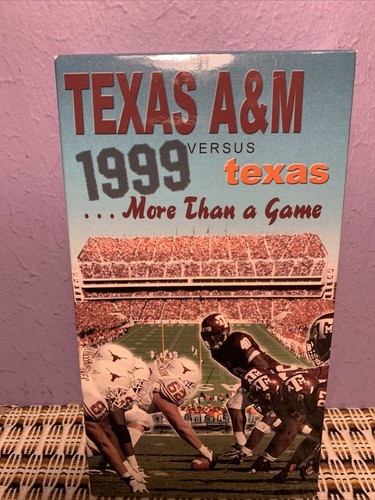
A VHS cassette of the game

Both teams used up all their emotion in those days, and lost their bowl games: The Longhorns lost the Big 12 Championship Game to Nebraska, and lost the Cotton Bowl to another of its old rivals, Arkansas; while the Aggies lost the Alamo Bowl to Penn State.

A&M has never held another official Bonfire. But, since 2002, a student-sponsored coalition has constructed an annual unsanctioned, off-campus "Student Bonfire" in the spirit of its predecessor.

After the 2011 season, Texas A&M left the Big 12 for the Southeastern Conference, ending the rivalry, at least as far as football is concerned. The Longhorns lead it, 76-37-5. In 2021, Texas, along with their other big rival, Oklahoma, announced it would leave the Big 12, and seek admission to the SEC. The SEC unanimously voted to invite both the Longhorns and the Sooners. This will allow them to become SEC members by the 2025 season, opening the door for a resumption of the Longhorn-Aggie football rivalry. (UPDATE: They made an agreement to join in 2024, restarting the rivalry a year earlier.)

*

November 18, 1999 was a Thursday. Baseball season was over. The NFL was in midweek. One college football game was played that day: Colorado State beat the Air Force Academy, 41-21 at Hughes Stadium in Fort Collins, Colorado.

There were 5 games played in the NBA:

* The Washington Wizards beat the Toronto Raptors, 92-81 at the MCI Center (now the Capital One Arena) in Washington.

* The Milwaukee Bucks beat the San Antonio Spurs, 99-88 at the Bradly Center in Milwaukee.

* The Sacramento Kings beat the Houston Rockets, 128-110 at The Summit in Houston. (The arena has since been converted into the Central Campus of the Lakewood Church, Dr. Joel Osteen's "megachurch.")

* The Denver Nuggets beat the Los Angeles Lakers, 93-82 at the new Pepsi Center (now the Ball Arena) in Denver. Shaquille O'Neal scored 36 points in defeat.

* And the Seattle SuperSonics beat the Vancouver Grizzlies, 110-108 at General Motors Place (now the Rogers Arena) in Vancouver.

And there were 7 games in the NHL:

* In an "Original Six" matchup, the New York Rangers lost to the Boston Bruins, 5-3 at the FleetCenter (now the TD Garden) in Boston.

* The Dallas Stars and the Philadelphia Flyers played to a tie, 1-1 at the First Union Center (now the Xfinity Mobile Arena) in Philadelphia.

* The Tampa Bay Lightning beat the Pittsburgh Penguins, 2-1 at the Ice Palace (now the Benchmark International Arena) in Tampa.

* The San Jose Sharks beat the Ottawa Senators, 4-1 at the Corel Centre in the Ottawa suburb of Kanata, Ontario. (It's now the Canadian Tire Centre. The town was absorbed into Ottawa proper in 2001.)

* The Nashville Predators beat the Montreal Canadiens, 6-1 at the Gaylord Entertainment Center (now the Bridgestone Arena) in Nashville.

* The St. Louis Blues beat the Florida Panthers, 3-0 at the Kiel Center (now the Enterprise Center) in St. Louis.

* And the Phoenix Coyotes beat the Los Angeles Kings, 3-2 at the new Staples Center (now the Crypto.com Arena) in Los Angeles.

Tuesday, November 8, 2022

November 8, 1924: Texas' Memorial Stadium Opens

November 8, 1924: War Memorial Stadium opens on the campus of the University of Texas in Austin. Surprisingly, the Longhorns lose to Baylor University, 28-10.

It was renamed simply Memorial Stadium in 1948, Texas Memorial Stadium in 1977, and Darrell K. Royal-Texas Memorial Stadium in 1995, after the coach who led the Longhorns to the 1963, 1969 and 1970 National Championships. It is known as "DKR" for short. Longhorn fans have not given it any other nicknames, either cutesy or tough.
It opened with a capacity of 27,000. It was raised to 40,000 in 1926, 60,000 in 1948, 66,000 in 1968, 78,000 in 1971, and its current 100,119 in 2009. On September 10, 2022, for Texas' 20-19 loss to Alabama, it attracted a record crowd of 105,213. The field was converted to AstroTurf in 1969, back to natural grass in 1996, and to FieldTurf in 2009.
Following the 3 National Championships won under Royal, the Longhorns won a 4th under Mack Brown in 2005. Since the stadium's opening, they've won 26 Conference Championships. In the old Southwest Conference, they won in 1928, '30, '42, '43, '45, '50, '52, '53, '59, '61, '62, '63, '68, '69, '70, '71, '72, '73, '75, '77, '83, '90, '94, '95 and '96. In the Big Twelve Conference, they've won in 2005 and 2009. (UPDATE: They won the Big 12 again in 2023, but are moving to the Southeastern Conference for 2024.)
They've had 2 Heisman Trophy winners: Running backs Earl Campbell in 1977 and Ricky Williams in 1998. Other notable Longhorns include 1940s quarterback Bobby Layne, 1960s linebacker Tommy Nobis, 1980s defensive tackle Kenneth Sims, and 2000s quarterbacks Vince Young and Colt McCoy.
In 1971, the Lyndon B. Johnson Presidential Library and Museum opened, almost right across Robert Dedman Drive from the stadium's east stand. Although he wasn't a UT graduate, it was pretty savvy of LBJ to put his Presidential Library across from, aside from the State Capitol, the Alamo and the Cotton Bowl, the most famous building in Texas. 
*

November 8, 1924 was a Saturday. These other notable college football games were played that day:

* Army beat Florida, 14-7 at Michie Stadium in West Point, New York. This was only the 4th game at their new stadium.

* Navy beat Vermont, 53-0 at Thompson Stadium in Annapolis, Maryland.

* Columbia beat New York University (NYU), 40-0 at Baker Field (now Wien Stadium) in Upper Manhattan.

* Princeton beat Harvard, 34-0 at Harvard Stadium in Boston. For reasons lost to time Rutgers played at arch-rival Princeton's Palmer Stadium, and beat Lafayette, 43-7.

* The University of Illinois and the University of Chicago played to a 21-21 tie at Stagg Field in Chicago. Three weeks earlier, Illinois had dedicated their Memorial Stadium in Champaign by beating Michigan, with Red Grange scoring 5 touchdowns, passing for another, and intercepting 2 passes.

* Notre Dame beat Wisconsin, 38-3 at Camp Randall Stadium in Madison, Wisconsin. Three weeks earlier, Notre Dame had beaten Army at the Polo Grounds, leading the nation's top sportswriter at the time, Grantland Rice, to call their backfield "The Four Horsemen," comparing them to those of the biblical Apocalypse.

There was 1 game played in the fledgling NFL: The Frankford Yellow Jackets beat the Kansas City Blues, 42-7 at Frankford Stadium in Northeast Philadelphia.

Also on this day, Johnny Bower, the Hall of Fame goaltender for the Toronto Maple Leafs' 1960s dynasty, was born. So was actor Joe Flynn.

Sunday, October 9, 2022

October 10, 1900: The 1st Red River Showdown

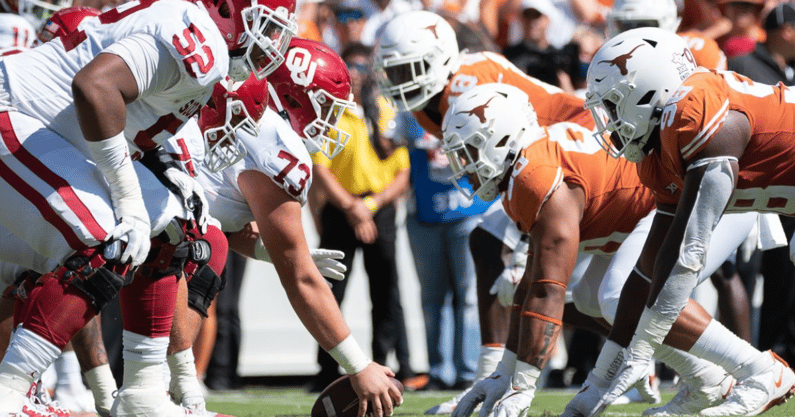
October 10, 1900: The University of Texas and the University of Oklahoma play each other in football for the 1st time, on the Texas campus in Austin. This was 7 years before Oklahoma gained Statehood. Texas wins, 28-2.

The game became an institution, and has several nicknames: The Red River Showdown (the Red River separates the States), the Red River Rivalry, the Red River Classic and the Red River Shootout. It was played in Austin from 1900, 1901, 1902, 1903, 1904, 1907, 1909, 1910, 1911 and 1923; Norman in 1901, 1903 (played twice in those seasons), 1908 and 1922; Oklahoma City in 1905 and 1906; Houston in 1913; and in Dallas every other time, including every season since 1929. A deal has been made to keep the game at the Cotton Bowl through at least 2025.
The fact that it's played in Texas would seem to give the Longhorns an unfair advantage. However, each school gets half the tickets, and it's actually closer to the OU campus in Norman (190 miles) than it is to the UT campus in Austin (197 miles).
As of the 2022 game, Texas' 49-0 win, the biggest blowout in the rivalry's history, Texas leads the rivalry 63-50-5. Oklahoma beat Texas in the 2018 Big 12 Conference Championship Game, which was also played in the Dallas area, but at the Cowboys' new AT&T Stadium in suburban Arlington.
A running joke is that, unlike the Longhorns' rivalries with Texas A&M and Arkansas, and the Sooners' with Oklahoma State and Nebraska, this is a rivalry not for the people but the rich, and that millionaires have bet ranches and oil wells on the outcome, many regretting it.

*

October 10, 1900 was a Wednesday, not a Saturday as is the case for most college football games today. There were other games played that day:

* Columbia and Williams College played to a 0-0 tie at Columbia Field in Manhattan.

* Manhattan College lost to Lafayette College, 11-0 at March Field in Easton, Pennsylvania.

* Princeton beat Penn State, 26-0 at Osborne Field in Princeton, New Jersey.

* Bowdoin College beat Colby College, 68-0 in Brunswick, Maine.

* Harvard beat cross-State Amherst, 18-0 at Soldiers' Field in Boston.

* Yale beat Bates College, 50-0 at Yale Field in New Haven, Connecticut.

* The University of Pennsylvania beat Dickinson College, 35-0 at the original Franklin Field in Philadelphia.

* And Illinois beat Chicago Physicians and Surgeons College, 6-0 at Illinois Field in Champaign, Illinois. CPSC is now part of the University of Illinois system, the University of Illinois College of Medicine.

And there was 1 baseball game played: The Philadelphia Phillies beat the Boston Beaneaters, 5-2 at National League Park in Philadelphia. In 1912, the Boston team of the National League, having gone through several names, settled on "Braves." The following season, the Phillies' ballpark was renamed Baker Bowl.

This was also the birthdate of actress Helen Hayes, known as "The First Lady of the American Theater."

Monday, August 1, 2022

August 1, 1966: The Texas Sniper

August 1, 1966: Guns, insanity, Texas, and toxic masculinity: A dangerous combination under any conditions. Never more so than on this day.

Charles Joseph Whitman was born on June 24, 1941, in the Miami suburb of Lake Worth, Florida. His father was physically and verbally abusive to his wife and children. He was also a firearms collector who taught his sons the proper use and care of guns. He later said of his namesake, "Charlie could plug the eye out of a squirrel by the time he was sixteen."

Young Charles was intelligent enough to make Eagle Scout within 2 years after joining the Boy Scouts. At 14, he had saved up enough money from a newspaper route to buy a motorcycle. But a month before graduating from high school, his father beat him up and threw him into the pool. So, after graduation, he ran away, and enlisted in the U.S. Marine Corps. In the Marines, "Sniper" is a category that must be achieved, and he never achieved it, despite his later characterization as "the Texas Sniper." But he did score very high in marksmanship.

In 1961, as part of the Naval Enlisted Science and Education Program (NESEP), an initiative designed to send enlisted personnel to college to train as engineers, and after graduation, be commissioned as officers, the Corps allowed him to return to civilian life, and to study mechanical engineering at the University of Texas, in Austin. (Then, as now, the Marines required a college degree to promote someone to officer, although it can be through this process, or through the Army or Naval War College.)

The University's Main Building is a 307-foot, 27-story tower, opened in 1937, 5 blocks west of the University's famed Memorial Stadium. Whitman was not a good student, and the Marines considered his grades insufficient for continuing his scholarship, and recalled him to active duty in 1963 -- but not before he looked up at the Main Building, and remarked to a fellow student, "A person could stand off an army from atop of it before they got him."


With his return to the Corps, his college credits got him a promotion to Lance Corporal. But he had become a compulsive gambler, and in November 1963 -- the same month in which another man who had been a Marine sharpshooter, Lee Harvey Oswald, was arrested for assassinating President John F. Kennedy -- Whitman was court-martialed on various charges related to his gambling. He was sentenced to 30 days' confinement and 90 days' hard labor, and busted back down to buck Private. Nevertheless, on time, he was honorably discharged, and returned to UT, and his wife, Kathleen Leissner.

He began experiencing headaches, and abusing amphetamines. His mother finally left his abusive father, and his younger brother went with her, both going to Austin to be close to Charles. On two occasions, Charles hit Kathleen, and he began to be afraid he would turn out like his father. He saw several doctors, including a psychiatrist, who prescribed Valium.

On the night of July 31, 1966, at the age of 25, he typed out a suicide note, saying, "I do not really understand myself these days. I am supposed to be an average reasonable and intelligent young man. However, lately (I cannot recall when it started) I have been a victim of many unusual and irrational thoughts. These thoughts constantly recur, and it requires a tremendous mental effort to concentrate on useful and progressive tasks."

In this note, he asked for an autopsy to be performed, to find out if there was a medical cause for his actions, not that he would ever know. And he said that he was going to kill his mother and his wife, not out of any anger toward them, but to relieve them of their suffering. But he did not mention using the Main Building's tower.

He killed his mother shortly after midnight on August 1, and his wife at around 3:00 AM, both by stabbing them in the heart. At 11:35 AM, he told a security guard at the Main Building that he was there to deliver equipment. He got to the observation deck on the 28th floor, killing 3 people along the way, took out his rifle, and started shooting.

For 1 hour and 36 minutes, he kept firing, before Patrolman Houston McCoy of the Austin Police Department fired a shot that killed him. There were 14 victims from his rifle, with 31 others suffering non-fatal wounds. In total, Whitman had killed 19 people in a little over 12 hours.

The following day, an autopsy was performed, and a "pecan-sized" brain tumor was found, pressing against Whitman's amygdala, a part of the brain related to anxiety and "fight or flight" responses.

Just 18 days before Whitman's shooting, Richard Speck had killed 8 nursing students in Chicago. This seemingly back-to-back occurrence would seem routine today, but, at the time, it was terribly shocking. On March 18, 1968, running for President, Senator Robert F. Kennedy of New York, his life already touched by gun violence, gave a speech at the University of Kansas:

Too much and too long, we seem to have surrendered community excellence and community values in the mere accumulation of material things.

Our gross national product counts air pollution and cigarette advertising, and ambulances to clear our highways of carnage. It counts special locks for our doors, and the jails for those who break them. It counts the destruction of our redwoods, and the loss of our natural wonder in chaotic sprawl. It counts napalm and the cost of a nuclear warhead, and armored cars for police who fight riots in our streets. It counts Whitman's rifle and Speck's knife, and the television programs that glorify violence in order to sell toys to our children.

Yet the gross national product does not allow for the health of our children, the quality of their education, or the joy of their play. It does not include the beauty of our poetry or the strength of our marriages; the intelligence of our public debate or the integrity of our public officials.

It measures neither our wit nor our courage; neither our wisdom nor our learning; neither our compassion nor our devotion to our country; it measures everything, in short, except that which makes life worthwhile. And it tells us everything about America except why we are proud that we are Americans.

Just 16 days after that, Dr. Martin Luther King was assassinated. And, 62 days after that, so was RFK. Crime was out of control -- but, in the case of Charles Whitman, it was, as it so often seems to be these days, both a medical and a mental health issue.

The University of Texas increased security for the Main Building, but has kept it in use. In 1972, Harry Chapin released a song titled "Sniper," a mostly-fictionalized account of the events, and put in on an album he titled Sniper and Other Love Songs. In 1975, Kurt Russell starred in the film The Deadly Tower.

*

August 1, 1966 was a Monday. These baseball games were played that day:

* The New York Yankees lost to the California Angels, 4-3 at Anaheim Stadium (now Angel Stadium of Anaheim). Joe Pepitone hit a home run, and Mickey Mantle went 1-for-4.

* The New York Mets lost to the San Francisco Giants, 4-2 at Shea Stadium. Willie Mays went 2-for-4 with an RBI.

* The Philadelphia Phillies beat the Houston Astros, 6-5 at Connie Mack Stadium in Philadelphia. The former Shibe Park had reduced its former 447-foot center field corner to 410 feet, but Dick Allen still sent a drive out there in the bottom of the 10th inning, and made an inside-the-park home run.

* The Los Angeles Dodgers beat the Pittsburgh Pirates, 5-1 at Forbes Field in Pittsburgh. For 7innings, Tommie Sisk outpitched Sandy Koufax. But the Dodgers tied the game in the 8th, and scored 4 runs in the 9th, including home runs by John Roseboro and Jim Gilliam, to make a winning pitcher out of Phil Regan. Games like that, where Regan would become the winning pitcher, led to his being nicknamed "The Vulture." Roberto Clemente went 3-for-4, and drive in the Pirates' only run.

* The Minnesota Twins beat the Boston Red Sox, 6-2 at Metropolitan Stadium in the Minneapolis suburb of Bloomington, Minnesota. Jimmie Hall hit 2 home runs, and Earl Battey added one. Harmon Killebrew went 1-for-4. For the Sox, Tony Conigliaro hit a home run, but Carl Yastrzemski went 0-for-4.

* The Cincinnati Reds beat the St. Louis Cardinals, 3-2 at Busch Memorial Stadium in St. Louis. Pete Rose went 1-for-4.

* The Washington Senators beat the Kansas City Athletics, 6-4 at Kansas City Municipal Stadium.

* The Chicago White Sox and the Detroit Tigers were rained out at Tiger Stadium in Detroit. The game was made up as part of a doubleheader 2 days later. The Tigers won the opener, 3-1. Ken Berry hit a home run off Mickey Lolich in the top of the 9th. But in the bottom of the 9th, the Tigers tied the game off Bruce Howard, and then Jim Northtrup hit a 2-run home run off Hoyt Wilhelm to win it.

The White Sox won the nightcap, 6-3, by scoring 5 runs in the top of the 8th. Al Kaline went 0-for-3 with a walk in the 1st game, and sat out the 2nd game.

* And the Baltimore Orioles, the Cleveland Indians, the Atlanta Braves and the Chicago Cubs were not scheduled.

Tuesday, January 4, 2022

January 4, 2006: USC vs. Texas, "The Game of the Century"

January 4, 2006: The Rose Bowl game is held in the stadium of the same name, in the Los Angeles suburb of Pasadena, California.

Traditionally, the Rose Bowl features the Champions of the league currently known as the Pacific-12 (or Pac-12) Conference against those of the Big Ten Conference. But the drive to a Playoff to determine a true National Champion for college football has tweaked that: After 55 consecutive seasons, all on New Year's Day except for years in which January 1 fell on a Sunday, moving the game to January 2, with a Big 10 vs. PCC/AAWU/Pac-8/Pac-10 matchup, starting with the 2001-02 season, 8 of the last 20 Rose Bowls have not paired up those leagues' newly-crowned titlists. (UPDATE: The shattering of the Pac-12 in 2023 ended the idea forever, especially with 4 of their teams joining the Big 10.)

And the 2006 game was one of them. True, the University of Southern California, winners of more titles in that league than any other team, winners of more Rose Bowls than any other team, and winners of more National Championships than any team in that league, had won the Pac-12 title again. And they had won the National Championship in each of the last 2 seasons, led by the last 2 Heisman Trophy winners, quarterback Matt Leinart and running back Reggie Bush. And they finished the regular season ranked Number 1 in every poll, including the Bowl Championship Series rankings.

But their opponents, the team that finished Number 2 in every poll, including the BCS, would not be the Big 10 Champions. That would be Pennsylvania State University, a.k.a. Penn State, who were ranked Number 3 in the BCS, and went on to win the Orange Bowl in Miami against Florida State University, the Atlantic Coast Conference Champions, on January 3.

No, the Number 2 team was the University of Texas. The most successful team in the since-concluded history of the Southwest Conference, they were now the Champions of the Big 12 Conference, formed in 1996 when half of the SWC teams were absorbed into the former Big Eight Conference. Texas was led by a spectacular quarterback, Vince Young, who could run and throw with equal aplomb.

Under head coach Pete Carroll, the USC Trojans had been Number 1, wire to wire, going 12-0. They had scored 70 at home to Arkansas, 66 at home to arch-rival and then-Number 11 UCLA, 63 away to Hawaii, 55 at home to Washington State, 51 away to Washington, 51 at home to Stanford, 50 at home to then-Number 16 Fresno State, 45 away to then-Number 24 Oregon, 42 at home to Arizona, 38 away to then-Number 14 Arizona State, 35 at home to the University of California, and 34 away to then-Number 9 Notre Dame. The Notre Dame game was a nationally-televised thriller, ending 34-31, and that was the only real close game the Trojans had all season.

Under head coach Mack Brown, the Texas Longhorns also came into the game 12-0, and were ranked Number 2 the entire season. The offense that Young led was every bit as impressive as USC's: They hung 66 on Kansas at home, 62 on Baylor University away, 60 on Louisiana-Lafayette at home, 52 on then-Number 10 Texas Tech at home, 51 on Rice at home, 51 on Missouri away, 47 on Oklahoma State away, 45 on Oklahoma on neutral ground in Dallas, 42 on then-Number 24 Colorado at home, and 40 on arch-rival Texas A&M away.

What's more, the Longhorns had a bigger win than USC did. On September 10, they traveled to Ohio State, then Number 4, and beat them 25-22. The Buckeyes were the only team that stayed within 10 points of Texas. In the Big 12 Championship Game in Houston, the 'Horns throttled Colorado, 70-3.

No question about it, if there was any team that could give USC a run for its money, it was Texas. USC had won 34 straight games. Texas had won 19 straight. Something had to give.

These were 2 of the titans of college football. USC had, to this point, won 35 Conference Championships. They also claimed 17 National Championships, but only 5 of these have been definitive under the current poll system, which has been in place since 1936: 1962, 1967, 1972, 2003 and 2004. (In 1978, the polls were split: UPI took USC, and the AP took Alabama.) Texas claimed 31 Conference Championships, and 8 National Championships, but only 1963 and 1969 were officially recognized by the NCAA.

This game was being hyped as "The Game of the Century," as had a few others in college football history. But this was the 21st Century, so there wasn't a previous game to live up to, unless you want to count Ohio State's dethroning of the University of Miami in the 2003 Fiesta Bowl.

A crowd of 93,988 crammed into the Rose Bowl stadium. An estimated 36 million more, making it the most-watched college football game ever, watched on ABC as Keith Jackson (who was calling his last game, and picked a great way to go out) and Pro Football Hall of Fame quarterback Dan Fouts, himself a Pac-8 veteran (University of Oregon), called the action. LeAnn Rimes sang the National Anthem.

Texas kicked off. USC couldn't do much on their opening possession. But they got the ball right back on a Texas fumble, and took a 7-0 lead to the end of the 1st quarter. Early in the 2nd quarter, Bush tried a lateral pass, but no one was there to receive it, and Texas recovered, leading to a field goal that made it 7-3.

A USC interception led to a Texas drive that ended in a lead-changing touchdown, although the extra point had been missed. Texas scored another touchdown, and USC added a field goal to make it 16-10 Texas at the half.

In the 3rd quarter, a USC drive ended with a LenDale White touchdown, and put the Trojans up 17-16. But Young led the 'Horns back, and scored himself, and Texas had a 23-17 lead. USC gambled on a 4th-and-1 from the Texas 12, and White scored again. That made it 24-23, and near the end of the 3rd quarter, Texas missed a field goal attempt.

Bush scored a touchdown early in the 4th quarter. The USC defense held Texas on their next possession, resulting in a field goal that made it 31-26 Trojans. USC scored again to make it 38-26 with 6 minutes and 42 seconds left, and it looked like they had done something no team had ever done: Win 3 straight NCAA Division I-A football championships.

Young refused to give up, leading a touchdown drive that made it 38-33 USC with 3:58 left. Now, it was the Longhorn defense's turn to be heroes, and they held USC to just 1 1st down. With 2:13 to go, USC faced 4th-and-2 at the Texas 45. Carroll decided to go for it. Leinart handed off to White, and he was held to 1 yard. (To the dismay of Seattle fans, this would not remain Carroll's greatest coaching blunder.) With 2:09 left, Texas needed to go 56 yards. (A field goal would only have made it 38-36.)

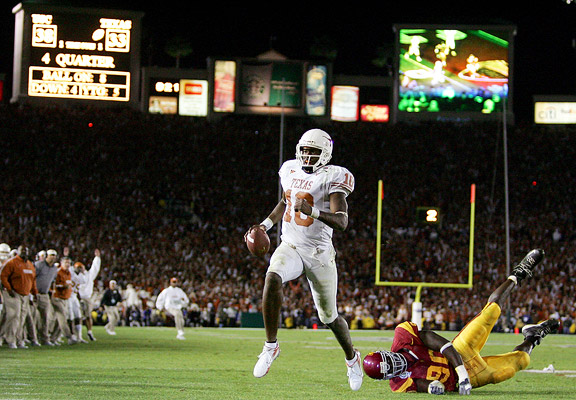
Young drove the Longhorns into Trojan territory. They got a big boost from a foolish face-mask penalty. They got to the 9-yard line, on 4th-and-5. A 1st down could have been gained without scoring a touchdown. The Longhorns went into their preferred formation, the shotgun. Young took the snap. His receivers were covered. He ran for the right sideline, got a key block from Justin Blalock, turned the corner, and dashed into the end zone with his 3rd rushing touchdown of the game. He got into the end zone again for the 2-point conversion. It was 41-38 Texas.

USC got the ball back with only 16 seconds left. It wasn't enough to for them to get into range for a tying field goal. Leinart only got them to the Texas 43. Had he time for 1 more play, a field goal from there would have been 60 yards.

But the clock had run out, and Texas were the undisputed National Champions for the 1st time in 36 years. The 2006 Rose Bowl, the 21st Century's 1st real Game of the Century, had lived up to the hype.

Soon, it would come out that USC had engaged in all kinds of recruiting violations. The NCAA vacated their last 2 wins of the 2004 season, all 12 in 2005, and both National Championships. They also revoked Bush's Heisman Trophy, the only time that has ever happened. The Trojans have since won the Pac-10 in 2006, '07 in '08, and the Pac-12 in 2017. But their mystique took a major hit. 

Texas has only won the Big 12 once since, in 2009. They advanced to the National Championship Game, but lost to Alabama. They are in roughly the same position as USC: Usually one of the better teams in the country, but not up to their previous standards.

(UPDATE: In 2024, USC became one of the Pac-12 teams that moved to the Big 10, and Texas moved from the Big 12 to the Southeastern Conference.)

Reggie Bush had a decent pro career, but Matt Leinart turned out to be an injury-plagued journeyman. Both went into network studio work. Vince Young saw his career damaged by poor management by his coaches and by his own struggles with mental illness. As of 2022, he works for the University of Texas athletic department.

Of the coaches: Pete Carroll went on to win a Super Bowl with the Seattle Seahawks, joining Paul Brown, Jimmy Johnson and Barry Switzer as the only head coaches to win both a National Championship and a World Championship. But he will be forever remembered for his play-calling in the next year's Super Bowl, which cost the Seahawks back-to-back titles. Mack Brown, who had rebuilt the program at North Carolina before moving on to Texas, has gone back to North Carolina and done it again.

*

January 4, 2006 was a Wednesday. It was the off-season for Major League Baseball. The NFL was between Playoff weekends. There were 9 games played that day in the NBA. Neither of the New York Tri-State Area teams were involved in any of them:

* The Toronto Raptors beat the Orlando Magic, 121-97 at the Air Canada Centre in Toronto. It's now named the Scotiabank Arena. Jameer Nelson scored 31 for the Magic, but it was far from enough.

* The Boston Celtics beat the Charlotte Bobcats, 109-106 at the TD Garden in Boston. Paul Pierce of the Celtics led all scorers with 31 points. The Bobcats would change their named to the Charlotte Hornets in 2014, after the former team by that name, now in New Orleans, gave it up to become the Pelicans. Speaking of whom:

* The New Orleans/Oklahoma City Hornets, playing their home games at the Ford Center in Oklahoma City while their usual arena was being repaired following Hurricane Katrina, hosted the Miami Heat, and beat them 107-92. In spite of this, the Heat went on to win the NBA Championship that season. The Ford Center is now named the Paycom Center.

* The Seattle SuperSonics beat the Chicago Bulls, 101-97 at the United Center in Chicago. The Sonics became the Oklahoma City Thunder in 2008.

* The Cleveland Cavaliers beat the Milwaukee Bucks, 91-84 at the Bradley Center in Milwaukee. LeBron James scored 32 for the Cavs.

* The Minnesota Timberwolves beat the Dallas Mavericks, 91-78 at the Target Center in Minneapolis.

* The San Antonio Spurs beat the Portland Trail Blazers, 106-75 at the SBC Center in San Antonio. It's now the Frost Bank Center.

* The Denver Nuggets beat the Indiana Pacers, 106-86 at the Pepsi Center in Denver. It's now named the Ball Arena, which makes sense at Nuggets games, if not at Colorado Avalanche games.

* And the Phoenix Suns beat the Philadelphia 76ers, 105-85 at the America West Arena in Phoenix. It is now named the Mortgage Matchup Center.

There were 5 games played in the NHL that day, only 1 of them involving a team from the New York Tri-State Area:

* The New York Islanders beat the Florida Panthers, 4-3 at the Nassau Coliseum. Mark Parrish scored the winning goal, 2:15 into overtime.

* The Ottawa Senators beat the Washington Capitals, 3-1 at the MCI Center in Washington. It's now named the Capital One Arena.

* The Carolina Hurricanes beat the Atlanta Thrashers, 4-3 at the RBC Center (now the Lenovo Center) in Raleigh. The Thrashers became the new Winnipeg Jets in 2011.

* The Nashville Predators beat the St. Louis Blues, 4-3 at the Savvis Center in St. Louis. It's now named the Enterprise Center.

* And the Dallas Stars beat the Vancouver Canucks, 3-1 at the American Airlines Center in Dallas. 

December 31, 1999 & January 1, 2000: The Millennium

December 31, 1999:  The Millennium arrives. The people of planet Earth survived. At a terrible cost. But we hadn't destroyed ourselves. ...