Showing posts with label maryland. Show all posts

Monday, November 14, 2022

November 14, 1963: The John F. Kennedy Memorial Highway Opens

Left to right: Governor Elbert Carvel of Delaware,
President John F. Kennedy, and Governor J. Millard Tawes of Maryland

November 14, 1963: President John F. Kennedy dedicates the opening of Interstate 95 at the Delaware-Maryland State Line, along with the Governors of the States involved, J. Millard Tawes of Maryland and Elbert N. Carvel of Delaware.

Just 8 days later, Kennedy was assassinated in Dallas. On December 17, the States of Maryland and Delaware named their sections of I-95 the John F. Kennedy Memorial Highway. Delaware kept the Delaware Turnpike name, which had been in place since the road opened in 1956.

The Delaware Turnpike runs 11 miles from the Pennsylvania State Line to the Maryland State Line. From there, it runs 110 miles, to the Baltimore Harbor Tunnel Thruway. South of that, I-95 no longer carries the JFK name.
I-95 -- including its more northern sections, such as the Delaware Expressway in Philadelphia, the New Jersey Turnpike, the New England Thruway in New York, and the Connecticut Turnpike -- essentially killed the old Pennsylvania Railroad, as people began driving up and down the Northeast Corridor, between the cities of Boston, Providence, New Haven, New York, Newark, New Brunswick, Trenton, Philadelphia, Wilmington, Baltimore and Washington.

As a result, rest areas became critical. The Delaware Welcome Center, now named the Biden Welcome Center after the State's most successful politician, opened in Newark, Delaware in 1963. So did the Maryland House in Aberdeen. The Chesapeake House opened in North East, Maryland in 1975. These plazas were demolished and replaced: The one in Delaware in 2010, and the two in Maryland in 2014.

*

November 14, 1963 was a Thursday. Baseball was out of season. Football was in midweek. There were 2 games played in the NBA. The Los Angeles Lakers beat the Baltimore Bullets, 123-115 at the Baltimore Civic Center (now the CFG Bank Arena). Terry Dischinger scored 36 points for the Bullets. And the St. Louis Hawks beat the San Francisco Warriors, 117-105 at the Kiel Auditorium in St. Louis. Cliff Hagan scored 38. Wilt Chamberlain had 34 points and 22 rebounds for the Warriors.

And 1 game was played in the NHL: The Toronto Maple Leafs beat the New York Rangers. 5-4 at the old Madison Square Garden.

Monday, October 24, 2022

October 24, 2002: The Beltway Snipers Are Arrested

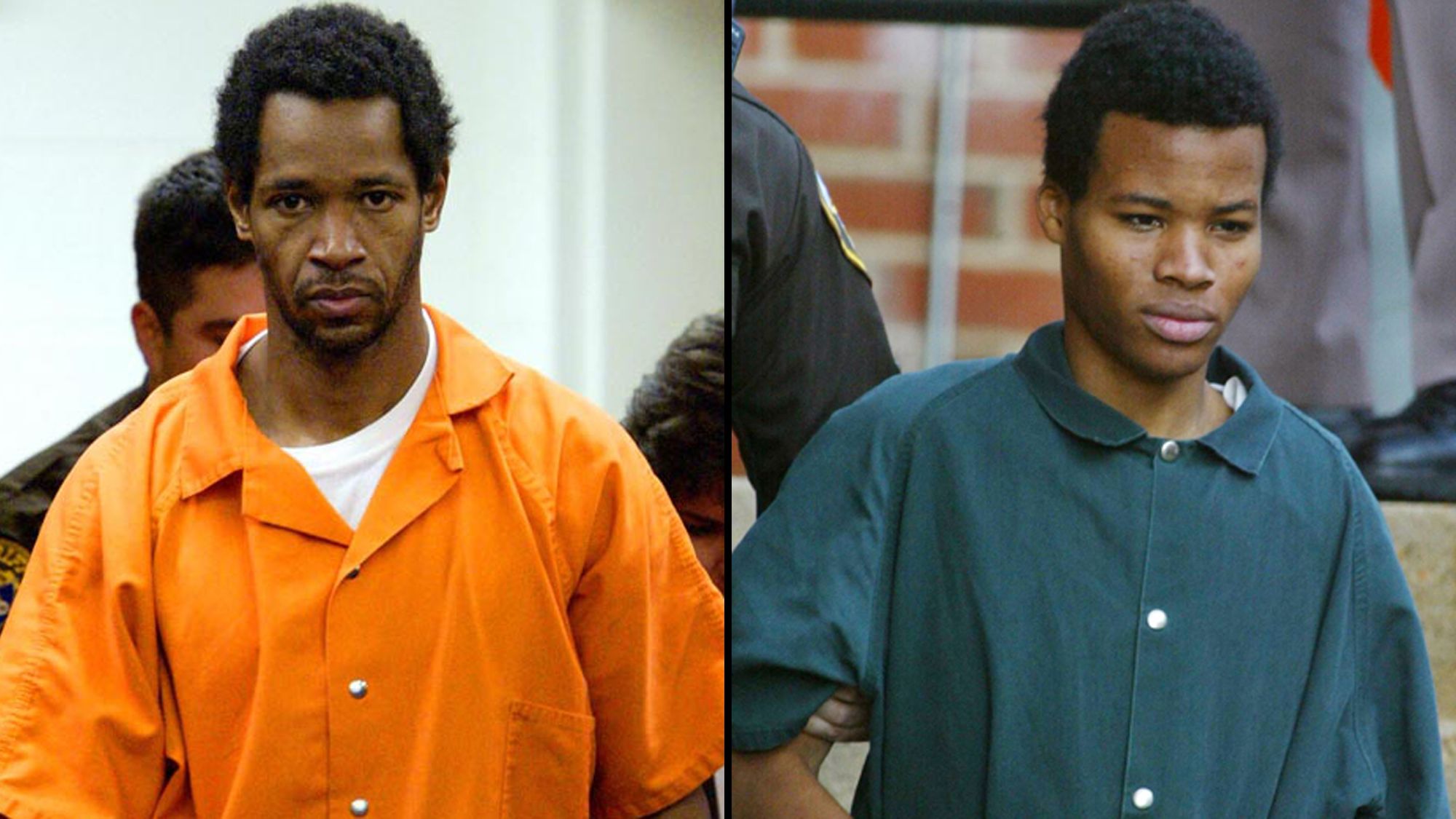
John Allen Muhammad (left) and Lee Malvo

October 24, 2002: The "Beltway Snipers," who killed 7 people in the Washington, D.C. area, are arrested.

John Allen Muhammad was 41 years old, and a native of Baton Rouge, Louisiana. He joined the Nation of Islam, dropping his birth name of John Allen Williams. In 1999, he kidnapped his children and took them to the Caribbean island nation of Antigua, apparently engaging in credit card and immigration document fraud.

It was during this time that he became close with Lee Boyd Malvo, who was living on Antigua with his mother. Then 17 and a native of Jamaica, he fell into a Svengali relationship with Muhammad, being converted to Islam and moved to Bellingham, Washington. There, he shoplifted a Bushmaster XM-15, an AR-15 style semi-automatic rifle.

At first, Muhammad was making Malvo shoot people connected with his ex-wife, Mildred Williams. On February 16, 2002, 21-year-old Keenya Nicole Cook was shot and killed by Malvo at the front door of her aunt's home in Tacoma, Washington. The aunt, Isa Nichols, had been good friends with John Allen Muhammad's ex-wife Mildred and had encouraged her to seek a divorce. This was the 1st of 9 shootings that the FBI later classified as "preliminary attacks": 3 in Maryland, 2 in Louisiana, and 1 each in Washington State, Arizona, Atlanta and Alabama.

Then came the series of shootings that became known as the Beltway Sniper attacks. A hole was cut at the rear of a blue 1990 Chevrolet Caprice driven by Muhammad and Malvo, as a firing port to be used during their attacks. This allowed them to remain hidden and escape the scene following their attacks.

On October 2, a shot was fired in Aspen Hill, Maryland, but it didn't hit anybody, and it was originally presumed to be random, before it was later compared to the other shootings. Just an hour later, in a supermarket parking lot in Wheaton, Maryland, James Martin was shot and killed.

The next morning, all within a span of 2 hours and 17 minutes, 4 people were killed in the Maryland suburbs of Washington, all in open areas where they were easy targets: A man at a car dealership in Rockville; a man at a gas station in Aspen Hill; a woman at in a shopping center parking lot in Norbeck; and a woman at a gas station in Kensington. That night, a man was killed outside a Target in the Shepherd Park neighborhood of Washington, D.C.

The next day, October 4, the pair of killers crossed the Potomac River into Virginia, and shot a woman in a mall parking lot in Spotsylvania. She survived. There were no shootings for 2 days, but on October 7, a 13-year-old boy was shot outside his school in Bowie, Maryland. He survived. On October 9, a man was shot and killed at a gas station in Manassas, Virginia. On October 11, a man was shot and killed at a gas station in Spotsylvania.

Charles Moose, Chief of the Montgomery County Department of Police, headed the investigation. Since more than one State was involved, he worked closely with the FBI even before one of their employees became a victim. On October 14, with the killers probably not realizing they were now messing with the wrong people, they shot a woman who was an FBI intelligence analyst in a shopping center parking lot in Falls Church, Virginia.

Just as a belief that the serial killer known as the Son of Sam was killing women with long blonde hair in New York in 1977, and women started tying their hair up or dying it, gas stations responded to these shootings by putting tarps up to conceal their customers, and some people crouched over while pumping their own gas.

It would take 5 more days before the shootings resumed. On October 19, a man was killed in a restaurant parking lot in Ashland, Virginia. At 90 miles, this was the furthest yet from downtown Washington. On October 22, a man was shot on his house steps in Aspen Hill.

Just after midnight on October 24, 2002, refrigerator mechanic Whitney Donahue called 911 at a rest stop off Interstate 70 near Myersville, Maryland. He said he saw a dark blue 1990 Chevrolet Caprice with New Jersey license plates, which matched the description that law enforcement had said they were looking for. At 3:19 AM, Muhammad and Malvo were found sleeping in their car, and were arrested on federal weapons charges.

The stolen Bushmaster rifle was found, and ballistics tests later conclusively linked it to 11 of the 14 shootings, including one in which no one was hurt. The Caprice was later discovered to have formerly been used as an undercover police car in Bordentown, New Jersey.

In total, Muhammad and Malvo were responsible for 27 people being shot, 17 of them fatally. There were 12 attacks in Maryland, 5 in Virginia, 2 in Louisiana, and 1 each in the District of Columbia, Washington State, Arizona, Georgia and Alabama.


In 2003, both defendants were convicted. Muhammad was sentenced to death, and was executed by lethal injection at Greensville Correctional Center in Virginia on November 10, 2009. As Malvo was legally a juvenile at the time of the shootings, he received 6 life sentences in Maryland and 3 in Virginia.

Charles Moose died in 2021. As of October 24, 2022, Mildred Muhammad, John Allen's ex-wife, is a motivational speaker and counselor, counseling people affected by crime, including the victims and the families of the perpetrators. Lee Malvo is serving multiple life sentences at Keen Mountain Correctional Center in Virginia. He is unlikely ever to be released alive. 

*

October 24, 2002 was a Thursday. This was also the day that Gary Lineker, former star soccer player for Leciester City Football Club, led a consortium to buy the team and save it from bankruptcy. the I have a separate entry for that event.

Game 5 of the World Series was played. The San Francisco Giants beat the team then known as the Anaheim Angels, 16-4. Jeff Kent hit 2 home runs. The most well-known moment in this game occurred in the bottom of the 7th inning, when Giants 1st baseman J.T. Snow scored off a Kenny Lofton triple. Three-year-old batboy Darren Baker, son of Giants manager Dusty Baker, ran to home plate to collect Lofton's bat before the play was completed, and was quickly lifted by the jacket by Snow with one hand as he crossed the plate, with David Bell close on his heels. Had Snow not acted quickly, Darren could have been seriously injured in a play at home plate.

The Giants were now 1 win away from winning the World Series for the 1st time in 1954, when they were still in New York. They would have to wait. Darren Baker was later drafted by the Washington Nationals as a 2nd baseman.

(UPDATE: In 2024, he played 9 games for the Nationals. These were his only major league games through the 2025 season.)

The NFL was in midweek. Two games were played in college football. Number 12 North Carolina State beat Clemson, 38-6 at Memorial Stadium in Clemson, South Carolina. And Colorado State beat Brigham Young University, 37-10 at Hughes Stadium in Fort Collins, Colorado.

The NBA season started 5 days later. There were 9 games in the NHL:

* The New York Islanders beat the Florida Panthers, 5-3 at the Nassau Coliseum.

* The Boston Bruins and the Ottawa Senators played to a tie, 2-2 at the FleetCenter (now the TD Garden) in Boston.

* The Philadelphia Flyers beat the Montreal Canadiens, 6-2 at the First Union Center (now the Xfinity Mobile Arena) in Philadelphia.

* The San Jose Sharks beat the Nashville Predators, 2-1 at the Gaylord Entertainment Center (now the Bridgestone Arena) in Nashville.

* The Minnesota Wild beat the Chicago Blackhawks, 3-2 at the United Center in Chicago.

* The Colorado Avalanche beat the Phoenix Coyotes, 3-2 at the American West Arena (now the Mortgage Matchup Center) in Phoenix.

* The Dallas Stars and the Calgary Flames played to a tie, 3-3 at the Saddledome in Calgary.

* The St. Louis Blues beat the Edmonton Oilers, 2-1 at the Skyreach Center (as the Northlands Coliseum was then known) in Edmonton.

* And the Vancouver Canucks and the Mighty Ducks of Anaheim played to a tie, 2-2 at General Motors Place (now the Rogers Arena) in Vancouver.) 

Saturday, July 30, 2022

July 30, 1952: The Chesapeake Bay Bridge Opens

July 30, 1952: The Chesapeake Bay Bridge opens, connecting mainland Maryland with the State's Eastern Shore. At the time, it was the world's longest continuous over-water steel structure.

This bridge should not be confused with the Chesapeake Bay Bridge-Tunnel, which opened in Virginia in 1964. Both of these conveyances replaced ferry boat systems.

Stretching 4.3 miles, it carries U.S. Routes 50 and 301 from the State capital of Annapolis to Stevensville. It cuts down the travel time from the capital; Baltimore, the State's largest city; and Washington, D.C., the national capital, to the resort towns of Ocean City, Maryland and Rehoboth Beach, Delaware.

In 1967, a few months after his death, the bridge was officially renamed the Governor William Preston Lane Jr. Memorial Bridge. Lane served as Governor of Maryland from 1947 to 1951, and was instrumental in getting the bill for the bridge's construction passed. Nevertheless, as with the San Francisco-Oakland Bay Bridge, most locals still refer to it as "The Bay Bridge."

In 1973, to relieve traffic congestion, a second span was added. The original span carries eastbound traffic, and the newer span carries westbound traffic. There has been consideration of a 3rd span at the bridge's location, or possibly a new bridge elsewhere over the Bay.

*

July 30, 1952 was a Wednesday. These baseball games were played that day:

* The New York Yankees lost to the Chicago White Sox, 7-0 at Comiskey Park in Chicago. Lou Kretlow pitched a shutout, allowing only 2 hits: A double by Phil Rizzuto in the 3rd inning, and a single to Joe Collins in the 6th. For the South Siders, Jim Rivera hit a home run.

* A doubleheader was split at the Polo Grounds. The New York Giants won the opener, 10-6. They did this without Willie Mays, who was serving in the Korean War. Alvin Dark and Dusty Rhodes hit home runs, and rookie Hoyt Wilhelm was the winning pitcher, with 6 innings of relief of Jim Hearn. The Chicago Cubs won the nightcap, 6-2.

* The Brooklyn Dodgers beat the Pittsburgh Pirates, 4-3 at Ebbets Field. Carl Furillo singled home the winning run in the bottom of the 10th inning. Joe Black was the winning pitcher, in relief of Carl Erskine. Roy Campanella hit a home run. Jackie Robinson pinch-hit for Rocky Bridges, stayed in the game, and went 0-for-2.

* The Boston Braves beat the St. Louis Cardinals, 2-1 at Braves Field in Boston. The Cardinals' run came on a home run by Stan Musial. This would be the Braves' last season in Boston. The next season, they moved to Milwaukee.

* The Philadelphia Phillies beat the Cincinnati Reds, 7-3 at Shibe Park in Philadelphia.

* The Boston Red Sox beat the Cleveland Indians, 5-4 at Cleveland Municipal Stadium. Dick Brodowski outpitched Bob Feller. The BoSox did this without Ted Williams, who was also serving in the Korean War.

* The Philadelphia Athletics beat the Detroit Tigers, 4-3 at Briggs Stadium (later Tiger Stadium) in Detroit.

* And the Washington Senators beat the St. Louis Browns, 6-2 at Sportsman's Park in St. Louis. In 1954, the Browns became the Baltimore Orioles, and that would be the beginning of the end of the Senators. The Orioles would benefit from the Bay Bridge much more than did the Senators, although the Washington Nationals now do.

Thursday, July 14, 2022

July 15, 1870: The Reunion of the Union Is Completed

The Flag of the United States, with 37 Stars,
in use from July 4, 1867 to July 4, 1877,
including when most of the former Confederate States
were readmitted to the Union.

July 15, 1870: The last of the States that had seceded from the United States of America to form the Confederate States of America is readmitted, completing the reunion of the Union.

Those States seceded over what they called "States' Rights," but each one's Ordinance of Secession mentioned slavery as one of those "rights." The secessions began after the election of Abraham Lincoln, who opposed the future expansion of slavery, as the President of the United States on November 6, 1860.

This was the order of secession:

1. December 20, 1860: South Carolina.
2. January 9, 1861: Mississippi.
3. January 10, 1861: Florida.
4. January 11, 1861: Alabama.
5. January 19, 1861: Georgia.
6. January 26, 1861: Louisiana.
7. February 23, 1861: Texas.

Lincoln was Inaugurated on March 4. On April 12, Confederate ships fired on Fort Sumter in Charleston, South Carolina, starting the American Civil War. This was followed by more secessions:

8. May 6, 1861: Arkansas.
9. May 20, 1861: North Carolina.
10. May 23, 1861: Virginia.
11. June 1, 1861: Tennessee.

On January 3, 1861, Delaware voted not to secede. On January 29, Kansas was admitted as the 34th State in the Union. On March 19, Missouri overwhelmingly vote to remain in the Union. On April 29, Maryland voted not to secede.

This was key: The District of Columbia, the seat of the Union's government, was between Maryland and Virginia, and Virginia was already considering secession. If both had seceded, the federal government would be trapped. As it was, when Virginia seceded, the U.S.A. literally had its capital on the border with an enemy nation. Fortunately, the C.S.A. didn't have engineers capable of building a bridge across the Potomac River to invade. Nor did they have cannons capable of reaching the U.S. Capitol or the White House.

On May 20, Kentucky declared its neutrality. But on November 18, delegates from 68 of Kentucky’s 110 Counties met, passed an ordinance of secession, adopted a new state seal, and elected a secessionist as Governor. Kentucky was admitted to the Confederacy on December 10. However, the elected State government did not secede, and Kentucky remained in the Union.

Still, the Confederate Flag -- and its variation that is more familiar today, the Confederate Battle Flag -- had 13 stars, one for each State that had seceded, and one each for Kentucky and Missouri, which had not. So the States of Delaware, Maryland, Kentucky and Missouri remained in the Union, despite still keeping slavery legal within their borders.

Several Western Counties in Virginia voted to secede from the rest of the State, and on June 20, 1863, those Counties, collectively, were admitted to the Union as West Virginia, the 35th State. This included Harpers Ferry, home to the federal arsenal that abolitionist John Brown tried and failed to capture in 1859.

The idea that Virginia went to the Confederacy and West Virginia stayed loyal to the Union will seem strange to people whose experience watching those States only goes back far enough to know Virginia as a State regularly voting Democratic and West Virginia as one regularly voting Republican.

Nevada was admitted as the 36th State on October 31, 1864. Because it was admitted during the Civil War, and immediately sent troops to the Union Army, the State’s motto is "Battle Born."

The Confederate States of America surrendered, piece by piece, in the Spring of 1865. This was the order of readmission to the Union, based on acceptance of the Constitution of the United States, including the Reconstruction Amendments: The 13th, prohibiting slavery; the 14th, guaranteeing citizenship and equal protection of the laws to all people born in the United States; and the 15th, guaranteeing the right to vote to all male American citizens age 21 and up:

1. July 24, 1866: Tennessee.
2. June 22, 1868: Arkansas.
3. June 25, 1868: Florida.
4. July 4, 1868: North Carolina.
5. July 9, 1868: Louisiana.
6. July 9, 1868: South Carolina (same day as Louisiana).
7. July 13, 1868: Alabama.
8. January 26, 1870: Virginia.
9. February 23, 1870: Mississippi.
10. March 30, 1870: Texas.
11. July 15, 1870: Georgia.

During this process, another State was admitted to the Union: Nebraska, the 37th State, on March 1, 1867. The 38th wouldn’t come until 1876, Colorado.

Of the 33 States in the Union when South Carolina became the 1st to secede, slavery had been banned in 18. Of the 37 States in the Union when Georgia became the last to rejoin, it had been banned in all 37.

So 1870 marked the final reunion of the Union. On October 12, Robert E. Lee, the leading General of the CSA, died from the effects of a stroke, in Lexington, Virginia. He was 63 years old. Jefferson Davis, the one and only President of the C.S.A., previously a U.S. Senator from Mississippi and Secretary of War under President Franklin Pierce, lived on until 1889.

*

July 15, 1870 was a Friday. By an odd coincidence, this was also the day that Manitoba became a Province of Canada, ending the Red River Rebellion. I have a separate entry for this event.

The only organized team sport in America at this point was baseball, and it was just starting the professional era. The difference between those teams that had turned pro and those that hadn't became stark. The only score I can find for this historic day involves the 1st team to openly turn pro, the Cincinnati Red Stockings, who beat the Eagle Base Ball Club of Louisville, Kentucky, 39-8. That season, against pro teams, the Red Stockings went 27-6; against amateur teams, they went 40-0.

Friday, June 3, 2022

June 3, 1949: The 1st Black Graduate of the U.S. Naval Academy

June 3, 1949: The Class of 1949 graduates from the United States Naval Academy at Annapolis, Maryland, 35 miles northeast of downtown Washington, and 30 miles southeast of downtown Baltimore. Among the newly-commissioned Ensigns is the Academy's 1st black graduate.

Wesley Anthony Brown was familiar with both of those cities. He was born on April 3, 1927 in Baltimore, and graduated from Dunbar High School in Washington. It was founded in 1870 as the 1st public high school for black students, and renamed in 1916 for the black poet Paul Laurence Dunbar. There are also high schools named for him in Baltimore; Dunbar's hometown of Dayton, Ohio; Chicago; and Lexington, Kentucky.

Although he had been admitted to Howard University in Washington, the school considered to be "the Black Harvard," he was, as all students at America's military academies must be, recommended by a member of Congress. In 1945, Brown was recommended by Adam Clayton Powell Jr., the flamboyant Harlem minister who had been newly elected to the House of Representatives. While at the Academy, Brown was on the cross-country team with James Earle Carter Jr., Class of 1946, who was elected President in 1976. Brown graduated on time in 1949.

Brown entered the Navy's Civil Engineer Corps. He was responsible for building military service member homes in Hawaii, roads in Liberia, wharves in the Philippines, a nuclear power plant in Antarctica -- nothing has ever gone wrong there, thank God -- and a desalination plant at Guantanamo Bay in Cuba.

He served during the Korean and Vietnam Wars, though not in combat. He retired in 1969, with the rank of Lieutenant Commander. He finally went to Howard, as a physical facilities analyst. He married Crystal Malone, and had 4 children. He died on May 22, 2012, at the age of 85.

*

June 3, 1949 was a Friday. These baseball games were played that day:

* The New York Yankees beat the Chicago White Sox, 9-7 at Comiskey Park in Chicago. Bob Porterfield started against Billy Pierce, and neither got out of the 2nd inning. Phil Rizzuto went 2-for-4 with a walk and 3 RBIs. Tommy Henrich and Gene Woodling also got 2 hits. Clarence "Cuddles" Marshall ended up as the winning pitcher. Joe DiMaggio was injured, and did not play.

* The New York Giants beat the Chicago Cubs, 15-5 at the Polo Grounds. Jack Lohrke, Sid Gordon and Bobby Thomson hit home runs.

* The Brooklyn Dodgers beat the St. Louis Cardinals, 5-2 at Ebbets Field in Brooklyn. Gil Hodges hit a home run. Jackie Robinson went 0-for-3. Stan Musial went 2-for-4.

* A doubleheader was split at Shibe Park in Philadelphia. The Cincinnati Reds won the opener, 3-2. The Philadelphia Phillies won the nightcap, 3-1.

* The Detroit Tigers beat the Philadelphia Athletics, 4-3 at Briggs Stadium (later Tiger Stadium) in Detroit.

* The Cleveland Indians beat the Boston Red Sox, 8-1 at Cleveland Municipal Stadium. Early Wynn went the distance, including holding Ted Williams to 0-for-4.

* The Washington Senators beat the St. Louis Browns, 12-5 at Sportsman's Park in St. Louis.

* And the Boston Braves and the Pittsburgh Pirates were not scheduled.

Sunday, May 22, 2022

May 22, 1949: The Death of James Forrestal

May 22, 1949: James Forrestal dies at Bethesda Naval Medical Center. He was only 57 years old, and the circumstances of his death are still debated.

James Vincent Forrestal was born on February 15, 1892 in Beacon, Dutchess County, New York. He attended Princeton University, but did not graduate. He became a Wall Street financier, and married Joseph Ogden. Both of them would be plagued by mental health issues.

He acted as a publicist for the Dutchess County Democratic Party, putting him in position to meet President Franklin D. Roosevelt. In 1940, FDR appointed him to a position that he, himself -- and also his distant cousin, President Theodore Roosevelt -- had previously held: Undersecretary of the Navy. In 1944, Secretary of the Navy Frank Knox died, and Forrestal rose to his position.

Following the victory in World War II, the new President, Harry Truman, reorganized the country's national security apparatus. The National Security Act of 1947 created the Department of Defense, and Forrestal was appointed the 1st Secretary of Defense.

But he clashed with Truman on several issues: While Forrestal was happy to assist with the desegregation of the armed forces, he wanted to streamline them, cutting out several weapons systems, while, at the same time, wanting a tougher tone with the Soviet Union. He also opposed Truman's recognition of the independence of Israel, for fear that it would anger the Arab nations selling America their oil. (Truman knew that it would, but knew it was the right thing to do, anyway.)

Shortly before the 1948 Presidential election, he met with the Republican nominee for President, Governor Thomas Dewey of New York, who assured Forrestal that he would remain at his post in the new Administration. Washington Post columnist Drew Pearson heard about this, and published it in his "Washington Merry-Go-Round" column. Truman hit the roof. He also hit the campaign trail, and won the election. On March 28, 1949, 2 months into what amounted to his 2nd term, he asked for, and received, Forrestal's resignation.

Shortly thereafter, Forrestal was diagnosed with "severe depression, of the type seen in operational fatigue during the war." He checked into the National Naval Medical Center in suburban Bethesda, Maryland (now part of Walter Reed National Military Medical Center), with his room on the 16th floor of the 20-story tower.

He seemed to be on the road to recovery, having regained 12 pounds since his admission into the hospital. However, in the early morning hours of May 22, his body, wearing only in the bottom half his pajamas, was found on a 3rd-floor roof below the 16th-floor kitchen across the hall from his room. By his beside was a piece of paper on which he had written words from a recent translation of the ancient Greek play Ajax by Sophocles, and this was considered to be a suicide note.

He was buried at Arlington National Cemetery, and an aircraft carrier was named USS Forrestal in his memory, in service from 1955 to 1993.

*

May 22, 1949 was a Sunday. These baseball games were played:

* The New York Giants split a doubleheader with the St. Louis Cardinals at Sportsman's Park in St. Louis. The Cardinals won the opener, 3-2. The Giants won the nightcap, 13-4. Over the 2 games, Stan Musial went 3-for-8 with a home run, a walk and 3 RBIs.

* The Brooklyn Dodgers also split a doubleheader, with the Cincinnati Reds, at Crosley Field in Cincinnati. The Dodgers won the 1st game, 3-0. Don Newcombe pitched a 5-hit shutout. The Reds won the 2nd game, 2-0. Ken Raffensberger allowed just 3 baserunners: a single by Gil Hodges, and walks by Hodges and Mike McCormick. But Dodger pitcher Joe Hatten allowed only 4, a double and 3 singles. Over the 2 games, Jackie Robinson went 2-for-6 with a walk and an RBI.

* The Boston Red Sox beat the Detroit Tigers, 3-2 at Fenway Park in Boston. Ted Williams went 1-for-5 with a walk. Mel Parnell not only pitched all 12 innings for the win, but singled home the winning run.

* A Philadelphia Athletics swept a doubleheader from the Cleveland Indians, 5-4 and 7-3 at Shibe Park in Philadelphia. In the 1st game, the A's knocked Gene Bearden out of the box in the 1st inning, and Satchel Paige pitched 6 2/3rd innings of relief, but still got the loss.

* The Chicago White Sox beat the Washington Senators, 6-4 at Griffith Stadium in Washington.

* The Philadelphia Phillies beat the Pittsburgh Pirates, 6-5 at Forbes Field in Pittsburgh. Danny Murtaugh, later to manage the Pirates to win 2 World Series, hit a home run. So did Ralph Kiner.

* The Boston Braves beat the Chicago Cubs, 7-2 at Wrigley Field in Chicago.

* And the New York Yankees and the St. Louis Browns were rained out at Yankee Stadium. It was made up on an off-day, 2 days later. The Yankees won, 13-3, scoring 10 runs in the bottom of the 5th inning. Bobby Brown and Yogi Berra hit home runs. Yogi had 4 RBIs, while Bobby and Phil Rizzuto, who had 3 hits, each had 3 RBIs. Vic Raschi started and won. Joe DiMaggio was injured, and did not play.

Tuesday, May 17, 2022

May 17, 1968: The Catonsville Nine

May 17, 1968: Nine people go to the draft board in Catonsville, Baltimore County, Maryland. They take 378 draft files, bring them to the parking lot in wire baskets, dump them out, pour homemade napalm over them, and set them on fire. The action is symbolic: Napalm was an incendiary used extensively by the U.S. military in Vietnam.

They were immediately arrested, and in October were found guilty of destruction of U.S. property, destruction of Selective Service files, and interference with the Selective Service Act of 1967. They were also sentenced to a total of 18 years' jail time and a fine of $22,000. But by mid-1972, they had all been released.

Of the Catonsville Nine: Brother David Darst was the first to die, killed in a car crash just 5 months later. Mary Moylan died in 1995. Father Philip Berrigan died in 2002, and his brother, Father Daniel Berrigan, in 2016. Thomas P. Lewis and John Hogan both died in 2008.

Former priest Thomas Melville and former nun Marjorie Bradford married each other. Thomas died in 2017, while Marjorie, as of May 17, 2022, lives in Mexico at the age of 92. The only other survivor is George Mische, whose idea it was. Now 84, he lives in the Minneapolis area, has praised the work of the students who have survived gun massacres, and says he sees a lot of 1968 in 2010s and 2020s activism.

*

May 17, 1968 was a Friday. This was "The Year of the Pitcher" in baseball, and, on this day, 2 games were scoreless after 9 innings, another was 1-1 after 15, and 2 others were shutouts:

* The New York Yankees lost to the Boston Red Sox, 6-4 at Fenway Park in Boston. The Sox scored 2 runs off former Sox pitcher Bill Monbouquette to win it in the bottom of the 8th inning, and make future Yankee Sparky Lyle a winning pitcher in relief of Gary Bell. Mickey Mantle and Carl Yastrzemski each went 1-for-4. Mike Andrews went 3-for-4 with 3 RBIs.

* The New York Mets lost to the Atlanta Braves, 3-1 at Shea Stadium. Deron Johnson singled home Hank Aaron, and Felipe Alou doubled him home, in the top of the 16th inning. Aaron went 0-for-5 with 2 walks. The Mets' run came on a home run by Art Shamsky.

* The Philadelphia Phillies beat the St. Louis Cardinals, 1-0 at Connie Mack Stadium in Philadelphia. Batting against his former teammate and road roommate, Bob Gibson, Bill White singled Woodie Fryman home with the winning run in the bottom of the 10th inning. Gibson and Fryman had both gone the distance.

* The Cincinnati Reds beat the Pittsburgh Pirates, 3-2 at Forbes Field in Pittsburgh. Pete Rose and Johnny Bench each went 1-for-4. Roberto Clemente went 1-for-5 with an RBI. Willie Stargell went 1-for-3 before being removed for defensive purposes.

* The Baltimore Orioles beat the Cleveland Indians, 6-2 at Cleveland Municipal Stadium. Brooks Robinson went 1-for-3 with a walk. Frank Robinson went 0-for-3 with a walk.

* The Detroit Tigers beat the Washington Senators, 7-3 at Tiger Stadium in Detroit. Al Kaline went 1-for-4 with an RBI.

* The Chicago White Sox beat the Oakland Athletics, 1-0 at Comiskey Park in Chicago. Duane Josephson singled Tommy McCraw home with the winning run in the bottom of the 10th inning. Joe Horlen went the distance, allowing 4 hits and no walks over 10 innings. Jim Nash had allowed only 3 hits and 4 walks, with 13 strikeouts. Rookie Reggie Jackson went 1-for-4.

* The Los Angeles Dodgers beat the Houston Astros, 6-0 at Dodger Stadium in Los Angeles. Bill Singer pitched a 2-hit shutout.

* The San Francisco Giants beat the Chicago Cubs, 2-0 at Candlestick Park in San Francisco. Ray Sadecki pitched a 2-hit shutout. Willie Mays and Ernie Banks each went 1-for-3 with a walk.

* And the California Angels and the Minnesota Twins were rained out at Metropolitan Stadium in the Minneapolis suburb of Bloomington, Minnesota. The game was made up as part of a doubleheader on July 23. The Angels won the opener, 3-1. The Twins won the nightcap, 3-1. Harmon Killebrew did not play in either game, and Rod Carew only played in the 2nd game, going 0-for-4.

Sunday, May 15, 2022

May 15, 1972: Governor George Wallace Is Shot

May 15, 1972: Governor George C. Wallace of Alabama, campaigning for the next day’s Maryland Primary, is shot at the Laurel Shopping Center, about halfway between Baltimore and Washington. He survives, but is paralyzed from the waist down for the rest of his life.


Although Wallace already had significant support from the blue-collar and country votes in Maryland and Michigan, which also had its Primary the next day, it may have been a sympathy vote that put him over the top. In Maryland, Wallace won 38 percent of the vote, to 26 percent for Senator and former Vice President Hubert Humphrey of Minnesota, and 22 percent for Senator George McGovern of South Dakota. In Michigan, it’s Wallace 51, McGovern 27, Humphrey 16.

Wallace with his wife Cornelia,
at Holy Cross Hospital in Silver Spring, Maryland,
holding up the May 17 Baltimore Sun headline on his win

The shooter, Arthur Bremer, a janitor from Milwaukee, had been following Wallace around, after realizing that his original target, the man Wallace wanted to replace as President, Richard Nixon, would be too difficult to get close to. His motive was self-aggrandizement, not politics.


An appeal to have his mental illness taken into account was rejected, and he was sentenced to 53 years in prison, and was released after 35, in 2007. As of May 15 2022, he is still alive, 71 years old. Since it could not be proven that Wallace’s death in 1998 was directly connected to the shooting, he was not then charged with murder.

Wallace could not continue as a candidate, but, if any single day can be said to be the one where it became clear that the Democrats were doomed for November, this was it. McGovern won only 2 Counties in Michigan, and only 2 in Maryland. Humphrey didn’t win any in either.

To people the Democratic candidates needed to reach, the disaffected within each party's ranks and the independents, Humphrey, a civil rights and labor icon who had been Vice President under Lyndon Johnson in the years of the Great Society, race riots and the early Vietnam War, represented a past they didn’t want to go back to; and McGovern, the favorite of the younger, more radical Democrats, represented a future that terrified them.

Each in their own way, Wallace and President Richard Nixon represented a past they did want to go back to, a time when they were the people being listened to, not black people, Hispanics, gays, feminists, abortion-rights activists, people looking to get drugs decriminalized. They wanted, as both Wallace and Nixon said, "Law and order," and seemed willing to give up other people's rights to get it -- not realizing that they might have to give up something themselves.

The Democratic Party's only hope seemed to be Nixon falling into a terrible scandal. He did -- but nobody seemed to care until the Spring of 1973.

When Wallace ran as a 3rd-party candidate in 1968, he got just under 10 million votes, and won 5 Southern States with 45 Electoral Votes: His native Alabama, Georgia, Mississippi, Louisiana and Arkansas, plus 1 Electoral Vote in North Carolina, to give him 46.

Humphrey was the Democratic nominee, and Wallace's presence on the ballot may have swung several other States to Nixon: Tennessee, South Carolina, North Carolina, Florida, Virginia, Kentucky, Delaware, Alaska, Ohio, Missouri, New Jersey, Illinois, Wisconsin and California, for as many as 206 Electoral Votes. Wallace couldn't beat Nixon, but he did beat Humphrey, despite finishing far behind him.

Overall, in 1968, the combined Nixon-Wallace vote meant that 57 percent of American voters, representing 347 Electoral Votes, were willing to say, "We have had enough of progress for the poor and minorities." In 1972, with McGovern edging Humphrey for the Democratic nomination, and almost everybody who hoped to vote for Wallace in November going to Nixon, Nixon won 60.7 percent of the vote, the 2nd-most ever behind Franklin Roosevelt in 1936, and 49 out of the 50 States, all but Massachusetts and the District of Columbia, for 520 Electoral Votes to McGovern's 17 (and 1 stray Elector).

So which was the nightmare scenario: Wallace dying, or Wallace surviving with only a minor wound?

* Had Wallace died: He would have become a martyr to white supremacy, and, eventually, this country might have had a President Jesse Helms.

* Had Wallace been able to continue campaigning: He could have won the Democratic nomination, and the Party would have been fractured, possibly irrevocably, in its worst shape in 100 years. A new liberal party would have had to grow out of the old New Deal coalition that McGovern, Humphrey, and the later Senator Robert F. Kennedy or New York (who was trying to do so more in the way adopted by McGovern than in the way Humphrey had always done it) had been trying to revive.

And with former Governor Ronald Reagan of California ready to take up the conservative mantle in 1976, it might have taken many years for the Democrats to recover -- just as it actually did, until 1992, as the 1976 win of former Governor Jimmy Carter of Georgia represented something of a false dawn, a win that wouldn't have been possible if not for the falls of Nixon and his Vice President, Spiro Agnew, in separate scandals.

Wallace did run for President again in 1976, but he didn't get very far. Aside from his home State of Alabama, he didn't win a single Primary, although he did win the Mississippi Caucus. He finished 2nd in Florida, Illinois, and North Carolina, but Carter projected himself as a son of the "New South" that was ready to move past the hatreds of the 1960s. His moment had passed.

Plus, Wallace faced a problem that Roosevelt didn't face: Television coverage of himself in a wheelchair. Although he did get elected to a 3rd and a 4th term as Governor, and lived until 1998 (though in constant pain throughout), he didn't look healthy enough to be President in 1976. A big part of his 1968 and 1972 persona was that he was a strong man who would hold the line against them. After being shot, he didn't look like he could hold the line against anything.

Art imitated life: The film Taxi Driver is partly based on Bremer's pursuit of Wallace, although there appears to have been no real-life counterpart to the teenage prostitute played by Jodie Foster. Then, life imitated art: Inspired by Robert De Niro’s taxi driver and his desire to protect people like Foster's character, John Hinckley tried to assassinate President Ronald Reagan in 1981.

*

May 15, 1972 was a Monday. There were 9 Major League Baseball games played that day, none postponed due to the attempted assassination. I suspect that, given the polarization he engendered in the American people, if Wallace had died before the games could begin, none would have been postponed, except maybe the one in Maryland, in Baltimore, had the Orioles been at home that day. But they weren't:

* The New York Mets beat the Montreal Expos, 5-3 at Shea Stadium. Tommie Agee and Jim Fregosi hit home runs in support of Jon Matlack.

* The Philadelphia Phillies beat the Chicago Cubs, 4-0 at Veterans Stadium in Philadelphia. Woodie Fryman pitched a 6-hit shutout, to beat Ferguson Jenkins. The next night, the Cubs won, 8-1, with Rick Monday hitting 3 home runs. Greg Luzinski hit one off the mockup of the Liberty Bell on the Vet's mezzanine. After that, to make sure that he would remain the only one ever to hit it, it was moved up to the stadium's roof.

* The Pittsburgh Pirates beat the St. Louis Cardinals, 4-1 at Three Rivers Stadium in Pittsburgh. Roberto Clemente hit a 3-run homer, and Willie Stargell went 1-for-4. For the Cards, Lou Brock went 1-for-4 with a stolen base, and Joe Torre went 1-for-3 and was hit with a pitch. Dock Ellis outpitched Bob Gibson.

* The Baltimore Orioles beat the Detroit Tigers, 3-2 at Tiger Stadium in Detroit. Merv Rettenmund hit a home run, and Brooks Robinson went 2-for-4 in support of Jim Palmer, who helped his own cause with a triple in this last year without the designated hitter in the American League. Al Kaline did not enter the game for the Tigers.

* The Chicago White Sox beat the Minnesota Twins, 4-3 at Comiskey Park in Chicago. Harmon Killebrew hit a home run. Rod Carew went 0-for-3, but drove in a run with a sacrifice fly. But knuckleballer Wilbur Wood outpitched Jim Perry.

* The Kansas City Royals beat the Texas Rangers, 5-4 at Kansas City Municipal Stadium.

* The Houston Astros beat the Atlanta Braves, 8-2 at the Astrodome in Houston. Hank Aaron had 2 hits, but neither of them was a home run. He had 645 of those for his career.

* The Los Angeles Dodgers beat the San Diego Padres, 2-1 at San Diego Stadium. (It was later renamed Jack Murphy Stadium, Qualcomm Stadium and SDCCU Stadium.) Frank Robinson, in his only season with the Dodgers, went 0-for-3, but also walked and scored, driven in by Bobby Valentine.

* The Oakland Athletics beat the California Angels, 2-1 at Anaheim Stadium. (It was later renamed Edison International Field, and Angel Stadium of Anaheim.) A home run was hit for the A's by... Angel Mangual. Not Reggie Jackson, who went 0-for-4. John "Blue Moon" Odom was the winning pitcher. Nolan Ryan left the game in the 4th, after giving up Mangual's homer, but it appears to have been due to an injury. On this day, the trade that sent Ryan to Anaheim and Fregosi to Flushing Meadow looked like a win for the Mets.

* The Cincinnati Reds were supposed to play the San Francisco Giants at Candlestick Park in San Francisco, but the game was rained out. It was made up as part of a doubleheader the next day. The Reds swept, winning the opener, 4-3; and the nightcap, 2-0. 

In the twinbill, Pete Rose went 1-for-6 with 2 walks and 2 RBIs, Johnny Bench 1-for-4 (he didn't play in the 2nd game), Joe Morgan 0-for-4 with 3 walks, and Willie McCovey did not play.

* The New York Yankees were supposed to play the Cleveland Indians at Cleveland Municipal Stadium, and the Boston Red Sox were supposed to play the Milwaukee Brewers at Milwaukee County Stadium. Both of these games were rained out, and neither was ever made up.

Football was out of season. The hockey season ended 4 days earlier, when the Boston Bruins won the Stanley Cup, beating the New York Rangers in 6 games.

The basketball season wasn't quite over. True, 4 days before the Bruins' Cup win, the Los Angeles Lakers won the NBA Championship, beating the New York Knicks in 5 games. But the American Basketball Association Finals were ongoing. In Game 4, at the Nassau Coliseum, the New York Nets beat the Indiana Pacers, 110-105, to tie the series. But the Pacers won the next 2 games to take the title.

Friday, April 15, 2022

April 15, 1954: Baltimore Grows Up

Clint Courtney

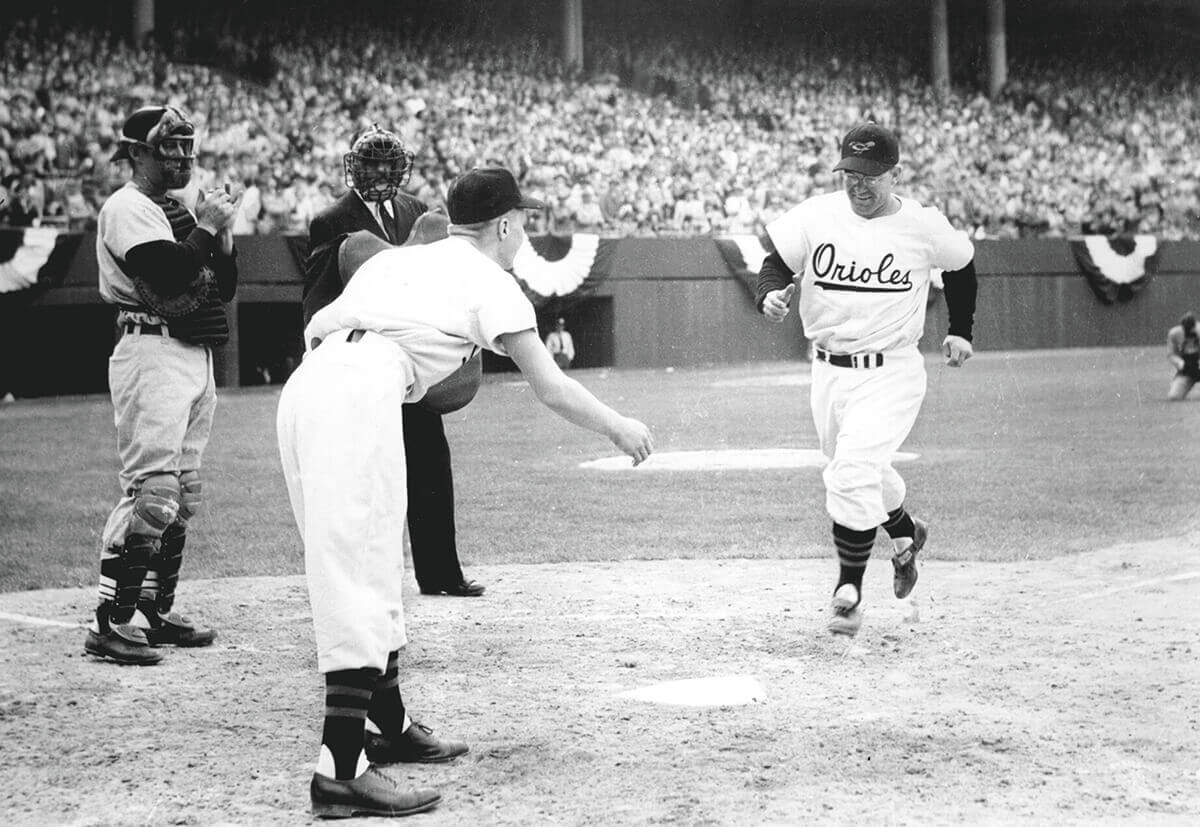
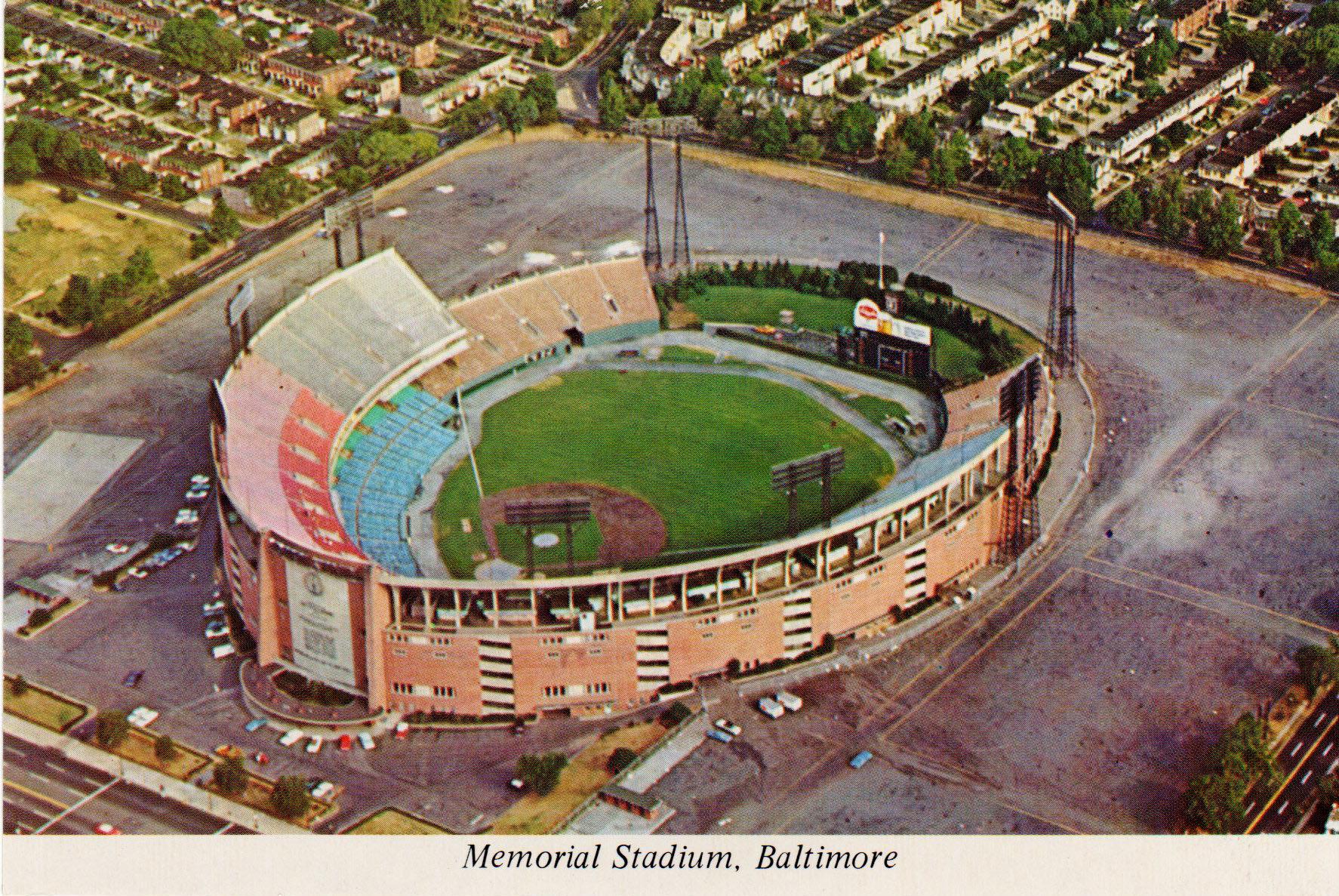
April 15, 1954: The Baltimore Orioles make their home debut, after spending the previous 52 seasons as the St. Louis Browns. They beat the Chicago White Sox, 3-1 at Memorial Stadium.

Memorial had been Municipal Stadium, a 70,000-seat football stadium, a horseshoe open at the south end, in Venable Park, a neighborhood northeast of downtown. When the Baltimore Colts began play in 1947, talk of Baltimore getting a major league baseball team -- which, not counting the Federal League of 1914 and 1915, they hadn't had since 1902 -- led to a plan to transform Municipal Stadium. It became a 54,000-seat horseshoe, open at the north end, but with enough room to put a baseball field in.
Before the game, the Oriole players rode up Charles Street, the city's main drag, in open cars in a ticker-tape parade. President Dwight D. Eisenhower was invited to throw out the ceremonial first ball. He couldn't make it. Vice President Richard Nixon, more of a baseball fan than the President was, filled in for him.

Clint Courtney, a former Yankee catcher who couldn't dislodge Yogi Berra, hit the park's 1st home run, leading off the bottom of the 3rd inning. Vern Stephens hit one leading off the bottom of the 4th.

The winning pitcher was Bob Turley, later to win the Cy Young Award with the Yankees, was the winning pitcher. The losing pitcher was Virgil Trucks, formerly of the Detroit Tigers. In 1991, when the Orioles had begun construction on Oriole Park at Camden Yards, they held their last Opening Day at Memorial Stadium. Turley and Trucks were invited to throw out ceremonial first balls.

Baltimore had had the Colts. And the Baltimore Bullets won the Championship of the Basketball Association of America in 1948. (The league became the NBA the following year, and the team folded in 1954, before a new Baltimore Bullets began in 1963.) But, at the time, having a major league baseball team was a sign that a city was, itself, "major-league," or "big-time," and could be taken seriously.

The previous year, to New York, Philadelphia, Washington, Boston, Pittsburgh, Cleveland, Cincinnati, Detroit, Chicago and St. Louis, Milwaukee had been added. Now, Baltimore was. The following year, Kansas City was. Then came the West Coast, then the South.

To put this in perspective: These were the populations, in thousands, of the MLB cities in the 1950 Census, plus those ahead of them without teams with no ranking and in italics:

1. (1, 2, 3) New York 7,892
2. (4, 5) Chicago 3,621
3. (6, 7) Philadelphia 2,072
Los Angeles 1,970
4. (8) Detroit 1,850
Baltimore 950
5. (9) Cleveland 915
6. (10, 11) St. Louis 857
7. (12) Washington 802
8. (13, 14) Boston 801
San Francisco 775
9. (15) Pittsburgh 677
Milwaukee 637
Houston 596
Buffalo 580
New Orleans 570
Minneapolis 522
10. (16) Cincinnati 504
Seattle 468
Kansas City 457

So, certainly, Baltimore, one of the minor-league cities with the most success, both on the field and at the box office, could support a major league baseball team. Now, they had one. Baltimore was playing with the grownup cities now.

The Colts won the NFL Championship in 1958 and 1959. The Orioles won the World Series in 1966. From October 1970 to April 1971, a span of 6 months, the Orioles won the World Series, the Colts won Super Bowl V, and the Bullets reached the NBA Finals. The Orioles also won American League Pennants in 1969 and 1971, but lost the World Series. The O's became a model baseball franchise; the Colts, an iconic football team; the city, one of the best sports cities in America.

But the Bullets moved to Washington in 1973, becoming the Washington Wizards in 1997. The Orioles won the Pennant but lost the World Series in 1979, and won the World Series in 1983. Five months later, the Colts, unable to get a deal for a new stadium, moved to Indianapolis.

Baltimore, unwilling to also lose its baseball team, because it would make them look like a team that used to be major league, but isn't anymore -- like Buffalo and Louisville were, and like Montreal would eventually be -- did what it took to build the Orioles a new ballpark. Oriole Park at Camden Yards opened in 1992. In 1998, across the street, what is now M&T Bank Stadium opened, for their new NFL team, the Baltimore Ravens. Memorial Stadium was torn down in 2002, and seniors' housing was built on the site.

Baltimore became a major-league city in 1954. It still is one.

UPDATE: The Orioles have a team Hall of Fame. It includes these figures:

* From their founding era, before they won a Pennant: Gene Woodling, Gus Triandos, Hal Brown, Milt Pappas, Hoyt Wilhelm and Jim Gentile.

* From their 1966 World Champions: Brooks Robinson, Frank Robinson, Luis Aparicio (the only World Series the former Chicago White Sox star would win), Jim Palmer, Steve Barber, Dick Hall, John "Boog" Powell, Dave McNally, Stu Miller, Paul Blair, Davey Johnson, Mark Belanger and Eddie Watt; plus manager Hank Bauer, and coach Billy Hunter.

* From their 1970 World Champions: Both Robinsons, Palmer, Hall, Powell, McNally, Blair, Johnson, Belanger, Watt, Don Buford, Elrod Hendricks, Mike Cuellar, Terry Crowley and Bobby Grich; plus manager Earl Weaver, and coaches Hunter and George Bamberger.

* From their 1979 American League Pennant: Palmer, Crowley, Eddie Murray, Al Bumbry, Doug DeCinces, Lee May, Ken Singleton, Mike Flanagan, Rich Dauer, Rick Dempsey, Felix "Tippy" Martinez, Dennis Martinez (no relation), Scott McGregor, John Lowenstein and Gary Roenicke; plus manager Weaver, and coaches Hendricks, Cal Ripken Sr. and Ray Miller.

* From their 1983 World Champions: Palmer, Murray, Bumbry, Singleton, Flanagan, Dauer, Dempsey, both Martinezes, McGregor, Lowenstein, Roenicke, Cal Ripken Jr., Mike Boddicker and Storm Davis; plus coaches Hendricks, Ripken Sr. and Miller -- but not, as yet, manager Joe Altobelli.

* From their near-Playoff team of 1989: Murray, Ripken Jr., Flanagan, Joe Orsulak and Gregg Olson; plus Frank Robinson back as manager, with coaches Ripken Sr., Hendricks and Johnny Oates.

* From their Playoff teams of 1996 and 1997: Ripken Jr., Mike Devereaux, Brady Anderson, Chris Hoiles, Mike Mussina, Harold Baines, B.J. Surhoff, Roberto Alomar and Mike Bordick; plus Davey Johnson back as manager, with coaches Hendricks and Miller. From the 2000s, a bad decade for the team: Melvin Mora.

* From the Playoff team of 2012, '14 and '16: Brian Roberts, Nick Markakis, Adam Jones, J.J. Hardy and Chris Davis. So far, there are no inductees from the Playoff teams of 2023 and '24.

* Management: Founding owner Jerry Hoffberger; general managers Paul Richards, Lee MacPhail, Harry Dalton, Frank Cashen and Hank Peters; scouts Jim Russo, Walter Youse, Dick Bowie, Don Pries, Lenny Johnston and Fred Uhlman; traveling secretaries Bob Brown, Bill O'Donnell and Phil Itzoe; and community relations director Julie Wagner, one of the few women to be elected to any team's Hall of Fame.

* Broadcasters: Chuck Thompson, Tom Davis, Joe Angel and Fred Manfra.

* Also, team trainers Eddie Weidner, Ralph Salvon and Richie Bancells; clubhouse attendant Ernie Tyler; and public address announcer Rex Barney, who had been a pitcher for the Brooklyn Dodgers.

* The Orioles have also honored 2 fans with induction into their Hall of Fame: Wild Bill Hagy, a cabdriver who, from the 1979 Pennant season until a dispute with the organization in 1985, led chants by spelling out "O-R-I-O-L-E-S" with his arms and legs, claiming he learned it from Colts fan Leonard "Big Wheel" Burrier; and Mosilla "Mo" Gaba, a childhood cancer patient who gained local fame by calling into sports-talk radio stations, and developed bonds with the Orioles' and Ravens' organization before his death in 2020, only 14 years old.

*

April 15, 1954 was a Thursday. These other baseball games were played that day:

* The New York Yankees beat the Philadelphia Athletics, 3-0 at Yankee Stadium. Tom Morgan allowed 8 hits, but kept the shutout. Mickey Mantle went 0-for-4. Hank Bauer and Bill "Moose" Skowron hit home runs. It was only Skowron's 2nd major league game.

* The New York Giants were losing to the Philadelphia Phillies, 2-0 in the 7th inning at Connie Mack Stadium in Philadelphia, when the game was called due to rain. Willie Mays went 1-for-3.

* The Brooklyn Dodgers beat the Pittsburgh Pirates, 7-4 at Ebbets Field. Jackie Robinson, Roy Campanella and Jim Gilliam hit home runs.

* The Boston Red Sox beat the Washington Senators, 6-1 at Fenway Park in Boston. Ted Williams did not play.

* The Detroit Tigers beat the Cleveland Indians, 3-2 at Cleveland Municipal Stadium. Al Kaline went 1-for-4.

* The Cincinnati Redlegs -- this was the 1st of 6 seasons in which the Reds bowed to anti-Communist pressure before switching back -- beat the Chicago Cubs, 11-5 at Wrigley Field in Chicago. Randy Jackson went 4-for-5 with a home run, Hank Sauer went 1-for-5 with a 3-run homer, Ralph Kiner went 2-for-3 with 2 walks, and Ernie Banks went 0-for-3 with 2 walks... and still lost. Gus Bell hit a home run, and Jim Greengrass hit a grand slam.

* And the Milwaukee Braves beat the St. Louis Cardinals, 7-6 at Milwaukee County Stadium. Danny O'Connell singled Billy Bruton home with the winning run in the bottom of the 11th inning. Warren Spahn went the distance for the win. Joe Adcock went 3-for-5 with 4 RBIs. Hank Aaron, in only his 2nd major league game, went 2-for-5. He would collect 3,770 more hits, 755 of them home runs.

December 31, 1999 & January 1, 2000: The Millennium

December 31, 1999:  The Millennium arrives. The people of planet Earth survived. At a terrible cost. But we hadn't destroyed ourselves. ...