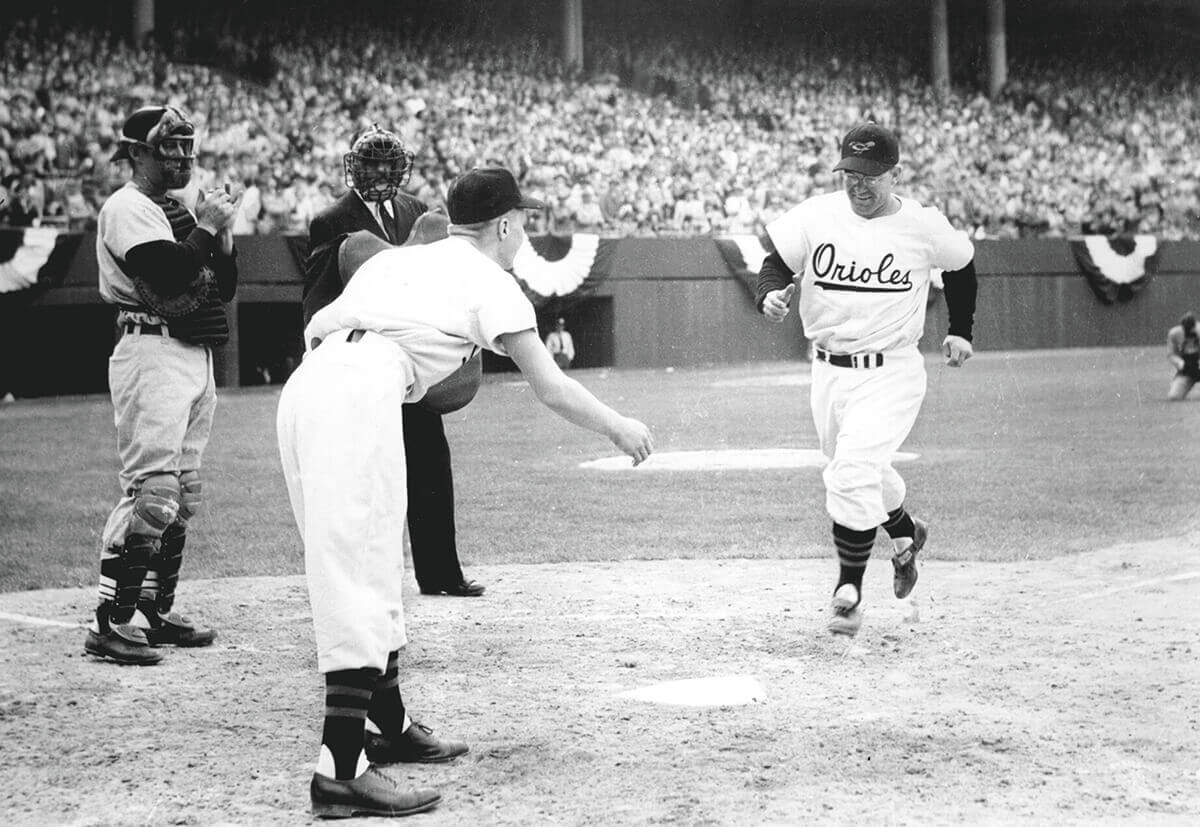
Clint Courtney
April 15, 1954: The Baltimore Orioles make their home debut, after spending the previous 52 seasons as the St. Louis Browns. They beat the Chicago White Sox, 3-1 at Memorial Stadium.
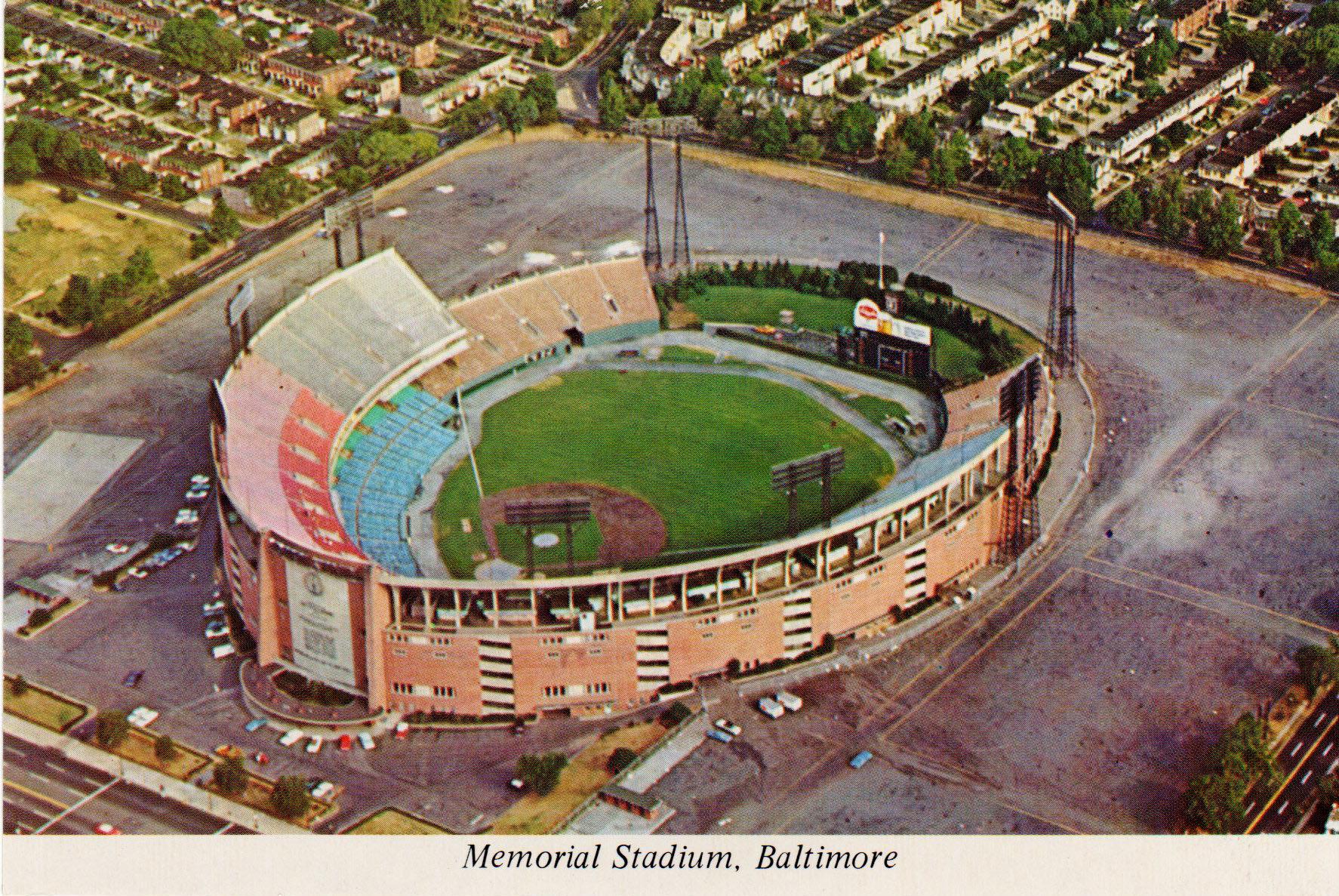
Memorial had been Municipal Stadium, a 70,000-seat football stadium, a horseshoe open at the south end, in Venable Park, a neighborhood northeast of downtown. When the Baltimore Colts began play in 1947, talk of Baltimore getting a major league baseball team -- which, not counting the Federal League of 1914 and 1915, they hadn't had since 1902 -- led to a plan to transform Municipal Stadium. It became a 54,000-seat horseshoe, open at the north end, but with enough room to put a baseball field in.
Before the game, the Oriole players rode up Charles Street, the city's main drag, in open cars in a ticker-tape parade. President Dwight D. Eisenhower was invited to throw out the ceremonial first ball. He couldn't make it. Vice President Richard Nixon, more of a baseball fan than the President was, filled in for him.
Clint Courtney, a former Yankee catcher who couldn't dislodge Yogi Berra, hit the park's 1st home run, leading off the bottom of the 3rd inning. Vern Stephens hit one leading off the bottom of the 4th.
The winning pitcher was Bob Turley, later to win the Cy Young Award with the Yankees, was the winning pitcher. The losing pitcher was Virgil Trucks, formerly of the Detroit Tigers. In 1991, when the Orioles had begun construction on Oriole Park at Camden Yards, they held their last Opening Day at Memorial Stadium. Turley and Trucks were invited to throw out ceremonial first balls.
Baltimore had had the Colts. And the Baltimore Bullets won the Championship of the Basketball Association of America in 1948. (The league became the NBA the following year, and the team folded in 1954, before a new Baltimore Bullets began in 1963.) But, at the time, having a major league baseball team was a sign that a city was, itself, "major-league," or "big-time," and could be taken seriously.
The previous year, to New York, Philadelphia, Washington, Boston, Pittsburgh, Cleveland, Cincinnati, Detroit, Chicago and St. Louis, Milwaukee had been added. Now, Baltimore was. The following year, Kansas City was. Then came the West Coast, then the South.
To put this in perspective: These were the populations, in thousands, of the MLB cities in the 1950 Census, plus those ahead of them without teams with no ranking and in italics:
1. (1, 2, 3) New York 7,892
2. (4, 5) Chicago 3,621
3. (6, 7) Philadelphia 2,072
Los Angeles 1,970
4. (8) Detroit 1,850
Baltimore 950
5. (9) Cleveland 915
6. (10, 11) St. Louis 857
7. (12) Washington 802
8. (13, 14) Boston 801
San Francisco 775
9. (15) Pittsburgh 677
Milwaukee 637
Houston 596
Buffalo 580
New Orleans 570
Minneapolis 522
10. (16) Cincinnati 504
Seattle 468
Kansas City 457
So, certainly, Baltimore, one of the minor-league cities with the most success, both on the field and at the box office, could support a major league baseball team. Now, they had one. Baltimore was playing with the grownup cities now.
The Colts won the NFL Championship in 1958 and 1959. The Orioles won the World Series in 1966. From October 1970 to April 1971, a span of 6 months, the Orioles won the World Series, the Colts won Super Bowl V, and the Bullets reached the NBA Finals. The Orioles also won American League Pennants in 1969 and 1971, but lost the World Series. The O's became a model baseball franchise; the Colts, an iconic football team; the city, one of the best sports cities in America.
But the Bullets moved to Washington in 1973, becoming the Washington Wizards in 1997. The Orioles won the Pennant but lost the World Series in 1979, and won the World Series in 1983. Five months later, the Colts, unable to get a deal for a new stadium, moved to Indianapolis.
Baltimore, unwilling to also lose its baseball team, because it would make them look like a team that used to be major league, but isn't anymore -- like Buffalo and Louisville were, and like Montreal would eventually be -- did what it took to build the Orioles a new ballpark. Oriole Park at Camden Yards opened in 1992. In 1998, across the street, what is now M&T Bank Stadium opened, for their new NFL team, the Baltimore Ravens. Memorial Stadium was torn down in 2002, and seniors' housing was built on the site.
Baltimore became a major-league city in 1954. It still is one.
UPDATE: The Orioles have a team Hall of Fame. It includes these figures:
* From their founding era, before they won a Pennant: Gene Woodling, Gus Triandos, Hal Brown, Milt Pappas, Hoyt Wilhelm and Jim Gentile.
* From their 1966 World Champions: Brooks Robinson, Frank Robinson, Luis Aparicio (the only World Series the former Chicago White Sox star would win), Jim Palmer, Steve Barber, Dick Hall, John "Boog" Powell, Dave McNally, Stu Miller, Paul Blair, Davey Johnson, Mark Belanger and Eddie Watt; plus manager Hank Bauer, and coach Billy Hunter.
* From their 1970 World Champions: Both Robinsons, Palmer, Hall, Powell, McNally, Blair, Johnson, Belanger, Watt, Don Buford, Elrod Hendricks, Mike Cuellar, Terry Crowley and Bobby Grich; plus manager Earl Weaver, and coaches Hunter and George Bamberger.
* From their 1979 American League Pennant: Palmer, Crowley, Eddie Murray, Al Bumbry, Doug DeCinces, Lee May, Ken Singleton, Mike Flanagan, Rich Dauer, Rick Dempsey, Felix "Tippy" Martinez, Dennis Martinez (no relation), Scott McGregor, John Lowenstein and Gary Roenicke; plus manager Weaver, and coaches Hendricks, Cal Ripken Sr. and Ray Miller.
* From their 1983 World Champions: Palmer, Murray, Bumbry, Singleton, Flanagan, Dauer, Dempsey, both Martinezes, McGregor, Lowenstein, Roenicke, Cal Ripken Jr., Mike Boddicker and Storm Davis; plus coaches Hendricks, Ripken Sr. and Miller -- but not, as yet, manager Joe Altobelli.
* From their near-Playoff team of 1989: Murray, Ripken Jr., Flanagan, Joe Orsulak and Gregg Olson; plus Frank Robinson back as manager, with coaches Ripken Sr., Hendricks and Johnny Oates.
* From their Playoff teams of 1996 and 1997: Ripken Jr., Mike Devereaux, Brady Anderson, Chris Hoiles, Mike Mussina, Harold Baines, B.J. Surhoff, Roberto Alomar and Mike Bordick; plus Davey Johnson back as manager, with coaches Hendricks and Miller. From the 2000s, a bad decade for the team: Melvin Mora.
* From the Playoff team of 2012, '14 and '16: Brian Roberts, Nick Markakis, Adam Jones, J.J. Hardy and Chris Davis. So far, there are no inductees from the Playoff teams of 2023 and '24.
* Management: Founding owner Jerry Hoffberger; general managers Paul Richards, Lee MacPhail, Harry Dalton, Frank Cashen and Hank Peters; scouts Jim Russo, Walter Youse, Dick Bowie, Don Pries, Lenny Johnston and Fred Uhlman; traveling secretaries Bob Brown, Bill O'Donnell and Phil Itzoe; and community relations director Julie Wagner, one of the few women to be elected to any team's Hall of Fame.
* Broadcasters: Chuck Thompson, Tom Davis, Joe Angel and Fred Manfra.
* Also, team trainers Eddie Weidner, Ralph Salvon and Richie Bancells; clubhouse attendant Ernie Tyler; and public address announcer Rex Barney, who had been a pitcher for the Brooklyn Dodgers.
* The Orioles have also honored 2 fans with induction into their Hall of Fame: Wild Bill Hagy, a cabdriver who, from the 1979 Pennant season until a dispute with the organization in 1985, led chants by spelling out "O-R-I-O-L-E-S" with his arms and legs, claiming he learned it from Colts fan Leonard "Big Wheel" Burrier; and Mosilla "Mo" Gaba, a childhood cancer patient who gained local fame by calling into sports-talk radio stations, and developed bonds with the Orioles' and Ravens' organization before his death in 2020, only 14 years old.
*
April 15, 1954 was a Thursday. These other baseball games were played that day:
* The New York Yankees beat the Philadelphia Athletics, 3-0 at Yankee Stadium. Tom Morgan allowed 8 hits, but kept the shutout. Mickey Mantle went 0-for-4. Hank Bauer and Bill "Moose" Skowron hit home runs. It was only Skowron's 2nd major league game.
* The New York Giants were losing to the Philadelphia Phillies, 2-0 in the 7th inning at Connie Mack Stadium in Philadelphia, when the game was called due to rain. Willie Mays went 1-for-3.
* The Brooklyn Dodgers beat the Pittsburgh Pirates, 7-4 at Ebbets Field. Jackie Robinson, Roy Campanella and Jim Gilliam hit home runs.
* The Boston Red Sox beat the Washington Senators, 6-1 at Fenway Park in Boston. Ted Williams did not play.
* The Detroit Tigers beat the Cleveland Indians, 3-2 at Cleveland Municipal Stadium. Al Kaline went 1-for-4.
* The Cincinnati Redlegs -- this was the 1st of 6 seasons in which the Reds bowed to anti-Communist pressure before switching back -- beat the Chicago Cubs, 11-5 at Wrigley Field in Chicago. Randy Jackson went 4-for-5 with a home run, Hank Sauer went 1-for-5 with a 3-run homer, Ralph Kiner went 2-for-3 with 2 walks, and Ernie Banks went 0-for-3 with 2 walks... and still lost. Gus Bell hit a home run, and Jim Greengrass hit a grand slam.
* And the Milwaukee Braves beat the St. Louis Cardinals, 7-6 at Milwaukee County Stadium. Danny O'Connell singled Billy Bruton home with the winning run in the bottom of the 11th inning. Warren Spahn went the distance for the win. Joe Adcock went 3-for-5 with 4 RBIs. Hank Aaron, in only his 2nd major league game, went 2-for-5. He would collect 3,770 more hits, 755 of them home runs.


No comments:
Post a Comment