Showing posts with label john birch society. Show all posts

Saturday, November 19, 2022

November 19, 1955: National Review Is First Published

November 19, 1955: The weekly magazine National Review is first published by its editor, William F. Buckley Jr.

Modern American conservatism, from Senator Joseph R. McCarthy onward, has been based on lies and hysterics. Buckley tried to change that. But, as is so often the case, telling the truth got him into just as much trouble.

Even his name wasn't originally correct: When born on November 24, 1925 -- 4 days after an eventual ideological opponent, Robert F. Kennedy -- in Manhattan, it was with the name William Francis Buckley. At some point, it was changed to William Frank Buckley Jr.

William Frank Buckley Sr. was a lawyer and an oil developer, whose work took him and his family to Mexico, and when it was time to send his son to his first school, it was a boarding school in Paris. Thus, he spoke Spanish first, French second, and English third. Which seems odd for someone who became so skilled with the English language, and seemed to have such a "patrician" accent.

"Bill" Buckley was an officer in the U.S. Army during World War II, but was never transferred off U.S. soil. He attended Yale University, where both its joys and its frustrations would serve him well. He served 2 years in the early CIA, which helped to inspire his later spy novels. His character Blackford Oakes was, basically, an upper-class American ripoff of James Bond.

Buckley married Patricia Taylor, and settled on an estate (they called it a "farm," perhaps for tax purposes, as rich people sometimes do) in Sharon, Connecticut, far enough from Midtown Manhattan (100 miles) to be isolated, but close enough to be near the corridors of power. Despite being an old-style Catholic and 1 of 10 siblings, he had only 1 child, a son named Christopher, who also became an acclaimed author.

In 1951, William F. Buckley Jr. wrote his 1st book, God and Man at Yale -- known thereafter to the conservative movement by its initials, GAMAY. He attacked several officials and professors at the school as "leftists," including McGeorge Bundy, who would go on to become National Security Adviser to 2 Democratic Presidents.

In a review titled "The Attack on Yale" for the November 1951 issue of The Atlantic, Bundy wrote: "In the end Mr. Buckley's indictment of Yale's economics texts turns out to be a self-indictment. This chapter shows him to be a twisted and ignorant young man whose personal views of economics would have seemed reactionary to Mark Hanna." (Hanna was the Senator from Ohio who managed the conservative Republican campaigns of President William McKinley, who died half a century earlier.) This was in Part I of Bundy's review. Part II began with "The worst is yet to come."

In 1955, with several fellow reactionaries -- including L. Brent Bozell Jr. (who had married Bill's sister, Patricia Buckley, and whose son, L. Brent Bozell III, had just been born, and would later write for the magazine), Russell Kirk (who had published the anthology The Conservative Mind 2 years earlier), Revilo P. Oliver (the noted historian's name is a palindrome, reading the same forwards and backwards), and Whittaker Chambers (the ex-Communist ex-editor for Time magazine, whose testimony had sent Alger Hiss to prison) -- Buckley founded National Review.

(Its 1st drama critic was 23-year-old Garry Wills, who became one of America's greatest historians, and not so conservative. A biographer of multiple Presidents, his books about Richard Nixon and Ronald Reagan were highly critical.)

Buckley's introductory essay made the magazine's mission clear:

Let's face it: Unlike Vienna, it seems altogether possible that did National Review not exist, no one would have invented it. The launching of a conservative weekly journal of opinion in a country widely assumed to be a bastion of conservatism at first glance looks like a work of supererogation, rather like publishing a royalist weekly within the walls of Buckingham Palace. It is not that, of course; if National Review is superfluous, it is so for very different reasons: It stands athwart history, yelling Stop, at a time when no one is inclined to do so, or to have much patience with those who so urge it.

National Review is out of place, in the sense that the United Nations and the League of Women Voters and the New York Times and Henry Steele Commager are in place. It is out of place because, in its maturity, literate America rejected conservatism in favor of radical social experimentation.

Of course, there was a reason for this: Conservatism caused the stock market Crash of 1929, just 26 years earlier, and the subsequent Great Depression of the 1930s, which led to the political backlash that caused the election of Franklin D. Roosevelt as president, and his Administration's radical social experimentation, which saved the nation's economy and perhaps worldwide capitalism itself. Unlike conservatives following the economic downturns of 1973-76, 1990-93, 2001-04, 2007-09, and 2020-21, Buckley was not asking people to forget that the Depression happened on conservatives' watch.

Rather, he was asking people to accept his position, which was that the time for radical social experimentation ended once the immediate economic emergency ended, and that a return to the kind of conservatism that brought the economic prosperity of the 1920s was what was needed today (1955). Of course, as I said, that kind of conservatism caused the Depression.

Buckley once wrote, "I want discretion in the sense that I want intelligence, and no crackpottery. But I want some positively unsettling vigor, a sense of abandon, and joy, and cocksureness that may, indeed, be interpreted by some as indiscretion." In 1957, he published a nasty review that Chambers wrote for Ayn Rand's right-wing novel Atlas Shrugged.

Nevertheless, in 1958, Oliver left the magazine, and joined candy executive Robert W. Welch Jr. to become one of the founders of the John Birch Society, which seemed to encourage crackpots, to the point where, in 1963, both Bob Dylan and the Chad Mitchell Trio wrote songs making them look like paranoid psychotics. (The Trio's song included the line, "There's no one left but thee and we, and we aren't sure of thee!")

And yet, in 1957, 3 years after Brown v. Board, 1 year after the Southern Manifesto, and a few weeks before the Little Rock Crisis, Buckley published an editorial titled "Why the South Must Prevail":

The central question that emerges... is whether the White community in the South is entitled to take such measures as are necessary to prevail, politically and culturally, in areas where it does not predominate numerically? The sobering answer is Yes – the White community is so entitled because, for the time being, it is the advanced race.

NR did improve its record on race -- somewhat. It denounced the 1968, 1972 and 1976 Presidential campaigns of Governor George Wallace of Alabama. But it has also, perennially, called for the end of affirmative action. In 1965, at Oxford University in England, Buckley himself infamously took the segregationist side in a debate with black writer James Baldwin.

In the 1980s, NR opposed sanctions against the apartheid government of South Africa, because that government was anti-Communist -- and, like all white-supremacy governments, including in the Southern U.S., it falsely took the official tack that civil rights activists were motivated by Communism.

The Spanish Fascist leader Francisco Franco was a hero in the Buckley household, celebrated as a conservative and Catholic bulwark against the officially atheist worldwide Communist movement, known to its opponents as "the Red Menace." In 1957, Buckley declared in his magazine, "General Franco is an authentic national hero." NR writer James Burnham echoed this sentiment in a 1975 obituary declaring "Francisco Franco was our century's most successful ruler."

(He wasn't. Within 3 years, Spain had a free election, and the voters chose a liberal government. Spanish voters have chosen conservative governments since, but never again a Fascist one.)

In his 1997 book Nearer, My God: An Autobiography of Faith, Buckley condemned the 1960s rulings that he viewed as "the Supreme Court's war against religion in the public school," and argued that Christian faith was being replaced by "another God... multiculturalism." He disapproved of the liturgical reforms following the Second Vatican Council of 1962-66.

On April 4, 1966, the program Firing Line, hosted by Buckley, premiered on NET, and continued on its successor network, PBS, until 1999. In addition to the various NR writers, and conservative activists -- Milton Friedman, Friedrich Hayek, Phyllis Schlafly, and so on -- Buckley invited people no one would have expected, like liberal activists Saul Alinsky, Julian Bond and Noam Chomsky; Watergate-busting reporters Bob Woodward and Carl Bernstein; Democratic political candidates like Jimmy Carter (not yet President), Jesse Jackson and John Kerry; and even figures from the 1960s "left," like Norman Mailer, Allen Ginsberg, Timothy Leary and Huey Newton.

In August 1968, ABC News invited Buckley and Gore Vidal, a liberal-leaning author and, like Ginsberg, one of the few openly gay celebrities of the time, to debate each other during the controversy-strewn Democratic Convention in Chicago. Even people who would normally have agreed with Vidal politically found themselves sympathizing with Buckley, because Vidal was completely rude, even telling Buckley, "Shut up a minute!"

Buckley compared New Left youths carrying pro–Viet Cong flags to pro-Nazis, which is ridiculous, because the Nazis, as Fascists, were a right-wing movement, not a left-wing one. Vidal responded by saying, "As far as I'm concerned, the only sort of pro- or crypto-Nazi that I can think of is yourself."

This set Buckley off: Remembering his gay-baiting pre-Vatican II Catholicism, and his service in World War II against the Nazis, he said, "Now, listen, you queer: Stop calling me a crypto-Nazi, or I'll sock you in the goddamned face, and you'll stay plastered!" (And by "plastered," he didn't mean "drunk.") And ABC either didn't have a seven-second delay to "bleep out" any profanities, or didn't use it, and Buckley's use of the word "goddamned" stayed on the broadcast -- to this day, a rarity on American television, at any hour of the day.

Buckley and Vidal were the same age, the former born just 9 days before the latter, so there was no age advantage. And, with his Army and CIA training, if there had been a fight, it would have seemed like Buckley would be heavily favored. But someone who knew Buckley mentioned that he had recently broken his left arm, and he could be seen on the videotape tucking that arm in, using his right hand to keep his earpiece in. He might not have won a fight on that occasion.

After Watergate, Buckley rallied the conservative movement behind Ronald Reagan, and was very pleased with how the Reagan Administration turned out. In that Administration's time, and also later in its wake, there would be copies of Buckley's work.

Debuting on NBC in 1982, The McLaughlin Group was a more freewheeling, if host-controlled, version of Firing LineThe American Spectator was founded in 1972, as more of a gut-punching magazine, and by the time Bill Clinton began his successful run for President in 1992, it was willing to embrace any conspiracy theory against him and other liberals, no matter how ridiculous. The Weekly Standard was founded in 1996, as a cheekier, less Ivy-ish version of National Review. Debuting the same year, Fox News Channel made Firing Line seem very quaint by comparison.

I used to read National Review, even though I agreed with very little in it, because it was so well-written, and, probably upon Buckley's insistence, the sense of humor was still there. And it wasn't a mean, bullying, frat-boy sense of humor, either, like The American Spectator had.

In 1995, on PBS, Michael Kinsley of the liberal-leaning magazine The New Republic moderated a Firing Line-sponsored debate on the subject of religion in public life. As captain of one side, favoring more of it, was Buckley. As captain of the other side, favoring less of it but otherwise a conservative, was controversial lawyer Alan Dershowitz.

During his opening remarks, Kinsley told the theater audience, "I should warn you: Some of these panelists are under the delusion that they have a special pipeline to God." Several people, including Buckley, laughed. Kinsley continued: "And some of these panelists are under the delusion that they are God." More people laughed. Buckley was one of them. Dershowitz was not.

But age and ill health caught up with Buckley. He retired Firing Line in 1999. And he gave up editorial control of National Review in 2005. Without him to hold it back, it totally embraced the insanity -- the "crackpottery," as Buckley once put it -- of the Republican Party in the 21st Century.

William F. Buckley Jr. died on February 27, 2008, at the age of 82. Surprising no one who knew him, his death came less than a year after his wife's.

Buckley's son, Christopher Buckley, became a novelist, and was chief of staff to George H.W. Bush while he was Reagan's Vice President.

Firing Line was revived in 2018, again on PBS, hosted by Margaret Hoover, a former Fox News correspondent, and a great-granddaughter of President Herbert Hoover.

*

November 19, 1955 was a Saturday. It was the 3rd Saturday in November, so it was the start of college football's major rivalries:

* Number 1 Oklahoma beat Nebraska, 41-0 at Memorial Stadium in Lincoln, Nebraska.

* Number 2 Maryland beat George Washington University, 19-0 at Byrd Stadium (now SECU Stadium) in the Washington suburb of College Park, Maryland. In what amounted to a de facto National Championship game, Oklahoma beat Maryland in the Orange Bowl, 20-6.

* Number 3 Michigan State beat Marquette, 33-0 at Macklin Stadium (now Spartan Stadium) in East Lansing, Michigan.

* Number 5 University of California at Los Angeles beat the University of Southern California, 17-7 at the Los Angeles Memorial Coliseum. USC had been ranked as high as Number 9 earlier in the season. UCLA then lost to Michigan State in the Rose Bowl.

* Number 6 Michigan lost to Number 9 Ohio State, 17-0 at Michigan Stadium in Ann Arbor.

* Number 12 Navy and Army had the week off, preparing to play each other the next week, at Municipal Stadium (later John F. Kennedy Stadium) in Philadelphia. Army pulled the upset, 14-6.

* Number 15 University of Pittsburgh beat Penn State, 20-0 at Beaver Field in State College, Pennsylvania. (Beaver Stadium opened in 1960.)  

* Number 17 Tennessee lost to Kentucky, 23-0 at McLean Stadium in Lexington, Kentucky.

* Number 18 Stanford beat the University of California, 19-0 at the old Stanford Stadium in Palo Alto, California.

* Number 19 Oregon State lost to Oregon, 28-0 at Hayward Field in Eugene, Oregon.

* Yale beat Harvard, 21-7 at the Yale Bowl in New Haven, Connecticut.

* North Carolina beat Virginia, 26-14 at Kenan Stadium in Chapel Hill, North Carolina.

* Louisiana State (LSU) beat Arkansas, 13-7 at War Memorial Stadium in Little Rock, Arkansas.

* Purdue beat Indiana, 6-4 at the old Memorial Stadium in Bloomington, Indiana.

* Illinois and Northwestern played to a tie, 7-7 at Dyche Stadium in Evanston, Illinois, outside Chicago. Northwestern finished the season 0-8-1, Illinois 5-3-1.

* Minnesota beat Wisconsin, 21-6 at Memorial Stadium in Minneapolis.

* Kansas beat Missouri, 13-7 at Memorial Stadium in Lawrence, Kansas.

* Washington beat Washington State, 27-7 at Husky Stadium in Seattle.

In non-rivalry games:

* Number 4 Notre Dame beat Iowa, 17-14 at Notre Dame Stadium in South Bend, Indiana.

* Number 7 Texas Christian University (TCU) beat Rice University, 35-0 at Among G. Carter Stadium in Fort Worth, Texas.

* Number 8 Texas A&M were idle.

* Number 10 Georgia Tech were idle. They beat Pitt in the Sugar Bowl.

* Number 13 West Virginia lost to Syracuse, 20-13 at the old Mountaineer Field in Morgantown, West Virginia.

* Number 14 Mississippi had the week off. They won the Southeastern Conference title, but, rather than play in the Sugar Bowl as the SEC Champion usually does, they played SWC Champions TCU in the Cotton Bowl, and won, 14-13.

* And in New Jersey, Rutgers beat Columbia, 12-6 at Baker Field in Upper Manhattan; and Princeton beat Dartmouth, 6-3 at Palmer Stadium in Princeton.

Baseball was out of season. The NFL played the next day. There were 4 games played in the NBA:

* The New York Knicks lost to the St. Louis Hawks, 104-91 at the old Madison Square Garden. Bob Pettit scored 33 for the Hawks.

* The Boston Celtics beat the Fort Wayne Pistons, 104-102 at the Boston Garden.

* The Philadelphia Warriors beat the Syracuse Nationals, 102-94 at the Philadelphia Civic Center. Neil Johnston scored 37 points for the Warriors. In 1962, the Warriors moved to San Francisco. In 1963, the Nationals took their place, as the Philadelphia 76ers.

* And the Minneapolis Lakers beat the Rochester Royals, 91-90 at the Rochester Community War Memorial (now the Blue Cross Arena) in Rochester, New York.

The NHL's entire "Original Six" were in action:

* The New York Rangers lost to the Montreal Canadiens, 6-1 at the Montreal Forum.

* The Toronto Maple Leafs beat the Boston Bruins, 3-2 at Maple Leaf Gardens in Toronto.

* And the Detroit Red Wings beat the Chicago Black Hawks, 4-1 at the Olympia Stadium in Detroit.

And in English soccer, North London team Arsenal went to Lancashire, and beat Preston North End, 1-0 at Deepdale. 

Thursday, August 25, 2022

August 25, 1945: The Death of John Birch

August 25, 1945: John Birch dies. This was not widely known at the time, nor was he famous during his lifetime. Most Americans never knew he was alive until they knew he was dead, and they didn't know that right after his death, either.

John Morrison Birch was born on May 28, 1918 in Landour, India, where his parents were Presbyterian missionaries. The family returned to America in 1920, due to his father suffering from malaria. They lived in Vineland, New Jersey and Macon, Georgia.

He graduated from high school, and enrolled at Mercer University, a Baptist-affiliated school in Macon. His fellow students noted his zealotry at Mercer, as he opposed the theory of evolution, and he made some enemies there. He graduated in 1939. He then entered the Fundamental Baptist Bible Institute in Fort Worth, Texas, needing only 1 year to graduate. In high school, at Mercer, and at FBBI, each time, he graduated at the top of his class.

FBBI's founder, J. Frank Norris, had been a missionary in China. Having heard from Norris about his missionary work in China, and finding the Chinese receptive to the Gospel, especially having suffered under Japanese oppression since 1931, Birch wanted to go. When Norris and some 150 members of the church gathered to send Birch and a friend off to China, Norris said they went "fully informed as to the dangers that await them, but they go like the Apostle Paul when he knew that it meant death at Jerusalem." Birch left his family with the words "Goodbye, folks. If we don't meet again on Earth, we'll meet in Heaven."

He arrived, and quickly learned the Mandarin dialect of Chinese. After the Japanese attacked Pearl Harbor, bringing America into World War II, he wrote to the American Military Mission in China, offering to enlist in the U.S. Army and serve as a chaplain, but willing to "tote a rifle or whatever they tell me to do."

He enlisted, and rose to the rank of Captain. He was part of a rescue crew that saved Lieutenant Colonel Jimmy Doolittle and members of his squadron after they bailed out over China. Upon Doolittle's recommendation, Birch was transferred into the Army Air Forces, which would be separated from the Army as the U.S. Air Force in 1947.

Birch was a genuine war hero, setting up intelligence networks of sympathetic Chinese, and rescuing downed American pilots. Contrary to what conservative Americans would later suggest, that the Nationalist Chinese government of President Chiang Kai-shek was blameless and worth supporting at all costs, Birch wrote to a friend that it was "relatively small and unrepresentative," and cited its "abuses, intolerance and impotence."

He did, however, praise Chiang for his steadfastness of purpose. But he considered the Communists of Mao Zedong, despite their having temporarily united with Chiang to fight the Japanese, an "equally small, non-representative group," "whose leaders I consider hypocritical thugs."

The Japanese surrendered on August 14, which was named V-J Day, Victory over Japan. Captain Birch was among the American officers assigned to go into Japanese-held territory to inform Japanese units of their government's surrender. But on August 25, having encountered a Communist group, Birch and his Nationalist Chinese aide were shot and killed. Birch was only 27 years old.

In spite of his work, Birch would probably be forgotten today, if not for Robert W. Welch Jr., a retired candy manufacturer and conservative political activist from the Boston suburb of Belmont, Massachusetts. In 1954, Welch wrote The Life of John Birch: In the Story of One American Boy, the Ordeal of His Age. On December 9, 1958, in Indianapolis, Welch founded the John Birch Society, naming his anti-Communist and (allegedly) pro-Christian group after Birch, calling him "the first American casualty of the Cold War."

Welch received permission from Birch's parents to name his Society after their son, and both parents participated in Society-related events. But in a memoir released after his 1993 death, Birch's friend, General Jimmy Doolittle, said of Birch, "He had no way of knowing that the John Birch Society, a highly vocal postwar anticommunist organization, would be named after him because its founders believed him to be the 'first casualty of World War III.' I feel sure he would not have approved."

Welch considered anybody not anti-Communist to his satisfaction to be a Communist sympathizer, and even called President Dwight D. Eisenhower "an active agent of the Communist conspiracy." After a few decisions of the Supreme Court that seemed to Welch to be pro-Communist and anti-religion, the Society sponsored billboards attacking the Chief Justice, reading: "IMPEACH EARL WARREN!"

In 1963, folk group The Chad Mitchell Trio recorded a song titled "The John Birch Society," which made the Society's members look not only excessively paranoid, but stupid:

We only hail the hero
from whom we get our name.
We're not sure what he did
but he's our hero just the same!

And there was this rhyme:

There's no one left but thee and we
and we're not sure of thee!

The song also included this verse:

Do you want Justice Warren
to be your Kommissar?
Do you want Mrs. Khruschchev in there
with the DAR?
You cannot trust your neighbors
or even next of kin!
If Mommy is a Commie
then you've got to turn her in!

There was no chance of the wife of Soviet Premier Nikita Khrushchev joining the Daughters of the American Revolution: He wasn't married at the time.

*

August 25, 1945 was a Saturday. These baseball games were played that day:

And in English soccer, Arsenal lost to Midlands team Coventry City, 2-0 at the Arsenal Stadium, a.k.a. Highbury, in North London.

* The New York Yankees swept a doubleheader from the Washington Senators, 4-2 and 5-4 at Yankee Stadium. Hersh Martin won the 2nd game with a single in the bottom of the 10th inning.

* The Brooklyn Dodgers swept a doubleheader from their arch-rivals, the New York Giants, 8-6 and 13-3 at Ebbets Field.

* The Boston Braves beat the Philadelphia Phillies, 5-3 at Shibe Park in Philadelphia.

* The Cincinnati Reds beat the Pittsburgh Pirates, 1-0 at Forbes Field in Pittsburgh. Vern Kennedy pitched a 6-hit shutout, outpitching future Brooklyn Dodger ace Elwin "Preacher" Roe. Steve Mesner singled home the winning run in the top of the 9th inning.

* The St. Louis Cardinals beat their arch-rivals, the Chicago Cubs, 3-1 at Wrigley Field in Chicago. The Cubs went on to win the National League Pennant, anyway. It was the only time between 1942 and 1946 that the Cardinals didn't win the Pennant.

* The St. Louis Browns beat the Chicago White Sox, 6-2 at Sportsman's Park in St. Louis.

* The Cleveland Indians and the Detroit Tigers were rained out at Cleveland Municipal Stadium. The game was made up as part of a doubleheader the next day. The Indians swept, 3-1 and 5-4. Mickey Rocco singled home the winning run in the bottom of the 9th inning.

* And the Boston Red Sox and Philadelphia Athletics were rained out at Fenway Park in Boston. The game was made up as part of a doubleheader on September 19. The Red Sox swept, 11-10 and 3-0. William Otis "Otey" Clark pitched a 7-hit shutout in the 2nd game.

Saturday, July 16, 2022

July 16, 1964: Extremism In the Defense of Liberty

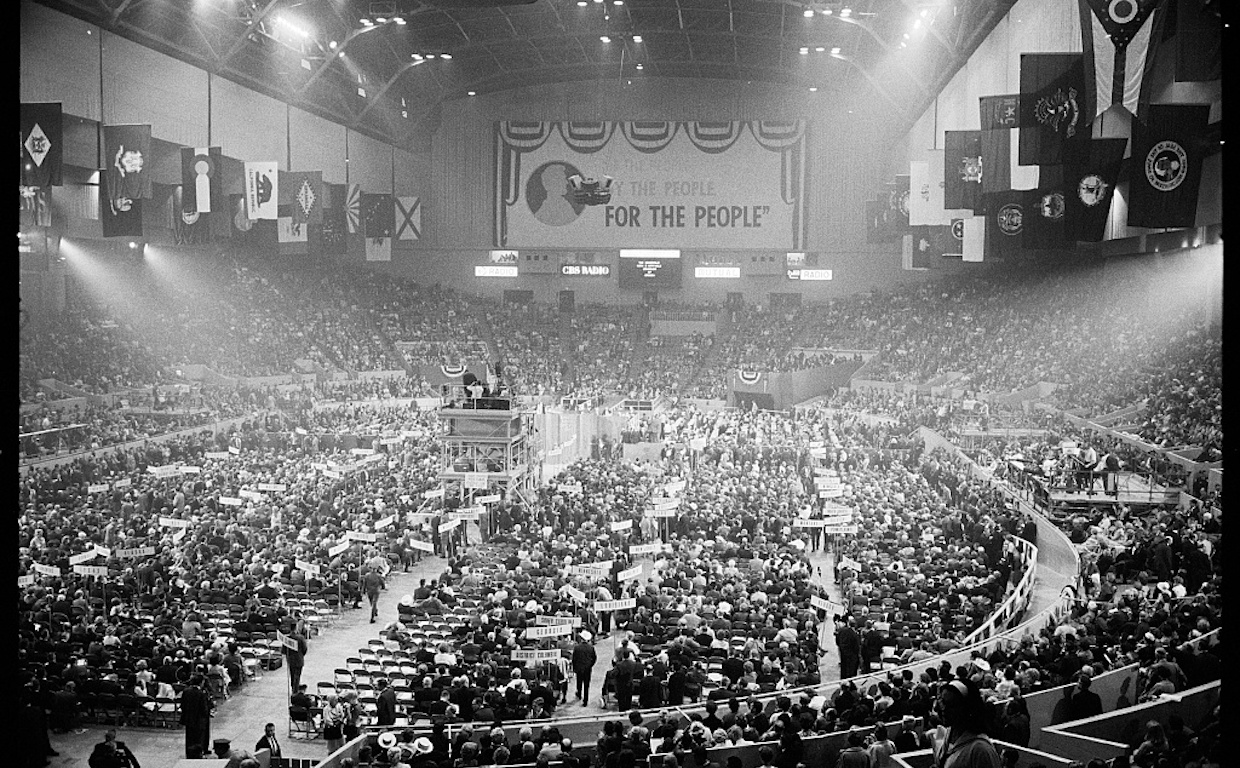
July 16, 1964: Senator Barry M. Goldwater of Arizona accepts the Republican Party's nomination for President, at their National Convention, at the Grand National Livestock Pavilion, a.k.a. the Cow Palace, just outside San Francisco in Daly City, California.

The site of the 1964 Republican National Convention may surprise people who know San Francisco as the most liberal city in America, which might not even be accurate. But, like all cities, San Francisco has its "old money" conservative elite. And this was the 2nd time the Grand Old Party had held its convention at the Cow Palace, built in 1940 for rodeo shows but later adapted for professional sports and concerts. They had previously nominated Dwight D. Eisenhower for a 2nd term there in 1956.

Then 55 years old, Goldwater was a Presbyterian, but had a Jewish grandfather, as the family name was originally Goldwasser. This makes the 1964 Republican Convention the closest either major party has ever come to nominating a Jewish person for President.

He was also very Western, living on a ranch outside Phoenix, with a solar-powered flagpole: Every morning, when the Sun came up, it raised the Stars & Stripes; every evening, when the Sun went down, the mechanism lowered the flag into a box.

A bomber pilot in World War II, Goldwater had been elected to the Phoenix City Council, and in 1952 defeated an incumbent Democrat for the U.S. Senate. Re-elected in 1958, he thought he could be the conservative alternative in 1960 to Vice President Richard Nixon, once considered the anti-Communist hard right's man, but now widely seen as more moderate -- the very thing that gave him a legitimate chance of election.

What is a conservative? According to Franklin D. Roosevelt, who knew difficulty walking, "A conservative is a man who, despite having two good legs, has never learned to walk forward." Comedian Mort Sahl said, "A conservative is someone who believes in reform -- but not now." Educator John Holt said, "Conservatism is the worship of dead radicals -- emphasis on the 'dead.'" (That quote is one of many that has been misattributed to Mark Twain.) Years later, Robert Orban would say, "A conservative is someone who wants the rules changed so that no one can make a pile the way he did."

No true conservative had been elected President since 1928, and that was Herbert Hoover, on whose watch the Great Depression began, and whose policies were seen as having made it worse, leading to his landslide loss to FDR in 1932. Every Republican nominee since had basically said, "We accept the New Deal, but we can do it better, and more efficiently, and with fewer Communists."

But there was another alternative to Nixon in 1960: Governor Nelson Rockefeller of New York, who had replaced a previous holder of his office, 1944 and 1948 Presidential nominee Thomas Dewey, as the leader of the moderate-to-liberal Eastern wing of the GOP. He wanted to be President, too. But he also wanted to win. So he invited Nixon to his apartment, and made a deal where he would endorse Nixon to hold off any conservative challenge. It became known as "The Compact of Fifth Avenue."

So, at the 1960 Republican Convention in Chicago, Goldwater told his supporters that they could take their party back, if they were properly organized: "Let's grow up, conservatives!"

Whether the conservative movement, as it came to be known, "grew up" is debatable: Conservatism has often listed from side to side, from old and stuffy to very childish. But they were very well organized, and, on the morning of November 22, 1963, with Nixon branded as a "loser," Goldwater and Rockefeller were the 2 leaders for the Party's nomination in 1964.

That day, John F. Kennedy, who had beaten Nixon in 1960, was assassinated. In his memoir, Goldwater admitted that his chance of winning had died with Kennedy. The 2 men had been friendly rivals, and Goldwater had really looked forward to a clash of ideas with JFK.

But with Vice President Lyndon B. Johnson now President, and sure to be the Democratic nominee in 1964, any chance for a real clash of ideas was doomed: LBJ would do anything to win, including "making Kennedy's ghost his running mate." His actual Vice Presidential nominee turned out to be Senator Hubert Humphrey of Minnesota, but he essentially "ran with JFK" every bit as much as Harry Truman ran with Franklin Roosevelt in 1948.

Goldwater told his advisers that he didn't want to run against Johnson. They told him that he had to do it, anyway, as the best way to continue the building of the conservative takeover of the Republican Party. To use a sports analogy, they were asking him to sacrifice himself, to "take one for the team."

And so he ran. He ran his campaign as a moral crusade, to bring down government spending, to end welfare programs that encouraged "immoral behavior," and to stand up to the Communist world better than the Democrats had.

His supporters took the "morality" thing even further, citing the fact that Rockefeller had divorced his first wife and quickly remarried -- as if that had anything to do with his qualifications for the job. When Goldwater refused to campaign in the Oregon Primary, and Rockefeller went, accompanied by signs saying, "He cared enough to come," Goldwater knew that the California Primary was it: Win it, or you're out.

And when Margaretta "Happy" Rockefeller gave birth to Nelson Rockefeller Jr. just 3 days before the Primary, it bolstered the "morality" argument by reminding voters of Rocky's divorce and remarriage --and the fact that Happy gave up custody of the children she already had, in order to more quickly gain the divorce, in order to more quickly marry the Governor. Goldwater won California, and clinched the nomination.

But right after that came the Senate's vote on the Civil Rights Act of 1964. Most of those voting against it were Southern Democrats. A higher percentage of Republicans than Democrats voted for it, because the Senate Minority Leader, Everett Dirksen of Illinois, was for it, and all but the most conservative of Republican Senators followed his lead.

But Goldwater voted against it -- on constitutional grounds, he said. But the vote tarred him as a racist, even though he wasn't one. He had gone out of his way to appeal to black, Hispanic, and Native American voters in Arizona. But most people outside that State didn't know that. There was no social media for people from Arizona to tell the other 49 States, "Hey, he's not like that! Let me show you what he's doing here!"

The fact that Senator Strom Thurmond of South Carolina, the "States' Rights" Presidential nominee of 1948, switched from the Democratic Party to the Republican Party after LBJ signed the bill, and then endorsed Goldwater, didn't help Goldwater at all -- at least, not outside the Deep South.

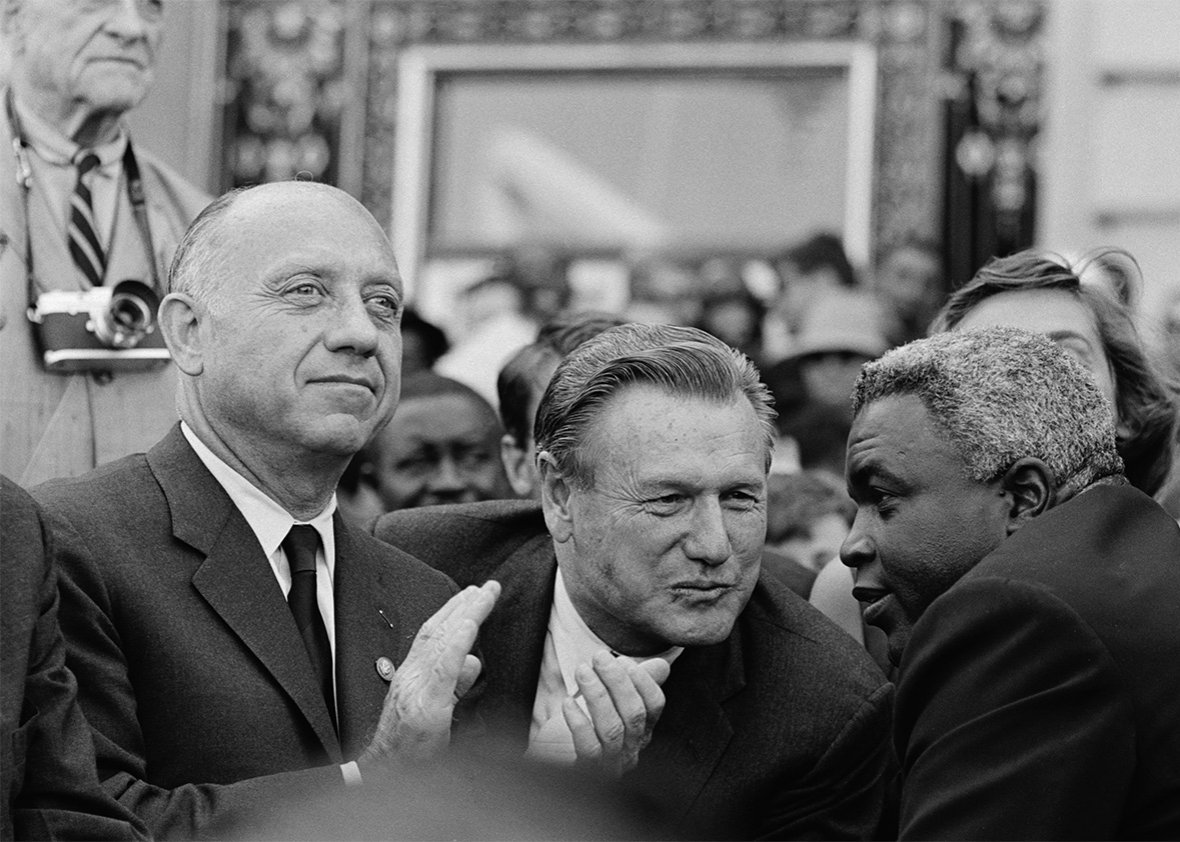
Jackie Robinson, the 1st black player in modern baseball, had been a Republican because he believed their favoring of "self-reliance" would be good for African-Americans. He had worked with Rockefeller on civil rights-friendly initiatives, all over New York State, and that had helped Rockefeller win black voters over.

Starting with his role as a Delegate from New York to the 1964 Republican National Convention, Robinson never voted for another Republican nominee for President. He told journalist Roger Kahn, who once covered Robinson's team, the Brooklyn Dodgers, for the New York Herald Tribune, "It would make everything I've worked for meaningless if baseball were integrated, but America's political parties were segregated."

That 1964 Convention set the standard for future ugly GOP Conventions to come in 1992, 2004 and 2016. Goldwater chose Representative William E. Miller of Western New York, then also the Chairman of the Republican National Committee, as his Vice Presidential nominee, "Because he drives Lyndon Johnson nuts."
The Cow Palace during the Convention

There was a proposed plank for the Party platform denouncing "extremist groups," specifically mentioning, on the left, the Communist Party; and, on the right, the Ku Klux Klan and the John Birch Society. They did not specifically mention liberal groups like Americans for Democratic Action (ADA), Students for a Democratic Society (SDS), or the Student Nonviolent Coordinating Committee (SNCC). The Black Panther Party had not yet been founded, so they couldn't be mentioned.

The problem was, many of Goldwater's supporters were in the Birch Society, including Fred Koch, an oil baron whose sons Charles and David followed in his footsteps as major conservative/libertarian donors, hated by liberals as "The Koch Brothers."

When Rockefeller came on to speak in favor of the plank, Goldwater supporters in the seats tried to boo him off the stage. It was a disgraceful spectacle, but Rocky stood up to them, and finished his speech. The plank was easily voted down, making the GOP look like extremists.
Three Delegates from New York. Left to right: Senator Jacob Javits,
Governor Nelson Rockefeller, and Jackie Robinson.

So, to use another sports analogy, Goldwater knew he needed a home run for his speech. He started off well: "This Party, with its every action, every word, every breath, and every heartbeat, has but a single resolve, and that is freedom. Freedom made orderly for this nation by our constitutional government. Freedom under a government limited by laws of nature and of nature's God. Freedom, balanced, so that order, lacking liberty, will not become the slavery of the prison cell; balanced, so that liberty, lacking order, will not become the license of the mob and of the jungle."

He knew that if he attacked the late President Kennedy and his policies, he had no chance. So he attacked the Democratic way in general: "During four futile years, the administration which we shall replace has distorted and lost that faith. It has talked and talked and talked and talked the words of freedom. Now, failures cement the wall of shame in Berlin. Failures blot the sands of shame at the Bay of Pigs. Failures mark the slow death of freedom in Laos. Failures infest the jungles of Vietnam."

This was a few days before what became known as the Gulf of Tonkin Incident. At the time, Berlin and Cuba were more familiar to Americans than Vietnam. At the time JFK took office, even Laos was more familiar.

Goldwater gave a few more platitudes about freedom, and fired a few more potshots at the Democrats. If he had then gone into his summation, it would have been a terrific speech. Instead, he addressed the need for unity within the Party's own ranks, and threw the Democrats a bone that they chewed on the rest of the way:

Anyone who joins us in all sincerity, we welcome. Those who do not care for our cause, we don't expect to enter our ranks in any case.

And let our Republicanism, so focused and so dedicated, not be made fuzzy and futile by unthinking and stupid labels.

Johnson would not go on to say it, but I can imagine a still-living Kennedy responding to this by saying, "I would remind you, my fellow Americans, that extremism in the defense of liberty is no defense of liberty."

What Johnson did go on to say was, "Extremism in the defense of liberty is an unpardonable vice. And moderation in the pursuit of justice is the highest virtue."

The Goldwater campaign produced buttons saying, "In your heart, you know he's right." The Johnson campaign produced buttons countering this, saying, "In your guts, you know he's nuts." And it produced other suggestions that he was too extreme to be President, including an ad known as the Daisy Spot.

Goldwater ended up winning only 6 States: His home State of Arizona, barely, and 5 Southern States who liked his apparent stance on civil rights, and may have been swayed by the Thurmond endorsement. In a few other Western States, embracing the idea of a Westerner becoming President, he came close.

But in most States, extremism was rejected as a defense of liberty. Richard Nixon, Ronald Reagan and both George Bushes learned from this campaign, and put a human face on conservative policies.

*

July 16, 1964 was a Thursday. Miguel Induráin, the Spanish (Basque) cyclist who won 5 straight Tours de France from 1991 to 1995, was born on this day.)

These baseball games were played:

* The New York Yankees lost to the Baltimore Orioles, 6-1 at Yankee Stadium. Steve Barber outpitched Jim Bouton, and helped his own cause with a home run. To counter the quote that Barber had in Bouton's later book Ball Four, Barber's arm wasn't sore, and it wasn't even a little stiff. Brooks Robinson went 1-for-2 with 2 walks. Mickey Mantle went 0-for-2 with 2 walks. Roger Maris went 0-for-4.

* The New York Mets lost to the Chicago Cubs, 11-1 at Wrigley Field in Chicago. Ernie Banks went 2-for-4 with 2 RBIs. The winning pitcher was Ernie Broglio, recently acquired for Curt Flood. For the rest of his tenure with the Cubs -- and in the major leagues -- he would go 9-15.

* The Chicago White Sox beat the Boston Red Sox, 9-3 at Fenway Park. Carl Yastrzemski and Tony Conigliaro both went 0-for-4.

* The Philadelphia Phillies beat the Pittsburgh Pirates, 7-5 at Forbes Field in Pittsburgh. Roberto Clemente went 2-for-5.

* The Cincinnati Reds beat the Houston Colt .45s, 3-2 at Crosley Field in Cincinnati. Frank Robinson went 0-for-4, and Pete Rose went 1-for-4. The Colt .45s became the Houston Astros the next year.

* The Milwaukee Braves beat the San Francisco Giants, 6-0 at Milwaukee County Stadium. Hank Fischer outpitches Gaylord Perry. Hank Aaron, Joe Torre and Denis Menke hit home runs for the Braves. Willie Mays went 1-for-4.

* The Washington Senators beat the Minnesota Twins, 7-2 at Metropolitan Stadium in the Minneapolis suburb of Bloomington, Minnesota. The only Twin runs came on solo homers by Bob Allison and Tony Oliva. Harmon Killebrew went 0-for-4.

* The Los Angeles Dodgers beat the St. Louis Cardinals, 10-2 at Busch Stadium (formerly Sportsman's Park) in St. Louis. Lou Brock went 2-for-4 in defeat.

* The Cleveland Indians beat the Kansas City Athletics, 12-9 at Kansas City Municipal Stadium. Woody Held won it with a home run in the top of the 10th inning.

* And the Detroit Tigers and the Los Angeles Angels were not scheduled to play.

December 31, 1999 & January 1, 2000: The Millennium

December 31, 1999:  The Millennium arrives. The people of planet Earth survived. At a terrible cost. But we hadn't destroyed ourselves. ...