
July 16, 1964: Senator Barry M. Goldwater of Arizona accepts the Republican Party's nomination for President, at their National Convention, at the Grand National Livestock Pavilion, a.k.a. the Cow Palace, just outside San Francisco in Daly City, California.
The site of the 1964 Republican National Convention may surprise people who know San Francisco as the most liberal city in America, which might not even be accurate. But, like all cities, San Francisco has its "old money" conservative elite. And this was the 2nd time the Grand Old Party had held its convention at the Cow Palace, built in 1940 for rodeo shows but later adapted for professional sports and concerts. They had previously nominated Dwight D. Eisenhower for a 2nd term there in 1956.
Then 55 years old, Goldwater was a Presbyterian, but had a Jewish grandfather, as the family name was originally Goldwasser. This makes the 1964 Republican Convention the closest either major party has ever come to nominating a Jewish person for President.
He was also very Western, living on a ranch outside Phoenix, with a solar-powered flagpole: Every morning, when the Sun came up, it raised the Stars & Stripes; every evening, when the Sun went down, the mechanism lowered the flag into a box.
A bomber pilot in World War II, Goldwater had been elected to the Phoenix City Council, and in 1952 defeated an incumbent Democrat for the U.S. Senate. Re-elected in 1958, he thought he could be the conservative alternative in 1960 to Vice President Richard Nixon, once considered the anti-Communist hard right's man, but now widely seen as more moderate -- the very thing that gave him a legitimate chance of election.
What is a conservative? According to Franklin D. Roosevelt, who knew difficulty walking, "A conservative is a man who, despite having two good legs, has never learned to walk forward." Comedian Mort Sahl said, "A conservative is someone who believes in reform -- but not now." Educator John Holt said, "Conservatism is the worship of dead radicals -- emphasis on the 'dead.'" (That quote is one of many that has been misattributed to Mark Twain.) Years later, Robert Orban would say, "A conservative is someone who wants the rules changed so that no one can make a pile the way he did."
No true conservative had been elected President since 1928, and that was Herbert Hoover, on whose watch the Great Depression began, and whose policies were seen as having made it worse, leading to his landslide loss to FDR in 1932. Every Republican nominee since had basically said, "We accept the New Deal, but we can do it better, and more efficiently, and with fewer Communists."
But there was another alternative to Nixon in 1960: Governor Nelson Rockefeller of New York, who had replaced a previous holder of his office, 1944 and 1948 Presidential nominee Thomas Dewey, as the leader of the moderate-to-liberal Eastern wing of the GOP. He wanted to be President, too. But he also wanted to win. So he invited Nixon to his apartment, and made a deal where he would endorse Nixon to hold off any conservative challenge. It became known as "The Compact of Fifth Avenue."
So, at the 1960 Republican Convention in Chicago, Goldwater told his supporters that they could take their party back, if they were properly organized: "Let's grow up, conservatives!"
Whether the conservative movement, as it came to be known, "grew up" is debatable: Conservatism has often listed from side to side, from old and stuffy to very childish. But they were very well organized, and, on the morning of November 22, 1963, with Nixon branded as a "loser," Goldwater and Rockefeller were the 2 leaders for the Party's nomination in 1964.
That day, John F. Kennedy, who had beaten Nixon in 1960, was assassinated. In his memoir, Goldwater admitted that his chance of winning had died with Kennedy. The 2 men had been friendly rivals, and Goldwater had really looked forward to a clash of ideas with JFK.
But with Vice President Lyndon B. Johnson now President, and sure to be the Democratic nominee in 1964, any chance for a real clash of ideas was doomed: LBJ would do anything to win, including "making Kennedy's ghost his running mate." His actual Vice Presidential nominee turned out to be Senator Hubert Humphrey of Minnesota, but he essentially "ran with JFK" every bit as much as Harry Truman ran with Franklin Roosevelt in 1948.
Goldwater told his advisers that he didn't want to run against Johnson. They told him that he had to do it, anyway, as the best way to continue the building of the conservative takeover of the Republican Party. To use a sports analogy, they were asking him to sacrifice himself, to "take one for the team."
And so he ran. He ran his campaign as a moral crusade, to bring down government spending, to end welfare programs that encouraged "immoral behavior," and to stand up to the Communist world better than the Democrats had.
His supporters took the "morality" thing even further, citing the fact that Rockefeller had divorced his first wife and quickly remarried -- as if that had anything to do with his qualifications for the job. When Goldwater refused to campaign in the Oregon Primary, and Rockefeller went, accompanied by signs saying, "He cared enough to come," Goldwater knew that the California Primary was it: Win it, or you're out.
And when Margaretta "Happy" Rockefeller gave birth to Nelson Rockefeller Jr. just 3 days before the Primary, it bolstered the "morality" argument by reminding voters of Rocky's divorce and remarriage --and the fact that Happy gave up custody of the children she already had, in order to more quickly gain the divorce, in order to more quickly marry the Governor. Goldwater won California, and clinched the nomination.
But right after that came the Senate's vote on the Civil Rights Act of 1964. Most of those voting against it were Southern Democrats. A higher percentage of Republicans than Democrats voted for it, because the Senate Minority Leader, Everett Dirksen of Illinois, was for it, and all but the most conservative of Republican Senators followed his lead.
But Goldwater voted against it -- on constitutional grounds, he said. But the vote tarred him as a racist, even though he wasn't one. He had gone out of his way to appeal to black, Hispanic, and Native American voters in Arizona. But most people outside that State didn't know that. There was no social media for people from Arizona to tell the other 49 States, "Hey, he's not like that! Let me show you what he's doing here!"
The fact that Senator Strom Thurmond of South Carolina, the "States' Rights" Presidential nominee of 1948, switched from the Democratic Party to the Republican Party after LBJ signed the bill, and then endorsed Goldwater, didn't help Goldwater at all -- at least, not outside the Deep South.
Jackie Robinson, the 1st black player in modern baseball, had been a Republican because he believed their favoring of "self-reliance" would be good for African-Americans. He had worked with Rockefeller on civil rights-friendly initiatives, all over New York State, and that had helped Rockefeller win black voters over.
Starting with his role as a Delegate from New York to the 1964 Republican National Convention, Robinson never voted for another Republican nominee for President. He told journalist Roger Kahn, who once covered Robinson's team, the Brooklyn Dodgers, for the New York Herald Tribune, "It would make everything I've worked for meaningless if baseball were integrated, but America's political parties were segregated."
That 1964 Convention set the standard for future ugly GOP Conventions to come in 1992, 2004 and 2016. Goldwater chose Representative William E. Miller of Western New York, then also the Chairman of the Republican National Committee, as his Vice Presidential nominee, "Because he drives Lyndon Johnson nuts."
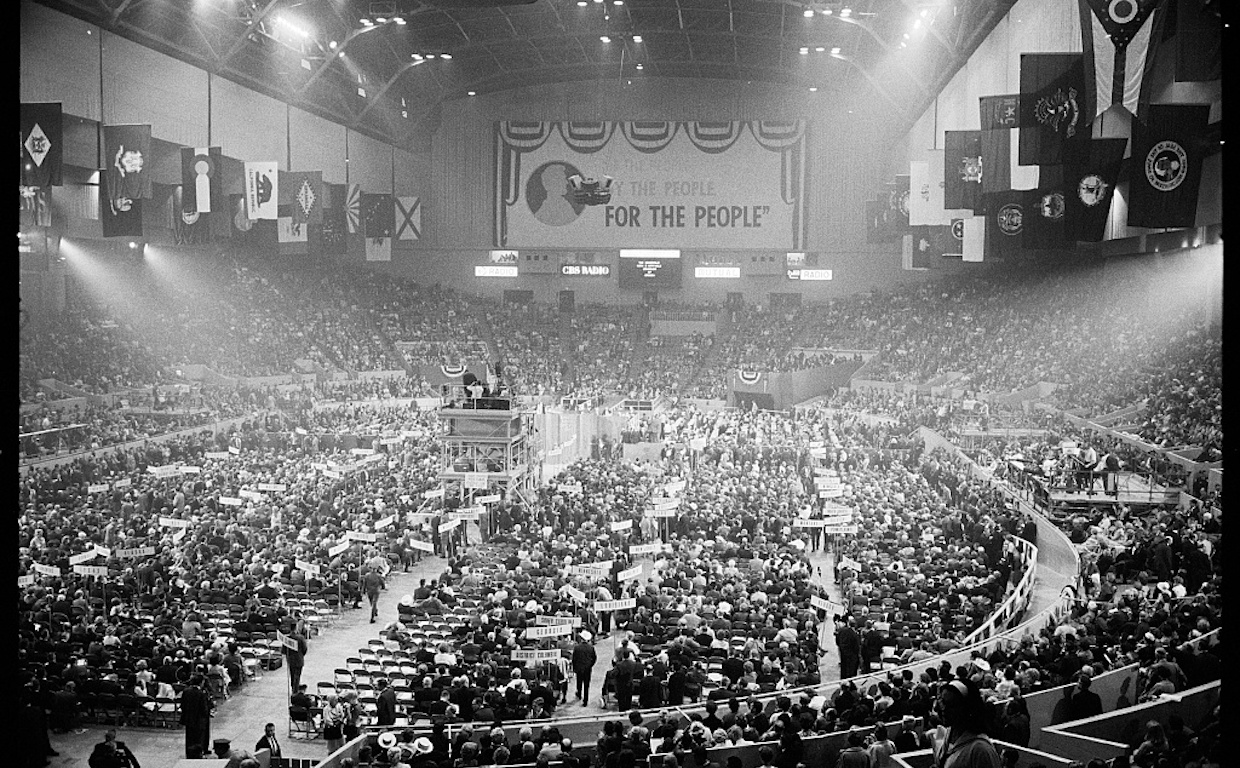
The Cow Palace during the Convention
There was a proposed plank for the Party platform denouncing "extremist groups," specifically mentioning, on the left, the Communist Party; and, on the right, the Ku Klux Klan and the John Birch Society. They did not specifically mention liberal groups like Americans for Democratic Action (ADA), Students for a Democratic Society (SDS), or the Student Nonviolent Coordinating Committee (SNCC). The Black Panther Party had not yet been founded, so they couldn't be mentioned.
The problem was, many of Goldwater's supporters were in the Birch Society, including Fred Koch, an oil baron whose sons Charles and David followed in his footsteps as major conservative/libertarian donors, hated by liberals as "The Koch Brothers."
When Rockefeller came on to speak in favor of the plank, Goldwater supporters in the seats tried to boo him off the stage. It was a disgraceful spectacle, but Rocky stood up to them, and finished his speech. The plank was easily voted down, making the GOP look like extremists.
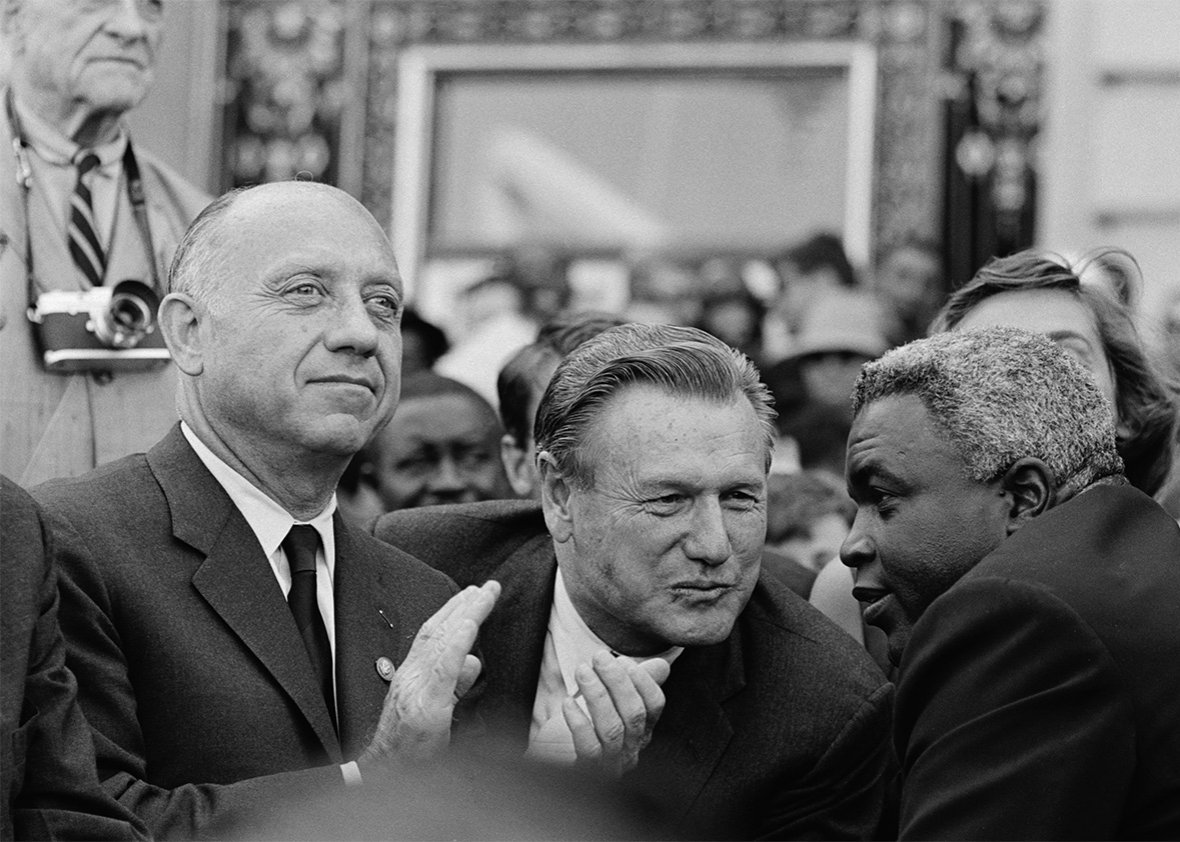
Three Delegates from New York. Left to right: Senator Jacob Javits,
Governor Nelson Rockefeller, and Jackie Robinson.
So, to use another sports analogy, Goldwater knew he needed a home run for his speech. He started off well: "This Party, with its every action, every word, every breath, and every heartbeat, has but a single resolve, and that is freedom. Freedom made orderly for this nation by our constitutional government. Freedom under a government limited by laws of nature and of nature's God. Freedom, balanced, so that order, lacking liberty, will not become the slavery of the prison cell; balanced, so that liberty, lacking order, will not become the license of the mob and of the jungle."
He knew that if he attacked the late President Kennedy and his policies, he had no chance. So he attacked the Democratic way in general: "During four futile years, the administration which we shall replace has distorted and lost that faith. It has talked and talked and talked and talked the words of freedom. Now, failures cement the wall of shame in Berlin. Failures blot the sands of shame at the Bay of Pigs. Failures mark the slow death of freedom in Laos. Failures infest the jungles of Vietnam."
This was a few days before what became known as the Gulf of Tonkin Incident. At the time, Berlin and Cuba were more familiar to Americans than Vietnam. At the time JFK took office, even Laos was more familiar.
Goldwater gave a few more platitudes about freedom, and fired a few more potshots at the Democrats. If he had then gone into his summation, it would have been a terrific speech. Instead, he addressed the need for unity within the Party's own ranks, and threw the Democrats a bone that they chewed on the rest of the way:
Anyone who joins us in all sincerity, we welcome. Those who do not care for our cause, we don't expect to enter our ranks in any case.
And let our Republicanism, so focused and so dedicated, not be made fuzzy and futile by unthinking and stupid labels.
Johnson would not go on to say it, but I can imagine a still-living Kennedy responding to this by saying, "I would remind you, my fellow Americans, that extremism in the defense of liberty is no defense of liberty."
What Johnson did go on to say was, "Extremism in the defense of liberty is an unpardonable vice. And moderation in the pursuit of justice is the highest virtue."
What Johnson did go on to say was, "Extremism in the defense of liberty is an unpardonable vice. And moderation in the pursuit of justice is the highest virtue."
The Goldwater campaign produced buttons saying, "In your heart, you know he's right." The Johnson campaign produced buttons countering this, saying, "In your guts, you know he's nuts." And it produced other suggestions that he was too extreme to be President, including an ad known as the Daisy Spot.
Goldwater ended up winning only 6 States: His home State of Arizona, barely, and 5 Southern States who liked his apparent stance on civil rights, and may have been swayed by the Thurmond endorsement. In a few other Western States, embracing the idea of a Westerner becoming President, he came close.
But in most States, extremism was rejected as a defense of liberty. Richard Nixon, Ronald Reagan and both George Bushes learned from this campaign, and put a human face on conservative policies.
*
July 16, 1964 was a Thursday. Miguel Induráin, the Spanish (Basque) cyclist who won 5 straight Tours de France from 1991 to 1995, was born on this day.)
These baseball games were played:
* The New York Yankees lost to the Baltimore Orioles, 6-1 at Yankee Stadium. Steve Barber outpitched Jim Bouton, and helped his own cause with a home run. To counter the quote that Barber had in Bouton's later book Ball Four, Barber's arm wasn't sore, and it wasn't even a little stiff. Brooks Robinson went 1-for-2 with 2 walks. Mickey Mantle went 0-for-2 with 2 walks. Roger Maris went 0-for-4.
* The New York Mets lost to the Chicago Cubs, 11-1 at Wrigley Field in Chicago. Ernie Banks went 2-for-4 with 2 RBIs. The winning pitcher was Ernie Broglio, recently acquired for Curt Flood. For the rest of his tenure with the Cubs -- and in the major leagues -- he would go 9-15.
* The Chicago White Sox beat the Boston Red Sox, 9-3 at Fenway Park. Carl Yastrzemski and Tony Conigliaro both went 0-for-4.
* The Philadelphia Phillies beat the Pittsburgh Pirates, 7-5 at Forbes Field in Pittsburgh. Roberto Clemente went 2-for-5.
* The Cincinnati Reds beat the Houston Colt .45s, 3-2 at Crosley Field in Cincinnati. Frank Robinson went 0-for-4, and Pete Rose went 1-for-4. The Colt .45s became the Houston Astros the next year.
* The Milwaukee Braves beat the San Francisco Giants, 6-0 at Milwaukee County Stadium. Hank Fischer outpitches Gaylord Perry. Hank Aaron, Joe Torre and Denis Menke hit home runs for the Braves. Willie Mays went 1-for-4.
* The Washington Senators beat the Minnesota Twins, 7-2 at Metropolitan Stadium in the Minneapolis suburb of Bloomington, Minnesota. The only Twin runs came on solo homers by Bob Allison and Tony Oliva. Harmon Killebrew went 0-for-4.
* The Los Angeles Dodgers beat the St. Louis Cardinals, 10-2 at Busch Stadium (formerly Sportsman's Park) in St. Louis. Lou Brock went 2-for-4 in defeat.
* The Cleveland Indians beat the Kansas City Athletics, 12-9 at Kansas City Municipal Stadium. Woody Held won it with a home run in the top of the 10th inning.
* And the Detroit Tigers and the Los Angeles Angels were not scheduled to play.


No comments:
Post a Comment