Showing posts with label national anthem. Show all posts

Friday, December 16, 2022

December 16, 1905: Rugby's "Match of the Century"

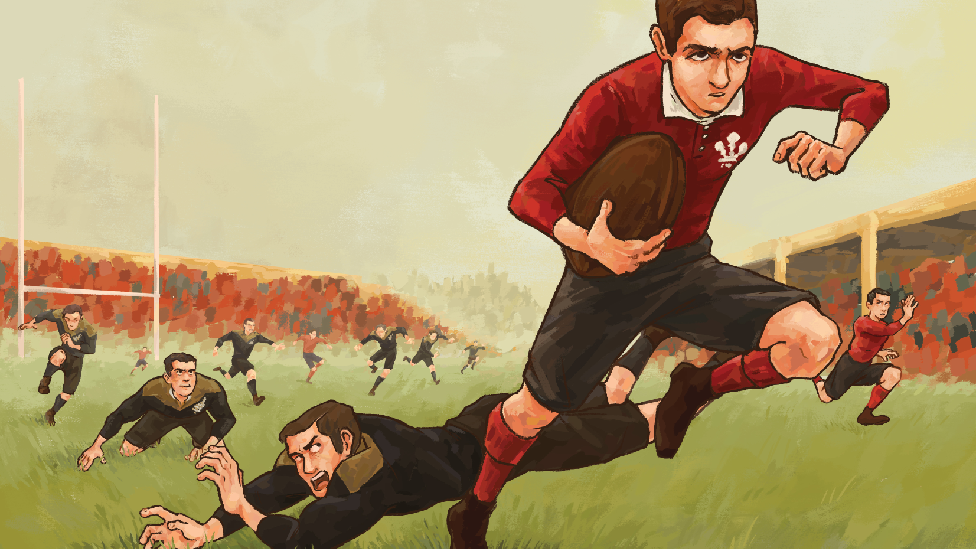
Illustration for a children's book about the match

December 16, 1905: A rugby union match is played, becoming known as the sport's "Match of the Century."

Rugby was allegedly invented at the prep school of the same name in England's Midlands in 1823. Wales began playing it in 1850, the Welsh Rugby Union was formed in 1881, and the Home Nations Championship, between Wales, England, Scotland and Ireland was first played 2 years later. (France was added in 1910, making it the Five Nations Championship. In 2000, Italy was added, making it the Six Nations Championship.)

The sport was first played in New Zealand in 1870. By 1904, New Zealand was sending its national team on tour. Because of their all-black uniforms, they became known as the All Blacks. (The soccer team eventually became known as the All Whites, and their cricket team as the Black Caps.)

The Original All Blacks, also known simply as "The Originals," were the first New Zealand team to tour outside Australasia. They toured the British Isles, France and the United States during 1905–1906. Their opening game, on September 16, 1905, was against Devon, in England's West Country, whom they defeated 55–4. They defeated every English side that they faced, including a 16–3 victory over English county champions Durham in the North-East, and a 32–0 victory over Blackheath in South-East London.

They defeated the national teams of Scotland, 12-7, easily the closest match on the tour before December 16; Ireland, 15-0; and England, also 15-0. On December 13, they beat Yorkshire in Leeds, 40-0. By the time the tour arrived in Wales, the All Blacks had not conceded a single point in their last 600 minutes of rugby. They had played 27 matches on the tour so far, scoring 801 points and conceding just 22.

The team travelled to Wales by train on 15 December, arriving at Cardiff Station in the evening. Despite the late hour, the visitors received a raucous welcome, a large crowd (contemporary estimates put it crowd at 20,000) had gathered to greet the All Blacks both inside the station and along the neighboring streets, preventing the players from getting to their hotel, and police had to force a path through the crowd for the tourists.

As early as October, the Welsh Match Committee had been observing the All Blacks tour. On October 19, the committee travelled to Gloucester, and say the tourists defeat one of the best club sides in England, 44–0. Rugby historians tend to accept that the scale and manner of this All Blacks victory encouraged the Welsh observers to develop new tactics that could match the tourists' unorthodox style.

As early as 1888, the New Zealand players had been performing a pregame routine that featured the haka, a dance of their native Māori people. They brought it with them to Britain. The Wales team debated how to counter this, and it was agreed that they would simply sing "Hen Wlad Fy Nhadau" ("Land of My Fathers"). It is believed to be the earliest performance of a National Anthem before a sporting event, and it whipped the crowd at Catdiff Arms Park into a frenzy, charging the players up.

As has become traditional for them, Wales wore all red, which would have been distinctive in person against New Zealand's literal all-black uniforms, but makes it difficult to tell the teams apart in black & white photographs.

Having studied the All Blacks' tactics, Wales concentrated on outside play. This resulted in a defensive struggle, and accounts of the match were unanimous in reporting how unusually poor New Zealand were in the 1st half, conceding an abundance of penalties in the opening 15 minutes. (Rugby union matches are 80 minutes, 2 halves of 40 minutes each.) One reporter stated that the normally free-scoring All Blacks did not get any play inside the Welsh 25 yard line until the very moment before half-time.

In the 23rd minute, a scrum was called, and Dicky Owen saw a chance to call the move he devised in training. As Wales won the ball, Owen ran it down the blindside, with the backline of Percy Bush, Gwyn Nicholls (the team Captain) and Willie Llewellyn following him in support. This initial move drew several New Zealand players. Owen then switched the play, throwing a long pass back to the openside, with Cliff Pritchard having to take the ball at his feet. The long pass gave Pritchard time to draw a covering tackle, before passing to Rhys Gabe, who similarly drew a would-be tackler. Finally, Gabe passed to Teddy Morgan, who sprinted more than 20 yards to touch down in the left corner. It was 3-0 to Wales, the first time that the All Blacks had conceded without first scoring themselves. Wales failed to kick the conversion.

The All Blacks had most of the attacking play in the 2nd half. Billy Wallace crossed the try line, but was called back, having run into touch and a forward pass from Bob Deans prevented an inevitable try for Duncan McGregor.

The closest opportunity came for the All Blacks when Deans was brought down inches from the line. By this point, there was a mist over the field, and it wasn't clear who had made the key tackle, with reports at the time saying it was a combined effort of Morgan and Gabe, but Morgan gave Gabe sole credit.

The mist led the All Blacks to believe that Deans had scored, which would have tied the game, and given them the chance to take the lead on the ensuing conversion. Even some of the Welsh players admitted that they thought he had scored, then been pulled back. But the referee, J.D. Dallas of Scotland, ruled that he never crossed the line, and was 6 to 12 inches short.

The 3-0 score held, and the crowd invaded the pitch after the final whistle, carrying some of the Wales players off on their shoulders. Dave Gallaher, the New Zealand Captain, went into the Wales locker room, congratulated their team, and admitted that the better team had won. He and Captain Nicholls exchanged shirts. Gallaher's shirt is now on display at the World Rugby Museum at Twickenham Stadium, "The Home of Rugby" in South-West London.

The All Blacks continued their tour, and managed narrow wins against 4 Welsh club teams, before opposing the France national team in its 1st-ever test match. On New Year's Day, January 1, 1906, New Zealand beat France, 38-8. They returned to New Zealand via North America, where they played 2 matches against Canadian teams. Overall, they played a total of 35 matches, which included 5 Tests. The Wales Test was their only loss.

The 1905 All Blacks tour of Britain went on to achieve legendary status within the rugby world, and New Zealand in particular. They scored 976 points and conceded only 59, and thus set the standard for future All Blacks sides. The tour also saw the first use of the All Blacks name, and established New Zealand's reputation as a world-class rugby nation. Some of these players eventually defected, to participate in the professional 1907-08 tour of Australia and Great Britain, where they played against Northern Union sides, in the variation on the sport that would eventually become known as rugby league.

Bob Deans died in 1908, only 3 years after the match, from a botched appendicitis operation. He was only 24. To the end, he insisted that he had scored.

Despite the sport's popularity around the world, there wasn't a Rugby World Cup until 1987, a joint hosting by Australia and New Zealand. It's also been hosted by each of those nations separately, England, Wales, a joint British-Irish hosting, France, South Africa and Japan. It's been won by New Zealand in 1987, 2011 and 2015; Australia in 1991 and 1999; South Africa in 1995, 2007 and 2019; and England in 2003. (UPDATE: South Africa repeated in 2023, making them the 1st 4-time winner, surpassing New Zealand with 3.)

*

December 16, 1905 was a Saturday. There were no scores in North America: Baseball was out of season, football season had just ended, and basketball and hockey were mostly all-amateur.

England's Football League played that day, among the games being a 2-2 tie between Woolwich Arsenal and Yorkshire team Middlesbrough, at the Manor Ground in Plumstead, South-East London. In 1913, the hosts moved to the Highbury section of North London, and dropped the Woolwich locality from their name, becoming simply Arsenal Football Club.

Friday, October 7, 2022

October 7, 1968: José, He Could See Better Than They Could

October 7, 1968: Game 5 of the World Series, at Tiger Stadium in Detroit. The St. Louis Cardinals lead the Detroit Tigers 3 games to 1. The Tigers must win 3 straight against the defending World Champions to win their 1st title in 23 years.

Lefthanded pitcher Mickey Lolich steps in, and pitches brilliantly, and gets an unlikely assist from Lou Brock. On 2nd base in the 5th‚ Brock, normally one of the game's greatest baserunners, tries to score standing up on Julian Javier's single, and is gunned down by Willie Horton's throw from left field. Al Kaline's bases-loaded single off Joe Hoerner in the 7th scores 2 for the winning margin: Tigers 5, Cardinals 3.

The Tigers stay alive, but still need to win Games 6 and 7 -- in St. Louis, with Bob Gibson the potential Game 7 starter.

The bigger story, at least in the short term, is the modern rendition of "The Star-Spangled Banner" by 23-year-old Puerto Rican-born, New York-raised singer and acoustic guitar wizard José Montserrate Feliciano García, better known as José Feliciano.

Born blind, Feliciano comes onto the field wearing sunglasses and being guided by a dog -- both of which are considered threatening by many in-person and TV viewers.

He does no vocal hysterics like some more recent singers we could mention; he just sings the National Anthem of the country he loves, of which he is a full citizen, as all Puerto Rico natives are, and which gave him the chance to become rich and famous. He simply sings the song a little differently, in his own style, which he calls "Latin jazz."

This is a time of the Vietnam War, race riots, assassinations and political unrest. Richard Nixon is about to be elected President in a squeaker because too many Democrats, turned off by the war and saddened by the assassinations of Martin Luther King and Robert Kennedy, stay home and don't vote for longtime liberal hero Hubert Humphrey.

The reaction to Feliciano's rendition is muted in the Tiger Stadium stands, but was absolutely furious on telephones, talk radio and newspapers. NBC's switchboard got overloaded. The reaction gets so bad that his career stalls for 2 years, until the release of his Christmas song "Feliz Navidad."

Tiger broadcaster Ernie Harwell, authorized by the office of Commissioner William D. "Spike" Eckert to select Detroit's Anthem singers for the Series, defended his choice. Harwell was a published songwriter (he would later write "Move Over Babe, Here Comes Henry" for Hank Aaron), an ordained minister, and, although he saw no combat, a U.S. Marine in World War II. His patriotism, decency and musical talent were on display throughout his long and mostly happy adult life, and were absolutely unassailable. Or so one would think.

Ironically, the man he'd selected for Game 4 was Marvin Gaye, a superstar of Detroit's Motown Records. Gaye sang it straight, and very nicely. In 1983, at the NBA All-Star Game, Gaye, in the midst of a big comeback that would tragically end with his death the next year, sang the Anthem gospel-style. The times had changed: His version was greeted with thunderous cheers and applause.

For Game 3, he had chosen Margaret Whiting, a Detroit native who'd had several hits in the 1940s and '50s, and whose father was the great songwriter Richard Whiting.

"Mr. Ernie" had introduced Feliciano to his wife, Susan, who grew up in Detroit. In 2010, Harwell died, and a memorial service was held at Detroit’s Comerica Park. Feliciano was invited to sing the Anthem at this service, and was wildly cheered afterward.
His version was also included on The Tenth Inning, Ken Burns' 2010 sequel to his 1994 miniseries BaseballListen and judge for yourself. (As I have pointed out before, NBC no longer has color videotape of most of the World Series prior to 1975.)

Since Colin Kaepernick, then the quarterback for the San Francisco 49ers, began kneeling during the playing of the National Anthem during 2016 games, controversy has raged. Further gestures have been made. Right-wingers have foamed at the mouth over such things, led by Donald Trump -- as Trump's fellow Queens native, and Feliciano's fellow 1968 hitmaker, Paul Simon would say, "the neon god they made."

There is an obvious solution to the problem: Don't play the National Anthem before games at all.

Because the right-wingers are lying: Kaepernick's original protest didn't have a damned thing to do with the flag. Or the troops, present and veteran. It's about white policemen exercising their choice to murder unarmed black people, including children, because they know they will get away with it. And they do.

O, say, can you see that?

*

October 7, 1968 was a Monday. This was the only baseball game played that day. There would not be Monday Night Football for another 2 years. The NHL season began on October 11; the NBA season, on October 15; and the ABA season, on October 18. So there were no other scores on this historic day.

There was one other note from music: Thom Yorke, the lead singer and main songwriter of the English rock band Radiohead, was born.

Monday, September 12, 2022

September 12, 1985: "Baseball Thursday" In New York

Keith Hernandez

September 12, 1985: New York Times sports columnist George Vescey called it "Baseball Thursday In New York." It remains the only day in the joint 1962-present history of the Yankees and the Mets when both teams were at home on the same September day, and were both playing the team they were fighting for a Division Title.

After making the Playoffs 5 times in 6 years from 1976 to 1981, including 2 World Series wins, the Yankees fell apart in 1982. They were quickly rebuilt, and put up good teams in 1983 and '84, although the Baltimore Orioles ran away with the American League Eastern Division in the former, and the Detroit Tigers did so in the latter.

But in 1985, the Yankees and the Toronto Blue Jays battled it out for the Division lead all season long. On September 11 -- the day Pete Rose (officially) became Major League Baseball's all-time hits leader -- the Jays led the Yanks by 2 1/2 games, with the Yankees having 24 games left to play, the Jays 23, and the next 4 against each other at Yankee Stadium in the South Bronx.

The Mets won the World Series in 1969 and the National League Pennant in 1973, and were still a respectable 3rd place in the NL Eastern Division in 1976. Then they fell apart. A change of ownership in 1980 led to a rebuilding, and in 1984, they finished 2nd behind the Chicago Cubs.

In 1985, with the Cubs bitten by the injury bug, it would be the St. Louis Cardinals that fought the Mets for the Division title. When those 2 teams took the field at Shea Stadium in Flushing Meadow, Queens on September 10, they were dead-even, tied for 1st. On the 10th, the Mets won, 5-4. On the 11th, the Cards won, 1-0 in 10 innings.

That led into "Baseball Thursday," September 12. A 1:35 PM start at Shea saw Ed Lynch start for the Mets, and Joaquín Andújar for the Cardinals. The Mets tagged Andújar for 3 straight doubles in the bottom of the 1st, and knocked him out of the box in the 2nd. The Mets led, 6-0, pleasing most of the crowd of 46,295. (Big game, but 9,000 empty seats.)

But Lynch didn't have good stuff, either, and the Cardinals chipped away, closing to within 6-5 in the top of the 4th. In the top of the 9th, Willie McGee, a great runner and fielder but mainly a contact hitter rather than a power hitter, hit a home run to tie the game.

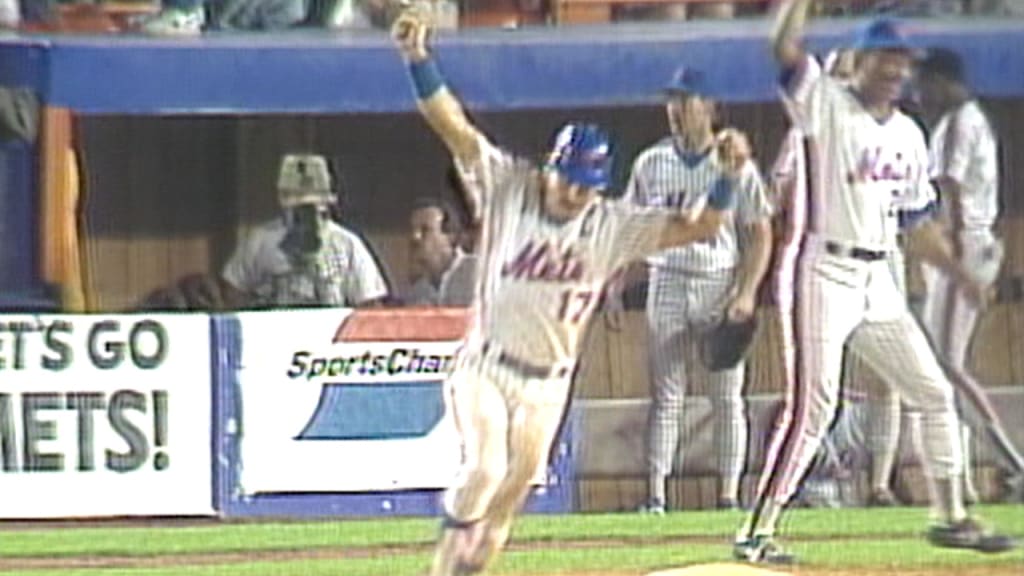
But Mookie Wilson singled to lead off the bottom of the 9th, got bunted over to 2nd by Wally Backman, and came home on a single by Keith Hernandez. Mets 7, Cardinals 6. Jesse Orosco was the winning pitcher; Ken Dayley, the losing pitcher. The Mets had taken 2 out of 3 from the Cards, and were now 1 game up on the Cards, with 24 games to play.

*

An even bigger crowd, 52,141 (about 5,000 short of a sellout), plowed into Yankee Stadium for the 7:05 start against the Blue Jays, the 1st game of a series of 4. Public-address announcer Bob Sheppard introduced Robert Merrill, the Brooklynese baritone who long graced the stage at the Metropolitan Opera. Merrill, as he had done so many times and would do so many more, would sing the National Anthems. As the Blue Jays were based in Canada, he began with "O Canada."

And boos rang down from the stands at Yankee Stadium. Seriously. The same building that had hosted Joe Louis' knockout of Max Schmeling in 1938 was now hosting the booing of the National Anthem of America's closest ally.

I was 15 years old, watching this game on WPIX-Channel 11, and I was sickened. There was no excuse for booing the song, just because the opposition was based outside the United States of America. I wonder what President Ronald Reagan thought of it. I wonder if the hyper-patriotism he inspired in many was a partial cause.

Each team started its ace: The Yankees, Ron Guidry; the Jays, Dave Stieb. Ernie Whitt hit a home run to give the Jays a 2-0 lead in the 3rd. They made it 3-0 in the 4th. The Yankees got on the board in the 5th, but the Jays took that run right back in the 6th. It was 4-1 Toronto at the 7th inning stretch.

With 1 out in the bottom of the 7th, Willie Randolph drew a walk. Bobby Meacham reached on an error by Jays shortstop Tony Fernández. Rickey Henderson walked, to load the bases. Bobby Cox, then managing the Jays in between his 2 tenures managing the Atlanta Braves, took Stieb out, and brought in Gary Lavelle.

Ken Griffey Sr. grounded to 3rd, and the Jays got a forceout at 2nd, but a run came home. Don Mattingly singled home a run. Cox took Lavelle out, and brought in Dennis Lamp. Dave Winfield grounded to Fernández, who made his 2nd error of the inning, allowing the tying run to score. And Ron Hassey, the Yankee catcher, hit a home run. Stan Clarke became the 4th Toronto pitcher of the inning, and he got Don Baylor to pop up, but it was 7-4 Yankees.

The Jays picked up a run in the 8th, but Brian Fisher closed it out in the 9th, and the Yankees had won, 7-5. Guidry had won his 19th game. The Yankees closed to within a game and a half of the Jays. Talk of a "Subway Series" between the Yankees and the Mets could be taken seriously for the first time.

Guidry finished the season with 22 wins; the Mets' Dwight Gooden, 24. Since 1985, the highest win total by a New York-based pitcher has been 21, which Andy Pettitte achieved in 1996 and 2003. The only other New York pitchers to win 20 in a season have been Roger Clemens with the Yankees, Frank Viola and R.A. Dickey with the Mets, and David Cone with both teams.
Ron Guidry

So both New York teams had beaten their main opponent for the Division title, at home, on the same day, in September.

*

The next night, before the 2nd game of the series, Sheppard prepared to introduce Merrill again, and this time, the St. John's University speech professor took no chances. Whether he wrote the message himself, or team owner George Steinbrenner did and Sheppard proudly went along with it, we may never know.

He reminded the fans that Canada was America's ally in World War I, World War II, and the Korean War. (Canada did not get involved in Vietnam, and America's 2 wars in Iraq hadn't happened yet.) If that was too far back for them to remember, he reminded the fans that Canadian diplomats had helped get the American hostages out of Iran just a few years before. And as such, their Anthem should be respected.

Merrill: "O, Canada... "

50,000 or so Yankee Fans: "Boooooooo!"

There have been times when players, managers, executives and owners of the Yankees have disgraced themselves. This is one of the few times, and by far the biggest time, that Yankee Fans have disgraced themselves. Indeed, they disgraced the entire country they thought they were supporting.

Buck Martinez, a Blue Jays catcher (and later manager and broadcaster for the team), looked at the Jays' roster, noting its September expansion, and told the press, "Some patriots. They're booing 25 Americans and 3 Dominicans." Perhaps it was poetic justice that the Jays took the last 3 games of the series, leaving the Yankees 4 1/2 games back.

As October dawned, the Mets went to St. Louis, needing a 3-game sweep to stay in the race. They won the 1st 2, but the Cardinals won the 3rd, and that pretty much knocked the Mets out. The Yankees went to Toronto for the last 3 games of the regular season, needing a sweep to force a Playoff for the Division title. They won on Friday night, on a dramatic 9th-inning homer by their other main catcher at the time, Butch Wynegar, but lost on Saturday, and that clinched for the Jays. On Sunday, Phil Niekro won his 300th game, and the Yankees won a game that was, standings-wise, meaningless.

The Yankees ended 97-64, 2 games behind the Jays. The Mets ended 98-64, 3 games behind the Cards. The Kansas City Royals won the AL West, by 1 game over the California Angels. The Los Angeles Dodgers won the NL West, by 5 1/2 games over the Cincinnati Reds. The Royals beat the Jays in the AL Championship Series. The Cards beat the Dodgers in the NL Championship Series. The Royals beat the Cardinals to win the World Series.

The next year, the Yankees finished 2nd, to their arch-rivals, the Boston Red Sox. The Mets won the World Series. They have never won another. The Yankees have won 5 over that stretch. The Jays won back-to-back World Series in 1992 and '93, the only titles they have ever won. The Cardinals won the Pennant again in 1987, but lost the World Series, and wouldn't win another World Series until 2006, wining it again in 2011, losing one in 2013.

Not until 1999, after the institution of the Wild Card, would both the Yankees and the Mets make the Playoffs in the same season. Not until 2000 would they play each other in the World Series, the Yankees having won the AL East, and the Mets, despite having a better record, only making the Playoffs as the Wild Card. And, of course, the Yankees won it. Not until 2006 would both teams win their Divisions in the same season. Both teams made the Playoffs again in 2015 and 2022.

But there has never been another day in New York like Baseball Thursday in 1985.

*

September 12, 1985 was, yes, a Thursday. These other MLB games were played that day:

* The Baltimore Orioles beat the Boston Red Sox, 3-1 at Fenway Park in Boston. Eddie Murray went 2-for-4. Cal Ripken Jr. went 1-for-4. Wade Boggs went 0-for-3 with a walk.

* The Montreal Expos beat the Philadelphia Phillies, 6-3 at Veterans Stadium in Philadelphia. Mike Schmidt went 0-for-3 with 2 walks.

* Atlanta Braves beat the Los Angeles Dodgers, 11-6 at Atlanta-Fulton County Stadium.

* The Pittsburgh Pirates beat the Chicago Cubs, 10-2 at Three Rivers Stadium in Pittsburgh.

* The Cincinnati Reds beat the San Diego Padres, 2-1 at Riverfront Stadium in Cincinnati. The night before, Pete Rose, the Reds' player-manager, had collected his 4,192nd hit, breaking what had long been accepted as Ty Cobb's record of 4,191. (There had already been a revision, which found Cobb's total to be 4,189, but Rose's record was still celebrated at 4,192, not 4,190.) He did not play in this game. Tony Gwynn did play for the Padres, going 1-for-3 with a walk and an RBI.

* The Chicago White Sox beat the Minnesota Twins, 4-2 at Comiskey Park in Chicago.

* The Houston Astros beat the San Francisco Giants, 5-2 at the Astrodome in Houston.

* The California Angels beat the Texas Rangers, 5-3 at Anaheim Stadium (now Angel Stadium of Anaheim). Reggie Jackson went 1-for-4. Rod Carew went 2-for-4 with an RBI.

* And the Cleveland Indians, the Detroit Tigers, the Kansas City Royals, the Milwaukee Brewers, the Oakland Athletics and the Seattle Mariners were not scheduled. Having 6 out of the 26 teams not playing is not surprising, since Thursday is often a travel day in baseball. Even the New York "doubleheader" sort-of reflect this, as it was the last game in the Mets-Cardinals series, and the 1st game in the Yankees-Blue Jays series.

Thursday, September 1, 2022

September 1, 2016: Colin Kaepernick Takes a Knee

September 1, 2016: The San Francisco 49ers beat the San Diego Chargers, 31-21 at Qualcomm Stadium in San Diego, in their last preseason game. Like any preseason game, the result doesn't matter. This time, it mattered less than ever.

Instead of standing while the National Anthem, "The Star-Spangled Banner," was played before the game, 49er quarterback Colin Kaepernick got down on one knee for the duration of the song.

He did this in protest of the many recent cases of police brutality. This earned him a bit of praise, and also a lot of nasty blowback from racists, who said he was "disgracing the Anthem" and "disgracing the American flag."

These people were not idiots: They were liars. It didn't have a damned thing to do with the flag. It has to do with white cops murdering unarmed black suspects who have been convicted of nothing, and knowing they will get away with it, because the men in power let them get away with it.

But they managed to redefine his protest, so that people didn't get the message that police brutality was a problem.

As a result, nothing changed. That was my only problem with the gesture: It didn't work. But he kept on doing it long after it became obvious that racist cops were still going to beat, and sometimes even murder, unarmed black people.

The people who attacked Kaepernick for his protest were not only disrespecting the 1st Amendment, one of the biggest things for which the flag stands. If they didn't respect his right, then the flag they claimed to love so much means nothing. By attacking Kaepernick for his protest, they were endorsing the cold-blooded murder of unarmed black people by white cops.

See? That's an extreme way to put it, but such a thing works both ways. If Kap is "un-American," then those people were racist. Or, they could have simply admitted that Kap has a point, and try to take that point away from him, by taking steps to solve the problem. That way, everybody would have won. Except the actual racists.

The 49ers went on to have a horrible season, 2-14. Statistically, Kaepernick wasn't much below what he had previously done, including taking the 49ers to Super Bowl XLVII in the 2012 season. In 2016, he completed 59.2 percent of his passes, for 2,241 yards, 16 touchdowns and only 4 interceptions. He also rushed for 468 yards. The position of quarterback was not the 49ers' problem.

Their defense was the problem: Following a 28-0 win over the Los Angeles Rams in their regular-season opener, they allowed the 6-10 Carolina Panthers to score 46, the 7-9 Buffalo Bills to score 45, the 7-9 New Orleans Saints and the Atlanta Falcons to each score 41, the Seattle Seahawks to score 37, the Tampa Bay Buccaneers to score 34, the Arizona Cardinals to score 33, the Miami Dolphins to score 31, and the New England Patriots to score 30.

Their only other win came near the end of the season, also over the 4-12 Rams, on Christmas Eve. Of their 14 losses, only 5 were within 7 points, so even if they'd won all of those, they still would have been 7-9 and missed the Playoffs. Head coach Chip Kelly and general manager Trent Baalke were both fired.

On New Year's Day, January 1, 2017, with Donald Trump, who called Kapernick "that son of a bitch" in a public speech, having ridden a wave of bigotry -- and Russian meddling -- to become President-elect, the 49ers lost their season finale to the Seahawks, 25-23. Kaepernick completed 17 out of 22 passes, for 215 yards, throwing a touchdown pass, and no interceptions. He was 29 years old, hardly old for a quarterback.

He has never thrown another professional pass, in any league on Earth. You see, in the NFL, you can do anything you want, as long as you don't embarrass your team or the League. Once you do that, they are done with you. And Kaepernick had embarrassed the National Football League. Other leagues, such as the Canadian Football League, didn't want him to do the same to theirs, so they didn't sign him, either.

He wasn't banned, he was -- pardon the choice of word, which originally had nothing to do with race -- blackballed. As Mike Lupica insinuated in his column in the New York Daily News, every single team organization in the NFL, some of whom desperately needed improvement at the position of quarterback, was sending a message: "We would rather go 0-16 for what would have been the rest of Colin Kapernick's career than have him play for our team."

A corollary to that message could have been, "We would rather have bigots pay for tickets, parking, food, souvenirs, etc. than take the money of Kaepernick's supporters." But even that didn't really enter into it. Every bigot is an asshole, but not every asshole is a bigot. For the team owners, this wasn't about money. If there is one thing that a rich person values more than money, it is control. And the NFL team owners could not control Colin Kaepernick.

UPDATE: On February 2, 2020, with Jimmy Garappolo as quarterback, the 49ers played in Super Bowl LIV, losing to the Kansas City Chiefs, 31-20. On January 20, 2023, the 49ers were in the NFC Championship Game, playing the Philadelphia Eagles at Lincoln Financial Field in Philadelphia. In the 2022 season opener, Trey Lance was their starting quarterback, but he got hurt on September 18. From then until December 4, it was Jimmy Garoppolo, but he was injured. From then onward, it was Brock Purdy, but he was injured early in that Championship Game. They had signed a previous quarterback, Josh Johnson, as an emergency backup after the December 4 game, and he stepped in for the NFC Championship, but left the game with a concussion in the 3rd quarter. Purdy was pressed back in for emergency duty, and threw 4 passes, completing them all, but for a total of 23 yards. The Niners lost, 31-7.

Colin Kaepernick was 35 years old. He should still have been their starter. If he had been, they might have won a 6th Super Bowl, and even a 7th.

*

September 1, 2016 was a Thursday. As I said, the NFL was still in preseason, so their scores on this historic day mean nothing. But there were 4 games played in Major League Baseball:

* The New York Mets lost to the Miami Marlins, 6-4 at Citi Field. The winning pitcher was José Miguel Ureña. The losing pitcher was Jacob deGrom, who gave up 3 runs on 6 hits and 4 walks in only 5 innings. Jay Bruce and Asdrúbal Cabrera hit home runs for the Metropolitans, but Christian Yelich went 3-for-4 with a home run and 4 RBIs for the Fish.

* The Atlanta Braves beat the San Diego Padres, 9-6 at Turner Field (now Center Parc Stadium) in Atlanta.

* The Chicago Cubs beat the San Francisco Giants, 5-4 at Wrigley Field in Chicago.

* And the Minnesota Twins beat the Chicago White Sox, 8-5 at Target Field in Minneapolis.

Tuesday, July 12, 2022

July 12, 1998: A France for the Whole World

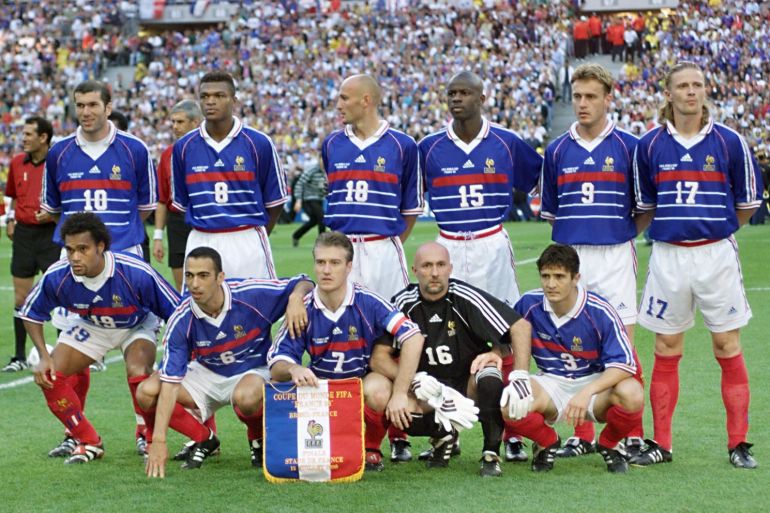
Top row, left to right: Zinedine Zidane, Marcel Desailly, Frank Leboeuf,
Lilian Thuram, Stéphane Guivarc'h, Emmanuel Petit.
Bottom row, left to right: Christian Karembeu, Youri Djorkaeff,
Didier Deschamps, Fabien Barthez, Bixente Lizarazu.
Thierry Henry did not play in the Final.

July 12, 1998: The World Cup Final is held, at the new Stade de France, in the Paris suburb of Saint-Denis. The host nation takes on defending Champions Brazil.

France had hosted the World Cup once before, in 1938, and reached the Quarterfinals. They reached the Semifinals in 1958, and did it again in 1982, with a team that many had thought would win. They won Euro 84, and reached the World Cup Semifinals again in 1986. But they failed qualify in 1990 and 1994.

The French team, known as Les Bleus for their blue shirts, had never shied away from using players who were citizens of France but not ethnically French. Their 1938 team featured Abdelkader Ben Bouali of Algeria; Frenchmen of Italian descent in Julien Darui, Laurent Di Lorto and Mario Zatelli; Jules Vandooren, of Dutch descent; Oscar Heisserer, of German descent; Ignace Kowalczyk and Martin Povolny, of Polish descent; and Hector Cazenave, born in Uruguay to French parents.

Their 1958 team was led by Raymond Kopa, a son of Polish immigrants; and also featured another Polish Frenchman, Maryan Wisniewski; Dominique Colonna, Bernard Chiarelli and Roger Piantoni, of Italian descent; Raymond Kaelbel, of German descent; Kazimir Hnatow, of Ukrainian descent.

The team that won Euro 84 was led by Michel Platini, of Italian descent. And their best player in between 1984 and 1998, but not on either team, was Eric Cantona, with a mother from Spain's Catalonia region and a father from Italy's island of Sardinia.

The 1998 team, managed by Aimé Jacquet, was alliteratively described, in a mixture of French and English, as "Blanc, black, beur." "Blanc" meaning white, and "beur" was a term, usually now considered a slur, meaning someone born in France, but with his ancestry coming from the Maghreb, the former French colonies of North Africa? Mauritania, Morocco, Algeria, Tunisia and Libya.

Some on the far right, including the fascist Le Pen family of politicians, treated the black and beur players, and even the "blanc" players whose ancestry wasn't fully French, as not fully French, flying in the face of the country's motto: Liberté, égalité, fraternité (Liberty, equality, brotherhood). Under French law, whether the Le Pens and their supporters like it or not, all people born in France, or in a French territory before it achieved independence, are considered citizens of France.

Here was the 1998 French squad:

"Blanc," of entirely French descent: Midfielder and team Captain Didier Deschamps, goalkeeper Fabien Alain Barthez (unusually among starting goalkeepers, chose a number other than 1, wearing 16 for clubs and country), defender Laurent Blanc, forward Stéphane Guivarc'h, midfielder Emmanuel Petit, defender Frank Leboeuf, forward Christophe Dugarry, and 3rd-string goalkeeper Lionel Charbonnier.

"Blanc," but of other descent: Defender Vincent Candela, Italian; defender Bixente Lizarazu, Basque descent; midfielder Youri Djorkaeff, half-Polish, half-Armenian; midfielder Robert Pires, half-Portuguese, half-Spanish; midfielder Alain Boghossian, Armenian; David Trezeguet, born in France as the son of an Argentine playing his club football there, and grew up in Argentina, but exercised his right to play for France. 

"Black": Midfielder Patrick Vieira, from Senegal in Africa, but entitled to play for France through his parents, as Senegal was a French colony; defender Marcel Desailly, born in Ghana but entitled to play for France through his adoptive father; forward Thierry Henry, born outside Paris, but his parents were from the Caribbean, his father from Guadeloupe and his mother from Martinique; midfielder Bernard Diomède, born in France to Guadeloupean parents; defender Lilian Thuram, born in Guadeloupe but grew up in France; and backup goalkeeper Bernard Lama, born in Central France but grew up in French Guiana, in South America.

"Beur": Midfielder Zinedine Zidane was the only one, but was already recognized as one of the best players in the world.

And one player who didn't fit any of these categories: Christian Karembeu, who came from the "overseas department" of New Caledonia, off the coast of Australia, and was therefore Polynesian.

Club-wise:

* The 1990 and 1992 French league-winning Olympique de Marseille had Deschamps. When they won the Champions League in 1993, they had Deschamp, Desailly and Barthez.
* The 1994 French league-winning Paris Saint-Germain had Lama.
Juventus, when they won the Italian league in 1995, and the UEFA Champions League in 1996, had Deschamps. When they won the Italian league in 1997 and 1998, they had Deschamps and Zidane.
* The 1995 French league-winning Nantes had Karembeu. So did the Real Madrid team that won the Champions League in 1998.
* The 1996 French league-winning Auxerre had Blanc, Guivarc'h and Diomède.
* The 1996 Italian league-winning AC Milan had Viera.
* The 1997 French league-winning AS Monaco had Henry, Trezeguet, Petit and Barthez.
* The 1998 English Double-winning Arsenal had Vieira and Petit.

So France certainly had a talented team. But the games still had to be played. Of course, they would be played on home soil. They beat South Africa, 3-0 at Marseille; Saudi Arabia, 4-0 at Saint-Denis; and Denmark, 2-1 at Lyon. France and Argentina were the only teams in the tournament to get through the Group Stage with wins in all 3 games.

The U.S. team, encouraged by reaching the knockout stage in 1994, completely flopped. They lost 2-0 to Germany in Paris, and 1-0 to Yugoslavia (at this point, reduced to Serbia and Montenegro) in Nantes, both understandable defeats. But their 2-1 loss to Iran in Lyon was inexcusable defeat.

In the Round of 16, France needed extra time, until Blanc scored in the 114th minute to beat Paraguay, 1-0 at Lens. Also in that round was England losing on penalties, as so often happens, this time to Argentina in Saint-Étienne. Argentina ran out of luck in the Quarterfinal, as Arsenal star Dennis Bergkamp scored in the 90th minute, and the Netherlands beat them, 2-1 in Marseille. France played Italy at Saint-Denis, and it went to penalties, after 120 minutes of no scoring. France won the penalty round, 4-3.

The Semifinals were set up with interesting stories. France played Croatia at Saint-Denis. Croatia having gotten this far was a very big deal: Not only was it as far as its former parent country, Yugoslavia, had ever gotten, but it was the first time a postwar, post-Yugoslavia country had gotten that far. Just after the 2nd half started, Davor Šuker scored for Croatia, but Thuram scored right after that, and scored later in the game -- a defender with 2 goals -- to put France in the Final.

The other Semifinal saw defending Champions Brazil, masters of "samba football," against the Netherlands, inventors of "total football," Marseille. Ronaldo de Lima, usually referred to by only his first name, scored early in the 2nd half, and Patrick Kluivert equalized for the Dutch in the 87th minute. The game went to extra time, and then to penalties. Like England, the Netherlands are notorious for losing on penalties, and Brazil beat them, 4-2.

The Final would be the hosts against the defending Champions. It should have been the perfect matchup. But on the morning of the Final, Ronaldo, thus far having justified his label as the best player in the world, suffered a convulsive fit. When the starting lineups were released to the media, 72 minutes before the 9:00 PM kickoff (3:00 PM, U.S. East Coast time), his name was not included with Brazil's. John Motson, announcing the game for the BBC, said, "The scenes in the commentary box have been absolute mayhem and chaos." 
Stade de France

And yet, right before kickoff, Ronaldo talked manager Mário Zagallo, who had played on their 1970 winners and managed their 1994 winners, into putting him into the starting XI.
Left to right: Ronaldo, Leonardo, Roberto Carlos,
Claudio Taffarel, Aldair, César Sampaio

I watched the game on ABC, and Jim McKay, who had broadcast so many sporting events for the network since the debut of Wide World of Sports in 1961, said the moment had come for which all of France had waited. No, not hosting the World Cup Final on home soil, but singing the National Anthem before the Final. No country does a National Anthem quite the way France does "La Marseillaise."

Ronaldo had nothing, and he even got hurt further in a collision with Barthez. Zagallo admitted that the fears over Ronaldo affected his team psychologically, and stated "for the whole of the first half, I was wondering whether to take him off," but feared a public outcry in Brazil had he done so.

So the star of the game would be a man with a shaved head, but not Ronaldo: It was Zidane. He scored in the 27th minute, and again in stoppage time in the 1st half. Brazil never recovered, despite Desailly receiving 2 yellow cards, resulting in his being sent off in the 68th minute. Guivarc'h nearly scored in the game's 1st minute, and just missed another shot in the 63rd. It could have been 5-0, but France had to settle for 3-0, when Arsenal men Vieira (on the assist) and Petit (on the goal) combined to score on the last kick of the game.
Zidane with the Jules Rimet Trophy

Over 1.5 million people poured into the Avenue des Champs-Élysées in downtown Paris, and photos of the players' faces were rotated in projections on the Arc de Triomphe. It was said to be the biggest celebration in Paris since the liberation from the Nazis on August 26, 1944. France were the Champions of the World, and had united the world within France.

Lizarazu played for Bayern Munich as they won the German league in 1999, 2000, 2001, 2003, 2005 and 2006, and the Champions League in 2001. Guivarc'h and Charbonnier played for Rangers when they won the Scottish league in 1999. Trezeguet and Barthez helped Monaco win the French league again in 2000. Karembeu helped Real Madrid win the Champions League again in 2000, and Olympiacos win the Greek league in 2002 and 2003. Candela went on to play for the AS Roma team that won the Italian league in 2001.

Vieira, Henry and Pires helped Arsenal win another Double in 2002, and an unbeaten League season in 2004, with Vieira as Captain and Henry leading the League in scoring. Vieira then helped Internazionale Milano win the Italian league in 2007, 2008 and 2009. Henry went on to help Barcelona win the Spanish league in 2009 and 2010, and the Champions League in 2009.

Zidane helped Real Madrid win the Champions League in 2002 and the Spanish league in 2003. Thuram and Trezeguet helped Juventus win the Italian league in 2002 and 2003. Barthez played for Manchester United when they won the Premier League in 2001. Their 2003 team had Barthez and Blanc.

France won the next major tournament, Euro 2000, with Trezeguet scoring a "golden goal" to beat Italy in extra time. After a dissension-ridden 2002 tournament that saw them crash out in the Group Stage, France regrouped, and, with Zidane as Captain, announcing that he would retire after the Final, they got back to the Final, against Italy.

But they lost it in controversial fashion, as Zidane was sent off in extra time for head-butting Italian defender Marco Materazzi, who had provoked him with racist remarks. Italy then won on penalties, with Materazzi available to take one and make it, and Zidane not available. That result left the team still admired by the whole country, but sparked anger at Zidane from the right.

In 2018, Deschamps managed France to win the World Cup, beating Croatia in the final in Moscow, Russia. He became only the 3rd man to both play on and manage a World Cup winner, joining Zagallo and Franz Beckenbauer of Germany. He also got them into the 2022 World Cup Final, losing to Argentina in Lusail, Qatar. In both tournaments, Boghossian was one of his assistants. The 2022 squad included Marcus Thuram, son of another former teammate.

Brazil recovered from their 1998 defeat, and, in 2002, made their 3rd straight Final. This time, Ronaldo was fine, and scored both goals in a 2-0 win over Germany. He became not just one of the greatest players in world history, but one of the most popular. How popular was he? He managed to play for both Spanish giants, FC Barcelona and Real Madrid; and for both Milan teams, Inter and AC Milan -- and remains beloved by fans of all 4 teams.

He began his career with Belo Horizonte team Cruzeiro, and ended it with São Paulo team Corinthians. When people talk about the greatest players of all time, some of those too young to have seen him play call Portuguese star Cristiano Ronaldo the greatest ever. I have to remind them that Cristiano isn't even the greatest Ronaldo to have played for Real Madrid in the 21st Century.

In 2024, the Stade de France will be the main stadium for the Olympic Games. This means it will join the old Wembley Stadium in London and the Olympiastadions in Munich and Berlin, as 1 of 4 stadiums to have hosted an Olympic Games, a World Cup Final and a UEFA European Cup/Champions League Final.

UPDATE: An article for ESPN.com, published after the 2026 World Cup, ranking all 23 tournaments, rated this one 12th.

*

July 12, 1998 was a Sunday. These games were played in Major League Baseball:

* The New York Yankees beat the Tampa Bay Devil Rays, 9-2 at Tropicana Field in St. Petersburg, Florida. The Yankees scored 7 runs in the top of the 9th inning. making a winning pitcher of Mike Stanton in relief of David Wells. Derek Jeter and Tino Martinez each went 2-for-5, with Derek having 2 RBIs and Tino having 4.

* The New York Mets beat the Montreal Expos, 5-2 at Shea Stadium.

* The Baltimore Orioles beat the Boston Red Sox, 11-7 at Camden Yards in Baltimore. Cal Ripken went 1-for-4 with a walk.

* The Florida Marlins beat the Atlanta Braves, 5-3at Pro Player Stadium in Miami Gardens, Florida.

* The Philadelphia Phillies beat the Pittsburgh Pirates, 10-4 at Three Rivers Stadium in Pittsburgh.

* The Minnesota Twins beat the Cleveland Indians, 11-6 at Jacobs Field (now Progressive Field) in Cleveland.

* The Toronto Blue Jays beat the Detroit Tigers, 7-2 at Tiger Stadium in Detroit.

* The Kansas City Royals beat the Chicago White Sox, 4-3 at the new Comiskey Park (now Rate Field) in Chicago.

* The Chicago Cubs beat the Milwaukee Brewers, 3-0 at Milwaukee County Stadium. Mark Clark pitched a 3-hit shutout.

* The St. Louis Cardinals beat the Houston Astros, 6-4 at Busch Memorial Stadium in St. Louis. Mark McGwire hit 2 home runs, giving him 40 on the season. At the same time, Ken Griffey Jr. of the Mariners had 37, and Sammy Sosa of the Cubs had 35.

* The Colorado Rockies beat the San Francisco Giants, 5-3 at Coors Field in Denver. Barry Bonds hit his 19th home run of the season. As far as is now known, he wasn't yet using steroids.

* The Cincinnati Reds beat the Arizona Diamondbacks, 5-3 at Bank One Ballpark (now Chase Field) in Phoenix.

* The San Diego Padres beat their arch-rivals, the Los Angeles Dodgers, 6-3 at Dodger Stadium in Los Angeles. Tony Gwynn went 0-for-3 with a walk. Ken Caminiti had 3 home runs and 5 RBIs. He later admitted to using steroids.

* The Oakland Athletics beat the Texas Rangers, 7-5 at the Oakland Coliseum (then named the Network Associates Coliseum). Rickey Henderson went 1-for-3 with a walk and an RBI.

* And the Anaheim Angels beat the Seattle Mariners, 8-5 at the Kingdome in Seattle. Ken Griffey Jr. went 2-for-3 with 2 walks.

The mention of steroids leads me to close on this note: While Zinedine Zidane played for Juventus and Real Madrid, 2 teams known for various forms of cheating, he is not known to have been a dirty player. Except, of course, for that last game, against Marco Materazzi.

Thursday, March 3, 2022

March 3, 1931: The National Anthem

The actual "Star-Spangled Banner" described in the song

March 3, 1931: In its final meeting of the term, Congress ratifies Francis Scott Key's poem "The Star-Spangled Banner" as America's National Anthem.

Key had written it, under the title of "Defence of Fort M'Henry," while on a British ship stationed outside Fort McHenry in Baltimore, where he, then a 35-year-old lawyer from Frederick, Maryland, was trying to negotiate the release of American prisoners.

It was September 13, 1814, the height of what became known as the War of 1812, and he saw ships of Britain's Royal Navy shell the fort, as part of their attempt to take the important port city of Baltimore, just 18 days after their Army had burned the national capital of Washington, D.C., including the Capitol Building and the White House.

In the morning, the British realized they weren't going to win this battle, and backed off. The Fort's commanding officer, Major George Armistead, ordered the flag raised. At the time, federal law said that the American Flag should have as many stars and as many stripes as there were States in the Union. At the time, there were 18 States, but most American Flags had 15 stars and 15 stripes, as had been the case since 1795, following the admission to the Union of Vermont and Kentucky. The flag that Key saw flying from Fort McHenry had 15 and 15. In 1818, a new law was passed, limiting the stripes to 13, honoring the 1st 13 States, while adding a new star for each State.

When Key's poem was published, it was set to the tune of, oddly enough, an English drinking song, "To Anacreon in Heaven," composed by John Stafford Smith. Since that song was already familiar in America, the song caught on, especially after the War of 1812 concluded with the Battle of New Orleans the following January 8.

Key's 1st verse is the only one that is usually sung. There are 4 verses, and the 3rd contains pro-slavery words: "No refuge could save the hireling and slave, from the terror of flight, or the gloom of the grave." So, even America's National Anthem is tinged with slavery, "America's original sin." Smith died in 1836, Key in 1843.

The flag remained in Armistead's family, which became the Appleton family through a daughter of Armistead's, and was displayed on special occasions. Some pieces of the flag, including one of the stars, were given away as souvenirs, resulting in the flag being much shorter than it originally was.

In 1912, the Appleton family donated the flag to the Smithsonian Institution in Washington, which renovated it in 1914, and again in 2008. It is now at the Smithsonian's National Museum of American History, at 1300 Constitution Avenue NW in Washington. It is now on display in a two-story display chamber that allows it to lie at a 10-degree angle in dim light, to protect it. The Flag House, where the flag was sewn in 1813 by Mary Young Pickersgill (1776-1857), is at 844 East Pratt Street.

In 1889, the U.S. Navy officially adopted "The Star-Spangled Banner." In 1916, President Woodrow Wilson ordered that the song be played at military and other appropriate occasions. During the 7th inning stretch of Game 1 of the 1918 World Series at Comiskey Park in Chicago -- the White Sox let the Cubs use it because it seated more than Wrigley Field -- a band played the song, as a tribute to the troops then fighting in World War I, and the fans stood up and sang along. It began to be played before every Major League Baseball game in 1942, the 1st season of World War II, and has been played before American sporting events ever since.

Also in 1918, Representative John Charles Linthicum, whose Maryland district included Fort McHenry, introduced a bill to officially recognize "The Star-Spangled Banner" as America's National Anthem. He continued to reintroduce the bill, but it went nowhere, until 1930, when the Veterans of Foreign Wars presented a petition with 5 million signatures recommending the adoption. Congress finally passed the bill, and President Herbert Hoover signed it into law.

*

March 3, 1931 was a Tuesday. Baseball was in Spring Training. Football was out of season. The NBA hadn't been founded yet. There were 3 games played in the NHL:

* The Boston Bruins beat the New York Rangers, 4-1 at the Boston Garden.

* The Toronto Maple Leafs beat the Philadelphia Quakers, 5-1 at the Philadelphia Arena.

* And the Montreal Canadiens beat the Ottawa Senators, 1-0 at the Ottawa Auditorium.

Sunday, February 13, 2022

February 13, 1983: Marvin Gaye Sings the National Anthem

February 13, 1983: The NBA All-Star Game is held at The Forum, outside Los Angeles in Inglewood, California. The Eastern Conference beat the Western Conference, 132-123. Julius "Dr. J" Erving of the Philadelphia 76ers (and thus the East) led all scorers with 25 points, and was named the game’s Most Valuable Player.

Nobody remembers. What they do remember was the National Anthem sung by Marvin Gaye. Gaye had sung the Anthem before Game 4 of the 1968 World Series in Detroit, done it straight, and gotten a nice hand. The next day, before Game 5, Jose Feliciano sang it differently, and got hate mail.

Times changed: This time, Marvin sang the Anthem as if it was a gospel song, and, along with Whitney Houston before Super Bowl XXV 8 years later, is regarded as one of the most beloved renditions ever. How beloved? Today, if you type "Marvin Gaye" into the Search feature of YouTube, this rendition is the 1st thing that comes up. The 2nd is his song "Let's Get It On," his 1973 Number 1 hit about sex.

Sadly, 14 months later, he was dead.

*

February 13, 1983 was a Sunday. Baseball and football were out of season. And, this being the NBA's All-Star Break, there were no regular-season games. But there were 5 games in the NHL that day:

* The Boston Bruins beat the Vancouver Canucks, 3-1 at the Boston Garden.

* The Hartford Whalers beat the Toronto Maple Leafs, 5-3 at the Hartford Civic Center (now the PeoplesBank Arena).

* The Los Angeles Kings beat the Philadelphia Flyers, 5-4 at The Spectrum in Philadelphia.

* The Washington Capitals beat the Winnipeg Jets, 6-1 at the Capital Centre in the Washington suburb of Landover, Maryland.

* And the Quebec Nordiques beat the Chicago Black Hawks, 5-4 at the Chicago Stadium.

December 31, 1999 & January 1, 2000: The Millennium

December 31, 1999:  The Millennium arrives. The people of planet Earth survived. At a terrible cost. But we hadn't destroyed ourselves. ...