Showing posts with label honus wagner. Show all posts

Saturday, October 15, 2022

October 16, 1909: Wagner vs. Cobb

Ty Cobb (left) and Honus Wagner

October 16, 1909: Rookie Charles "Babe" Adams comes through with a 6-hit shutout as the Pittsburgh Pirates beat the Detroit Tigers, 8-0. It is his 3rd complete-game World Series victory, and gives the Pirates their 1st World Series win -- if not, technically, their 1st World Championship.
Since there was no World Series in 1901 and 1902, and the NL was widely considered the better League, the present-day Bucs could claim "world championships" for those seasons, the way the New York Giants always did for 1904. However, they do not.
The Pirates and Tigers combine for 34 errors‚ with Detroit contributing 19. Both of these figures remain World Series records. In the battle between the 2 best players in baseball, Pittsburgh's John Peter "Honus" Wagner, a.k.a. the Flying Dutchman, considered the best player in the game at this point, excels much more than Detroit's Tyrus Raymond "Ty" Cobb, a.k.a. the Georgia Peach, who would soon replace Wagner as the best player in fans' imagination.
Adams would be the only Pirate player still on the team when they won their next Pennant and Series, in 1925, 16 years later. By the time the Tigers won another Pennant, in 1934, 25 years later, none would be left.
Babe Adams
Adams was the only rookie in the 20th Century to win a Game 7 in the World Series. The next to do it was John Lackey of the Anaheim Angels in 2002. Frank "Spec" Shea in 1947 and Mel Stottlemyre in 1964 would be rookies starting Game 7s for the Yankees, but Mel would lose, and while the Yankees did win in '47, Shea would not be the winning pitcher. Billy Martin was planning on using Ron Guidry had the 1977 Series gone to a Game 7, but the Yankees won Game 6 on Reggie Jackson's 3 home runs and Mike Torrez's complete game, rendering a Game 7 unnecessary.

The last survivors of this World Series? For the Pirates, pitcher Albert "Lefty" Leifield, who lived until 1970; for the Tigers, left fielder Davy Jones, who lived until 1972 -- beating out, by just 2 days, shortstop Owen "Donie" Bush. Ironically, Bush would be the manager of the next Pirate title team. He was also the namesake of the ballpark in his hometown of Indianapolis, home of one of the great teams of Triple-A ball, the Indianapolis Indians, whom he would serve as manager for many years.

In 1949, Ogden Nash, my grandmother's favorite poet, wrote "Line-Up for Yesterday" for Sport magazine, an alphabetical list of star players. For the letter C, he wrote: 

C is for Cobb,
Who grew spikes and not corn,
And made all the basemen
Wish they weren't born.

And for W:

W is for Wagner,
The bowlegged beauty;
Short was closed to all traffic
With Honus on duty.

UPDATE: The Pirates have a team Hall of Fame. However, from their 1900s teams, they have inducted only shortstop Honus Wagner and right fielder-manager Fred Clarke. From their previous period, from their 1882 founding until their 1899 merge with the Louisville Colonels, they have inducted 1st baseman Jake Beckley.
The Tigers do not have a team Hall of Fame, but they honor their Hall of Fame players on the outfield wall at Comerica Park. From the 1907, '08 and '09 Pennant winners, they honor center fielder Ty Cobb, right fielder Sam Crawford, and manager Hughie Jennings. Along with pitcher George Mullin and team owner Frank Navin, they are also in the Michigan Sports Hall of Fame.
Between their 1909 and 1934 Pennants, right fielder Harry Heilmann and left fielder Henry "Heinie" Manush were also elected to both the Baseball Hall of Fame and the Michigan Sports Hall of Fame.
*
October 16, 1909 was a Saturday. This was also the day that Jack Johnson knocked Stanley Ketchel out in one of the most famous Heavyweight Championship fights of the era. I have a separate entry for that event.
These notable games were played in college football:

* In a match of unbeatens, at the original Franklin Field in Philadelphia, the University of Pennsylvania beat Brown University, 13-5.

* In another match of unbeatens, on "The Plain" at the U.S. Military Academy in West Point, New York, Yale beat Army, 17-0.

* At Worden Field on the campus of the U.S. Naval Academy in Annapolis, Maryland, Villanova upset Navy, 11-6.

* Michigan beat Ohio State, 33-6 at Ferry Field in Ann Arbor, Michigan.

* Alabama beat Clemson, 3-0 at the Birmingham Fairgrounds in Birmingham, Alabama.

* At the Polo Grounds in New York, Carlisle beat Syracuse, 14-11.

* In New Jersey, in another battle of unbeatens, Princeton beat Sewanee, of Sewanee, Tennessee, 20-0.

* And Rutgers lost to Franklin & Marshall, 15-0 in Lancaster, Pennsylvania.

Also, Woolwich Arsenal lost 6-2 to Sunderland, at Roker Park in Sunderland, in the North-East of England. 

Friday, October 14, 2022

October 15, 1899: The End of Major League Baseball In Louisville

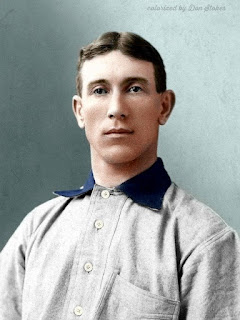
Honus Wagner, as a rookie in 1897

October 15, 1899: The Louisville Colonels beat the Chicago Orphans, 9-5 at the West Side Grounds in Chicago. The former Chicago White Stockings got this name because their longtime 1st baseman and manager, Adrian Anson, known as "Cap" (for "Captain") when he was younger and "Pop" as he got older, had retired, and "they missed their Pop."

The Orphans actually played 2 games against 2 different teams on this day. They also beat the St. Louis Perfectos, 7-0 at the West Side Grounds in Chicago. The Perfectos became the Cardinals in 1900, and the Orphans became the Cubs in 1903.

The Colonels' win over Chicago would be the last game they ever played, as they were absorbed by the Pittsburgh Pirates. Led by manager and left fielder Fred Clarke, and shortstop John "Honus" Wagner, they ended the season on this day in 9th place, at 75-77.

The National League contracted from 12 to 8 teams for the 1900 season. Barney Dreyfuss, owner of the Colonels, bought 
a half-interest in the Pirates. As part of the deal, he negotiated the transfer of the best Louisville players, namely Wagner (himself a Pittsburgh native), Clarke, center fielder Tommy Leach, and pitchers Charles "Deacon" Phillippe and George "Rube" Waddell, to the Pirates.

As a result of this deal, the Pirates won 4 of the next 10 NL Pennants, and were at least in the race for most of the rest. With Wagner becoming the best player in baseball, the Pirates reached but lost the 1st World Series in 1903, and won the World Series in 1909.

The Colonels began in the American Association in 1882, won the Pennant in 1890, and transferred to the NL with the AA's demise after the 1891 season. But most ballparks at the time were made of wood, and their home field, Eclipse Park, burned down on September 27, 1892. It was rebuilt, but burned down again on August 12, 1899, while the team was on the road, and they finished the season on the road.

Given the team's struggles on the field since entering the NL, and the fact that the NL was determined to contract -- the Baltimore Orioles, the Cleveland Spiders and the Washington Senators were also eliminated -- it made more sense for the Colonels to be one of the teams that gave up.

Louisville has since been one of the top minor-league cities of the last 120 years, in terms of both competitiveness and attendance. But it has never returned to the major leagues, nor is it likely to, since the Louisville metropolitan area is home to only 1.4 million people, and the city is just 82 miles from Cincinnati, itself one of MLB's smallest markets. Louisville has been denied a team in every MLB expansion: 1961-62, 1969, 1977, 1993 and 1998.

In a new, Class AAA league called the American Association, the Louisville Colonels won Pennants in 1909, 1916, 1921, 1925, 1926, 1930, 1939, 1940, 1944, 1945, 1946, 1954, 1960, 1961 and 1962. That team was moved, due to stadium issues. A new Louisville Colonels played in the Class AAA International League from 1967 to 1972, winning no Pennants.

On January 6, 1964, Charlie Finley signed a 2-year pact to move the Athletics from Kansas City to Louisville, pending American League approval. He is later denied that approval, and the A's stay put in Kansas City until after the 1967 season, when they moved to Oakland. 

In 1982, the Louisville Redbirds began play in the IL, and won Pennants in 1984, 1985 and 1995. They were renamed the Louisville RiverBats in 1999, and won the Pennant in 2001. The name was shortened to the Louisville Bats in 2002, and, through the 2022 season, they have not won another Pennant, although they have won their Division as recently as 2010.

Charlie Emig, a lefthanded pitcher from Cincinnati, who started 1 game for the Colonels in 1896, was not only the club's last surviving player, but also the last surviving man who had played a Major League Baseball (as we would now call it) game in the 19th Century. He died on October 2, 1975, age 100.

*

October 15, 1899 was a Sunday. There were 2 other baseball games played on this day, a doubleheader at League Park in Cincinnati, between the 2 Ohio teams. The Cincinnati Reds swept the Cleveland Spiders, 16-1 and 19-3.

I have a separate entry for that event, because the Spiders put together the worst season in the history of what's now called Major League Baseball. Their removal from the NL opened the door in 1901 for the AL team that was named the Blues, renamed the Bronchos in 1902, renamed the Naps for Napoleon Lajoie in 1903, renamed the Indians, in 1915, and renamed the Guardians in 2022.

Along with Cleveland and Louisville, the NL also dropped the Baltimore Orioles and the Washington Senators. The American League added teams with those names in 1901.

The Orioles had won the Pennant in 1894, 1895 and 1896, and had nearly done so in 1897. But the era of "syndicate baseball" meant that some of their best men were transferred to the Brooklyn team, including manager Ned Hanlon.

Hanlon's name reminded sportswriters of a circus troupe called Hanlon's Superbas, and so the team formerly known as the Grays and the Bridegrooms was renamed the Superbas. They won the Pennant in 1899, and would do so again in 1900. In 1911, they became the Dodgers.

The AL's Orioles were mismanaged, and the franchise was canceled after the 1902 season. A new team was established for the 1903 season, called the New York Highlanders, and renamed the Yankees in 1913. A minor-league version of the Orioles was established, and replaced in 1954 when the St. Louis Browns moved to Baltimore to take up the old name.

Wednesday, October 12, 2022

October 13, 1903: The 1st World Series Is Won

The 1903 Boston Americans, with their leading fan club,
the Royal Rooters

October 13, 1903: The 1st World Series is won by the Boston Americans, 3-0, over the Pittsburgh Pirates, at the Americans' home field, the Huntington Avenue Baseball Grounds in Boston. 

Both teams were led by player-managers: Boston by 3rd baseman Jimmy Collins, Pittsburgh by left fielder Fred Clarke. This was the 1st Pennant for the Americans, and the 3rd overall and the 3rd straight for the Pirates.

The American League had been founded in 1901, and offered the National League a deal: Accept us as a major league, separate but equal, and we will respect every contract you have, with any player. The NL refused, and the AL raided their rosters. After 2 years, an agreement was reached: The NL would accept the AL as an equal, the AL agreed to respect NL contracts and adopt the reserve clause, a National Commission would be set up to oversee both Leagues, and transactions between an NL team and an AL team would be allowed.

Pirates owner Barney Dreyfuss, seeing his team run away with the NL Pennant, challenged Americans owner Henry Killilea to a best-6-out-of-11 postseason series. They settled on a best-5-out-of-9.

On October 1, at Huntington Avenue, Denton True "Cy" Young, the man for whom the award for the best pitcher in each major league would one day be named, started Game 1 for the Americans. Deacon Phillippe started for the Pirates. Young did not pitch like a Cy Young Award winner: The Pirates tagged him for 4 runs in the top of the 1st inning. In the top of the 7th, already leading 6-0, right fielder Jimmy Sebring hit an inside-the-park home run, the 1st home run in World Series history. The Pirates won, 7-3.

In Game 2, on October 2, it looked like the Pirates had used up all their offense in Game 1. Bill Dinneen allowed only 3 hits. Patrick "Patsy" Dougherty was the 1st Boston batter of the game, and led off with a home run. Not until 2015 would that happen again in a World Series game. Dougherty then became the 1st player to hit 2 home runs in a World Series game, and his 2nd homer was the 1st fair ball to actually go over the fence in a World Series game. The Red Sox won, 3-0.

On October 3, Phillippe came back after just 1 day's rest, and pitched another complete-game victory, and the Pirates got the runs they needed, beating Boston, 4-2, to take a 2-1 lead in the series.
Deacon Phillippe

The action moved out to Exposition Park, in Allegheny City, on the north bank of the Ohio River. In 1907, it would be annexed by the City of Pittsburgh. That same year, the Boston Americans would change their name to the Boston Red Sox.

There were 2 days off, and Phillippe, winner of Games 1 and 3, was ready to go again on October 6. So was Dinneen, winner of Game 2. The Pirates scored 3 runs in the bottom of the 7th, to take a 5-1 lead. The Americans tried to come back in the top of the 9th, but Phillippe bore down and stopped them, and the Pirates were 5-4 winners. They now led 3 games to 1, although it took 5 games to win the series.

Game 5, on October 7, would see the return of Cy Young. The Pirates started Bill "Brickyard" Kennedy, who had helped the Brooklyn Superbas, forerunners of the Dodgers, win the NL Pennant in 1899 and 1900. The game was scoreless for 5 innings, but the Americans broke out with 6 runs in the top of the 6th, and 4 more in the 7th. They won, 11-2.
Cy Young

Game 6, on October 8, was a rematch between the Game 2 starters, Dinneen and Sam Leever. The score was different, but the result was the same: Boston 6, Pittsburgh 3. The Series was now tied, 3-3.

Regardless of result, Game 7, on October 10, was going to be the last game in Pittsburgh, with the now-assured Game 8 taking place in Boston. This time, Young outpitched Phillippe, pitching a 4-hit shutout, as the Americans won, 3-0.

It was Boston's 3rd straight win, and the Pirates blamed the traveling Boston fans, the "Royal Rooters," who were singing a big hit song of the time, "Tessie," making up new lyrics to distract the Pirate hitters. Example: Instead of "Tessie, you make me feel so badly," they sang, "Honus, why do you hit so badly?"

The Royal Rooters had been set up as fans of the city's NL team, the Boston Beaneaters, who played at the South End Grounds, on the other side of the railroad from the Huntington Avenue Grounds. But when team owner Arthur Soden raised ticket prices, the Rooters defected to the new team. The Beaneaters never recovered, and, as the Boston Braves, went from winning 12 Pennants between 1871 and 1898 to winning only 2 Pennants from then until 1952, moving to Milwaukee and then to Atlanta in 1966.

John Peter "Honus" Wagner, the Pirates' shortstop, the man then regarded as the best player in the sport, and still, more than a century after his last game, as the greatest shortstop of all time, had a bad Series: 6-for-27, batting .222, although he did have 3 RBIs and 3 stolen bases.
Honus Wagner

"I was a joke in that Boston-Pittsburgh Series," he later said. "What does it profit a man to hammer along and make a few hit,s when they are not needed only to fall down when it comes to a pinch?" 

Game 8 was played on October 13, at Huntington Avenue. For the Pirates, Phillippe made his 5th start of the Series. For the Americans, Dinneen made his 4th. In the bottom of the 4th, Albert "Hobe" Ferriss singled home 2 runs, and that would be all Dinneen needed, as he pitched a 4-hit shutout. The Americans won, 3-0, and won the Series, 5 games to 3. The last out was Dinneen striking out Wagner.
Bill Dinneen

The 1903 World Series was an agreement between 2 teams, not the 2 Leagues. In 1904, the Americans won the AL Pennant again, edging the New York Highlanders, the team that would become the Yankees. The New York Giants won the NL Pennant, but team owner John T. Brush refused to play the Champions of "an inferior league." In reality, he didn't want to face the embarrassment of losing, especially if it was to the other New York team.

The outcry was so intense that Brush met with the members of the National Commission, and they wrote the rules that would govern the World Series thereafter. Aside from from 1919, 1920 and 1921, when they temporarily went back to a best-5-out-of-9 format, every World Series from 1905 has been a best-4-out-of-7. And the Giants won the 1905 World Series, beating the Philadelphia Athletics. Not until 1912 would the Giants play the Red Sox in a World Series, with the Red Sox winning in 8 games, forced by Game 2 being called due to darkness while tied.

In 1908, somewhat copying the National League team's former name of Red Stockings, the Americans became the Boston Red Sox.

The Pirates won another Pennant in 1909, and this time, Wagner was the Series' star, going 8-for-24, batting .333, with 6 RBIs and 6 stolen bases, outshining his new competitor for the title of baseball's best player, Ty Cobb, as Wagner's Pirates beat Cobb's Detroit Tigers in 7 games.

The last survivor of the 1st World Series was Boston shortstop Freddy Parent, who lived on until 1972. Right fielder Tommy Leach was the last surviving 1903 Pirate, living until 1969. Home run hero Sebring was the first to die: Bright's disease, a kidney disorder, took his life in 1909, at the age of 27.

Northeastern University's Cabot Gym is now on the site, and a statue of Cy Young stands at the approximate location of the pitcher’s mound.
The Red Sox have a team Hall of Fame. From their 1903 and 1904 World Champions, they have inducted team owner John I. Taylor, 3rd baseman anad manager Jimmy Collins, right fielder Buck Freeman, and pitchers Cy Young and Bill Dinneen.

October 13, 1903 was a Tuesday. There were no other games in any other sports on either day.

Thursday, October 6, 2022

October 7, 1902: The 1st All-Star Game In American Sports?

Honus Wagner

October 7, 1902: Perhaps the first all-star game in North American sports is played, at Exposition Park in Pittsburgh, home of the National League's Pittsburgh Pirates. The Pirates' current stadium, PNC Park, is built roughly on the site. The Pirates, including the great shortstop John Peter "Honus" Wagner, beat a team of American League all-stars‚ 4-3. Sam Leever is the winning pitcher, and Cy Young of the Boston Americans (Red Sox) is the losing pitcher.

The Pirates ran away with the National League Pennant, going 103-36, to finish a record 27 1/2 games ahead of the 2nd-place team, the Brooklyn Superbas, forerunners of the Dodgers. In the American League, and across the State of Pennsylvania, the Philadelphia Athletics, managed by Connie Mack -- the eventual "Grand Old Man of Baseball" was about to turn 40 -- won the Pennant by 5 games over the St. Louis Browns. However, with the Leagues still "at war" with each other, there would be no postseason World Series until the following year.

October 7, 1902 was a Tuesday. This was the only score on this historic day: Football was in midweek, hockey was still all-amateur, and basketball barely existed.

Monday, October 3, 2022

October 4, 1902: The Flying Dutchman and the Record-Setting Pirates

Honus Wagner

October 4, 1902: The Pittsburgh Pirates beat the Cincinnati Reds, 11-2 at Exposition Park in Pittsburgh. Shortstop Honus Wagner goes 1-for-5 with an RBI, while 1st baseman William "Kitty" Bransfield goes 3-for-5 with an RBI. Charles "Deacon" Phillippe goes the distance, for his 20th win against 9 losses.

The Pirates finish the season with a record of 103 wins and 36 losses. That's a winning percentage of .741, and it's still a record. They win the National League Pennant by 27 1/2 games, also a record 1st-place finish to this day. They clinched the Pennant on September 2, yet another record. (The American League record is September 4, by the 1941 New York Yankees.)

Pitching, as it so often is for a championship team, was the key. In addition to Phillippe going 20-9 with a 2.05 ERA, Jack Chesbro went 28-6 with 2.17, Jesse Tannehill went 20-6 with 1.95, Ed Doheny went 16-4 with 2.53, and Sam Leever went 15-7 with 2.39.

The team as a whole batted .286. Center fielder Clarence "Ginger" Beaumont led them with a .357 average, while Wagner batted .330, and right fielder-manager Fred Clarke batted .316. Wagner led the team with 91 RBIs, and 3rd baseman Tommy Leach had 85.

A Pittsburgh native, John Peter Wagner was the son of German immigrants, and so "John" was often reverted to the German name "Hans," which became "Honus." Despite his bowed legs, he was very fast, allowing him to steal bases, and play just about any position well, but especially shortstop, the most difficult position in the infield. He was known as "The Flying Dutchman" -- "Dutch" meaning "Deutsch," as in "German," not "Dutch" as we now understand that term, meaning "from the Netherlands."

At the time, Wagner was 28 years old, and was regarded as the best player in baseball -- at the least, one of the top two, along with Napoleon Lajoie, of the team that would, the next season, actually be named for him, the Cleveland Naps.

John McGraw, himself a pretty good player in the 1890s, and newly installed as manager of the New York Giants, called Wagner "the nearest thing to a perfect ballplayer." And Chicago sportswriter Hugh Fullerton once wrote, "If a man with a voice loud enough to make himself heard all over the United States should stand on top of Pike's Peak, and ask, 'Who is the greatest ball player?' the name he'd hear shouted back would be, 'Wagner.'"

He helped the Pirates win 3 straight NL Pennants: 1901, 1902 and 1903. The Pirates lost the 1st World Series, in 1903, to the team now known as the Boston Red Sox. By the start of the next decade, he would be surpassed by Ty Cobb, center fielder for the Detroit Tigers. But in 1909, Wagner's Pirates beat Cobb's Tigers in the World Series, and Wagner outplayed Cobb. Both men would be among the 1st 5 players elected to the Baseball Hall of Fame, along with Babe Ruth, Christy Mathewson and Walter Johnson.

*

October 4, 1902 was a Saturday. These other baseball games were played that day:

* A doubleheader was split at the South End Grounds in Boston. The Boston Beaneaters won the opener, 5-2. John Malarkey (yes, that was his name) outpitched Christy Mathewson. The New York Giants won the nightcap, 5-1. Joe McGinnity (21-18) outpitched Vic Willis (27-20).

* And the Chicago Cubs and the St. Louis Cardinals were rained out after 7 innings at Robison Field in St. Louis, with the game tied, 7-7.

It was also a day for college football. The University of Kansas and Kansas State University play each other in football for the 1st time. The Kansas Jayhawks beat the Kansas State Wildcats 16-0, at McCook Field on the Jayhawks' campus in Lawrence. Through the 2021 season, the Jayhawks lead the all-time series in the "Sunflower Showdown," 64-49-5. (UPDATE: Through 2023, it's 65-51-5. The Jayhawks haven't won it since 2008.)

In other notable games:

* Army beat Tufts, 5-0 on The Plain in West Point, New York.

* Navy lost to Princeton, 11-0 at Worden Field in Annapolis, Maryland.

* Harvard beat Bates College, 23-0 at Soldiers' Field in Boston. (Unlike the later stadium in Chicago, this one was, and is, named "Soldiers' Field," not "Soldier Field.)

* Massachusetts beat Boston College, 30-0 at Alumni Field in Amherst, Massachusetts.

* Yale beat Amherst, 23-0 at Yale Field in New Haven, Connecticut.

* The University of Pennsylvania beat Penn State, 17-0 at the original Franklin Field in Philadelphia. The schools haven't played each other since 1958, when Penn embraced its Ivy League status, and accepted that they couldn't be as big as Penn State then was, even with Joe Paterno just an assistant coach under Rip Engle.

* Michigan, defending and upcoming National Champions, beat Case, 48-6 at Regents Field in Ann Arbor, Michigan.

* The University of Chicago beat Knox College, 5-0 at Marshall Field in Chicago.

* Nebraska beat Colorado, 10-0 at Gamble Field in Boulder, Colorado.

* And Columbia beat Rutgers, 43-0 at Neilson Field in New Brunswick, New Jersey.

And in English soccer, Bristol City beat Woolwich Arsenal, 1-0 at St John's Lane in Bristol, in England's West Country. In 1904, City moved to Ashton Gate. Woolwich Arsenal would later move to North London, change their name to simply "Arsenal," and, decades later, become the team I support.

Friday, September 30, 2022

October 1, 1903: The 1st World Series Is Played

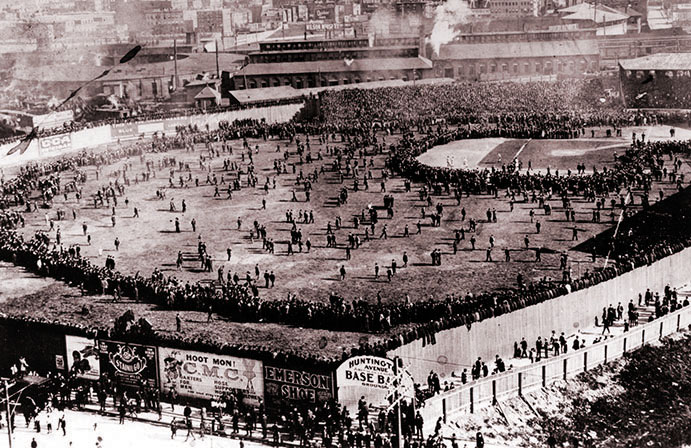
The Huntington Avenue Grounds, during the 1903 World Series

October 1, 1903: The 1st World Series game is played, at the Huntington Avenue Baseball Grounds in Boston. Denton True "Cy" Young, the man for whom the award for the best pitcher in each major league would one day be named, started for the home team, the American League Champions, the Boston Americans. Deacon Phillippe started for the visitors, the National League Champions, the Pittsburgh Pirates.

Both teams were led by player-managers: Boston by 3rd baseman Jimmy Collins, Pittsburgh by left fielder Fred Clarke. This was the 1st Pennant for the Americans, and the 3rd overall and the 3rd straight for the Pirates.

The AL had been founded in 1901, and offered the NL a deal: Accept us as a major league, separate but equal, and we will respect every contract you have, with any player. The NL refused, and the AL raided their rosters. After 2 years, an agreement was reached: The NL would accept the AL as an equal, the AL agreed to respect NL contracts and adopt the reserve clause, a National Commission would be set up to oversee both Leagues, and transactions between an NL team and an AL team would be allowed.

Pirates owner Barney Dreyfuss, seeing his team run away with the NL Pennant, challenged Americans owner Henry Killilea to a best-6-out-of-11 postseason series. They settled on a best-5-out-of-9.

In Game 1, Cy Young did not pitch like a Cy Young Award winner: The Pirates tagged him for 4 runs in the top of the 1st inning. In the top of the 7th, already leading 6-0, right fielder Jimmy Sebring hit an inside-the-park home run, the 1st home run in World Series history. The Pirates won, 7-3.

The home plate umpire for this game was Hank O'Day. A major league pitcher from 1884 to 1890, he umpired National League Games from 1895 to 1927, most famously in the "Merkle's Boner" game of 1908. He is one of the few umpires elected to the Baseball Hall of Fame.

Also on this day, the Pennsylvania Railroad opened its new station at New Brunswick, New Jersey, replacing a former station on the site. Following a major renovation in time for its 100th Anniversary, the station is still in operation, a major one on New Jersey Transit's Northeast Corridor Line between New York City and Trenton, and also carries Amtrak traffic, although Amtrak no longer uses it as a stop on their own Northeast Corridor between Boston and Washington. 

In Game 2, it looked like the Pirates had used up all their offense in Game 1. Bill Dinneen allowed only 3 hits. Patrick "Patsy" Dougherty was the 1st Boston batter of the game, and led off with a home run. Not until 2015 would that happen again in a World Series game. Dougherty then became the 1st player to hit 2 home runs in a World Series game, and his 2nd homer was the 1st fair ball to actually go over the fence in a World Series game. The Red Sox won, 3-0.

Phillippe came back after just 1 day's rest, and pitched another complete-game victory, and the Pirates got the runs they needed, beating Boston, 4-2, to take a 2-1 lead in the series.
Deacon Phillippe

The action moved out to Exposition Park, in Allegheny City, on the north bank of the Ohio River. In 1907, it would be annexed by the City of Pittsburgh. That same year, the Boston Americans would change their name to the Boston Red Sox.

There were 2 days off, and Phillippe, winner of Games 1 and 3, was ready to go again. So was Dinneen, winner of Game 2. The Pirates scored 3 runs in the bottom of the 7th, to take a 5-1 lead. The Americans tried to come back in the top of the 9th, but Phillippe bore down and stopped them, and the Pirates were 5-4 winners. They now led 3 games to 1, although it took 5 games to win the series.

Game 5 would see the return of Cy Young. The Pirates started Bill "Brickyard" Kennedy, who had helped the Brooklyn Superbas, forerunners of the Dodgers, win the NL Pennant in 1899 and 1900. The game was scoreless for 5 innings, but the Americans broke out with 6 runs in the top of the 6th, and 4 more in the 7th. They won, 11-2.
Cy Young

Game 6 was a rematch between the Game 2 starters, Dinneen and Sam Leever. The score was different, but the result was the same: Boston 6, Pittsburgh 3. The Series was now tied, 3-3.

Regardless of result, Game 7 was going to be the last game in Pittsburgh, with the now-assured Game 8 taking place in Boston. This time, Young outpitched Phillippe, pitching a 4-hit shutout, as the Americans won, 3-0.

It was Boston's 3rd straight win, and the Pirates blamed the traveling Boston fans, the "Royal Rooters," who were singing a big hit song of the time, "Tessie," making up new lyrics to distract the Pirate hitters. Example: Instead of "Tessie, you make me feel so badly," they sang, "Honus, why do you hit so badly?"

John Peter "Honus" Wagner, the Pirates' shortstop, the man then regarded as the best player in the sport, and still, more than a century after his last game, as the greatest shortstop of all time, had a bad Series: 6-for-27, batting .222, although he did have 3 RBIs and 3 stolen bases.
Honus Wagner

"I was a joke in that Boston-Pittsburgh Series," he later said. "What does it profit a man to hammer along and make a few hits when they are not needed only to fall down when it comes to a pinch?" 

October 13, 1903: Game 8 of the 1st World Series, at the Huntington Avenue Grounds in Boston. For the Pirates, Phillippe made his 5th start of the Series. For the Americans, Dinneen made his 4th. In the bottom of the 4th, Albert "Hobe" Ferriss singled home 2 runs, and that would be all Dinneen needed, as he pitched a 4-hit shutout. The Americans won, 3-0, and won the Series, 5 games to 3. The last out was Dinneen striking out Wagner.
Bill Dinneen

The 1903 World Series was an agreement between 2 teams, not the 2 Leagues. In 1904, the Americans won the AL Pennant again, edging the New York Highlanders, the team that would become the Yankees. The New York Giants won the NL Pennant, but team owner John T. Brush refused to play the Champions of "an inferior league." In reality, he didn't want to face the embarrassment of losing, especially if it was to the other New York team.

The outcry was so intense that Brush met with the members of the National Commission, and they wrote the rules that would govern the World Series thereafter. Aside from from 1919, 1920 and 1921, when they temporarily went back to a best-5-out-of-9 format, every World Series from 1905 has been a best-4-out-of-7. And the Giants won the 1905 World Series, beating the Philadelphia Athletics. Not until 1912 would the Giants play the Red Sox in a World Series, with the Red Sox winning in 8 games, forced by Game 2 being called due to darkness while tied.

In 1908, the Americans sort-of adopted the former name of the National League team in town, becoming the Boston Red Sox.

The Pirates won another Pennant in 1909, and this time, Wagner was the Series' star, going 8-for-24, batting .333, with 6 RBIs and 6 stolen bases, outshining his new competitor for the title of baseball's best player, Ty Cobb, as Wagner's Pirates beat Cobb's Detroit Tigers in 7 games.

The last survivor of the 1st World Series was Boston shortstop Freddy Parent, who lived on until 1972. Right fielder Tommy Leach was the last surviving 1903 Pirate, living until 1969. Home run hero Sebring was the first to die: Bright's disease, a kidney disorder, took his life in 1909, at the age of 27.

Northeastern University's Cabot Gym is now on the site, and a statue of Cy Young stands at the approximate location of the pitcher’s mound.

*

October 1, 1903, the day the World Series opened, was a Thursday. Classical pianist Vladimir Horowitz was born on that day. There were no other games in any other sport on that day.

Sunday, June 12, 2022

June 12, 1939: The Baseball Hall of Fame Opens

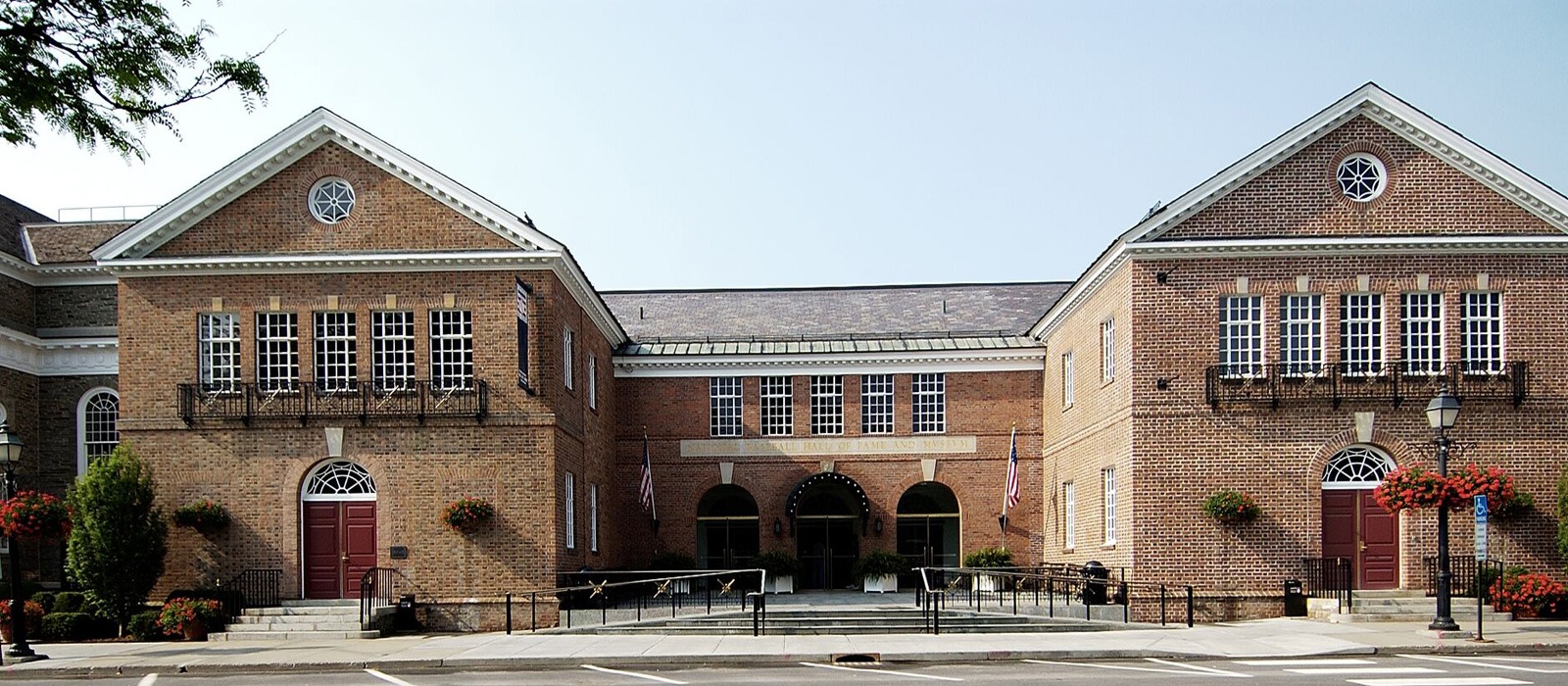
June 12, 1939: The National Baseball Hall of Fame and Museum opens, at 25 Main Street in Cooperstown, Otsego County, in Central New York. It was the official 100th Anniversary of baseball being invented in that town by Abner Doubleday.

Of course, just as most people already knew the world was round long before Christopher Columbus was born, most people already knew that Doubleday, a hero of the American Civil War, who did come from Cooperstown, didn't have a damn thing to do with baseball. The real reason the Hall, and its accompanying museum, were established there is that the Clark family, the unofficial powers-that-be (and still do) in Cooperstown, wanted a tourist attraction during, and that would outlast, the Great Depression. Mission accomplished.

The opening ceremony is presided over by the Commissioner of Baseball, Kenesaw Mountain Landis. It is broadcast nationwide on NBC radio.

In each of the past 4 years, there had been elections for the Hall of Fame. These were the inductees thus far:

* 1936: Ty Cobb, Babe Ruth, Honus Wagner, Christy Mathewson and Walter Johnson. "The First Five," or "The First Class," whose plaques are located in an X pattern, with leading vote-getting Cobb's in the middle, at the center of the back wall of the Hall's Gallery.
Top left: Christy Mathewson. Top right: Honus Wagner.
Center: Ty Cobb.
Bottom left: Babe Ruth. Bottom right: Walter Johnson.

* 1937: Players George Wright, Cy Young, Nap Lajoie and Tris Speaker; managers Connie Mack and John McGraw; and the 1st President of each major league, the National League's Morgan Bulkeley and the American League's Ban Johnson.

* 1938: One player, Grover Cleveland Alexander; and pioneers Alexander Cartwright and Henry Chadwick.

* 1939: Players Candy Cummings, Al Spalding, Cap Anson, Buck Ewing, Charles "Old Hoss" Radbourn, Willie Keeler, Eddie Collins and George Sisler; and executive Charles Comiskey. (Due to the unusual circumstances of his retirement, Lou Gehrig would be elected later in the year, after the Hall's opening.)

So there were 5 inaugural electees, and 25 inaugural inductees. Of these, 11 were still alive: Mack was 76 years old, Young 72, Wagner 65, Lajoie 64, Alexander and Collins 52, Johnson and Speaker 51, Sisler 46, and Ruth 44.

And of those 11 men, 10 posed for a commemorative photograph. Legend has it that Cobb arrived late, in order to spite someone, probably Landis. He was late, arriving a few minutes after the photo was taken, but it was due to circumstances beyond his control: He lived in California, and, transportation links being what they were at the time, he just plain didn't make it.
Top row, left to right: Honus Wagner, Grover Cleveland Alexander,
Tris Speaker, Nap Lajoie, George Sisler and Walter Johnson.
Bottom row, left to right: Eddie Collins, Babe Ruth, Connie Mack and Cy Young.
No, I don't know why the Babe has no tie and has his
collar sticking out over his lapels, like he's in the 1970s.

Sisler is probably the least well-remembered player of these 10, partly because he fell just short of 3,000 hits for his career; and partly because he played most of his career for a team that no longer exists in that form: The St. Louis Browns became the Baltimore Orioles in 1954.

Uniform numbers have only been worn since 1929, so most of the original 25 honorees are not honored with the retirement of their uniform number, because the number, let alone the honor, wasn't available. Wagner wore one as a coach, and was so honored; Johnson wore one as a manager, and Speaker and Collins wore them as coaches, but were not so honored.

Cobb, Johnson, Mack and Sisler are honored with statues at the current ballparks in their cities. Ruth is honored with one at the ballpark in his hometown. Young is honored with one at the site of one of his home ballparks. And Mathewson is honored with the renaming of his school's football stadium for him. (In college, he excelled at that sport as well.) Comiskey was once, but is no longer, honored with the naming of the ballpark he built for him.

In 1949, Ogden Nash, my grandmother's favorite poet, wrote "Line-Up for Yesterday" for Sport magazine, an alphabetical list of star players. For the letter Z, instead of citing a single player, since none with a last name starting with Z has been elected to the Hall of Fame, he wrote:

Z is for Zenith
The summit of fame.
These men are up there.
These men are the game.

For the letter I, he cheated a little:

I is for Me,
Not a hard-hitting man,
But an outstanding all-time
Incurable fan.

*

June 12, 1939 was a Monday. There were no scores on that historic day: MLB got the day off so the ceremony could be the focus, it was the off-season for the NFL and the NHL, and the NBA hadn't been founded yet.

Wednesday, February 2, 2022

February 2, 1936: The 1st Baseball Hall of Fame Election

Top left: Christy Mathewson. Top right: Honus Wagner.
Center: Ty Cobb.
Bottom left: Babe Ruth. Bottom right: Walter Johnson.

February 2, 1936: The Baseball Hall of Fame holds its 1st election for players.

Members of the Baseball Writers' Association of America (BBWAA) were given authority to select individuals from the 20th Century; while a special Veterans Committee, made up of individuals with greater familiarity with the 19th Century game, was polled to select deserving individuals from that era. The intent was for 15 honorees to be selected before the ceremony that would open the Hall's Museum in 1939: 10 from the 20th Century and 5 from the 19th; and that additional players from both eras would be selected in later years.

The Voters were given free rein to decide for themselves in which group a candidate belonged, with neither group knowing the outcome of the other election; some candidates had their vote split between the elections as a result: Cy Young, the pitcher with most wins in Major League history, finished 8th in the BBWAA vote, and 4th in the Veterans vote.

In addition, there was no prohibition on voting for active players, a number of whom received votes. Individuals who had been banned from baseball, such as "Shoeless" Joe Jackson and Hal Chase, were also not formally excluded, though few voters chose to include them on ballots.

In the BBWAA election, voters were instructed to cast votes for 10 candidates, the same number of desired selections. In the Veterans' election, voters were also instructed to vote for 10, although the desire for only 5 initial selections led to revisions in the way the votes were counted.  Any candidate receiving votes on at least 75 percent of the ballots in either election would be honored with induction to the Hall upon its opening in the sport's supposed centennial year of 1939.

A total of 226 ballots were cast, with 2,231 individual votes for 47 specific candidates, an average of 9.87 per ballot. 170 votes were required for election.
PlayerVotesPercent
Ty Cobb22298.2
Babe Ruth21595.1
Honus Wagner21595.1
Christy Mathewson20590.7
Walter Johnson18983.6
Nap Lajoie14664.6
Tris Speaker13358.8
Cy Young11149.1
Rogers Hornsby10546.4
Mickey Cochrane8035.3
George Sisler7734.0
Eddie Collins6026.5
Jimmy Collins5825.6
Grover Cleveland Alexander5524.3
Lou Gehrig5122.5
Roger Bresnahan4720.7
Willie Keeler4017.6
Rube Waddell3314.6
Jimmie Foxx219.2
Ed Walsh208.8
Ed Delahanty177.5
Pie Traynor167.1
Frankie Frisch146.1
Lefty Grove125.3
Hal Chase114.8
Ross Youngs104.4
Bill Terry93.9
Johnny Kling83.5
Lou Criger73.1
Mordecai Brown62.6
Johnny Evers62.6
Frank Chance52.2
John McGraw41.7
Ray Schalk41.7
Al Simmons41.7
Chief Bender20.8
Joe Jackson20.8
Edd Roush20.8
Frank Baker10.4
Bill Bradley10.4
Fred Clarke10.4
Sam Crawford10.4
Kid Elberfeld10.4
Connie Mack10.4
Rube Marquard10.4
Nap Rucker10.4
Dazzy Vance10.4
Charlie Gehringer00
Gabby Hartnett00
Billy Sullivan00
Note: All players whose names are in italics here have since been elected. Eddie Collins and Jimmy Collins were not related, but they were teammates, on the 1907 and 1908 Philadelphia Athletics, at the end of Jimmy's playing career and near the beginning of Eddie's.

Still active at the time of the vote: Hornsby, Cochrane, Gehrig, Foxx, Traynor, Frisch, Grove, Simmons, Gehringer and Hartnett. Ruth had played his last game only 8 months earlier.

The Hall would eventually ban from its balloting all players declared ineligible by Major League Baseball, so, as of February 2, 2022, Chase and Jackson have never been elected. Nor have, from this list, Kling, Criger, Bradley, Elberfeld and Rucker. None of those have many advocates at this point.

Cobb finished 1st in the voting. This made him, unofficially, not just in baseball, but the 1st member of any major sport's Hall of Fame. As time passed, however, despite neither man playing a game in the interim -- Ruth was the most recently-retired of the 5, having played his last game on May 30, 1935 -- Ruth came to surpass Cobb in fans' minds as the greatest player in the history of the sport.

Brief profiles:

* Tyrus Raymond Cobb, born on December 18, 1886 in Narrows, Georgia, and grew up in Royston, Georgia. Nicknamed "The Georgia Peach."

Center field, Detroit Tigers, 1905-26; Philadelphia Athletics, 1927-28. .366 lifetime batting average, still an all-time record. 4,189 hits, formerly a record, still 2nd all-time. 892 stolen bases, formerly a record. 168 OPS+. (His hit total had long been listed as 4,191, and thus his batting average at .367, but a later check of records showed that 1 game, and thus 2 of his hits, had mistakenly been counted twice.)
This photo is colorized, but real.

* George Herman Ruth Jr., born on February 6, 1895 in Baltimore, Maryland, and grew up there. Nicknamed "Babe" because his teammates, referring to the scout who signed him, called him "Jack Dunn's Baby." Also known as "The Great Bambino," "The Sultan of Swat," and a lot of similar hard-hitting royal nicknames.

Boston Red Sox, 1914-19; New York Yankees, 1920-34; Boston Braves, 1935. As a pitcher, most of it from 1914 to 1918: 94-46 record, 2.28 ERA, 122 ERA+, 1.159 WHIP, so he was on his way to a Hall of Fame level at that before his hitting meant that he had to be was switched to an everyday player. As an offensive player, mostly from 1918 onward: .342 batting average. 714 home runs, formerly a record. 2,214 RBIs, formerly a record. .474 on-base percentage, 2nd all-time. .690 slugging percentage, still a record. 206 OPS+, still a record. 
The Yankees did not put the interlocking N-Y logo
on their jerseys permanently until 1936,
so Ruth never wore such a jersey.

* John Peter Wagner, born February 24, 1874 in Carnegie, Pennsylvania, outside Pittsburgh. Being of German descent, he was called the German variation of John, "Hans," which became "Honus." Known for his speed as "The Flying Dutchman," keeping in mind that "Dutch" was a name given to people of German descent, as well as to people descended from the Netherlands.

Shortstop, Louisville Colonels, 1897-99; Pittsburgh Pirates, 1900-17. .328 batting average. 3,420 hits, the record until surpassed by Cobb. 723 stolen bases. Considered the best defensive player of his era. 151 OPS+.
* Christopher Mathewson, born August 12, 1880 in Factoryville, in the Lehigh Valley of Pennsylvania. Nicknamed "Christy," "Matty" and "Big Six," because he was 6 feet tall, at a time when that was considered big. Pitcher, New York Giants, 1900-16, concluding that last year with the Cincinnati Reds. 373-188, 2.13 ERA, 136 ERA+, 1.058 WHIP.
Colorized, but definitely a photo, not a painting.

* Walter Perry Johnson, born November 6, 1887 in Humboldt, Kansas, and grew up in Fullerton, California, outside Los Angeles. Nicknamed "The Big Train" early in his career, and "Old Barney" in his later years. Pitcher, Washington Senators, 1907-27. 417-279, 2.17 ERA, 147 ERA+ 1.061 WHIP.
These men became known as "The First Five," or "The First Class." Their plaques are located in an X pattern, with leading vote-getter Cobb's in the middle, at the center of the back wall of the Hall's Gallery.

Cobb was infamous for being difficult to get along with, including with Ruth, but the men eventually put aside their personal and, in terms of baseball playing, stylistic rivalry, and formed a friendship. Cobb had no problem getting along with the others, nor did any of them with each other.
Cobb visiting with Mathewson, 1911 World Series

In 1999, The Sporting News named its 100 Greatest Baseball Players. Ruth had last played 64 years earlier; Cobb, 71; Johnson, 72; Wagner, 82; Mathewson, 83. The number of people who could accurately remember watching them play was already pretty small. The rankings: Ruth came in 1st, Cobb 3rd, Johnson 4th, Mathewson 7th, Wagner 13th. (In between: Willie Mays was 2nd, Hank Aaron 5th, Lou Gehrig 6th, Ted Williams 8th, Hornsby 9th, Stan Musial 10th, Joe DiMaggio 11th, and Alexander 12th.)

In 2022, ESPN listed their Top 100. Ruth's last game was now further back that Mathewson's was in the earlier vote. Ruth came in 1st again, with David Schoenfeld writing for their article, "The baseball we watch today is Babe Ruth's game. Many players make an impact, a few become folk heroes, but nobody changed a sport like Ruth did when he joined the Yankees and transformed baseball into a game of power."

Cobb came in 4th, Johnson 9th, Wagner 12th, Mathewson 25th. (In between: Mays 2nd, Aaron 3rd, Williams 5th, Gehrig 6th, Mickey Mantle 7th, Barry Bonds a steroid-aided 8th, Musial 10th, Pedro Martinez a stupid 11th, Ken Griffey Jr. 13th, Greg Maddux 14th, Mike Trout a laughable 15th, DiMaggio 16th, Roger Clemens 17th, Mike Schmidt 18th, Frank Robinson 19th, Hornsby 20th, Young 21st, Tom Seaver 22nd, Rickey Henderson 23rd, and Randy Johnson -- no relation to Walter, although nearly as fast -- 24th.)

Lajoie, Speaker and Young were elected to the Hall of Fame in its 2nd election, in 1937; Alexander in 1938; Anson, Eddie Collins, Ewing, Keeler, Radbourn, Sisler and, in a special election due to his fatal illness, Gehrig, in 1939.

In addition, elected as managers were Connie Mack and John McGraw in 1937; elected as executives or "pioneers" were Morgan Bulkeley, Ban Johnson and George Wright in 1937; Alexander Cartwright and Henry Chadwick in 1938; and Charles Comiskey, Candy Cummings and Al Spalding in 1939.

So there were 25 inductees when the Hall had its opening ceremony in Cooperstown, New York, already known not to really be the sport's birthplace, on June 12, 1939. There were 11 still alive: Cobb, Ruth, Wagner, Johnson, Lajoie, Speaker, Young, Alexander, Eddie Collins, Sisler and Mack. Transportation links being what they were at the time, Cobb had difficulty getting there, and arrived just too late to appear in the photograph taken of the other 10.

Cobb did turn out to be the last survivor of the First Five, living until 1961. Mathewson had died in 1925, well before the vote; Johnson in 1946, and Ruth in 1948; both too young and from cancer; and Wagner in 1955. Sisler was the last of the Initial Inductees, living until 1973.

*

February 2, 1936 was a Sunday. Baseball and football were out of season. The NBA hadn't been founded yet. There were 2 games in the NHL. The New York Americans lost to the Boston Bruins, 2-1 at the Boston Garden. And the Chicago Black Hawks beat the Toronto Maple Leafs, 2-0 at the Chicago Stadium.

December 31, 1999 & January 1, 2000: The Millennium

December 31, 1999:  The Millennium arrives. The people of planet Earth survived. At a terrible cost. But we hadn't destroyed ourselves. ...