The 1903 Boston Americans, with their leading fan club,
the Royal Rooters
October 13, 1903: The 1st World Series is won by the Boston Americans, 3-0, over the Pittsburgh Pirates, at the Americans' home field, the Huntington Avenue Baseball Grounds in Boston.
Both teams were led by player-managers: Boston by 3rd baseman Jimmy Collins, Pittsburgh by left fielder Fred Clarke. This was the 1st Pennant for the Americans, and the 3rd overall and the 3rd straight for the Pirates.
The American League had been founded in 1901, and offered the National League a deal: Accept us as a major league, separate but equal, and we will respect every contract you have, with any player. The NL refused, and the AL raided their rosters. After 2 years, an agreement was reached: The NL would accept the AL as an equal, the AL agreed to respect NL contracts and adopt the reserve clause, a National Commission would be set up to oversee both Leagues, and transactions between an NL team and an AL team would be allowed.
Pirates owner Barney Dreyfuss, seeing his team run away with the NL Pennant, challenged Americans owner Henry Killilea to a best-6-out-of-11 postseason series. They settled on a best-5-out-of-9.
On October 1, at Huntington Avenue, Denton True "Cy" Young, the man for whom the award for the best pitcher in each major league would one day be named, started Game 1 for the Americans. Deacon Phillippe started for the Pirates. Young did not pitch like a Cy Young Award winner: The Pirates tagged him for 4 runs in the top of the 1st inning. In the top of the 7th, already leading 6-0, right fielder Jimmy Sebring hit an inside-the-park home run, the 1st home run in World Series history. The Pirates won, 7-3.
In Game 2, on October 2, it looked like the Pirates had used up all their offense in Game 1. Bill Dinneen allowed only 3 hits. Patrick "Patsy" Dougherty was the 1st Boston batter of the game, and led off with a home run. Not until 2015 would that happen again in a World Series game. Dougherty then became the 1st player to hit 2 home runs in a World Series game, and his 2nd homer was the 1st fair ball to actually go over the fence in a World Series game. The Red Sox won, 3-0.
On October 3, Phillippe came back after just 1 day's rest, and pitched another complete-game victory, and the Pirates got the runs they needed, beating Boston, 4-2, to take a 2-1 lead in the series.
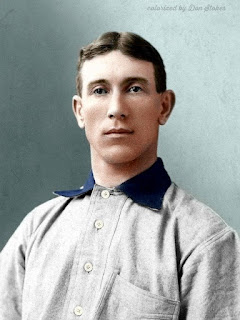
Deacon Phillippe
The action moved out to Exposition Park, in Allegheny City, on the north bank of the Ohio River. In 1907, it would be annexed by the City of Pittsburgh. That same year, the Boston Americans would change their name to the Boston Red Sox.
There were 2 days off, and Phillippe, winner of Games 1 and 3, was ready to go again on October 6. So was Dinneen, winner of Game 2. The Pirates scored 3 runs in the bottom of the 7th, to take a 5-1 lead. The Americans tried to come back in the top of the 9th, but Phillippe bore down and stopped them, and the Pirates were 5-4 winners. They now led 3 games to 1, although it took 5 games to win the series.
Game 5, on October 7, would see the return of Cy Young. The Pirates started Bill "Brickyard" Kennedy, who had helped the Brooklyn Superbas, forerunners of the Dodgers, win the NL Pennant in 1899 and 1900. The game was scoreless for 5 innings, but the Americans broke out with 6 runs in the top of the 6th, and 4 more in the 7th. They won, 11-2.

Cy Young
Game 6, on October 8, was a rematch between the Game 2 starters, Dinneen and Sam Leever. The score was different, but the result was the same: Boston 6, Pittsburgh 3. The Series was now tied, 3-3.
Regardless of result, Game 7, on October 10, was going to be the last game in Pittsburgh, with the now-assured Game 8 taking place in Boston. This time, Young outpitched Phillippe, pitching a 4-hit shutout, as the Americans won, 3-0.
It was Boston's 3rd straight win, and the Pirates blamed the traveling Boston fans, the "Royal Rooters," who were singing a big hit song of the time, "Tessie," making up new lyrics to distract the Pirate hitters. Example: Instead of "Tessie, you make me feel so badly," they sang, "Honus, why do you hit so badly?"
The Royal Rooters had been set up as fans of the city's NL team, the Boston Beaneaters, who played at the South End Grounds, on the other side of the railroad from the Huntington Avenue Grounds. But when team owner Arthur Soden raised ticket prices, the Rooters defected to the new team. The Beaneaters never recovered, and, as the Boston Braves, went from winning 12 Pennants between 1871 and 1898 to winning only 2 Pennants from then until 1952, moving to Milwaukee and then to Atlanta in 1966.
John Peter "Honus" Wagner, the Pirates' shortstop, the man then regarded as the best player in the sport, and still, more than a century after his last game, as the greatest shortstop of all time, had a bad Series: 6-for-27, batting .222, although he did have 3 RBIs and 3 stolen bases.

Honus Wagner
"I was a joke in that Boston-Pittsburgh Series," he later said. "What does it profit a man to hammer along and make a few hit,s when they are not needed only to fall down when it comes to a pinch?"
Game 8 was played on October 13, at Huntington Avenue. For the Pirates, Phillippe made his 5th start of the Series. For the Americans, Dinneen made his 4th. In the bottom of the 4th, Albert "Hobe" Ferriss singled home 2 runs, and that would be all Dinneen needed, as he pitched a 4-hit shutout. The Americans won, 3-0, and won the Series, 5 games to 3. The last out was Dinneen striking out Wagner.

Bill Dinneen
The 1903 World Series was an agreement between 2 teams, not the 2 Leagues. In 1904, the Americans won the AL Pennant again, edging the New York Highlanders, the team that would become the Yankees. The New York Giants won the NL Pennant, but team owner John T. Brush refused to play the Champions of "an inferior league." In reality, he didn't want to face the embarrassment of losing, especially if it was to the other New York team.
The outcry was so intense that Brush met with the members of the National Commission, and they wrote the rules that would govern the World Series thereafter. Aside from from 1919, 1920 and 1921, when they temporarily went back to a best-5-out-of-9 format, every World Series from 1905 has been a best-4-out-of-7. And the Giants won the 1905 World Series, beating the Philadelphia Athletics. Not until 1912 would the Giants play the Red Sox in a World Series, with the Red Sox winning in 8 games, forced by Game 2 being called due to darkness while tied.
In 1908, somewhat copying the National League team's former name of Red Stockings, the Americans became the Boston Red Sox.
The Pirates won another Pennant in 1909, and this time, Wagner was the Series' star, going 8-for-24, batting .333, with 6 RBIs and 6 stolen bases, outshining his new competitor for the title of baseball's best player, Ty Cobb, as Wagner's Pirates beat Cobb's Detroit Tigers in 7 games.
The last survivor of the 1st World Series was Boston shortstop Freddy Parent, who lived on until 1972. Right fielder Tommy Leach was the last surviving 1903 Pirate, living until 1969. Home run hero Sebring was the first to die: Bright's disease, a kidney disorder, took his life in 1909, at the age of 27.

The Red Sox have a team Hall of Fame. From their 1903 and 1904 World Champions, they have inducted team owner John I. Taylor, 3rd baseman anad manager Jimmy Collins, right fielder Buck Freeman, and pitchers Cy Young and Bill Dinneen.
October 13, 1903 was a Tuesday. There were no other games in any other sports on either day.


No comments:
Post a Comment