Showing posts with label george martin. Show all posts

Sunday, September 4, 2022

September 4, 1962: The Beatles' 1st Recording Session

September 4, 1962: The Beatles have their 1st recording session with EMI-Parlophone Records. No one could yet foresee that the band would be so successful, they would pretty much own what was once Electrical & Mechanical Industries, and it would be renamed Apple Records.

To set the scene: For less than a year, the band from Liverpool, England had been managed by Brian Epstein, who took them out of their black leather jackets and pants, and put them in business suits, but encouraged their continued efforts to write their own songs with nice harmonies.

He had gotten them signed to EMI, on the provision that rhythm guitarist John Lennon, bass guitarist Paul McCartney and lead guitarist George Harrison fire drummer Pete Best, and replace him with Richard Starkey, a.k.a. Ringo Starr, a drummer from another Liverpool band, with whom they were already familiar and liked.

Now, they were at EMI's Abbey Road Studios in London, ready to record professionally for the first time. And what would become famous as their "quirky Liverpool sense of humor" was already apparent. Producer George Martin, who would become integral in their success, told them, "Let me know if there's anything you don't like." And Harrison said, "Well, for starters, I don't like your tie."

The band rehearsed 6 songs. One was "Please Please Me," which would become their 2nd single and their 1st really big hit. One was "How Do You Do It?" which Mitch Murray had written for Adam Faith, one of the earliest British rock stars. Martin insisted that this be the band's 1st single. They recorded it, but it wasn't very good. John sang lead, and it's clear that none of them had their hearts in it. The song would be recorded the next year as the 1st single by another Liverpool band, Gerry & The Pacemakers, and there version was a lot better.

Martin wanted them to play a pre-written song: "It wasn't a question of what they could do, as they hadn't written anything great at that time. But what impressed me most was their personalities. Sparks flew off them when you talked to them."

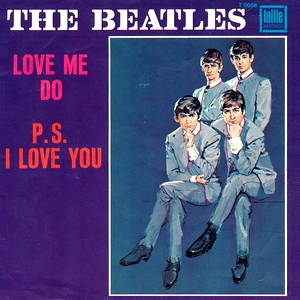
But he let them record 2 songs that they had written. One was "Love Me Do." In later interviews, John said that it was mostly Paul's composition, saying, "Maybe I helped out in the middle." But Paul, for once deflecting some credit, said it was a 50-50 writing effort, as a lot of their early songs were. The other was "P.S. I Love You," which, clearly, was all Paul. Paul sang lead on both.

Martin agreed to let them record "Love Me Do" because he liked the harmonica that John played on it. Although Martin was used to recording jazz, he said John's harmonica part on a version of the song they had previously recorded with Best on drums reminded him of blues records he liked by Sonny Terry and Brownie McGhee. So it was recorded, the 1st session with what would become the familiar lineup: "John, Paul, George and Ringo."

And Martin didn't like it. He had them come back in a week later, on September 11, 1962, and record it again. This time, a session drummer, Andy White, was brought in to play drums, and Ringo was relegated to playing the tambourine.

The version with Ringo on drums was released as the single -- and proved Martin's point. It only reached Number 17 on the British music charts. The version with White on drums was put on the group's 1st album, titled Please Please Me, after the 2nd single which was released around the same time. This would be the version released as the U.S. version of the single. The way to tell the difference is that the one where Ringo plays drums has no tambourine on it. I have to admit: The White version is better. Even the vocals are better on it.

By the time that album was recorded, in a single all-day session on February 11, 1963, Ringo had been with the band a bit longer, and was more integrated into them, and they sounded better together. "Please Please Me" was their 1st U.K. Number 1, and even Mimi Smith, John's hyper-critical aunt, who practically raised him, and told them "Love Me Do" was no good, said she liked it. The rest is history. 

Andy White, a Scotsman, was 32 years old at the time, 10 years older than Ringo, the oldest Beatle. He was the drummer every British producer wanted, a Scottish version of New York's Buddy Saltzman, New Orleans' Earl Palmer and Los Angeles' Hal Blaine. He would end up drumming on some of the biggest soloists' hits to come off the Sceptered Isle in the Swinging Sixties, including "It's Not Unusual" by Tom Jones and Lulu's version of The Isley Brothers' "Shout."

Despite his name, he had nothing to do with The Beatles, the 1968 production nicknamed "The White Album" for its all-white cover. In the 1980s, he moved to New Jersey, taught drumming, and lived until 2015, at the age of 85.

*

September 4, 1962 was a Tuesday. It was a few days before the NFL and AFL seasons would begin, and several weeks before the starts of the NBA and NHL seasons. These Major League Baseball games were played that day:

* The New York Yankees lost to the Los Angeles Angels, 7-6 at the old Yankee Stadium. Mickey Mantle did not play. Clete Boyer hit a home run, but Whitey Ford ran out of gas in the 7th inning, and the Angels scored 6 runs, including a home run by Lee Thomas. The Yankees tied it 6-6 in the 8th, but a single by future Angels, Milwaukee Brewers and Montreal Expos manager Robert "Buck" Rodgers off Bud Daley won it for the Halos in the 9th.

* The New York Mets lost to the Pittsburgh Pirates, 5-1 at Forbes Field in Pittsburgh. The expansion Mets went 40-120 that year, the most losses in any season in the 20th Century. There would be only 14 days in 1962 that the Mets won and the Yankees lost, and this was not one of them.

* The Kansas City Athletics beat the Boston Red Sox, 7-2 at Fenway Park in Boston.

* The Chicago White Sox beat the Cleveland Indians, 3-2 at Comiskey Park in Chicago. Dick Donovan, on the staff of Chicago's 1959 Pennant-winning "Go-Go White Sox," pitched all 13 innings for the Indians. This was a mistake by manager Al Lopez, as Al Smith singled home the winning run off him.

* The Cincinnati Reds beat the Milwaukee, Braves, 9-6 at Milwaukee County Stadium. Warren Spahn didn't have it that day. Eddie Mathews hit 2 home runs, and Hank Aaron hit a double, but it wasn't enough.

* The St. Louis Cardinals beat the Chicago Cubs, 7-1 at the original Busch Stadium, formerly Sportsman's Park, in St. Louis. Stan Musial hit a home run.

* The Houston Colt .45s beat the Philadelphia Phillies, 4-1 at Colt Stadium in Houston. In 1965, the Colts would move into the Astrodome, and change their name to the Houston Astros.

* The Baltimore Orioles were supposed to host the Detroit Tigers at Memorial Stadium, but the game was rained out. It was played the next day, as part of a doubleheader. The Tigers won both games, taking the 1st 5-2, and the 2nd 6-0, as Hank Aguirre pitched a 5-hit shutout.

* The Minnesota Twins and the Washington Senators were also rained out that day -- not surprising, as Washington and Baltimore are so close, although the Yankees' game with the Angels in New York was played as scheduled. This game was also rescheduled as part of a doubleheader the next day. The Twins won the opener 9-7, on a Vic Power double in the 11th inning. The Senators won the 2nd game 3-0, as Claude Osteen pitched a 3-hit shutout.

* And the Los Angeles Dodgers beat the San Francisco Giants, 5-4 at Dodger Stadium in Los Angeles. Tom Haller and Jose Pagan hit home runs in defeat. Willie Mays went 0-for-3. This win put the Dodgers 3 1/2 games ahead of the Giants with 23 games left to play (24 for the Giants). But they would finish tied for the Pennant, and, as in 1951 on the other coast, the Giants would win the Playoff. Also as in 1951, the Giants would lose the World Series to the Yankees.

Wednesday, June 1, 2022

June 1, 1967: The Beatles Release "Sgt. Pepper's Lonely Hearts Club Band"

June 1, 1967: The Beatles release Sgt. Pepper's Lonely Hearts Club Band. It wasn't the first "concept album," but it has been called the greatest album ever released. Certainly, it changed the way rock and roll music was recorded.

The influence of drugs on the band is apparent. Fortunately, you don't have to be high -- or tripping -- to enjoy it.

That month, Paul McCartney, The Beatles' bass guitarist, and secondary songwriter along with rhythm guitarist John Lennon, was going to turn 25. Two days after that, Brian Wilson, the bass guitarist and main songwriter for The Beach Boys, also turned 25. And the two men were in competition with each other.

At the end of 1965, The Beatles released Rubber Soul, a (mostly) softer, more contemplative album, which experimented with non-rock instruments. Lead guitarist George Harrison used it to introduce the sitar, a stringed instrument from India, into rock. Rock historian Dave Marsh once wrote that Rubber Soul proved that The Beatles would still have become stars even if they had never recorded a single uptempo song, although half the songs on the album were uptempo. In mid-1966, The Beatles went further, with Revolver.

But it was mainly Rubber Soul that inspired Wilson to create what appeared to be The Beach Boys' magnum opus, Pet Sounds. (It would have been undeniable as their greatest work, had "Good Vibrations" been on it, but that came afterwards.) Paul heard Pet Sounds, and knew that it was on now, chaps: He had to top it.

So Sgt. Pepper was more his album than any that had come before, but all 4 of them got their chances to shine. Side One:

* "Sgt. Pepper's Lonely Hearts Club Band." Written by Paul, who sang lead, it created an alternate identity for the band, suggesting a pre-rock persona.

* "With a Little Help from My Friends." Written by Paul, it was sung by drummer Ringo Starr, in persona as "the one and only Billy Shears." It would be sung by Joe Cocker at Woodstock, and his version would become a hit single, and the theme song to the ABC nostalgia series The Wonder Years. Richie Havens, who also sang at Woodstock, called it "My favorite song in the whole universe." He would later have a hit with George's song "Here Comes the Sun."

* "Lucy in the Sky with Diamonds." Perhaps the ultimate psychedelic song. It was pointed out to John that the initials were "LSD." He claimed he didn't notice that, saying that the idea came from a drawing his 3-year-old son Julian had made and named. Nobody believed him. Years later, Julian found the drawing, and proved to the world that his father was telling the truth.

In 1974, Elton John would cover it, with John playing guitar on the session, and it would hit Number 1. Personally, I like the Elton version better.

* "Getting Better." Typical of them, Paul sang, "It's getting better," while the more pessimistic John followed with, "It couldn't get much worse."

* "Fixing a Hole." This Paul song has been said to be about heroin. He's always denied it.

* "She's Leaving Home." Paul's song about the generation gap.

* "Being for the Benefit of Mr. Kite!" John's song about a circus. The line, "And of course, Harry the Horse dances the waltz" led some people to think that was about heroin.

Side Two:

* "Within You Without You." George's only song on the album.

* "When I'm Sixty-Four." The one song on the album that sounds like it could have been recorded by Sgt. Pepper's Band, had they actually existed. Paul wrote it. Sadly, only he and Ringo would make it to age 64.

* "Lovely Rita." Paul's song about a fling with a metermaid.

* "Good Morning Good Morning." No way John could get away with saying this song wasn't about drugs.

* "Sgt. Pepper's Lonely Hearts Club Band (Reprise)."

* "A Day in the Life." Without this song, the longest on the album at 5 minutes and 38 seconds, this would still have been a great album. But any pretense to being the greatest ever is dependent upon it. John wrote 3 verses: One about a car crash that killed a rich man (based on the real-life death of Guinness heir Tara Browne -- yes, Tara was a man), one about a war film (John had recently filmed scenes for the World War I picture How I Won the War), and one about "four thousand holes in Blackburn, Lancashire."

Between the 2nd and 3rd verses was an orchestra's crescendo, an alarm clock, and a middle-eight by Paul about getting up and going to work, which may have inspired Prince to write "Manic Monday" years later.

Producer George Martin conducted a full orchestra for it, and the closing piano note seems to drift away forever...

Total time 39 minutes and 36 seconds. In less than 40 minutes, the men who had been "the lovable Mop Tops" had changed music forever.

The cover showed The Beatles in old-style military band uniforms: John, in yellow, with a French horn; Paul, in blue, with an English horn (not a clarinet, as is often erroneously thought); George, in orange, with a piccolo; and Ringo, in pink, with a trumpet. They were surrounded with wax figures of their early selves, and photos of many celebrities. As John sang in "In My Life," some were dead and some were living.

Some choices seemed odd. They could have chosen the recently-defrocked Heavyweight Champion of the World, Muhammad Ali, whom they met in Miami right before he fought Sonny Liston for the title in 1964, and had become a symbol of rebellion. Instead, they chose Liston, who had refused to meet with them. They could have chosen Marilyn Monroe. Instead, they chose the actress billed as the British version of her, Diana Dors. John chose several artists, and George chose some Indian spiritualists, that were not well known.

John wanted pictures of both Jesus of Nazareth and Adolf Hitler. George wanted Mohandas Gandhi. Management refused all three, fearing a backlash, especially given John's "We're more popular than Jesus now" comment of the previous year. Including Hitler would have offended the markets of both America and Europe, and including Gandhi would have offended the market of India, still a big buyer of British products.

Of the living people included, only one initially refused: Actress Mae West. She said, "What would I be doing in a Lonely Hearts Club?" She relented after all four Beatles wrote her personal letters expressing their deep admiration for her work. The agent for Bowery Boys actor Leo Gorcey, demanded a $400 fee, the only living person to demand money for it. Beatles manager Brian Epstein refused, and Gorcey was the only figure to be airbrushed off the cover.

The album also included several "clues" in the later "Paul Is Dead" rumor: Paul's horn is black, while the others are holding brass instruments; a hand over Paul's head, a "death sign"; a series of flowers forming a guitar seems to form the words "PAUL?" complete with question mark; the photo on the back cover showing Paul's back turned to the camera (he wasn't available that day, and roadie Mal Evans stood in for him); and clues as to the alleged car crash that killed Paul the previous year, including the line from "A Day in the Life," "He blew his mind out in a car," and the alleged time of the crash being mentioned in "She's Leaving Home": "Wednesday morning at five o'clock."

It became the album of the Summer of 1967, "the Summer of Love." And it has been hailed by many as the greatest rock album of all time. (Then again, some people don't think it was even the Beatles' best album, although they can't agree on whether that's Rubber Soul, Revolver, or the last one, Abbey Road.) And, from this point onward, any band wanting to do their best album ever would be said to be attempting "their Sgt. Pepper." Few have ever approached that height, and none has ever matched it.

All 4 Beatles retained ownership of their Sgt. Pepper uniforms, although Ringo donated his to the Rock and Roll Hall of Fame Museum in Cleveland.

The cover has been parodied many times. Later in the year, The Rolling Stones did so with Their Satanic Majesties Request. The next year, Frank Zappa & The Mothers of Invention did so with We're Only In It for the Money. Rolling Stone magazine did so with its 1,000th issue in 2006, which made sense, since, later in 1967, they put Lennon on the cover of their 1st issue.

In 1978, a film titled Sgt. Pepper's Lonely Hearts Club Band was released, with the "Beatle" roles taken by Peter Frampton and The Bee Gees: Barry, Robin and Maurice Gibb. Aside from covers of Beatle songs, the only true Beatle connection was their 1969 Let It Be collaborator, Billy Preston, playing "the one and only Billy Shears." The film tanked.

In 1978, Paul Gambaccini ranked it 1st on his list in his book Critic's Choice: Top 200 Albums, based on his poll of rock critics. In 1987, Rolling Stone celebrated its 20th Anniversary by ranking it 1st on its list of "The 100 Best Albums of the last Twenty Years." In 1993, and again in 2012, the magazine ranked it 1st on a list of "The 500 Greatest Albums of All Time." In 1994, Colin Larkin ranked it 1st in his book All Time Top 1000 Albums. In 1998, British music store chain HMV and network Channel 4 released a poll showing it voted the best album of all time.

Time passed, and times changed. Q magazine listed it 3rd on a list of "The Music That Changed the World" in 2004, and 5th on a list of "The 40 Greatest Psychedelic Albums of All Time" in 2005. And in 2020, Rolling Stone dropped it all the way to 24th. It is possible that there were a few better albums released between 1967 and 2020, but there is no way that there have been 23 better albums released between 2012, Rolling Stone's last time ranking it 1st, and 2020. Come on, man!

In the 1st-ever episode of the YouTube series Epic Rap Battles of History, "Nice" Peter Shukoff played John Lennon in his yellow Sgt. Pepper uniform, against "Epic" Lloyd Ahlquist as newscaster Bill O'Reilly. The matchup didn't seem to make much sense, as there was no commonality, and the only contrast was in politics, as Lennon was seen as left and O'Reilly as far right. Unfortunately, Peter did not attempt to imitate John's voice, sounding nothing like a man from Liverpool. The least he could have done was tell O'Reilly, as John said to some people in A Hard Day's Night, "Yer a swine!"

As of June 1, 2022, there are 5 surviving people among the figures shown on the cover: Paul, Ringo, Bob Dylan, doo-wop singer Dion DiMucci, and sculptor Larry Bell, included because John admired his work.

*

June 1, 1967 was a Thursday. Football, basketball and hockey were out of season. These games were played in Major League Baseball:

* The New York Mets lost to the Houston Astros, 4-1 at the Astrodome in Houston. Mike Cuellar, the Cuban curveball master not yet a Baltimore Oriole, outpitched Tom Seaver.

* The Minnesota Twins beat the Boston Red Sox, 4-0 at Fenway Park in Boston. Harmon Killebrew went 0-for-3, although he drew a walk. Rod Carew and Carl Yastrzemski went 1-for-4. The American League Pennant would come down to the last day of the season, on which these same 2 teams would play, each still having a chance.

* The Washington Senators beat the California Angels, 1-0 at District of Columbia Stadium in Washington. (It was renamed Robert F. Kennedy Memorial Stadium in 1969.) Camilo Pascual, who had been with the "Old Senators" in 1960-61 when they moved to become the Twins, pitched a 4-hit shutout for the "New Senators."

* The Cincinnati Reds beat the Chicago Cubs, 7-6 at Crosley Field in Cincinnati. Billy Williams hit 2 home runs, and Ernie Banks went 3-for-5, but it wasn't enough. Pete Rose went 1-for-2 with 3 walks, and Tony PĂ©rez hit a home run. Johnny Bench would be called up to the Reds on August 28, about 3 months later.

* The Cleveland Indians beat the Detroit Tigers, 8-2 at Tiger Stadium in Detroit. John O'Donoghue, later to become famous for appearing in Jim Bouton's book Ball Four, not only outpitched Denny McLain, but hit a home run off him. Al Kaline went 1-for-3.

* The St. Louis Cardinals beat the Atlanta Braves, 5-4 at Busch Memorial Stadium in St. Louis. Bobby Tolan won it for the Cards with an RBI triple in the bottom of the 10th inning. For the Braves, Hank Aaron went 2-for-4 with a home run, and Joe Torre went 1-for-5.

* The Philadelphia Phillies beat the Los Angeles Dodgers, 6-1 at Dodger Stadium in Los Angeles.

* The San Francisco Giants beat the Pittsburgh Pirates, 7-1 at Candlestick Park. Gaylord Perry outpitched former Giant Juan Pizarro. Jesus Alou and Dick Dietz hit home runs, while Willie Mays went 1-for-3 with a walk, and Willie McCovey pinch-hit a double that drove in 2 runs.

* And the New York Yankees, the Baltimore Orioles, the Chicago White Sox and the the Kansas City Athletics were not scheduled to play.

Friday, February 11, 2022

February 11, 1963: The Beatles Record Their 1st Album

Left to right: Ringo, Paul, George, John

February 11, 1963: The Beatles recorded most of the songs that will go on their 1st album, Please Please Me. The world -- and not just the world of music -- will never be the same.

On September 4, 1962, at Studio 2 at EMI Studios at 3 Abbey Road, in the St John's Wood neighborhood of "The City of Westminster," in London, NW8 9AY. There, they recorded some songs, including both sides of what would become their 1st single for EMI's Parlophone Records label, which was run by the man producing the session, George Martin: "Love Me Do" and "P.S. I Love You."

Martin wasn't satisfied with the recording of those 2 songs, so he brought the not-yet-Fab Four -- rhythm guitarist, sometimes lead singer, and sometimes writer John Lennon; bass guitarist, sometimes lead singer, and sometimes writer Paul McCartney; lead guitarist George Harrison; and drummer Ringo Starr -- back a week later, on September 11, to redo the songs.

On "Love Me Do," he gave Ringo a tambourine, and replaced him on drums with session drummer Andy White, and it was this version that would go on the album, and eventually be released as a single in America, which would hit Number 1. On "P.S. I Love You," Martin gave Ringo maracas, and there was no drumming.

On February 11, 1963, a break in their performing schedule, they gathered at Abbey Road, with John suffering from a cold, and popping throat lozenges as if they were the amphetamines that the group had taken to stay up all night when they were playing clubs in Hamburg, Germany in 1960 and '61, honing their craft.

Ringo later said, "We didn't rehearse our first album. In my head, it was done "live". We did the songs through first, so they could get some sort of sound on each one; then we had to just run, run them down."

They began their morning session at 10:00 AM, with "There's a Place," and then a song then titled "Seventeen," which would become "I Saw Her Standing There." One song they recorded that day that didn't go on the album was "Hold Me Tight."

Before the group started experimenting, John and Paul would give George and Ringo one lead vocal each on every album. George's was "Do You Want to Know a Secret," and he got a 2nd lead vocal, on "Chains"; while Ringo's was "Boys." Which, like Elvis Presley's "Jailhouse Rock" in 1957, with its line of "You the cutest jailbird I ever did see," didn't raise homophobic eyebrows like it might have later.

In addition to George on lead guitar, John on rhythm guitar, Paul on bass guitar and Ringo on drums, George Martin played piano on "Misery" (as he would on the cover of "Money (That's What I Want)" on their 2nd album), and celesta on "Baby It's You."

At 10:00 PM, it was decided to record "Twist and Shout." This was a cover of an Isley Brothers hit on which John had sung lead in Beatles' performances. But with his cold and the long day, he didn't think he could do it.

Martin thought they nailed it on the 1st take, and so they used it. Martin said, "I don't know how they do it. We've been recording all day, but the longer we go on, the better they get." John said, "The last song nearly killed me. My voice wasn't the same for a long time after. Every time I swallowed, it was like sandpaper."

The day of recording cost approximately £400 (equivalent to £10,000 in 2022 -- with the exchange rate, about $160,000). Martin said: "There wasn't a lot of money at Parlophone. I was working to an annual budget of £55,000." This budget had to cover all of the artists on Martin's roster. Individually, under a contract with the Musicians' Union, each Beatle collected 22 pounds, 10 shillings (in 2022 money, about £54, or $864).

Side One: "I Saw Her Standing There," written by Paul, and it would become the B-side of the later-recorded "I Want to Hold Your Hand," which became their 1st U.S. Number 1 hit; "Misery," a Lennon-McCartney co-write and co-lead-sing; "Anna (Go to Him)," a cover of an Arthur Alexander song, with John singing lead; "Chains," written by Gerry Goffin & Carole King for The Cookies; "Boys," written by Luther Dixon and Wes Farrell for The Shirelles, as The Beatles all loved the American "girl groups," especially the black ones; "Ask Me Why," by John; and "Please Please Me," and John-Paul co-write, with John singing lead.

Side Two: "Love Me Do," Paul's song; "P.S. I Love You," Paul's song; "Baby It's You," written by Mack David, Barney Williams and Burt Bacharach, and another hit for The Shirelles; "Do You Want to Know a Secret," written by John and sung by George; "A Taste of Honey," written by Bobby Scott and Ric Marlow, a minor hit for Lenny Welch, Paul singing leade, and later an instrumental hit for Herb Alpert; "There's a Place," a John song; and "Twist and Shout," written by Bert Berns for The Isley Brothers (under the dual pen name of Phil Medley and Bert Russell, as Berns had done on the Isleys' similarly-titled "Shout!"), with John on the raspy lead.

Total: 31 minutes and 59 seconds of rock and roll history.

The album was released on March 22, 1963. Think about that: In a little over 12 hours, they recorded 13 songs, using 12 of them, and released the album with them on it less than 6 weeks later. Within 10 years, it was taking a rock band over a year from first recording session to release.

While "Love Me Do" had only hit Number 17 on the British pop music charts, "Please Please Me" hit Number 1 there. "Beatlemania" was on. Their 2nd album, With the Beatles, was recorded in pieces from mid-July to late October, and released on November 22. That album became their 1st U.S. album, Meet the Beatles!

*

February 11, 1963 was a Monday. This was also the day that Julia Child's cooking show The French Chef premiered on what would become PBS, and the day . I have separate entries for those events.

Baseball and football were out of season. No NBA or NHL games were played. So there were no scores on this historic day. 

December 31, 1999 & January 1, 2000: The Millennium

December 31, 1999:  The Millennium arrives. The people of planet Earth survived. At a terrible cost. But we hadn't destroyed ourselves. ...