Showing posts with label sydney. Show all posts

Sunday, December 25, 2022

December 26, 1908: The Shocking Triumph of Jack Johnson

December 26, 1908: Jack Johnson, a 30-year-old black man from Texas, known as the Galveston Giant, knocks out Canadian fighter Tommy Burns at Sydney Stadium in Sydney, Australia. This makes Johnson the 1st black man to win the Heavyweight Championship of the World.

(Johnson wasn't really a giant: He was 6 feet even, but a solid 200 pounds at his peak fighting condition.)

It was what we would now call a technical knockout: It was stopped after the 14th round, because Burns, considerably lighter and possibly ill with the flu, was totally outmatched.

Ironically, Burns might well be totally forgotten today had he won the fight. After all, who remembers who he beat for the title? (It was Marvin Hart.)

This "conquest of the white man," and his flamboyant lifestyle, made Johnson the most hated man in America. Even many black people hated him, for making them look bad. He didn't care: He was still going to be Jack Johnson.

So America's white establishment looked for a "Great White Hope" who could beat Johnson. Four times in 1909, a fighter was put up against Johnson:

* Philadelphia Jack O'Brien, the Light Heavyweight Champion, fought him in Philadelphia. It was a draw, but O'Brien didn't want a rematch.

* Tony Ross fought him in Pittsburgh, and Johnson beat him.

* Al Kaufman fought him in San Francisco, and Johnson beat him.

* Stanley Ketchel, the Middleweight Champion, a vicious fighter known as the Michigan Assassin, made a deal with Johnson, the same deal that O'Brien had made with him: They would fight to a draw, and thus split the proceeds from the film rights. It was a good plan. Except Ketchel got greedy, for the title and the money, and knocked Johnson down. All that did was make Johnson mad, and he not only knocked Ketchel out, he knocked out a bunch of his teeth. The film of the fight is clear enough to see Johnson brushing Ketchel's teeth out of his glove.

Now, the search for a Great White Hope became truly intense. Novelist Jack London, tapping into the racism of the time, had a nationally syndicated newspaper column, and used it to address Jim Jeffries, who had been Heavyweight Champion from 1899 to 1904, and retired undefeated to an alfalfa farm outside Los Angeles. London wrote, "Jeff, it's up to you."

Johnson was willing to fight Jeffries. Having waited so long for his shot at the title, he knew he had no right to duck anybody. Jeffries had gotten fat in his retirement. He went on a crash diet and exercise program, and actually got back down to his usual fighting weight. But losing so much weight so soon weakened him. And the fight was the middle of the desert, in Reno, Nevada. Jeffries was used to California heat, but not this kind of heat, and the South Texas native Johnson was used to it. And Johnson was in peak physical condition.

So the fight was a mismatch. It was scheduled for a maximum of 45 rounds, which sounds brutal for the modern era, where the norm became 15, and eventually 12 by the 1980s. Jeffries hung on for 12 rounds, but in the 13th, Johnson did what (it was said -- the records may be wrong) no other fighter had ever done: He knocked Jeffries down. Jeffries got up. He shouldn't have, because Johnson knocked him out in the 15th.

In 1912, Johnson was arrested for violating the Mann Act, which forbade "transporting women across State lines for immoral purposes." The woman in question was Lucille Cameron. Contrary to what is often reported, Cameron was not already Johnson's wife, which would have made the charge impossible to prove in court -- not that an all-white jury would have cared. But she refused to cooperate, and soon married Johnson.

In 1913, Johnson was arrested on the Mann Act again. This time, in a Chicago courtroom presided over by Judge Kenesaw Mountain Landis, later to become the 1st Commissioner of Baseball and the perpetuator of the sport's "color line," Johnson was convicted by an all-white jury, and sentenced to a year and a day in prison.

He skipped bail, and escaped first to Canada, then to France. Having only defended his title once since the Jeffries fight, he could now only do so abroad. On December 19, 1913, in Paris, in the 1st-ever Heavyweight Championship fight between 2 black men, he may have recognized the significance, and held back a little, as he fought Battling Jim Johnson (no relation) to a rather lackluster draw. In 1914, he defeated Frank Moran in Paris. In early 1915, he knocked Jack Murray out in Buenos Aires, Argentina.

Finally, it all caught up with him. Jess Willard, a 6-foot-6 Kansan, became the latest "Great White Hope." On April 5, 1915, at Oriental Park, a horse racing track in Havana, Cuba, in a fight scheduled for 45 rounds, and held in heat even worse than in Reno 4 years earlier, perhaps he finally got tired of being Jack Johnson, and threw the fight. Or maybe, at 37, the oldest Heavyweight Champion ever (and he would remain so until Jersey Joe Walcott in 1951), he just wasn't in shape anymore. Willard knocked him out in the 26th round.

Jack and Lucille Johnson continued to live abroad. Finally, on July 20, 1920, Jack crossed the border from Mexico to America, and surrendered to federal agents. He was taken to the federal penitentiary at Leavenworth, Kansas (with some irony, in Willard's home State), and began serving his sentence. He was released early, on July 9, 1921.

Lucille was the 3rd of what turned out to be 4 wives for Jack Johnson. Only the 1st was black. On June 10, 1946, he was driving on U.S. Route 1 near Franklinton, North Carolina, when he crashed into a telegraph pole, and died. He was 68 years old.

*

December 26, 1908 was a Saturday. Baseball was out of season. Football season had ended. Professional basketball did not exist. And the biggest hockey league of the time, the Eastern Canada Amateur Hockey Association, didn't start its season for another 11 days.

But there were scores. It was Boxing Day, and, in Britain, there was a tradition of soccer teams playing each other on back-to-back days, a home-and-home series on Christmas Day and Boxing Day. On the 25th, Woolwich Arsenal and Leicester Fosse played each other to a 1-1 draw at the Filbert Street stadium in Leicester. On the 26th, they played at The Arsenal's home, the Manor Ground, in Plumstead, South-East London, and Arsenal won, 2-1. Eventually, Woolwich Arsenal would move to North London, and become simply Arsenal Football Club; while Leicester Fosse became Leicester City.

Thursday, October 20, 2022

October 20, 1973: The Sydney Opera House Opens

October 20, 1973: The Sydney Opera House, Australia's most famous structure, opens, just 1 mile from the structure it replaced as such, the Sydney Harbour Bridge.

Danish architect Jørn Utzon designed it in 1957, to look like sails on a boat in the harbor. Construction was approved the following year, and the complex opened in stages, delayed because the materials necessary to sustain the design proved hard to determine.

The first person to perform at the Sydney Opera House site was Paul Robeson: The African-American football player-turned-lawyer-turned-singer-turned-actor sang his signature song, "Ol' Man River," to construction workers as they ate lunch in 1960. The formal opening was on October 20, 1973, dedicated by Australia's head of state, Queen Elizabeth II. The opening was televised and included fireworks and a performance of Ludwig van Beethoven's 1824 Symphony No. 9.

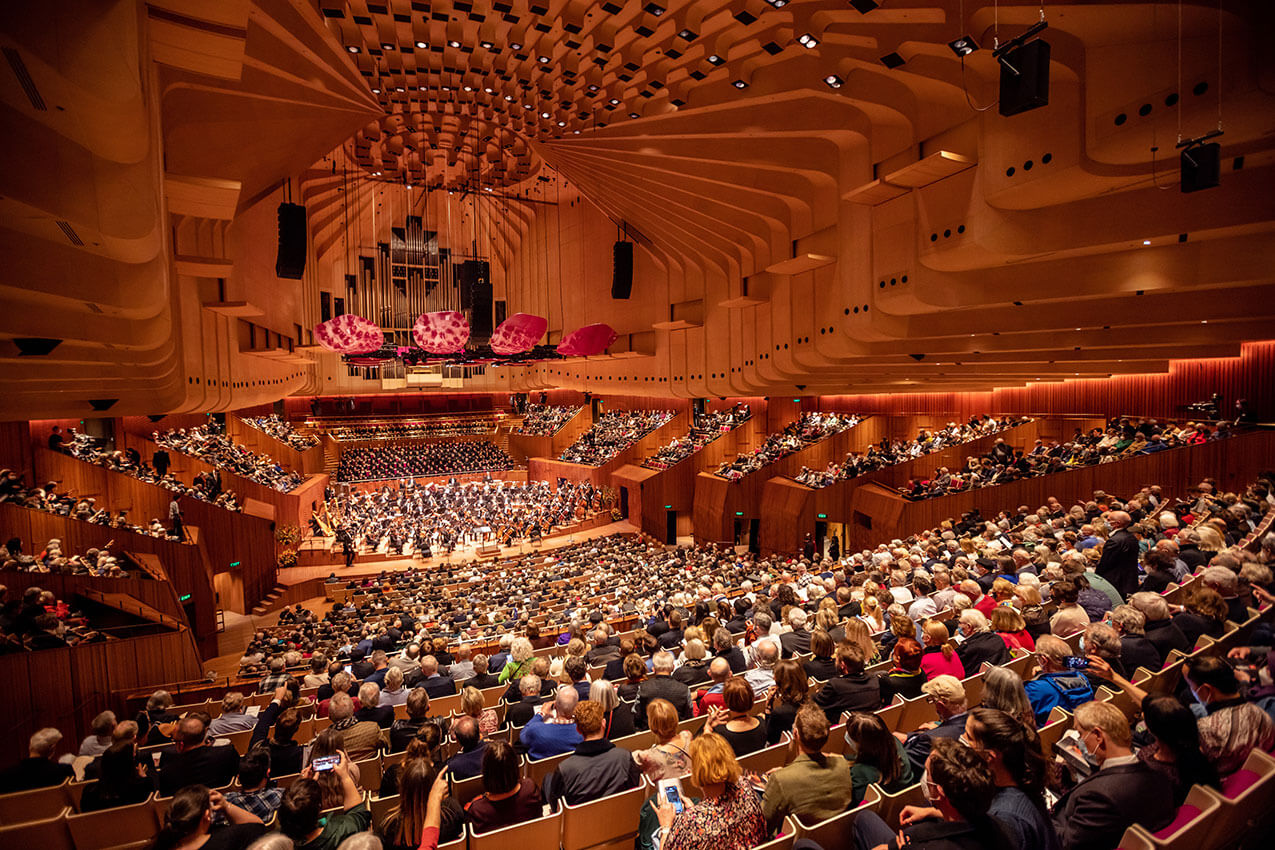
The complex includes the Concert Hall, seating 2,679, home of the Sydney Symphony Orchestra; the Joan Sutherland Theatre, seating 1,507, named for the country's most beloved opera singer, home of Opera Australia and The Australian Ballet; the Drama Theatre, seating 544, used by the Sydney Theatre Company; the Playhouse, seating 398; the Studio, seating 280; the Utzon Room, a small multi-purpose venue for parties, corporate functions and small productions, such as chamber music performances; the Recording Studio; and the Outdoor Forecourt: A flexible open-air venue with a wide range of configuration options, including the possibility of utilizing the Monumental Steps as audience seating, used for a range of community events and major outdoor performances.
The Concert Hall

The building is managed by the Sydney Opera House Trust, an agency of the New South Wales State Government.

*

October 20, 1973 was a Saturday. This was also the day of "The Saturday Night Massacre," a scandal within the larger Watergate scandal that would force the resignation of the President of the United States, Richard Nixon, 10 months later. It was also the day that The Six Million Dollar Man premiered on ABC, starring Lee Majors as astronaut-turned-bionic-federal-agent Steve Austin. (Definitely not to be confused with the Stone Cold "professional wrestler" using the same name.)

Among the major college football games played that day were these:

* Number 1 Ohio State beat Indiana, 37-7 at Memorial Stadium in Bloomington, Indiana.

* Rivalry: Number 2 Alabama beat Number 10 Tennessee, 42-21 at Legion Field in Birmingham.

* Number 3 Oklahoma beat Number 16 Colorado, 34-7 at Owen Field in Norman, Oklahoma.

* Number 4 Michigan beat Wisconsin, 35-6 at Michigan Stadium in Ann Arbor.

* Number 5 Penn State beat Syracuse, 49-6 at Archbold Stadium in Syracuse, New York.

* Number 6 University of Southern California (USC) beat Oregon, 31-10 at the Los Angeles Memorial Coliseum.

* Number 7 Missouri beat Oklahoma State, 13-9 at Faurot Field in Columbia, Missouri.

* Number 8 Notre Dame beat Army, 62-3 at Michie Stadium in West Point, New York.

* Number 9 Louisiana State University (LSU) beat Kentucky, 28-21 at Tiger Stadium in Baton Rouge, Louisiana.

* Number 11 Nebraska beat Number 18 Kansas, 10-9 at Memorial Stadium in Lincoln, Nebraska.

* One ranked team lost to an unranked team: Number 19 Arizona lost to Texas Tech, 31-17 at Arizona Stadium in Tucson.

* Rivalry: Virginia Tech beat Virginia, 27-15 at Lane Stadium in Blacksburg, Virginia.

* Rivalry: Minnesota beat Iowa, 31-23 at Kinnick Stadium in Iowa City.

* Rivalry: Texas beat Arkansas, 34-6 at Razorback Stadium in Fayetteville, Arkansas.

* Navy beat Air Force, 42-6 at Navy-Marine Corps Memorial Stadium in Annapolis, Maryland.

* Yale beat Columbia, 29-0 at Baker Field in Upper Manhattan.

* Rutgers beat Delaware, 24-7 at Rutgers Stadium in Piscataway, New Jersey.

* Princeton beat Colgate, 37-21 at Palmer Stadium in Princeton, New Jersey.

There were no NFL games played that day. But a very big baseball game was played at the Oakland Coliseum: Game 6 of the World Series.

The New York Mets just need to win 1 of the last 2 games against the Oakland Athletics in Oakland, and they will have their 2nd World Championship in 5 seasons -- it has been 11 years since the Yankees went all the way. And Tom Seaver, "The Franchise," is on the mound. What can go wrong?

This can go wrong: Met manager Yogi Berra has sent Seaver out on just 3 days' rest, hoping that "Tom Terrific" can close out the defending World Champions on their own patch, so that no Game 7 will be necessary.

But Reggie Jackson, not yet a New York baseball legend, hits 2 doubles, scores 1 run and knocks in 2. Jim "Catfish" Hunter, also a future Hall-of-Famer and a future New York baseball legend, pitches brilliantly. The A's beat the Mets 3-1. So there will be a Game 7 tomorrow.

To this day, many Met fans are angry at Yogi for starting Seaver on short rest. I'm sure some of them thought of Yogi as a Yankee and hated him for that reason alone. They shouldn't: There are only 5 human beings who have managed the Mets to a Pennant: Yogi, Gil Hodges, Davey Johnson, Bobby Valentine and Terry Collins. And only Johnson, Valentine and Collins are still alive.

There are 8 National Basketball Association games played on this day:

* The New York Knicks do not play like defending World Champions, losing to the Chicago Bulls, 85-69 at Madison Square Garden. Indeed, in the other 7 NBA games played that day, only 1 other team scored fewer than the Bulls' 85, but that 85 was enough to win this game.

* The Capital Bullets play their 1st home game after 10 years in Baltimore, at the Cole Field House on the campus of the University of Maryland, in College Park, just inside the Capital Beltway. At this point, the Bullets are one of the better teams in the NBA, and they prove it, beating the Boston Celtics 96-87. Phil Chenier leads all scorers with 26 points.

It will take until December 2 for their new arena, the Capital Centre in Landover, on the other side of the Beltway, to be ready for the Bullets to play there. They then changed their name to the Washington Bullets. The following season, it also became home to an NHL expansion team, the Washington Capitals. In 1997, both teams would move into a new arena in the District of Columbia, now known as the Capital One Arena, and the Bullets would change their name to the Washington Wizards.

* The Buffalo Braves beat the Philadelphia 76ers, 116-100 at The Spectrum in Philadelphia.

* The Phoenix Suns beat the Atlanta Hawks, 118-108 at The Omni in Atlanta.

* The Milwaukee Bucks beat the Cleveland Cavaliers, 101-88 at the Cleveland Arena.

* The Golden State Warriors beat the Kansas City Kings, 100-81 at the Oakland Coliseum Arena (now the Oracle Arena).

* The Detroit Pistons beat the Houston Rockets, 107-104 at the Hofheinz Pavilion (now the Fertitta Center) in Houston.

* And the Portland Trail Blazers beat their regional rivals, the Seattle SuperSonics, 123-108 at the Portland Memorial Coliseum.

There were 3 games played in the American Basketball Association:

The Virginia Squires beat the Utah Stars, 106-95 at The Scope in Norfolk.

* The Carolina Cougars beat the Kentucky Colonels, 105-102 at Freedom Hall in Louisville.

* And the San Antonio Spurs beat the Indiana Pacers, 92-66 at the HemisFair Arena in San Antonio.

There were 6 games played in the National Hockey League:

* The New York Rangers lost to the Toronto Maple Leafs, 3-2 at Maple Leaf Gardens in Toronto.

* The New York Islanders lost to the Buffalo Sabres, 2-1 at the Nassau Coliseum.

The Atlanta Flames beat the Montreal Canadiens, 4-2 at the Montreal Forum.

* The Pittsburgh Penguins beat the California Golden Seals, 5-3 at the Civic Arena in Pittsburgh.

* The St. Louis Blues and the Minnesota North Stars played to a 4-4 tie, at the Metropolitan Sports Center in the Minneapolis suburb of Bloomington, Minnesota.

* And the Los Angeles Kings beat the Philadelphia Flyers, 3-0 at The Forum in the Los Angeles suburb of Inglewood, California.

There were 3 games played in the World Hockey Association:

* The New York Golden Blades lost to the Quebec Nordiques, 8-1 at Le Colisee de Quebec.

* The Cleveland Crusaders beat the Toronto Toros, 6-4 at the Cleveland Arena, which also hosted a Cavs game that day.

* And the Vancouver Blazers beat the Chicago Cougars, 4-3 at the Pacific Coliseum in Vancouver.

In notable college football games played that day:

* Number 1 Ohio State beat Indiana, 37-7 at Memorial Stadium in Bloomington, Indiana.

* In their traditional 3rd Saturday in October meeting, Number 2 Alabama beat Number 10 Tennessee, 42-21 at Legion Field in Birmingham.

* Number 3 Oklahoma also beat a ranked opponent, Number 16 Colorado, 34-7 at Owen Field in Norman, Oklahoma.

* Number 4 Michigan beat Wisconsin, 35-6 at Michigan Stadium in the Detroit suburb of Ann Arbor.

* Number 5 Penn State beat Syracuse, 49-6 at Archbold Stadium in Syracuse.

* Number 11 Notre Dame beat Army, 62-3 at Michie Stadium in West Point, New York. Army hadn't beaten Notre Dame since 1958, and still hasn't, losing 15 games over those 63 years.

* In New Jersey, Rutgers beat the University of Delaware, 24-7 at the old Rutgers Stadium in Piscataway.

* Princeton beat Colgate, 37-21 at Palmer Stadium in Princeton, New Jersey.

* And New York City's only major team of the time, Columbia University, lost to Yale, 29-0 at Baker Field.

Also, what would become my high school, East Brunswick in Middlesex County, New Jersey, beat New Brunswick, 41-0 at Memorial Stadium in New Brunswick.

And Arsenal drew 1-1 with Ipswich Town at Highbury. 

Sunday, August 14, 2022

August 15, 1903: The 1st Australia vs. New Zealand Rugby Match

A 2023 match. Australia in yellow, New Zealand in black.

August 15, 1903: For the 1st time, the national rugby union teams of Australia and New Zealand play each other, at the Sydney Cricket Ground. New Zealand dominate, 22-3.

Rugby union has a long history in Australia, with the first club being formed in 1863 at Sydney University. The sport was first played in New Zealand in 1870. As early as 1888, their players included the indigenous people of their islands, the Māori, who taught the white players the haka dance, and they've been doing this (hopefully) intimidating tactic before matches ever since.

By 1904, New Zealand was sending its national team on tour. Because of their all-black uniforms, they became known as the All Blacks. (The soccer team eventually became known as the All Whites, and their cricket team as the Black Caps.) 

In contrast to these basic colors, Australian sports teams wear green and gold. These represent the green leaves and golden blooms of the golden wattle flower, a symbol of the country's natural landscape and mineral wealth. Australia calls its rugby team the Wallabies.

Australia has been independent since 1901, New Zealand since 1907, though both remain in the British Commonwealth, with a Parliament led by a Prime Minister, but with the monarch of Great Britain as head of state, represented in-country by a Governor-General. Today, Australia is home to about 25 million people; New Zealand, 5 million.

There has never been a war between the 2 nations, mainly because they are separated by water: It is 1,340 air miles over the Tasman Sea between Sydney, Australia and Auckland, New Zealand, which is pretty much the closest points between the island nations. They have gone to war together, and, along with another nearby island nation, Tonga, celebrate the 25th of April, the anniversary of the heavy losses they all sustained in the Battle of Gallipoli in World War I in 1915, as ANZAC Day. (ANZAC: Australia and New Zealand Army Corps.)

So their rivalry is pretty much limited to sports. And, while they do play other sports, including the sport that most of the world calls "football" (though both of them tend to call it "soccer," and the Aussie team is "The Socceroos"), they prefer rugby. "Australian rules football" is also closer to rugby than to soccer. Both nations are usually strong in cricket as well.

Since 1931, the overall winner of the annual test matches -- between 1 and 3 games in any given year -- between the All Blacks and the Wallabies takes possession of the Bledisloe Cup, named after Charles Bathurst, 1st Viscount Bledisloe, Governor-General of New Zealand from 1930 to 1935, who donated the trophy.

There has been a Rugby World Cup every 4 years since 1987. Australia and New Zealand were joint hosts the 1st time. New Zealand have hosted alone in 2011, and won in 1987, 2011 and 2015. Australia have hosted alone in 2003; and won in 1991 and 1999.

In 1996, with the fall of apartheid in South Africa, the Tri-Nations Championship was founded, with New Zealand taking the 1st tournament. In 2012, Argentina were invited to make it a 4-team competition, titled simply "The Rugby Championship," in effect the title for the Southern Hemisphere.

As of August 15, 2022, New Zealand have won 120 matches, Australia 45, and there have been 8 draws.

UPDATE: As of New Zealand's 28-14 win in Perth on October 4, 2025, they lead, 128-45-8, having won the last 11. Australia's last win over New Zealand was on November 7, 2020 in Brisbane.

*

August 15, 1903 was a Saturday. In America, these games were played in baseball that day:

* The New York Highlanders lost to the Cleveland Naps, 6-5 at the 1891-1909 version of League Park in Cleveland. Willie Keeler went 2-for-4 with an RBI for the Highlanders, who officially became the New York Yankees in 1913.

The Cleveland team was named for its manager and 2nd baseman, Napoleon "Nap" Lajoie, who went 4-for-5 with 2 RBIs on this day. They became the Cleveland Indians in 1915, and the Cleveland Guardians in 2022.

* The New York Giants lost to the Cincinnati Reds, 8-3 at the 1890-1911 version of the Polo Grounds. Frank "Noodles" Hahn outpitched Joe "Iron Man" McGinnity.

* The Brooklyn Superbas swept a doubleheader from the St. Louis Cardinals, 7-0 and 4-3 at Washington Park in Brooklyn. Oscar Jones pitched a 7-hit shutout in the 1st game. The Superbas became the Dodgers in 1911.

* The Boston Americans beat the Detroit Tigers, 6-3 at Bennett Park in Detroit. The Americans became the Red Sox in 1908.

* The Washington Senators beat the St. Louis Browns, 5-1 at Sportsman's Park in St. Louis.

* The Philadelphia Athletics beat the Chicago White Sox, 5-1 at South Side Park in Chicago. Eddie Plank outpitched Patsy Flaherty.

* A doubleheader was split at the 1894-1914 version of the South End Grounds in Boston. The Pittsburgh Pirates won the opener, 5-1. The Boston Beaneaters won the nightcap, 8-5. Over the 2 games, Honus Wagner went 3-for-8 with a walk. The Beaneaters went through some name changes until 1912, when they became the Boston Braves.

* And the Philadelphia Phillies were supposed to be playing the Chicago Cubs at Baker Bowl in Philadelphia. However, a partial stadium collapse moved this weekend's games to at West Side Park in Chicago, for September 18. The Cubs won the 1st game, 6-5. The Phillies won the 2nd game, 10-0. Charles "Chick" Frasier pitched a no-hitter.

Tuesday, March 22, 2022

March 22, 2014: Major League Baseball in Australia

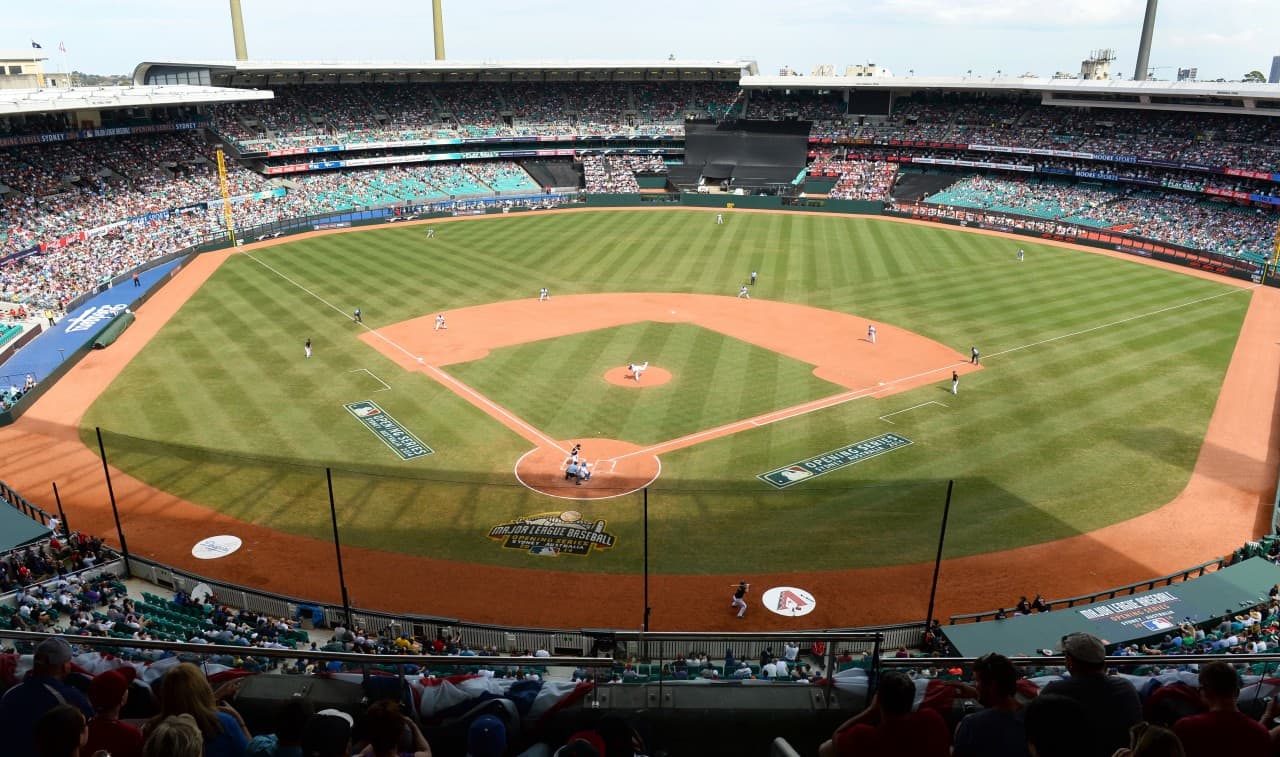
The Sydney Cricket Ground, catching baseball fever

March 22, 2014: For the 1st time, a regular-season Major League Baseball game is played in the Southern Hemisphere. It is set a week before everybody else's Opening Day, so that the teams involved can have time to adjust to the long distances and the time zone differences.

Baseball has gained in popularity in Australia in the 21st Century, but it is not as popular there as cricket, or swimming (a sport at which Australians have long excelled at in international competition), or various forms of football: Soccer, rugby, and Australian Rules Football (similar to rugby, but no padding, and the "kits" look more like basketball uniforms).

Contrary to what many believe, cricket is not an ancestor of baseball. They are more like cousins: The similarities between the two bat-and-ball games are strong, but the differences are even more significant.

The games would be played between 2 teams in the National League Western Division, the Los Angeles Dodgers and the Phoenix-based Arizona Diamondbacks. The venue would be the Sydney Cricket Ground, where seating capacity is usually 48,601, but was reduced to 38,000 for these games. The foul poles were 328 feet from home plate, the power alleys 370, and center field 400.

The SCG had hosted cricket since 1848, and while the Members' Pavilion dates to 1878 and the Ladies' Pavilion to 1896, most of the stadium is considerably newer: The Berwongle Stand to 1980, the Bill O'Reilly Stand (not named for the disgraced American newscaster) in 1984, the Clive Churchill Stand in 1986, the Victor Trumper Stand in 2008, and, opening in time for this series, the M.A. Noble, Bradman and Messenger Stands.

(You know how, when someone is far and away the best at something, he is known as the Babe Ruth of it? Donald Bradman was the Babe Ruth of cricket, building a legendary career that began in 1927, Ruth's baseball peak, and lasting until 1949, the time of Joe DiMaggio and Ted Williams.)

The SCG is, along with the Melbourne Cricket Ground, the home of the Australia national cricket team. It is also the home of the New South Wales cricket team. (Each of Australia's States has its own, just as every County in England, Wales and Scotland do.). It is home to Australian baseball's Sydney Sixers, the Australian Football League's Sydney Swans, the New South Wales Waratahs of Super Rugby ("rugby union," the more common form of that sport), and the Sydney Roosters of the National Rugby league ("rugby league" is a variant).

The 1st game in the series began at 7:00 PM, Australian Eastern Standard Time, 1:00 AM U.S. Pacific Daylight Time, and 4:00 AM U.S. Eastern Daylight Time. The Diamondbacks were officially the home team for the opener.

The Dodgers opened the scoring in the top of the 2nd inning. Cliché Alert: Walks can kill you, especially the leadoff variety, even Down Under. Adrian Gonzalez led off the inning with a walk, and was doubled over to 3rd base by Scott Van Slyke. After a strikeout by Juan Uribe, Andre Eithier grounded to 2nd, and Gonzalez scored, making it 1-0 Dodgers.

In the top of the 4th, Gonzalez reached 1st base on a dropped 3rd strike by Diamondback catcher Miguel Montero, and Van Slyke hit a home run off D-backs starter Wade Miley. That made it 3-0. Clayton Kershaw pitched superbly, allowing a run on a groundout in the bottom of the 6th. The Dodger bullpen held, and Los Angeles won, 3-1.

The 2nd game was played at 1:00 PM local time on March 23, 7:00 PM Pacific and 4:00 PM Eastern on March 22 in the U.S. The Diamondbacks were again treated as the home team, but found no advantage. An Ethier single got the Dodgers on the board in the 1st, and they tacked on 2 more runs each in the 3rd and the 5th, and 1 each in the 6th and the 7th. 

Arizona pulled a run back in the 8th. In the 9th, they mounted a rally, including the 1st MLB home run ever hit in the Southern Hemisphere, by Mark Trumbo. But it fell short, and the Dodgers won, 7-5. Hyun-Jim Ryu, closer to his homeland of Japan than he would have been in Los Angeles, was the starting and winning pitcher for the Dodgers. Trevor Cahill of the Diamondbacks had previously been 6-0 against the Dodgers in his career, but took the loss on this occasion.

MLB has not returned to Australia, but these contests showed that there's no reason why they couldn't: The games were sellouts, and well-received, and the sport continues to grow in popularity there.

*

March 22, 2014 was a Saturday. Baseball was, otherwise, in Spring Training; and football was out of season. There were 8 games played in the NBA that day:

* The Charlotte Hornets beat the Portland Trail Blazers, 124-94 at the Time Warner Cable Arena in Charlotte. (It's now named the Spectrum Center.)

* The Memphis Grizzlies beat the Indiana Pacers, 82-71 at the FedEx Forum in Memphis.

* The New Orleans Pelicans beat the Miami Heat, 105-95 at the Smoothie King Center in New Orleans.

* The Houston Rockets beat the Cleveland Cavaliers, 118-111 at the Quicken Loans Arena in Cleveland. James Harden scored 37 points for the Rockets. (That's not why the arena is now named the Rocket Arena.)

* The Chicago Bulls beat the Philadelphia 76ers, 91-81 at the United Center in Chicago.

* The Utah Jazz beat the Orlando Magic, 89-88 at the Delta Center in Salt Lake City (then named the EnergySolutions Arena).

* The Los Angeles Clippers beat the Detroit Pistons, 112-103 at the Staples Center in Los Angeles. (It's now named the Crypto.com Arena.)

* And the San Antonio Spurs beat the Golden State Warriors, 99-90 at the Oakland Coliseum Arena (then named the Oracle Arena).

There were 7 games in the NHL:

* The New Jersey Devils beat the Toronto Maple Leafs, 3-2 at the Prudential Center.

* The New York Islanders beat the Columbus Blue Jackets, 2-0 at the Nassau Coliseum.

* The St. Louis Blues beat the Pittsburgh Penguins, 1-0 at the Consol Energy Center in Pittsburgh. (It's now named the PPG Paints Arena.)

* The Minnesota Wild beat the Detroit Red Wings, 4-3 at the Joe Louis Arena in Detroit. Matt Moulson scored the winning goal with 2:45 left in overtime. 

* The Nashville Predators beat the Chicago Blackhawks, 2-0 at the United Center, which hosted both sports in the same day.

* The Anaheim Ducks beat the Florida Panthers, 6-2 at the Honda Center in Anaheim.

* And the Vancouver Canucks beat the Buffalo Sabres, 4-2 at the Rogers Arena in Vancouver.

Also, in England's Premier League, Arsenal Football Club of North London played its 1,000th match under manager Arsène Wenger. It was a disaster, as they lost to Chelsea, 6-0 at Chelsea's home of Stamford Bridge in West London.

It wasn't entirely their own fault: Referee Andre Marriner was clearly favoring Chelsea, and even gave a straight red card to Kieran Gibbs for a handball in the box, when it was Alex Oxlade-Chamberlain, also a young black player with a shaved head, who committed the foul. "Ox" told Marriner, "It was me!" to no avail, and everyone who watched the game had come to two conclusions: Marriner was incompetent, and all black players looked alike to him.

Saturday, March 19, 2022

March 19, 1932: The Sydney Harbour Bridge Opens

March 19, 1932: The Sydney Harbour Bridge opens in Sydney, New South Wales, Australia. Along with the city's Opera House, built just 1 mile away in 1973, it has been a symbol of its country ever since.

Running 3,770 feet, it carries the Cahill Expressway, national highway M1, across the harbor from Sydney to Kirribilli, The Expressway was named for Joseph Cahill, Premier of New South Wales (equivalent to an American State's Governor) from 1952 to his death in 1959, following his approval of the construction of the Opera House.

"The Coathanger" is a steel arch bridge, and it resembles 2 bridges constructed earlier in New York City. The Hell Gate Bridge connected Queens and Roosevelt Island over the East River in 1917, and the Bayonne Bridge opened on November 15, 1931, just 4 months before the Sydney Harbour Bridge. It connects Staten Island and Bayonne, New Jersey, over the Kill Van Kull.

*

March 19, 1932 was a Saturday. Baseball was in Spring Training. Football was in midweek. The NBA hadn't been founded yet.

There were 2 games in the NHL. The Montreal Canadiens beat the Montreal Maroons, 6-4 at the Montreal Forum. And the Toronto Maple Leafs, on their way to winning the Stanley Cup, beat the Chicago Black Hawks, 11-3 at the new Maple Leaf Gardens in Toronto. King Clancy, Joe Primeau, Busher Jackson, Earl Miller and Baldy Cotton each scored 2 goals and an assist.

And in English soccer, Arsenal defeated North-East team Newcastle United, 1-0 at the Arsenal Stadium, a.k.a. Highbury, in North London. Newcastle would get its revenge a month later, beating Arsenal in the FA Cup Final.

Friday, December 31, 2021

January 1, 1900: The Feat of the Century

January 1, 1900: Or should I say, December 31, 1899? The last major feat of the 19th Century is performed, and it is also the first great feat of the 20th Century.

Spare me the semantics. It was widely accepted at the time that the 19th Century ended, and the 20th Century began, on January 1, 1901. But most people accepted that the 20th Century ended, and the 21st Century began, on January 1, 2000, and thus retroactively decided on 1899 to 1900, not 1900 to 1901. So put a sock, or whatever passed for a sock in 1899, in it.

SS Warrimoo was a passenger and refrigerated cargo liner that was launched in 1892, in England for Australian owners. It was named for the village of Warrimoo, New South Wales, not far from Sydney.

On December 31, 1899, Warrimoo was sailing quietly across the Pacific Ocean, on its way from Vancouver, British Columbia, Canada to Australia. The navigator finished checking the stars for the ship’s position, and gave the result to Captain John D. S. Phillips:
Latitude: 0° 31' North, just north of the Equator.
Longitude: 179° 30' West, near the International Date Line.
First Mate Payton realized something exciting, and told Phillips, "Captain, we’re just a few miles from the point where the Equator and the International Date Line meet!"
Phillips saw a chance to do something unforgettable. He slightly changed the ship's course and adjusted the speed. The night was calm, the sky was clear, and the timing was perfect. At exactly 12:00 Midnight, ship's time, the SS Warrimoo was positioned so that:
  • The front of the ship (bow) was in the Southern Hemisphere, enjoying Summer.
  • The back of the ship (stern) was in the Northern Hemisphere, in the middle of Winter.
  • The date at the back was still December 31, 1899.
  • The date at the front had already become January 1, 1900.
This meant the ship was in: two different days, two different months, two different seasons, two different years, and two different centuries, all at the same time.
Warrimoo became a troop ship in World War I. In 1918, the French destroyer Catapulte collided with Warrimoo in the Mediterranean Sea. In the collision some of Catapulte's depth charges broke loose and fell into the sea, where they detonated and sank both ships. There were 58 deaths about Catapulte, 1 aboard Warrimoo.
*
January 1, 1900 was a Monday. Being that this was the era before college football began playing "bowl games" on New Year's Day, there were no games scheduled, and thus there were no scores on this historic day.

December 31, 1999 & January 1, 2000: The Millennium

December 31, 1999:  The Millennium arrives. The people of planet Earth survived. At a terrible cost. But we hadn't destroyed ourselves. ...