Showing posts with label larry macphail. Show all posts

Tuesday, October 11, 2022

October 11, 1946: The Reynolds-Gordon Trade

Allie Reynolds

October 11, 1946: A trade is made in baseball, and it is a rarity: One that works out very well for both teams.

The New York Yankees trade 2nd baseman Joe Gordon to the Cleveland Indians for pitcher Allie Reynolds. Gordon, the 1942 American League Most Valuable Player, was nicknamed "Flash," not because of his flashy defense, but because he reminded people of science-fiction film hero Flash Gordon, played by Buster Crabbe, who also played another sci-fi hero, Buck Rogers.

Joe Gordon secured his (posthumously-elected) Hall of Fame status by helping the Indians win the 1948 World Series, on October 11, 2 years to the day after the trade. This was his 5th title, having won 4 with the Yankees. But the Yankees had gotten George "Snuffy" Stirnweiss in a separate trade, and then had Jerry Coleman, Billy Martin and Bobby Richardson at the keystone sack for the next 15 years.
Joe Gordon

The Indians needed a veteran infield presence like Gordon, and their owner, Bill Veeck, was willing to trade any pitcher except the future Hall-of-Famer Bob Feller. Yankee general manager Larry MacPhail asked his best player, Joe DiMaggio, which one he should take. The Yankee Clipper said, "Take Reynolds. I'm a fastball hitter, but he can buzz his hard one by me any time he has a mind to." In other words, "He's really good, so even if he does nothing for us, at least he won't be doing anything to us."

That fastball, and his Cherokee heritage, got Reynolds a nickname that applied to Native Americans and a famous train of the time: The "Superchief." Still, he was only 51-47, with a 3.31 ERA, for his career when the Yankees acquired him. There was no indication that he would become a great pitcher.

But he did. In a rotation that already included Vic Raschi, the "Springfield Rifle," the Yankees won the 1947 World Series. In 1948, the Yankees obtained Eddie Lopat, a lefthander specializing in off-speed pitches, known as "the Junkman."

And with new manager Charles "Casey" Stengel coming in for the 1949 season, and pitching the speedy righthander Reynolds followed by the junkballing lefty Lopat, followed by the speeding righthander Raschi, the Yankees had a very tough combination that won the next 5 World Series: 1949, '50, '51, '52 and '53 -- each time with a different 4th starter. So this trade helped the Yankees get 6 titles.

Reynolds only won 20 games once, in 1952, but that was partly because Stengel also frequently used him as a reliever. Had he come along 30 years later, he might have been a big blazing righthanded closer in the mold of Goose Gossage, Rob Dibble or Rod Beck. He hurt his back in 1954, but still managed to go 13-4 at age 37. He then retired: Having invested in oil wells in Oklahoma, he could afford to play for the love of the game, and then walk away.

The Yankees honored him with a Plaque for Monument Park in Yankee Stadium in 1989, although they have never retired his Number 22. He died in 1994.

*

October 11, 1946 was a Friday. There was baseball action on this day, Game 5 of the World Series at Fenway Park in Boston. The Boston Red Sox beat the St. Louis Cardinals, 6-3. Ted Williams singled in a run in the bottom of the 1st inning, and Cardinal manager Eddie Dyer panicked, taking out starter Howie Pollet. While Al Brazle got out of the jam, he gave up a home run to Leon Culberson in the 6th inning, and fell apart in the 7th. In contrast, Joe Dobson went the distance for the Sox, holding Stan Musial to a 1-for-3 day.

The Sox thus took a 3-games-to-2 lead in the Series. All they had to do was win 1 of 2 games at Sportsman's Park in St. Louis. They just had to win 1 more World Series game, and they would have their 1st World Championship since 1918. It took them another 58 years to get that title.

Thursday, October 6, 2022

October 6, 1947: The Triumph and Tragedy of Larry MacPhail

Left to right: Joe DiMaggio, Joe Page, Larry MacPhail.
At the moment, MacPhail seems to be happy to celebrate with Page.

October 6, 1947: This was a day for goodbyes, as the 1947 World Series came to an end with the Yankees beating the Dodgers in Game 7. Three of the heroes of the Series -- Bill Bevens of the Yankees, and Cookie Lavagetto and Al Gionfriddo of the Dodgers -- never appeared in another big-league game, although Lavagetto would become a big-league coach for years to come, including with the early Mets.

But it was at the postgame celebration that the fireworks really started. At the time, the Yankees had 3 owners: Dan Topping, 35, a wealthy playboy (translation: He spent the tin-industry millions made by his father); Del Webb, 48, a construction magnate who'd made his fortune building Army bases in World War II, casino-hotels in Las Vegas (with the help of men involved in organized crime), and retirement communities in Arizona; and Larry MacPhail, 57, who had previously built Pennant winners as general manager with the Dodgers and, before that, the Cincinnati Reds.

As general manager of the Yankees, MacPhail did with them what he'd done with the Reds and the Dodgers: He modernized the ballpark (giving Yankee Stadium lights and expanding the clubhouses), favorably renegotiated the broadcasting contracts (including putting the team on television starting with the next season), and making roster moves to revitalize the team (although they had won the World Series in 1943 and fallen just 1 game short of the Pennant in 1944, the year before the triumvirate bought the team from the heirs of the late Jacob Ruppert).

But MacPhail had a thin skin and a big ego. Presaging George Steinbrenner and Billy Martin on the Yankees by more than a generation, he fired and rehired Dodger manager Leo Durocher within a span of a few hours, several times. And he was an alcoholic: It was said that with no drinks he was brilliant, with one he was wonderful, with two he was impossible, and he rarely stopped at two.

The Reds had won the Pennant in 1939, but lost the World Series to the Yankees. In 1940, they won the Series, beating the Detroit Tigers. But, by that point, MacPhail was already in Brooklyn. The Dodgers won the Pennant in 1941, but was already feuding with the team's owners. After the 1942 season, accepting an officer's commission for the U.S. Army in World War II enabled MacPhail, a genuine hero in World War I, a quiet way out that made him look good.

In just 3 seasons, MacPhail had built the Yankees into World Champions. A scrappy Dodger team, built in the image of their since-suspended manager, Durocher (replaced for this season by Burt Shotton), and led by barrier-breaker and National League Rookie of the Year Jackie Robinson, had extended the World Series to a Game 7 at Yankee Stadium. It would be the last gasp for the Dodger team built by MacPhail and managed by Durocher: Over the next year, MacPhail's replacement, Branch Rickey, built the team that would become known as "The Boys of Summer."

Neither starter, Yankee rookie Frank "Spec" Shea or Dodger Hal Gregg, got out of the 4th inning. The Dodgers scored 2 runs in the top of the 2nd inning, driven in by singles by Bruce Edwards and Johnny "Spider" Jorgensen. Phil Rizzuto got a run back in the bottom of the 1st with an RBI single.

Cliché Alert: Walks can kill you. With 1 out in the bottom of the 4th, Gregg walked Billy Johnson. He struck Aaron Robinson out, but Rizzuto singled. Pinch-hitting for Bevens, who had replaced Shea, Bobby Brown doubled Johnson home to tie the game. Reliever Hank Behrman walked George "Snuffy" Stirnweiss, and then Tommy Henrich -- once again, victimizing the Dodgers and earning the nickname bestowed on him by Yankee broadcaster Mel Allen, "Old Reliable" -- singled Rizzuto home to give the Yankees the lead.

The Yankees added a run in the 6th, Rizzuto scoring again on a single by Allie Clark; and another in the 7th, on a sacrifice fly by Robinson that scored Johnson. Joe Page got Fred "Dixie" Walker to ground out to start the top of the 9th, but he allowed a single to Eddie Miksis. Edwards grounded to Rizzuto, who started a season-ending double play, throwing to Stirnweiss to eliminate Miksis, and over to George McQuinn at 1st base to eliminate Edwards.

Yankees 5, Dodgers 2. Bucky Harris was a World Series-winning manager for the 2nd time, 23 years after doing it as the "Boy Wonder" manager of the Washington Senators.

This remains the only World Series where the Yankees have won Game 7 on their home field. They lost Game 7s at the old Yankee Stadium in 1926, 1955 and 1957; won Game 7s at Ebbets Field in Brooklyn in 1956, Milwaukee County Stadium in 1958, Candlestick Park in San Francisco in 1962; and lost Game 7s at Forbes Field in Pittsburgh in 1960, Busch Stadium (formerly Sportsman's Park) in St. Louis in 1964, and Bank One Ballpark (now named Chase Field) in Phoenix in 2001.

One of the best World Series ever came to an end with a Game 7 that was a little anticlimactic. If it was drama that anyone was looking for, it came after the game. First, MacPhail went into the Dodger clubhouse to congratulate Rickey for the job he'd done assembling that Pennant-winning team.

But Rickey was a hyper-moralist, who only put up with shenanigans when people made him money. He told MacPhail, "I am taking your hand only because people are watching us." He launched into reasons for his disappointment in MacPhail as a man, and ended their relationship once and for all: "Don't you ever speak to me again."

That ticked MacPhail off. He went into the Yankee clubhouse, starting insulting people, punched a sporswriter, and announced his resignation. Then came the team's official celebration, a formal affair at the Cascades Ballroom of the Biltmore Hotel in Midtown Manhattan. In between, MacPhail had had plenty of time to drink.

MacPhail walked into the Ballroom, and the sportswriters, knowing he was a quote machine, rushed up to him. He gave them a quote, all right: "Stay away or get punched!" He found the Yankees' farm system director, George Weiss, cursed him out, and fired him.

He found John McDonald, a friend from his Dodger tenure, and called Rickey "That Bible-quoting, hypocritical, tightwad son of a bitch!" While Rickey was cheap and, in some ways, a hypocrite, McDonald stood up for him. MacPhail called McDonald, "You Judas!" and punched him. (Using a Biblical reference? Who's a hypocrite now?)

Topping saw this, and got between them. MacPhail said, "Hey, Topping, do you know what you are? A guy born with a silver spoon in your mouth, who never made a dollar in your life!" This wasn't true: Topping had made some money running a bank.

Like a lot of rich guys, Topping couldn't handle it when people questioned his money management. Unlike a lot of rich guys, Topping was no coddled wimp, unable to stand up to a physical challenge: He was a prep-school athlete, and had served in combat as a Colonel in the Marine Corps, as one of World War II's "island-hoppers" in the Pacific. He grabbed MacPhail, pulled him to the nearest door, and threw him into the kitchen, saying, "I've heard enough from you. We've taking everything from you we're going to take. If you act up again, Larry, I'm going to knock your head off."

Half an hour later, MacPhail came back. He walked up to Joe Page and his wife Kay, and said, "What were you, Joe, before I picked you up? A bum! You and this broad here, you were nothing!" Joe, 6-foot-3 and 200 pounds, stood up. So did Topping. MacPhail knew he had crossed the line into "I deserve to get knocked out" territory. He backed off, and walked out of the room.

It became known as the Battle of the Biltmore. The next day, MacPhail met with his partners for the last time. Topping and Webb each put up a million dollars, and bought out MacPhail's share. MacPhail never worked in baseball again, at any level. He died in 1975.

His son Lee, grandson Andy and great-grandson Leland Stanford MacPhail IV (also called Lee) have all worked in major league front offices. Larry and Lee are the only father and son both elected to the Baseball Hall of Fame.

Topping and Webb promoted Weiss to the GM's slot, and he built the most dynastic Yankee team of them all, until his resignation in 1960. Dan Topping Jr. was briefly Yankee GM in 1966, while his father and Webb were in the process of selling the team to CBS. Dan Topping III was briefly a catcher in the San Francisco Giants' minor-league system. Del Webb was the only member of his family involved in baseball.

The Biltmore Hotel was at 355 Madison Avenue, at 45th Street. Built in 1913, it was closed in 1981, gutted, and converted into an office building.

Although he only played for the Dodgers, in 2007, on the 60th Anniversary of his debut, the Yankees placed a plaque in Monument Park to honor Jackie Robinson, and, in general, the contributions of nonwhite players to baseball.

*

October 6, 1947 was a Monday. There were no other scores on this historic day.

Sunday, September 25, 2022

September 25, 1941: The Brooklyn Dodgers' Wild Ride

September 25, 1941: The Dodgers can clinch their 1st Pennant in 21 years today, if they beat the Boston Braves at Braves Field in Boston. If not, there are 2 games left, both at home to the woeful Philadelphia Phillies.

They had opened the season on April 15, with a lot of hope. They hadn't won a National League Pennant since 1920, and hadn't been in a Pennant race since 1924. But they had been rebuilt, under the auspices of team president Larry MacPhail. He had renovated Ebbets Field, hired Walter "Red" Barber as radio broadcaster, traded for shortstop Leo Durocher, made Durocher the manager, and made other key transactions, including trading for Durocher's replacement as shortstop, Harold "Pee Wee" Reese.

After going 62-91 in the last pre-MacPhail season, 1937, the Dodgers improved to 69-80 in 1938. In 1939, they improved to 84-69, 3rd place, but still 12 1/2 games behind the Pennant-winning Cincinnati Reds. In 1940, they were 88-65, 2nd place, but still 12 games behind the Pennant-winning Reds.

Still, hopes were high for 1941. But their opening series, at home to their arch-rivals, the New York Giants, was a flop: They were swept 3 straight, 6-4, 3-1 and 7-5. It wasn't that surprising: The Giants still had some of the players that had won Pennants in 1933 (also winning the World Series that year), 1936 and 1937. Then the Dodgers went up to Boston and turned it around, sweeping a 3-game series from the Braves.

The same teams started a new series on April 20. It was the Giants' home opener at the Polo Grounds, with a full house of 56,314 on hand. Remembering that Joe Medwick, the former St. Louis Cardinal slugger had been beaned shortly after MacPhail had traded for him, the Dodgers came to bat with metal inserts inside their caps. This was the 1st step toward baseball teams wearing batting helmets. The Dodgers won the game, 10-9, and ended up taking 2 out of 3 in the series.

From April 18 to 30, the Dodgers went 13-1. They ended the month in 1st place by 1 game. From May 6 to 14, they rattled off a 7-game winning streak. Then, through May 22, they lost 6 straight. Then, through June 1, they won 9 straight. They were tied for 1st with the Cardinals, with the next-closest team, the Giants, being 8 games behind.

But after June 1, they went downhill again. From June 2 to 18, they went 6-8. Then they got going again, winning 15 out of 19 decisions (plus a game that was called due to rain while tied) through July 11. They were 3 1/2 games ahead of the Cardinals. After losing 2, they won another 4, to go 4 games up.

This streaky team then took another downturn, going 2-10, including going 0-4 against the Cards, plus a game that was called due to darkness after 12 innings, as the Cards' Sportsman's Park didn't yet have lights. At the close of business on July 30, the Dodgers trailed the Cards by 3 games. They were playing like "Dem Bums" of old.

But they closed July by taking the finale of their series in St. Louis, 9-5. That started another hot streak, going 9-1 through August 11. But the Cards stayed hot, too, so, by that date, the teams were tied for 1st. The Dodgers won 5 straight: A doubleheader in Boston on August 17, a single game at home to the Pittsburgh Pirates on August 18, and a doubleheader against the Pirates on August 19. But no matter what the Dodgers did, they couldn't shake the Cards: As late as September 3, the teams were tied for 1st.

The Dodgers got hot one more time, going 13-6 from September 6 to 24. This run included a 10-inning win at home to the Giants on the 7th, an 11-inning win away to the Cards on the 11th, and 4 runs in the top of the 17th to beat the defending World Champion Reds.

On September 25, they played the Boston Braves at Braves Field. They need not have worried. Their ace, Whitlow Wyatt, pitched a shutout for his 22nd win of the season, and was backed by a home run by Pete Reiser. The Dodgers won, 6-0.

Listening on the radio back at Ebbets Field, MacPhail called the New York Central Railroad office at Grand Central Terminal. He wanted the Dodgers' train back from Boston's Back Bay Station stopped at 125th Street, the last stop before Grand Central, so he can get on, and then get off with them to enjoy the party on arrival.

On the train, already a party every bit as chaotic as the plane flight that the New York Mets would have back from Houston 45 years later, Durocher is told this, and he tells the conductor to forget the order, and plow right on through to Grand Central. Why should their fans wait any longer to celebrate, just because MacPhail's massive ego wanted some validation? And so, the train barreled right on through 125th Street, leaving MacPhail fuming on the platform.

The next day, MacPhail called Durocher into his office, and fired him on the spot. Durocher appealed to the team's various owners, including the young lawyer operating the Brooklyn Trust bank's 1/4 share of the team, Walter O'Malley. MacPhail was overruled.

It was a difficult time for the world. World War II was on, and Nazi Germany was still pounding Great Britain with bombs, but the Royal Air Force rendered them unable to make a crossing of the English Channel for a land invasion. Every country in Western Europe had been either conquered by the Nazis or, as in the case with the already-fascist-ruled nations of Italy, Spain and Portugal, and the neutral nations of Switzerland and Sweden, taken into their diplomatic orbit. And they had invaded the Soviet Union, and were besieging Leningrad, and were knocking on the door of Moscow itself. The Red Army was digging in.

And in the Pacific region, the Empire of Japan was truly a rising Sun, having effectively taken over Korea, Japan, and the Dutch East Indies (the eventual Indonesia). They were threatening British and French interests in Southeast Asia, and even Australia. As would soon be seen, even American possessions in the Pacific Ocean were not safe.

But baseball had been America's distraction from the threat of being dragging into this horrible war. The Dodgers had that great Pennant race. The Yankees ran away with the American League Pennant, due largely to the 56-game hitting streak that Joe DiMaggio had from May 15 to July 16. And Ted Williams of the Boston Red Sox had batted .406, clinching the .400 batting average on the season's last day, September 28.

The Dodgers and their fans were feeling particularly potent at this moment. They were convinced that they would beat the New York Yankees in the World Series, and take over New York.

It didn't happen. How was a stunning story. The Dodgers would have a near-miss for the Pennant in 1942, fall short during World War II, had another near-miss in 1946, and won the Pennant in 1947. That year and 1948 were transition seasons, and in 1949, they began a run of success with a new group of players, some of whom had debuted in 1947, including Jackie Robinson and Duke Snider. Included in that was, finally, a World Series win.

Then came something much worse for their fans than losing a World Series: They lost their team.

*

September 25, 1941 was a Thursday. There were 3 other bas* eball games were played that day:

* The New York Giants beat the Philadelphia Phillies, 3-2 at Shibe Park in Philadelphia. Mel Ott went 0-for-3 with a walk. Bob Carpenter went the distance to win the game for the Giants. Two years later, a different Bob Carpenter would buy the Phillies, and restore them to glory.

* The Pittsburgh Pirates beat the St. Louis Cardinals, 3-1 at Forbes Field in Pittsburgh. Rookie Stan Musial, who'd made his major league debut just 8 days earlier, went 2-for-4.

* And the Cincinnati Reds beat the Chicago Cubs, 6-0 at Crosley Field in Cincinnati.

Friday, August 26, 2022

August 26, 1939: The 1st Baseball Game On Television

August 26, 1939: The Brooklyn Dodgers host a doubleheader against the Cincinnati Reds at Ebbets Field. The 2nd game is the 1st Major League Baseball game ever broadcast on television.

In 1935, Larry MacPhail was the general manager of the Reds. He made them the 1st MLB team ever to play under lights. He also put their games on regular radio for the first time, and his broadcaster was Walter "Red" Barber, a rural Floridian who adjusted well to a big city.

In 1938, these two redheads adjusted to a much larger city, New York, when MacPhail was named general manager of the Dodgers, and brought Barber with him, breaking the "gentlemen's agreement" that none of the City's teams would broadcast their games on radio.

MacPhail also made Ebbets Field the 1st of the City's 3 ballparks to put up lights. It may not have been a coincidence that the 1st night game there was against the Reds. Fortunately for baseball history, but unfortunately for the Dodgers, this game, on June 15, 1938, was the game in which the Reds' Johnny Vander Meer became the only man, to this date, to pitch back-to-back no-hitters in the major leagues.

On April 30, 1939, the New York World's Fair got underway in Flushing Meadow-Corona Park in Queens, across Roosevelt Avenue from where Shea Stadium and Citi Field would later be constructed. The opening, with a dedication by President Franklin D. Roosevelt, himself a New Yorker, was the 1st broadcast of W2XBS, New York's 1st television station.

Run by RCA, the Radio Corporation of America, W2XBS was going to be the centerpiece of a new TV network, to go along with the radio network they had established in 1926, the National Broadcasting Company, NBC. Now, it was going to broadcast baseball, and Red Barber was going to call the action.

But only for the 2nd game. The 1st game was won by the Reds, 5-2. This was not surprising: The Dodgers were a team on the rise, and would finish 3rd in the National League that season; but the Reds went on to win the next 2 NL Pennants.

Bucky Walters, the Reds' ace, won his 21st game of the season, outpitching Luke Hamlin. Walters would finish the season 27-11. If there had been a Cy Young Award back then, he surely would have won the NL's edition that season. Hamlin didn't pitch badly, but was undone by 2 errors by his teammates.

Between games, the telecast began. Barber gave a recap of the opener, and conducted interviews, including with Dodger manager and shortstop Leo Durocher. It was the beginning of a long and productive relationship between Barber and television -- and one between Durocher and television, as "Leo the Lip" used the medium, as he had already used print and radio, for his own cynical ends.

The 2nd game was the rescheduling of a game originally set for June 12, postponed not due to weather, but because it was the Opening Day of the Baseball Hall of Fame. Hugh Casey, better known as a reliever, started for Brooklyn, and Johnny Niggeling did so for Cincinnati. As the home team's starting pitcher, Casey thus became the 1st Major League Baseball player to play on television.

The Dodgers got on the board in the bottom of the 2nd inning. Art Parks led off with a single, and Dolph Camilli hit a home run. They broke the game open in the 3rd: Pete Coscarart led off with a single, and Cookie Lavagetto doubled him home. Dixie Walker grounded out, but Parks singled again, and Camilli doubled him home. Al Todd drew a walk, and Ernie Koy singled home Parks and Camilli. The Dodgers led 6-0.

The Reds reached Casey for a run in the 8th, but that was it: The Dodgers won 6-1, and the few hundred people capable of watching this game outside Ebbets Field (where a full house of 33,535 paid to watch) got their money's worth.

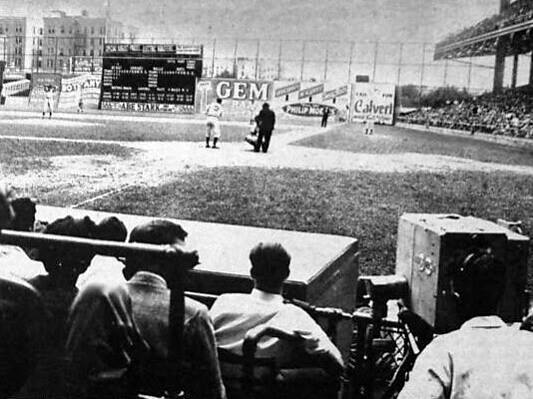
Sadly, it appears that no record of this game survives: Not the original TV broadcast, not a radio recording, not a film. The photograph at the top of the page is allegedly from that game.

Later in 1939, W2XBS would also become the 1st TV station in the world to broadcast college football and the 1st to broadcast pro football. In 1940, it became the 1st American TV station to broadcast a National Hockey League game (a British station had telecast a hockey game in London in 1938), the 1st to broadcast a religious service (Easter Mass from St. Patrick's Cathedral, a short walk from the RCA Building at Rockefeller Center), and the 1st to broadcast a political convention (the Republican Convention in Philadelphia, nominating Wendell Willkie to run against FDR, unsuccessfully as it turned out).

On July 1, 1941, the Federal Communications Commission (FCC) gave licenses to W2XBS and W2XAB, which was owned by the Columbia Broadcasting Service, CBS. Doing so on the same day meant that neither could claim to be the 1st. W2XBS became WNBT, broadcasting on Channel 4. They changed their call letters to WRCA in 1954, and to WNBC in 1960. W2XAB broadcast on Channel 2, and became WCBW, and then WCBS in 1946.

The other New York VHF TV stations:

* Channel 5 went on the air on May 2, 1944, on the DuMont Network, with its call letters being WABD, for its founder, Allen B. DuMont, went independent when DuMont folded in 1956, became WNEW in 1958, and WNYW when it became a Fox station in 1956.

* Channel 13 went on the air on May 13, 1948, as an independent station, WATV. It became WNTA in 1958, and WNDT in 1962. That year, it joined National Educational Television (NET), America's 1st "public television" network. In 1970, NET became the Public Broadcasting Service, PBS, and the station's call letters were changed to WNET. Why not WPBS? Those call letters were not already being used, but were subsequently given to a PBS station in Watertown, New York, on the St. Lawrence River, Channel 16.

* Channel 11 went on the air on June 15, 1948, as WPIX, the call letters referring to its ownership by the New York Daily News, "New York's Picture Newspaper." This was not unusual: Many radio TV stations were founded by newspapers. WPIX continues to use the Daily News Building on East 42nd Street as its headquarters, even though the paper has moved its offices elsewhere. The station joined Warner Brothers in 1995, becoming part of The WB. When The WB and UPN merged in 2006 to form The CW, WPIX went along with it.

* Channel 7 went on the air on August 10, 1948, as WJZ, an ABC station, becoming WABC in 1953.

* Channel 9 went on the air on October 11, 1949, as WOR, an independent station, becoming WWOR when bought by MCA in 1987, moved to United Paramount Network (UPN) in 1995, and to MyNetwork in 2006, following the WB/UPN merger.

*

August 26, 1939 was a Saturday. It was the off-season for the NFL and the NHL, and the NBA hadn't been founded yet. Here are the other MLB games that were played that day:

* The New York Yankees beat the St. Louis Browns, 6-1 at Sportsman's Park in St. Louis. Irving "Bump" Hadley went the distance. The Yankees hit no home runs, but got 2 hits each from Joe DiMaggio, Red Rolfe, Joe Gordon and Babe Dahlgren, who had replaced Lou Gehrig at 1st base.

* The New York Giants swept a doubleheader from the Pittsburgh Pirates at the Polo Grounds. The Jints won the opener 6-2, and the nightcap 8-0, as Cliff Melton pitched a 3-hit shutout.

* The St. Louis Cardinals swept a doubleheader from the Philadelphia Phillies at Shibe Park in Philadelphia. The Cards won the 1st game 5-0, as Curt Davis allowed 10 hits, but kept the shutout. The Cards won the 2nd game 11-4.

* The Chicago Cubs swept a doubleheader from the Boston Bees at Braves Field in Boston. This was during the stretch when the Braves, trying to change their identity after a horrible 1935 season, changed their name, with their ballpark being nicknamed "The Bee Hive." It didn't take, and they went back to being named the Braves in 1941. Both games in this doubleheader ended 8-1 in the Cubs' favor.

* It was also Chicago beating Boston in the American League, as the Chicago White Sox beat the Boston Red Sox, 5-4 at Comiskey Park in Chicago.

* The Cleveland Indians beat the Philadelphia Athletics, 7-5 at League Park in Cleveland.

* And the Detroit Tigers beat the Washington Senators, 6-3 at Briggs Stadium in Detroit. That ballpark would be renamed Tiger Stadium in 1961.

Also, Arsenal opened what turned out to be their shortest Football League season by drawing with Wolverhampton Wanderers, 2-2 at Molineux Stadium in Wolverhampton, outside Birmingham in England's West Midlands. Two weeks later, the League would suspend play due to the start of World War II. 

Tuesday, May 24, 2022

May 24, 1935: The 1st Major League Night Game

May 24, 1935: For the 1st time, a night game is played in Major League Baseball.

It's important to add the qualifier that it was the 1st in MLB. On September 2, 1880, competing teams of department stores in Boston played each other under lights in nearby Hull, Massachusetts. The Negro Leagues had been playing under lights since at least 1928.

On April 28, 1930, in the Class A Western Association, the Independence Producers of Kansas and the Muskogee Chiefs of Oklahoma played the 1st official minor-league night game in Independence. And on February 21, 1931, the 1st night game involving major league teams was played: The Chicago White Sox beat the New York Giants, 11-6 at Buffalo Stadium in Houston.

One of the minor-league teams that had played night games was the Columbus Red Birds of Ohio and the American Association. Larry MacPhail had been their general manager, and knew that night games, played when more people weren't working and could see games, had saved some minor-league teams during the Great Depression.

Now, he was the GM of the Cincinnati Reds. In the 1934-35 off-season, the National League had voted to allow teams to play up to 7 night games per season. He decided to make the 1st one a Friday night game at Crosley Field, when the Reds, not doing too well, were to play the Philadelphia Phillies, who were doing even worse.

Before the game, there were a performance by an American Legion band and fireworks. With the ceremonies over, and the Sun set, a prearranged method for turning the lights on was carried out. President Franklin D. Roosevelt pushed a button at the White House, and the connection with Crosley Field was made, turning on 632 lamps in 8 metal stanchions, totaling over 1 million watts of light, and bringing cheers from a crowd of 20,422, in a ballpark that then seated 26,060. (It would top out at a little over 30,000.) National League President Ford Frick threw out a ceremonial first ball.

Paul Derringer, then the Reds' ace, started for them. The Phillies' starter was Joe Bowman. In the bottom of the 1st, Billy Myers doubled, moved to 3rd on a groundout by Lew Riggs, and got home on a groundout by Ival Goodman. In the bottom of the 4th, Billy Sullivan singled, was singled over to 3rd by Harlin Pool, and scored on a groundout by Gilly Campbell, making it 2-0 Cincinnati.

In the top of the 5th, Al Todd singled, was moved over to 3rd by a Mickey Haslin single, and Bowman grounded into an error that scored Todd. The Phillies were within 2-1. A great catch of a Dolph Camilli drive to center by Sammy Byrd saved a run, to hold that score. And it held until the end, as Derring pitched a complete game -- lasting 1 hour and 35 minutes.

The rest of the majors were slow to adopt night games. MacPhail would be the catalyst again: He moved on to the Brooklyn Dodgers in 1938, and broke the "gentlemen's agreement" banning radio broadcasts of regular season games in New York City. He brought the Reds' broadcaster with him, Walter Lanier "Red" Barber. He also rebuilt the Dodgers' farm system, making them competitive for the first time since the mid-1920s. And he seriously fixed up Ebbets Field, including the installation of lights.

*

As I said, May 24, 1935 was a Friday. A full slate of games was played that day, except for the Reds-Phillies game that night. Here are the others:

* The New York Yankees lost to the St. Louis Browns, 6-3 at Yankee Stadium. Red Rolfe had 3 hits, but it wasn't enough, as Lefty Gomez didn't have good stuff that day.

* The New York Giants beat the Chicago Cubs, 13-0 at Wrigley Field in Chicago. Hal Schumacher pitched a 4-hit shutout, backed by 3 hits each from Mel Ott, Hank Lieber, Gus Mancuso, and former Yankee shortstop Mark Koenig, who hit a home run.

* The Brooklyn Dodgers beat the St. Louis Cardinals, 5-3 at Sportsman's Park in St. Louis.

* The Boston Red Sox beat the Detroit Tigers, 8-4 at Fenway Park in Boston.

* The Cleveland Indians beat the Philadelphia Athletics, 12-2 at Shibe Park in Philadelphia.

* The Washington Senators beat the Chicago White Sox, 10-0 at Griffith Stadium in Washington. Bobo Newsom pitched a 5-hit shoutout.

* And the Pittsburgh Pirates beat the Boston Braves, 7-6 at Forbes Field in Pittsburgh. The next day, Babe Ruth, playing out the string with the Braves, hit 3 home runs, the last of his career.

*

The 1st major league night game in New York City was played at Ebbets Field on June 15, 1938. Appropriately, the opponent was the Reds. Johnny Vander Meer, who had pitched a no-hitter against the Boston Bees (as the Braves were known from 1936 to 1940) at Crosley Field 4 days earlier, pitched another, becoming the only major league pitcher ever to throw back-to-back no-hitters. The Reds won, 6-0.

On May 16, 1939, the 1st night game in the American League was played, at Shibe Park in Philadelphia. The Athletics lost to the Indians, 8-3. Having moved from Baker Bowl to Shibe the previous year, the Phillies were now able to play home games at night, and did so on June 1. But they also lost, 5-2 to the Pirates.

Later in 1939, on June 27, the Indians played their 1st night game, beating the Tigers 5-0 at Cleveland Municipal Stadium; and the White Sox played the 1st night game in Chicago, on August 14, beating the Browns 5-2 at Comiskey Park.

Four teams had their nighttime home debuts in 1940: The Giants on May 24, beating the Bees/Braves 8-1 at the Polo Grounds; the Browns on the same day, the 1st night game in St. Louis, losing to the Indians 3-2 at Sportsman's Park; the Pirates on June 4, beating the Bees/Braves 14-2 at Forbes Field; and the Cardinals, also on June 4, losing to the Dodgers 10-1 at Sportsman's Park.

The Yankees and the Senators played their 1st home night games against each other: At Griffith Stadium in Washington on May 28, 1941, a 6-5 Yankee win; and at Yankee Stadium on May 28, 1946, a 2-1 Senators win. The 1st night games in Boston came on May 11, 1946, with the Braves losing 5-1 to the Giants at Braves Field; and on June 13, 1947, with the Red Sox beating the White Sox 5-3 at Fenway Park.

The last AL team to get lit was the Tigers, on June 15, 1948, beating the A's 4-1 at Briggs Stadium (later Tiger Stadium). The Cubs were the last holdouts, by plenty. The Wrigley family long claimed that the lights would disturb the neighborhood around Wrigley Field. Finally, with the threat of not being allowed to play home games in the postseason due to the demands of TV networks for prime-time ratings, the Tribune Company, which had bought the team from the Wrigleys in 1981, relented. On August 9, 1988, the Cubs played their 1st home night game, beating the New York Mets, 6-4. 

December 31, 1999 & January 1, 2000: The Millennium

December 31, 1999:  The Millennium arrives. The people of planet Earth survived. At a terrible cost. But we hadn't destroyed ourselves. ...