Showing posts with label the forum. Show all posts

Saturday, December 31, 2022

December 31, 1967: The Ice Bowl

Lambeau Field as it appeared in 1967.
Note the shadow cast by the scoreboard
at the south end. This will matter later on.

December 31, 1967: As the narrator for a 1987 NFL Films production put it, "On a day savage enough to make a Saint Bernard whimper, they played the 1967 NFL Championship Game." Or, as it has become known in football lore, The Ice Bowl.

I don't know who the narrator was -- the Internet has failed me in this regard -- but the film was made in 1987, so it wasn't John Facenda, the voice of NFL Films from 1966 until his death in 1984. Let the record show that Facenda never actually spoke the words "the frozen tundra of Lambeau Field." ESPN's Chris Berman, imitating Facenda, made that up.

The Ice Bowl isn't even the coldest game in NFL history anymore. The 1981 AFC Championship Game, played at Riverfront Stadium in Cincinnati on January 10, 1982, was 9 degrees below zero without the wind chill factor, and 37 below with it. The San Diego Chargers, used to warm weather, had played one of the hottest games in NFL history just 8 days earlier, against the Miami Dolphins at the Orange Bowl, and were totally unused to this kind of cold. The Bengals won, 27-7. This one is known as the Freezer Bowl.

Many NFL Championship Games, nearly all played in December to that point, had been plagued by cold weather. Vince Lombardi had been born and raised in Brooklyn, and had coached the Green Bay Packers since 1959, so he could handle cold weather.

But from having coached in the title games of 1956, 1958 (these 2 as an assistant coach with the New York Giants), 1961, 1962 and 1965, he knew that cold weather could be a problem for football. Fortunately, since the Packers' unusual ownership structure, and his role as both head coach and general manager, left him a virtual dictator, he had the field torn up, and heating coils placed under the field. When resodded, the idea was that the coils would keep the field from freezing. It became known as "Lombardi's Electric Blanket."

Lombardi had been offensive coordinator to Giants head coach Jim Lee Howell. The defensive coordinator was Tom Landry, who became the 1st head coach of the Dallas Cowboys, the team the Packers had defeated to win the 1966 NFL Championship, and whom they would have to beat again to win for 1967. Lombardi and Landry were opposites: Landry was a great stone face, never showing emotion during the game; while Lombardi was, in the words of his Hall of Fame guard Jerry Kramer, "a raving Italian lunatic!"

But the teams were the other way around: The Cowboys -- not yet the dominant team that they would become -- were braggarts, having earned very little right to do so thus far; while the Packers let their performance do the talking for them. The exception was Hall of Fame running back Paul Hornung, but he was retired by this point. The Packers were going for their 5th NFL Championship in 7 years, which included ending the previous season by winning "The AFL-NFL World Championship Game," retroactively named "Super Bowl I."

The day before the game, NFL Commissioner Pete Rozelle made some phone calls, and was told that the game-time temperature would be about 5 degrees above zero. (All temperatures mentioned in this post will be in degrees Fahrenheit.)

Rozelle didn't like that, and began to consider postponing the game to the next day, Monday, New Year's Day 1968, despite the fact that it would compete for TV ratings with the college bowl games. But he was told that the oncoming cold front would make it even colder on Monday. So, already in Green Bay, he called Lombardi at his house, and Landry at his hotel, and told them the game would go on as scheduled.

But the cold front arrived sooner, and was worse than expected. As Cowboy receiver Rentzel reported, he was told that it was 15 degrees below zero. The official NFL Films record of the game shows a rotating bank clock backing that up, reading "-15°."
I couldn't find a photo online.
I had to photograph it off my computer screen.
Yes, that's me and my phone in the reflection.

When Lombardi got to Lambeau Field, he discovered that it was so cold (This was before comedians began doing things like, "How cold was it?"), the mechanism for the heating coils broke. With the machine inoperable, the field was frozen. To make matters worse, when the tarp was taken off the field, it had left moisture on it, which froze. The field was an ice rink.

At the time, Lambeau Field held 50,861 people. That was the official attendance: In spite of the cold, there was not an empty seat in the house -- until an elderly spectator died from exposure. Yes, only one fan died from the cold. Among those in attendance was a 12-year-old boy from Appleton, Wisconsin, who went on to become a renowned actor: Willem Dafoe. In 2017, NFL Films released a 50th Anniversary documentary on the Ice Bowl, with Dafoe narrating. 

The marching band of the University of Wisconsin-La Crosse was scheduled to perform the pregame and halftime shows. But during -- pardon the choice of words -- the warmups, the spit inside their woodwind instruments froze, rendering them impossible to play. The mouthpieces of brass instruments stuck to their players' lips. Seven members of the band were taken to the hospital for hypothermia.

The officials' whistles also had the spit freeze inside, and, during the pregame midfield meeting with the team captains, they said that play would be stopped by the officials putting their hands on the backs of players who, due to concentrating on the ballcarrier, couldn't otherwise see that play had stopped.

Frank Gifford, the Hall of Fame running back for the Giants who was serving as one of the CBS announcers for the game, said, on the air, "I'm going to take a bite of my coffee."
The game was played anyway. When it kicked off at 1:00 PM Central Standard Time -- 2:00 Eastern -- it was 13 below, with a wind-chill factor, on the since-changed current scale, of -36.
Note the ticket price: $10. That's about $83 in 2022 money.
For the Championship Game. Today, a regular-season game
would almost certainly cost you much more.

The game did affect the Cowboys more than the Packers. The film shows Hall of Fame linebacker Ray Nitschke running onto the field in short sleeves, with no gloves. He was from Chicago. He could handle it. But Meredith's face froze, to the point where he couldn't make his words understood in the huddle unless he pressed on his cheeks. Bob Hayes, the Olympic sprinting champion who'd hauled in so many of Meredith's passes, had to run with his hands tucked in a hole cut in his jersey.

The Packers opened the game with a 9-minute drive that ended with a touchdown pass from Bart Starr to Boyd Dowler. Starr connected with Dowler again in the 2nd quarter, giving the Packers a 14-0 lead. It would then have been very easy to guess that the Texas-based team were done in by the cold, and were finished.

They weren't. They showed a tremendous amount of courage, and came back. They didn't get a single 1st down in the 2nd quarter, but fumbles by Starr and of a punt return by Wood led to Cowboy scores, making it 14-10 Green Bay at the half.

In the 3rd quarter, the Packers stopped a Cowboy drive with a fumble, and ended another that resulted in a missed field goal by Danny Villanueva. At the start of the 4th quarter, Landry gambled, and called an option pass for Dan Reeves -- later to coach the Denver Broncos, the Giants and the Atlanta Falcons -- to Rentzel. It went for 50 yards and a touchdown.

Despite seemingly everything going against them, the Cowboys led 17-14. The Packers' Don Chandler missed a field goal, and it looked like the Packers would be dethroned.

With 4 minutes and 50 seconds left, the Packers took over on their own 32-yard line. Since the goalposts would be on the goal line until the 1974 season, but Chandler had already missed a 40-yard attempt, this meant that they probably needed to get the ball to the Dallas 30-yard line for a field goal -- but that would only have tied it, and sent this already-miserable experience to overtime.

Starr advanced the Packers with short passes to Dowler and Donny Anderson. But a hit knocked Dowler down, and his head hit the frozen turf. Even with the protection of a football helmet, he was knocked unconscious. As with the Super Bowl nearly a year earlier, Max McGee came in to replace him. Unlike that Super Bowl, McGee would not turn out to be the hero this time.

Lombardi's most famous play was the "power sweep": Both guards, Kramer and Fred "Fuzzy" Thurston, would pull out of the line at the snap, and run in the same direction (either left or right), and Starr would pitch to a running back, who would then run behind the guards. This had worked so many times with Hornung and Jim Taylor, and now with Anderson and Elijah Pitts.

This time, Lombardi had a trick up his sleeve, a play known in the Packer playbook as "54-Give." He called it the "sucker play": It was a fake power sweep, with Gale Gillingham, having replaced Thurston, pulling to the right. This caught the attention of the Cowboys' Hall of Fame defensive tackle, Bob Lilly, and he followed. This left a hole up the middle, and running back Chuck Mercein got to the 3-yard line.

The Packers then needed to get to the 1-yard line for a 1st down, and did. Some of the Cowboys thought Anderson had scored. Had there been a rule at the time, allowing a coach to challenge a call via instant replay, what happened next might not have happened, and Anderson would have been the big hero of the game. But the officials didn't see the ball cross the plane of the goal line, and so it was 1st and goal on the 1.

It was getting late. Lambeau Field did have lights, so darkness was not going to be an issue. But a lack of sunlight was. To make matters worse, the action was now at the south end of the field, where the shadow of the scoreboard loomed, making it even colder. I've seen sources say that, with the wind chill factor (on the old scale), it was as low as 48, or even 55, degrees below zero.

There was less than a minute left. On 1st down, Starr handed off to Anderson, but he slipped on the icy field. On 2nd down, Anderson slipped even before Starr could get the ball to him. Now, it was 3rd and goal on the 1. The Packers called their last timeout. There were 16 seconds left.

On the film, Lilly can be shown kicking the field, and he kicks up specks of frost. The Cowboys actually considered getting a drill, and drilling holes in the field, to get a better footing. I don't know if that was legal at the time, or if they would have had time for it, even if they took all their remaining timeouts.

The Packers' dilemma was equally tricky. Run the ball and fail, and they wouldn't be able to stop the clock in time to kick the tying field goal. Pass the ball, and it could fall incomplete, leaving 4th down with the clock stopped with a few seconds left, and you could still kick the field goal -- but it could also be intercepted, as Tom Brown did with Meredith's desperation pass with just under a minute to play, which clinched the Packer victory in the Championship Game the year before, in Dallas. Kick the field goal now, on 3rd down, and Chandler could miss again; and, even if he makes it, the game is still only tied.

Starr wasn't as good a passer as his contemporaries Johnny Unitas, Sonny Jurgensen and Joe Namath, but he was smarter than any of them. He recommended a play called "31-Wedge," telling Lombardi, "Coach, the linemen can get their footing on the wedge, but the backs are slipping. I'm right there. I can just shuffle my feet and lunge in."

At this point, Lombardi, who had famously said, "Fatigue makes cowards of us all," was as cold and as tired as anyone, and was not looking forward to overtime, so he told Starr, "Run it, and let's get the hell out of here!"

Starr called the play. It required guard Kramer and center Ken Bowman to double-team the Cowboys' other tackle, Jethro Pugh. Bowman snapped the ball, Starr took it, lowered his head, and followed the block.

Touchdown. On the film, Mercein can be shown raising his hands. He's not signaling, "Touchdown!" He's showing the referee that he's not illegally helping Starr. To this day, Cowboy fans insist that Kramer was offside. As if the Cowboys wouldn't win a whole slew of games due to cheating and favorable officials' calls in the years to come. Besides, Anderson might have broken the plane of the goal line 3 plays earlier, and the refs missed that.
Starr (15) over the goal line. Mercein (30) with his hands up.
Kramer (64) having blocked Pugh (75).
This is Walter Iooss Jr.'s photo for Sports Illustrated.
The most familiar shot of the touchdown is in black & white,
and I wanted a color photo.

In his 1981 book Pro Football's 10 Greatest Games, in which he included both this game and the previous season's NFL Championship Game between the Packers and the Cowboys, sports historian (usually specializing in baseball) John Thorn wrote, "It is the most famous touchdown in football history."

He published that book before the 1982 Dwight Clark "The Catch," but put Starr's Sneak ahead of the 1958 Alan Ameche overtime score (he included that title game in the book), and the 1974 Clarence Davis "Sea of Hands" catch (he included that game, too), and apparently ahead of the 1972 Franco Harris "Immaculate Reception" (he did not include that game).

Chandler kicked the extra point to make it 21-17. There were still 13 seconds left. The Packers kicked off, and the Cowboys let it go into the end zone. Meredith threw 2 incompletions, and, at 3:44 PM Central Time (4:44 Eastern), the game was over.
How anybody still had any desire to remain outside
long enough to tear down the goalposts, I'll never know.

The Packers went Super Bowl II, in considerably friendlier weather at the Orange Bowl in Miami, and beat the AFL Champion Oakland Raiders, 33-14. Lombardi retired as head coach after that game, but stayed on as general manager. As with the 1964-65 Yankees, the team seemed to get old all at once, and the dynasty collapsed. The team wouldn't reach the title game again for 29 years, winning Super Bowl XXXI in the 1996-97 season.

After the 1968 season, Lombardi accepted Edward Bennett Williams' offer to be head coach and general manager of the Washington Redskins, and began to rebuild them in 1969. But he developed colon cancer -- much more easily treatable now, but fatal then. He died on September 3, 1970, only 57 years old. The Redskins hired George Allen away from the Los Angeles Rams, and reached Super Bowl VII 3 seasons later.

The Cowboys got tagged as a team that "can't win the big one." They reached Super Bowl V, but lost to the Baltimore Colts. Finally, they came to dominate the NFC in the 1970s, reaching 5 Super Bowls, winning Super Bowls VI and XII. They began calling themselves "America's Team." They were featured on TV so much that people joked that CBS stood for "Cowboys Broadcasting System." Landry remained head coach until 1989, and died in 2000.

The Ice Bowl lives on in sports memory. It still gives chills, even to people like me who weren't even born yet. In 2019, a poll ranked this game 3rd on a list of the 100 Greatest Games of the NFL's 1st 100 years.

*

December 31, 1967 was a Sunday. The 1967 AFL Championship Game was played the same day. The Oakland Raiders beat the Houston Oilers, 40-7 at the Oakland Coliseum. While that stadium has been known for chilly conditions, there was no issue with the weather there on that day.

There were 2 games played in the NBA. The Los Angeles Lakers beat the expansion San Diego Rockets, 147-118. It was the 1st game the Lakers played at their new arena, The Forum, outside Los Angeles in Inglewood, California.

And the San Francisco Warriors beat the other expansion team, the Seattle SuperSonics, 126-124 at the Seattle Center Coliseum. For the Warriors, Nate Thurmond had 34 points and 25 rebounds.

There was 1 game played in the American Basketball Association, which was in its 1st season: The Pittsburgh Pipers beat the Indiana Pacers, 121-106 at the Civic Arena in Pittsburgh. The Pipers would go on to win the 1st ABA Championship. But before the 1972-73 season, they were out of business. The Pacers would win the ABA title in 1970, '72 and '73, and were 1 of the 4 teams absorbed from the ABA into the NBA in 1976.

There were 4 games played in the NHL that day:

* The New York Rangers beat the Toronto Maple Leafs, 4-0, in one of the last events at the old Madison Square Garden.

* The Philadelphia Flyers beat the Los Angeles Kings, 9-1 at The Spectrum in Philadelphia.

* The Detroit Red Wings beat the Boston Bruins, 6-4 at the Olympia Stadium in Detroit.

* The Chicago Blackhawks beat the Oakland Seals, 3-0 at the Chicago Stadium.

* The Montreal Canadiens, the Pittsburgh Penguins, the St. Louis Blues and the Minnesota North Stars were not scheduled.

Friday, December 30, 2022

December 30, 1967: The Forum Opens In Inglewood

December 30, 1967: The Forum opens, outside Los Angeles in Inglewood, California. It becomes, and remains, the most famous indoor sports venue in the Western United States.

It was designed by architect Charles Luckman, and built on the site of a golf course, at Manchester Boulevard and Prairie Avenue, across Kelso Street from the Hollywood Park racetrack, 11 miles southwest of downtown Los Angeles.

It was built because Jack Kent Cooke, the Canadian media mogul who owned the NBA's Los Angeles Lakers, wanted to bring the NHL to Los Angeles. He had been told that there were more than 300,000 former Canadians living within a three-hour drive of Los Angeles. The Lakers had arrived in 1960, and had played at the Los Angeles Memorial Sports Arena, next-door to the Los Angeles Memorial Coliseum, whose Commission owned both buildings.

Dan Reeves, owner of the Rams, who played in the Coliseum, also owned the Western Hockey League's Los Angeles Blades, who played in the Sports Arena. The Coliseum Commission wanted to own L.A.'s NHL team, and told Cooke that, if he won the bid, his team wouldn't be allowed to play in the Sports Arena.

(This Dan Reeves was no relation to the man of the same name, then a running back for the Dallas Cowboys, who later became a successful NFL coach.)

So Cooke built The Forum, with $16 million his own money (about $140 million in 2022 dollars), and won the bid. The Kings debuted on October 14, at the Long Beach Convention Center, beating another expansion team, the Philadelphia Flyers, 4-2. The Kings played 11 home games at the Sports Arena, and 6 at Long Beach, before The Forum opened on December 30, with a 2-0 loss to the Philadelphia Flyers, a fellow expansion team. The Lakers played their 1st Forum game the next day, December 31, beating the San Diego Rockets, 147-118. (The Rockets moved to Houston in 1971.)

The Lakers did very well at The Forum. The Kings did not, and their attendance reflected this. About those 300,000 people, Cooke remarked, "Now I know why they left Canada: They hate hockey!" In 1979, Cooke sold the Forum, the Kings, and the Lakers to Dr. Jerry Buss (his doctorate was in chemistry) for a then-record $67.5 million (equivalent to $272 million in 2022). Half of the payment was in cash, and half was in real estate, with part of Buss's payment including the Chrysler Building in New York.

The Forum hosted 14 NBA Finals: 1968, 1969, 1970, 1972, 1973, 1980, 1982, 1983, 1984, 1985, 1987, 1988, 1989 and 1991, with the Lakers winning in 1972, 1980, 1982, 1985, 1987 and 1988; but only 1 Stanley Cup Finals, in 1993, with the Kings losing it. It never hosted an NCAA Final Four (the Sports Arena did so in 1968 and 1972), but it hosted the NBA All-Star Game in 1972 and 1983, the NHL All-Star Game in 1981, and the Olympic basketball games in 1984.

In addition to the Lakers and Kings, it hosted the Los Angeles Strings of World Team Tennis from 1975 to 1978, the indoor-season games of the Los Angeles Aztecs of the North American Soccer League in the 1979-80 season, and the Los Angeles Sparks of the WNBA from 1997 to 2000.

For sponsorship purposes, The Forum was known as the Great Western Forum from 1988 to 2003, The Forum presented by Chase from 2014 to 2022, and now as the Kia Forum.

In 1999, the Lakers, the Kings, the Sparks, and the NBA's Los Angeles Clippers all moved into the Staples Center, now named the Crypto.com Arena, in downtown Los Angeles. The last Kings game at The Forum was on April 18, 1999, a 3-2 loss to the St. Louis Blues. The last Lakers game was on May 23, 1999, a 118-107 loss to the San Antonio Spurs. Both teams played preseason exhibitions there before moving downtown.

Faithful Central Bible Church, with a congregation of over 12,000, purchased The Forum at the end of 2000, and began holding church services there on Sunday mornings. Unlike Houston's Lakewood Church, whose pastor, Dr. Joel Osteen, converted the Rockets' former arena, The Summit, into their church, Faithful Central representatives said that they never intended to convert the arena for religious purposes. In 2009, the church discontinued their regular use of the Forum for services.

The Forum was used for the 2002 film Like Mike and the 2009 film Hannah Montana: The Movie. In 2009, Michael Jackson rehearsed at The Forum for his upcoming concert tour, but died while those rehearsals were in progress.

In 2012, the Madison Square Garden Corporation bought The Forum, and renovated it until 2014. It began hosting award shows: The Nickelodeon Kids' Choice Awards in 2015, '16 and '18; the American Country Countdown Awards in 2016; the Teen Choice Awards in 2016 and '18; the MTV Video Music Awards in 2017; and the iHeartRadio Music Awards in 2016, '17 and '18.

In 2020, SoFi Stadium was built on the site of the demolished Hollywood Park; and Clippers owner Steve Ballmer bought The Forum, planning to built a new arena for his team nearby, the Intuit Dome. The Forum will remain standing through at least 2028, when Los Angeles hosts the Olympics again: The Forum is slated to host gymnastics.

*

December 30, 1967 was a Saturday. Baseball was out of season. Two college football bowl games were played that day: Penn State and Florida State played to a tie, 17-17, at the Gator Bowl in Jacksonville, Floirda; and the University of Texas at El Paso (UTEP), playing on its home field, beat Mississippi (Ole Miss), 14-7 in the Sun Bowl.

The next day, New Year's Eve, the pro football leagues' Championship Games were held. In the AFL, the Oakland Raiders beat the Houston Oilers, 40-7 at the Oakland Coliseum. And in a game so cold it became known as the Ice Bowl, the Green Bay Packers beat the Dallas Cowboys, 21-17 at Lambeau Field in Green Bay, Wisconsin.

The day after that, New Year's Day 1968, the major college bowls were played. Number 1 University of Southern California (USC) beat Indiana, 14-3 in the Rose Bowl in Pasadena, and clinched the National Championship. Number 3 Oklahoma beat Number 2 Tennessee, 26-24 in the Orange Bowl in Miami. Louisiana State University (LSU) beat Number 6 Wyoming, 20-13 in the Sugar Bowl in New Orleans. And Texas A&M beat Number 8 Alabama, 20-16 in the Cotton Bowl in Dallas.

There were 2 NBA games played on December 30, 1967. The Philadelphia 76ers beat the Detroit Pistons, 122-107 at Cobo Hall (now Huntington Place) in Detroit. Wilt Chamberlain scored 30 points and grabbed 18 rebounds. And the Los Angeles Lakers beat the St. Louis Hawks, 106-104 at the Kiel Auditorium in St. Louis. Jerry West scored 34 points.

There were 4 games played in the American Basketball Association, which was in its 1st season:

* The New Jersey Americans (who became the New York Nets the next season) beat the Oakland Oaks, 123-117 at the Oakland Coliseum Arena.

* The Indiana Pacers beat their rivals, the Kentucky Colonels, 124-80 at the Indiana State Fairgrounds Coliseum (now the Corteva Coliseum) in Indianapolis.

* The Minnesota Muskies beat the Dallas Chaparrals, 104-92 at the Metropolitan Sports Center in the Minneapolis suburb of Bloomington, Minnesota.

* And the Denver Rockets beat the Houston Mavericks, 96-80 at the Auditorium Arena in Denver.

And the entire newly-expanded NHL was in action. In addition to the Kings and the Flyers:

* The New York Rangers and the Chicago Black Hawks played to a tie, 3-3 at the old Madison Square Garden.

* The Montreal Canadiens beat the Oakland Seals, 2-0 at the Montreal Forum.

* The Toronto Maple Leafs beat the St. Louis Blues, 8-1 at Maple Leaf Gardens in Toronto.

* The Detroit Red Wings beat the Pittsburgh Penguins, 5-2 at the Civic Arena in Pittsburgh.

* And the Minnesota North Stars beat the Boston Bruins, 5-4 at the Met Center in Bloomington. Yes, it hosted an NHL game and an ABA game on the same day.

And in English soccer, a London derby was held at the Arsenal Stadium, a.k.a. Highbury, in North London. Arsenal and Chelsea played to a 1-1 draw.

Tuesday, October 18, 2022

October 18, 1969: Kareem Abdul-Jabbar's 1st Professional Game

October 18, 1969: Kareem Abdul-Jabbar (then still using his birth name of Lew Alcindor), the greatest player in the history of college basketball, makes his professional debut. The Milwaukee Bucks beat the Detroit Pistons, 119-110 at the Milwaukee Arena.

In 1974, it was renamed the Milwaukee Exposition and Convention Center Arena. Because of its initials, and its status as a gathering place, the arena was nicknamed "The MECCA." I have never heard Kareem, a devout Muslim, give his opinion on that fact. at the Milwaukee Arena. Since 2014, it has been named the UW-Panther Arena.

In this game, Kareem led all players with 29 points and 12 rebounds, and he added 6 assists. Teammates Jon McGlocklin and Flynn Robinson each scored 23. Walt Bellamy led the Pistons with 25.

Six days later, Kareem opposed Wilt Chamberlain, the man he would eventually surpass as the NBA's all-time leading scorer, for the 1st time, at The Forum, outside Los Angeles in Inglewood, California. Kareem scored 23 points, but the Milwaukee Bucks were led by Robinson with 33. Wilt scored 25, but the Los Angeles Lakers were led by Elgin Baylor with 26. The Lakers won, 123-112.

The Bucks entered the NBA for the 1968-69 season, along with the Phoenix Suns. The way the NBA Draft worked in those days, the teams with the 2 worst records faced a coin flip, with the winner getting the 1st pick and the loser getting the 2nd pick, so that it paid to "tank," but not that much. The Bucks won the coin flip, and "Big Lew," who had led UCLA to an 88-2 record and 3 National Championships (keeping in mind that freshmen weren't eligible to play on the varsity until 1972), winning the National Player of the Year and the NCAA Tournament's Most Outstanding Player all 3 times, was the easy choice.

With the 2nd pick, the Suns chose Neal Walk, a center from the University of Florida. He played 9 seasons in the NBA, and the fact that he was the next pick after Kareem is by far the most interesting thing about his pro career.

Instead of Walk, the Suns could have chosen Lucius Allen (Kareem's teammate at UCLA, and later in Milwaukee), Bob Dandridge (whom the Bucks also drafted), Bingo Smith, Jo Jo White, Butch Beard, Rick Roberson, Norm Van Lier, Luther Rackley, Steve Mix or Willie Wise, any of whom would have been a noticeably better choice than Walk.

To be fair, the Suns didn't do that badly: Both teams were usually in the Playoffs throughout the 1970s and into the 1980s. But the Bucks, led by Kareem, the veteran star Oscar Robertson, McGlocklin, Robinson, Allen and Dandridge, and coached by Larry Costello, won the 1971 NBA Championship, and also reached the Finals in 1974. Through the 2021-22 season, each team has been to the Finals 3 times, but the Bucks have won 2, while the Suns are still looking for their 1st. The Suns are usually a good team, often a really good one, but they've never been NBA Champions.

Kareem would remain with the Bucks until June 16, 1975. He didn't think Milwaukee was a big enough city for him. He wanted to return to New York, where he was from; or Los Angeles, where he went to UCLA. The Bucks traded him to the Lakers, although with Walt Wesley, for Dave Meyers (another UCLA player), Junior Bridgeman, Brian Winters and Elmore Smith.

This was not a terrible trade for the Bucks: Bridgeman and Winters helped them win 7 straight Division titles, and both of their numbers have been retired, along with those of Kareem, McGlocklin and Dandridge. But the Lakers still got the better part of the deal: Kareem would lead them to 5 titles in the 1980s.

*

October 18, 1969 was a Saturday. This was also the night that The Jackson Five, including Michael Jackson, made their national television debut, on ABC's The Hollywood Palace. They were introduced by fellow Motown Records star Diana Ross, and her boss -- and, secretly, her boyfriend -- Berry Gordy Jr. falsely told the media that Diana had "discovered" them.

These 6 other games were played in the NBA on that night:

* The New York Knicks beat the Los Angeles Lakers, 99-96 at the new Madison Square Garden. Willis Reed scored 25 points, Dick Barnett 21, and Walt Frazier 19. For the Lakers, Jerry West scored 42, Elgin Baylor 18, and Wilt Chamberlain was comparatively quiet with 12 points and 16 rebounds.

This 1st game of the season turned out to be a preview of the last, when the Knicks beat the Lakers at The Garden to win their 1st NBA Championship.

* The Atlanta Hawks beat the Phoenix Suns, 121-116 at the Alexander Memorial Coliseum (now the McCamish Pavilion) in Atlanta.

* The Baltimore Bullets beat the Boston Celtics, 124-117 at the Baltimore Civic Center (now the CFG Bank Arena). Earl "the Pearl" Monroe scored 34.

* The Philadelphia 76ers beat the Cincinnati Royals, 134-123 at the Cincinnati Gardens. Billy Cunningham scored 40 points, and Archie Clark added 31. For the Royals, Luther Rackley scored 29, and Oscar Robertson 23.

* The Chicago Bulls beat the Seattle SuperSonics, 131-126 in overtime at the Chicago Stadium. Chet "The Jet" Walker scored 31.

* And the San Diego Rockets beat the San Francisco Warriors, 125-124 in overtime at the Cow Palace in the San Francisco suburb of Daly City, California. For the 1971-72 season, the Rockets moved to Houston, and the Warriors moved across San Francisco Bay to Oakland, taking the name "Golden State Warriors."

There were 4 games played in the American Basketball Association:

* The Washington Capitols beat the New Orleans Buccaneers, 110-104 at the Washington Coliseum.

* The Dallas Chaparrals beat the Carolina Cougars, 108-97 at the Greensboro Coliseum in Greensboro, North Carolina.

* The Miami Floridians beat the Kentucky Colonels, 110-106 at the Louisville Convention Center.

* And the Los Angeles Stars beat the Indiana Pacers, 126-123 at the Indiana State Fairgrounds Coliseum (now the Corteva Coliseum) in Indianapolis.

There were 5 games in the NHL:

* The New York Rangers lost to the Montreal Canadiens, 7-3 at the Montreal Forum. Jean Béliveau and Ivan Cournoyer each scored 2 goals.

* The Toronto Maple Leafs beat the Chicago Black Hawks, 4-1 at Maple Leaf Gardens in Toronto.

* The Boston Bruins and the Pittsburgh Penguins played to a tie, 3-3 at the Civic Arena in Pittsburgh.

* The St. Louis Blues beat the Minnesota North Stars, 4-2 at the St. Louis Arena.

* And the Los Angeles Kings beat the Oakland Seals, 5-0 at The Forum, outside Los Angeles in Inglewood, California. Former Toronto Maple Leafs star Eddie Shack lived up to his nickname, "Eddie the Entertainer," by scoring a hat trick. This built-in geographic rivalry did not last, as the Seals failed in 1976.

The baseball season had ended 2 days earlier, when the New York Mets beat the Baltimore Orioles in Game 5 to win the World Series. There was college football on this day, including the following games:

* Number 1 Ohio State beat Minnesota, 34-7 at Memorial Stadium in Minneapolis.

* Number 2 Texas were idle. They were supposed to play Arkansas on this date, but ABC convinced them to move it to the open date of December 6, making it the only game played that day and, as both a rivalry game and the game that could have decided the Southwest Conference title, it would get a huge national audience and be a great advertisement for both schools. Both went for it.

* Number 3 Southern California and Number 11 Notre Dame, played to a tie, 14-14 at Notre Dame Stadium in South Bend, Indiana. This turned out to be the only blemish on USC's record, as they won the Pacific-Eight Conference title.

* Number 4 Arkansas rescheduled its game with Baylor for this date, and won, 21-7 at Baylor Stadium (later Floyd Casey Stadium) in Waco, Texas. And after USC's tie with Notre Dame, and Ohio State's upset loss to Michigan, Arkansas were ranked Number 2 when they took the field against Texas on December 6, and Texas were ranked Number 1. It became known as "The Game of the Century," and Texas came from 14-0 down to win, 15-14. Texas then beat Notre Dame in the Cotton Bowl, and were awarded the National Championship.

* Number 5 Penn State beat Syracuse, 15-14 at Archbold Stadium in Syracuse, New York. Penn State had been offered a berth in the Cotton Bowl, to face the Texas-Arkansas winner, and set up a de facto National Championship Game. But they turned it down, since Ohio State were still undefeated and Number 1 at the time the bid was offered.

* Number 6 Missouri beat Oklahoma State, 31-21 at Faurot Field in Columbia, Missouri. Missouri won the Big Eight title, but lost the Orange Bowl to Penn State. As a result of this, Penn State finished undefeated, and ranked Number 2. Their fans still say they would have beaten Texas, given the chance. They were given the chance, and head coach Joe Paterno turned it down. For 40 years, that looked like the biggest mistake that "Saint Joseph" ever made in "Happy Valley." It was not.

* Number 7 Tennessee beat Number 20 Alabama, 41-24 at Legion Field in Birmingham. Tennessee would end up winning the Southeastern Conference title, but a loss to Mississippi caused the Sugar Bowl, which normally invited the SEC Champion, to invite "Ole Miss" instead.

* Number 8 UCLA beat the University of California, 32-0 at the Los Angeles Memorial Coliseum.

* Number 9 Louisiana State beat Kentucky, 37-10 at McLean Stadium in Lexington, Kentucky.

* Number 10 Florida beat North Carolina, 52-2 at Florida Field in Gainesville. Florida went on to beat Tennessee in the Gator Bowl in Jacksonville.

* Number 13 Michigan were upset by Michigan State, 23-12 at Spartan Stadium in East Lansing. Michigan would rebound, winning the Big Ten title by upsetting Ohio State. But they lost the Rose Bowl to USC.

* Number 16 Wyoming beat Brigham Young, 40-7 at War Memorial Stadium in Laramie, Wyoming. They did this despite head coach Lloyd Eaton kicking 14 black players off the team, for wanting to wear black armbands on their sleeves, in protest of the Church of Jesus Christ of Latter-Day Saints, which runs BYU, discriminating against black people, including refusing to let black men be priests in their Church. (That policy was struck down in 1978.)

Without those black players, Wyoming won their next game, but lost their last 4 of the season, and went 1-10 the next season. Eaton was fired, not for being a bigot, but for being a loser. He got a front office job with the Green Bay Packers, but that would be the only subsequent job he would hold in football, at any level.

* Number 19 Mississippi beat Southern Mississippi, 69-7 at Hemingway Stadium (now Vaught-Hemingway Stadium) in Oxford. Despite finishing only 5th in the SEC, "Ole Miss" were invited to the Sugar Bowl, and beat former Number 2 Arkansas.

* Among the service academies, Air Force beat Oregon, 60-13 at Falcon Stadium in Colorado Springs, Colorado; but Army lost to Utah State, 23-7 at Michie Stadium in West Point, New York; and Navy...

* Among New Jersey teams, Rutgers beat Navy, 20-6 at Rutgers Stadium in Piscataway; and Princeton lost to Colgate, 35-28 at Palmer Stadium in Princeton.

* And in New York City, Columbia lost to Yale, 41-6 at Baker Field in Manhattan.

And in English soccer, North London team Arsenal went to the North-East, and played Sunderland to a 1-1 draw at Roker Park in Sunderland.

Tuesday, May 31, 2022

May 31, 1983: Moses Malone Gets Julius Erving a Ring

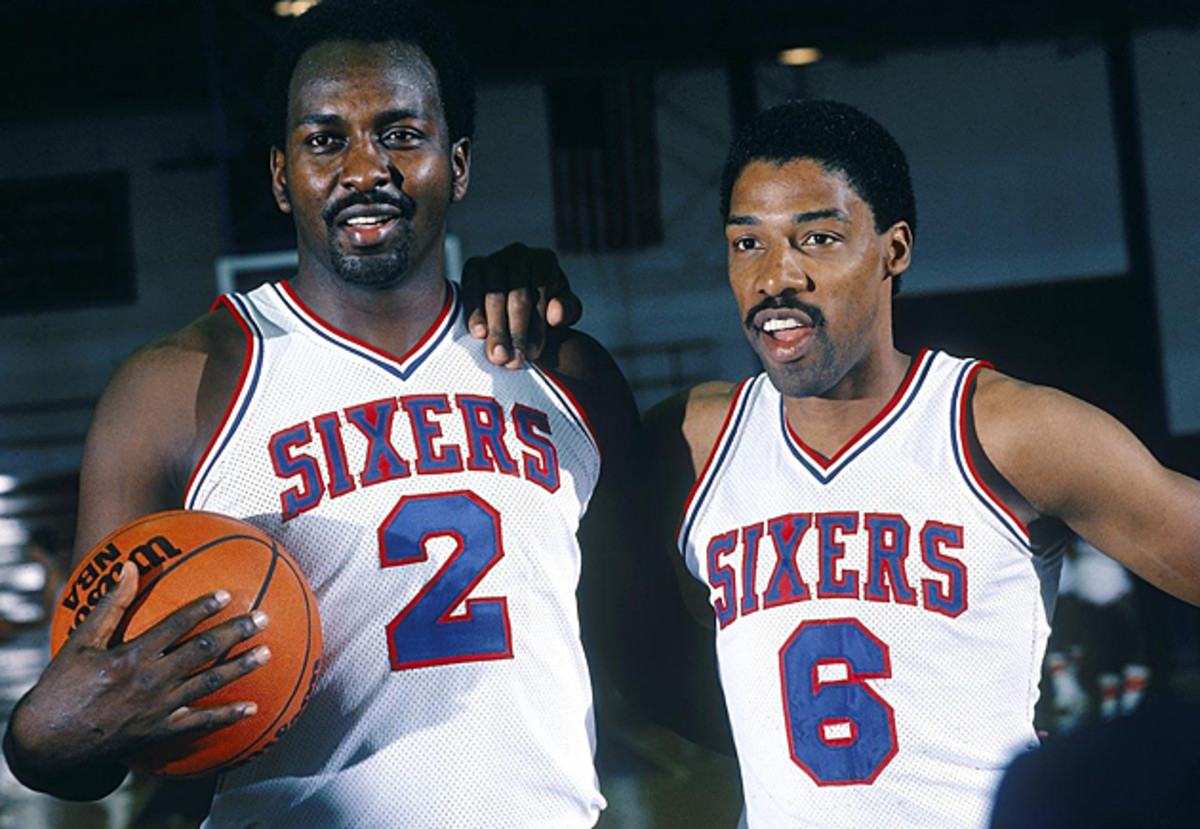
Moses Malone (left) and Julius Erving. Big Mo and Dr. J.

May 31, 1983: The Philadelphia 76ers, and Julius Erving, finally win an NBA Championship, on the massive shoulders of the man who, for most of the early 1980s, was the best basketball player in the world.

Not Erving. Not Kareem Abdul-Jabbar or Magic Johnson of the Los Angeles Lakers, whom the Sixers beat in these Finals. Not Larry Bird of the Boston Celtics, whom the Sixers beat to get into the Finals.

His name was Moses Malone.

It was a story of 2 men, who couldn't have been more different in style, but who combined to get a precious result for one of basketball's greatest cities.

Both players started out in the American Basketball Association. Erving began with the Virginia Squires in 1971, and went to the New York Nets in 1973. Known as "Doctor J," his stunning moves led the Long Island team to the ABA Championship in 1974 and 1976. But when the Nets were invited into the NBA for the 1976-77 season, the territorial indemnification fee they had to pay to the New York Knicks forced them to dump Erving's salary. They traded him to the 76ers.

The 76ers, previously the Syracuse Nationals until 1963, and NBA Champions in 1967, reached the NBA Finals in 1977, but lost it to the Portland Trail Blazers. For 1978, the team adopted the slogan of "We owe you one," but they lost the Eastern Conference Finals to the Washington Bullets.

By 1980, Erving had cut back some on the superhuman moves (but not entirely: There was a basket in that year's NBA Finals against the Lakers that got the tag "The Move"), and became a better defensive player in the process. But the 76ers again lost the Finals. They blew a 3-games-to-1 lead in the Conference Finals in 1981, to the Celtics. They beat the Celtics to get into the NBA Finals in 1982, but, again, lost to the Lakers.

It was said at the time that Dr. J had 2 "red, white and blue rings," but, still, no "real ring." And even fans in New England, Celtic fans who'd hated Philadelphia basketball teams going back to Warriors, who debuted in 1946 and moved to San Francisco in 1962, began to feel bad for him.

Enter Moses Malone. In 1974, he became the 1st player to jump from high school directly to the pros, signing with the ABA's Utah Stars. In 1976, after brief stopovers with the ABA's Spirits of St. Louis and the NBA's Buffalo Braves, he was traded to the Houston Rockets, and was named NBA Most Valuable Player in 1979 and 1982. He got the Rockets to their 1st NBA Finals berth in 1981, where they lost to the Celtics.

After the 1981-82 season, he was a free agent. The Sixers knew that enough was enough: They had to go for it, and adopt a "The future is now" attitude, and so they opened the vault for Malone. Head coach Billy Cunningham and assistant coach Matt Guokas, both rookie forwards on the 76ers' 1967 title team, now had Malone at center, Erving and Bobby Jones as forwards, and Maurice Cheeks and Andrew Toney as guards. There was good scoring, and truly rugged defense. Toney was particularly good against the Celtics, and became known as the Boston Strangler.

The Sixers went 65-17, by 7 games over the Lakers the best record in the NBA. Malone, a native of the Norfolk, Virginia area, was asked how he thought the Playoffs would go. He said, "Fo', fo', fo'." In other words, he thought the Sixers would sweep all three series in four straight games. It had never been done.

In the Conference Semifinals, the Sixers did, indeed, sweep the New York Knicks in 4 straight. Malone led the team in scoring in all 4 games: 38 points, 30, 28 and 29. Knicks coach Hubie Brown, making a point about talent, if not one about proper pronunciation, said, "Moses Malone is a real man. They cannot pay him a-nough."

The Sixers won the 1st 3 games of the Eastern Conference Finals against the Milwaukee Bucks, although none of those 3 was easy. They were 7-0 in the Playoffs. The Bucks won Game 4, 100-94, ending the sweep dream. But the Sixers closed it out in Game 5, 115-103.

The Sixers went into the NBA Finals like a steamroller. The Lakers did not: Rookie sensation James Worthy broke his leg late in the regular season, and missed the entire Playoffs. Bob McAdoo -- like Worthy, Abdul-Jabbar and Johnson, on his way to the Basketball Hall of Fame -- was also hurt, though he was playing through it.

Indeed, in a 1996 ESPN discussion as to what was the greatest team in NBA history, the '83 76ers got nominated by Roy S. Johnson, then with Sports Illustrated. But Bob Ryan of The Boston Globe, who chose the '86 Celtics, said of the '83 76ers, "There's a team out there that could have beaten them," citing the injuries to Worthy and McAdoo.

How much difference could those 2 have made? Perhaps enough to deny those Sixers entry into the "greatest team ever" conversation, but not enough to deny them the NBA title. The Sixers won Game 1 at The Spectrum, 113-107, with Malone scoring 27. They won Game 2, 103-93, with Malone scoring 24. With all the focus on Malone, Erving could relax a little, and played some of the best basketball of his career.

The series moved out to Inglewood, California. Basketball pundits like to say that a series is never over until a home team loses at least once. But the Sixers mopped up the Forum floor with the Lakers in Game 3, 111-94. Malone had 28 points and 19 rebounds. A sweep was now a fait accompli, and Malone accomplished it with 24 points and 23 rebounds in Game 4. He had controlled the entire postseason, which ended with a 115-108 76ers victory. The joke was easy: Moses had led them to the Promised Land.

Moses Malone had carved his name into the marble of NBA history, winning the MVP of both the regular season and the Finals. And Julius Erving finally had an NBA Championship. Pretty much anybody who wasn't a hardcore Laker fan was happy for him.

This closed a very productive period for Philadelphia sports. Over the past 9 years, Philly teams had reached 11 Finals, winning 4 titles. After this, though, it would take 25 years for another Philly major league team to win a World Championship, going 0-for-7 in Finals. (The Phillies lost in 1983 and 1993; the Flyers lost in 1985, 1987 and 1997; the Sixers lost in 2001; and the Eagles lost in 2005.)

The 76ers remained a strong team for 3 more years. But on June 15, 1986, team owner Harold Katz traded Malone, and they traded the top pick the Draft. They've never been the same since, making only 1 NBA Finals, in 2001 with Allen Iverson. Otherwise, with Charles Barkley, Iverson, and Joel Embiid, and under 3 different ownership regimes, the Philadelphia 76ers have been one of the most underachieving teams in North American sports.

From the NBA Finals of 1984 to that of 2021, the count of NBA Championships is as follows: Los Angeles Lakers 9, Chicago Bulls 6, San Antonio Spurs 5, Detroit Pistons 3, Boston Celtics 3, Miami Heat 3, Golden State Warriors 3, Houston Rockets 2, Dallas Mavericks 1, Cleveland Cavaliers 1, Toronto Raptors 1, Milwaukee Bucks 1. The other 18 teams, including the Philadelphia 76ers, none. And of the teams that have won since the last Sixer title, the Mavs, the Heat and the Raps didn't even exist in 1983.

"Trust the process"? The 76ers acquired James Harden in 2022, but Harden is no Moses Malone. And Embiid is no Julius Erving.

The 76ers retired Malone's Number 2, Erving's Number 6, Cheeks' Number 10, Jones' Number 24, and Cunningham's Number 32. Those men, along with Tony, executive Sonny Hill, statistician Harvey Pollack and public address announcer Dave Zinkoff, have been elected to the Philadelphia Sports Hall of Fame. So has Doug Collins, who had played on the 76ers' 1977 and 1980 NBA Finalists, but not on this team.

It says a lot about how the 76ers have been run since that their only retired numbers since have been the 34 of Charles Barkley and the 3 of Allen Iverson; and that only those 2 and Pat Williams, the general manager of their 2001 NBA Finalists that included Iverson, have been elected to the Philadelphia Sports Hall of Fame.

*

May 31, 1983 was a Tuesday. Ordinarily, football would have been out of season. But this was the 1st year of the United States Football League. However, being a Tuesday, no games were played.

The hockey season had ended 2 weeks earlier, when the New York Islanders completed a 4-game Finals sweep over the Edmonton Oilers, to win their 4th straight Cup, making them the only team besides the Montreal Canadiens to achieve it. (The Canadiens won 5 straight, 1956-60; and 4 straight, 1976-79.) The Oiler dynasty began the next season, ending the Islander dynasty in the Finals.

These Major League Baseball games were played that day:

* The New York Yankees beat the California Angels, 5-3 at Yankee Stadium. The Yankees got 4 runs in the bottom of the 8th to win it, capped by a 2-run single by Ken Griffey Sr. Uncharacteristically, Rod Carew went 0-for-3 for the Angels, although he did draw a walk. Reggie Jackson went 1-for-3 with a walk -- for the Angels, not the Yankees.

* The New York Mets lost to the San Francisco Giants, 2-1 at Candlestick Park in San Francisco.

* The Boston Red Sox beat the Chicago White Sox, 2-1 at Fenway Park in Boston. Carl Yastrzemski, in his final season, did not play in this game.

* The Atlanta Braves beat the Pittsburgh Pirates, 10-2 at Three Rivers Stadium in Pittsburgh.

* The Cleveland Indians beat the Seattle Mariners, 5-2 at Cleveland Municipal Stadium.

* The Houston Astros beat the Chicago Cubs, 12-10 at Wrigley Field in Chicago. The wind must have been blowing out, because the Astros got home runs from Alan Ashby, Phil Garner and Tim Tolman, none of them known as sluggers. The Cubs got one from Ryne Sandberg, not yet a star.

* The Milwaukee Brewers beat the Oakland Athletics, 5-2 at Milwaukee County Stadium. Robin Yount went 1-for-2 with 2 RBIs. Paul Molitor went 1-for-4. Rickey Henderson went 1-for-4, with no stolen bases.

* The Minnesota Twins beat the Baltimore Orioles, 10-3 at the Metrodome in Minneapolis. Eddie Murray hit a home run, but Cal Ripken Jr. went 0-for-4.

* The Cincinnati Reds beat the St. Louis Cardinals, 2-1 at Busch Memorial Stadium in St. Louis.

* The Kansas City Royals beat the Texas Rangers, 6-5 at Arlington Stadium in the Dallas suburb of Arlington, Texas. George Brett went 1-for-3 with 2 walks.

* The San Diego Padres beat the Montreal Expos, 5-3 at Jack Murphy Stadium in San Diego.

* And the Los Angeles Dodgers beat the Philadelphia Phillies, 4-1 at Dodger Stadium in Los Angeles. Mike Schmidt went 0-for-3 with a walk. Joe Morgan went 0-for-4. Pete Rose only appeared as a pinch-hitter, unsuccessfully.

Friday, May 27, 2022

May 27, 1993: A Gift for Gretzky

May 27, 1993: Game 6 of the NHL Western Conference Finals, at what was then named the Great Western Forum in the Los Angeles suburb of Inglewood, California. The Toronto Maple Leafs haven't won the Stanley Cup, or even been to the Finals, since 1967. The following season, the Los Angeles Kings began play, and have never been to the Finals. Something's got to give.

The Kings had some big names on their roster. They had Wayne Gretzky, Jari Kurri and Paul Coffey -- and, if you want to count him as a "legend," Marty McSorley -- from the 1980s Edmonton Oilers dynasty. They also had Dave Taylor, the last remaining player from their 1980s "Triple Crown Line" with Marcel Dionne and Charlie Simmer. They also had Luc Robitaille, Rob Blake, Tomas Sandstrom, Alexei Zhitnik and Darryl Sydor. And a decent goalie, Kelly Hrudey.

The Leafs were no slouches, either. They had their own 1980s Edmonton refugees, Grant Fuhr, Glenn Anderson and Mike Krushelnyski. They also had Doug Gilmour, from the 1989 Calgary Flames Champions. They had Dave Andreychuk, Wendel Clark, Peter Zezel, Mike Foligno, Sylvain Lefebvre, and a good goalie in Felix Potvin (to whom the more accomplished Fuhr was backup).

What's more, the Leafs went into Game 6 with a 3-games-to-2 lead. Win Game 6, and they were in the Finals, and against their ancient rivals, no less: The Montreal Canadiens. The Habs and the Leafs were (and are) the last 2 remaining founding franchises of the NHL from 1917. (The new Ottawa Senators, named for the founding franchise that went bust in 1935, had just played their 1st season.)

Leaf fans from St. John's Newfoundland to Kenora, Ontario were pumped. This was going to be The Year. And it was far from a delusion: Their team was talented enough to deserve to get as far as they already had, 5 wins from the Cup.

There was already bad blood between the Leafs and the Kings. On November 22, 1992, Gilmour had slashed at Sandstrom with his stick, breaking Sandstrom's arm. The injury kept him out for over a month. Gilmour was suspended for 8 days.

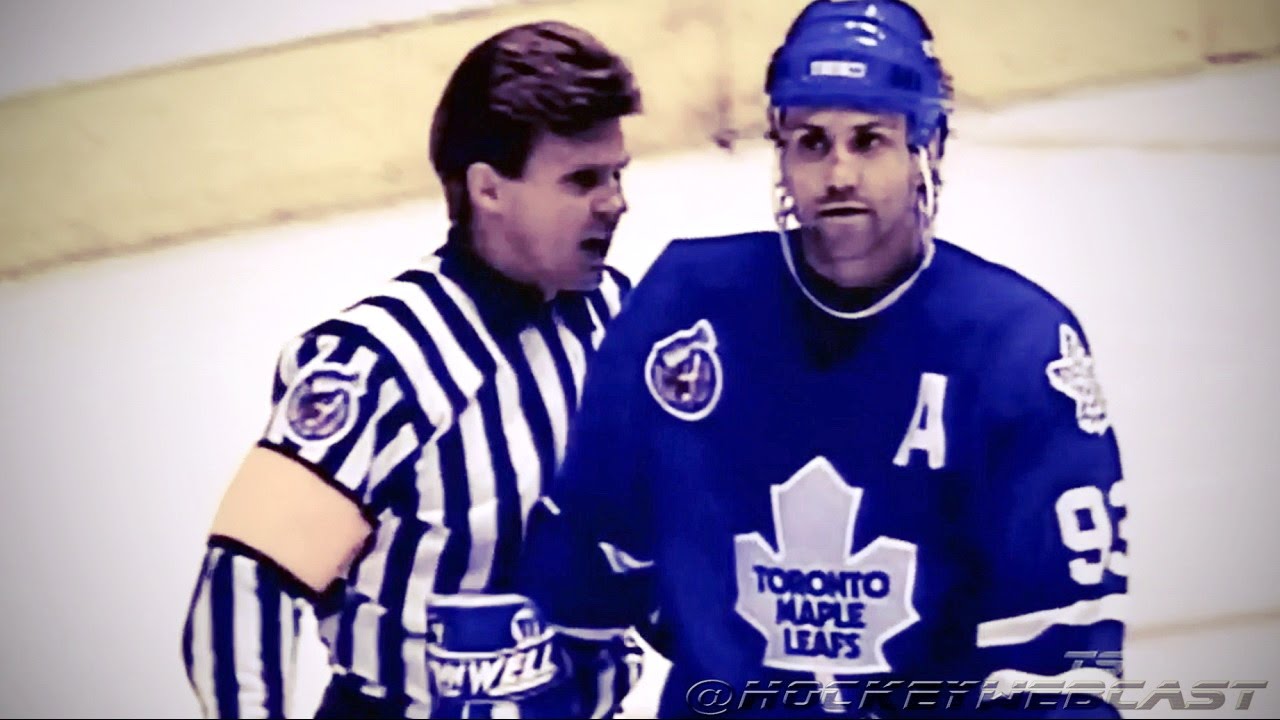
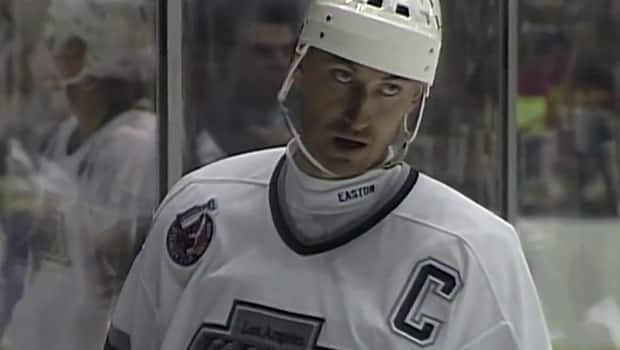
Game 6 went to overtime, 4-4. Then, in the 1st minute of overtime, Gretzky, so often hailed as the greatest player of all time (even then), and as a class guy, did something decidedly unclassy: He high-sticked Gilmour in the face, drawing blood from his chin.

According to the rules, this should have meant a game misconduct penalty, meaning Gretzky should have been thrown out of the game; and a 5-minute major penalty (with another player sent to the penalty box in Gretzky's place), meaning the Leafs should have had a 5-minute power play in overtime. Gretzky probably also should have been suspended for a potential Game 7.

But referee Kerry Fraser did not penalize Gretzky. Apparently, 2 "unwritten rules" came into play: Don't call penalties in overtime, and don't call penalties on The Great One.
The Hero
To make matters worse, within a minute of the unpenalized infraction, 1:41 into the overtime, Gretzky scored the winning goal. In Game 7 at Maple Leaf Gardens in Toronto, the Kings won 5-4, with Gretzky scoring 3 times and assisting on another goal.

He would call that the greatest game he'd ever played -- and it was a game which, due to what he'd done in the previous game, at the very least, he shouldn't even have been in; and, at the most, shouldn't have been played, because his absence and the 5-minute power play that should have resulted should have given the Leafs the win that would have made a Game 7 unnecessary.

It's been 27 years. Leaf fans are still outraged. This was probably their best team since the breakup of their 1960s dynasty (4 Cups in 7 years).

What's more, in a 2016 article for Canadian newspaper The National Post, Fraser admitted he blew the call:

I was uncertain but thought I had it right. I’m sorry. Most people probably know the story, but they know it from the perspective of a single camera in one corner of the Great Western Forum. All I can tell you is my perspective from the ice..

As the Kings set up on the power play, I was down by the far circle, away from the puck. In my brain, this is what I was processing: Gretzky gets the puck. He shoots it, and my eyes go to the net. But Jamie Macoun blocks it. The puck rebounds between Gretzky and Doug Gilmour. When my eyes go back to Gretzky, I see a motion. Gilmour goes down.

Did Gretzky’s stick follow through and catch him? Gilmour’s bent over now. He’s got blood on his chin. And I have no idea what happened. That’s a helpless, helpless feeling.

Under the 1993 rules, if Gretzky high-sticks Gilmour and it draws blood, it’s a five-minute major. He’s gone. It was a huge call to make — a worse one to miss.

Guys from both teams were skating up to me. It didn’t smell right. I should have known when I saw Gretzky skating away. Whenever there was a dispute, Gretz was always at the forefront arguing his side of it. But this time, he kind of slinked away. That was uncharacteristic. That should have tipped me off.

But to be honest, I was attempting to roll back the play in my mind, over and over, looking for some measure of recall that would provide the evidence I needed. 

Fraser consulted with his linesmen. They were unable to tell him that Gretzky had conclusively done anything wrong. As with the rule the NFL would later institute for instant replay, if it's not conclusive that the initial call was wrong, it has to stand. Fraser continued:
I had to make a decision. In referee school, they hammer it into you: Call what you see. Don’t guess. The honest to God truth is, I didn’t see it. I had to eat it. I said, “No penalty.”
The next faceoff, Gretzky stays in the game and scores to win it. He went on to have the game of his career in Game 7, and the Kings went to the Finals.
At the time, I had no idea the call would follow me for the rest of my life. There weren’t all the slow-motion cameras like they have today. It wasn’t until the next day that I saw another angle of the play on television. You could clearly see Gretzky high-sticking Gilmour. It was missed. Period.
It was agony for Leafs fans. I understand the passion, the emotion and the frustration that Leafs fans have endured. They felt it was their time. When people come up to me and ask about it now, I just try to have a conversation with them. If I had one opportunity to turn back the hands of time for a “do-over,” it would be to catch that high-stick. I’m sure I’m not alone in that department.
Would it make Leaf fans angrier if he still denied it? Maybe. But it makes them feel justified in their anger to hear Fraser admit it.

The Leafs would return to the Conference Finals the next year, and again in 1999, but lost both. They still haven't made the Finals since 1967.

The Kings took a 1-0 lead over the Canadiens in the finals, and were leading in Game 2. This time, they got caught cheating: McSorley was cited for having too big a curve on his stick, and the Canadiens tied the game, and then won it in overtime, and made it 4 straight wins for the Cup. They haven't won it since, either. The Kings would finally win their 1st Cup in 2012, and a 2nd in 2014. But the 1988 Cup with Edmonton remained Gretzky's last.

Barry Melrose was the Kings' coach then. He has since built a career as an ESPN hockey pundit. He points out that the Leafs' huge fan base, encompassing so much of Canada (including some places that have NHL teams, but didn't before the expansions of the 1970s):

Of course, it gets more attention because it's Toronto... The minute I get on a plane, someone will say, "Barry, high stick, what do you think?" And I'll go, "Toronto, right?" And he'll go, "Yeah, yeah, Toronto." It's funny to figure that out. I never hear an L.A. guy ask me that question...

I'm a big believer in the harder you work, the luckier you get. And I really feel like we were the hardest-working club in that series. We deserved everything we got.

Fraser admitted he blew the call. But was he really the sole, or the biggest, reason the Leafs lost that series? No. The linesmen missed the call, too. Had one of them said, "Absolutely, Gretzky cut Gilmour with a high stick. It might not have been intentionally malicious, but he did it," Fraser would have had the justification he needed to send Gretzky off. He never got it until he saw the replay the next day, when it was too late.

Which brings us to the fact that, at the time, the NHL only used instant replay to check whether a goal had been properly scored. It wouldn't be until the 2015-16 season that coaches could challenge other plays. Had that rule been in place in 1993, it would have been obvious, Gretzky would have been sent off, and the Leafs would have had a golden opportunity to finish the Kings off, and the next game in Toronto would have been Game 3 of the Stanley Cup Finals. (Not Game 1: The Canadiens had the better record, and thus would have had home-ice advantage.)

Fraser was one of the NHL's most respected officials. He had been calling games since 1973, and as a full referee since 1980. He was so respected by the International Ice Hockey Federation (IIHF) that, after this incident, he was still hired to officiate at the 1996 World Cup and the 1998 Winter Olympics. In 2005, NHL players -- the players, mind you -- voted him the League's most consistent referee.

He retired in 2010, having officiated at the NHL Winter Classic, and still holds the NHL records for most regular-season and most Playoff games officiated.

Did he make a mistake in that 1993 game? Yes, and he admitted it. Was it indicative of a pattern of favoritism toward Gretzky, or toward the Kings? Far from it.

Then there were the goaltenders. In the 7 games, Felix Potvin of the Leafs allowed 22 goals, or 3.14 per game. Kelly Hrudey of the Kings allowed 23, or 3.28 per game. Sounds like the Leafs had the better goalie, right? Not so fast. Games 2, 5, 6 and 7 were all 1-goal games, and the Leafs only won 1 of the 4. And when the Leafs needed Potvin to help them win Game 6, and then Game 7, he allowed 5 goals each time.

And remember that "golden opportunity" I mentioned? Sometimes, when opportunity knocks, the door isn't fully opened. Suppose Gretzky had been sent off, and the Leafs had gotten a 5-minute power play. Does that mean they would have gotten the goal they needed to win the game? Not necessarily. Paul Coffey was a Hall of Fame defenseman. So was Rob Blake. Darryl Sydor probably should be in the Hall.

And the Kings could have won the game anyway. After all, they had other good attacking players besides Gretzky. And they were at home.

Of course, home-ice advantage is no guarantee, either. Which brings us to the fact that there was a Game 7, in Toronto. The Leafs had home-ice advantage, in front of their fans, who were out for blood. There was no way they should have lost that game. But they did. They fell behind 3-0, and tied it 3-3, before losing 5-4.

They became the hockey equivalent of the 1985 St. Louis Cardinals: Instead of saying, "The hell with what happened in Game 6, let's beat these guys in Game 7," they let the mistake stick in their heads, and fell totally flat. And unlike the '85 Cards, they had the home comforts and home crowd behind them. (The NHL and the NBA go 2-2-1-1-1, while MLB goes 2-3-2, so if a World Series or an LCS goes the full 7, the same team hosts Games 6 and 7.)

If you blow Game 7 on home ice, you're (Atrocious Pun Alert) on thin ice to claim you got screwed out of a deserved victory in that round.

Furthermore, the Kings were better. They won Games 2 and 7 in Toronto. And they were 1 minute and 14 seconds away from going to home ice up 2-0 in the Stanley Cup Finals, before McSorley got caught cheating. True, it's possible he was cheating the whole way, and maybe other Kings were as well. But we don't know that.

We do know that the Kings had more talent -- and still might have even without Gretzky. If they had won Game 6 without him, they might have won Game 7 without him, too.

Fraser pleaded guilty to making a mistake. But he certainly didn't singlehandedly cost the Leafs the series.

*

May 27, 1993 was a Thursday. These Major League Baseball games were played that day:

* The New York Yankees lost to the Baltimore Orioles, 4-3 at Yankee Stadium. Mike Devereaux singled home Brady Anderson with the winning run in the top of the 10th inning. Cal Ripken Jr. went 0-for-4. Don Mattingly did not play, with Jim Leyritz playing 1st base.

* The Milwaukee Brewers beat the Toronto Blue Jays, 9-3 at the SkyDome (now the Rogers Centre) in Toronto.

* The Pittsburgh Pirates beat the Florida Marlins, 13-8 at Three Rivers Stadium in Pittsburgh.

* The Cincinnati Reds beat the Atlanta Braves, 5-4 at Riverfront Stadium in Cincinnati.

* The Kansas City Royals beat the Chicago White Sox, 6-4 at the new Comiskey Park (now Rate Field) in Chicago. George Brett, in his final season, went 0-for-4.

* The Chicago Cubs beat the San Francisco Giants, 5-4 at Wrigley Field in Chicago. Yes, both Chicago teams were at home on the same day. Barry Bonds only appeared as a pinch-hitter, and struck out.

* The Houston Astros beat the Colorado Rockies, 8-0 at the Astrodome in Houston. Doug Drabek pitched a 7-hit shutout.

* And the California Angels beat the Seattle Mariners, 5-0 at the Kingdome in Seattle. Scott Sanderson pitched a 5-hit shutout. Ken Griffey Jr. went 0-for-4.

Tuesday, May 10, 2022

May 10, 1973: The Knicks' Last Title & Wilt Chamberlain's Last Game

May 10, 1973: The New York Knickerbockers beat the Los Angeles Lakers, 102-93, at The Forum outside Los Angeles in Inglewood, California, winning Game 5 of the NBA Finals, and taking the NBA Championship.

In this clincher, the Knicks used only 8 players: Earl Monroe scored 23 points, Bill Bradley 20, Walt Frazier and Willis Reed 18 each, Jerry Lucas 10, Phil Jackson 6, Dean Meminger 5, and Dave DeBusschere (a more defense-oriented player) 2.

For the Lakers: Gail Goodrich scored 28, Wilt Chamberlain 23 (and had 21 rebounds), Jim McMillan 19, Jerry West 12, Bill Bridges 9, Keith Erickson 2, and Happy Hairston, Mel Counts and Pat Riley didn't score any.

For the Knicks, this capped their greatest period ever: 1970 to 1973, 4 seasons, 3 trips to the Finals (all against the Lakers), 2 titles. Their only 2 titles.

Hail the champions: William "Red" Holzman, head coach; Eddie Donovan, general manager; 6, Tom Riker, center; 7, Dean "the Dream" Meminger, guard; 10, Walt "Clyde" Frazier, guard; 12, Dick Barnett, guard; 15 Earl "the Pearl" Monroe, guard; 17, Henry Bibby, guard; 18, Phil Jackson, forward; 19, Willis Reed, center, team Captain; 22, Dave "Double D" DeBusschere, forward; 23, Luther Rackley, center; 24, Bill Bradley, forward; 32, Jerry Lucas, forward; 40, John Gianelli, center; and 43, Harthorne Wingo, forward.

Frazier, Barnett, Reed, DeBusschere and Bradley also played for the Knicks on their 1969-70 title. Jackson was in the organization at that time, but missed the entire season due to injury.

Members of the 1970 Knicks who were not also 1973 Knicks were center Nate Bowman (Number 17), forwards Don May (5), Dave Stallworth (9), Bill Hosket (20) and Jazzy Cazzie Russell (33); and guards Mike Riordan (6) and John Warren (16).

Frazier, Barnett, Reed, DeBusschere and Bradley would have their uniform numbers retired by the Knicks. Holzman would be honored with a banner with the number 613 on it, for the number of games he won as Knicks coach. Frazier, Jackson, Reed, DeBusschere, Bradley, Lucas and Holzman would be elected to the Basketball Hall of Fame. Frazier, Reed, DeBusschere and Lucas would be elected to the NBA's 50th Anniversary 50 Greatest Players and its 75th Anniversary 75 Greatest Players -- though it should be noted that Lucas was elected for what he did with the Cincinnati Royals; he was a stabilizing veteran presence for the '73 Knicks.

Bibby was the father of later NBA All-Star Mike Bibby. Bradley was elected to 3 terms in the U.S. Senate, representing New Jersey, and ran for President in 2000.

And, yes, kids, that Phil Jackson, the one who would coach the Chicago Bulls to 6 titles and the Lakers to 5. He was a decent player, not a great one. As was Pat Riley, who played for the Lakers against the Knicks in those Finals, and would later coach the Lakers to 4 titles, the Knicks into a Finals, and the Miami Heat to a title.

After one more year, Reed, DeBusschere and Lucas all retired, and the Knicks began to fall apart. Pearl, obtained from the Baltimore Bullets (forerunner of the Washington Wizards) after the Bullets beat the Knicks in the '71 Eastern Conference Finals, was the last to remain, in 1980.

The clinching Game 5 was the last game for NBA legend Wilt Chamberlain. He signed on to be player-coach of the American Basketball Association's San Diego Conquistadors, but an injunction in a legal court kept him off the basketball court, enforcing the last year of his contract with the Lakers.
He sat out the 1973-74 season as a player, got the Conquistadors into the 1st Round of the ABA Playoffs, and then decided he was done with pro basketball. The greatest player in the sport's history -- yes, he was better than Michael Jordan, and he would have eaten LeBron James -- never drew another paycheck from a pro basketball team, in any capacity.

He would, however, have his uniform Number 13 retired by every team he played for: The University of Kansas (1956-58), the Harlem Globetrotters (1958-59), the Golden State Warriors (1959-65, including 1959-62 in Philadelphia), the Philadelphia 76ers (1965-68), and the Lakers (1968-73). And a statue of the West Philadelphia native stands outside the 76ers' Wells Fargo Center.

Jerry West and Oscar Robertson, like Reed, DeBusschere and Lucas, would hang on for one more year. Lew Alcindor had just recently changed his name to Kareem Abdul-Jabbar. Julius "Doctor J" Erving would soon move from the ABA's Virginia Squires to the Nets. Bill Walton was still at UCLA, winning the recent National Championship, the 7th straight for coach John Wooden, in the middle of an 88-game winning streak.

Magic Johnson and Larry Bird were in junior high school. Michael Jordan, Patrick Ewing and Charles Barkley were in grade school. Shaquille O'Neal was a rather large baby. Kobe Bryant, Tim Duncan and LeBron James weren't born yet.

UPDATE: The Knicks do not have a team Hall of Fame. They have honored 10 men with banners for retiring their uniform number or the equivalent for a coach.

From their 1951, '52 and '53 NBA Finalists, they've retired 15 for guard Dick McGuire. From their 1994 and '99 NBA Finalists, they've retired 33 for center Patrick Ewing.

All other honorees are from their 1970 and 1973 NBA Championships: 10, for guard Walt "Clyde" Frazier; 12, for guard Dick Barnett; 15, for guard Earl "The Pearl" Monroe, 19 for center and Captain Willie Reed, 22 for foreward Dave DeBusschere, 24 for forward Bill Bradley, and head coach William "Red" Holzman has been honored with the number of his coaching wins with the Knicks, 613.

Each of those men is in the Basketball Hall of Fame. Other noteworthy Knicks in the Hall:

* From the 1951, '52 and '53 NBA Finalists: Team founder Ned Irish; and forwards Harry Gallatin and Nat "Sweetwater" Clifton, guard Carl Braun.

* From between the 1953 and 1970 Finals berths: Guard Richie Guerin.

* From the 1973 NBA Champions: Center Jerry Lucas.

* From after the 1973 title: Forwards Bernard King, Amar'e Stoudemire and Carmelo Anthony.

* Marty Glickman, Bob Wolff, Marv Albert, John Andariese, Mike Breen and Frazier have received the Curt Gowdy Media Award, the Hall of Fame's award for broadcasters.

*

May 10, 1973 was a Thursday. The same day the Knicks won the title, the Montreal Canadiens won their 18th Stanley Cup, beating the Chicago Blackhawks in Game 6 of the Finals, 6-4 at the Chicago Stadium. It was their 6th Cup in the last 9 seasons.

Four days earlier, the New England Whalers, then based in Boston, won the 1st World Hockey Association title, the AVCO Cup, beating ex-Blackhawk star Bobby Hull and his Winnipeg Jets.

Two days after the Knicks won their title, the Indiana Pacers won their 3rd ABA Championship in the last 5 years, beating the Louisville-based Kentucky Colonels.

Football was out of season. There were 5 games played in Major League Baseball:

* The Boston Red Sox beat the Cleveland Indians, 4-3 at Fenway Park in Boston. Carl Yastrzemski went 2-for-4 with an RBI.

* The Kansas City Royals beat the Detroit Tigers, 8-2 at Royals Stadium (now Kauffman Stadium) in Kansas City. Al Kaline went 0-for-3 with a walk.

* The Oakland Athletics beat the Texas Rangers, 17-2 at Arlington Stadium in the Dallas suburb of Arlington, Texas. Reggie Jackson went 2-for-4 with a walk and 2 RBIs. Ray Fosse and Deron Johnson hit home runs. Fosse and Joe Rudi each had 3 RBIs. All this was in support of Ken  Holtzman.

* The Chicago White Sox beat the California Angels, 4-3 at Anaheim Stadium (now Angel Stadium of Anaheim). Frank Robinson went 2-for-6 with an RBI for the Angels. Pat Kelly singled home the winning run in the top of the 12th inning.

* And the San Francisco Giants beat the St. Louis Cardinals, 6-3 at Candlestick Park in San Francisco. Willie McCovey and Dave Kingman hit home runs for the Giants. Lou Brock went 3-for-5, but was caught in his only stolen base attempt. Joe Torre went 1-for-4 with a walk.

December 31, 1999 & January 1, 2000: The Millennium

December 31, 1999:  The Millennium arrives. The people of planet Earth survived. At a terrible cost. But we hadn't destroyed ourselves. ...