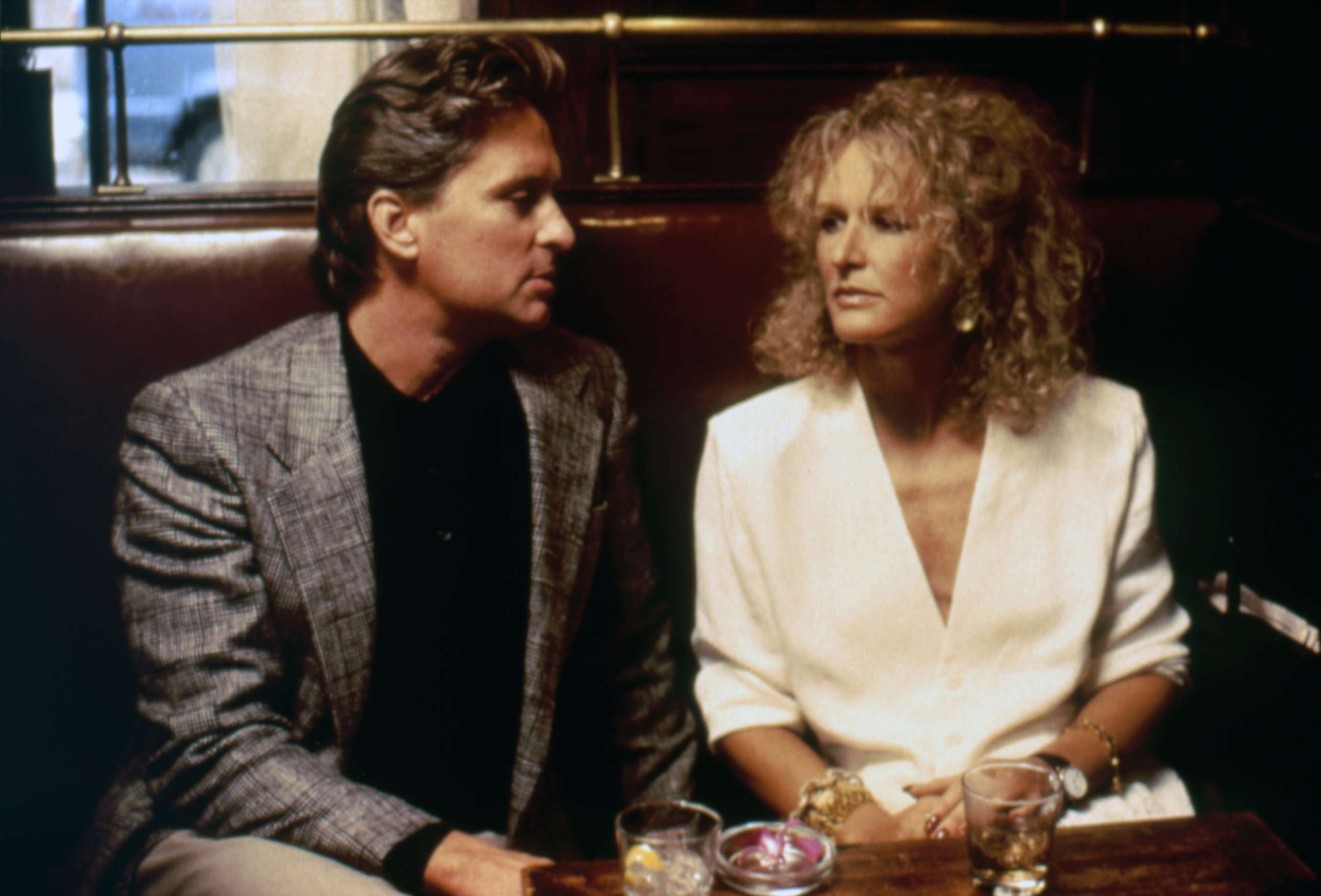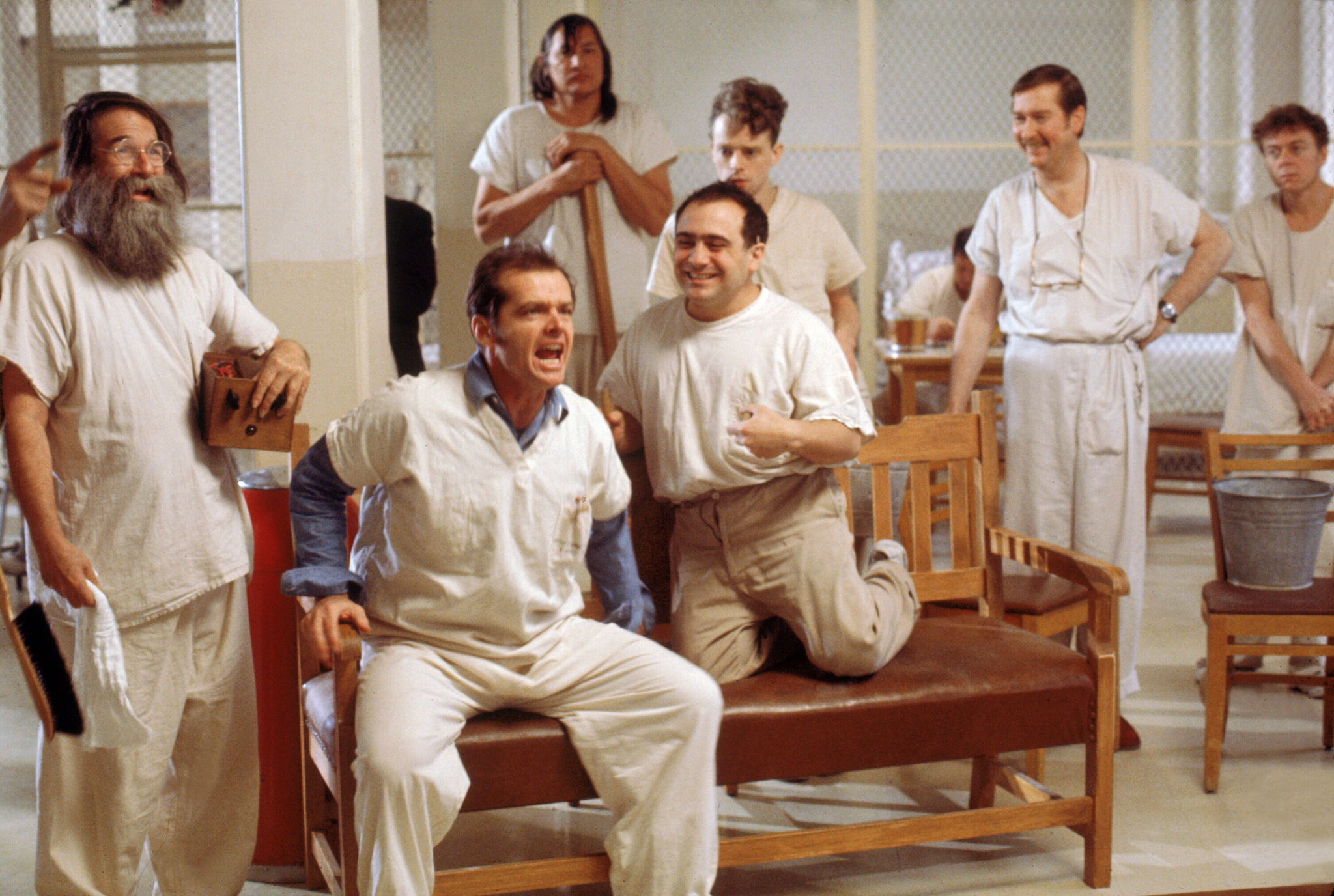
November 19, 1975: One Flew Over the Cuckoo's Nest premieres, directed by Miloš Forman, and based on the 1962 novel by Ken Kesey. Kesey himself hated the film.
Maybe the film's star, Jack Nicholson, had something to do with it. After all, in 1980, Stanley Kubrick directed a film version of Stephen King's The Shining, and cast Nicholson as the lead, and King hated it.
Shortly after its publication, the novel had been produced on Broadway, starring Kirk Douglas. Gene Wilder, not yet a star, played Billy Bibbitt. Ed Ames, already a star, 6-foot-3, and, despite being Jewish, dark-skinned enough to have played Native Americans before and after, played Chief Bromden.
Douglas held the film rights to it, but it remained stuck in "development hell." He allowed his son, actor Michael Douglas, to produce the film. Michael hired Hal Ashby to direct, but Ashby decided that Kirk was now too old to play the lead, and Michael backed him up on this. When Forman, Kirk's first choice to direct but stuck in Communist Czechoslovakia, escaped to America, Ashby gracefully stepped aside, but Forman also maintained that Kirk was too old. (He was just short of turning 59 when the film was released.)
Oddly, Michael Douglas would have been about the right age (31 when the film was released), but things were already strained between him and his father, so he stepped aside, and served as producer only. Gene Hackman (45) and Marlon Brando (51) were also too old for the role, but were offered it, anyway. So were James Caan and Burt Reynolds, who were age-appropriate (35 and 39, respectively). All 4 turned it down. Nicholson (38) accepted.
The title comes from a nursery rhyme read to Chief Bromden as a child by his grandmother, mentioned in the book:
Vintery, mintery, cutery corn,
Apple seed and apple thorn,
Wire, briar, limber lock,
Three geese in a flock.
One flew East, one flew West,
And one flew over the cuckoo's nest.
It was filmed in the exact same place that the book takes place, the Oregon State Hospital, in the State capital of Salem, although the building where most of the action takes place has since been torn down. (Kesey lived most of his life in Oregon, and had worked as an orderly in that hospital.) Since it's a psychiatric hospital, the patients are "cuckoo," hence, "cuckoo's nest."
The film takes place in 1963, a year after the novel was published. We know it's 1963 because, when Randle Patrick McMurphy, played by Nicholson, asks the other inmates to imagine they're watching the World Series on television, he says that Sandy Koufax of the Los Angeles Dodgers is pitching against the New York Yankees.
McMurphy is 38, and has been arrested for assault many times. This time, he is convicted of the statutory rape of a 15-year-old girl. The film makes no effort to suggest that he was innocent. Let me make that clear: McMurphy is not the hero of the film, or any kind of hero.
He is sentenced to a State work farm, but wants to avoid hard labor. He pretends to be insane -- which, of course, is what Nicholson spent much of the 1970s and 1980s doing for a living, pretending to be insane -- so that he can be transferred to a psychiatric institution, and avoid hard labor. He would have been better off leaving well enough alone, and serving his sentence and doing the labor. Let me make this clear, as well: McMurphy was not as smart as he thought he was.
Louise Fletcher plays Mildred Ratched, the "Big Nurse" (big in power, not in physical size -- she's not especially tall, and not fat) who runs the ward. Like the character of Major Margaret "Hot Lips" Houlihan on the TV show M*A*S*H, she was an Army nurse. Unlike Margaret, she let her wartime experience turn her into a cold, passive-aggressive tyrant. She maintains her World War II-era hairstyle, as Kesey pointed out in the book that "life had stopped for her a long time ago." (In real life, years later, he ran into the woman on whom he modeled the character, recalling, "She was much smaller than I remembered, and a whole lot more human.")
She holds near-absolute power over the patients' access to medications, privileges, and basic necessities such as food and toiletries. She capriciously revokes these privileges whenever a patient displeases her. She maintains order, keeping the patients from acting out, either through antipsychotic and anticonvulsant drugs, or her own brand of psychotherapy, which consists mostly of humiliating patients into doing her bidding. They are terrified of her, and, since the doctors and the hospital administrators value order, they let her get away with it all. Let's make one more thing clear: The 1960s were not a golden age for the treatment of mental health.
Among the actors playing patients are Danny DeVito and Christopher Lloyd, not yet stars, and later reunited in the cast of the TV sitcom Taxi. Will Sampson, a 6-foot-7 member of the Muscogee Nation, plays Chief Bromden, a very tall Native American who acts as though he is deaf and mute. Brad Dourif, later to be the voice of Chucky in the Child's Play franchise, plays Billy Bibbitt.
McMurphy quickly realizes that some of the patients don't really belong there, and wouldn't be if people had just taken more care with them, especially Billy. McMurphy and Ratched begin a war of wills, which leads to her decision to have him given electroconvulsive therapy. It doesn't work, and only makes him more defiant. That inspires the other inmates.
But they're still too scared to stand up to Ratched. Murphy says he'll pick up the hydrotherapy console and throw it out the window, breaking it, and allowing the inmates to escape. He can't, as it's too heavy. He tells them, "At least I tried!"
Bromden reveals to McMurphy that he can hear and speak. They plan to escape. But first, McMurphy gets a hold of the ward's phone, and makes arrangements for what he calls "a Christmas party." He brings a pair of prostitutes over, with bottles of booze.
The next morning, Ratched sees the ward is a mess, and sees Billy and a prostitute named Candy sleeping naked together. She verbally abuses Billy, as always. This time, he stands up to her, and even loses his stutter. But she has one more "fear card to play": She threatens to tell his mother. He goes back to fear and stuttering, and is taken to the office. Billy breaks some glass, and slits his throat with it, killing himself. Upon learning this, McMurphy blames Ratched, and lunges at her, and tries to strangle her to death, before the orderlies can pull him off her.
Time passes without McMurphy being seen, and rumor spreads that he has escaped -- leaving Bromden behind, breaking his promise that they would do it together. But McMurphy is brought back to his bed. He has been lobotomized, and is now "a vegetable." Ratched appears to have won the war.
But Ratched has suffered the consequences of the attack: She is wearing a neck brace, and her voice is only a whisper. And McMurphy has kept his promise to Bromden, although not in the way he had hoped. Bromden carries out a "mercy killing," smothering McMurphy with a pillow, and ending his suffering. Bromden is strong enough to lift the hydrotherapy machine, and to throw it through the window. He escapes. Ratched and the orderlies can't stop him. The other inmates cheer -- but don't follow him.
Bromden is the hero of the film. But, since neither the book nor the film have ever had an authorized sequel, we have no idea of what will happen to him afterward: Maybe he'll truly escape, maybe he'll get caught; maybe he can now "make it" in the outside world, maybe he can't. Given this, and given what happened to every inmate but Bromden, it's arguable that Ratched is still "the winner." The "bad guy" wins -- barely.
Bromden narrates the book, which, unlike the film, details his background: He became a paranoid schizophrenic due to his World War II experiences, and his white mother committed him to embarrass his Native father.
Another big difference from the book: McMurphy is considerably less violent in the film, which treats him as more of a con man than a serious threat. And the fishing trip isn't McMurphy hijacking a hospital bus on a whim, taking the patients with him, doing the fishing, and then taking them back rather than making it a permanent escape. In the book, it's planned by the doctors, but Ratched attempts to sabotage it.
The film was nominated for 8 Academy Awards, and swept the 5 major "Oscars": Best Picture for producer Michael Douglas, Best Director for Forman, Best Actor for Nicholson, Best Actress for Fletcher, and Best Adapted Screenplay for Laurence Hauben and Bo Goldman. The only other films to do that have been It Happened One Night in 1934 and The Silence of the Lambs in 1991.
Michael Douglas would later win Best Actor in 1988, for Wall Street. His 2nd wife, Catherine Zeta-Jones, would win Best Supporting Actress in 2003, for Chicago. Kirk Douglas was nominated for Best Actor 3 times, but never won an Oscar, in any capacity. Jack Nicholson has 12 acting nominations (only Meryl Streep, who's won 3 times out of 21 nominations, has more), and 3 wins: Along with One Flew Over the Cuckoo's Nest, he won Best Supporting Actor in 1983, for Terms of Endearment; and a 2nd Best Actor in 1997, for As Good As It Gets.
Laurence Hauben died in 1985, Will Sampson in 1987, Kirk Douglas in 2016 (at the age of 103), Miloš Forman in 2018, and Louise Fletcher earlier in 2022. As of November 19, 2022, Jack Nicholson, Danny DeVito, Christopher Lloyd, Brad Dourif, Bo Goldman and Michael Douglas are still alive. (UPDATE: Goldman died in 2023.)
*
November 19, 1975 was a Wednesday. Baseball was out of season. Football was in midweek. There were 6 games in the NBA:
* The Philadelphia 76ers beat the Kansas City Kings, 113-103 at The Spectrum in Philadelphia.
* The Atlanta Hawks beat the Golden State Warriors, 104-98 in overtime at The Omni in Atlanta.
* The Detroit Pistons beat the Portland Trail Blazers, 120-114 at Cobo Hall (now Huntington Place) in Detroit.
* The Los Angeles Lakers beat the Houston Rockets, 118-110 at The Summit in Houston. (The arena has been converted into the "Central Campus" of televangelist Joel Osteen's Lakewood Church.)
* The Milwaukee Bucks beat the Phoenix Suns, 96-94 at the Arizona Veterans Memorial Coliseum in Phoenix.
* And the Seattle SuperSonics beat the Chicago Bulls, 97-87 at the Seattle Center Coliseum.
There were 4 games played in the American Basketball Association:
* The New York Nets lost to the Virginia Squires, 110-100 at The Scope in Norfolk, Virginia.
* The Denver Nuggets beat the Spirts of St. Louis, 119-106 at the St. Louis Arena.
* The San Antonio Spurs beat the Kentucky Colonels, 113-106 at the HemisFair Arena in San Antonio.
* And the Indiana Pacers beat the Utah Stars, 130-110 at the Salt Palace in Salt Lake City.
There were 5 games in the NHL:
* The New York Rangers lost to the Kansas City Scouts, 6-4 at Madison Square Garden. The Scouts played 2 seasons before moving, and won exactly 7 away games. This was the 6th. The Rangers had indeed fallen on hard times.
* The Vancouver Canucks beat the Washington Capitals, 5-2 at the Capital Centre in the Washington suburb of Landover, Maryland.
* In an "Original Six" matchup, the Boston Bruins and the Detroit Red Wings played to a tie, 3-3 at the Olympia Stadium in Detroit.
* The Montreal Canadiens beat the Minnesota North Stars, 6-0 at the Metropolitan Sports Center in the Minneapolis suburb of Bloomington, Minnesota.
* And the Chicago Black Hawks beat the Los Angeles Kings, 4-2 at The Forum outside Los Angeles in Inglewood, California.
And there were 2 games in the World Hockey Association. The Cleveland Crusaders beat the Minnesota Fighting Saints, 4-3 in overtime at The Coliseum in the Cleveland suburb of Richfield, Ohio. And the Indianapolis Racers beat the New England Whalers, 3-1 at the Market Square Arena in Indianapolis.