Showing posts with label 1965. Show all posts

Monday, December 26, 2022

December 26, 1965: The Tom Matte Game

December 26, 1965: The Green Bay Packers play the Baltimore Colts in a Playoff to decide the Championship of the NFL's Western Conference, at Lambeau Field in Green Bay, Wisconsin. Like its predecessor, the facility had been named City Stadium, but had recently been renamed, in memory of Earl "Curly" Lambeau, the Packers' co-founder and original head coach, who guided them to 6 NFL Championships.

Both teams finished the season 10-3-1. The Packers had won both games between them that season, but head-to-head was not a tiebreaker: Won-lost record was the only one, and so a Playoff was mandated. 

In this win-or-go-home game, both teams would have to rely on backup quarterbacks. For the Packers, Edmund "Zeke" Bratkowski, a career backup now 34 years old -- he was born on October 20, 1931, the same day as baseball legend Mickey Mantle -- had to substitute for the injured Bart Starr early in the game.

The Packers were thus taken by surprise. The Colts were not, but they were down to their 4th string quarterback. They were 9-1-1 when Johnny Unitas, then considered the best quarterback in the game, was injured in a 13-0 loss to the Baltimore Colts. Gary Cuozzo stepped in, but he was injured in the next game, a 42-27 loss to the Packers.

The only player the Colts had left on their roster who had ever played quarterback was running back Tom Matte, who had played quarterback at Ohio State, under coach Woody Hayes. But, given Hayes' disdain for the passing game -- he famously said, "There are three things that can happen when you throw the football, and two of them are bad," meaning an incompletion and an interception -- that meant that he hardly ever threw the ball. So he wasn't considered a long-term option.

For their season finale, the Colts signed a free agent, Ed Brown, who was also a good punter. He guided them to a 20-17 win over the Los Angeles Rams. The problem was, he was signed too late in the season to be eligible for any postseason games. So the Colts were stuck with Matte as quarterback. And it would be in Green Bay, and it would be "Packer Weather": No snow, but just 22 degrees, with the wind-chill factor making it 12. Baltimore can get cold in the Winter, but that kind of cold was unusual for Colt games at Memorial Stadium.

At first, it seemed to work. Matte threw 12 passes, completing 5, ran for 57 yards, and was sacked only once. Don Shinnick picked up a fumble by the Packers' Donny Anderson, and returned it 25 yards for a touchdown, just 21 seconds into the game. Starr was the last man between the huge Shinnick and the end zone, and hurt his ribs in his failure to make the tackle, resulting in Bratkowski having to take over.

Lou Michaels kicked the extra point. In the 2nd quarter, Matte drove the Colts downfield, and Michaels kicked a 15-yard field goal, and the Colts went into the locker room leading, 10-0.

In the 3rd quarter, Paul Hornung, who was a Heisman Trophy-winning quarterback at Notre Dame before becoming a running back with the Packers, ran the ball in from the 1-yard line to score a touchdown. Don Chandler kicked the extra point.

With 1:58 left to play in regulation, Chandler attempted a tying field goal from 22 yards out. The ball appeared to be wide of the right upright, and Chandler's reaction suggested that he thought he'd missed it. But referee Jim Tunney ruled that it was good, and it was 10-10. Overtime.

Bratkowski led the Packers downfield, and, with 1:21 left in the 1st overtime, Chandler attempted a 25-yard field goal. There was no doubt about this one: It was good, and the Packers would host the NFL Championship Game, against the Cleveland Browns. 

Baltimore football fans have complained ever since that Chandler's 4th quarter field goal was no good. Before the 1966 season, the NFL made 2 changes in response to these complaints: Goalposts were extended from to 10 feet high to 20 feet, and an official would be placed directly under each upright on field goal attempts.

In 1981, John Thorn left his comfort zone, baseball, and published Pro Football's 10 Greatest Games. He included this game as one of them.

The Packers beat the Browns, 23-12. They won the next 2 NFL Championships, and the subsequent games, too, which were retroactively renamed Super Bowl I and Super Bowl II. With Matte as running back, and Earl Morrall filling in for an injured Unitas, the Colts won the 1968 NFL Championship, but lost Super Bowl III to the New York Jets. Unitas led them to win the 1970 NFC Championship, but got hurt in Super Bowl V, and Morrall had to come to the rescue, and the Colts beat the Dallas Cowboys. Matte, and all the other Colts who had lost Super Bowl III, got their redemptions and their rings.

Bratkowski died in 2019, Matte in 2021.

*

December 26, 1965 was a Sunday. The American Football League held its Championship Game that day, and the Buffalo Bills beat the San Diego Chargers, 23-0 at Balboa Stadium in San Diego. The Bills had now won 2 straight AFL Championships. They have not won a league championship since.

Baseball was out of season. There were 3 games played in the NBA:

* The Boston Celtics beat the Baltimore Bullets, 120-99 at the Boston Garden. Sam Jones scored 34 points.

* The Philadelphia 76ers beat the San Francisco Warriors, 121-107 at the Philadelphia Civic Center. Wilt Chamberlain had 33 points and 30 rebounds.

* And the Cincinnati Royals beat the St. Louis Hawks, 117-115 at the Kiel Auditorium in St. Louis. Oscar Robertson led all scorers on the day with 37 points.

And the NHL's entire "Original Six" were in action:

* The New York Rangers beat the Boston Bruins, 6-4 at the old Madison Square Garden. Bob Nevin had a hat trick.

* The Toronto Maple Leafs and the Chicago Black Hawks played to a tie, 1-1 at the Chicago Stadium.

* And the Detroit Red Wings beat the Montreal Canadiens, 1-0 at the Olympia Stadium in Detroit. This turned out to be a preview of the Stanley Cup Finals, but the Canadiens beat the Wings.

Wednesday, December 14, 2022

December 14, 1965: The Death of Mack Lee Hill

December 14, 1965: Mack Lee Hill dies on the operating table during knee surgery, at Menorah Medical Center in Kansas City, Missouri. He was only 25 years old.

This was a compound tragedy: Born on August 17, 1940 in Quincy, Florida, outside Tallahassee, and nicknamed "The Truck" after Mack Trucks, he had been drafted out of Southern University in 1964, essentially to fill the hole left a year earlier, when running back Stone Johnson was killed when he broke his neck in a preseason game. He was only 23, and had yet to play a regular-season game in the NFL (or the American Football League, in which the Chiefs were playing at the time).

Hill had rushed for 576 yards in 1964, and had already gained 627 yards in 1965. In both seasons, he led the AFL in yards per carry. He seemed to be a star in the making. But on December 12, 1965, in a 34-25 loss to the Buffalo Bills at War Memorial Stadium in Buffalo, he tore a ligament in his right knee, ending his season.

He was taken back to Kansas City, and was operated on 2 days later. The surgery should have been routine, and seemed to have been completed. But his temperature suddenly spiked to 108 degrees, triggering severe convulsions, and he died an hour and a half later. The team doctor, Albert R. Miller, determined that a fat globule had broken off, entering the bloodstream, and causing a pulmonary embolism.

Chiefs coach Hank Stram said, "Mack Lee Hill was a fine gentleman and a great football player. He was probably one of the most unselfish players I have ever coached. He was completely dedicated to the team. Football was his life."

The Chiefs retired his Number 36, and created the Mack Lee Hill Award, given annually to the team's outstanding rookie. When their team Hall of Fame was established, Hill was elected to it.

The Chiefs have had a sad history, starting with the death of Stone Johnson, and it didn't stop with the death of Hill. In 1980, former All-Pro offensive tackle Jim Tyrer, going through business failures, did what Belcher did today: He shot and killed his wife, and then killed himself. He was 41.

In 1983, running back Joe Delaney, having played 2 All-Pro seasons, drowned in a failed attempt to save 2 drowning boys. He was 24.

In 2000, Derrick Thomas, then one of the best linebackers in the game, crashed his car, was paralyzed, and died a few days later of a blood clot, at 33.

In 2012, Jovan Belcher was added to the list. I don't know what the Chiefs did to bring all this on, but it seems like the club is cursed. In 2020, they won Super Bowl LIV, their 1st World Championship in 50 years. But their history is still tragic.

*

December 14, 1965 was a Tuesday. Actor Ted Raimi was born on this day.

Football was in midweek. Baseball was in the off-season. And no games were scheduled in the NHL. But there were 3 games played in the NBA:

* The New York Knicks beat the San Francisco Warriors, 141-137 at the old Madison Square Garden. Rick Barry scored 57 points for the Warriors, but it wasn't enough, as the Knicks got 31 points from Walt Bellamy and 30 from Dick Barnett.

* The Baltimore Bullets beat the Detroit Pistons, 142-129 at the Baltimore Civic Center (now the CFG Bank Arena). Kevin Loughery scored 35 points for the Bullets.

* And the Cincinnati Royals beat the Philadelphia 76ers, 112-109 at the Cincinnati Gardens. For the Royals, Oscar Robertson had 31 points, while Jerry Lucas had 30 points and 25 rebounds. For the Sixers, Wilt Chamberlain had 32 points and 20 rebounds.

Monday, December 12, 2022

December 12, 1965: The Gale Sayers Game

December 12, 1965: The most amazing one-man, one-game performance in NFL history occurs.

On November 28, 1929, the Chicago Cardinals beat the Chicago Bears, 40-6 at Wrigley Field in Chicago. Ernie Nevers of the Cardinals set a single-game record by scoring all 40 points: 6 rushing touchdowns and 4 kicked extra points.

On November 25, 1951, the Cleveland Browns beat the Bears, 42-21 at Cleveland Municipal Stadium. William "Dub" Jones scored 6 touchdowns, 4 rushing and 2 receiving. His son would also become an NFL star, 1970s Baltimore Colt quarterback Bert Jones.

On December 25, 2020, Christmas Day, the New Orleans Saints beat the Minnesota Vikings, 52-33 at the Superdome in New Orleans. Alvin Kamara rushed for 6 touchdowns.

But what Gale Sayers did on December 12, 1965 was even more amazing. Not just because, unlike the others, he was a rookie, but because the weather was miserable.

*

Sayers scored 22 touchdowns in 1965, setting an NFL record that stood for 10 years. Think about that: 22 NFL touchdowns at age 22: 14 rushing, 6 receiving, a punt return and a kickoff return. On October 17, against the Minnesota Vikings, he had a rushing touchdown, a receiving touchdown, and a kickoff return for a touchdown in the same game. That would not happen in the NFL again until 2016, when Tyreek Hill did it for the Kansas City Chiefs.

After that October 17, 1965 game, Bears founder-owner-general manager-head coach George "Papa Bear" Halas compared Sayers favorably to old-time Bears Red Grange and George McAfee. As it turned out, the Kansas Comet was just getting warmed up.

This was also the rookie season for Dick Butkus, who would revolutionize the position of middle linebacker, becoming the most ferocious player of his generation.
The Bears had opened the season, and thus Sayers' and Butkus' careers, on September 19 at Kezar Stadium in San Francisco, and lost 52-24. On December 12, the 49ers came to Wrigley Field, and the Bears wanted revenge. I don't think anybody expected it to take this form, though.
Wrigley Field, with football bleachers added

It rained all day, and the field on which Grange and McAfee -- and Bronko Nagurski, and Bill Osmanski, and Willie Galimore -- had run was practically a swamp. How anybody could get any speed on it was a mystery.

On that field, Gale Sayers had 113 rushing yards, 89 receiving yards, and 134 punt return yards. He scored 4 touchdowns rushing, 1 receiving, and 1 on a punt return. He had 326 total yards. He scored 6 touchdowns. Talk about "announcing your presence with authority."

The Bears pounded the 49ers, 61-20. One of the 49ers' receivers that day was Bernie Casey, who went on to become one of the top black actors of the 1970s.

The Bears finished the season at 9-5. With 2,272 all-purpose yards, 1,371 of them rushing, Sayers was an easy choice for NFL Rookie of the Year.

Sadly, injuries would cut Sayers' career short. He retired after the 1971 season, having played only 68 regular-season games -- enough to add up to a shade over 4 full seasons -- and, like Butkus, who hung on for 2 years longer despite his own ravaged knees, never appeared in a Playoff game, because the players from the Bears' 1963 NFL Champions had gotten old, and, except for the all-time greats Sayers and Butkus, there weren't any good players coming up to replace them.

In 1969, the year immortalized in Sayers' book I Am Third, and in the movie based on it, Brian's Song, starring Billy Dee Williams as Sayers and James Caan as ailing running back Brian Piccolo, the Bears went 1-13.

Halas, in his 70s and set in his ways, gave up coaching after the 1967 season, but it would take another decade or so before he turned operational control of the team over to his son, George "Mugs" Halas Jr., and Jim Finks. But Mugs died in 1979, of a heart attack, only 54 years old. Since Papa Bear wasn't willing to give control to his daughter, Virginia, he gave it to her husband, "Big Ed" McCaskey, who handed some to their son, Mike McCaskey. This would result in short-term glory, but not enough, and long-term problems. 

Sayers was elected to both the College and Pro Football Halls of Fame in 1977. He was 34 years old, the youngest player ever elected to the Pro Football Hall. He became a successful businessman and a college sports administrator. Butkus was elected to the Pro Football Hall in 1979, and the College Football Hall in 1983. He became an actor, especially known for his commercials for Miller Lite Beer, playing on his tough-guy image.
It took until 1994, in a nationally-televised halftime ceremony during a Monday Night Football game on a miserably rainy and cold Halloween Night, for the Bears to formally retire the Number 40 of Gale Sayers and the Number 51 of Dick Butkus. As the Bears were losing to the Green Bay Packers, their arch-rivals, most of the fans stayed long enough to cheer the honorees and boo Mike McCaskey, and then left without watching the 2nd half.

Sayers died in 2020. As of December 12, 2022, Butkus is still alive. (UPDATE: He died in 2023.)

*

December 12, 1965 was a Sunday. These other games were played in the NFL that day:

 * The New York Giants beat the Washington Redskins, 27-10 at District of Columbia Stadium in Washington. It was renamed Robert F. Kennedy Stadium in 1969.

* The Green Bay Packers beat the Baltimore Colts, 42-27 at Memorial Stadium in Baltimore.

* The Philadelphia Eagles beat the Pittsburgh Steelers, 47-13 at Pitt Stadium in Pittsburgh.

* The Minnesota Vikings beat the Detroit Lions, 29-7 at Tiger Stadium in Detroit.

* The Los Angeles Rams beat the Cleveland Browns, 42-7 at the Los Angeles Coliseum.

* The day before, the Dallas Cowboys beat the St. Louis Cardinals, 27-13 at the Cotton Bowl in Dallas.

In the American Football League:

* The New York Jets lost to the Oakland Raiders, 24-14 at Frank Youell Field in Oakland.

* The Buffalo Bills beat the Kansas City Chiefs, 34-25 at War Memorial Stadium in Buffalo.

* The San Diego Chargers beat the Houston Oilers, 37-26 at Rice Stadium in Houston.

* And the Boston Patriots beat the Denver Broncos, 28-20 at Bears Stadium in Denver. It was renamed Mile High Stadium in 1968.

There was 1 NBA game that day: The Los Angeles Lakers beat the St. Louis Hawks, 123-101 at the Los Angeles Sports Arena. Jerry West scored 33 points.

And the entire "Original Six" of the NHL were in action that day:

* The New York Rangers played the Toronto Maple Leafs to a tie, 1-1 at the old Madison Square Garden.

* The Detroit Red Wings beat the Boston Bruins, 5-3 at the Boston Garden.

* And the Montreal Canadiens beat the Chicago Black Hawks, 5-3 at the Chicago Stadium. 

Friday, December 9, 2022

December 9, 1965: "A Charlie Brown Christmas" Premieres

December 9, 1965: A Charlie Brown Christmas airs for the 1st time. Charles Schulz had been drawing the comic strip Peanuts since 1950, and CBS was ready to take a gamble on a holiday TV special about Charlie Brown, his dog Snoopy, and the other kids in the strip. (It was around this time that such a program began to be called a "special." Previously, it would have been a "spectacular.")

I have a theory, and, as far as I can tell, there is nothing in the images or the script of the special that disproves it. Charlie Brown is depressed during the Christmas season, and everyone else has thrown themselves into the superficial and commercial sides of it, for the same reason: The special takes place in December 1963, after the assassination of President John F. Kennedy, and they want to forget.

Charlie Brown (voiced here by Peter Robbins) wasn't the 1st fictional character to wonder what Christmas was all about, nor the last. Nor was he the first, nor the last, to get his Christmas hopes laughed at.

But, as his best friend Linus Van Pelt (voiced by Chris Shea) points out (after quoting The Gospel According to Luke, Chapter 2, Verses 8 through 14, to remind us of "what Christmas is all about"), like the scrawny little tree that he'd found, ol' Chuck just needed a little love.

The special was a great success, and it remains the most popular Peanuts TV special, maybe the most popular Christmas TV special. And, today, when someone describes a Christmas tree as "a Charlie Brown tree," we still know exactly what that means. It's not about the quality of the tree, it's about the hearts of the people decorating it.

The Halloween special It's the Great Pumpkin, Charlie Brown premiered on October 27, 1966. It featured the 1st animated sequence of Lucy, Linus' crabby older sister, pulling the football away from Charlie Brown. It also featured the 1st animated sequence of Snoopy as "The World War I Flying Ace," imagining himself taking on Manfred von Richtofen, the German ace known as the Red Baron.

A Charlie Brown Thanksgiving premiered on November 20, 1973. Again, Lucy is shown pulling the football away from him. In 2021, having watched the special for around the 20th time, I noticed something for the 1st time. When Peppermint Patty suggests that the kids have their own separate Thanksgiving meal at Charlie Brown's house, Lucy doesn't get invited. Her brother Linus does, and, in the spirit of the holiday, helps Charlie Brown with the "cooking." But Lucy isn't invited. Serves her right. (She doesn't crash it, either.)

It's the Easter Beagle, Charlie Brown premiered on April 9, 1974. After that, though, they kind of ran out of major holidays, so that was the last special to be considered a classic. Be My Valentine, Charlie Brown premiered on January 28, 1975, a little early for Valentine's Day, February 14. On March 16, 1976, CBS kinda pushed their luck with It's Arbor Day, Charlie Brown.

They redeemed themselves on Memorial Day, May 30, 1983. A sequel to Bon Voyage, Charlie Brown (And Don't Come Back), the 1980 feature film that showed the Peanuts gang as exchange students in France, What Have We Learned, Charlie Brown? A Tribute sees them visit battlefields of World War I and World War II. A reference is made to Snoopy as the Flying Ace, but, for the most part, it's deadly serious.

On New Year's Day, January 1, 1986, they aired Happy New Year, Charlie Brown! And on November 27, 1992, the day after Thanksgiving, they came full circle, sort of, with It's Christmastime Again, Charlie Brown. It was a series of short stories featuring the gang in Christmas situations, which would be done again on December 8, 2002 with Charlie Brown's Christmas Tales. That was the 1st special aired after Peanuts creator Charles Schulz died in 2000, ending the strip. It was also the 1st special after the move from CBS to ABC. ABC aired I Want a Dog for Christmas, Charlie Brown on December 9, 2003.

*

December 9, 1965 was a Thursday. This was also the day that the great baseball executive Branch Rickey died. And it was the day the Baltimore Orioles traded Milt Pappas to the Cincinnati Reds for Frank Robinson. I have a separate entry for that event.

Baseball was out of season. Football was in midweek. Only 1 NBA game was played that night. The San Francisco Warriors beat the Cincinnati Royals, 110-109 -- in Dayton, Ohio, at the University of Dayton Fieldhouse, now known as the Thomas J. Frericks Center, 45 miles northeast of the Royals' usual home court, the Cincinnati Gardens.

And only 1 NHL game was played that night. The New York Rangers lost to the Detroit Red Wings, 7-3 at the Olympia Stadium in Detroit. The Wings pulled off a rare feat, one which might even be worthy of a "Scores On This Historic Day" post all by itself: 7 different goalscorers. Floyd Smith and Doug Barkley scored in the 1st period; Norm Ullman, Gordie Howe and Ab McDonald in the 2nd; and Alex Delvecchio and former Ranger star Andy Bathgate in the 3rd. 

December 9, 1965: The Frank Robinson-Milt Pappas Trade

December 9, 1965: Branch Rickey, baseball's greatest executive ever, dies at age 84. A mediocre catcher in the major leagues from 1905 to 1914, he wasn't much of a field manager, either, from 1913 to 1925. But he served as general manager of the St. Louis Browns from 1913 to 1919, then of the St. Louis Cardinals until 1942, then of the Brooklyn Dodgers until 1950, and finally of the Pittsburgh Pirates until 1955.

As those teams' GMs, he did the following:

* He  practically (if not completely) invented the farm system, revolutionizing baseball.

* He brought Grover Cleveland Alexander to the Cardinals, setting up the most dramatic moment of the 1926 World Series.

* He traded Rogers Hornsby for Frankie Frisch, one future Hall-of-Famer for another.

* He built the team known as "The Gashouse Gang," the 1934 World Champion St. Louis Cardinals.

* He built the team led by Stan Musial that would dominate the National League in the World War II years.

* He built on the success of his Brooklyn predecessor Larry MacPhail, and built the team that became known as "The Boys of Summer."

* He revolutionized baseball, a 2nd time by racially integrating the Dodgers by signing Jackie Robinson.

* And he rebuilt the Pirates by signing Roberto Clemente and Bill Mazeroski, though he was no longer there by the time they won a World Series.

The teams he built won 16 Pennants and 8 World Series, the 1st in 1926 and the last in 1960.

He was what country singer Kris Kristofferson would have called "a walking contradiction, partly truth and partly fiction." He was a devout Methodist who would not work on Sundays, and thus would not even go to the ballpark on Sundays, letting a coach manage for him while he was the manager. Yet he would still accept the gate receipts from Sunday, the most lucrative day of the week.

It was said that he had money and he had players, and he didn't like to see them mix. He would be forced out of the Dodgers by Walter O'Malley. The two men had these things in common: They were cheap, they loved cigars, and they were Republicans. That was it: On important matters -- human dignity, racial sensitivity, and the Borough of Brooklyn -- they were incredibly different men.

On November 13, 1965, he was making his acceptance speech for his induction into the Missouri Sports Hall of Fame in Columbia, when he suffered a stroke. He never regained consciousness, and died on December 9, at the age of 84.

He was posthumously elected to the Baseball Hall of Fame in 1967, 5 years after Robinson was elected. Oddly, while Rickey's plaque at the Hall in Cooperstown, New York mentions his signing of Robinson, Robinson's original plaque made no mention of the fact that he was the 1st black player in modern baseball. A new plaque, cast in 2008, mentions it.

*

Frank Robinson, no relation to Jackie, was rising through the Cincinnati Reds' minor-league system during Rickey's final days as GM of the Pirates. Rickey was so desperate to improve the team, he offered the Reds $1 million -- about $10.3 million in today's money -- for a man who had yet to reach the majors. Gabe Paul was the GM of the Reds, in his 1st major league job, and told Rickey, "I wouldn't give you Frank Robinson for your entire team."

Paul was fired after the 1960 season, and his replacement, Bill DeWitt Sr., father of the man who now owns the Cardinals, was hired, and got the credit for the Reds' 1961 National League Pennant, a year in which Robinson was named the NL's Most Valuable Player. Robinson continued to be one of the best players in baseball over the next 4 seasons.

But on December 9, 1965, DeWitt traded Robinson to the Baltimore Orioles for Milt Pappas, Jack Baldschun and Dick Simpson. Baldschun and Simpson were throw-ins, designed to make the trade a 3-for-1, so it didn't look like the Reds were trading Robinson even-up for a single pitcher.

This looked like a bad trade rather quickly, as, in the very next season, 1966, Robinson led the Orioles to their 1st American League Pennant and their 1st World Championship, winning the Triple Crown and the Most Valuable Player award for himself, thus becoming the 1st man to win the MVP in both Leagues. (He's still the only one. Six pitchers have won the Cy Young Award in both Leagues: Gaylord Perry, Pedro Martinez, Randy Johnson, Roger Clemens, Roy Halladay and Max Scherzer.)

As for the Reds, they wouldn't win another Pennant until 1970, and another World Series until 1975. To make matters worse, when the Reds did win the Pennant in 1970, who beat them in the World Series? Robinson and the Orioles, although Brooks Robinson (no relation, of course) was a bigger reason than Frank on that occasion.

So why did they trade Robinson? Because he was "an old 30." Or maybe it was "not a young 30." The wording varies, depending on who tells the story.

Pappas was making $32,500, Baldschun $24,000, and Simpson $8,000; total, $64,500. Robinson, all by himself? $57,000. Robinson wanted $64,000 for 1966, and DeWitt decided he couldn't throw that kind of money around for just 1 player.

Orioles owner Jerry Hoffberger gave Frank his $64,000. He made it $100,000 after the Triple Crown/MVP/World Series season. The most he ever made? $160,000 in 1973 and '74. He actually took a pay cut in '75, to $105,000, even though he was both playing and managing. (He was the 1st black manager in Major League Baseball. By 1971, that was predictable; in 1965, it wasn't.)

The Reds needed pitching, and Pappas was a very good pitcher. He was then 26 years old, and had already won 110 games in the major leagues, against just 74 losses. In 1965, for an Oriole team that finished a distant 2nd to the Minnesota Twins, he went 13-9, with a 2.60 ERA -- an ERA+ of 133, so he wasn't just taking advantage of a pitching-friendly period in baseball history. His WHIP was a nifty 1.102.

He had made the All-Star Team for the 2nd time in 4 seasons. He'd won 16 games in '63 and did it again in '64, and had just won 13 in '65. That's 45 wins over the preceding 3 seasons. Not great, but very good. And he was reliable: He'd never had a significant injury.
His career record turned out to be 209-164 -- by 1 win in the National League, he missed winning at least 100 games in each League. Ten pitchers have done that: Cy Young, Al Orth, Jim Bunning, Ferguson Jenkins, Gaylord Perry, Nolan Ryan, Dennis Martinez, Kevin Brown, Randy Johnson and Pedro Martinez. (UPDATE: As of the end of the 2025 season, Max Scherzer is 7 AL wins away from turning the trick.)

Does this sound like a failed pitcher to you? Hardly. The problem wasn't that the Reds acquired him, it was that they let him go too soon. He had a down year in 1966, just 12-11, 4.29. But, even then, he won just 1 fewer game than he did the season before. In 1967, he went 16-13, 3.35. Much better. And then, in 1968, they traded him to the Atlanta Braves, in a 3-for-3 deal.

The names that mattered in that trade turned out to be Pappas and Clay Carroll. Carroll did turn out to be a key cog in the Big Red Machine bullpen of the 1970s. Then again, you wouldn't trade Frank Robinson and Milt Pappas for Clay Carroll, would you?

In 1970, between the Braves and the Chicago Cubs, Pappas went 12-10, 3.34. If he'd been available for the Reds against the Orioles during the 1970 World Series, it might have been a very different story.

*

December 9, 1965 was a Thursday. This was also the day that A Charlie Brown Christmas premiered. I have a separate entry for that event.

Baseball was out of season. Football was in midweek. Only 1 NBA game was played that night. The San Francisco Warriors beat the Cincinnati Royals, 110-109 -- in Dayton, Ohio, at the University of Dayton Fieldhouse, now known as the Thomas J. Frericks Center, 45 miles northeast of the Royals' usual home court, the Cincinnati Gardens.

And only 1 NHL game was played that night. The New York Rangers lost to the Detroit Red Wings, 7-3 at the Olympia Stadium in Detroit. The Wings pulled off a rare feat, one which might even be worthy of a "Scores On This Historic Day" post all by itself: 7 different goalscorers. Floyd Smith and Doug Barkley scored in the 1st period; Norm Ullman, Gordie Howe and Ab McDonald in the 2nd; and Alex Delvecchio and former Ranger star Andy Bathgate in the 3rd. 

Saturday, December 3, 2022

December 3, 1965: The Greatest Day In British Rock

December 3, 1965: This might have been the greatest day in the history of British rock and roll.

The Beatles release their album Rubber Soul. Rock historian Dave Marsh said it proved they could have been stars even if they never released a single uptempo song.

John Lennon songs, listed in the order in which they appear on the album: "Norwegian Wood (This Bird Has Flown)," supposedly about an affair the married John had with British journalist Maureen Cleave, who soon did the interview in which John said, "We're more popular than Jesus now"; "Nowhere Man," which he later said was describing his own feelings of feeling "lost" at that point; "The Word"; "Girl," which upset some people with its reference to death; "In My Life," which might be my favorite Beatles song; "Wait"; and "Run for Your Life."

That last one starts by borrowing a line from an early Elvis Presley song, "Baby Let's Play House": "I'd rather see you dead, little girl, than to be with another man." John later regretted using that line, among the many things he came to regret, including his own history of domestic violence toward his 1st wife, Cynthia Twist, and some of the women he used to cheat on Cynthia.

Paul McCartney songs: "Drive My Car," inspiring many radio stations' traffic reports; "You Won't See Me"; "Michelle," which translates the words, "These are words that go together well" into French as "Sont des mots qui vont très bien ensemble"; and "I'm Looking Through You." This was much more a John album than a Paul album. Every remaining Beatle album, all 7 of them, would be more of a Paul albums, in some cases much more.

George Harrison songs: "Think for Yourself" and "If I Needed Someone." Having begun his study of Eastern music and philosophy, George also made "Norwegian Wood" the 1st recorded song outside India to have a sitar on it. Ringo Starr's obligatory one song on the album: "What Goes On," which he co-wrote with John and Paul.

On the exact same day, The Rolling Stones released December's Children (And Everybody's). It included the original Mick Jagger & Keith Richards-written "Get Off of My Cloud," which hit Number 1, and "As Tears Go By," which had already been a hit for Marianne Faithfull, soon to leave her husband and become Jagger's girlfriend.
It also included covers, of Sonny & Cher's "She Said Yeah," Chuck Berry's "Talkin' About You," Arthur Alexander's "You Better Move On," Muddy Waters' "Look What You've Done," Bobby Troup's "Route 66," and Hank Snow's "I'm Moving On."

And The Who released their debut album, My Generation. It included the title track, with its unforgettable line, "Hope I die before I get old." Songwriter and guitarist Pete Townshend explained that lead singer Roger Daltrey was stuttering because the character he was playing was high on amphetamines, the main drug of choice for English "mods." There was also the line, "Why don't you all just... f... f... f... fade away!" It was lost on American audiences: They only heard the stutter, because they were not yet familiar with the English expression, "Fuck off!"
The album also included "The Kids Are Alright," and covers of James Brown's "Please, Please, Please" and Bo Diddley's "I'm a Man."

While The Beatles were trying to move forward as songwriters and musicians, the Stones and The Who were embracing their roots as fans of American blues and rhythm & blues (R&B), or in the case of the Snow cover, country music -- exemplified by their album's cover photo being in black & white. The Who would come to call what they played "Maximum R&B," even though it sounded nothing like R&B as Americans understood the term.

Later British acts would follow in the footsteps of these 2 bands, with Led Zeppelin covering blues songs in such a way that they seemed to be among the inventors of what became known as "heavy metal."

John Mayall had formed a band known as the Bluesbreakers, whose members, at various times, included Eric Clapton and Jack Bruce of Cream; Mick Taylor, who would replace Brian Jones in the Stones, before being himself replaced by Faces guitarist Ron Wood; Peter Green, John McVie and Mick Fleetwood of Fleetwood Mac; and drummer Aynsley Dunbar of Frank Zappa's Mothers of Invention, Journey, and Jefferson Starship.

And there was a band named Bluesology, whose members included saxophonist Elton Dean, singer Long John Baldry, and a young pianist named Reginald Dwight, who took the names of each of the preceding, becoming Elton John.

*

December 3, 1965 was a Friday. Olympic figure skater Katarina Witt, arguably both the first and the last person from the nation known in the West as "East Germany" to be popular in the West, was born.

Baseball was out of season. Football was in midweek. And no games were scheduled for the NHL. There were 2 games in the NBA. The Philadelphia 76ers beat the Boston Celtics, 119-103 at the Boston Garden. Just another day at the office for Wilt Chamberlain: With Bill Russell guarding him, he scored 28 points and grabbed 30 rebounds. And the Cincinnati Royals beat the Los Angeles Lakers, 122-118 at the Los Angeles Memorial Sports Arena. Jerry West scored 51 points.

Wednesday, November 30, 2022

November 30, 1965: Ralph Nader Publishes “Unsafe At Any Speed”

November 30, 1965: Ralph Nader, then 31 years old, publishes Unsafe At Any Speed: The Designed-In Dangers of the American Automobile. It accused car manufacturers of resistance to the introduction of safety features, like seat belts, and their general reluctance to spend money on improving safety.

In particular, the book profiled the Chevrolet Corvair. As the name suggested, it was a combination of the sporty Corvette and the full-size Bel Air. It was produced for the model years 1960 to 1969. Like the Volkswagen Beetle, it had a rear engine. This, along with rear swing axles, seemed to make it, as the title of Nader's book suggested, unsafe at any speed. For the 1970 model year, Chevy replaced it with the Vega.
1965 Chevrolet Corvair

The book resulted in the creation of the U.S. Department of Transportation in 1966, and the predecessor agencies of the National Highway Traffic Safety Administration in 1970. Along with the gas crisis of 1973-74, it also led to the national speed limit of 55 miles per hour, which lasted from 1974 to 1995.

Ralph Nader did a lot of good with this book. The consumer-advocacy group he led, nicknamed Nader's Raiders, did some more good. A pity his ego led him to run for President in 2000, causing the Administration of George W. Bush, the most un-Nader-like President we've ever had.

As of November 30, 2022, Nader is still alive.

*

November 30, 1965 was a Tuesday. Actor Ben Stiller was born, the son of the husband & wife comedy team of Jerry Stiller & Anne Meara.

Baseball was out of season. Football was in midweek. No games were scheduled in the NHL. There were 3 in the NBA:

* The New York Knicks beat the St. Louis, Hawks, 138-119 at the old Madison Square Garden. Dick Barnett scored 36 points.

* The Baltimore Bullets beat the Philadelphia 76ers, 129-108. Despite the loss, Wilt Chamberlain scored 41 points and grabbed 33 reboounds.

* And the Cincinnati Royals beat the Los Angeles Lakers, 126-120 at the Cincinnati Gardens. Oscar Robertson matched Wilt with 41 points.

Sunday, November 27, 2022

November 27, 1965: Pauley Pavilion, and Kareem's Career, Open

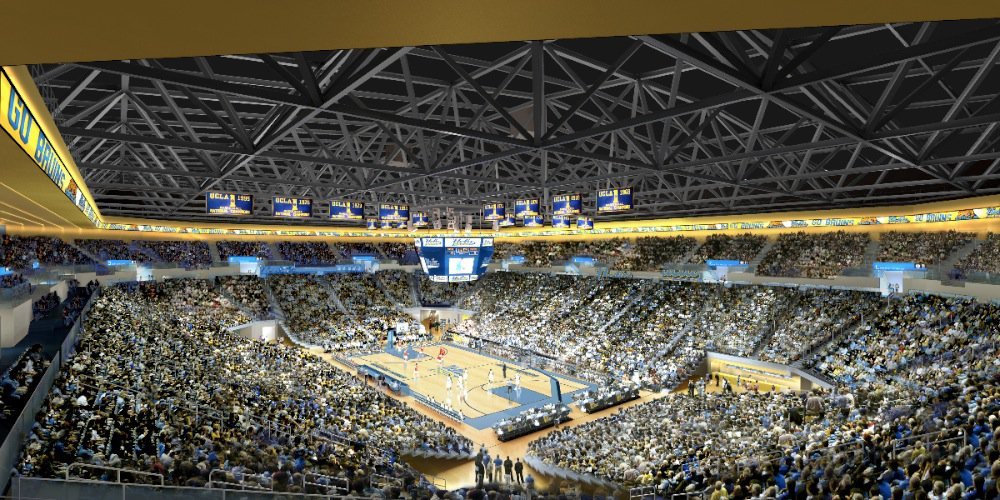
November 27, 1965: Pauley Pavilion opens, on the campus of the University of California at Los Angeles.

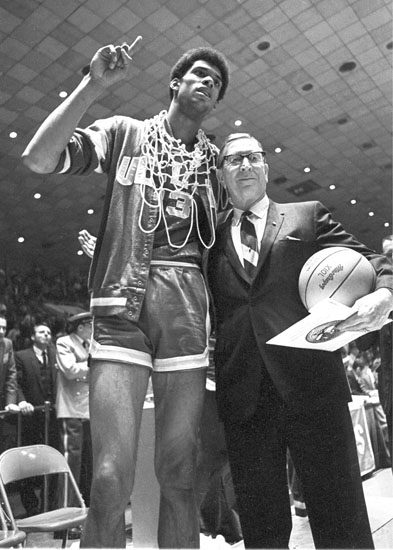
Following their 1964 National Championship -- they would win it again in 1965 -- UCLA coach John Wooden wanted a suitable arena for his ever-growing program. He got it in time for the 1965-66 season, and it has hosted 9 more National Championships, making for 11 banners, 10 coached by Wooden.

But they would not win the 12,829-seat Pavilion's opening game. In fact, the 1st game was between the UCLA varsity and the UCLA freshman team. Until 1972, the NCAA did not allow freshmen to play on varsity teams, with rare exceptions. (For example, due to the manpower drain of World War II, it was allowed for the duration.) The freshman team won, 75–60.

How could this happen? Had UCLA been hit that hard by graduation? No, they were hit that hard by Wooden's prize recruit: Ferdinand Lewis Alcindor Jr. Better known as Lew Alcindor, the Harlem native had been the top high school player in the country. Every college coach in the country wanted him, thinking he would be the next Bill Russell or Wilt Chamberlain. Wooden told him that he could be the first star of a big new building in one of America's biggest cities.

Alcindor justified that faith, starting in the 1st game: Against the 2-time defending National Champions, he scored 31 points and grabbed 21 rebounds. Against junior colleges and 4-year schools' freshmen teams, the UCLA frosh went 21-0.

As a sophomore in 1966-67, Alcindor led the Bruins to a 30-0 season. As a junior in 1967-68, they went 29-1, losing only a nationally-televised regular-season "Game of the Century" to Elvin Hayes and the University of Houston at the Astrodome. That loss was solidly avenged in the NCAA Tournament Semifinal. In 1968-69, they went 29-1, losing only a meaningless conference finale to their arch-rivals, the University of Southern California (USC).

In his 3 seasons on the varsity, Alcindor led UCLA to a record of 88-2, and 3 National Championships, winning the NCAA Tournament's Most Outstanding Player all 3 times. Counting his freshman record, he went 109-2.
In 1971, just after leading the Milwaukee Bucks to the NBA Championship, Alcindor, having converted to Islam 3 years earlier, publicly announced that he had changed his name to Kareem Abdul-Jabbar. There were 2 people he allowed to continue to call him "Lew": His father -- after all, it was his name, too -- and Coach Wooden. He went on to win 5 more NBA Championships, back in Los Angeles with the Lakers. The greatest player in the history of college basketball became one of the Top 10 players in the history of professional basketball.

Pauley Pavilion was named for an oil magnate who was also a Regent of the University of California system, whose donation to its building went a long way toward making it possible. Edwin Pauley was a friend of, and appointee to several offices by, Presidents Franklin Roosevelt and Harry Truman, but the student protests of the 1960s led him to switch parties and support Ronald Reagan for Governor.

Speaking of politics, the Pavilion was the site of the 2nd debate of the 1988 Presidential campaign, where CNN anchor Bernard Shaw asked the question that shattered the campaign of Governor Michael Dukakis – not that the Duke helped himself with his answer. Oddly, Dukakis chose to hold held his Election Eve rally there, despite being a Bostonian. (In contrast, Boston's JFK held his Convention in the Los Angeles Coliseum complex, but his Election Eve rally at the Boston Garden.)


Pauley Pavilion was renovated during the 2011-12 season, which the Bruins spent playing home games at the Los Angeles Memorial Sports Arena. They had won the National Championship game there in 1968 and 1972. Ironically, until 2006, it was USC's home court, until USC opened the nearby Galen Center.
With the Pavilion renovated and modernized, the Bruins now play in a 13,800-seat venue, on the Nell and John Wooden Court, named for the old coach and his wife. The 11 National Championship banners hang overhead: 1964, 1965, 1967, 1968, 1969, 1970, 1971, 1972, 1973, 1975 and 1995.

*

November 27, 1965 was a Saturday. It was a big day in college sports, as it was the end of Thanksgiving week, and thus rivalry week in football. These games were played, not all of them rivalries:

* Rivalry: Number 5 Alabama beat Auburn, 30-3 at Legion Field in Birmingham. 'Bama won the Southeastern Conference title.

* Number 6 Notre Dame and Miami played to a 0-0 tie at the Orange Bowl in Miami. This late-season game, in a stadium named after the New Year's Day game played there, was as close to a bowl game at Notre Dame would come: From the 1925 season until 1969, they refused all bowl bids.

* Number 8 University of Southern California (USC) beat Wyoming, 56-6 at the Los Angeles Memorial Coliseum.

* Rivalry: Number 9 Tennessee beat Vanderbilt, 21-3 at Neyland Stadium in Knoxville, Tennessee.

* Rivalry: Army and Navy played to a tie, 7-7 at John F. Kennedy Stadium in Philadelphia.

* The Quantico Marines beat Memphis State, 20-14 at Butler Stadium in Quantico, Virginia. The Marines were a 2-touchdown underdog. Memphis State University became the University of Memphis in 1994. The Quantico Marines had a team from 1919 to 1972, and the NCAA counted them as a "college football team." The program was canceled due to rising costs. 

While graduates of the U.S. Naval Academy can become officers in the U.S. Marine Corps, the closest thing the Marines have to their own academy is the Quantico Marine Base in Quantico, Virginia -- the town that is also home to the FBI Academy, and to the headquarters of the CID, which investigates crimes involving the Army and the Air Force, and the NCIS, which investigates crimes involving the Navy and the Marines (though the TV show NCIS still shows the agency headquartered at the Washington Navy Yard).

* Rivalry: Boston College beat Holy Cross, 35-0 at Fitton Field in Worcester, Massachusetts.

* Rivalry: Georgia beat Georgia Tech, 17-7 at Grant Field in Atlanta.

* Rivalry: Florida beat Florida State, 30-17 at Florida Field (now Ben Hill Griffin Stadium) in Gainesville.

* Rivalry: Mississippi (Ole Miss) beat Mississippi State, 21-0 at Scott Field (now Davis Wade Stadium) in Starkville, Mississippi.

* Rivalry: Texas Christian University (TCU) beat Southern Methodist University (SMU), 10-7 at Amon G. Carter Stadium in Fort Worth, Texas.

* Baylor beat Rice, 17-13 at Rice Stadium in Houston.

* Brigham Young University (BYU) beat New Mexico, 42-8 at University Stadium in Albuquerque, New Mexico.

* Rivalry: Arizona State beat Arizona, 14-6 at Sun Devil Stadium (now Mountain America Stadium) in the Phoenix suburb of Tempe, Arizona.

* Two days earlier, on Thanksgiving, there were 6 games, including Texas beating Texas A&M, 21-17 at Kyle Field in College Station. But only 1 involved a ranked team: Number 3 Nebraska beat Oklahoma, 21-9 at Memorial Stadium in Lincoln, to clinch the Big 8 Conference title.

* Idle that week, but not yet finished with their regular season: Number 4 UCLA, Champions of the Athletic Association of Western Universities (which became the Pacific-Eight in 1968, the Pacific-Ten in 1978, and the Pacific-Twelve in 2011); 

* Having finished their schedules the week before were the entire the Big Ten Conference, including Number 1 Michigan State; the entire Southwest Conference, including its Champion, Number 2 Arkansas, and Number 10 Texas Tech; Number 7 Missouri; and New Jersey's teams, Rutgers and Princeton.

At the time, the final Associated Press (AP) sportswriters' poll was taken after the regular season, but before the bowl games. So Michigan State were named National Champions in that poll. Entering New Year's Day, the top 3 teams were all 10–0, but all lost: Number 1 Michigan State lost the Rose Bowl to Number 5 UCLA, Number 2 Arkansas lost the Cotton Bowl to Number 14 Louisiana State (LSU), and Number 3 Nebraska lost the Orange Bowl to Number 4. Alabama. So the post-bowl United Press International (UPI) coaches poll named Alabama the National Champions. (Number 6 Missouri beat Number 12 Florida in the Sugar Bowl.)

There were 4 games played in the NBA:

* The New York Knicks lost to the Cincinnati Royals, 132-129 at the old Madison Square Garden. Oscar Robertson scored 44 points.

* The Boston Celtics beat the Los Angeles Lakers, 101-95 at the Boston Garden. Bill Russell scored 28 points, and had 35 rebounds.

* The St. Louis Hawks beat the Baltimore Bullets, 136-110 at the Kiel Auditorium in St. Louis.

* And the Philadelphia 76ers beat the San Francisco Warriors, 124-117 at the Civic Auditorium (now the Bill Graham Auditorium) in San Francisco. Wilt Chamberlain, who had played for the Warriors in Philadelphia, scored 38 points and had 31 rebounds.

The NHL's entire "Original Six" were in action:

* The New York Rangers lost to the Chicago Black Hawks, 1-0 at the old Madison Square Garden. Yes, the Garden hosted an NBA game and an NHL game on the same day.

* The Montreal Canadiens beat the Detroit Red Wings, 3-2 at the Montreal Forum.

* And the Boston Bruins beat the Toronto Maple Leafs, 2-1 at Maple Leaf Gardens in Toronto.

Monday, November 14, 2022

November 14, 1965: The Battle of Ia Drang

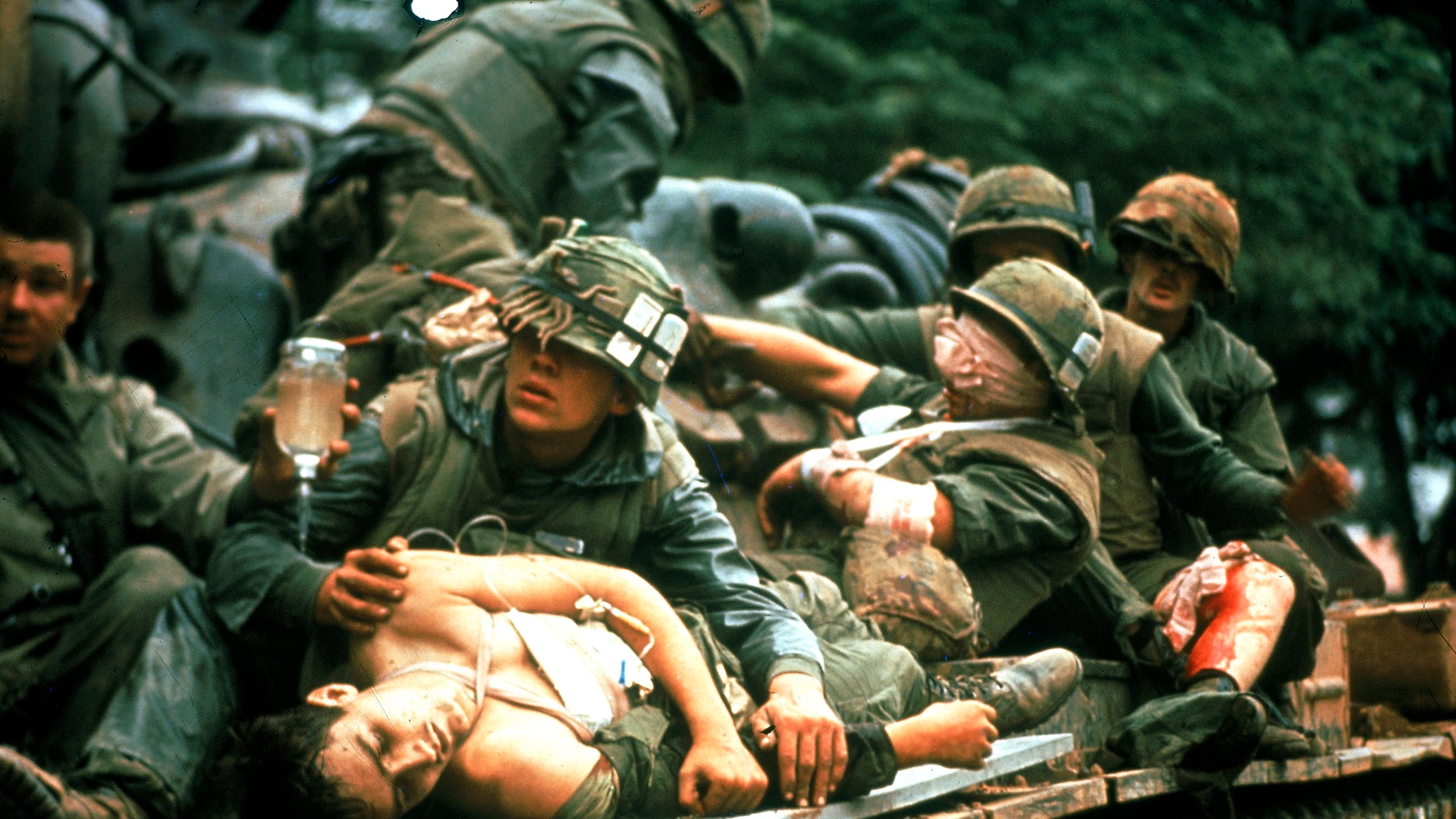
November 14, 1965: The Battle of Ia Drang is fought, the first major engagement between American and Vietcong troops. Both sides claimed victory. About 1,300 American soldiers were killed.

The battle was part of the Pleiku campaign conducted early in the Vietnam Warin the central highlands of Vietnam, in 1965. It is notable for being the first large scale helicopter air assault, and also the first use of Boeing B-52 Stratofortress strategic bombers in a tactical support role.

General William Westmoreland had been assigned as Commander of Military Assistance Command, Vietnam (MACV) on June 20, 1964. President Lyndon B. Johnson assigned him to the post because Secretary of Defense Robert McNamara had told him Westmoreland was "the best we have, without question."
The Pentagon, and the Johnson Administration as a whole, treated Ia Drang as a victory. Time magazine named Westmoreland its Man of the Year for 1965. In a later article, Time suggested Westmoreland as a candidate for the Republican Presidential nomination in 1968. After all, successful Generals, even without political experience, were often touted as possible Presidents.

Ia Drang set the blueprint for the Vietnam War with the Americans relying on air mobility, artillery fire and close air support, while the People's Army of Viet Nam (PAVN) neutralized that firepower by quickly engaging American forces at very close range.

In other words, as generals so often do, America's generals were "fighting the last war," and the Vietnam War was not going to be like World War II, because the Vietcong were not the Wehrmacht, nor were they the Imperial Japanese Army. And it wasn't going to be like the Korean War, either. This was guerrilla warfare, and America hadn't been involved in that since... well, since their own Revolution of 1775 to 1783. And the Pentagon didn't know how to handle it. And so, the "quagmire" of Vietnam began.

On July 3, 1968, with the Tet Offensive already well past, and U.S. troop levels in Vietnam having risen from 16,000 to 535,000 under Westmoreland's command, LBJ promoted Westmoreland to Chief of Staff of the Army. At first glance, this would seem to be a reward -- for putting the U.S. in position to win the war, and for not running for President.

In hindsight, it seemed more like "kicking him upstairs," removing him from direct command as a punishment for failure. Westmoreland never achieved a "V-V Day," never got that 5th star, never got serious consideration for President from either major party, never joined the pantheon of legendary American Generals such as George Washington, Andrew Jackson, Zachary Taylor, Ulysses S. Grant, John Pershing, Dwight D. Eisenhower and Douglas MacArthur. Norman Schwarzkopf would eventually join that list, but Westmoreland died in 2005, at the age of 91, remembered as a General who failed.

*

November 14, 1965 was a Sunday. These NFL games were played:

* The New York Giants lost to the Cleveland Browns, 34-21 at Cleveland Municipal Stadium.

* The Philadelphia Eagles beat the Washington Redskins, 21-14 at Franklin Field in Philadelphia.

* The San Francisco 49ers beat the Detroit Lions, 27-21 at Tiger Stadium in Detroit.

* The Chicago Bears beat the football version of the St. Louis Cardinals, 34-13 at Wrigley Field in Chicago.

* The Green Bay Packers beat the Los Angeles Rams, 6-3 at Milwaukee County Stadium.

* The Baltimore Colts beat the Minnesota Vikings, 41-21 at Metropolitan Stadium in the Minneapolis suburb of Bloomington, Minnesota.

* And the Dallas Cowboys beat the Pittsburgh Steelers, 24-17 at the Cotton Bowl in Dallas.

In the American Football League:

* The New York Jets beat the Boston Patriots, 30-20 at Fenway Park in Boston.

* The Kansas City Chiefs beat the San Diego Chargers, 31-7 at Kansas City Municipal Stadium.

* The Denver Broncos beat the Houston Oilers, 31-21 at Rice Stadium in Houston.

* And the Buffalo Bills beat the Oakland Raiders, 17-14 at Frank Youell Field in Oakland.

Baseball was out of season. There was 1 game in the NBA: The Los Angeles Lakers beat the Baltimore Bullets, 129-114 at the Los Angeles Memorial Sports Arena.

And the NHL's entire "Original Six" were in action:

* The New York Rangers beat the Chicago Black Hawks, 4-2 at the Chicago Stadium.

* The Boston Bruins beat the Toronto Maple Leafs, 2-0 at the Boston Garden.

* And the Montreal Canadiens and the Detroit Red Wings, played to a tie, 2-2 at the Olympia Stadium in Detroit.

Wednesday, November 9, 2022

November 9, 1965: The Night the Lights Went Out

November 9, 1965: It was "The Night the Lights Went Out." At 5:27 PM, just as the Tuesday night rush hour was getting rough, a blackout hit the Northeastern United States, hitting New York City especially hard. Over 30 million people were without power.

Given the time of year, it was already dark out. Traffic lights went out. People got stuck in elevators. People got stuck in the City's Subway system.

The Consolidated Edison Company, a.k.a. Con Ed, managed to spare Staten Island and parts of Brooklyn from the blackout when they disconnected their Arthur Kill Generation Station, on Staten Island, from the grid. Some parts of New Jersey, powered by Public Service Electric & Gas, a.k.a. PSE&G, were not affected, allowing the City's newspapers to use the printing presses of the Newark Evening News to print their next day's editions, such as they were: Even The New York Times only printed 10 pages.

The New York Police Department later said that the City had the fewest reported crimes of any night since records began to be kept, breaking the record of February 9, 1964, the night The Beatles made their 1st appearance on The Ed Sullivan Show. This would end up in sharp contrast to the next major blackout, in 1977, when rioting developed, and it was the most arrests the NYPD ever made in 1 night.

Power was restored before the morning rush hour. Ever since, while there were also blackouts in New York in 1961, 1963, 1967, 1977 (as mentioned), and in 2003, people old enough to remember it mean November 9, 1965 when they asked, "Where were you when the lights went out?" (UPDATE: There was a brief blackout in 2023 as well.)

And there is no truth to the (pardon my choice of words) urban legend: There were no more babies born in New York in early August 1966, 9 months later, than there were in early August 1965 or in early August 1967.

*

As I said, November 9, 1965 was a Tuesday. The baseball season was over, as the Los Angeles Dodgers had won the World Series 26 days earlier, beating the Minnesota Twins in the World Series. Both the NFL and the AFL were in midweek.

It was early in the NBA and NHL seasons. However, because of the blackout, for only the 2nd time in their history, the New York Knicks had to postpone a game. The 1st was on November 22, 1963, the night of the day that President John F. Kennedy was assassinated.

The New York Rangers were not affected by the blackout, as they were not scheduled. None of the NHL's 6 teams were. But there were 3 games played in the NBA that night -- 2 of them, surprisingly, in the Northeast:

* The Boston Celtics beat the Baltimore Bullets, 130-116, at the Rhode Island Auditorium in Providence.

* The Philadelphia 76ers beat the Los Angeles Lakers, 118-110 at the Philadelphia Civic Center's Convention Hall. Wilt Chamberlain scored 39 points, and Hal Greer scored 32. In a losing effort, Jerry West scored 32.

* And the San Francisco Warriors beat the Detroit Pistons, 107-102 at the Cow Palace in the San Francisco suburb of Daly City, California. Nate Thurmond scored 18 points, and grabbed 42 rebounds.

Wednesday, November 2, 2022

November 2, 1965: John Lindsay Is Elected Mayor of New York

November 2, 1965: John Vliet Lindsay, a liberal Republican Congressman, is elected Mayor of New York City. He defeats the Democratic nominee, City Comptroller Abraham D. Beame.

A few days short of his 43rd birthday at the time of his election, he had served in World War II, in battles in both the European and the Pacific Theaters of Operations, rising to the rank of 1st Lieutenant in the U.S. Army. In 1958, he was elected to Congress, representing the East Side of Manhattan, the district nicknamed the Perfumed Stockade, and re-elected in 1960, '62 and '64.

He was handsome and well-spoken, and, up to this point, people found him eminently likable. His basic decency allowed him to connect with liberals, moderates and minorities. However, he was elected as a plurality Mayor in a 3-way race. He got the nominations of the Republican and Liberal Parties, and got 45 percent of the vote. Democratic nominee Beame got 41 percent.

William F. Buckley Jr., publisher of National Review magazine and founder of the Conservative Party of the State of New York, got 13 percent, despite the fact that he didn't even live in the City, said he didn't want to. He even said he didn't want the job: He just wanted to make a point that conservatives should have a choice between Democrats and liberal Republicans.

Lindsay would proclaim, "New York is a fun city." and was lampooned as "Mayor Linseed" on the Batman TV series that soon premiered. (The equivalent to Governor Nelson Rockefeller would be "Governor Stonefellow.") But Fun City would not respond well to him: The day of his Inauguration, January 1, 1966, was the day the Transport Workers Union's contract ran out, and the Subway employees went on strike. After 11 days, Lindsay caved in to the union, and his support never recovered.

Seeming to have pandered to civil rights groups and the antiwar movement, and responding too slowly to a blizzard early in 1969, his own party dumped him for re-election that year. But he secured the Liberal Party's nomination in New York State's odd four-party structure, and rode the "miracles" of the Mets and Jets to victory.

But his 2nd term was even more troubling than his 1st, as the City spiraled downward in crime and corruption that, try as he might, he couldn't stop. I've often thought that Lindsay and Rockefeller, also a liberal Republican, should have switched jobs: Rocky could have governed what University of Massachusetts historian Vincent J. Cannato, writing in 2002 about about Lindsay's terms, titled The Ungovernable City; while Lindsay would have been better off in Albany.

But many people thought Lindsay was merely using the Mayoralty as a stepping-stone for the Presidency -- a charge also leveled at Rockefeller. In the end, neither ever came close to it. Indeed, dumped by the Republicans, Lindsay ran in the Democratic Primaries in 1972, and was laughed out of the race. My mother, a City native, likes to say that she knew Lindsay was really a Democrat before he did.

Lindsay did not dare run for a 3rd term in 1973. Having regained the Comptroller's post in 1969, Abe Beame ran for Mayor again, and was elected. But things got even worse, and he wouldn't even get nominated for a 2nd term. Lindsay was ill for a long time, lost his fortune due to his medical bills, and died at age 79 at the end of 2000. Beame died a few days later, at 94, also a tragic figure.

*

November 2, 1965 was, like all Election Days in modern America, a Tuesday. Baseball was out of season. Football was in midweek. And no games were scheduled in the NBA or the NHL. So there were no scores on this historic day.

December 31, 1999 & January 1, 2000: The Millennium

December 31, 1999:  The Millennium arrives. The people of planet Earth survived. At a terrible cost. But we hadn't destroyed ourselves. ...