Showing posts with label bolshevik revolution. Show all posts

Monday, November 7, 2022

November 7, 1917: The Bolshevik Revolution

November 7, 1917: The Winter Palace in Petrograd is stormed by Bolshevik troops, and the Bolshevik Revolution is complete. It is also known as the October Revolution, since Russia was still using the Julian Calendar, and they thought it was October 25. The new national leader, Vladimir Lenin, switches the vast country to the Gregorian Calendar.

Lenin also moved the capital to Moscow, and after his death in 1924, Petrograd was renamed Leningrad. After the end of the Soviet Union in 1991, that city's name was restored to what it was before the failed Russian Revolution of 1905: St. Petersburg. As was said at the time, "Better to name it for a saint than for a monster."

In March, there was (again, because of the discrepancy of the calendars) the February Revolution, forcing Czar Nicholas II to abdicate his imperial throne. But the provisional government, led by Alexander Kerensky, could not feed the country, get it out of World War I, or free the farmers from the owners of their land. Lenin promised them "Peace, land and bread." It is a bit ironic to say of the most successful exponent that Communism has ever had, "They bought what he was selling." But they did.

On July 14, 1918, the Bolsheviks had the Czar, his wife, their 4 children, and as many living members of the House of Romanov as they could find executed, to remove the focal point for any opposition Lenin might have.

Kerensky died in exile in 1940. He outlived the Czar and his family, Lenin (1924), Leon Trotsky (1940), and Joseph Stalin (1953).

We may never know how sports in Russia would have developed had either the Czars or the provisional government under Kerensky had lasted. Some dictators understand how sports can be used to spread propaganda for their government at home and for their country abroad. The fascist dictators of the 1930s did: Adolf Hitler of Germany, Benito Mussolini of Italy, and Francisco Franco of Spain.

Lenin and Stalin did not use sports to their advantage. Lenin was too busy trying to keep his country from flying apart to care. Stalin is only known to have attended 1 sporting event in his life, a soccer demonstration on Moscow's Red Square itself.

But Nikita Khrushchev certainly used the Olympics to spread Red propaganda, and Leonid Brezhnev used the 1980 Olympics in Moscow to do so. Vladimir Putin is a former judo champion, although he's not nearly as good at hockey as he's been allowed to think he is -- much like Fidel Castro and his pitching. Putin used the 2014 Winter Olympics in Sochi and the 2018 World Cup to spread the Russian image.

One thing is for sure: If the Bolsheviks had failed, the 1972 Summer Olympic basketball tournament, the 1972 "Summit Series" between Canada and the Soviets, and the 1980 Winter Olympic hockey tournament, while still exciting, would have had far less controversy. Also, movies such as WarGames, Red Dawn and Rocky IV might still have been made, but would have had a very different enemy.

*

November 7, 1917 was a Wednesday. Baseball season was over. Football was in midweek. There was hardly any professional basketball. And, at the time, hockey season began in December, and the 1917-18 season would begin with a new league, the National Hockey League. But there were no scores on this historic day.

Tuesday, August 30, 2022

August 30, 1918: The Attempted Assassination of Vladimir Lenin

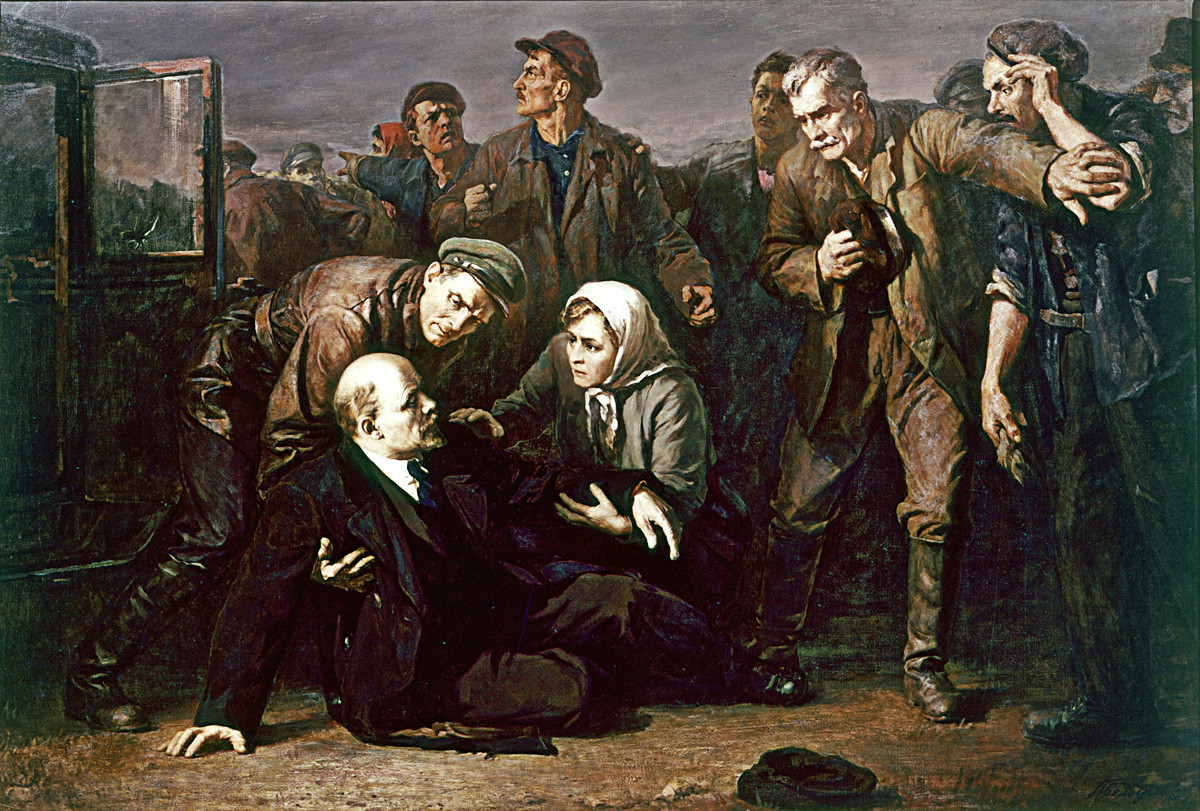
Artist's depiction of the event

August 30, 1918: An attempt is made to assassinate Vladimir Lenin, leader of the Bolshevik Revolution, and dictator of Russia. Although he does not die immediately, the attempt can be said to have succeeded.

Born into a Jewish family, Feiga "Fanny" Kaplan served a sentence of hard labor during the Czarist years for her revolutionary activities. She became a member of the Socialist Revolutionary Party, and originally supported Lenin. But when the Bolsheviks banned all parties but their own, she began to view him as a "traitor to the revolution."
On August 30, 1918, she approached Lenin, who was leaving a Moscow factory, and fired 3 shots. One bullet passed through his coat. One lodged in his left shoulder. One passed through his neck, punctured part of his left lung, and stopped near his right collarbone.

Lenin was taken back to his living quarters at the Kremlin. He feared that others might be planning to kill him, and refused to leave the security of the Kremlin to seek medical attention. Doctors were brought in to treat him, but could not remove the bullets outside a hospital. Despite the severity of his injuries, Lenin survived, but his health never fully recovered from the attack. It has been speculated that the shooting contributed to the strokes that incapacitated him, and eventually killed him in 1924.

Interrogated by the Cheka, the forerunner of the KGB, she refused to name any accomplices, and was executed by firing squad in Moscow on September 3. She was 28 years old.

*

August 30, 1918 was a Friday. Baseball legend Ted Williams of the Boston Red Sox was born. So was another baseball All-Star of the 1940s, New York Yankees 3rd baseman Billy Johnson. And J. Donald Cameron died, the last surviving member of President Ulysses S. Grant's Cabinet. He was Grant's last Secretary of War, and later a U.S. Senator from Pennsylvania.

These baseball games were played:

* The New York Yankees lost to the Washington Senators, 6-1 at Griffith Stadium in Washington. Walter Johnson went the distance for the win.

* The New York Giants beat their arch-rivals, the Brooklyn Dodgers (or the Robins, as they were known during Wilbert Robinson's management from 1914 to 1931), 1-0 at the Polo Grounds. William "Pol" Perritt pitched a 2-hit shutout.

* The Boston Red Sox swept a doubleheader from the Philadelphia Athletics, 12-0 and 4-1 at Fenway Park in Boston. Carl Mays allowed 9 hits in the opener, but kept the shutout. Over the 2 games, Babe Ruth went 2-for-6 with 3 walks and 2 RBIs.

* A doubleheader was split at Baker Bowl in Philadelphia. The Philadelphia Phillies won the opener, 1-0. Joe Oeschger pitched a 3-hit shutout. The Boston Braves won the nightcap, 8-3. Two years later, Oeschger and Brooklyn's Leon Cadore with oppose each other, and go the distance -- 26 innings, in a 1-1 tie.

* The Cleveland Indians swept a doubleheader from the Detroit Tigers, 2-1 and 4-2 at Navin Field. (That ballpark was renamed Briggs Stadium in 1938, and Tiger Stadium in 1961.) Over the 2 games, Tris Speaker went 1-for-8 with a walk, and Ty Cobb went 0-for-7 with a walk.

* The Cincinnati Reds beat the Chicago Cubs, 5-0 at Weeghman Park in Chicago. (That ballpark was renamed Cubs Park in 1920, and Wrigley Field in 1926.) Roy Mitchell pitched a 4-hit shutout.

* And the Chicago White Sox, the Pittsburgh Pirates, and the 2 St. Louis teams, the Cardinals and the Browns, were not scheduled.

Sunday, July 17, 2022

July 17, 1918: The Execution of the Russian Imperial Family

July 17, 1918: The Bolshevik Revolution executes Czar Nicholas II and his entire immediate family, in Ekaterinburg, Russia, about 1,100 miles east of Moscow.

World War I went very badly for the Russian Empire, and the biggest reason was that the Czar took personal control of the Army. He proved to be completely inept as a commander, and by early 1917, both the Army and the home front were on the brink of collapse. The Army forced him to abdicate the throne on March 15.

A provisional government was set up, with Alexander Kerensky as President. But it could not feed the country, get it out of the war, or free the farmers from the owners of their land fast enough, and the people turned to others for hope.

Those others turned out to be the Bolsheviks, Communists led by Vladimir Lenin. He promised the people "Peace, land and bread." It is a bit ironic to say of the most successful exponent that Communism has ever had, "They bought what he was selling." But they did.

On November 7, 1917, the Czar's former residence, the Winter Palace in Petrograd, was stormed by Bolshevik troops, and the Bolshevik Revolution was complete. It is also known as the October Revolution, since Russia was still using the Julian Calendar, and they thought it was October 25. Lenin switched the vast country to the Gregorian Calendar.

Lenin also moved the capital to Moscow, and after his death in 1924, Petrograd was renamed Leningrad. After the end of the Soviet Union in 1991, that city's name was restored to what it was before the failed Russian Revolution of 1905: St. Petersburg. As was said at the time, "Better to name it for a saint than for a monster."

For Lenin was a monster. He kept his promise of peace, producing the Treaty of Brest-Litovsk that pulled Russia out of the war on March 3, 1918. Well, actually, he kept half of his promise of peace, because the Kerensky forces and the Czarist forces launched a civil war against the Bolsheviks. So there was still fighting. And there was no land, as the federal government took it all over. And there were precious little bread: People were still starving.

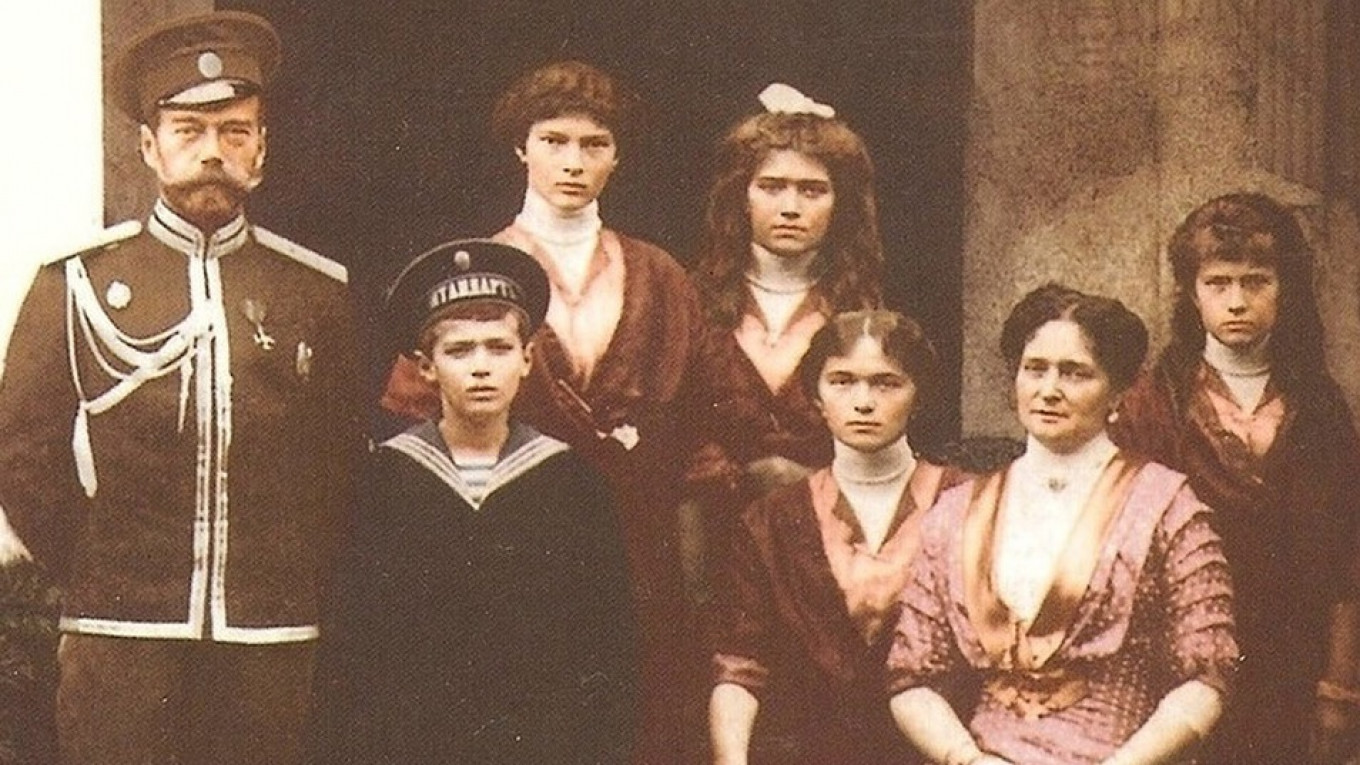
Lenin knew that, as long as the Czar was still alive, as long as any potential Czar was still alive, the Czarist forces would have someone to rally around. The House of Romanov -- the Czar, his wife, and their 5 children -- had been moved around, first by the provisional government, then by the Bolsheviks, but were still available.

Finally, Lenin made the decision that the Romanovs had to go, as a psychological blow to the Czarist forces. They were taken to Ipatiev House in Ekaterinburg. And they were all shot:

* Czar Nicholas II, 50 years old.
* His wife, Czarina Alexandria, a.k.a. Alix, 46. And their children:
* Grand Duchess Olga, 22. 
* Grand Duchess Tatiana, 21. As nurses in the war, she and Olga had each fallen in love with at least 2 soldiers, but, despite having reached adulthood, neither was ever engaged to be married.
* Grand Duchess Maria, 19. Although renowned in her lifetime for her beauty, and having expressed a desire to have a large family of her own, she is not known to have had any romances, much less come close to being married.
* Grand Duchess Anastasia, 17. While there were impostors claiming to be her in the decades to come, the discovery of the Romanov mass grave led to DNA testing that proved that none of them escaped. And the rumor that Grigori Rasputin, assassinated by relatives of the Czar at the end of 1916, had seduced the Czarina and all 4 Grand Duchesses was completely false.
* Czarevich Alexei, 14, who stood to become Czar Alexander IV.

Had things worked out differently, and both he and his father had lived to be 70, Nicholas would have remained on the throne until 1938, and Alexei until 1974. But, Alexei having hemophilia, that would have been unlikely in any case. Any child of his would be a 3rd cousin of Britain's Queen Elizabeth II, and could have still been on the Russian throne today.

Also shot: Alexei Trupp, 62, the Romanovs' lead servant; Ivan Kharitonov, 46, their family cook; Eugene Botkin, 53, their family doctor; Anna Demidova, 40, Alexandra's lady-in-waiting; and even a dog that belonged to Tatiana. Their executions may seem pointless, but the Bolsheviks wanted to make the point to any other Romanovs, or Romanov-affiliated people remaining: No one was safe.

Nicholas' brother, Grand Duke Michael, whom he had named as heir after his abdication, since Alexandra had convinced Nicholas that the strain of being Czar would be too much for Alexei's health, had already been executed, in Perm, on June 13. He was 39.

Alexandra's sister, and fellow granddaughter of Queen Victoria of Britain, Princess Elisabeth, widow of Nicholas' brother Grand Duke Sergei, one of the few popular members of the family due to her status as the founder of Russia's modern nursing system, revered as a living saint, was murdered on July 18, by being flung down a mineshaft. She was 53.

The execution -- really, the mass murder -- of the Romanovs was mentioned as one of the actions claimed by the Devil, played by Mick Jagger, in The Rolling Stones' 1968 song "Sympathy for the Devil." He said, "Anastasia screamed in vain." The phony story of the youngest daughter escaping, as told in the 1956 film Anastasia, starring Ingrid Bergman, made the reference familiar to listeners. Of course, by the time the song came out, the former capital of the Russian Empire had been named Leningrad since 1924, confusing people who wondered why Mick was singing about St. Petersburg, which they thought was in Florida.

The bodies were buried in a forest near Ipatiev House. They were found in 1979, and DNA testing identified them in 1998. On July 17, the 80th Anniversary of their execution, and 7 years after the fall of the Soviet Union, they were buried at Saints Peter and Paul Cathedral in St. Petersburg, with their ancestors. The Church of the Blood was built on the site of Ipatiev House, and the Russian Orthodox Church has canonized the imperial couple and their 5 children as saints within their Church. This, despite Nicholas' terrible neglect of the people over whom he reigned. When you're a Martyr, it tops everything, and absolves all sins.

The Czarist forces, now demoralized, did collapse, and the White forces (the republicans supporting Kerensky) eventually fell to the Red forces (Lenin's Communists). The Soviet Union was founded in 1922, and would last until 1991.

Alexander Kerensky fled Russia after the Bolshevik Revolution, living in Paris and later New York, and died in exile in New York in 1970. He outlived the Czar and his family, Lenin (1924), Leon Trotsky (1940) and Joseph Stalin (1953), and very nearly Nikita Khrushchev (1971).

After the executions, Grand Duchess Xenia Alexandrovna was the only surviving sibling of Nicholas. The current pretense to the Russian throne is through her descendants: She lived until 1960, and the meaningless title passed to her son, Prince Alexei, who lived in London until his death in 1981. His son, Prince Andrew Romanov, was born in London in 1923, moved to California, and became an artist. He died in 2021.

In 2022, the heir is Andrew's son, Prince Alexis Andreevich Romanov, 69, who runs a fiduciary services company in San Francisco. (It is interesting that so many would-be European monarchs got involved in banking.) He is married, to a woman named Zoey, but has had no children. So his heir is his half-brother, Prince Peter, 61, who runs a car business in San Francisco. No word on whether this wing of the Romanov family lives in the city's Russian Hill neighborhood.
Alexis & Zoey Romanoff

*

July 17, 1918 was a Wednesday. These baseball games were played that day:

* The New York Giants and the Cincinnati Reds played a doubleheader at Redland Field in Cincinnati. (It was renamed Crosley Field in 1934.) The Reds won the 1st game, 2-1. The Giants won the 2nd game, 4-1.

* The Boston Red Sox swept a doubleheader from the St. Louis Browns at Fenway Park in Boston, 7-0 and 4-0. Bullet Joe Bush pitched a 7-hit shutout, and Babe Ruth pitched a 4-hit shutout, in a game called after 5 innings due to darkness. Over the 2 games, Ruth went 3-for-6 with 2 RBIs.

* The Washington Senators beat the Cleveland Indians, 5-4 at National Park in Washington Park. (It was renamed Griffith Stadium in 1922.)

* The Pittsburgh Pirates beat the Brooklyn Robins, 5-4 at Forbes Field in Pittsburgh. George Cutshaw drove in the winning run with a single in the bottom of the 11th inning. (The Brooklyn team became the Dodgers in 1911, then the Robins in 1914 in honor of manager Wilbert Robinson, and then the Dodgers again after he was fired after the 1931 season.)

* The Chicago Cubs beat the Philadelphia Phillies, 2-1 at Weeghman Park in Chicago. (It was renamed Cubs Park in 1920, and Wrigley Field in 1926.) The game lasted 21 innings. Max Flack went 5-for-8 with an RBI for the Cubs, and Emil "Irish" Meusel went 0-for-9.

* The St. Louis Cardinals beat the Boston Braves, 4-3 at Robison Field in St. Louis.

* The New York Yankees and the Detroit Tigers were supposed to play at the Polo Grounds, but were rained out. It was made up as part of a doubleheader the next day. The Tigers won the opener, 4-1. Ty Cobb went 0-for-2, but drew a walk and had an RBI on a groundout. He left the game with an injury, and didn't play in the nightcap, which the Yankees won, 3-2.

* And the Chicago White Sox and the Philadelphia Athletics were supposed to play at Shibe Park in Philadelphia, but were also rained out. This one was also made up as part of a doubleheader the next day. The White Sox won the 1st game, 3-1. The A's won the 2nd game, 4-3. Shoeless Joe Jackson didn't play in either game: He was working in a shipyard as World War I duty.
Saturday, April 16, 2022

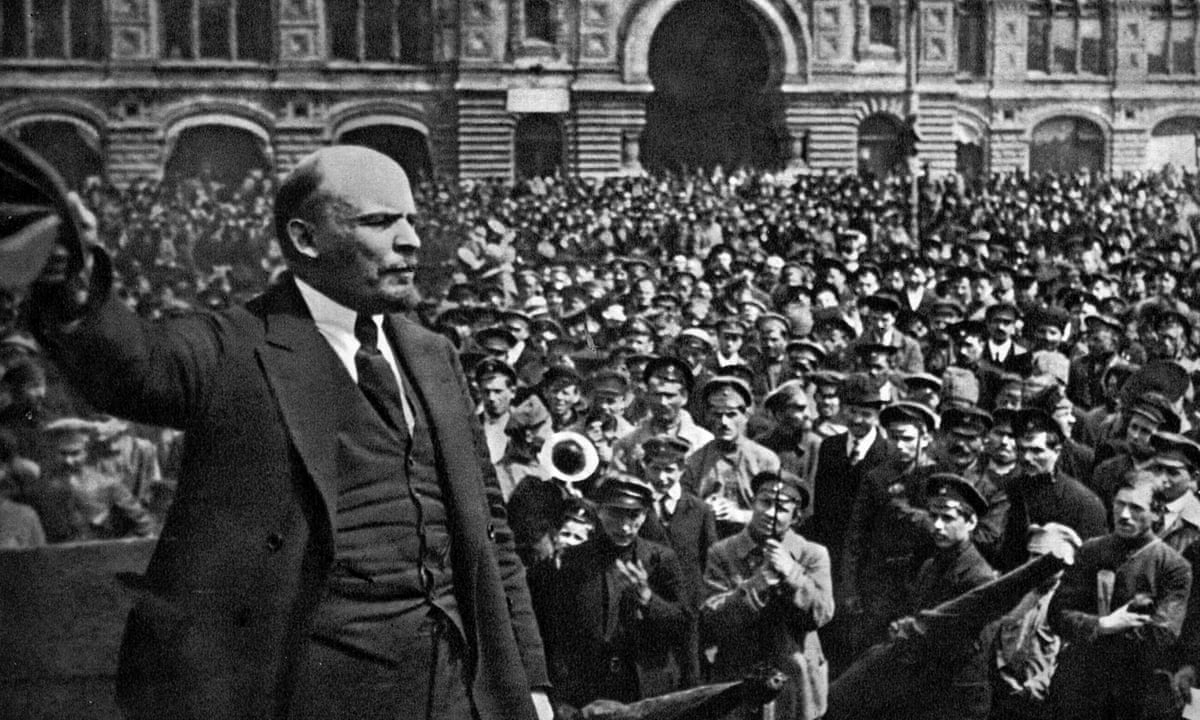
April 16, 1917: Lenin Arrives at the Finland Station

Painting of Lenin's arrival. Artist unknown.

April 16, 1917: The most famous train ride in history ends, as Vladimir Lenin disembarks at the Finland Station in Petrograd, Russia.

He was stepping into a situation where history seemed to be rewritten every day. World War I was raging, and it proved to be the undoing of Czar Nicholas II. The Eastern Front between Germany and Russia proved every bit as brutal as the Western Front between Germany and the alliance of Britain and France.

Nicholas, thinking himself smarter than he really was, took personal control of the Army, and was away from the capital, Petrograd (formerly St. Petersburg), for much of 1915 and 1916. He proved a spectacularly bad commander, and his neglect of the home front left the people of the Russian Empire impoverished, in some cases starving.

The people hated him as a tyrant, and hated his wife the Czarina Alexandra as a German interloper. By February 23, 1917, a cold snap had made everything worse, and people began marching through the streets of the cities with red banners. Police shot at them, and riots resulted. And several military units were in mutiny. The "February Revolution" was underway.

The Czar's Cabinet told him that the only way to stop the rioting was to abdicate. He refused. On March 11, the 48-year-old Emperor suffered a coronary occlusion. By this point, the troops had stopped firing on the rioters, and let them run riot. Finally, on March 15, the Czar's Generals told him that abdication was the only way to avoid either a civil war or complete conquest by the Germans. He relented, and a provisional government was installed, with Alexander Kerensky as President.

Lenin, 46, and the leader of Russia's Communist Party, was living in exile in Switzerland. When he learned of the February Revolution, he decided to return to Russia to take charge of the Bolsheviks, but found that most passages into the country were blocked due to the ongoing conflict.

He organized a plan with other dissidents to negotiate a passage for them through Germany. Recognizing that these dissidents could cause problems for their Russian enemies, the German government agreed to permit 32 Russian citizens to travel by train through their territory, among them Lenin and his wife, Nadezhda Krupskaya.

For political reasons, Lenin and the Germans agreed to a cover story that Lenin had travelled by sealed train carriage through German territory, but in fact the train was not truly sealed, and the passengers were allowed to disembark to, for example, spend the night in Frankfurt.

The group travelled by train from Zürich to Sassnitz, proceeding by ferry to Trelleborg, Sweden -- which was neutral in the war, and would also be in World War II -- and from there to the Haparanda-Tornio border crossing and then to Helsinki, in Russian-controlled Finland, before taking the final train to Petrograd in disguise.

Arriving at Finland Station on April 16, Lenin gave a speech to Bolshevik supporters, condemning the Provisional Government, and, as he had before, calling for a continent-wide European proletarian revolution.
Old Finland Station

Over the following days, he publicly condemned both the Mensheviks and the Social Revolutionaries, for supporting the Provisional Government, denouncing them as traitors to socialism. Considering the government to be just as imperialist as the Czarist regime, he advocated immediate peace with Germany and Austria-Hungary, rule by soviets, the nationalization of industry and banks, and the state expropriation of land, all with the intention of establishing a proletariat government and pushing toward a socialist society.

Things turned against Lenin, and he had to return to Finland on August 10. The tide turned back toward the Bolsheviks, and he returned on October 10. On November 7, the Bolsheviks took power.

Built in 1870, the original Finland Station was demolished and replaced with a new one, inaugurated in 1960. The turreted building is decorated with sculptures glorifying the October Revolution, and incorporates a portico preserved from the original 1870 edifice.
New Finland Station

The station is 107 miles southeast of the Russian border with Finland, and 450 miles northwest of Moscow. St. Petersburg replaced Moscow as the capital of Russia in 1721, when it was established by Czar Peter I, a.k.a. Peter the Great, who named it for himself. Afterward, it was said to be named for St. Peter, the Apostle and the 1st Pope. To make it sound less German and more Russian following the failed revolution of 1905, it was renamed Petrograd.

Lenin restored Moscow as the capital. Following Lenin's death in 1924, Petrograd was renamed Leningrad. After the fall of the Soviet Union in 1991, it was renamed St. Petersburg. As was said at the time, it was better to name it after a saint than after a monster. With 5.6 million people, it remains the 2nd-largest city in Russia, behind Moscow.

*

April 16, 1917 was a Monday. Football was out of season. Professional basketball barely existed. The hockey season ended 3 weeks earlier, when the Seattle Metropolitans became the 1st American team to win the Stanley Cup.

Baseball season was newly underway:

* The New York Giants beat their arch-rivals, the Brooklyn Robins, 5-0 at Ebbets Field. (The Dodgers were named for Wilbert Robinson while he managed them from 1914 to 1931.) Ferdie Schupp pitched a 5-hit shutout.

* The Boston Braves beat the Philadelphia Phillies, 3-1 at Braves Field in Boston. Jesse Barnes outpitched Grover Cleveland Alexander.

* The Boston Red Sox beat the Philadelphia Athletics, 6-1 at Shibe Park in Philadelphia. Babe Ruth went the distance to be the winning pitcher, and went 1-for-4.

* The Pittsburgh Pirates beat the Cincinnati Reds, 8-4 at Redland Field (later Crosley Field) in Cincinnati. Honus Wagner, entering his final season, did not play.

* The Chicago White Sox beat the Detroit Tigers, 4-0 at Navin Field (later Briggs Stadium and Tiger Stadium) in Detroit. Urban "Red" Faber pitched a 2-hit shutout, allowing a double by Ty Cobb and a single by Owen "Donie" Bush. Eddie Collins went 1-for-3 with a walk and an RBI. "Shoeless" Joe Jackson went 2-for-4 with an RBI.

* The St. Louis Cardinals beat their arch-rivals, the Chicago Cubs, 5-1 at Weeghman Park (later Wrigley Field) in Chicago. Rookie Rogers Hornsby went 1-for-4 with an RBI.

* The New York Yankees and the Washington Senators were postponed at the Polo Grounds, on account of cold. (It couldn't have been colder than it would have been in Petrograd that day.) The game was made up as part of a doubleheader on July 5. The Senators won the opener, 2-1. The Yankees won the nightcap, 5-4. In the bottom of the 13th inning, Frank "Home Run" Baker lived up to his nickname by hitting a home run off Walter Johnson, who was in his 3rd inning of relief.

* And the Cleveland Indians and the St. Louis Browns were rained out at Sportsman's Park in St. Louis. This one was also made up as part of a doubleheader on July 5. The Indians won the 1st game, 5-3. The Browns won the 2nd game, 4-1. Over the 2 games, Tris Speaker went 1-for-8 with 2 RBIs, and George Sisler went 5-for-7 with a walk and 2 RBIs.

Friday, January 21, 2022

January 21, 1924: Vladimir Lenin Dies

Lenin's mummy
January 21, 1924: Vladimir Lenin, leader of the Bolshevik Revolution of 1917, dictator of the Soviet Union ever since, and the leader of the worldwide Communist movement, dies of a stroke at his home in Gorki, about 6 miles south of central Moscow. He was 53 years old, and had been dealing with ill health the entire time he was in power.
His body was embalmed to preserve it for long-term public display in a mausoleum in Moscow's Red Square. It's still there, as shown in this photograph.
His death led to a power struggle within the Politburo. Ultimately, it was Joseph Stalin who won out, forcing out Leon Trotsky and other Lenin loyalists. Stalin also inherited Lenin's cult of personality, and took it to new levels.
Lenin had governed a nation wracked with civil war, great poverty, and extensive hunger. And while he made inspirational speeches and wrote stirring papers, he was guilty of atrocities, just as Stalin turned out to be -- although Stalin went on to perform them on a scale not previously imagined.
Charles Kuralt and retired U.S. Army General Norman Schwarzkopf co-hosted a 1994 CBS Reports broadcast: Hitler & Stalin: Legacy of Hate. After the opening segment, about Hitler's rise, they went to commercial, and, upon coming back, Schwarzkopf said, "The world didn't know it at the time, Charles, but 1924 was a very bad year. That was the year that Adolf Hitler formed the Nazis into a national party, and Joseph Stalin became the Premier of Russia." Before addressing Stalin's rise, Kuralt added, "Both their mothers wanted them to be priests."
After Stalin died in 1953, there was another power struggle, won by Nikita Khrushchev. In a 1956 speech, Khrushchev revealed some of Stalin's atrocities, denouncing him, and recommitting the Union of Soviet Socialist Republics to the ideals of its founder, Lenin -- an official hero there, but not to the free world.
Following viewer demands for a battle with a Russian as a character, a 2013 episode of the YouTube series Epic Rap Battles of History, featured a five-man "battle royale": "Nice" Peter Shukoff, himself of Russian descent, played Rasputin, Vladimir Lenin and Vladimir Putin; while "Epic" Lloyd Ahlquist played Joseph Stalin and Mikhail Gorbachev.
*
January 21, 1924 was a Monday. English comedian Benny Hill was born on this day.
Baseball and football were in their off-seasons. There was, as yet, no major professional basketball league. And there was only 1 game played in the National Hockey League that day. The Ottawa Senators beat the Montreal Canadiens, 3-2.
The Senators had won the Stanley Cup in 1920, 1921 and 1923, so they were the defending Champions at this time. They were led by Hall-of-Famers Frank Nighbor, Jack Darragh, Harry "Punch" Broadbent, Cy Denneny, Eddie Gerard, Frank "King" Clancy, and goaltender Clint Benedict.
In spite of this game, the Canadiens would go on to dethrone the Senators as Cup winners, led by Hall-of-Famers Howie Morenz, Aurel Joliat, and the man for whom the trophy for best goaltender would be named, Georges Vezina.

December 31, 1999 & January 1, 2000: The Millennium

December 31, 1999:  The Millennium arrives. The people of planet Earth survived. At a terrible cost. But we hadn't destroyed ourselves. ...