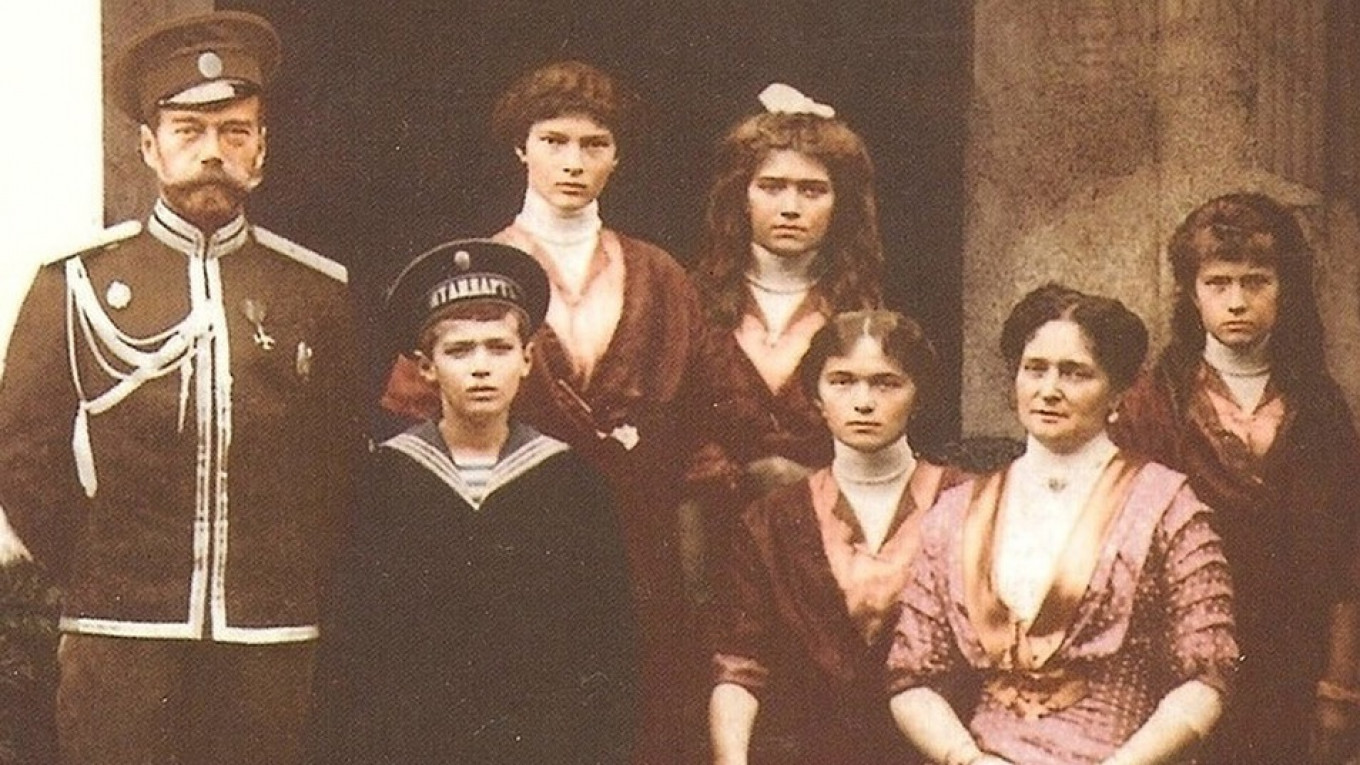
July 17, 1918: The Bolshevik Revolution executes Czar Nicholas II and his entire immediate family, in Ekaterinburg, Russia, about 1,100 miles east of Moscow.
World War I went very badly for the Russian Empire, and the biggest reason was that the Czar took personal control of the Army. He proved to be completely inept as a commander, and by early 1917, both the Army and the home front were on the brink of collapse. The Army forced him to abdicate the throne on March 15.
A provisional government was set up, with Alexander Kerensky as President. But it could not feed the country, get it out of the war, or free the farmers from the owners of their land fast enough, and the people turned to others for hope.
Those others turned out to be the Bolsheviks, Communists led by Vladimir Lenin. He promised the people "Peace, land and bread." It is a bit ironic to say of the most successful exponent that Communism has ever had, "They bought what he was selling." But they did.
On November 7, 1917, the Czar's former residence, the Winter Palace in Petrograd, was stormed by Bolshevik troops, and the Bolshevik Revolution was complete. It is also known as the October Revolution, since Russia was still using the Julian Calendar, and they thought it was October 25. Lenin switched the vast country to the Gregorian Calendar.
Lenin also moved the capital to Moscow, and after his death in 1924, Petrograd was renamed Leningrad. After the end of the Soviet Union in 1991, that city's name was restored to what it was before the failed Russian Revolution of 1905: St. Petersburg. As was said at the time, "Better to name it for a saint than for a monster."
For Lenin was a monster. He kept his promise of peace, producing the Treaty of Brest-Litovsk that pulled Russia out of the war on March 3, 1918. Well, actually, he kept half of his promise of peace, because the Kerensky forces and the Czarist forces launched a civil war against the Bolsheviks. So there was still fighting. And there was no land, as the federal government took it all over. And there were precious little bread: People were still starving.
Lenin knew that, as long as the Czar was still alive, as long as any potential Czar was still alive, the Czarist forces would have someone to rally around. The House of Romanov -- the Czar, his wife, and their 5 children -- had been moved around, first by the provisional government, then by the Bolsheviks, but were still available.

Finally, Lenin made the decision that the Romanovs had to go, as a psychological blow to the Czarist forces. They were taken to Ipatiev House in Ekaterinburg. And they were all shot:
* Czar Nicholas II, 50 years old.
* His wife, Czarina Alexandria, a.k.a. Alix, 46. And their children:
* Grand Duchess Olga, 22.
* Grand Duchess Tatiana, 21. As nurses in the war, she and Olga had each fallen in love with at least 2 soldiers, but, despite having reached adulthood, neither was ever engaged to be married.
* Grand Duchess Maria, 19. Although renowned in her lifetime for her beauty, and having expressed a desire to have a large family of her own, she is not known to have had any romances, much less come close to being married.
* Grand Duchess Anastasia, 17. While there were impostors claiming to be her in the decades to come, the discovery of the Romanov mass grave led to DNA testing that proved that none of them escaped. And the rumor that Grigori Rasputin, assassinated by relatives of the Czar at the end of 1916, had seduced the Czarina and all 4 Grand Duchesses was completely false.
* Czarevich Alexei, 14, who stood to become Czar Alexander IV.
Had things worked out differently, and both he and his father had lived to be 70, Nicholas would have remained on the throne until 1938, and Alexei until 1974. But, Alexei having hemophilia, that would have been unlikely in any case. Any child of his would be a 3rd cousin of Britain's Queen Elizabeth II, and could have still been on the Russian throne today.
Also shot: Alexei Trupp, 62, the Romanovs' lead servant; Ivan Kharitonov, 46, their family cook; Eugene Botkin, 53, their family doctor; Anna Demidova, 40, Alexandra's lady-in-waiting; and even a dog that belonged to Tatiana. Their executions may seem pointless, but the Bolsheviks wanted to make the point to any other Romanovs, or Romanov-affiliated people remaining: No one was safe.
Nicholas' brother, Grand Duke Michael, whom he had named as heir after his abdication, since Alexandra had convinced Nicholas that the strain of being Czar would be too much for Alexei's health, had already been executed, in Perm, on June 13. He was 39.
Alexandra's sister, and fellow granddaughter of Queen Victoria of Britain, Princess Elisabeth, widow of Nicholas' brother Grand Duke Sergei, one of the few popular members of the family due to her status as the founder of Russia's modern nursing system, revered as a living saint, was murdered on July 18, by being flung down a mineshaft. She was 53.
The execution -- really, the mass murder -- of the Romanovs was mentioned as one of the actions claimed by the Devil, played by Mick Jagger, in The Rolling Stones' 1968 song "Sympathy for the Devil." He said, "Anastasia screamed in vain." The phony story of the youngest daughter escaping, as told in the 1956 film Anastasia, starring Ingrid Bergman, made the reference familiar to listeners. Of course, by the time the song came out, the former capital of the Russian Empire had been named Leningrad since 1924, confusing people who wondered why Mick was singing about St. Petersburg, which they thought was in Florida.
The bodies were buried in a forest near Ipatiev House. They were found in 1979, and DNA testing identified them in 1998. On July 17, the 80th Anniversary of their execution, and 7 years after the fall of the Soviet Union, they were buried at Saints Peter and Paul Cathedral in St. Petersburg, with their ancestors. The Church of the Blood was built on the site of Ipatiev House, and the Russian Orthodox Church has canonized the imperial couple and their 5 children as saints within their Church. This, despite Nicholas' terrible neglect of the people over whom he reigned. When you're a Martyr, it tops everything, and absolves all sins.
The Czarist forces, now demoralized, did collapse, and the White forces (the republicans supporting Kerensky) eventually fell to the Red forces (Lenin's Communists). The Soviet Union was founded in 1922, and would last until 1991.
Alexander Kerensky fled Russia after the Bolshevik Revolution, living in Paris and later New York, and died in exile in New York in 1970. He outlived the Czar and his family, Lenin (1924), Leon Trotsky (1940) and Joseph Stalin (1953), and very nearly Nikita Khrushchev (1971).
After the executions, Grand Duchess Xenia Alexandrovna was the only surviving sibling of Nicholas. The current pretense to the Russian throne is through her descendants: She lived until 1960, and the meaningless title passed to her son, Prince Alexei, who lived in London until his death in 1981. His son, Prince Andrew Romanov, was born in London in 1923, moved to California, and became an artist. He died in 2021.
In 2022, the heir is Andrew's son, Prince Alexis Andreevich Romanov, 69, who runs a fiduciary services company in San Francisco. (It is interesting that so many would-be European monarchs got involved in banking.) He is married, to a woman named Zoey, but has had no children. So his heir is his half-brother, Prince Peter, 61, who runs a car business in San Francisco. No word on whether this wing of the Romanov family lives in the city's Russian Hill neighborhood.

Alexis & Zoey Romanoff
*
July 17, 1918 was a Wednesday. These baseball games were played that day:
* The New York Giants and the Cincinnati Reds played a doubleheader at Redland Field in Cincinnati. (It was renamed Crosley Field in 1934.) The Reds won the 1st game, 2-1. The Giants won the 2nd game, 4-1.
* The Boston Red Sox swept a doubleheader from the St. Louis Browns at Fenway Park in Boston, 7-0 and 4-0. Bullet Joe Bush pitched a 7-hit shutout, and Babe Ruth pitched a 4-hit shutout, in a game called after 5 innings due to darkness. Over the 2 games, Ruth went 3-for-6 with 2 RBIs.
* The Washington Senators beat the Cleveland Indians, 5-4 at National Park in Washington Park. (It was renamed Griffith Stadium in 1922.)
* The Pittsburgh Pirates beat the Brooklyn Robins, 5-4 at Forbes Field in Pittsburgh. George Cutshaw drove in the winning run with a single in the bottom of the 11th inning. (The Brooklyn team became the Dodgers in 1911, then the Robins in 1914 in honor of manager Wilbert Robinson, and then the Dodgers again after he was fired after the 1931 season.)
* The Chicago Cubs beat the Philadelphia Phillies, 2-1 at Weeghman Park in Chicago. (It was renamed Cubs Park in 1920, and Wrigley Field in 1926.) The game lasted 21 innings. Max Flack went 5-for-8 with an RBI for the Cubs, and Emil "Irish" Meusel went 0-for-9.
* The St. Louis Cardinals beat the Boston Braves, 4-3 at Robison Field in St. Louis.
* The New York Yankees and the Detroit Tigers were supposed to play at the Polo Grounds, but were rained out. It was made up as part of a doubleheader the next day. The Tigers won the opener, 4-1. Ty Cobb went 0-for-2, but drew a walk and had an RBI on a groundout. He left the game with an injury, and didn't play in the nightcap, which the Yankees won, 3-2.
* And the Chicago White Sox and the Philadelphia Athletics were supposed to play at Shibe Park in Philadelphia, but were also rained out. This one was also made up as part of a doubleheader the next day. The White Sox won the 1st game, 3-1. The A's won the 2nd game, 4-3. Shoeless Joe Jackson didn't play in either game: He was working in a shipyard as World War I duty.


No comments:
Post a Comment