Showing posts with label moscow. Show all posts

Sunday, November 20, 2022

November 20, 1995: The Death of Sergei Grinkov

"Kayta" & Sergei

November 20, 1995: Sergei Grinkov dies of a heart attack, while practicing with his wife and figure skating partner, Ekaterina Gordeeva, in Lake Placid, New York. He was 28 years old, and an autopsy showed that he had severely clogged coronary arteries.

Sergei Mikhailovich Grinkov was born on February 4, 1967 in Moscow. Ekaterina Alexandrovna Gordeeva was born on May 28, 1971, also in Moscow. Sergei and "Katia" were paired up in 1981, at ages 14 and 10, respectively, by coach Vladimir Zaharov.

Together, competing for the Soviet Union, they won the Gold Medal in pairs skating at the European Championships in 1988 and 1990; at the World Championships in 1986, 1987, 1989 and 1990; and at the 1988 Winter Olympics in Calgary.

They were married on April 20, 1991, and began touring in Stars On Ice, in America. They had to drop out when Katia was found to be pregnant. On September 11, 1992, their daughter, Daria, was born -- in America, in Morristown, New Jersey. Two months later, Katia began training again. By this point, the Soviet Union had fallen, and professionals were allowed to compete in formerly all-amateur events such as the Olympics. Competing for the Russian Federation, they won both the Olympics (in Lillehammer, Norway) and the European Championships in 1994.

On November 20, 1995, they were training for the next round of Stars On Ice, in Lake Placid, on the rink where Gold Medals were won at the 1980 Winter Olympics by Robin Cousins of Britain, Anett Pötzsch of East Germany, and 2 Soviet duos, Irina Rodnina and Alexander Zaitsev in paris and Natalia Linichuk and Gennadi Karponossov in ice dancing -- and also won there by the U.S. hockey team, beating the Soviets and then Finland for the Gold Medal.

During a practice, Grinkov collapsed, having suffered a massive heart attack. Doctors found that he had severely clogged coronary arteries, to the point where his arterial opening was reportedly the size of a pinhole. Later testing revealed that he also had a genetic risk factor linked with premature heart attacks. The risk factor is called the PLA-2 variant, and is also known as the "Grinkov Risk Factor." He was 28 years old. His wife was 24, and their daughter was only 3.

Katia, along with an all-star cast, skated a tribute in his honor titled "Celebration of a Life" in February 1996, which was later televised. She also wrote a book about their life and partnership titled My Sergei: A Love Storywhich was later turned into a television movie.

Katia later married and divorced another Russian skating champion, Ilia Kulik, had another daughter, Liza, and ran a skating rink in the suburbs of Los Angeles. In 2020, she married to another Gold Medal-winning skater, David Pelletier of Canada, and they run a rink in Edmonton.

*

November 20, 1995 was a Monday. Baseball was out of season. On ABC Monday Night Football, the San Francisco 49ers beat the Miami Dolphins, 44-20 at Joe Robbie Stadium (now Hard Rock Stadium) in Miami Gardens, Florida.

There were 4 games in the NBA:

* The New Jersey Nets lost to the Utah Jazz, 105-79 at the Delta Center in Salt Lake City, Utah.

* The Houston Rockets beat the Boston Celtics, 98-93 at the new FleetCenter (now the TD Garden) in Boston.

* The Orlando Magic beat the Golden State Warriors, 101-95 at the Orlando Arena.

* And the Portland Trail Blazers beat the Los Angeles Clippers, 113-94 at the new Rose Garden (now the Moda Center) in Portland.

And there were 2 games in the NHL. The Montreal Canadiens beat the Hartford Whalers, 4-3 at the Montreal Forum. Turner Stevenson scored the winning goal, with 1:48 left in overtime. And the Colorado Avalanche and the Edmonton Oilers played to a tie, 3-3 at the Northlands Coliseum (then known as the Edmonton Coliseum).

Thursday, November 10, 2022

November 10, 1982: Leonid Brezhnev "Has a Cold"

November 10, 1982: Soviet Premier Leonid Brezhnev dies of a heart attack in Zarechye, outside Moscow, 3 days after his last public appearance, at a parade commemorating the 65th Anniversary of the Bolshevik Revolution.

His health, like his government, had been failing for years. Soviet media tried to cover up his final illness, by saying that he had a cold. Hosting The Tonight Show, Johnny Carson made a lot of jokes about this, and did so again when Brezhnev’s successor, Yuri Andropov, died just 15 months later; and again when Andropov's successor, Konstantin Chernenko, died 13 months after that. Even President Ronald Reagan said, "How can I make peace with the Russians, when they keep dying on me?"

No one knew it at the time, but Brezhnev’s nearly "absentee boss" governance was the beginning of the end of the Cold War. Over the last 10 years of his dictatorship, roughly from the time he and President Richard Nixon signed their 1972 treaties, the Soviet Union had deteriorated almost as much as his health -- something ignored by fans of Reagan, who wanted us to believe that the Soviet state was never stronger than under its enabler (they alleged), Jimmy Carter.

His funeral was, typical for a totalitarian nation putting its leader to rest, over the top. Clips of it would be used on Saturday Night Live the next year, for the funeral of Buckwheat, assassinated by John David Stutts (both characters played by Eddie Murphy) -- with the Reagans and a sad-looking Princess Diana in attendance.

More notable to me in this photo of Brezhnev than his 5 "Hero of the Soviet Union" medals are his oversize glasses, like Chicago Cubs broadcaster Harry Caray, and singer-actor Dean Martin in his last few years, unable to hide just how bad he was looking.

*

November 10, 1982 was a Wednesday. Actress Heather Matarazzo was born.

Baseball was out of season. Football was in midweek. There were 8 games played in the NBA:

* The New Jersey Nets beat the New York Knicks, 99-90 at the Brendan Byrne Arena at the Meadowlands.

* The Philadelphia 76ers beat the Chicago Bulls, 145-108 at The Spectrum in Philadelphia. Despite the high team point total, the Sixers' highest scorer was Moses Malone with 22 points.

* The Milwaukee Bucks beat the Boston Celtics, 105-101 at the Boston Garden.

* The Detroit Pistons beat the Indiana Pacers, 115-91 at the Silverdome in the Detroit suburb of Pontiac, Michigan.

* The Seattle SuperSonics beat the Dallas Mavericks, 94-91 at the Reunion Arena in Dallas.

* The Utah Jazz beat the Denver Nuggets, 125-119 at the Salt Palace in Salt Lake City. Adrian Dantley led all scorers on the night with 43 points.

* The Phoenix Suns beat the Kansas City Kings, 106-100 at the Arizona Veterans Memorial Coliseum in Phoenix.

* And the Cleveland Cavaliers beat the Golden State Warriors, 132-120 at the Oakland Coliseum Arena. Lloyd "World B." Free scored 38 points in defeat.

And there were 8 games in the NHL:

* The New York Rangers beat the St. Louis Blues, 5-4 at Madison Square Garden.

* The New Jersey Devils, in their 1st season, lost to the Washington Capitals, 3-0 at the Capital Centre in the Washington suburb of Landover, Maryland.

* The Hartford Whalers beat the Quebec Nordiques, 7-5 at the Hartford Civic Center (now the PeoplesBank Arena).

* In an "Original Six" matchup, the Toronto Maple Leafs beat the Detroit Red Wings, 8-2 at Maple Leaf Gardens in Toronto.

* The Buffalo Sabres beat the Philadelphia Flyers, 7-2 at the Buffalo Memorial Auditorium.

* The Pittsburgh Penguins beat the Edmonton Oilers, 5-4 at the Civic Arena in Pittsburgh.

* In another "Original Six" matchup, the Chicago Black Hawks beat the Montreal Canadiens, 6-3 at the Chicago Stadium.

* The Vancouver Canucks beat the Los Angeles Kings, 4-2 at the Pacific Coliseum in Vancouver.

* And the Boston Bruins, the Minnesota North Stars and the Winnipeg Jets were not scheduled.

Monday, November 7, 2022

November 7, 1917: The Bolshevik Revolution

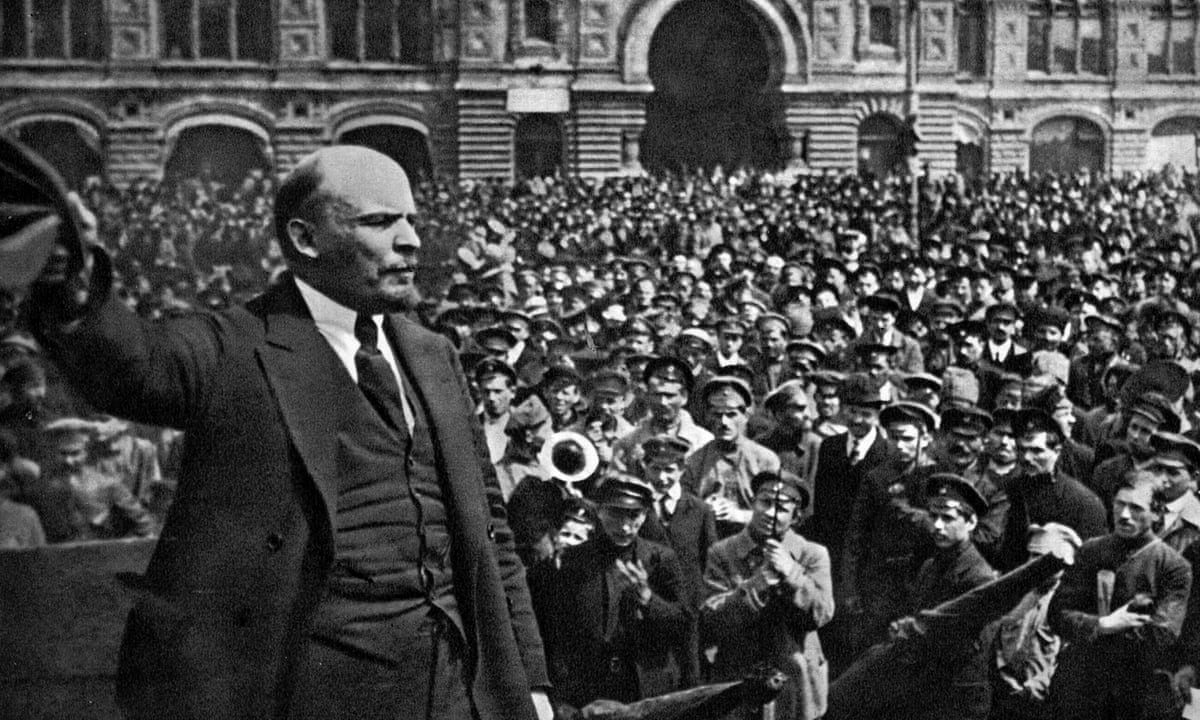
November 7, 1917: The Winter Palace in Petrograd is stormed by Bolshevik troops, and the Bolshevik Revolution is complete. It is also known as the October Revolution, since Russia was still using the Julian Calendar, and they thought it was October 25. The new national leader, Vladimir Lenin, switches the vast country to the Gregorian Calendar.

Lenin also moved the capital to Moscow, and after his death in 1924, Petrograd was renamed Leningrad. After the end of the Soviet Union in 1991, that city's name was restored to what it was before the failed Russian Revolution of 1905: St. Petersburg. As was said at the time, "Better to name it for a saint than for a monster."

In March, there was (again, because of the discrepancy of the calendars) the February Revolution, forcing Czar Nicholas II to abdicate his imperial throne. But the provisional government, led by Alexander Kerensky, could not feed the country, get it out of World War I, or free the farmers from the owners of their land. Lenin promised them "Peace, land and bread." It is a bit ironic to say of the most successful exponent that Communism has ever had, "They bought what he was selling." But they did.

On July 14, 1918, the Bolsheviks had the Czar, his wife, their 4 children, and as many living members of the House of Romanov as they could find executed, to remove the focal point for any opposition Lenin might have.

Kerensky died in exile in 1940. He outlived the Czar and his family, Lenin (1924), Leon Trotsky (1940), and Joseph Stalin (1953).

We may never know how sports in Russia would have developed had either the Czars or the provisional government under Kerensky had lasted. Some dictators understand how sports can be used to spread propaganda for their government at home and for their country abroad. The fascist dictators of the 1930s did: Adolf Hitler of Germany, Benito Mussolini of Italy, and Francisco Franco of Spain.

Lenin and Stalin did not use sports to their advantage. Lenin was too busy trying to keep his country from flying apart to care. Stalin is only known to have attended 1 sporting event in his life, a soccer demonstration on Moscow's Red Square itself.

But Nikita Khrushchev certainly used the Olympics to spread Red propaganda, and Leonid Brezhnev used the 1980 Olympics in Moscow to do so. Vladimir Putin is a former judo champion, although he's not nearly as good at hockey as he's been allowed to think he is -- much like Fidel Castro and his pitching. Putin used the 2014 Winter Olympics in Sochi and the 2018 World Cup to spread the Russian image.

One thing is for sure: If the Bolsheviks had failed, the 1972 Summer Olympic basketball tournament, the 1972 "Summit Series" between Canada and the Soviets, and the 1980 Winter Olympic hockey tournament, while still exciting, would have had far less controversy. Also, movies such as WarGames, Red Dawn and Rocky IV might still have been made, but would have had a very different enemy.

*

November 7, 1917 was a Wednesday. Baseball season was over. Football was in midweek. There was hardly any professional basketball. And, at the time, hockey season began in December, and the 1917-18 season would begin with a new league, the National Hockey League. But there were no scores on this historic day.

Thursday, October 20, 2022

October 20, 1982: The Luzhniki Stadium Disaster

October 20, 1982: A UEFA Cup match was scheduled for the Grand Sports Arena of the Central Lenin Stadium, now named the Luzhniki Stadium. Spartak Moscow, the most popular sports team in the Soviet Union, hosted Dutch club HFC Haarlem. (In 2010, the UEFA Cup was rebranded as the UEFA Europa League.)

Unlike some other soccer disasters, including the Hillsborough Disaster in Sheffield, England in 1989, the problem this time wasn't errors or overreactions by the police, despite the reputation of law enforcement under Communism. Nor was it, as was also the case at Hillsborough, due to too many tickets being sold. Even by Russian standards, this was a cold day for October: 14 degrees below zero, Fahrenheit. As a result, a stadium that could then hold as many as 102,000 people sold only 16,643 tickets.
Lenin Stadium, as it appeared at the time

Contrast that with the 1967 NFL Championship Game, known as "the Ice Bowl": It was 13 below at kickoff, but Lambeau Field in Green Bay was still filled to its capacity at the time, 50,861. An NFL Films voiceover covering it for the 1986 video The NFL's Greatest Games said, "It is called 'Russian Winter,' the kind of cold that made Napoleon and Hitler flee in terror from the doorstop of Moscow. But in Green Bay, it is known as 'Packer Weather.'" Are Wisconsans tougher than Russians?

It is believed that only 100 fans had come from the Netherlands to support Haarlem, despite their having a young Ruud Gullit in their ranks. They won the Dutch league, the Eredivisie, in 1946 and had won promotion back into it in 1981 and qualified for the UEFA Cup in 1982. But they were relegated in 1990, and went bankrupt in 2010, and have had to start all over; the new club, named Haarlem Kennemerland, now plays in the Netherlands' 9th division.

Edgar Gess, a Tajik midfielder, scored in the 16th minute. The score remained 1-0 to Spartak nearly the rest of the way, and, not anticipating the poorly-supported visitors to get a late equalizer, hundreds of fans in the East Stand left their seats to leave the stadium and get to the Metro (Moscow's subway).

But in stoppage time, Georgian defender Sergei Shvetsov scored to make it 2-0. The fans leaving heard the remaining fans cheer, and, in what was long believed to be the same setup as the Ibrox Disaster in Glasgow, Scotland in 1971, many of them turned around to head back and see what happened. This led to fans bumping into each other on the stairwell and falling like dominoes.

There is an alternate theory that the reaction to Shvetsov's goal had nothing to do with it: Rather, it was a young woman losing a shoe, going back to pick it up, getting trampled, and a few fans stopping to help her, thus, in trying to make a bad situation better, instead making it far worse: Good Samaritanism gone horribly wrong.

Initially, the Soviet government announced that the number of fatalities was a mere 3. Some had speculated that it was as high as 340. It wasn't until the fall of the Soviet Union, and the declassification of many documents, that the true number of deaths was revealed: 66 -- oddly, the exact same number as the similar Ibrox Disaster. It remains the greatest sporting disaster ever to happen on the European continent.

Four stadium officials, including the stadium's director and its top police officer, were criminally charged. Two of them were never tried, due to illness. The other two were imprisoned for 3 years.

On November 3, the 2nd leg of the UEFA Cup tie was played in Haarlem. Despite Haarlem taking a 1-0 lead, Spartak won the game 3-1, including another goal by Shvetsov, won the tie 5-1, and advanced. On October 20, 2007, the 25th Anniversary, the players gathered at Luzhniki Stadium again, playing a memorial match for charity.

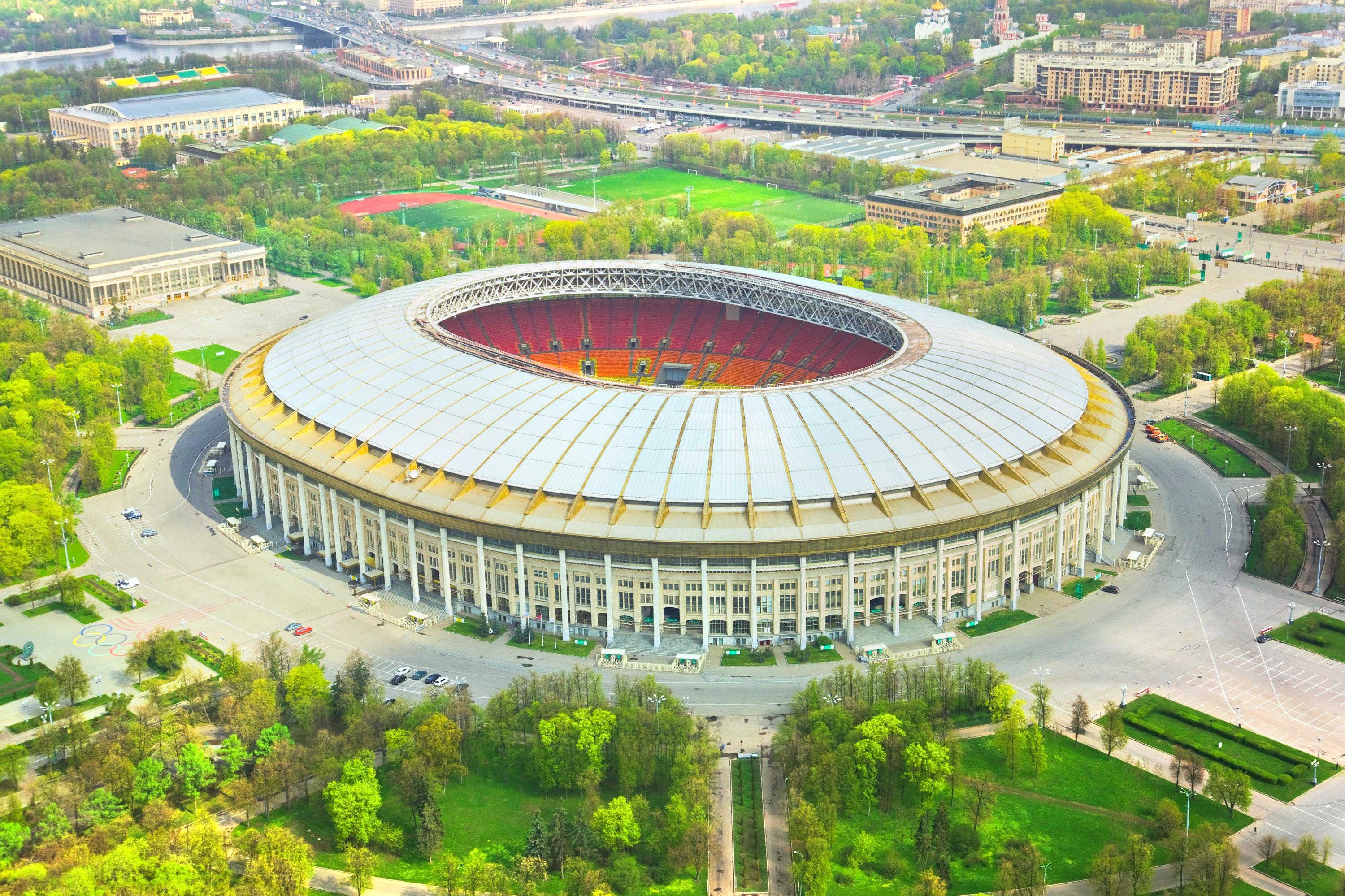
Built in 1956, the Luzhniki Stadium was the main stadium for the 1980 Olympics. Lenin's name was removed in 1992, following the fall of the Soviet Union. In 1996, the stadium was made all-seater, cutting capacity to 81,000, and a roof was added. In 2013, the stadium was demolished, with a new stadium built on the site, opening in 2017, for the 2018 World Cup, whose Final it hosted, with France beating Croatia.
The Luzhniki Stadium today. The building at the left is the Palace of Sport,
which hosted the Soviet side of the 1972 hockey "Summit Series."

*

October 20, 1982 was a Wednesday. It was midweek for American football. The NBA regular season wouldn't start for another 9 days.

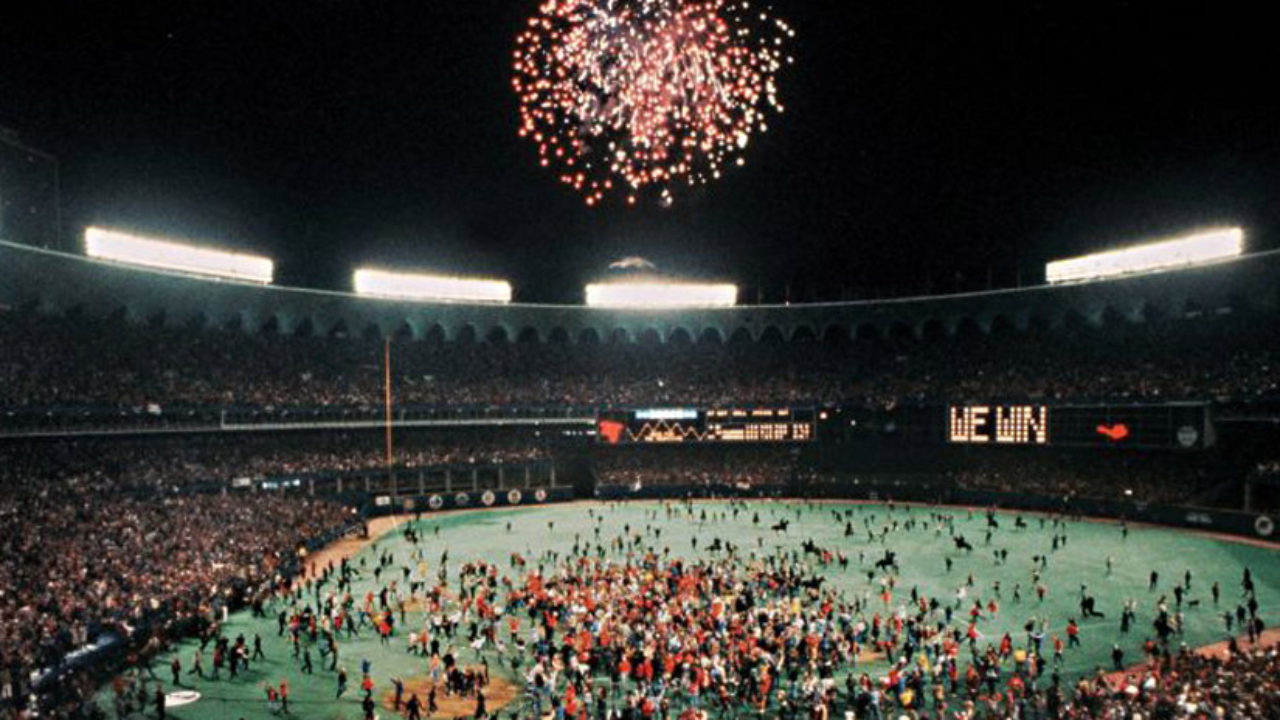
But on this day, Game 7 of the World Series was played at Busch Memorial Stadium in St. Louis. I have a separate entry for this event. The Cardinals, including birthday boy Keith Hernandez, rallied for 3 runs in the 6th innings, to defeat the Milwaukee Brewers, 6-3. As far as I know, Hernandez is the only player ever to appear on the winning side of a World Series-winning game on his birthday.
This "pitch invasion" did not result in any injuries.

The Cardinals won their 9th World Series, a total surpassed only by the Yankees. Since then, if you combine their Philadelphia and Oakland titles, it has been matched by the Athletics, although the Cards have now made it 11.

And 8 games were played in the new National Hockey League season:

* The New Jersey Devils, having debuted on October 5, lost to the Los Angeles Kings, 7-4 at The Forum in the Los Angeles suburb of Inglewood, California.

* The New York Rangers beat the Vancouver Canucks, 6-5 at Madison Square Garden.

* The Montreal Canadiens and the Washington Capitals played to a tie, 3-3 at the Capital Centre in the Washington suburb of Landover, Maryland.

* The Toronto Maple Leafs beat the Minnesota North Stars, 5-2 at Maple Leaf Gardens in Toronto.

* The St. Louis Blues beat the Pittsburgh Penguins, 5-3 at the Civic Arena in Pittsburgh.

* The Quebec Nordiques beat the Detroit Red Wings, 5-3 at Joe Louis Arena in Detroit.

* The Chicago Black Hawks beat the Buffalo Sabres, 4-0 at the Chicago Stadium.

* And the Edmonton Oilers beat the Hartford Whalers, 4-2 at the Northlands Coliseum in Edmonton. 

Thursday, September 29, 2022

September 29, 1982: The Ballad of Fedya Cherenkov

September 29, 1982: Arsenal Football Club are stunned by Spartak Moscow, 5-2 in a UEFA Cup match at the Arsenal Stadium, a.k.a. Highbury, in North London. Spartak are sparked by Fyodor Cherenkov, perhaps the most popular soccer player in Russian history. The following season, he will lead them past another English team in a UEFA Cup match, Birmingham team Aston Villa.

Fyodor Fyodorovich Cherenkov was born on July 25, 1959 in Moscow. A midfielder, "Fedya" had joined the youth setup at Spartak in 1971, and reached the senior team in 1977. He helped them win the Soviet Top League in 1979, 1987 and 1989, and the Russian Premier League in 1993 and the Russian Cup in 1994. He was named Soviet Footballer of the Year in 1983 and 1989. 

Because of the decline of Soviet football from its 1960s heights (winning the 1st European Championship in 1960 and finishing 3rd at the 1966 World Cup), Cherenkov never played in a World Cup. But English fans noticed him because of those wins over Arsenal and Aston Villa in the UEFA Cup. He led the Soviet team to the Bronze Medal in the 1980 Olympics in his hometown. (Czechoslovakia won the Gold Medal.)

In his book Spartak: A History of the People's Team in the Workers' State, Robert Edelman described him as "the longest-serving and most beloved of all Spartakovsky":

Navigating between midfield and forward, he played with an originality and eccentricity that endeared him to the public. Cherenkov was an enigmatic and fragile personality whose capacity for unexpected improvisation fit the Spartak image of the player as romantic artist.

A true original, he was the embodiment of what many of Spartak's male Moscow supporters liked to believe about themselves. Lacking great speed but quick on his feet, small of stature but possessed of great guile, Cherenkov seemed to practice a new kind of masculinity, that of the urban trickster. By the time his Spartak career was over, he was the leading point producer (goal plus pass) in the team's history.

"The urban trickster" -- shares of Brazilian soccer's malandro
Michael Yokhin, a Russian who writes on soccer for ESPN, eulogized him on their web page:

Fyodor Cherenkov was the ultimate Russian legend, the most idolized player of all time, and the greatest artist imaginable. He was a ray of light in a ruthless and cynical world, a source of pure joy, and a reminder how people should behave. His death at the age of 55 is a great loss.

Cherenkov was loved by everyone, which is surprising, considering he was a Spartak Moscow hero. They are the most popular team in Russia, and thus, naturally, one of the most hated.

Usually, their players are loathed by Dynamo Kiev, CSKA (Moscow) and Zenit (St. Petersburg) fans, but not Cherenkov. He was universally admired, and Spartak away games were celebrated all over the country as people just wanted to go and watch him play.

Fyodor Cherenkov died on October 4, 2014 in Moscow, as a result of complications from a head injury sustained in a fall. He was only 55 years old, and was coaching the Spartak youth teams at the time. statue of him has been erected at the team's new Otkrytie Stadium, and one of its stands bears his name.

*

September 29, 1982 was a Wednesday. This was also the day the "Tylenol Murders" began. I have a separate entry for this event.

These Major League Baseball games were played that day:

* The New York Yankees beat the Cleveland Indians, 13-6 at Cleveland Municipal Stadium. Ken Griffey Sr. went 4-for-4 with 5 RBIs, Jerry Mumphrey went 3-for-5 with 4 RBIs, and Dave Winfield went 1-for-5, with rookie Don Mattingly driving in a run with a sacrifice fly, all in support of Jay Howell. Nevertheless, the dynasty of 1976-81 was over, as the Yankees had their worst season since 1967.
* The New York Mets lost to the Chicago Cubs, 4-1 at Shea Stadium. Bill Buckner hit a home run. I don't know if it was his best day at Shea, but the worst was yet to come.
* The Milwaukee Brewers beat the Boston Red Sox, 6-3 at Fenway Park in Boston. For the Brew Crew, on their way to their 1st Pennant, Don Money and Ned Yost hit home runs. Robin Yount went 0-for-2, but drew 2 walks and had an RBI on a sacrifice fly. Paul Molitor went 2-for-4 with a walk. For the BoSox, Jim Rice and Gary Allenson homered, and Carl Yastrzemski went 1-for-4.
* The Philadelphia Phillies beat the Montreal Expos, 4-0 at Veterans Stadium in Philadelphia. It was Win Day: Steve Carlton pitched a 2-hit shutout. Mike Schmidt went 1-for-4 with an RBI, and Pete Rose went 0-for-4 with an RBI groundout.
* The Minnesota Twins beat the Toronto Blue Jays, 8-0 at Exhibition Stadium in Toronto. Gary Ward went 2-for-4 with a home run and 4 RBIs, in support of Brad Havens, who allowed 9 hits bur kept the shutout.
* The Pittsburgh Pirates beat the St. Louis Cardinals, 7-3 at Three Rivers Stadium in Pittsburgh. Willie Stargell, in his last week as an active player, did not get into the game. In spite of this loss, the Cardinals went on to win the World Series, beating the Brewers in 7 games.
* The Detroit Tigers beat the Baltimore Orioles, 3-2 at Tiger Stadium in Detroit. Eddie Murray went 0-for-4, but Cal Ripken hit a home run.
* The Chicago White Sox beat the Seattle Mariners, 6-5 at Comiskey Park in Chicago.
* The Kansas City Royals beat the California Angels, 6-5 at Royals Stadium (now Kauffman Stadium) in Kansas City. George Brett went 1-for-4 with an RBI. For the Angels, Reggie Jackson and Don Baylor hit home runs, and Rod Carew went 2-for-4.
* The Texas Rangers beat the Oakland Athletics, 5-3 at Arlington Stadium in the Dallas suburb of Arlington, Texas. Rickey Henderson went 1-for-5 with an RBI.
* The San Diego Padres beat the Cincinnati Reds, 3-2 at Jack Murphy Stadium in San Diego. Terry Kennedy singled home the winning run in the bottom of the 10th inning. Tony Gwynn went 1-for-3 with an RBI. Johnny Bench did not play.
* The Atlanta Braves beat the Los Angeles Dodgers, 4-3 at Dodger Stadium in Los Angeles. The Braves scored 2 runs in the top of the 12th, while the Dodgers could only score 1 in the bottom half.
* And the San Francisco Giants beat the Houston Astros, 6-1 at Candlestick Park in San Francisco.

Wednesday, September 28, 2022

September 28, 1972: Canada Wins the Summit Series

"Henderson has scored for Canada!"
Number 12 is Yvan Cournoyer.

September 28, 1972: The "Summit Series" between Canada and the Soviet Union comes to a close with Game 8 at the Luzhniki Palace of Sports in Moscow.

Team Canada had made a big mistake in only letting NHL players play for them, meaning that Bobby Hull, who had signed a contract with the Winnipeg Jets of the new World Hockey Association, wasn't eligible. Also, Bobby Orr of the Boston Bruins was injured. If either of the Bobbys was able to play, it would have been a very different series.

But the Soviets, led by goaltender Vladislav Tretiak and left wing Valery Kharlamov, shocked the Canadians by winning Game 1, 7-3, at the Montreal Forum, no less. It was the most distressing moment in the history of Canadian sport.

For Game 2, at Maple Leaf Gardens in Toronto on September 4, Canada manager Harry Sinden, also the general manager and former head coach of the Boston Bruins, made a few changes, including replacing Ken Dryden in goal with Tony Esposito. It worked: Canada won, 4-1, and the Canadian media calmed down.

Game 3 was played at the Winnipeg Arena on September 6 -- which seems odd to me, given that Winnipeg had a team in the new WHA, not the NHL, and Team Canada had purposely frozen out the WHA players. Canada blew leads of 3-1 and 4-2, and it ended in a 4-4 tie. There was no provision for overtime.

Game 4, at the Pacific Coliseum in Vancouver, was a disaster. Serge Savard hurt his ankle in practice, and turned out to be unavailable until Game 6. Sinden put Dryden back in goal. Bill Goldsworthy committed 2 dumb early penalties, both converted into goals by Boris Mikhailov. A Rod Gilbert goal was disallowed, and Sinden told the media after the game that this took a lot out of his players.

The Soviets won, 5-3, taking a 2-1-1 lead, with the rest of the games set for Moscow. And it would be 2 weeks before Game 5, with plenty of time for the bad feelings to fester in Canadian hearts and minds. It looked bad, and the fans in Vancouver booed their national team off the ice.

The last Canada player to leave the ice was Phil Esposito, and he spoke to CTV interviewer Johnny Esaw:
To the people across Canada, we tried, we gave it our best, and to the people that boo us, Jeez. I'm really, all of us guys are really disheartened and we're disillusioned, and we're disappointed at some of the people. We cannot believe the bad press we've got, the booing we've gotten in our own buildings.
 
If the Russians boo their players, the fans, Russians boo their players, some of the Canadian fans, I'm not saying all of them, some of them booed us, then I'll come back, and I'll apologize to each one of the Canadians, but I don't think they will.
 
I'm really, really, I'm really disappointed. I am completely disappointed. I cannot believe it. Some of our guys are really, really down in the dumps. We know. We're trying like hell. I mean, we're doing the best we can. And they got a good team, and let's face facts. But it doesn't mean that we're not giving it our 150 percent, because we certainly are.
 
I mean, the more, every one of us guys, 35 guys that came out and played for Team Canada, we did it because we love our country, and not for any other reason, no other reason. They can throw the money, uh, for the pension fund out the window. They can throw anything they want out the window. We came because we love Canada. And even though we play in the United States, and we earn money in the United States, Canada is still our home, and that's the only reason we come. And I don't think it's fair that we should be booed
.

In an interview almost 20 years later, Dryden said, "Here's a guy standing there, with the sweat of the world dripping off of him." And Dryden, and many other people, gave Espo credit for stopping the negativity from the fans and the media.

After the Vancouver game, the series went on a two-week hiatus. The Soviets returned home and played in a domestic tournament. The Canadians took a few days off, then travelled to Sweden for a pair of exhibition games, before arriving in Moscow. On September 16, Canada beat Sweden, 4-1. The next day, those teams played to a 4-4 tie. Both games were played at Johanneshovs Isstadion (a.k.a. "Hovet") in Stockholm.
The Moscow games would all be played at the Luzhniki Palace of Sport in Moscow, built in 1956 as part of the sports complex that includes Luzhniki Stadium, then known as the Lenin Stadium. Game 5 was played on September 22. Soviet Premier Leonid Brezhnev was in attendance. Also on hand, in Moscow for a treaty negotiation between the United States and the Soviet Union, is Ambassador and former child film star Shirley Temple Black. There were 3,000 seats among the 14,000 set aside for Canadian fans.
I recently saw a rerun of The Dick Cavett Show, with Shirley as a guest, telling that she thought the games in Moscow were thrilling. Rod Gilbert of the New York Rangers, who played for Team Canada in this series, was a guest on the same show, and he admitted that the Canadian scouts had let the players down, by downplaying the Soviet players' talents.
Canada led 4-1 with 18 minutes left. But the Soviets stormed back and won, 5-4. The Soviets now led 3 games to 1, with 1 tie. Canada had to win the last 3 straight, on Soviet ice, to win the series. It didn't look good.
Game 6, on September 24, changed everything. The Soviets took a 1-0 lead early in the 2nd period. But the Canadians took a 3-1 lead on goals by Dennis Hull, Yvan Cournoyer and Paul Henderson. And, on the advice of assistant coach John Ferguson Sr., who had been one of the roughest players of the 1960s, they targeted Kharlamov. Brad Park threw several solid but legal checks on him.
At one point, Kharlamov knocked down one of the youngest Canadians, Bobby Clarke. Perhaps the birth of the reputation of his team, the Philadelphia Flyers, as "The Broad Street Bullies," began right there in Moscow: Clarke threw his glove into Kharlamov's face, starting a fight. After Kharlamov later knocked Pete Mahovlich down, Clarke raced down the ice, and, knowing that Kharlamov had an injured ankle, slashed it with his stick.
In obvious pain, Kharlamov skated over to the Canadian bench, and yelled at their players, not that they could understand Russian. (Not even Stan Mikita, born in Slovakia but raised in Ontario.) The referees, a pair of Germans named Franz Baader and Josef Kompalla, whose seeming pro-Soviet calls led the Canadians to nickname them "Badder and Worse," gave Clarke 2 minutes for slashing, and an additional 10 minutes for misconduct, leading to a power play goal by Alexander Yakushev. But the Russians had been intimidated, and Canada held on for a 3-2 victory.
Game 7 was played on September 26. In spite of Dryden's win in Game 6, Sinden went back to Tony Esposito. Maybe it inspired his brother Phil, because he scored 2 goals. Yakushev also scored 2, but with just 2:06 to go, Henderson scored to give Canada a 4-3 win. It was now tied, 3 games apiece, plus the Game 2 tie. Game 8, on September 28, would be for all the marbles.
Dryden was back in goal, while Tretiak had played every minute of the series for the Soviets. A power play led to a Yakushev goal at 3:34, but one on the other side led to a Phil Esposito equalizer at 6:45. Vladimir Lutchenko scored at 13:10, but Park tied it at 16:59.
Vladimir Shadrin scored just 21 seconds into the 2nd period, but the Canadians tied it again, on a goal by Bill White at 10:32. Yakushev scored another, and Valeri Vasiliev scored with 3:16 left in the period. It was 5-3 Soviets, and it looked all over.
It wasn't. Phil scored 2:27 into the 3rd period, to make it 5-4. With 7:04 left, Cournoyer tied the game at 5-5. With one minute left, Soviet officials went to the Canadian officials, and claimed victory on total goals.
But as the seconds ticked down, Phil assisted Henderson, and with 34 seconds left, Foster Hewitt, the 1st man to broadcast a hockey game on radio, and the Voice of Canada for so long, who had come out of retirement for this series, shortly before his 70th birthday, broadcasting on CBC with Brian Conacher, said, "Cournoyer has it on that wing. Here's a shot! Henderson made a wild stab for it and fell. Here's another shot. Right in front, they score! Henderson has scored for Canada!"
It remains the most famous goal in the sport's history, and it lifted Henderson, a good player but never considered a great one, to the role of national hero. Dryden and the rest of the Canadians hung on for another 34 seconds, and had the win, 6-5, to take the Series.

Canada had been shaken by the Series, but emerged victorious. The nation celebrated harder than they had for anything since World War II ended. It was a confirmation of national greatness -- barely. In contrast, when the U.S. team beat the Soviets, including many of the same players, 8 years later in the Winter Olympic in Lake Placid, New York, instead of avoiding a tremendous upset, it was one. In the end, the Soviets are remembered more for those 2 losses than for all the games they won.

Foster Hewitt died in 1985. Bill Goldsworthy of the Minnesota North Stars died in 1996. Gary Bergman of the Detroit Red Wings died in 2000. John Ferguson died in 2007. Johnny Esaw, to whom Phil Esposito delivered his speech, died in 2013. Jean-Paul Parisé of the North Stars died in 2015. Bill White of the Chicago Black Hawks died in 2017. Stan Mikita of the Black Hawks died in 2018. Pat Stapleton of the Black Hawks died in 2020. Tony Esposito of the Black Hawks and Rod Gilbert of the New York Rangers died in 2021.

The remaining 20 Canadian players are still alive, 50 years later: Frank Mahovlich of the Montreal Canadiens (a legend in Toronto) is 84; Red Berenson of the Red Wings is 82; Jean Ratelle and Vic Hadfield, both of the New York Rangers, are about to turn 82; Phil Esposito of the Boston Bruins is 80; Paul Henderson of the Toronto Maple Leafs and Don Awrey of the Bruins are 79; Yvon Cournoyer of the Montreal Canadiens is 78; Wayne Cashman of the Bruins, Dennis Hull of the Black Hawks (Bobby's brother), Rod Seiling of the Rangers and Ron Ellis of the Toronto Maple Leafs are 77; Serge Savard of the Canadiens is 76; Pete Mahovlich of the Canadiens (Frank's brother) is about to turn 76; Ken Dryden of the Canadiens is 75; Brad Park of the Rangers, Guy Lapointe of the Canadiens and Mickey Redmond of the Red Wings are 74; Bobby Clarke of the Philadelphia Flyers is 73; and Gilbert Perreault of the Buffalo Sabres is 71. Head coach Harry Sinden is 90. Broadcaster Brian Conacher is 81.
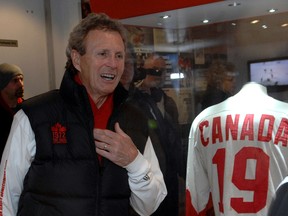
Paul Henderson, posing next to his 1972 Canada jersey,
on display at the Hockey Hall of Fame in Toronto
Of the Soviet players, most of them came from Moscow and environs, and all were from Russia proper, except for Evgeni Paladiev, from Kazakhstan.

Viacheslav Solodukhin was a suicide in 1979, Valeri Kharlamov was killed in a car crash in 1981, Alexander Ragulin died in 2004, Gennadiy Tsygankov in 2006, Yevgeni Mishakov in 2007, Viktor Kuzkin in 2008, Evgeni Paladiev in 2010, Valeri Vasiliev in 2012, Vladimir Vikulov in 2013, Vladimir Petrov and Alexander Bodunov in 2017, Yuri Shatalov and Yevgeni Zimin in 2018, Alexander Gusev in 2020, and Vladimir Shadrin in 2021.

Still alive: Vyacheslav Starshinov is 82, Boris Mikhailov is about to turn 78, Yuri Lyapkin and Alexander Martynyuk are 77, Alexander Yakushev is 75; Vladimir Lutchenko, Yuri Blinov and Alexander Maltsev are 73; Yuri Lebedev and Vyacheslav Anisin are 71, and Vladislav Tretiak and Alexander Volchkov are 70.

(UPDATE: Alexander Martynyuk died later in 2022. Ron Ellis died in 2024. Ken Dryden died in 2025. Dennis Hull died in 2026.)

*

September 28, 1972 was a Thursday. This was also the day The Temptations released their song "Papa Was a Rollin' Stone." I have a separate entry for that event.

September was chosen for the Summit Series because it was before either country's major league began play for the new season. The NBA and the ABA hadn't yet started their 1972-73 seasons, either. And while it was during the football season, at the time, NFL and college games played on Thursdays other than Thanksgiving were rare. And only 4 Major League Baseball games were played:

* The New York Yankees beat the Detroit Tigers, 3-2 at Tiger Stadium in Detroit. Thurman Munson, Roy White and pitcher Lindy McDaniel all hit home runs off the Tigers' Mickey Lolich. Because of the designated hitter, McDaniel remains the last Yankee pitcher to have hit a home run. White's homer won the game in the 12th inning. Mel Stottlemyre started the game, and Sparky Lyle won it in relief of Stottlemyre and McDaniel.

* The Boston Red Sox beat the Kansas City Royals, 3-1 at Fenway Park in Boston.

* The Philadelphia Phillies beat the Pittsburgh Pirates, 2-1 at Veterans Stadium in Philadelphia.

* And the Oakland Athletics beat the Minnesota Twins, 8-7 at the Oakland Coliseum.

Tuesday, August 30, 2022

August 30, 1963: The Moscow-Washington Hot Line

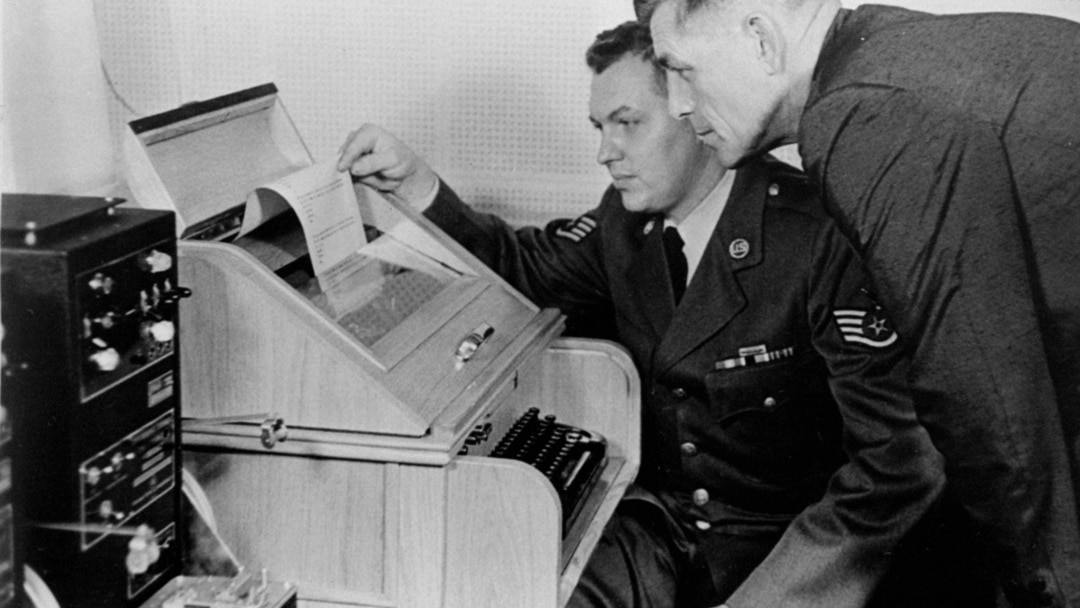
August 30, 1963: The Moscow-Washington Hot Line goes into operation. It was put in place in the wake of the Cuban Missile Crisis the previous year, to make for quicker diplomacy.

In American popular culture, the Hot Line usually appears as a red telephone on the desk of the President of the United States. It has never been a phone, it has never been in the White House, and it doesn't link the 2 countries' respective heads of state.

Rather, it was originally a Teletype machine, became a fax machine in 1986, and a secure computer link in 2008; and its Washington end is actually across the Potomac River in Arlington, Virginia, at the Pentagon, the headquarters of the U.S. Department of Defense, while the Russian end is in the General Staff Building, home of the Russian Federation's Ministry of Defense. Of course, the respective Presidents do have secure phone lines that they can use to talk directly to each other, through translators.

Through August 30, 2022, it has been used 11 times:

* In 1963, following the assassination of President John F. Kennedy.
* 1967, during the Arab-Israeli Six-Day War.
* 1971, during the India-Pakistan War.
* 1973, during another Arab-Israeli conflict, the Yom Kippur War.
* 1974, during the Turkish invasion of Cyprus.
* 1979, after the Soviet invasion of Afghanistan.
* 1981, when the Soviets were threatening to invade Poland.
* 1982, during the Israeli invasion of Lebanon.
* 1991, during the Persian Gulf War.
* 2003, during the Iraq War.
* And, most recently, on October 31, 2016, when Barack Obama told Vladimir Putin he'd better not interfere in the Presidential election that was happening 8 days later. Putin interfered anyway.

*

August 30, 1963 was a Friday. This was also the day that the modern audio cassette tape, and the tape recorder that used it, were both introduced to the public by the Philips Company. I have a separate entry for that event. Actor Michael Chiklis was born that day.

And these baseball games were played:

* The New York Yankees beat the Baltimore Orioles, 4-1 at Memorial Stadium in Baltimore. Al Downing outpitched Steve Barber. Barber's arm probably wasn't sore, just a little stiff. (Ball Four reference.) Mickey Mantle, Roger Maris and Yogi Berra were all held out of this game. Brooks Robinson went 0-for-4.

* The New York Mets lost to the Milwaukee Braves, 3-1 at the Polo Grounds. Hank Aaron went 0-for-4. Duke Snider appeared as a pinch-hitter for the Mets, but did not reach base.

* The St. Louis Cardinals beat the Philadelphia Phillies, 11-6 at Connie Mack Stadium in Philadelphia. In his final season, Stan Musial got the day off.

* The Washington Senators beat the Boston Red Sox, 7-0 at Fenway Park in Boston. Claude Osteen pitched a 5-hit shutout. Carl Yastrzemski did not play for the Sox.

* The Cincinnati Reds beat the Pittsburgh Pirates, 2-1 at Forbes Field in Pittsburgh. Frank Robinson went 1-for-4. So did Pete Rose, soon to be named National League Rookie of the Year. So did Roberto Clemente, who also had an RBI.

* The Cleveland Indians beat the Detroit Tigers, 5-4 at Cleveland Municipal Stadium. Al Kaline went 0-for-4.

* The Houston Colt .45s beat the Chicago Cubs, 5-1 at Wrigley Field in Chicago. Ernie Banks did not play. The Colts became the Houston Astros in 1965.

* The Minnesota Twins beat the Chicago White Sox, 5-3 at Metropolitan Stadium in the Minneapolis suburb of Bloomington, Minnesota. Harmon Killebrew and Bob Allison hit home runs.

* The Los Angeles Angels beat the Kansas City Athletics, 6-2 at Kansas City Municipal Stadium.

* And the Los Angeles Dodgers beat their arch-rivals, the San Francisco Giants, 3-1 at Dodger Stadium in Los Angeles. Don Drysdale outpitched Juan Marichal. Willie Mays went 2-for-4, and drove in the Giants' only run.

August 30, 1918: The Attempted Assassination of Vladimir Lenin

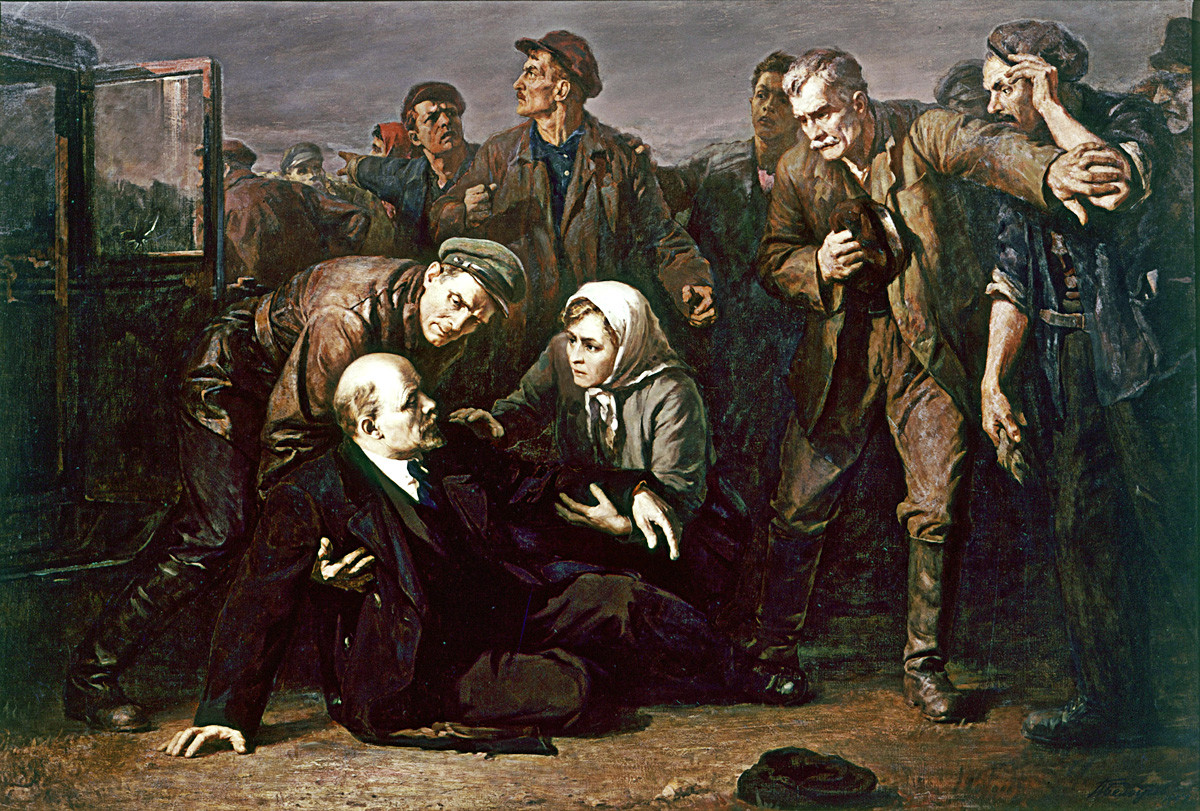
Artist's depiction of the event

August 30, 1918: An attempt is made to assassinate Vladimir Lenin, leader of the Bolshevik Revolution, and dictator of Russia. Although he does not die immediately, the attempt can be said to have succeeded.

Born into a Jewish family, Feiga "Fanny" Kaplan served a sentence of hard labor during the Czarist years for her revolutionary activities. She became a member of the Socialist Revolutionary Party, and originally supported Lenin. But when the Bolsheviks banned all parties but their own, she began to view him as a "traitor to the revolution."
On August 30, 1918, she approached Lenin, who was leaving a Moscow factory, and fired 3 shots. One bullet passed through his coat. One lodged in his left shoulder. One passed through his neck, punctured part of his left lung, and stopped near his right collarbone.

Lenin was taken back to his living quarters at the Kremlin. He feared that others might be planning to kill him, and refused to leave the security of the Kremlin to seek medical attention. Doctors were brought in to treat him, but could not remove the bullets outside a hospital. Despite the severity of his injuries, Lenin survived, but his health never fully recovered from the attack. It has been speculated that the shooting contributed to the strokes that incapacitated and eventually killed him in 1924.

Interrogated by the Cheka, the forerunner of the KGB, she refused to name any accomplices, and was executed by firing squad in Moscow on September 3. She was 28 years old.

*

August 30, 1918 was a Friday. Baseball legend Ted Williams of the Boston Red Sox was born. So was another baseball All-Star of the 1940s, New York Yankees 3rd baseman Billy Johnson. And J. Donald Cameron died, the last surviving member of President Ulysses S. Grant's Cabinet. He was Grant's last Secretary of War, and later a U.S. Senator from Pennsylvania.

These baseball games were played:

* The New York Yankees lost to the Washington Senators, 6-1 at Griffith Stadium in Washington. Walter Johnson went the distance for the win.

* The New York Giants beat their arch-rivals, the Brooklyn Dodgers (or the Robins, as they were known during Wilbert Robinson's management from 1914 to 1931), 1-0 at the Polo Grounds. William "Pol" Perritt pitched a 2-hit shutout.

The Boston Red Sox swept a doubleheader from the Philadelphia Athletics, 12-0 and 4-1 at Fenway Park in Boston. Carl Mays allowed 9 hits in the opener, but kept the shutout. Over the 2 games, Babe Ruth went 2-for-6 with 3 walks and 2 RBIs.

* A doubleheader was split at Baker Bowl in Philadelphia. The Philadelphia Phillies won the opener, 1-0. Joe Oeschger pitched a 3-hit shutout. The Boston Braves won the nightcap, 8-3. Two years later, Oeschger and Brooklyn's Leon Cadore with oppose each other, and go the distance -- 26 innings, in a 1-1 tie.

* The Cleveland Indians swept a doubleheader from the Detroit Tigers, 2-1 and 4-2 at Navin Field. (That ballpark was renamed Briggs Stadium in 1938, and Tiger Stadium in 1961.) Over the 2 games, Tris Speaker went 1-for-8 with a walk, and Ty Cobb went 0-for-7 with a walk.

* The Cincinnati Reds beat the Chicago Cubs, 5-0 at Weeghman Park in Chicago. (That ballpark was renamed Cubs Park in 1920, and Wrigley Field in 1926.) Roy Mitchell pitched a 4-hit shutout.

* And the Chicago White Sox, the Pittsburgh Pirates, and the 2 St. Louis teams, the Cardinals and the Browns, were not scheduled.

Thursday, August 25, 2022

August 25, 1936: Stalin's Show Trials

Lev Kamenev

August 25, 1936: Lev Kamenev and Grigory Zinoviev are executed, ending the first of what became known as the Moscow Show Trials, designed to consolidate the power of Soviet dictator Joseph Stalin.

Zinoviev, Kamenev and Stalin formed a ruling triumvirate in 1923, after Vladimir Lenin, founder and dictator of the Soviet Union, had become incapacitated from a stroke. He died in 1924, enabling the triumvirate to effect the marginalization of the People's Commissar, Leon Trotsky. But as Stalin took more and more power for himself, Zinoviev and Kamenev sided with Trotsky. Stalin expelled Trotsky from the country in 1929, and his allies, including Zinoviev and Kamenev, were marginalized.

In 1934, Stalin ally Sergei Kirov was assassinated. No one has ever proven who did it, or ordered it. Both Kamenev and Zinoviev had been secretly tried for it in 1935, but it appears that Stalin decided that, with suitable confessions, their fate could be used for propaganda purposes.

On August 19, 1936, the first of the Moscow Show Trials began, conducted by the Military Collegium of the Supreme Court of the Soviet Union, and presided over by Vasiliy Ulrikh, who would preside over most of the trials to come. Russian historian Anton Antonov-Ovseenko would eventually describe him as "a uniformed toad with watery eyes."
He looks like he would have fit in more
in Germany at the time.

And those trials, including those of Zinoviev and Kamenev, were pure bred sivoy kobyly. That's Russian for "bullshit." All the "evidence was lies." The verdict was preordained. Zinoviev and Kamenev were convicted on August 24. The next day, Kamenev was executed by firing squad. Zinoviev begged for his life, and resisted being taken to where he was to be shot, until the guards finally got tired of him, dumped him in an open cell, and shot him. Both men were 53 years old.
Grigori Zinoviev

More trials were to come in 1937 and 1938, all with the aim of making Stalin look good and making Trotsky look bad. In 1940, Stalin sent an agent to Mexico City, where Trotsky was living in exile, and had him assassinated. In 1941, Stalin's purges continued, trying and executing generals he thought were disloyal.

Then Adolf Hitler broke the Non-Aggression Pact their countries had signed 2 years earlier. Stalin could have used some of those generals in the Eastern European phase of World War II, known in Russia and the other former Soviet "republics" as "The Great Patriotic War." That war began because Stalin was a shortsighted paranoid egomaniac who thought he knew more than his generals did. It ended because all of those things were true of Hitler as well.

Vasiliy Ulrikh died in 1951, of natural causes, unlike most of those over whose trials he presided.

*

August 25, 1936 was a Tuesday. These baseball games were played that day:

* The New York Yankees beat the St. Louis Browns, 13-1 at Yankee Stadium. Lefty Gomez was the winning pitcher. Lou Gehrig went 2-for-2... with 4 walks. Bill Dickey went 4-for-6 with 4 RBIs. And Joe DiMaggio, putting together perhaps the best rookie season in baseball history, went 5-for-6 with a home run and 2 RBIs.

* The New York Giants beat the Cincinnati Reds, 6-5 at Crosley Field in Cincinnati. Mel Ott went 0-for-5.

* The Brooklyn Dodgers beat the Pittsburgh Pirates, 4-1 at Forbes Field in Pittsburgh.

* The Detroit Tigers beat the Boston Red Sox, 5-0 at Fenway Park in Boston. Jimmie Foxx went 0-for-3 for the Red Sox. Hank Greenberg was injured early in the season, and was unavailable for the Tigers.

* The Philadelphia Athletics beat the Chicago White Sox, 13-11 at Shibe Park in Philadelphia. Two teams, 24 runs -- and none scored on a home run. As Mel Allen, 3 years away from becoming the radio "Voice of the Yankees," would say, How about that?

* The Washington Senators beat the Cleveland Indians, 5-3 at Griffith Stadium in Washington.

* And the Boston Bees -- as the Braves were known from 1936 to 1940 -- swept a doubleheader from the St. Louis Cardinals, 20-3 and 5-4.

Friday, August 19, 2022

August 20, 1882: The "1812 Overture" Premieres

August 20, 1882: The 1812 Overture, by Pyotr Ilyich Tchaikovsky, makes its public premiere at the Cathedral of Christ the Savior in Moscow, Russia.

Tchaikovsky, then 42 years old, did not conduct the work himself. Instead, the conductor was Ippolit Al'tani, a violinist and choirmaster who was the leading conductor in the Russian Empire at the time.

Tchiakovsky had already composed Piano Concerto No. 1 in 1875 and Swan Lake in 1876, and would compose The Nutcracker in 1892. And he wasn't the 1st Russian to turn the failed French expedition in Russia into great art: Leo Tolstoy published War and Peace in 1869.

Written in the key of E-flat major, the Overture is a 15-minute work based on the invasion of Russia by Emperor Napoleon Bonaparte of France and his seemingly invincible Grande Armée in 1812. On September 7, at Borodino, 75 miles west of Moscow, General Mikhail Kutuzov took a stand with his forces. Kutuzov finally had to retreat, but not before both sides had lost about 40,000 men -- one-quarter of the Russian force, one-fifth of the combined French, Polish, Italian and German force.

With considerably fewer resources, and his supply lines stretched too far, Napoleon took his men into Moscow. But Czar Alexander I had had the city evacuated. The Mayor of Moscow, Count Fyodor Rostopchin, stayed behind, and burned the city, hoping to take more of Napoleon's men in the fire; or, failing that, leaving them with nothing to claim, as the Russian capital was still St. Petersburg, to the north.

Napoleon couldn't even set up camp in the ruined city, as there wasn't sufficient food to feed his army. So he retreated on October 19, and was unable to escape the miserably cold Russian Winter, or the ravaging of his men by disease and hunger, or Cossacks launching what would later be called guerilla attacks. By the time the Grande Armée reached Poland -- friendly to him because Russia was a common enemy -- it was one-tenth the size he started with. One thing led to another, and Napoleon fell from power in 1814.

He was exiled to Elba, an island in the Mediterranean Sea, but in 1815, he escaped, returned to France, rebuilt his army, and resumed his threat. On June 18, 1815, at Waterloo, Belgium, he was defeated by a combined British-Prussian-Austrian force, although the British commander, Arthur Wellesley, the Duke of Wellington, admitted it was "a near-run thing." This time, Napoleon was exiled to the South Atlantic island of St. Helena, far from any civilization, and better-guarded. He died there on May 5, 1821, of stomach cancer, at the age of 51.

Throwing their largest city away to save their country was Russia's favorite, if not "greatest," military victory until "The Great Patriotic War" -- their name for World War II. In 1869, Leo Tolstoy published War and Peace, perhaps the country's greatest novel, about Russia in the Napoleonic period.

Tchaikovsky was commissioned to compose a piece for the opening of the Cathedral, itself dedicated to the memory of those lost in the war. It had been 70 years since the battle, and it would be the last major gathering of veterans of the war. With its appropriation of La Marseillaise (itself a swipe at Napoleon, as he had banned it in 1805, and it had been reinstated as France's national anthem only in 1879), and the cannons at its conclusion, the Overture was a huge success.

In 1974, Arthur Fiedler, conductor of the Boston Pops, began the tradition of the Pops playing the Overture at the Hatch Memorial Shell on the Esplanade on the Charles River every 4th of July. While the piece has nothing to do with America, which was involved in its own struggle for survival in 1812, the cannon fire goes well with the fireworks that are shot off. (The Pops' 4th of July show is always closed with John Philip Sousa's The Stars and Stripes Forever.)

The Overture was also notably used at both the beginning and the end of the 2005 film V for Vendetta, for the film's dystopian future depiction of the destruction of London's Old Bailey and Palace of Westminster, respectively.

The Cathedral of Christ the Savior was brand-new when the Overture premiered. Joseph Stalin had it destroyed in 1931. For the site, he had planned a Palace of the Soviets, a new national capital building. It was supposed to rise to 1,365 feet, making it the tallest building in the world at the time. (For the sake of perspective, the Twin Towers of the original World Trade Center were 1,368 and 1,362 feet.) Construction began in 1937, and the foundation was completed in 1939.

But the Nazis destroyed what had been built by 1941. After World War II, Stalin lost interest in the project, and construction was never restarted. After the fall of the Soviet Union in 1991, a replacement Cathedral was planned, and it opened in 2000.

Johann Sebastian Bach died in 1750, Wolfgang Amadeus Mozart in 1791, and Ludwig van Beethoven in 1827. (Beethoven's 5th Symphony premiered in 1808, his 9th in 1824.) So their works precede professional sports, thus preventing any chance at a "Scores On This Historic Day" post for the premieres of any of their notable works. (UPDATE: I have since improvised, doing a profile of Mozart for a post on the 1984 premiere of the film Amadeus. I have not yet done anything for Bach or Beethoven, though.)

Tchaikovsky died on November 6, 1893, in St. Petersburg, Russia, 9 days after conducting the premiere of his 6th Symphony there. He was 53, and the cause is in dispute. There was a cholera outbreak, and he may have drunk tainted water. Whether this was an accident or suicide is also unsure. He was also a prodigious consumer of tobacco and alcohol.

In a 2011 episode of the YouTube series Epic Rap Battles of History, "Epic" Lloyd Ahlquist played Napoleon Bonaparte, against "Nice" Peter Shukoff as the fictional character Napoleon Dynamite. The joke was that Lloyd is just 5-foot-6, like Napoleon. However, 5-foot-6 was not considered especially short at the time, and the idea that Napoleon was short is now considered to have been British propaganda.

UPDATE: In 2025, Napoleon became only the 2nd ERB character, after Donald Trump, to be played by both Peter and Lloyd. Peter played him against Lloyd's portrayal of medieval French king Charlemagne.

*

August 20, 1882 was a Sunday. The National League then forbade playing games on Sunday. That season, the American Association was founded, and it allowed games on Sunday -- because, the American labor movement then being what it was, it was the one day of the week when most people didn't have to work, thus making higher attendances possible. So the only 2 games played that day were in the AA:

* The Pittsburgh Alleghenys beat the Louisville Eclipse, 3-1 at Eclipse Park in Louisville. Within a few years, the Alleghenys would acquire a player in a move that was called "nothing but piratical," and, noting the alliteration, became the Pittsburgh Pirates. In 1887, the Pirates joined the NL. In 1892, the Eclipse, by then known as the Louisville Colonels, also joined the NL. In 1899, the Eclipse were contracted out of the NL, and their assets, including star shortstop Honus Wagner, a Pittsburgh native, were bought by the Pirates.

* And the Philadelphia Athletics beat the St. Louis Brown Stockings, 10-5 at the original Sportsman's Park in St. Louis. Both of these teams would later have teams in the American League named after them. But while these Athletics went out of business after the 1890 season, the Brown Stockings still exist. They were renamed the Browns in 1883, joined the NL in 1892, and were renamed the Cardinals in 1900.  

Saturday, July 30, 2022

July 30, 1980: The Kozakiewicz Gesture

July 30, 1980: The Olympic Games continue in Moscow. With the United States, West Germany, and many other nations boycotting, in protest of the host country, the Soviet Union, having invaded Afghanistan, the Soviets and other Eastern Bloc or "Warsaw Pact" nations were doing very well.

Poland was not. Poland was going through a crisis in which its government, tightly controlled by the Kremlin, was repressing a genuine "workers' revolution" in the country. People marched in the streets, protesting the Soviet government. As a result, in these Games, the Soviet crowd booed Polish athletes.

One they booed was a pole vaulter, Władysław Kozakiewicz. Born in 1953, to Polish parents in Lithuania, the family was sent to Poland in 1958, as part of the last wave of post-World War II "repatriations" of ethnicities. His older brother Edward was a pole vaulter, before switching to the decathlon (which includes the pole vault), and taught Wład.

Wład became one of the best in the world, winning junior championships, and was favored for a medal at the 1976 Olympics in Montreal, but was injured, and only finished 11th. In 1977, and again in 1979, he won both the European Indoor Championships and the World University Games, known as the Universiade.

He was booed as he took his place for his vault at the Central Lenin Stadium (later renamed the Luzhniki Stadium) for the 1980 Olympic Final. He shook this off, and set a world record with a vault of 18 feet, 11½ inches, to win the Gold Medal. The crowd booed him as he landed from his record vault.

He didn't miss a beat: He got up, and immediately gave them the obscene gesture that the French call "L'bras d'honneur": The Arm of Honor. Spain and Portugal call it the Iberian Slap, and Italy calls it the Italian Salute.

After the Olympics ended, the Soviet Ambassador to Poland demanded that Kozakiewicz be stripped of his medal over his "insult to the Soviet people." The official response of the Polish government was that Kozakiewicz's arm gesture had been "an involuntary muscle spasm caused by his exertion." It was no more truthful than many a statement made by other Communist governments, but, this time, the Kremlin got a taste of its own medicine. Ever since, the Poles have called it Gest Kozakiewicza --Kozakiewicz's gesture.

Interviewed in 2018, Kozakiewicz said:

The Russian crowd was whistling... at any non-Russian contestant. They were whistling to distract us. You can only imagine the noise: 70,000 people at the Luzhniki Stadium, probably only 10,000 of them were tourists.

It occurred to me that I'm the only person in the world who got whistled at for breaking the world record. So when I landed, I showed them this "Polish shaft," the nicest one you can imagine. I expressed my anger at the whistling Soviet audience. Nobody whistles in athletics. If you take a look at TV broadcasts, you find that people either clap rhythmically when they feel like it, or simply sit quietly.

The Soviet government demanded that he apologize for this action. He refused. Perhaps the backlash got to him, because he was never so good again. He tried to regain his form in time for the 1984 Olympics in Los Angeles, but the Warsaw Pact turned the tables and boycotted those games.

In 1985, a dispute with Poland's athletics (track & field) federation led him to defect to West Germany. He competed for that country until the 1988 Olympics in Seoul, Korea, but Poland refused to give him the necessary permission to compete for another country, effectively ending his career. He remained in Germany after its reunification, and coached athletes, later managing their professional careers, specializing in athletes from former Communist countries.
As of July 30, 2022, he is still alive.

*

July 30, 1980 was a Wednesday. It was also the day that J.R. Richard of the Houston Astros, perhaps the best pitcher in baseball at the time, suffered a stroke that ended his playing career. I have a separate entry for that event.

These Major League Baseball games were played:

* In a bit of foreshadowing, without J.R. Richard available, the Houston Astros lost to the Philadelphia Phillies, 6-4 at Veterans Stadium in Philadelphia. The losing pitcher was... Nolan Ryan. The winning pitcher was Dick Ruthven. Mike Schmidt drew 2 walks and had to leave the game due to injury, but would be named the NL's Most Valuable Player that season. Pete Rose went 0-for-3 with a walk.

* The New York Yankees lost to the Minnesota Twins, 2-1 at Metropolitan Stadium in the Minneapolis suburb of Bloomington, Minnesota. John Castino doubled home Ken Landreaux with the winning run in the bottom of the 10th inning, off Goose Gossage, after Tom Underwood had started. Jerry Koosman went the distance for the Twins. The lone Yankee run came in the 3rd, when Eric Soderholm singled home Bob Watson. Reggie Jackson went 0-for-3 with a walk.

* The New York Mets beat the Atlanta Braves, 3-0 at Shea Stadium. Pat Zachry pitched a 4-hit shutout. Claudell Washington had 3 hits.

* The Montreal Expos beat the Cincinnati Reds, 2-1 at the Olympic Stadium in Montreal. Johnny Bench went 1-for-4.

* The Oakland Athletics beat the Toronto Blue Jays, 11-1 at Exhibition Stadium in Toronto. Rickey Henderson went 2-for-5 with a stolen base. The A's got home runs from Wayne Gross (2 of them), Dave Revering and Jeff Newman.

* The Cleveland Indians beat the Seattle Mariners, 5-2 at Cleveland Municipal Stadium.

* The California Angels beat the Detroit Tigers, 6-5 at Tiger Stadium in Detroit. Rod Carew only appeared as a pinch-hitter, but, as you might guess, he got a hit.

* The Chicago White Sox beat the Milwaukee Brewers, 6-5 at Comiskey Park in Chicago. Robin Yount went 0-for-4. Paul Molitor went 2-for-5 with an RBI.

* The Boston Red Sox beat the Kansas City Royals, 7-1 at Royals Stadium in Kansas City. It was renamed Kauffman Stadium in 1993. Carl Yastrzemski went 1-for-5. George Brett went 2-for-2 with a walk and an RBI.

* The Baltimore Orioles beat the Texas Rangers, 3-2 at Arlington Stadium in the Dallas suburb of Arlington, Texas. Eddie Murray went 2-for-4 with an RBI.

* The San Diego Padres beat the Chicago Cubs, 5-2 at San Diego Stadium. It was renamed Jack Murphy Stadium the next year, and Qualcomm Stadium in 1997.

* The Los Angeles Dodgers beat the Pittsburgh Pirates, 3-0 at Dodger Stadium in Los Angeles. Willie Stargell did not play. Jerry Reuss pitched a 4-hit shutout, to beat John Candelaria, who also went the distance.

* And the St. Louis Cardinals beat the the San Francisco Giants, 4-0 at Candlestick Park in San Francisco. John Fulgham pitched a 5-hit shutout.

December 31, 1999 & January 1, 2000: The Millennium

December 31, 1999:  The Millennium arrives. The people of planet Earth survived. At a terrible cost. But we hadn't destroyed ourselves. ...