Showing posts with label warsaw pact. Show all posts

Monday, November 7, 2022

November 7, 1983: Able Archer 83

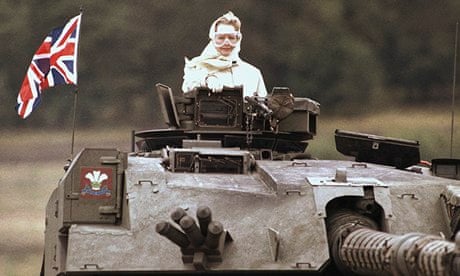
A Welsh tank unit (note the Union Jack and the daffodil logo)
taking part in Able Archer 83

November 7, 1983: Able Archer 83 begins. It is the codename for wargames by the North Atlantic Treaty Organization (NATO), which had been an annual event for a few years. The purpose was to simulate a period of conflict escalation between NATO and the Warsaw Pact, meaning the Soviet Union and their satellite nations in Eastern Europe. It was coordinated from NATO headquarters in Casteau, Belgium.

This came while President Ronald Reagan was placing Pershing II missiles in Western Europe; 8 months after he made a speech declaring the Soviet Union to be "an evil empire"; 67 days after the Soviets shot down Korean Air Lines Flight 007; 42 days after Soviet Lieutenant Colonel Stanislav Petrov figured out that the detection of 2 U.S. nuclear missiles heading for Russia were a false alarm, and refused to give the order to launch a retaliation, thus becoming known (years later, once the world found out) as "The Man Who Saved the World"; and would be followed, 13 days later, with ABC airing the TV-movie The Day After, which imagined a nuclear attack on the U.S.

Able Archer 83 included some steps forward that previous exercises had not. These, on top of everything else that had happened in 1983, led the Soviet government to consider that this was a setup for an actual war. So they placed their military units on the highest possible alert.

Able Archer 83 ended on November 11 -- appropriately enough, the anniversary of the Armistice that ended World War I -- and so the Warsaw Pact forces, seeing that nothing further had happened, were ordered to stand down. This may have been the closest the world came to nuclear war, except for the Cuban Missile Crisis of 1962 and Col. Petrov's moment.

The 1980s -- especially the Autumn of 1983 -- were not "a simpler time." Not even for those of us who were kids at the time.

*

November 7, 1983 was a Monday. Actor Adam DeVine, known for his roles in the Pitch Perfect films and his role as Andy Bailey on the TV show Modern Family, was born on this day. And this was also the day a bomb exploded in the U.S. Senate. Despite the lucky fact that there were no injuries, I have a separate entry for this event.

The baseball season was over. There were no NBA or NHL games scheduled. On ABC Monday Night Football, the Detroit Lions beat the New York Giants, 15-9 at the Silverdome in the Detroit suburb of Pontiac, Michigan.

Friday, November 4, 2022

November 4, 1956: The Hungarian Revolution Is Crushed

Time with a collective "Man of the Year" for 1956.
Note the Communist seal cut out of the flag.

November 4, 1956: Soviet troops enter Hungary to end the Hungarian Revolution that started on October 23. Thousands are killed, more are wounded, and nearly a quarter of a million people leave the country. (Today, the population is about 10 million.)

Cardinal József Mindszenty, the leader of the Catholic Church in Hungary, having previously been imprisoned by the Nazis, was arrested in 1949, and imprisoned and tortured for his anti-Communist activities. He was freed during the Revolution, and given asylum in the U.S. Embassy in Budapest. He became a hero of the movement, remained there until 1971, and died in 1975.
József Mindszenty

The city of New Brunswick, New Jersey once had a large Hungarian community, and their St. Ladislaus Roman Catholic Church has a memorial to the Revolution and a statue of Mindszenty out front.

Imre Nagy, Chairman of the Council of Ministers (effectively, the Prime Minister) from July 4, 1953 to April 18, 1955, wasn't so lucky. He was forced out of office by hardliner András Hegedüs, who was forced out by the Revolution on October 24, fleeing to the Soviet Union. Nagy was reappointed, dissolved the secret police (ÁVH), and withdrew Hungary from the Warsaw Pact on November 1.
Imre Nagy

When the Soviet tanks rolled in, he fled to the Yugoslavian Embassy, hoping that country's leader, Josip Broz Tito, a fellow anti-Moscow Communist, could protect him. He was lured out of the embassy under false promises on November 22, was arrested, and was deported to Romania. On June 16, 1958, Nagy was tried and executed for treason alongside his closest allies, and his body was buried in an unmarked grave. His remains would be repatriated to Hungary after the 1989 revolution. (Hegedüs returned to Hungary thereafter, but taught at a university rather than return to governing, and lived until 1989.)

Soccer team Budapest Honvéd FC was out of the country at the time of the Revolution, playing Athletic Bilbao in the European Cup. Eliminated, they managed to get their families out of the country. Their stars, the bulk of the "Magnificent Magyars" team that won the 1952 Olympics, embarrassed England at Wembley Stadium in 1953, and reached the 1954 World Cup Final, went elsewhere, including some staying in Spain: Ferenc Puskás to Real Madrid, and Sándor Kocsis and Zoltán Czibor to FC Barcelona. 

Since that year's Olympics were given to Melbourne, Australia, in the Southern Hemisphere, they began on November 22 so the weather would be warm. Throughout the Olympics, Hungarian athletes were cheered by fans from the host nation and other countries. Many of them gathered in the boxing arena when Laszlo Papp won a Gold Medal.

A few days later, the crowd was with the Hungarian water polo team in its match against the Soviet Union which became known as "the Blood In the Water Match." The game became rough and, when a Hungarian player, Ervin Zador, was forced to leave the pool with blood streaming from a cut over his eye, a riot almost broke out. But police restored order, and the game was called early, with Hungary leading 4–0. The Hungarians went on to win the Gold Medal.

At the end of the calendar year, Time magazine named the Hungarian Freedom Fighters their Men of the Year. This was before they made the distinction "Person (or People) of the Year," although women had been recognized as such before.

At the same time as the Hungarian Revolution, the "Polish October" was taking place. President
Bolesław Bierut, a Stalinist dictator, had died on March 12. On June 28, a demonstration by workers in Poznań was crushed, leading to at least 57 and possibly more than 100 deaths. In October, a reform faction took over, led by Władysław Gomułka. However, Gomulka's administration ended up getting more and more repressive until his removal in 1970. As Hungary, Poland, and the rest of Eastern Europe found out, post-Stalin Communism was only a slight improvement over Stalinist Communism.

*

November 4, 1956 was a Sunday. These NFL games were played:

* The New York Giants beat the Pittsburgh Steelers, 17-14 at Forbes Field in Pittsburgh.

* The Chicago Cardinals beat the Philadelphia Eagles, 28-17 at Comiskey Park in Chicago.

* The Cleveland Browns beat the Green Bay Packers, 24-7 at Milwaukee County Stadium.

* The Chicago Bears beat the Los Angeles Rams, 35-24 at the Los Angeles Memorial Coliseum.

* The Detroit Lions beat the San Francisco 49ers, 17-13 at Kezar Stadium in San Francisco.

* And the Baltimore Colts and the Washington Redskins had a bye week.

Three games were played in the NBA:

* The New York Knicks beat the Fort Wayne Pistons, 96-83 at the Allen County War Memorial Coliseum in Fort Wayne, Indiana. (It still stands.)

* The St. Louis Hawks beat the Syracuse Nationals, 78-76 at the Onondaga County War Memorial in Syracuse, New York. (It still stands, as the Upstate Medical University Arena.) Dolph Schayes had 28 points and 25 rebounds for the Nats, but it wasn't enough.

* And the Minneapolis Lakers beat the Rochester Royals, 88-87 at the Minneapolis Auditorium. (This venue does not still stand.)

Two games were played in the NHL. The New York Rangers lost to the Boston Bruins, 4-1 at the Boston Garden. And the Montreal Canadiens beat the Chicago Black Hawks, 1-0 at the Chicago Stadium. The Toronto Maple Leafs and the Detroit Red Wings were not scheduled.
Tuesday, August 23, 2022

August 23, 1989: The Baltic Way

The chain in Lithuania. Note the flag.

August 23, 1989: On the occasion of the 50th Anniversary of the Nazi-Soviet Non-Aggression Pact, the Baltic Way, also known as the Chain of Freedom, was undertaken.

A human chain of about 2 million people stretched 420 miles between the capitals of the "Baltic States," which had been under Soviet rule since 1940, except for Nazi occupation from 1941 to 1944: Vilnius, Lithuania; Riga, Latvia; and Tallinn, Estonia.

For the most part, they got away with it: The Soviets responded with intense rhetoric, but no military or economic action.

But when these same countries tried to break away from the Soviet Union over the next 2 years, they were hit back, hard. But with their domestic situation in disarray, the Soviets couldn't continue, and had to fall back. Lithuania regained its independence on March 11, 1990. Latvia declared independence on May 4, 1990, but the Soviet Union did not recognize it until September 6, 1991, after the August Coup. Estonia's was recognized on August 20, 1991.

*

August 23, 1989 was a Wednesday. These Major League Baseball games were played:

* The New York Yankees lost to the Boston Red Sox, 4-1 at Yankee Stadium. Mike Boddicker outpitched Andy Hawkins. Don Mattingly went 1-for-4. Dave Winfield missed the entire season due to a back injury.

* The New York Mets lost to the San Francisco Giants, 5-0 at Shea Stadium. It took 3 Giant pitchers to pitch a 5 hit-shutout: Rick Reuschel allowed 3 hits over 6 innings, Craig Lefferts 2 over 2, and Steve Bedrosian pitched a perfect 9th. David Cone took the loss. Matt Williams hit a home run.

* The Los Angeles Dodgers beat the Montreal Expos, 1-0 at the Olympic Stadium in Montreal. This was one of the longest games ever played: 22 innings. Pascual Pérez pitched 8 innings for the Expos, and Orel Hershiser 7 for the Dodgers. Alfredo Griffin went 0-for-9 for the Dodgers, on top of an 0-for-4 the night before, his batting average dropping from .272 to .263 in 2 days. Rick Dempsey, better known as a good-fielding but not really good-hitting catcher for Baltimore, led off the top of the 22nd inning with a home run to end the scoreless duel.

* The San Diego Padres beat the Philadelphia Phillies, 7-3 at Veterans Stadium in Philadelphia. Tony Gwynn did not play.

* The Baltimore Orioles beat the Milwaukee Braves, 3-1 at Memorial Stadium in Baltimore. Cal Ripken went 0-for-4. So did Robin Yount. Paul Molitor went 1-for-4.

* The Atlanta Braves beat the St. Louis Cardinals, 3-0 at Atlanta-Fulton County Stadium. Marty Clary pitched a 5-hit shutout.

* The Toronto Blue Jays beat the Detroit Tigers, 11-4 at the SkyDome (now the Rogers Centre) in Toronto.

* The Pittsburgh Pirates beat the Houston Astros, 6-1 at Three Rivers Stadium in Pittsburgh. Barry Bonds went 0-for-1 with 3 walk. No, he wasn't yet the big bulky slugger that he would become.

* The Cleveland Indians beat the Seattle Mariners, 5-3 at Cleveland Municipal Stadium. Rookie Ken Griffey Jr. went 0-for-4.

* The Cincinnati Reds beat the Chicago Cubs, 8-5 at Wrigley Field in Cincinnati. This was Pete Rose's 4,219th game in a Major League Baseball uniform, as a player and/or a manager. It would also be his last.

* The Minnesota Twins beat the Chicago White Sox, 8-7 at the Metrodome in Minneapolis.

* The Kansas City Royals beat the California Angels, 6-4 at Royals Stadium (now Kauffman Stadium) in Kansas City. George Brett went 3-for-5 with 2 RBIs.

* The Oakland Athletics beat the Texas Rangers, 5-4 at Arlington Stadium in the Dallas suburb of Arlington, Texas. Dave Stewart outpitched Kevin Brown. Rickey Henderson went 2-for-4 with a walk.

Sunday, August 21, 2022

August 21, 1968: The Prague Spring Is Crushed

August 21, 1968: Soviet tanks roll into Prague, the capital of Czechoslovakia, to put an end to the Prague Spring. For the 2nd time in 30 years, following the Munich Agreement of 1938 that allowed Nazi Germany to invade, the Western democracies saw the Czechs being invaded, and chose to let it happen.

This marked the end of the Prague Spring, which began on the preceding January 5. On that day,
Alexander Dubček was elected First Secretary of the Communist Party of Czechoslovakia. He began a series of reforms, including a loosening of restrictions on the media, speech and travel, and a partial decentralization of the economy. The Soviets didn't like that, and they acted.
Alexander Dubček

Dubček was arrested, but when the Soviets found out he had told his people not to resist, they kept him for only 6 days. His most lasting punishment was his expulsion from the Communist Party in 1970.

It would be 1989 before the "Velvet Revolution" truly freed the country from the Soviets' grip. Dubček
lived long enough to see it, dying in 1992. Two months later came the Velvet Divorce: The country was split into the Czech Republic, or Czechia, and Slovakia.

*

August 21, 1968 was a Wednesday. These Major League Baseball games were played:

* The New York Yankees beat the Minnesota Twins, 2-1 at Metropolitan Stadium in Bloomington, outside Minneapolis. Al Downing outpitched future Yankee broadcaster Jim Kaat. Rocky Colavito, whom we don't usually think of as a Yankee, hit a home run off Kaat. Mickey Mantle, whom we do, played 1st base, and went 1-for-4. Both Mantle and Colavito would play in the major leagues for the last time on the following September 28.

* The New York Mets lost to the San Francisco Giants, 13-3 at Shea Stadium. Willie Mays went 3-for-4 with a home run and 2 RBIs.

* The St. Louis Cardinals beat the Philadelphia Phillies, 8-3 at Connie Mack Stadium in Philadelphia. Steve Carlton, pitching for the Cards, not yet for the Phils, didn't get out of the 4th inning, but the Cards won anyway. Lou Brock went 0-for-2 before leaving the game due to an injury.

* The Cleveland Indians beat the Boston Red Sox, 8-2 at Cleveland Municipal Stadium. Carl Yastrzemski went 1-for-2 with 2 walks and an RBI.

* The Pittsburgh Pirates beat the Cincinnati Reds, 19-1 at Crosley Field in Cincinnati. Roberto Clemente went 3-for-4 with 2 solo home runs. Willie Stargell did not play. Playing 1st base instead was Donn Clenendon, and he went 2-for-6 with a home run and 5 RBIs. A year later, he would be traded to the Mets, and would be instrumental in their "Miracle." Pete Rose went 1-for-4, and Johnny Bench only appeared as a pinch-hitter, unsuccessfully.

* The Detroit Tigers beat the Chicago White Sox, 3-2 at Tiger Stadium in Detroit. Al Kaline was injured and did not play. Jim Price won the game with a home run in the bottom of the 10th inning.

* The Chicago Cubs swept a doubleheader from the Atlanta Braves at Wrigley Field, 5-4 and 13-5. Hank Aaron went 4-for-9 with a home run and 3 RBIs over the doubleheader, and Joe Torre went 3-for-5 with an RBI. Ernie Banks went 0-for-5 in the opener, but 3-for-4 with 2 homers and 3 RBIs in the nightcap.

* The Houston Astros beat the Los Angeles Dodgers, 6-1 at the Astrodome.

* The Baltimore Orioles beat the California Angels, 4-3 at Anaheim Stadium. Boog Powell singled home the winning run in the top of the 15th inning. Brooks Robinson went 0-for-6, although he did draw a walk. Frank Robinson went 2-for-4 with 3 walks and a solo home run.

The winning pitcher was Gene Brabender. The losing pitcher was Marty Pattin. They would be teammates the next season, on the expansion Seattle Pilots, as told in teammate Jim Bouton's book Ball Four.

* And the Oakland Athletics (with Reggie Jackson) and the Washington Senators were not scheduled to play.

Saturday, July 30, 2022

July 30, 1980: The Kozakiewicz Gesture

July 30, 1980: The Olympic Games continue in Moscow. With the United States, West Germany, and many other nations boycotting, in protest of the host country, the Soviet Union, having invaded Afghanistan, the Soviets and other Eastern Bloc or "Warsaw Pact" nations were doing very well.

Poland was not. Poland was going through a crisis in which its government, tightly controlled by the Kremlin, was repressing a genuine "workers' revolution" in the country. People marched in the streets, protesting the Soviet government. As a result, in these Games, the Soviet crowd booed Polish athletes.

One they booed was a pole vaulter, Władysław Kozakiewicz. Born in 1953, to Polish parents in Lithuania, the family was sent to Poland in 1958, as part of the last wave of post-World War II "repatriations" of ethnicities. His older brother Edward was a pole vaulter, before switching to the decathlon (which includes the pole vault), and taught Wład.

Wład became one of the best in the world, winning junior championships, and was favored for a medal at the 1976 Olympics in Montreal, but was injured, and only finished 11th. In 1977, and again in 1979, he won both the European Indoor Championships and the World University Games, known as the Universiade.

He was booed as he took his place for his vault at the Central Lenin Stadium (later renamed the Luzhniki Stadium) for the 1980 Olympic Final. He shook this off, and set a world record with a vault of 18 feet, 11½ inches, to win the Gold Medal. The crowd booed him as he landed from his record vault.

He didn't miss a beat: He got up, and immediately gave them the obscene gesture that the French call "L'bras d'honneur": The Arm of Honor. Spain and Portugal call it the Iberian Slap, and Italy calls it the Italian Salute.

After the Olympics ended, the Soviet Ambassador to Poland demanded that Kozakiewicz be stripped of his medal over his "insult to the Soviet people." The official response of the Polish government was that Kozakiewicz's arm gesture had been "an involuntary muscle spasm caused by his exertion." It was no more truthful than many a statement made by other Communist governments, but, this time, the Kremlin got a taste of its own medicine. Ever since, the Poles have called it Gest Kozakiewicza --Kozakiewicz's gesture.

Interviewed in 2018, Kozakiewicz said:

The Russian crowd was whistling... at any non-Russian contestant. They were whistling to distract us. You can only imagine the noise: 70,000 people at the Luzhniki Stadium, probably only 10,000 of them were tourists.

It occurred to me that I'm the only person in the world who got whistled at for breaking the world record. So when I landed, I showed them this "Polish shaft," the nicest one you can imagine. I expressed my anger at the whistling Soviet audience. Nobody whistles in athletics. If you take a look at TV broadcasts, you find that people either clap rhythmically when they feel like it, or simply sit quietly.

The Soviet government demanded that he apologize for this action. He refused. Perhaps the backlash got to him, because he was never so good again. He tried to regain his form in time for the 1984 Olympics in Los Angeles, but the Warsaw Pact turned the tables and boycotted those games.

In 1985, a dispute with Poland's athletics (track & field) federation led him to defect to West Germany. He competed for that country until the 1988 Olympics in Seoul, Korea, but Poland refused to give him the necessary permission to compete for another country, effectively ending his career. He remained in Germany after its reunification, and coached athletes, later managing their professional careers, specializing in athletes from former Communist countries.
As of July 30, 2022, he is still alive.

*

July 30, 1980 was a Wednesday. It was also the day that J.R. Richard of the Houston Astros, perhaps the best pitcher in baseball at the time, suffered a stroke that ended his playing career. I have a separate entry for that event.

These Major League Baseball games were played:

* In a bit of foreshadowing, without J.R. Richard available, the Houston Astros lost to the Philadelphia Phillies, 6-4 at Veterans Stadium in Philadelphia. The losing pitcher was... Nolan Ryan. The winning pitcher was Dick Ruthven. Mike Schmidt drew 2 walks and had to leave the game due to injury, but would be named the NL's Most Valuable Player that season. Pete Rose went 0-for-3 with a walk.

* The New York Yankees lost to the Minnesota Twins, 2-1 at Metropolitan Stadium in the Minneapolis suburb of Bloomington, Minnesota. John Castino doubled home Ken Landreaux with the winning run in the bottom of the 10th inning, off Goose Gossage, after Tom Underwood had started. Jerry Koosman went the distance for the Twins. The lone Yankee run came in the 3rd, when Eric Soderholm singled home Bob Watson. Reggie Jackson went 0-for-3 with a walk.

* The New York Mets beat the Atlanta Braves, 3-0 at Shea Stadium. Pat Zachry pitched a 4-hit shutout. Claudell Washington had 3 hits.

* The Montreal Expos beat the Cincinnati Reds, 2-1 at the Olympic Stadium in Montreal. Johnny Bench went 1-for-4.

* The Oakland Athletics beat the Toronto Blue Jays, 11-1 at Exhibition Stadium in Toronto. Rickey Henderson went 2-for-5 with a stolen base. The A's got home runs from Wayne Gross (2 of them), Dave Revering and Jeff Newman.

* The Cleveland Indians beat the Seattle Mariners, 5-2 at Cleveland Municipal Stadium.

* The California Angels beat the Detroit Tigers, 6-5 at Tiger Stadium in Detroit. Rod Carew only appeared as a pinch-hitter, but, as you might guess, he got a hit.

* The Chicago White Sox beat the Milwaukee Brewers, 6-5 at Comiskey Park in Chicago. Robin Yount went 0-for-4. Paul Molitor went 2-for-5 with an RBI.

* The Boston Red Sox beat the Kansas City Royals, 7-1 at Royals Stadium in Kansas City. It was renamed Kauffman Stadium in 1993. Carl Yastrzemski went 1-for-5. George Brett went 2-for-2 with a walk and an RBI.

* The Baltimore Orioles beat the Texas Rangers, 3-2 at Arlington Stadium in the Dallas suburb of Arlington, Texas. Eddie Murray went 2-for-4 with an RBI.

* The San Diego Padres beat the Chicago Cubs, 5-2 at San Diego Stadium. It was renamed Jack Murphy Stadium the next year, and Qualcomm Stadium in 1997.

* The Los Angeles Dodgers beat the Pittsburgh Pirates, 3-0 at Dodger Stadium in Los Angeles. Willie Stargell did not play. Jerry Reuss pitched a 4-hit shutout, to beat John Candelaria, who also went the distance.

* And the St. Louis Cardinals beat the the San Francisco Giants, 4-0 at Candlestick Park in San Francisco. John Fulgham pitched a 5-hit shutout.

Saturday, June 4, 2022

June 4, 1989: Poland's Free Elections

Tadeusz Mazowiecki

June 4, 1989: The Republic of Poland holds its 1st parliamentary election since 1938. It is considered the beginning of the Eastern European revolutions of the year.

Like many countries, Poland has a bicameral legislature. The Sejm is the lower house, equivalent to America's House of Representatives, or the House of Commons in Britain and its Commonwealth nations. As with America, Canada, and some other countries, the upper house is called the Senate.

After a genuine workers' revolution began to agitate the Polish United Workers Party, the Polish version of the Communist Party, in 1980, the Communists allowed multi-party elections on April 5, 1989, set for June 4. On April 17, Solidarity (in Polish, Solidarność), the trade union led by Lech Wałęsa, was legalized, and allowed to participate in the elections as a political party, the Solidarity Citizens Committee.

Solidarity won 99 out of the 100 seats in the Senate. The United Workers Party won 173 seats in the Sejm, to Solidarity's 161 -- but that 161 was all of the seats that were available, as 299 seats were reserved for the Communists and other parties linked in the Patriotic Movement for National Rebirth.

On August 24, the Communist cabinet of Czesław Kiszczak was rejected by the Sejm, forcing a vote for a new Prime Minister and cabinet on September 12. This was won by Tadeusz Mazowiecki, who governed until January 4, 1991. Replacing the dictatorial Wojciech Jaruzelski, Wałęsa served as President of Poland, head of state but not head of government, from December 22, 1990 to December 22, 1995.

Mazowiecki lived until 2013, Jaruzelski until 2014, Kiszczak until 2015. As of June 4, 2022, Wałęsa is still alive.

*

June 4, 1989 was a Sunday. This was also the day of the Tienanmen Square Massacre in Beijing, China. I have a separate entry for that event.

It was the off-season for the NFL. The NHL season was over, as the Stanley Cup was awarded on May 25, as the Calgary Flames beat the Montreal Canadiens in the Finals. And the NBA was between the Conference Finals and the NBA Finals. The Detroit Pistons went on to sweep the Los Angeles Lakers in 4 straight.

But there was a full slate of Major League Baseball games:

* The New York Yankees beat the Milwaukee Brewers, 12-9 at Milwaukee County Stadium. Jesse Barfield hit 2 home runs, and homers were also hit by Steve Balboni, Mel Hall and... Deion Sanders. Yes, the football player. Jimmy Jones was the winning pitcher.

* The New York Mets beat the Pittsburgh Pirates, 4-3 at Shea Stadium. Kevin Elster and Mark Carreon hit home runs, in support of Sid Fernandez, but Don Aase (AH-see) ended up as the winning pitcher.

* The Toronto Blue Jays beat the Boston Red Sox, 13-11 at Fenway Park in Boston. Junior Felix won the game with a home run in the top of the 12th inning.

* The Montreal Expos beat the Philadelphia Phillies, 7-4 at Veterans Stadium in Philadelphia.

* The Atlanta Braves beat the San Francisco Giants, 6-3 at Atlanta-Fulton County Stadium.

* The Cincinnati Reds beat the San Diego Padres, 5-3 at Riverfront Stadium in Cincinnati.

* The Baltimore Orioles beat the Detroit Tigers, 7-4 at Tiger Stadium in Detroit.

* The Chicago White Sox beat the Minnesota Twins, 2-1 at Comiskey Park in Chicago.

* The Chicago Cubs beat the St. Louis Cardinals, 11-3 at Busch Memorial Stadium in St. Louis.

* The Houston Astros beat the Los Angeles Dodgers, 7-6 at the Astrodome in Houston. Mike Scott, usually a starting pitcher, was relieving in the 13th inning, and hit a sacrifice fly to score Rafael Ramirez.

* The California Angels beat the Kansas City Royals, 5-1 at Anaheim Stadium. (Today, the team is named the Los Angeles Angels, and the ballpark is named Angel Stadium of Anaheim.)

* The Oakland Athletics beat the Cleveland Indians, 4-0 at the Oakland Coliseum. Dave Stewart itched 7 innings of 3-hit shutout ball, but A's manager Tony La Russa was the original pitch-count guy. Todd Burns allowed a hit in a scoreless 8th, and Rick Honeycutt pitched a perfect 9th.

* And the Seattle Mariners beat the Texas Rangers, 2-1 at the Kingdome in Seattle.

December 31, 1999 & January 1, 2000: The Millennium

December 31, 1999:  The Millennium arrives. The people of planet Earth survived. At a terrible cost. But we hadn't destroyed ourselves. ...