Showing posts with label international amphitheatre. Show all posts

Sunday, August 28, 2022

August 28, 1968: Riot at the Democratic Convention

August 28, 1968: The Democratic National Convention is in progress, held at the International Amphitheatre, at 4200 South Halsted Street on the South Side of Chicago. Anger over the Party's role in the Vietnam War has led to the incumbent President, Lyndon B. Johnson, dropping out of the race for what would have amounted to a 2nd full term. At this point, LBJ couldn't even attend the Convention -- and a celebration planned for August 27, his 60th birthday, had to be canceled.

Given the way things were set up at the time, with Primaries not yet having the influence they would have -- the 1968 nomination process would lead the Democratic Party to change the process for 1972 and thereafter -- once LBJ dropped out, the nominee was always going to be the Vice President, Hubert Humphrey.

It was not going to be Senator Robert F. Kennedy of New York, brother of John F. Kennedy, the President whose assassination in 1963 led to the rise of LBJ from Vice President to President. RFK had won key Primaries, but Johnson, no longer a candidate but still the leader of the Party, controlled the Delegates. RFK was shot and killed mere minutes after claiming victory in the California Primary, but even if he had lived, the chances of his winning the nomination over Humphrey were not good.

It was not going to be Senator Eugene McCarthy of Wisconsin: He was a single-issue candidate, and once Bobby Kennedy got into the race, he became "the peace candidate," and McCarthy was finished.

With RFK dead, and McCarthy only running half-heartedly thereafter, there was no real challenge to Humphrey. And people who wanted the war over were furious. They demonstrated in Chicago's Grant Park, which the main hotel for Convention Delegates, the Conrad Hilton Hotel (now the Hilton Chicago), overlooked.

And, egged on by agitators Abbie Hoffman and Jerry Rubin -- who were more interested in making trouble than making peace -- the demonstrators challenged the Chicago Police. The Police charged, and there was a riot. It became known as "the New Battle of the Midway" and "the Melee on Michigan Avenue."

The cops wore short-sleeved blue shirts (understandable due to the heat) and blue helmets (understandable due to the need for protection). They swung their nightsticks freely, and even poked demonstrators in the stomach.

Borrowing a line from Bob Dylan's song "When the Ship Comes In," demonstrators chanted, "The whole world is watching! The whole world is watching! The whole world is watching!" And TV cameras were, indeed, getting the whole picture: The police were seen as the aggressors -- although half of the viewing audience thought them justified.

The Number 1 song in America was "People Got to Be Free" by The Rascals. But the people in power didn't seem to be listening.

Mayor Richard J. Daley, the Convention's host and the cops' boss, was as much a part of the Democratic Party establishment as anyone. The year before, he had been elected to a 4th term as Mayor of what was still the nation's 2nd-largest city. (It would be the early 1980s before its "white flight"-led population decline allowed Los Angeles to surpass it.) And, with RFK dead, he was probably now the most famous Irish, and the most famous Catholic, politician in America. He was 66 years old, and looked even older due to his receding hairline, heavy jowls and fat physique.
At a press conference to address the violence, he came up with one of the all-time great malaprops/Freudian slips: "Gentlemen, let's get something straight, for once and for all: The policeman is not there to create disorder. The policeman is there to preserve disorder."

When the nominating speeches were given for the candidates, Senator Abraham Ribicoff of Connecticut, who had previously been Secretary of Health, Education & Welfare under President John F. Kennedy, rose to nominate Senator George McGovern of South Dakota, in the faint hope of uniting RFK and McCarthy supporters behind a peace candidate.

He knew what was happening outside, and he knew that Daley knew what was happening outside. Being Jewish, Ribicoff decided to, as would be said in later years, "go there": He said, "With George McGovern as President, we wouldn't have Gestapo tactics in the streets of Chicago!"

Half the Amphitheatre cheered. The other half booed. A camera was put on Daley, and people who could read lips thought he yelled at Ribicoff: "You Jew fucker!" Congressman Dan Rostenkowski, a Daley ally, told an interviewer in 1998, on the 30th Anniversary, that Daley had actually called him, "You faker," explaining that "faker" was a frequent insult of Daley's.

Whatever Daley said, anti-Semitic or not, Ribicoff did not back down. He stared at Daley, nodded a couple of times, and said, "How hard it is, how hard it is to accept the truth!"
Neither man served in World War II: Daley was the Minority Leader of the Illinois State Senate, while Ribicoff was a judge in Hartford. Regardless, at that moment, Ribicoff was tougher than Daley.

Humphrey won the nomination easily. The next night, he addressed the violence and the anger, inside the hall and out, in his acceptance speech:

This moment, this moment is one of personal pride and gratification. Yet one cannot help but reflect the deep sadness that we feel over the troubles and the violence which have erupted, regrettably and tragically, in the streets of this great city, and for the personal injuries which have occurred.
Surely we have now learned the lesson that violence breeds counterviolence, and it cannot be condoned, whatever the source.
I know that every Delegate to this Convention shares tonight my sorrow and my distress over these incidents. And for just one moment, in sober reflection and serious purpose, may we just quietly and silently, each in our own way, pray for our country.
And may we just share for a moment a few of those immortal words of the prayer of St Francis of Assisi, words which I think may help heal the wounds, ease the pain and lift our hearts. Listen to this immortal saint:
"Where there is hatred, let me know love. Where there is injury, pardon. Where there is doubt, faith. Where there is despair, hope. Where there is darkness, light."
Those are the words of a saint. And may those of us of less purity listen to them well and may America tonight resolve that never, never again shall we see what we have seen.
My mother had recently turned 21, and so was voting for President for the first time. My father was voting for the second time. Mom saw this speech, and she told me years later that she thought Humphrey "was on the verge of a nervous breakdown."

In 2008, on the 40th Anniversary, C-SPAN showed the speech in its entirety, and I saw what she meant. "Nervous breakdown" was a bit of a stretch, but Humphrey seemed a beaten man, on the verge of tears, knowing that this nomination, which he had previously tried for halfheartedly at the 1956 Convention and in the 1960 Primaries, was a "poisoned chalice."

At the very least, Humphrey chose a nominee for Vice President who did him no harm, and may even have helped: Senator, and former Governor, Edmund S. Muskie of Maine. Certainly, he looked like a better choice for Vice President that the Republican nominee, Governor Spiro T. Agnew of Maryland.

Other conventions have had Delegates walking out thinking, "We've nominated the wrong guy." There was no right guy available to the Democrats in August 1968.

A week later, former Vice President Richard Nixon, already nominated for President by the Republican Party in Miami Beach on August 8, rode in an open car down Michigan Avenue, and was wildly cheered. Nixon may have been the only person who went to Chicago that Summer and got his reputation enhanced.

Republicans have long blamed Nixon's very close 1960 loss to John F. Kennedy on shenanigans by officials in Chicago. In 1968, events in Chicago made Nixon the 37th President of the United States.

Under Johnson, the U.S. Department of Justice made no effort to prosecute anyone for crimes committed at the Convention. When Nixon took office the following January 20, with his former campaign manager, John Mitchell, as the U.S. Attorney General, such efforts began. On March 20, eight demonstrators were indicted: Abbie Hoffman, Jerry Rubin, David Dellinger, Tom Hayden, Rennie Davis, John Froines, Lee Weiner, and Bobby Seale. Seale, a member of the Black Panther Party, eventually had his case separated, and the "Chicago Eight" became a "Chicago Seven."

On February 18, 1970, all defendants were acquitted on the charge of conspiracy, a charge that left Hoffman incredulous: "Conspiracy? We can't even agree on lunch!" On the charge of traveling across State Lines with intent to incite a riot, Froines and Weiner were acquitted, but the others were convicted. They were sentenced to 5 years in prison, but remained free upon appeal. On November 21, 1972, 2 weeks after Nixon was re-elected, the U.S. Court of Appeals threw out their convictions.

My parents each made lists of reasons to vote for Humphrey and reasons to vote for Nixon, and, for each of them, Nixon came out ahead. They both voted for Nixon. Mom told me she regretted it the instant she stepped out of the voting booth. Dad took a little longer to regret it. When the Democrats nominated McGovern to oppose Nixon in 1972, both parents voted for McGovern, for all the good it did.

As of August 28, 2022, my mother is still alive, and has never voted for a Republican for President again. My father died in 2014, and made one exception, for Ronald Reagan in 1984. He would not have voted for Trump.

*

August 28, 1968 was a Wednesday. Scottish actor Billy Boyd was born.

These Major League Baseball games were played that day:

* The New York Yankees were actually in Chicago that night, a mile and a half to the northeast, at Comiskey Park. They lost to the Chicago White Sox, 3-0. Rookie lefthander Jerry Nyman got his 1st major league victory, outpitching Mel Stottlemyre. The only Yankee hits were singles by Mickey Mantle, Horace Clarke, and 2 by catcher Frank Fernandez. Nyman would make his last big-league appearance just 2 years later, with a career record of 6-7.

* Back in the Big Apple, the New York Mets hosted a doubleheader against the Cincinnati Reds at Shea Stadium, and got swept, losing the 1st game 8-3, and losing the 2nd game 5-2. Pete Rose went 2-for-9 over the 2 games. Johnny Bench didn't play in the opener, and went 1-for-4 in the nightcap.

* The Atlanta Braves swept the Philadelphia Phillies in a doubleheader at Connie Mack Stadium in Philadelphia. The Braves won the 1st game 9-2, and the 2nd game 2-1. Hank Aaron went 5-for-8 with a home run and 2 RBIs on the day.

* The Washington Senators beat the Baltimore Orioles, 3-2 at Memorial Stadium in Baltimore. Frank Howard hit a home run for the Senators. For the Orioles, Frank Robinson went 1-for-4, and Brooks Robinson went 2-for-3 with a walk.

* The Oakland Athletics beat the Boston Red Sox, 5-3 at Fenway Park in Boston. Rookie Reggie Jackson went 1-for-5, and Carl Yastrzemski went 1-for-3 with a 2-run homer.

* The St. Louis Cardinals beat the Pittsburgh Pirates, 8-0 at Forbes Field in Pittsburgh. Bob Gibson pitched a 4-hit shutout, striking out 14. At the conclusion of this game, his ERA for the season was 1.03. Willie Stargell went 0-for-4, and Roberto Clemente did not play.

* The Cleveland Indians beat the Minnesota Twins, 3-2 at Cleveland Municipal Stadium. Rod Carew went 0-for-3, but got an RBI on a groundout. Harmon Killebrew did not play.

* The Detroit Tigers beat the California Angels, 6-1 at Tiger Stadium in Detroit. Denny McLain went the distance, and was now 26-5 with a month to go. His chances of winning 30 games in the season were now very good. Al Kaline did not play.

* In a doubleheader at Dodger Stadium in Los Angeles, the Los Angeles Dodgers lost the 1st game to the Chicago Cubs, 7-4, but won the 2nd game, 8-4. Ernie Banks went 2-for-9 with 2 RBIs.

* And the San Francisco Giants beat the Houston Astros, 4-3 at Candlestick Park in San Francisco. Willie McCovey hit a home run, and Willie Mays went 1-for-3 with an RBI.

Tuesday, July 26, 2022

July 26, 1952: Adlai Stevenson Wants to Talk Sense to the American People

July 26, 1952: The Democratic National Convention wraps up at the International Amphitheatre in Chicago. A legend is born. But a Presidential Administration is not.

Since coming to power in 1932, when the Great Depression caused the American people to turn against the Republican Party, the Democratic Party had won 5 straight Presidential elections: 1932, 1936, 1940 and 1944 under Franklin Delano Roosevelt; and 1948 under Harry S Truman, who benefited from several things: Voters' fondness for FDR's "New Deal," their memories of the Republicans' incompetence and heartlessness, the Republicans' overconfidence going into the '48 election, and their colorless candidate, Governor Thomas E. Dewey of New York.

All those things went against the Democrats this time. FDR died early in his 4th term, meaning Truman got to serve nearly 2 full terms. His 2nd term was hard. The Korean War forced him to turn his attention away from some of his "Fair Deal" programs. Accusations of Communist influence in his Administration (nearly all of them untrue) were a distraction. Accusations of corruption in his Administration abounded (more of them were true, but nothing as bad as would later be seen in Republican Administrations).

The Republicans thought they had the right formula: They called it "K1C2," for "Korea, Communism, and Corruption." It had been 20 years since the public had seen a Republican government in action, and they had largely forgotten. Most of all, this time, the Republicans had the right guy running.

As the leading General of the U.S. Army from the D-Day invasion of June 6, 1944 to the end of "The War" (for those who lived through it, like my grandparents, always Capital T, Capital W), Dwight D. Eisenhower was expected to follow in the footsteps of previous American Generals: George Washington, Andrew Jackson, William Henry Harrison, Zachary Taylor, Franklin Pierce, Ulysses S. Grant and Theodore Roosevelt (who never got promoted from Colonel to General).

In 1952, Ike looked around at the potential candidates, on both sides, considered their ability to both maintain American prosperity and stand up to the Communist world, and thought that he could do a better job than any of them. So he ran, as a Republican.

The conservative wing of the Party saw Ike as the candidate of the more moderate "Eastern Establishment" wing of the Party, which would eventually be called "the Rockefeller Republicans." (Nelson Rockefeller, having already crossed Party lines to serve in FDR's Administration as an Assistant Secretary of State, was part of Ike's advisory committee.)

And they saw this wing as the one that nominated Wendell Willkie in 1940, and Dewey in 1944 and 1948, and doomed the Party to defeat. They were sure -- as conservatives usually are -- in a great delusion: That, if the American people saw a Republican Party sticking to true conservative principles, they would sweep the nation. (It's only worked once, for Ronald Reagan, and that was because Jimmy Carter's last year in office, unlike his 1st 3 years, was a disaster.)

Senator Everett Dirksen of Illinois gave a speech nominating Senator Robert Taft of Ohio. The son of President William Howard Taft, and the grandson of an Attorney General and Secretary of War, Taft was one of the Senate's leading isolationists, which cost him the nomination in 1940. He was so conservative, he was known as "Mr. Republican."

With a bass voice that earned him the nickname "The Wizard of Ooze," Dirksen extolled Taft's virtues, and then pointed at Dewey, who was seated with the New York delegation, and shouted, "We followed you before, and you took us down the road to defeat!" Dirksen's condemnation of Dewey touched off sustained anti-Dewey and pro-Taft demonstrations.

Had there been a single opponent for Eisenhower, it might have derailed him. There wasn't: Governor Earl Warren of California, the Party's 1948 Vice Presidential nominee, was in the race. So was Governor Harold Stassen of Minnesota. After the 1st ballot, with 614 required to win the nomination, Ike had 595 Delegates, Taft 500, Warren 81, and Stassen 20, all from his home State, including Warren Burger, who, like Warren, would eventually serve as Chief Justice of the Supreme Court.

But a quirk in the balloting rules saved Ike: Because Stassen had not received 10 percent of the total Delegates, those Delegates were freed from their pledge to him. Thus, with the results of the 1st ballot not yet made official, they were free to switch their votes. They did, putting Eisenhower over the top, with 615.

The Party regulars saddled him with a running mate they liked, but almost nobody else did: Senator Richard Nixon of California. In less than 6 years in Congress, including a year and a half in the Senate, Nixon had already generated a reputation as the slimiest, most dishonest major politician in America. His opponent in his 1950 Senate election, Congresswoman Helen Gahagan Douglas, gave him the nickname that stuck with him for the rest of his life: "Tricky Dick."

*

Under a "grandfather clause" in the 22nd Amendment to the Constitution of the United States, Truman was the last President who could have run for what would have amounted to a 3rd term. He refused. He was tired of the job, and his wife hated being in Washington: He said that if he ran again, "Bess would impeach me."

And the Democrats didn't have an obvious successor to Truman, nor had he "groomed" one. Vice President Alben Barkley, a former Senate Majority Leader from Kentucky, was popular within the Party, but not especially well-known in the nation at large, and was 74 years old, and a Southerner.

Also Southerners were the next-highest-ranking Democrat, Sam Rayburn of Texas, the Speaker of the U.S. House of Representatives, and on top of being a Southerner, was 70 years old, bald, and divorced; the man who seemed to have the most interest in becoming the Democratic nominee, Senator Estes Kefauver of Tennessee, who had become famous the year before for chairing committee hearings on organized crime; and 2 other men popular within the Party, Senator Richard Russell of Georgia, and Senator Robert Kerr of Oklahoma.

And the men who turned out to be the next generation of major Democrats, despite whatever they might have already achieved, were not yet ready. In descending order of age:

* W. Stuart Symington was 51, the Chairman of the Reconstruction Finance Corporation (RFC), was the 1st Secretary of the Air Force, and was running for the Senate from Missouri. (He won.)
* Richard J. Daley was 50, and the Clerk of Cook County, Illinois, which is mostly made up of Chicago. He was 3 years away from being elected Mayor.
* Mike Mansfield was 49, and a Representative from Montana, running for the Senate.
* Edmund G. "Pat" Brown was 47, and the Attorney General of California.
* Lyndon B. Johnson was 43, a Senator from Texas, and the Senate's Minority Whip.
* Robert F. Wagner Jr. was 42, and the Borough President of Manhattan, preparing to run for Mayor of New York the next year. (He won.)
* Sam Yorty was 42, and a Representative from California, having won the seat of Helen Gahagan Douglas. He was 9 years from being elected Mayor of Los Angeles.
* Hubert H. Humphrey was 40, and a Senator from Minnesota.
* Thomas P. "Tip" O'Neill was 39, and the Speaker of the Massachusetts House of Representatives, running for the U.S. House. (He won.)
* Edmund S. Muskie was 38, and out of office, having lost re-election for the State House in Maine.
* Eugene McCarthy was 36, and a Representative from Minnesota.
* John F. Kennedy was 35, and a Representative from Massachusetts, running for the Senate. (O'Neill was running for his U.S. House seat.) Because of his father's promotion of him, his 1940 best-seller Why England Slept, and his status as the son of a familiar figure, he was, along with Humphrey, due to his speech about civil rights at the 1948 Democratic Convention, the closest any of these men came to being a nationally-known figure.
* Robert C. Byrd was 34, a member of the West Virginia Senate, and a candidate for the U.S. House. (He won.)
* George McGovern was 30, and a history professor at Dakota Wesleyan University.
* Jimmy Carter was 27, and in the U.S. Navy.
* Robert F. Kennedy was 26, and his brother Jack's campaign manager.
* Walter Mondale was 24, and in the U.S. Army.
* Thomas Eagleton was 22, and in law school at Harvard University.
* And another brother, Edward M. "Ted" Kennedy, was 20, and an undergraduate (and a star football player) at Harvard.

So when the Democrats convened at the Amphitheatre on July 21, 2 weeks after the Republicans had met in the same building, the only thing anybody knew for sure was that President Truman, through his own choice as much as the circumstances being against him, was not going to be the nominee.

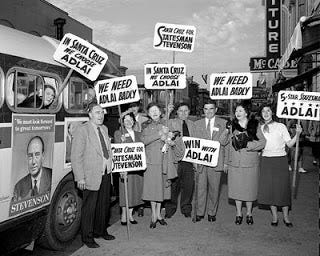
One man who was definitely not considered a serious candidate going in, and had said he wasn't running, was the Convention's host, the Governor of Illinois, Adlai Ewing Stevenson II. A grandson of Adlai Stevenson, who was Grover Cleveland's Vice President from 1893 to 1897, he was 51 years old, had served in various parts of FDR's New Deal, and in the Departments of State and the Navy. In 1948, he was elected Governor. He'd done pretty well in the role, and had already decided not to run for re-election.

Had he been actively running for President, he would have been a great candidate -- by the old, print-media standards. Even by the standards of the radio era, because he had a fantastic voice, and was already renowned for his speeches.

But this was the dawn of the television age. And he was bald. And he had a broken nose. What's more, he was divorced. His wife, Ellen Borden Stevenson, was mentally ill, and such things weren't talked about then. True, Eisenhower was also bald, but he had the great military record. Stevenson was a little too young to serve in World War I, and too old to be drafted into World War II.

And "Ike" had a "winning smile." Adlai did not. Both men had gravitas, but Ike had more. Plus, Ike had the good nickname. Adlai only had "Ad," and that didn't work. And he couldn't go by his middle name: "Ewing Stevenson" would have sounded like the name of a law firm.

Stevenson gave a welcoming speech to the Delegates, and they loved it. A "Draft Stevenson" movement arose. Jacob Arvey, a member of the Democratic National Committee and the leader of the Illinois delegation, talked him into getting in.

On the 1st ballot, Kefauver led with 340 Delegates, Stevenson was 2nd with 273, Russell was 3rd with 268, and Averell Harriman, a former Secretary of Commerce and, by this point, Director of the Mutual Security Agency, was 4th with 123. (Harriman would be elected Governor of New York in 1954, but was defeated for re-election by Rockefeller. He would later be a Presidential foreign policy advisor.)

The 2nd ballot was virtually unchanged. But Harriman dropped out, and on the 3rd ballot, Stevenson gained most of his supporters: He got 617 Delegates, a majority, with Kefauver falling to 275 and Russell to 261. This remains the last Convention at which either major party failed to select a nominee on the 1st ballot. To mollify the South, the Democrats nominated Senator John Sparkman of Alabama for Vice President.
Stevenson's acceptance speech has been hailed as one of the best ever. He began by saying, "Mr. President, Ladies and Gentlemen of the Convention, My Fellow Citizens: I accept your nomination, and your program. I should have preferred to hear those words uttered by a stronger, a wiser, a better man than myself. But, after listening to the President's speech, I even feel better about myself. None of you, my friends, can wholly appreciate what is in my heart. I can only hope that you understand my words. They will be few."

Then Stevenson made a massive mistake. He told the American people the truth:

The ordeal of the 20th Century, the bloodiest, most turbulent era of the whole Christian age, is far from over. Sacrifice, patience, understanding, and implacable purpose may be our lot of years to come.

Let's face it. Let's talk sense to the American people. Let's tell them the truth, that there are no gains without pains, that there -- that we are now on the eve of great decisions, not easy decisions, like resistance when you're attacked; but a long, patient, costly struggle which alone can assure triumph over the great enemies of man: War, poverty, and tyranny, and the assaults upon human dignity which are the most grievous consequences of each.

Let's tell them that the victory to be won in the 20th Century, this portal to the Golden Age, mocks the pretensions of individual acumen and ingenuity, for it is a citadel guarded by thick walls of ignorance and of mistrust, which do not fall before the trumpets' blast or the politicians' imprecations -- or even a general's baton.

They are, they are, my friends, walls that must be directly stormed by the hosts of courage, of morality, and of vision, standing shoulder to shoulder, unafraid of ugly truth, contemptuous of lies, half truths, circuses, and demagoguery.

The people are wise, wiser than the Republicans think. And the Democratic Party is the people's party -- not the labor party, not the farmers' party, not the employers' party. It is the party of no one because it is the party of everyone.

That, that, I, I think, is our ancient mission. Where we have deserted it, we have failed. With your help, there will be no desertion now. Better we lose the election than mislead the people, and better we lose than misgovern the people.

That speech inspired a lot of people. McGovern later said that it convinced him to go into politics, and he made his 1st run for Congress in 1956. As late as 1984, Garry Trudeau, in his politically-themed comic strip Doonesbury, used Stevenson as a counterpoint to conservative Republican insurgents, calling out Newt Gingrich by name.

Stevenson wanted to talk sense to the American people. But they weren't willing to listen. As occasionally happens -- it had happened in 1840, 1876, 1896 and 1920; and would happen again in 1980, 2000 and 2016 -- they wanted to step back from the difficult things, like war abroad, and big-government answers to big problems at home. They didn't want difficult decisions, they wanted easy answers.

And Stevenson knew it. A story which may be apocryphal says that a woman told him, "All the intelligent people are voting for you," and he said, "But I need a majority."

It didn't help that, unlike all previous major-party nominees except one (James M. Cox in 1920), he was divorced. Then again (as with Cox), it wouldn't have mattered if he were happily married. Or had matinee-idol looks. Or had a few medals of his own from wartime service.

Because, after 20 years of Democratic leadership, the party had grown stale in office, and the Republicans used the slogan, "It's time for a change." As far as I know, this was the first time it was used. And Ike was way too popular: The biggest fashion accessory of 1952 -- and 1956, as it turned out -- was an "I LIKE IKE" button. (The counterpart, "WE NEED ADLAI BADLY," didn't get far.)
Stevenson seemed perpetually sad and tired, while Ike always seemed to be smiling, except when he was talking about standing up to Communism. The famous photo by William Gallagher of the Flint Journal, of Stevenson sitting next to Governor G. Mennen Williams of Michigan, with a hole in his shoe, on a campaign visit to Flint, Michigan on September 1, was used as a symbol of hard work by Democrats, but also a symbol of hopelessness by Republicans.
In the end, Stevenson asked, "How you expect to defeat a man called Ike with a name like Adlai?" He never figured that out in 1956, either, and lost to Eisenhower by an even wider margin.

In 1960, Stevenson was determined not to run for a 3rd time. But Senator Eugene McCarthy of Minnesota, who (for reasons I won't get into here) despised John F. Kennedy, the frontrunner going into the Convention, gave a nominating speech for Stevenson, one that attempted to copy Stevenson's own high-soaring rhetoric, and failed.

Upon winning, JFK appointed Stevenson to be the U.S.' Ambassador to the United Nations. He served in that office until dying in 1965. Hearing JFK's Inaugural Address, which inspired more people than Stevenson ever could, compared them to two renowned public speakers of ancient times, albeit 300 years apart: "Do you remember that, in classical times, when Cicero had finished speaking, the people said, 'How well he spoke.' But when Demosthenes had finished speaking, they said, 'Let us march!'"

High schools have been named for Stevenson in The Bronx, in the suburbs of Detroit, and in the suburbs of Chicago. From Lake Shore Drive to Interstate 294 in the Chicago area, Interstate 55 is known as the Adlai E. Stevenson Expressway, not far from expressways named for his opponent, Eisenhower; and his successor, Kennedy.

His son, Adlai Stevenson III, served Illinois in the U.S. Senate from 1970 to 1981. His son, Adlai Stevenson IV, is a business executive and a former journalist. His son, Adlai Stevenson V is a computer engineer. As of July 26, 2022, Adlai V does not have any children.

*

July 26, 1952 was a Saturday. Also on this day, Eva Perón, the First Lady of Argentina, died of cancer at age 33. I have a separate entry for that event.

These baseball games were played that day:

* The New York Yankees lost to the Detroit Tigers, 10-6 at Briggs Stadium in Detroit. (The ballpark was renamed Tiger Stadium in 1961.) Mickey Mantle hit a grand slam in the 1st inning to give the Yankees a 4-0 lead, but starting pitcher Vic Raschi blew it. Despite that slam, and 3 hits each from Phil Rizzuto and Hank Bauer, the game went to extra innings, and Bobby Hogue gave up a walkoff grand slam to Bud Souchock in the 10th. Ted Gray went all 11 innings for the Tigers.

* The New York Giants beat the Cincinnati Reds, 7-2 at the Polo Grounds. Hank Thomspon hit a grand slam, and Dusty Rhodes also hit a home run. Willie Mays was serving in the Korean War, and was unavailable for the Giants.

* The Brooklyn Dodgers lost to the St. Louis Cardinals, 5-3 at Ebbets Field. Stan Musial had hurt the Dodgers so often that it led to his nickname: He became known as Stan the Man because Brooklyn fans would say, "That man is back in town." This time, he went 1-for-3 with 2 walks and an RBI. Jackie Robinson only appeared as a pinch-hitter, and did not reach base.

* The Pittsburgh Pirates beat the Boston Braves, 6-4 at Braves Field in Boston.

* The Philadelphia Phillies beat the Chicago Cubs, 7-2 at Shibe Park in Philadelphia.

* The Washington Senators beat the Cleveland Indians, 11-10 at Cleveland Municipal Stadium. Gil Coan went 4-for-5 with a home run and 5 RBIs for the Senators.

* The Chicago White Sox beat the Philadelphia Athletics, 9-3 at Comiskey Park in Chicago.

* The St. Louis Browns beat the Boston Red Sox, 7-2 at Sportsman's Park in St. Louis. Ted Williams was unavailable for the Red Sox, due to serving in the Korean War.

Saturday, July 23, 2022

July 23, 1960: The Compact of Fifth Avenue

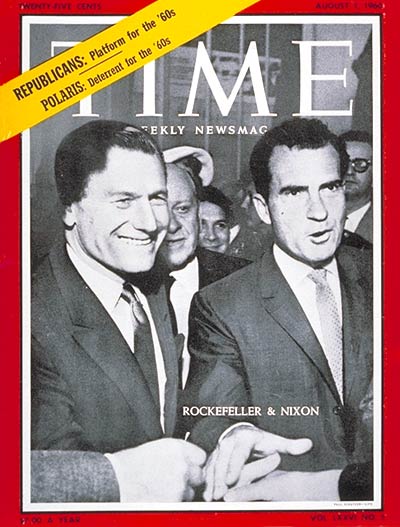
July 23, 1960: Vice President Richard Nixon and Governor Nelson Rockefeller of New York conclude a late-night meeting at Rockefeller's penthouse at 810 5th Avenue, at 62nd Street, on the Upper East Side of Manhattan, with an agreement on a platform for the upcoming Republican National Convention. A newspaper headline writer called it "The Compact of Fifth Avenue," although it has also been called "The Treaty of Fifth Avenue."
810 Fifth Avenue

Two days later, on July 25, the Republican Convention convened, at the International Amphitheatre in Chicago. Dwight D. Eisenhower is the 1st President limited to 2 terms by the 22nd Amendment to the Constitution, something the Republicans wanted as a swipe at the memory of Franklin Roosevelt, and now, it comes back to bite them. Though "Ike" might not have wanted to run for a 3rd term anyway.

With Rockefeller out of the way, the path for Nixon to be nominated for President was clear. For Vice President, the Party nominated the U.S.' Ambassador to the United Nations, Henry Cabot Lodge – who had been defeated for re-election to the Senate from Massachusetts in 1952 by the man the Democratic Party just nominated for President, John F. Kennedy.

The conservative wing of the Republican Party wasn't happy over Nixon's nomination, any more than they were about Wendell Willkie's in 1940, Thomas Dewey's in 1944 and 1948, and Eisenhower's in 1952. They wanted one of their own nominated. Never mind that conservatism was still identified with Herbert Hoover and the Great Depression. Senator Barry Goldwater of Arizona was the only other Presidential candidate to get any Delegates: 10, all of them from Louisiana, to Nixon's 1,321.

Before the vote tally, Goldwater spoke, and asked that his name be withdrawn from consideration, as a gesture of unity. He told his supporters, and any others who opposed Nixon's nomination, "We've had our chance. We've fought our battles. Now, let's put our shoulders to the wheel of Dick Nixon and push him across the line... Let's grow up, conservatives. If we want to take this party back, and I think we can someday, let's get to work." He had just published a political manifesto, The Conscience of a Conservative, and it became one of the defining texts of the movement.

Following Kennedy's win over Nixon, the Republican Party would follow Goldwater's lead in the next election. Rockefeller ran again in 1964, but the conservative wing never forgave him for getting in their way, and they treated him shabbily. Goldwater was nominated, but lost badly.

Rockefeller ran again in 1968, but so did Nixon, and there was no true conservative alternative. There wouldn't be until 1976, when Ronald Reagan nearly beat out incumbent President Gerald Ford, and Rockefeller, by then Ford's Vice President, was hounded off the ticket. In 1980, Reagan won, to the delight of Goldwater and the conservatives.

*

July 23, 1960 was a Saturday. These baseball games were played:

* The New York Yankees lost to the Chicago White Sox, 5-3 at Yankee Stadium. Bob Shaw outpitched Whitey Ford. Minnie Miñoso went 4-for-5 with 3 RBIs. Bill "Moose" Skowron hit a home run, Yogi Berra went 2-for-4 with an RBI, Roger Maris went 0-for-4, and Mickey Mantle only appeared as a pinch-hitter, and did not reach base.

* The Cleveland Indians beat the Boston Red Sox, 4-2 at Fenway Park in Boston. Ted Williams, in his final season, hit his 508th career home run.

* A doubleheader was split at Memorial Stadium in Baltimore. The Detroit Tigers won the opener, 4-1. The Baltimore Orioles won the nightcap, 4-3. Al Kaline sat it out, after going 1-for-4 in the opener. Over the 2 games, Brooks Robinson went 4-for-8 with an RBI.

* The Washington Senators beat the Kansas City Athletics, 8-3 at Griffith Stadium in Washington.

* The St. Louis Cardinals beat the Cincinnati Reds, 7-5 at Crosley Field in Cincinnati. Each team scored 2 runs in the 9th inning, but Walt "Moose" Moryn hit a home run in the top of the 10th inning to win it. Stan Musial appeared as a pinch-hitter, and did not reach base. Frank Robinson and Wally Post hit home runs for the Reds.

* The Milwaukee Braves beat the Chicago Cubs, 3-0 at Wrigley Field in Chicago. Juan Pizarro took a shutout into the 9th inning, striking out 12, but allowed 8 hits and 3 walks, and Ron Piché had to get the last 2 outs and preserve the shutout. Hank Aaron and Eddie Mathews both hit home runs. Ernie Banks went 0-for-4.

* The Los Angeles Dodgers beat the Philadelphia Phillies, 2-0 at the Los Angeles Memorial Coliseum. Roger Craig pitched a 3-hit shutout. Dallas Green went the distance for the Phils. Each man would go on to become a rare thing, a former pitcher who managed a team to a Pennant.

* And the San Francisco Giants beat the Pittsburgh Pirates, 3-1 at Candlestick Park in San Francisco. Juan Marichal outpitched Harvey Haddix. Willie Mays went 3-for-4 with a home run and 2 RBIs. Roberto Clemente went 0-for-2 with a walk.

Saturday, July 9, 2022

July 9, 1952: Dirksen vs. Dewey at the Republican Convention

Everett McKinley Dirksen

July 9, 1952: The Republican Convention is in progress at the International Amphitheatre in Chicago. The Eastern establishment wing of the Party, led by Governor Thomas Dewey of New York, their 1944 and 1948 nominee, is angry at losing 5 straight elections, and they want to win. So they want to nominate the most popular man in the country.

Unfortunately, while he is a Republican, Bing Crosby isn't available. So they settle for former General Dwight D. Eisenhower, whom they promote as the man who beat the Nazis (as if he didn't answer to President Franklin D. Roosevelt and Army Chief of Staff George C. Marshall), and is the best man to beat both the Communists and "the mess in Washington." They run on a formula they call "K1C2," for "Korea, Communism, and Corruption."

The conservative wing of the Party is angry at losing 4 straight nomination fights -- to Governor Alf Landon of Kansas in 1936, to Wall Street lawyer Wendell Willkie in 1940, and then to Dewey twice -- and they want one of their own to be nominated. They want Senator Robert Taft of Ohio: The son of a President, the grandson of an Attorney General, a mover and shaker on both domestic and foreign policy, and a man known so conservative, he is known as "Mr. Republican."

Senator Everett McKinley Dirksen of Illinois, who, like Taft, will one day be named the GOP's Senate floor leader, gives Taft's nominating speech. With a voice so low and a style so florid that it earned him the nickname "The Wizard of Ooze," he points at Dewey, saying, "We followed you before, and you took us down the road to defeat!"

The conservatives had decided they would rather lose with Taft than win with a "liberal." And they launched a pro-Taft demonstration that lasted half an hour. This actually made the Delegate race close. But on the 1st ballot, Eisenhower had 595, leaving him 9 short of a majority. Taft had 500, and his team thought that, by denying Ike a majority on the 1st ballot, they had burst his bubble of invincibility.

Governor Earl Warren of California, Dewey's 1948 running mate, had 81. Governor Harold Stassen of Minnesota, making the 2nd of his many runs for President, had 20. And General Douglas MacArthur, not actively running because he wanted to be seen as having been "drafted," had 10.

But Stassen, running as a "favorite son," with his own State as a Delegate base, had not received 10 percent of the Delegates. That freed Minnesota's Delegates from their pledge to support him, and, before the 1st ballot could be finalized, those Delegates changed their vote, all but 1 or them, giving Ike 614 and a majority.

There no longer were enough conservative Delegates to deny Eisenhower the nomination. But there were enough of them to stick "Ike" with one of their own as his Vice Presidential nominee. Senator Richard M. Nixon of California was only 39 years old, but already had a reputation as a Communist-hunting firebrand -- and also one as the biggest liar in either house of Congress.
Pat & Dick, Ike & Mamie, and the Chicago Tribune,
still billing itself as "The World's Greatest Newspaper,"
was, as usual, in the tank for the GOP.

Two nights later, on July 11, Ike was nominated. He had famously titled his postwar memoir Crusade in Europe. The Republicans had called their fight against Communism a "crusade." Ike told the Delegates, and told the nation, "I know something about leading a crusade. I have led one."

If the Democrats want to keep the White House for another 4 years, they will have to run against the Republicans as a whole, and against the man already known as "Tricky Dick," as much against Ike. Because running just against Ike, without the strength of the incumbent, but with the status as incumbents in an anti-incumbent year, would be a fool's errand. And, at this point, they don't even know who their nominee will be, only that it won't be outgoing President Harry Truman.

*

July 9, 1952 was a Wednesday. John Tesh, former co-host of the TV show Entertainment Tonight, and composer of "Roundball Rock," the theme song to NBC's NBA broadcasts, was born on this day.

But there were no games played: The only sport in season in North America at the time was baseball, and this was during the All-Star Break. The night before, the All-Star Game was played at Shibe Park in Philadelphia. This is the only time that game has ever been shortened due to rain: The National League was leading the American League, 3-2 after 5 innings, making it official, when it was called.

Jackie Robinson of the Brooklyn Dodgers and Hank Sauer of the Chicago Cubs, who would go on to be named the NL's Most Valuable Player despite the Cubs only finishing 5th, hit home runs. Among those selected for the 1st time, but not getting into the game, were 20-year-old Mickey Mantle of the New York Yankees and 46-year-old Leroy "Satchel" Paige, then with the St. Louis Browns.

Tuesday, April 19, 2022

April 19, 1974: Peter Pan 1, World Hockey Association 0

$13.50 in 1974 = around $80.14 in 2022.

April 19, 1974: A story typical of "rebel leagues" plagues the World Hockey Association.

The Chicago Cougars were a charter WHA team, and played their home games at the International Amphitheatre on the South Side of the city, since the Chicago Stadium, on the West Side, was owned by the NHL's Chicago Black Hawks, who kept them out, and the Amphitheatre was, at the time, the 2nd-biggest arena in the metropolitan area.

They made the Playoffs in their 2nd season, 1973-74. In the Quarterfinals, they beat the New England Whalers in 7 games, and the series passed without incident. But the Amphitheatre was unavailable for the Semifinals against the Toronto Toros. Since the WHA was still considered a minor league, the Amphitheatre booked something else for what turned out to be the Cougars' remaining Playoff dates: A touring production of the Walt Disney musical Peter Pan.

Since Mary Martin on Broadway in 1954, the character of Peter Pan had usually been played by short, thin women. A few years after this, actress Sandy Duncan would memorably play the role. This 1974 touring production starred Cathy Rigby, who had recently become, to that point, America's greatest gymnast, and was comfortable with the harness required to simulate the character's flying.

The Amphitheatre seated 9,000, and the Cougars were not even drawing that many. It didn't help that the Black Hawks and the NBA's Bulls were also in their leagues' Playoffs, and that baseball season had started, so the Cubs and the White Sox were also vying for the attention of sports fans.

The Cougars knew that, in order to rent the Stadium, they would have to pay through the nose, something they could ill afford to do. But it didn't matter: All the dates there were taken up by a Playoff game by one of the arena's usual home teams.

The Cougars considered playing "home games" at another city, as had been done before. Traditionally, April had been the month when the Ringling Brothers Barnum & Bailey Circus had performed at the old Madison Square Garden. In 4 consecutive years, The Garden had been booked for the Circus, forcing one of its teams to play its Finals all on the road. As a result, the New York Rangers had lost the 1950 Stanley Cup Finals to the Detroit Red Wings while playing their "home games" at Maple Leaf Gardens in Toronto; and the New York Knicks were forced to go across Manhattan to the 69th Regiment Army during the Finals, losing in 1951 to the Rochester Royals and in 1952 and 1953 to the Minneapolis Lakers.

But instead of playing in Cleveland, as they had initially sought to do, the Cougars caught something of a break. The Randhurst Twin Ice Arena, next to the Randhurst Mall in nearby Mount Prospect, Illinois, was available. It could only hold 2,000 fans, but, at this point, there was a question of whether they could fill even that.

The Toros were having their own venue issues. Harold Ballard, owner of Maple Leaf Sports & Entertainment, and thus also of the NHL's Toronto Maple Leafs and Maple Leaf Gardens, wanted to make things as hard as possible for the rebel league, so he charged the Toros an exorbitant rent, and leaned on the owners of every other arena in the Greater Toronto Area to keep the Toros out. So, pay Ballard, they did.

And, with Ballard -- also the owner of the CFL's Toronto Argonauts, and perhaps the most hated man in the history of Canadian sports -- refusing to promote the Toros' games, they, like the Cougars, had attendance issues. At any rate, the Cougars beat the Toros in 7 games, and advanced to the WHA Finals against the Houston Aeros.

At this point, with the Peter Pan show having moved on, the Amphitheatre should have been available for the Cougars. Except the Amphitheatre's management figured the hockey season was over, and so they disassembled their ice surface and equipment for the season. The Cougars had to stay at Randhurst, and play for the championship of their sport before a maximum of 2,000 fans.

In contrast, the Aeros could put 9,000 people into the Sam Houston Coliseum, and knew that a new arena, The Summit, was coming for the 1975-76 season. With 45-year-old Gordie Howe and his sons Mark and Marty leading the way, the Aeros won the series in 4 straight.

The Cougars played just 1 more season, and folded. The WHA had now failed in America's 3 biggest markets: New York, Los Angeles and Chicago. It still held on until 1979, with 4 of its teams joining the NHL. Despite repeating as Champions in 1975, and reaching the Finals again in 1976, the Aeros would not be one of them: After losing the Howes to the Whalers in 1977, they folded in 1978.

The Randhurst Ice Arena was new when the Cougars played there. It didn't last long, torn down in 1998. A Home Depot store currently stands on the site.

*

April 19, 1974 was a Friday. No games were played in the Stanley Cup Playoffs. One game was played in the NBA Playoffs: The New York Knicks beat the Boston Celtics, 103-100 at the Boston Garden. Walt Frazier scored 38 points. However, the Celtics won the next game, which turned out to be Willis Reed's last game; and the game after that, clinching the series and a berth in the NBA Finals, and that turned out to be the last game for Dave DeBusschere and Jerry Lucas. The Celtics went on to beat the Milwaukee Bucks in the Finals.

Football was out of season. These baseball games were played:

* The New York Yankees lost to the Baltimore Orioles, 5-3 at Memorial Stadium in Baltimore. Brooks Robinson went 1-for-3. Graig Nettles hit a home run for the Yankees.

* The Boston Red Sox beat the Cleveland Indians, 6-3 at Fenway Park in Boston. Carl Yastrzemski went 1-for-3 with an RBI and a walk.

* The Philadelphia Phillies beat the Chicago Cubs, 9-2 at Veterans Stadium in Philadelphia. Mike Schmidt hit a home run.

* The Cincinnati Reds beat the San Diego Padres, 8-4 at Riverfront Stadium in Cincinnati. Pete Rose went 1-for-4. Johnny Bench went 0-for-2 with 2 walks. Dave Winfield went 1-for-5.

* The Chicago White Sox beat the Kansas City Royals, 5-4 at Comiskey Park in Chicago.

* The Montreal Expos beat the St. Louis Cardinals, 5-4 at Busch Memorial Stadium in St. Louis. Lou Brock went on to set a new record that season, with 118 stolen bases. Not on this night: He went 0-for-4.

* The Houston Astros beat the Atlanta Braves, 8-2 at the Astrodome in Houston. Hank Aaron went 1-for-4.


* The Texas Rangers beat the Minnesota Twins, 10-2 at Arlington Stadium in the Dallas suburb of Arlington, Texas. Rod Carew went 1-for-4. Harmon Killebrew did not play.

* The San Francisco Giants beat their arch-rivals, the Los Angeles Dodgers, 5-4 at Dodger Stadium in Los Angeles.

* The Oakland Athletics beat the California Angels, 5-1 at Oakland Coliseum. Catfish Hunter went the distance, outpitching Bill Singer. Reggie Jackson went 2-for-4 with a home run and 2 RBIs. Frank Robinson, in his only season with the Angels, went 0-for-4.

* The New York Mets and the Pittsburgh Pirates were rained out at Shea Stadium. The game was made up as part of a doubleheader on July 30. The Pirates won the opener, 6-0. The Mets won the nightcap, 4-3. Willie Stargell went 1-for-5 in the 1st game, and did not play in the 2nd game.

* And the Detroit Tigers and the Milwaukee Brewers were not scheduled.

December 31, 1999 & January 1, 2000: The Millennium

December 31, 1999:  The Millennium arrives. The people of planet Earth survived. At a terrible cost. But we hadn't destroyed ourselves. ...