.jpg)
July 26, 1952: The Democratic National Convention wraps up at the International Amphitheatre in Chicago. A legend is born. But a Presidential Administration is not.
Since coming to power in 1932, when the Great Depression caused the American people to turn against the Republican Party, the Democratic Party had won 5 straight Presidential elections: 1932, 1936, 1940 and 1944 under Franklin Delano Roosevelt; and 1948 under Harry S Truman, who benefited from several things: Voters' fondness for FDR's "New Deal," their memories of the Republicans' incompetence and heartlessness, the Republicans' overconfidence going into the '48 election, and their colorless candidate, Governor Thomas E. Dewey of New York.
All those things went against the Democrats this time. FDR died early in his 4th term, meaning Truman got to serve nearly 2 full terms. His 2nd term was hard. The Korean War forced him to turn his attention away from some of his "Fair Deal" programs. Accusations of Communist influence in his Administration (nearly all of them untrue) were a distraction. Accusations of corruption in his Administration abounded (more of them were true, but nothing as bad as would later be seen in Republican Administrations).
The Republicans thought they had the right formula: They called it "K1C2," for "Korea, Communism, and Corruption." It had been 20 years since the public had seen a Republican government in action, and they had largely forgotten. Most of all, this time, the Republicans had the right guy running.
As the leading General of the U.S. Army from the D-Day invasion of June 6, 1944 to the end of "The War" (for those who lived through it, like my grandparents, always Capital T, Capital W), Dwight D. Eisenhower was expected to follow in the footsteps of previous American Generals: George Washington, Andrew Jackson, William Henry Harrison, Zachary Taylor, Franklin Pierce, Ulysses S. Grant and Theodore Roosevelt (who never got promoted from Colonel to General).
In 1952, Ike looked around at the potential candidates, on both sides, considered their ability to both maintain American prosperity and stand up to the Communist world, and thought that he could do a better job than any of them. So he ran, as a Republican.
The conservative wing of the Party saw Ike as the candidate of the more moderate "Eastern Establishment" wing of the Party, which would eventually be called "the Rockefeller Republicans." (Nelson Rockefeller, having already crossed Party lines to serve in FDR's Administration as an Assistant Secretary of State, was part of Ike's advisory committee.)
And they saw this wing as the one that nominated Wendell Willkie in 1940, and Dewey in 1944 and 1948, and doomed the Party to defeat. They were sure -- as conservatives usually are -- in a great delusion: That, if the American people saw a Republican Party sticking to true conservative principles, they would sweep the nation. (It's only worked once, for Ronald Reagan, and that was because Jimmy Carter's last year in office, unlike his 1st 3 years, was a disaster.)
Senator Everett Dirksen of Illinois gave a speech nominating Senator Robert Taft of Ohio. The son of President William Howard Taft, and the grandson of an Attorney General and Secretary of War, Taft was one of the Senate's leading isolationists, which cost him the nomination in 1940. He was so conservative, he was known as "Mr. Republican."
With a bass voice that earned him the nickname "The Wizard of Ooze," Dirksen extolled Taft's virtues, and then pointed at Dewey, who was seated with the New York delegation, and shouted, "We followed you before, and you took us down the road to defeat!" Dirksen's condemnation of Dewey touched off sustained anti-Dewey and pro-Taft demonstrations.
Had there been a single opponent for Eisenhower, it might have derailed him. There wasn't: Governor Earl Warren of California, the Party's 1948 Vice Presidential nominee, was in the race. So was Governor Harold Stassen of Minnesota. After the 1st ballot, with 614 required to win the nomination, Ike had 595 Delegates, Taft 500, Warren 81, and Stassen 20, all from his home State, including Warren Burger, who, like Warren, would eventually serve as Chief Justice of the Supreme Court.
But a quirk in the balloting rules saved Ike: Because Stassen had not received 10 percent of the total Delegates, those Delegates were freed from their pledge to him. Thus, with the results of the 1st ballot not yet made official, they were free to switch their votes. They did, putting Eisenhower over the top, with 615.
The Party regulars saddled him with a running mate they liked, but almost nobody else did: Senator Richard Nixon of California. In less than 6 years in Congress, including a year and a half in the Senate, Nixon had already generated a reputation as the slimiest, most dishonest major politician in America. His opponent in his 1950 Senate election, Congresswoman Helen Gahagan Douglas, gave him the nickname that stuck with him for the rest of his life: "Tricky Dick."
*
Under a "grandfather clause" in the 22nd Amendment to the Constitution of the United States, Truman was the last President who could have run for what would have amounted to a 3rd term. He refused. He was tired of the job, and his wife hated being in Washington: He said that if he ran again, "Bess would impeach me."
And the Democrats didn't have an obvious successor to Truman, nor had he "groomed" one. Vice President Alben Barkley, a former Senate Majority Leader from Kentucky, was popular within the Party, but not especially well-known in the nation at large, and was 74 years old, and a Southerner.
Also Southerners were the next-highest-ranking Democrat, Sam Rayburn of Texas, the Speaker of the U.S. House of Representatives, and on top of being a Southerner, was 70 years old, bald, and divorced; the man who seemed to have the most interest in becoming the Democratic nominee, Senator Estes Kefauver of Tennessee, who had become famous the year before for chairing committee hearings on organized crime; and 2 other men popular within the Party, Senator Richard Russell of Georgia, and Senator Robert Kerr of Oklahoma.
And the men who turned out to be the next generation of major Democrats, despite whatever they might have already achieved, were not yet ready. In descending order of age:
* W. Stuart Symington was 51, the Chairman of the Reconstruction Finance Corporation (RFC), was the 1st Secretary of the Air Force, and was running for the Senate from Missouri. (He won.)
* Richard J. Daley was 50, and the Clerk of Cook County, Illinois, which is mostly made up of Chicago. He was 3 years away from being elected Mayor.
* Mike Mansfield was 49, and a Representative from Montana, running for the Senate.
* Edmund G. "Pat" Brown was 47, and the Attorney General of California.
* Lyndon B. Johnson was 43, a Senator from Texas, and the Senate's Minority Whip.
* Robert F. Wagner Jr. was 42, and the Borough President of Manhattan, preparing to run for Mayor of New York the next year. (He won.)
* Sam Yorty was 42, and a Representative from California, having won the seat of Helen Gahagan Douglas. He was 9 years from being elected Mayor of Los Angeles.
* Hubert H. Humphrey was 40, and a Senator from Minnesota.
* Thomas P. "Tip" O'Neill was 39, and the Speaker of the Massachusetts House of Representatives, running for the U.S. House. (He won.)
* Edmund S. Muskie was 38, and out of office, having lost re-election for the State House in Maine.
* Eugene McCarthy was 36, and a Representative from Minnesota.
* John F. Kennedy was 35, and a Representative from Massachusetts, running for the Senate. (O'Neill was running for his U.S. House seat.) Because of his father's promotion of him, his 1940 best-seller Why England Slept, and his status as the son of a familiar figure, he was, along with Humphrey, due to his speech about civil rights at the 1948 Democratic Convention, the closest any of these men came to being a nationally-known figure.
* Robert C. Byrd was 34, a member of the West Virginia Senate, and a candidate for the U.S. House. (He won.)
* George McGovern was 30, and a history professor at Dakota Wesleyan University.
* Jimmy Carter was 27, and in the U.S. Navy.
* Robert F. Kennedy was 26, and his brother Jack's campaign manager.
* Walter Mondale was 24, and in the U.S. Army.
* Thomas Eagleton was 22, and in law school at Harvard University.
* And another brother, Edward M. "Ted" Kennedy, was 20, and an undergraduate (and a star football player) at Harvard.
So when the Democrats convened at the Amphitheatre on July 21, 2 weeks after the Republicans had met in the same building, the only thing anybody knew for sure was that President Truman, through his own choice as much as the circumstances being against him, was not going to be the nominee.
One man who was definitely not considered a serious candidate going in, and had said he wasn't running, was the Convention's host, the Governor of Illinois, Adlai Ewing Stevenson II. A grandson of Adlai Stevenson, who was Grover Cleveland's Vice President from 1893 to 1897, he was 51 years old, had served in various parts of FDR's New Deal, and in the Departments of State and the Navy. In 1948, he was elected Governor. He'd done pretty well in the role, and had already decided not to run for re-election.
Had he been actively running for President, he would have been a great candidate -- by the old, print-media standards. Even by the standards of the radio era, because he had a fantastic voice, and was already renowned for his speeches.
But this was the dawn of the television age. And he was bald. And he had a broken nose. What's more, he was divorced. His wife, Ellen Borden Stevenson, was mentally ill, and such things weren't talked about then. True, Eisenhower was also bald, but he had the great military record. Stevenson was a little too young to serve in World War I, and too old to be drafted into World War II.
And "Ike" had a "winning smile." Adlai did not. Both men had gravitas, but Ike had more. Plus, Ike had the good nickname. Adlai only had "Ad," and that didn't work. And he couldn't go by his middle name: "Ewing Stevenson" would have sounded like the name of a law firm.

The International Amphitheatre
Stevenson gave a welcoming speech to the Delegates, and they loved it. A "Draft Stevenson" movement arose. Jacob Arvey, a member of the Democratic National Committee and the leader of the Illinois delegation, talked him into getting in.
On the 1st ballot, Kefauver led with 340 Delegates, Stevenson was 2nd with 273, Russell was 3rd with 268, and Averell Harriman, a former Secretary of Commerce and, by this point, Director of the Mutual Security Agency, was 4th with 123. (Harriman would be elected Governor of New York in 1954, but was defeated for re-election by Rockefeller. He would later be a Presidential foreign policy advisor.)
The 2nd ballot was virtually unchanged. But Harriman dropped out, and on the 3rd ballot, Stevenson gained most of his supporters: He got 617 Delegates, a majority, with Kefauver falling to 275 and Russell to 261. This remains the last Convention at which either major party failed to select a nominee on the 1st ballot. To mollify the South, the Democrats nominated Senator John Sparkman of Alabama for Vice President.

Stevenson's acceptance speech has been hailed as one of the best ever. He began by saying, "Mr. President, Ladies and Gentlemen of the Convention, My Fellow Citizens: I accept your nomination, and your program. I should have preferred to hear those words uttered by a stronger, a wiser, a better man than myself. But, after listening to the President's speech, I even feel better about myself. None of you, my friends, can wholly appreciate what is in my heart. I can only hope that you understand my words. They will be few."
Then Stevenson made a massive mistake. He told the American people the truth:
The ordeal of the 20th Century, the bloodiest, most turbulent era of the whole Christian age, is far from over. Sacrifice, patience, understanding, and implacable purpose may be our lot of years to come.
Let's face it. Let's talk sense to the American people. Let's tell them the truth, that there are no gains without pains, that there -- that we are now on the eve of great decisions, not easy decisions, like resistance when you're attacked; but a long, patient, costly struggle which alone can assure triumph over the great enemies of man: War, poverty, and tyranny, and the assaults upon human dignity which are the most grievous consequences of each.
Let's tell them that the victory to be won in the 20th Century, this portal to the Golden Age, mocks the pretensions of individual acumen and ingenuity, for it is a citadel guarded by thick walls of ignorance and of mistrust, which do not fall before the trumpets' blast or the politicians' imprecations -- or even a general's baton.
They are, they are, my friends, walls that must be directly stormed by the hosts of courage, of morality, and of vision, standing shoulder to shoulder, unafraid of ugly truth, contemptuous of lies, half truths, circuses, and demagoguery.
The people are wise, wiser than the Republicans think. And the Democratic Party is the people's party -- not the labor party, not the farmers' party, not the employers' party. It is the party of no one because it is the party of everyone.
That, that, I, I think, is our ancient mission. Where we have deserted it, we have failed. With your help, there will be no desertion now. Better we lose the election than mislead the people, and better we lose than misgovern the people.
That speech inspired a lot of people. McGovern later said that it convinced him to go into politics, and he made his 1st run for Congress in 1956. As late as 1984, Garry Trudeau, in his politically-themed comic strip Doonesbury, used Stevenson as a counterpoint to conservative Republican insurgents, calling out Newt Gingrich by name.
Stevenson wanted to talk sense to the American people. But they weren't willing to listen. As occasionally happens -- it had happened in 1840, 1876, 1896 and 1920; and would happen again in 1980, 2000 and 2016 -- they wanted to step back from the difficult things, like war abroad, and big-government answers to big problems at home. They didn't want difficult decisions, they wanted easy answers.
And Stevenson knew it. A story which may be apocryphal says that a woman told him, "All the intelligent people are voting for you," and he said, "But I need a majority."
It didn't help that, unlike all previous major-party nominees except one (James M. Cox in 1920), he was divorced. Then again (as with Cox), it wouldn't have mattered if he were happily married. Or had matinee-idol looks. Or had a few medals of his own from wartime service.
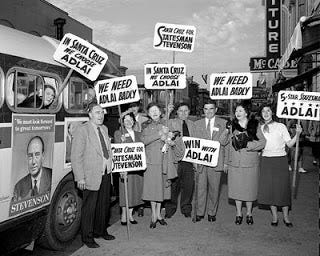
Because, after 20 years of Democratic leadership, the party had grown stale in office, and the Republicans used the slogan, "It's time for a change." As far as I know, this was the first time it was used. And Ike was way too popular: The biggest fashion accessory of 1952 -- and 1956, as it turned out -- was an "I LIKE IKE" button. (The counterpart, "WE NEED ADLAI BADLY," didn't get far.)
Stevenson seemed perpetually sad and tired, while Ike always seemed to be smiling, except when he was talking about standing up to Communism. The famous photo by William Gallagher of the Flint Journal, of Stevenson sitting next to Governor G. Mennen Williams of Michigan, with a hole in his shoe, on a campaign visit to Flint, Michigan on September 1, was used as a symbol of hard work by Democrats, but also a symbol of hopelessness by Republicans.

In the end, Stevenson asked, "How you expect to defeat a man called Ike with a name like Adlai?" He never figured that out in 1956, either, and lost to Eisenhower by an even wider margin.
In 1960, Stevenson was determined not to run for a 3rd time. But Senator Eugene McCarthy of Minnesota, who (for reasons I won't get into here) despised John F. Kennedy, the frontrunner going into the Convention, gave a nominating speech for Stevenson, one that attempted to copy Stevenson's own high-soaring rhetoric, and failed.
Upon winning, JFK appointed Stevenson to be the U.S.' Ambassador to the United Nations. He served in that office until dying in 1965. Hearing JFK's Inaugural Address, which inspired more people than Stevenson ever could, compared them to two renowned public speakers of ancient times, albeit 300 years apart: "Do you remember that, in classical times, when Cicero had finished speaking, the people said, 'How well he spoke.' But when Demosthenes had finished speaking, they said, 'Let us march!'"
High schools have been named for Stevenson in The Bronx, in the suburbs of Detroit, and in the suburbs of Chicago. From Lake Shore Drive to Interstate 294 in the Chicago area, Interstate 55 is known as the Adlai E. Stevenson Expressway, not far from expressways named for his opponent, Eisenhower; and his successor, Kennedy.
His son, Adlai Stevenson III, served Illinois in the U.S. Senate from 1970 to 1981. His son, Adlai Stevenson IV, is a business executive and a former journalist. His son, Adlai Stevenson V is a computer engineer. As of July 26, 2022, Adlai V does not have any children.
*
July 26, 1952 was a Saturday. Also on this day, Eva Perón, the First Lady of Argentina, died of cancer at age 33. I have a separate entry for that event.
These baseball games were played that day:
* The New York Yankees lost to the Detroit Tigers, 10-6 at Briggs Stadium in Detroit. (The ballpark was renamed Tiger Stadium in 1961.) Mickey Mantle hit a grand slam in the 1st inning to give the Yankees a 4-0 lead, but starting pitcher Vic Raschi blew it. Despite that slam, and 3 hits each from Phil Rizzuto and Hank Bauer, the game went to extra innings, and Bobby Hogue gave up a walkoff grand slam to Bud Souchock in the 10th. Ted Gray went all 11 innings for the Tigers.
* The New York Giants beat the Cincinnati Reds, 7-2 at the Polo Grounds. Hank Thomspon hit a grand slam, and Dusty Rhodes also hit a home run. Willie Mays was serving in the Korean War, and was unavailable for the Giants.
* The Brooklyn Dodgers lost to the St. Louis Cardinals, 5-3 at Ebbets Field. Stan Musial had hurt the Dodgers so often that it led to his nickname: He became known as Stan the Man because Brooklyn fans would say, "That man is back in town." This time, he went 1-for-3 with 2 walks and an RBI. Jackie Robinson only appeared as a pinch-hitter, and did not reach base.
* The Pittsburgh Pirates beat the Boston Braves, 6-4 at Braves Field in Boston.
* The Philadelphia Phillies beat the Chicago Cubs, 7-2 at Shibe Park in Philadelphia.
* The Washington Senators beat the Cleveland Indians, 11-10 at Cleveland Municipal Stadium. Gil Coan went 4-for-5 with a home run and 5 RBIs for the Senators.
* The Chicago White Sox beat the Philadelphia Athletics, 9-3 at Comiskey Park in Chicago.
* The St. Louis Browns beat the Boston Red Sox, 7-2 at Sportsman's Park in St. Louis. Ted Williams was unavailable for the Red Sox, due to serving in the Korean War.


No comments:
Post a Comment