Showing posts with label queen's park fc. Show all posts

Sunday, October 30, 2022

October 31, 1903: Hampden Park Opens

October 31, 1903: Hampden Park opens in Glasgow, and becomes Scotland's national stadium. The previous facility with the name had been home to Queen's Park Football Club, the 1st professional sports team in Scotland, since 1873.

Queen's Park have played on the current site since 1903, the Scottish Cup Final has been held there since 1904, the national team has used it as their main home since 1906, and the Scottish Claymores of NFL Europe played there from 1998 to 2004.

The east and north stands of the stadium were redeveloped as all-seater in 1994, in time for Glasgow team Celtic to use Hampden while their own Celtic Park was redeveloped in the 1994-95 season. The rest of the stadium was upgraded by 1999. A record crowd of 149,415 saw a Scotland vs. England game in 1937, but the capacity is now 51,866.
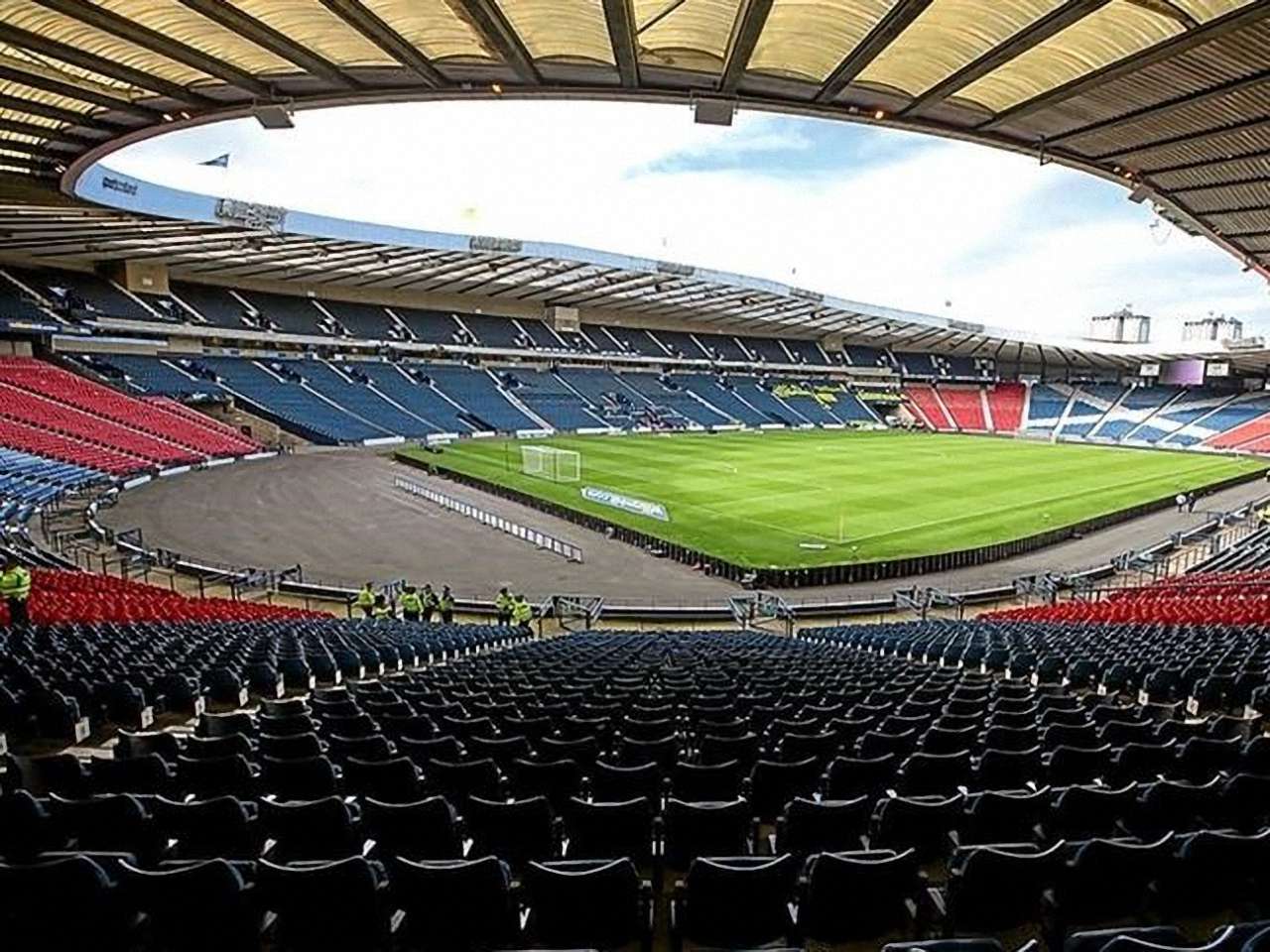
Hampden hosted the Final of the European Cup in 1960 (Real Madrid beating Eintracht Frankfurt), 1976 (Bayern Munich beating Saint-Étienne), and 2002 (by which point the tournament had been renamed the UEFA Champions League, with Real Madrid beating Bayer Leverkusen). It was used as a venue for Euro 2020 (delayed until 2021 due to the COVID pandemic).

*

October 31, 1903 was a Saturday. Baseball season was over. Basketball barely existed, and hockey hadn't yet turned professional. These other noteworthy games were played in college football:

* The universities of Michigan and Minnesota played to a 6-6 tie at Northrop Field in Minneapolis. This led to the rivalry known as "The Little Brown Jug." I have a separate entry for that event.

* The game that was supposed to be played between Indiana University and Purdue University was canceled, due to the Purdue Wreck. I have an entry for that event as well.

* Army beat Vermont, 32-0 on The Plain in West Point, New York.

* Penn State beat Navy, 17-0 at Worden Field in Annapolis, Maryland.

* Yale beat Columbia, 25-0 at the Polo Grounds.

* Harvard beat the Carlisle Indian School, 12-11 at Soldier's Field in Boston. Jim Thorpe was too young to play on the Carlisle varsity, but they almost didn't need him. Two weeks later, on November 14, Harvard Stadium opened, and Harvard lost to Dartmouth. They still play there today.

* The University of Pennsylvania beat Bucknell, 47-6 at Franklin Field in Philadelphia. A new stadium by that name would be built on the same site in 1922.

* Lafayette beat New York University, 8-6 at Ohio Field in The Bronx.

* Princeton beat Cornell, 44-0 at University Field in Princeton, New Jersey.

* And Rutgers beat Stevens Institute, 36-6 at Neilson Field in New Brunswick, New Jersey.

Sunday, February 13, 2022

February 14, 1880: The 1st Black Footballer

February 14, 1880: Andrew Watson is selected to play left back for the Glasgow Select Team, a soccer team representing Glasgow, Scotland in their annual match against a team representing Sheffield, England, at Bramall Lane in Sheffield, home of Sheffield United F.C. (Football Club). Glasgow won, 1-0.

This made Watson the 1st black man to be selected for a "football match" of such a high profile, anywhere in the world. I've chosen this date to tell his story, since, while checks of the historical record show that he appears to have been the first black man to play the sport at any level, anywhere in the world, the date on which he first did so is not so clear.

Other details of his life are clearer. He was born on May 24, 1856 in Demerara, in what was then British Guiana, in South America. Since 1966, the land has been the independent nation known as the Co-operative Republic of Guyana. Sadly, it is now best known as the location of the Jonestown Massacre, perpetrated by the Rev. Jim Jones against his followers in 1978.

He and a sister were the children of a wealthy Scottish sugar planter and a Guianese woman. Their father took them to London, and they inherited his fortune when he died in 1869. Andrew entered the University of Glasgow, where he studied mathematics, engineering and natural philosophy, and discovered football, playing both right back and left back as the situation required.

This would place his debut, and thus of footballing by black people, at sometime in 1875, 12 years after the founding of England's Football Association, 4 years after the founding of the FA Cup, 3 years after the 1st international match between England and Scotland, and 2 years after the founding of the Scottish Football Association -- but 10 years before Arthur Wharton, a goalkeeper for Darlington F.C., became the 1st black player known to have played professionally in England; 13 years before the founding of England's Football League, and 15 years before the founding of the 1st Scottish Football League.

The fact that some men of color may have passed for white, and are thus not known to have been black men achieving "firsts," complicates the question of historical distinctions.

Watson went on to play 3 games for the Scotland national side, and for Glasgow-based clubs Parkgrove F.C. and Queen's Park F.C., whom he helped win 3 Scottish Cups. He then went to England, for work reasons, playing for Swifts of Slough, Berkshire; and Corinthians of West London, before returning to Queen's Park in 1885. From 1887 until his retirement in 1892, he played for Bootle, in Liverpool.

He was married, was widowed, and married again, having a son and a daughter with each wife. He retired from his business in 1910, and died on March 8, 1921, in London, at the age of 64.

*

February 14, 1880 was a Saturday. There were no scores in North American sports on this historic day: Baseball and football were out of season, professional hockey did not exist, and basketball would not exist in any form for almost another 12 years.

December 31, 1999 & January 1, 2000: The Millennium

December 31, 1999:  The Millennium arrives. The people of planet Earth survived. At a terrible cost. But we hadn't destroyed ourselves. ...