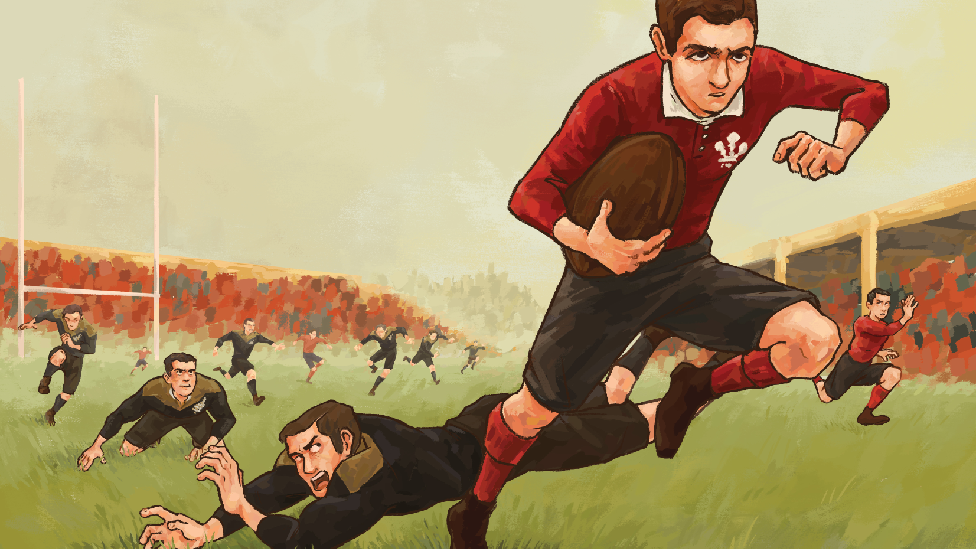
Illustration for a children's book about the match
December 16, 1905: A rugby union match is played, becoming known as the sport's "Match of the Century."
Rugby was allegedly invented at the prep school of the same name in England's Midlands in 1823. Wales began playing it in 1850, the Welsh Rugby Union was formed in 1881, and the Home Nations Championship, between Wales, England, Scotland and Ireland was first played 2 years later. (France was added in 1910, making it the Five Nations Championship. In 2000, Italy was added, making it the Six Nations Championship.)
The sport was first played in New Zealand in 1870. By 1904, New Zealand was sending its national team on tour. Because of their all-black uniforms, they became known as the All Blacks. (The soccer team eventually became known as the All Whites, and their cricket team as the Black Caps.)
The Original All Blacks, also known simply as "The Originals," were the first New Zealand team to tour outside Australasia. They toured the British Isles, France and the United States during 1905–1906. Their opening game, on September 16, 1905, was against Devon, in England's West Country, whom they defeated 55–4. They defeated every English side that they faced, including a 16–3 victory over English county champions Durham in the North-East, and a 32–0 victory over Blackheath in South-East London.
They defeated the national teams of Scotland, 12-7, easily the closest match on the tour before December 16; Ireland, 15-0; and England, also 15-0. On December 13, they beat Yorkshire in Leeds, 40-0. By the time the tour arrived in Wales, the All Blacks had not conceded a single point in their last 600 minutes of rugby. They had played 27 matches on the tour so far, scoring 801 points and conceding just 22.
The team travelled to Wales by train on 15 December, arriving at Cardiff Station in the evening. Despite the late hour, the visitors received a raucous welcome, a large crowd (contemporary estimates put it crowd at 20,000) had gathered to greet the All Blacks both inside the station and along the neighboring streets, preventing the players from getting to their hotel, and police had to force a path through the crowd for the tourists.
As early as October, the Welsh Match Committee had been observing the All Blacks tour. On October 19, the committee travelled to Gloucester, and say the tourists defeat one of the best club sides in England, 44–0. Rugby historians tend to accept that the scale and manner of this All Blacks victory encouraged the Welsh observers to develop new tactics that could match the tourists' unorthodox style.
As early as 1888, the New Zealand players had been performing a pregame routine that featured the haka, a dance of their native Māori people. They brought it with them to Britain. The Wales team debated how to counter this, and it was agreed that they would simply sing "Hen Wlad Fy Nhadau" ("Land of My Fathers"). It is believed to be the earliest performance of a National Anthem before a sporting event, and it whipped the crowd at Catdiff Arms Park into a frenzy, charging the players up.
As has become traditional for them, Wales wore all red, which would have been distinctive in person against New Zealand's literal all-black uniforms, but makes it difficult to tell the teams apart in black & white photographs.
Having studied the All Blacks' tactics, Wales concentrated on outside play. This resulted in a defensive struggle, and accounts of the match were unanimous in reporting how unusually poor New Zealand were in the 1st half, conceding an abundance of penalties in the opening 15 minutes. (Rugby union matches are 80 minutes, 2 halves of 40 minutes each.) One reporter stated that the normally free-scoring All Blacks did not get any play inside the Welsh 25 yard line until the very moment before half-time.
In the 23rd minute, a scrum was called, and Dicky Owen saw a chance to call the move he devised in training. As Wales won the ball, Owen ran it down the blindside, with the backline of Percy Bush, Gwyn Nicholls (the team Captain) and Willie Llewellyn following him in support. This initial move drew several New Zealand players. Owen then switched the play, throwing a long pass back to the openside, with Cliff Pritchard having to take the ball at his feet. The long pass gave Pritchard time to draw a covering tackle, before passing to Rhys Gabe, who similarly drew a would-be tackler. Finally, Gabe passed to Teddy Morgan, who sprinted more than 20 yards to touch down in the left corner. It was 3-0 to Wales, the first time that the All Blacks had conceded without first scoring themselves. Wales failed to kick the conversion.
The All Blacks had most of the attacking play in the 2nd half. Billy Wallace crossed the try line, but was called back, having run into touch and a forward pass from Bob Deans prevented an inevitable try for Duncan McGregor.
The closest opportunity came for the All Blacks when Deans was brought down inches from the line. By this point, there was a mist over the field, and it wasn't clear who had made the key tackle, with reports at the time saying it was a combined effort of Morgan and Gabe, but Morgan gave Gabe sole credit.
The mist led the All Blacks to believe that Deans had scored, which would have tied the game, and given them the chance to take the lead on the ensuing conversion. Even some of the Welsh players admitted that they thought he had scored, then been pulled back. But the referee, J.D. Dallas of Scotland, ruled that he never crossed the line, and was 6 to 12 inches short.
The 3-0 score held, and the crowd invaded the pitch after the final whistle, carrying some of the Wales players off on their shoulders. Dave Gallaher, the New Zealand Captain, went into the Wales locker room, congratulated their team, and admitted that the better team had won. He and Captain Nicholls exchanged shirts. Gallaher's shirt is now on display at the World Rugby Museum at Twickenham Stadium, "The Home of Rugby" in South-West London.
The All Blacks continued their tour, and managed narrow wins against 4 Welsh club teams, before opposing the France national team in its 1st-ever test match. On New Year's Day, January 1, 1906, New Zealand beat France, 38-8. They returned to New Zealand via North America, where they played 2 matches against Canadian teams. Overall, they played a total of 35 matches, which included 5 Tests. The Wales Test was their only loss.
The 1905 All Blacks tour of Britain went on to achieve legendary status within the rugby world, and New Zealand in particular. They scored 976 points and conceded only 59, and thus set the standard for future All Blacks sides. The tour also saw the first use of the All Blacks name, and established New Zealand's reputation as a world-class rugby nation. Some of these players eventually defected, to participate in the professional 1907-08 tour of Australia and Great Britain, where they played against Northern Union sides, in the variation on the sport that would eventually become known as rugby league.
Bob Deans died in 1908, only 3 years after the match, from a botched appendicitis operation. He was only 24. To the end, he insisted that he had scored.
Despite the sport's popularity around the world, there wasn't a Rugby World Cup until 1987, a joint hosting by Australia and New Zealand. It's also been hosted by each of those nations separately, England, Wales, a joint British-Irish hosting, France, South Africa and Japan. It's been won by New Zealand in 1987, 2011 and 2015; Australia in 1991 and 1999; South Africa in 1995, 2007 and 2019; and England in 2003. (UPDATE: South Africa repeated in 2023, making them the 1st 4-time winner, surpassing New Zealand with 3.)
*
December 16, 1905 was a Saturday. There were no scores in North America: Baseball was out of season, football season had just ended, and basketball and hockey were mostly all-amateur.
England's Football League played that day, among the games being a 2-2 tie between Woolwich Arsenal and Yorkshire team Middlesbrough, at the Manor Ground in Plumstead, South-East London. In 1913, the hosts moved to the Highbury section of North London, and dropped the Woolwich locality from their name, becoming simply Arsenal Football Club.

_(cropped).jpg/500px-Lenglen_Wills_Match_of_the_Century_1926_2_(instant)_(cropped).jpg)


