Showing posts with label dartmouth big green. Show all posts

Wednesday, November 16, 2022

November 16, 1940: The Cornell 5th Down Forfeit

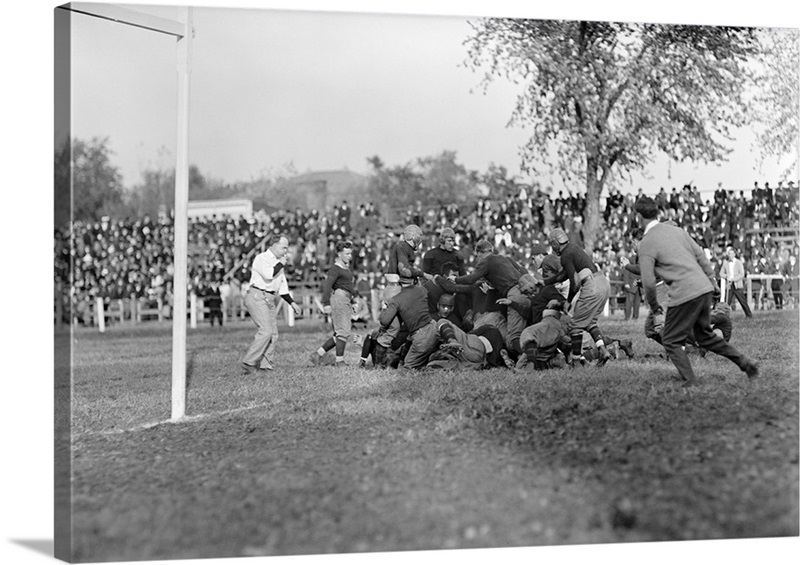
November 16, 1940: A game in what will later be called the Ivy League is played at Memorial Field in Hanover, New Hampshire. Dartmouth College hosts Cornell University.

Cornell came into the game with a 6-0 record, a 14-game winning streak, an 18-game unbeaten streak, the nation's Number 2 ranking, and a claim on the previous season's National Championships. (Most sources, including the recently-established Associated Press poll of sportswriters, gave it to Texas A&M.)

Dartmouth came in 3-4, although only 1 of their losses was by more than 6 points. They were coached by Earl "Red" Blaik, who would later coach the U.S. Military Academy at West Point to 3 straight National Championships.

The game was scoreless until the 4th quarter, when a field goal gave Dartmouth a 3-0 lead. With less than a minute left in the game, Cornell got the ball on Dartmouth's 6-yard line. On 1st down, fullback Mort Landsberg gained 3 yards. On 2nd down, Cornell halfback Walt Scholl managed to run the ball to the 1-yard line. On 3rd down, Landsberg tried to run up the middle, but gained maybe a few inches.

Then came the 4th down. Cornell was penalized for delay of game, and referee Red Friesell spotted the ball just over the 5-yard line. With 9 seconds left on the clock, Cornell quarterback "Pop" Scholl threw an incomplete pass into the end zone.

That should have meant Cornell turned the ball over. and Dartmouth got the ball on their own 20-yard line, and could run out the clock with 1 play and win. Linesman Joe McKenney correctly signaled this. But Friesell had miscounted, and placed the ball on the 6-yard line, giving Cornell 1 more chance -- a 5th down, labeled as a 4th down. Given this extra life, Scholl threw a last-play touchdown pass to William Murphy. The extra point was good, and Cornell were 7-3 winners.

Two days later, while reviewing the game film, Cornell head coach Carl Snavely discovered that the officials had mistakenly given his team an extra down. He told acting athletic director Bob Kane and University President Edmund Day. Day happened to be a Dartmouth graduate, although that turned out to be irrelevant. They all agreed that Cornell should send a telegram to Dartmouth, offering to forfeit. Dartmouth's response was an acceptance, and Cornell sent another telegram to the NCAA, officially forfeiting the game. The NCAA declared Dartmouth the winners, 3-0.

What would have happened if Snavely hadn't noticed the mistake? Or had refused to forfeit? Friesell admitted his mistake to the Eastern Intercollegiate Football Association, and acknowledged that his authority "ceased at the close of the game," so there was little he could do about it. The NCAA might have overruled the result, and declared Dartmouth the winners, anyway. But Snavely's sporting gesture made their decision easy.

On December 8, 1966, the Los Angeles Rams were penalized for holding as they attempted a winning drive against the Chicago Bears at the Los Angeles Coliseum. Holding is one of the penalties that results in a down being replayed, not lost. But the officials mistakenly changed the down marker from 1st to 2nd. Nobody noticed, the Rams went on to turn the ball over on downs, and lost, 17-16. The loss didn't change the NFL's Playoff race, so nothing was ever done about it.

On October 14, 1972, the University of Miami played Tulane at the Orange Bowl, and the officials mistakenly called Miami's offense back on the field after it had turned over on downs. Miami scored a touchdown on the next play, and won, 24-21. They did not forfeit. It wasn't a conference game (both teams were then independents), and neither team went to a bowl game, so this didn't matter much.

On October 6, 1990, a Big Eight Conference game was played at Faurot Field in Columbia, Missouri, between the University of Missouri and the University of Colorado. Late in the game, needing a touchdown to win, Colorado called time-out on what should have been 3rd down, but the officials did not change the down marker. At the time, officials were not required to carry handheld down markers.

So on what should have been 3rd down, every on-field indication was of 2nd down. The scoreboard operator saw this, and put a "2" up on the board. Colorado thus got a 5th down, and scored a touchdown n a quarterback keeper, to win, 33-31. That win, which they refused to forfeit, was certified by the NCAA. They already had a loss and a tie, but still ended up winning the Big Eight and National Championships, neither of which they deserved.

It had been half a century, minus a few weeks, since Cornell's forfeit, and a few people involved in that game were still alive, so it was brought up as an example. But Colorado head coach Bill McCartney, so loud in his evangelical Christian faith, did not do the honorable thing and forfeit, the way Carl Snavely had done 50 years before.

In 2006, ESPN published The ESPN College Football Encyclopedia, which named Cornell's concession the 2nd-greatest moment in college football history. Number 1 was Notre Dame's 1928 win over Army, following coach Knute Rockne's halftime "Win one for the Gipper" speech. That shouldn't surprise anyone, given that the Encyclopedia was edited by Beano Cook, a University of Pittsburgh graduate, but one who, on the air, made no secret of his love of Notre Dame.

*

November 16, 1940 was a Saturday. These other notable college football games were played that day:

* Number 1 Minnesota beat Purdue, 33-6 at Memorial Stadium in Minneapolis. Minnesota won the Big Ten Conference, and were named National Champions by the AP.

* Number 3 Texas A&M beat Rice, 25-0 at Kyle Field in College Station, Texas. A&M won the Southwest Conference and the Cotton Bowl.

* Number 4 Stanford beat Number 19 Oregon State, 28-14 at the old Stanford Stadium in Palo Alto, California. Stanford won the Pacific Coast Conference and the Rose Bowl, and were named National Champions by some polling organizations.

* Number 5 Tennessee beat Virginia, 41-14 at Shields-Watkins Field (later renamed Neyland Stadium) in Knoxville, Tennessee. Tennessee won the Southeastern Conference.

* Number 6 Michigan beat Number 10 Northwestern, 20-13 at Michigan Stadium in Ann Arbor.

* Number 7 Notre Dame were upset by Iowa, 7-0 at Notre Dame Stadium in South Bend, Indiana.

* Number 8 Boston College beat Number 9 Georgetown, 19-18 at Fenway Park in Boston. BC went on to beat Tennessee in the Sugar Bowl, and claimed the National Championship, but most sources gave it to Minnesota or Stanford.

* In a rivalry game, Number 12 Duke were upset by North Carolina, 6-3 at Kenan Stadium in Chapel Hill, North Carolina.

* In what would later, but not yet, be considered a major rivalry game, Florida beat the University of Miami, 46-6 at Burdine Stadium (later the Orange Bowl) in Miami.

* In a rivalry game between Catholic schools on opposite sides of San Francisco Bay, St. Mary's beat the University of San Francisco, 13-7 at Kezar Stadium in San Francisco.

* Army lost to the University of Pennsylvania, 48-0 at Franklin Field in Philadelphia.

* Among New York City teams, New York University (NYU) lost to Penn State, 25-0 at Beaver Field in State College, Pennsylvania; while Columbia played Navy to a 0-0 tie at Baker Field; and Manhattan College lost to Villanova, 13-6 at the Polo Grounds.

* And among New Jersey teams, Princeton beat Yale, 10-7 at Palmer Stadium in Princeton; while Rutgers beat St. Lawrence, 20-0 at Rutgers Stadium in Piscataway.

Baseball was out of season. The NBA hadn't been founded yet. Two games were played in the NHL. The New York Rangers and the Detroit Red Wings played to a tie, 3-3 at the old Madison Square Garden. And the Toronto Maple Leafs beat the Montreal Canadiens, 4-2 at Maple Leaf Gardens in Toronto.

Sunday, November 13, 2022

November 14, 1903: Harvard Stadium Opens

November 14, 1903: Harvard Stadium opens, changing the history of college football, and of sports venues in general.

Harvard University, America's 1st college and one of its earliest practitioners of intercollegiate sports, began playing football in 1873, at Jarvis Field. In 1898, their baseball and football teams moved to Soldier's Field, dedicated as a memorial to Harvard men who had sacrificed their lives in the American Civil War. Their baseball team still plays there today, although since 1997 it has been named Joseph J. O'Donnell Field, after a former Harvard baseball player whose donations allowed them to upgrade it.

But college football was becoming a business, and Harvard perennially had one of the best teams in the sport. In 1903, Harvard Stadium was built, the 1st vertical structure to employ reinforced structural concrete.

This would inspire not just football stadiums, but baseball stadiums: In 1909, Shibe Park in Philadelphia would be the first concrete-and-steel ballpark, followed later that year by Sportsman's Park in St. Louis and Forbes Field in Pittsburgh; in 1910, League Park in Cleveland and Comiskey Park in Chicago; in 1911, the Polo Grounds in New York and Griffith Stadium in Washington; in 1912, Crosley Field in Cincinnati, Tiger Stadium in Detroit and Fenway Park in Boston; in 1913, Ebbets Field in Brooklyn; in 1914, Wrigley Field in Chicago; and in 1915, Braves Field in Boston.

After playing their 1st 8 games of the 1903 season at Soldier's Field, the Crimson opened Harvard Stadium on November 14. Dartmouth College spoiled the party, winning, 11-0. However, when Harvard's arch-rivals, Yale University, opened the Yale Bowl in 1914, Harvard would win the first game there.

In 1905, a newspaper with a photograph of a bloody football player, Swarthmore College guard Robert "Tiny" Maxwell," made its way to President Theodore Roosevelt. A former athlete himself -- he had been on the Harvard boxing team in 1880, and played tennis even while President -- he requested figures, and found out that 18 young men had died playing college football in 1904.

So the Rough Rider hauled the presidents of Harvard, Yale and Princeton -- then the nation's leading football-playing universities -- into the White House, and told them point-blank: Either you do something to make football safer, or I will take action. Given his reputation as a man who got things done and didn't let anything stand in his way, just the possibility that he would be taking over their sport, taking their power away, was enough to spur them into action. The safety measures they took over the next year are now considered the founding of the National Collegiate Athletic Association (NCAA).

One move that was made in the interest of safety was the invention of hashmarks, putting the ball at the yard-line where the last play ended, but closer to the middle of the field, instead of putting the ball exactly where the play ended every time.

Another suggestion was widening the field. But Harvard shot this idea down, since they had only opened Harvard Stadium in 1903, and they didn't have room to widen their field, and they weren't going to tear down half of their new stadium just to accommodate everyone else. In those days, what Harvard wanted, Harvard got. So an alternative was thought up: The legalization of the forward pass. It would take a few years, but football became considerably more exciting because of it.

The addition of stands in the northeast end zone of Harvard Stadium's horseshoe raised the seating capacity to 57,166. But as the Ivy League decreased in importance and influence, so did crowds, and this bleachers were replaced by a smaller structure in 1952, dropping capacity to 40,280. This would be the attendance for the stadium's, and the Ivy League's, most famous game, the title decider that decided nothing, as unbeaten Harvard came from 16 points down in the last minute to hold unbeaten Yale to a tie -- or, as the Harvard Crimson newspaper headline put it, "HARVARD BEATS YALE, 29-29."

In the 1970 season, and only in that season, Harvard Stadium was the home of the NFL's Boston Patriots. In 1971, they moved to suburban Foxborough, Massachusetts. In 1998, the steel bleachers in the open end were torn down, and replaced by the Murr Center. This reduced the seating capacity to the current 30,323.

The oldest active stadium in college football, and still in good shape due to the donations of rich alumni, Harvard Stadium maintained a natural grass surface until the 2006 season, when it was replaced by FieldTurf. That same year, it got its first permanent lights. Its 1st night game was played on September 22, 2007, a 24-17 win over Brown University.

*

November 14, 1903 was a Saturday. These other noteworthy college football games were played:

* Elsewhere in what would became known as the Ivy League, Princeton beat Yale, 11-6 at Yale Field in New Haven, Connecticut; Columbia beat Cornell, 17-12 at Percy Field in Ithaca, New York; the University of Pennsylvania lost to the Carlisle Indian School, 16-6 at Franklin Field in Philadelphia, perhaps the 1st notable upset by a school that would produce many over the next few years; and Brown beat Syracuse, 12-5 at the Old Oval in Syracuse, New York.

* Among the service academies, Army beat the University of Chicago, 10-6 on The Plain in West Point, New York; and Navy lost to Bucknell, 23-5 at Worden Field in Annapolis, Maryland.

* Alabama, not yet a big football school, lost to Cumberland College, 44-0 on The Quad in Tuscaloosa, Alabama.

* Georgia, already a big football school, were upset by the Savannah Athletic Club, 6-0 in Savannah, Georgia.

* Michigan beat Wisconsin, 16-0 at Regents Field in Ann Arbor, Michigan.

* Minnesota beat Illinois, 32-0 at Illinois Field in Champaign, Illinois.

* Notre Dame, not yet a big football school, played Northwestern to a 0-0 tie at South Side Park, then the home of the Chicago White Sox.

* The Pennsylvania State College, not yet a university, let alone a big football school -- unlike a lot of schools then using only colors as a team name, before developing mascots, they were simply "the Penn State football team" -- lost to Dickinson College, 6-0 at Williamsport, Pennsylvania.

* In an intracity rivalry, Georgetown University beat George Washington University, 33-0 at Georgetown Field in Washington, D.C.

* In what would become one of the biggest rivalries in the sport was played the day before: Texas beat Oklahoma, 11-5 at Colcord Park in Oklahoma City. Oklahoma was still a Territory, and wouldn't gain Statehood until 1907.

* And in another growing Western rivalry, Colorado A&M beat Wyoming, 17-0 at Durkee Field in Fort Collins, Colorado. A&M was renamed Colorado State in 1957.

Monday, November 7, 2022

November 7, 1908: The Deaths (?) of Butch Cassidy & the Sundance Kid

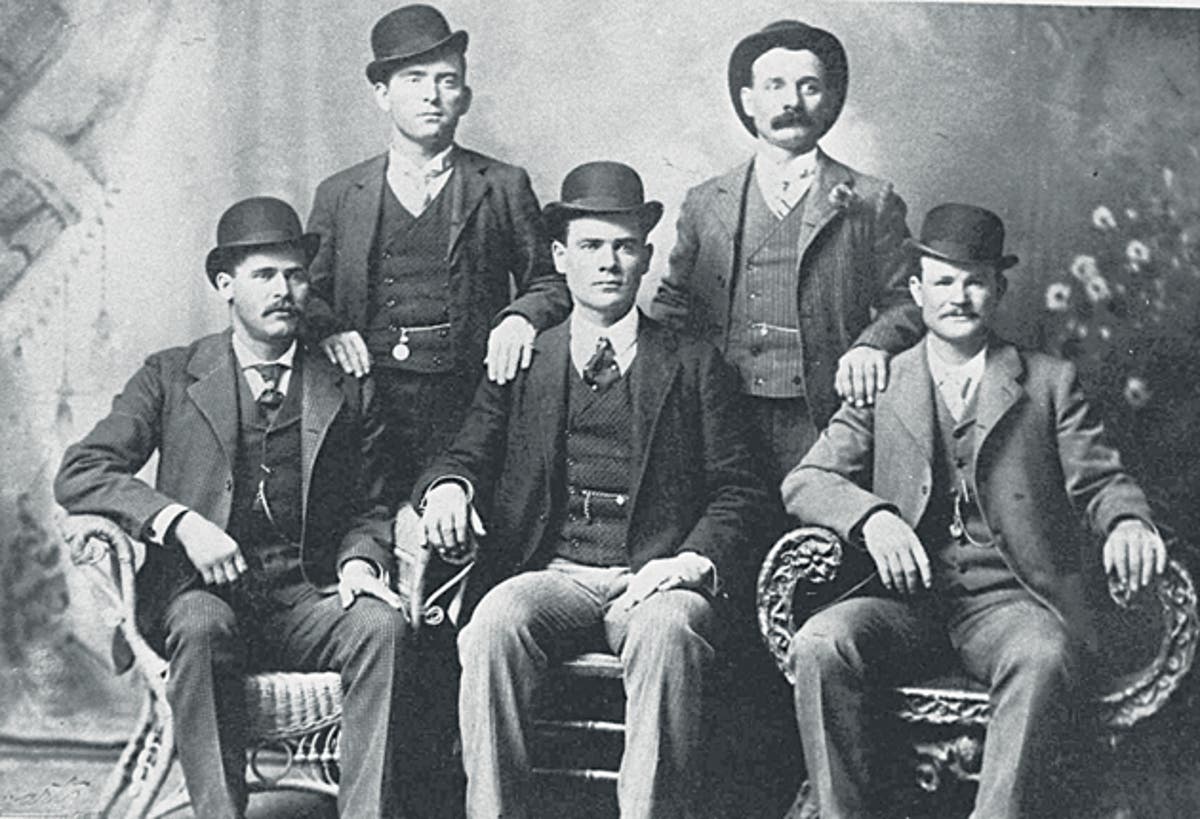
The 1899 "Fort Worth Five" photo.
Top row, left to right: William Carver and Harvey Logan.
Bottom row, left to right: Harry Longabaugh (the Sundance Kid),
Ben Kilpatrick, and Robert Parker (Butch Cassidy).

November 7, 1908: In San Vicente, Bolivia, soldiers engage in a shootout with 2 men who had robbed the payroll of a silver mine. The robbers were found dead: Apparently, with both men wounded, one shot the other to put him out of his misery, and then used his last bullet on himself.
The local authorities confirmed that these men were the robbers, but they did not know the men's names. The widely-accepted story is that the men were Robert Leroy Parker and Harry Alonzo Longabaugh -- a.k.a. the American outlaws known as Butch Cassidy and the Sundance Kid, respectively.
Butch and Sundance were the last of the major Wild West outlaws. From 1889 to 1901, with their Wild Bunch gang, they robbed banks and trains throughout the Rocky Mountain States, especially Parker's native Utah (which gained Statehood in 1896). In 1901, along with Longabaugh's girlfriend Etta Place, they escaped to New York, and then took a ship to South America: First to Argentina, then to Chile, and finally to Bolivia, in the hopes of becoming respectable ranchers.
But they couldn't make an honest living, so they turned back to robbery, which is why they had to leave Argentina and then Chile. Finally, in 1906, Place got tired of living on the run, and went back to America. History loses track of her after that.
Attempts to determine whether Butch and Sundance actually were the men killed in the San Vicente shootout have thus far failed. It has been alleged, including by Cassidy's sister, that Butch left Bolivia and was still alive as late as 1937. (He would have been 72.) A suggestion that Sundance was still alive as late as 1936 has been proven by DNA testing to be false, but, so far, that's as close as DNA testing has come to proving anything. Among the stories, it has been suggested that Etta may have been alive as late as 1966.
For all we know, the old Utah and Wyoming bank and train robbers of the 1890s may well have had a good laugh about it all for a long time thereafter.
Among the depictions of Butch and Sundance: The 1951 film The Texas Rangers (played by John Doucette and Ian MacDonald, respectively), the 1956 film The Three Outlaws (Neville Brand and Alan Hale Jr.), a 1958 episode of Tales of Wells Fargo (only Butch appears, played by a young Charles Bronson), the 1969 film Butch Cassidy and the Sundance Kid (Paul Newman and Robert Redford, with Katharine Ross as Etta), the 1979 film Butch and Sundance: The Early Days (Tom Berenger and William Katt), the 1994 TV-movie The Gambler V: Playing for Keeps (Scott Paulin and Brett Cullen, with Mariska Hargitay as Etta), and the 2004 TV-movie The Legend of Butch & Sundance (David Clayton Rogers and Ryan Browning, with Rachelle Lefevre as Etta).
*
November 7, 1908 was a Saturday. Baseball was out of season. Basketball and hockey were not yet professional. But there was college football to be played. Among the games:
* The Polo Grounds in New York hosted a crowd of 10,000, as undefeated Dartmouth (5-0-1) beat previously undefeated Princeton (5-0-3), 10-6.
* Harvard and the Carlisle Indian School (with Jim Thorpe not yet playing) were both 6-0-1 when facing each other in Cambridge, Massachusetts, and Harvard won, 17-0.
* Yale, undefeated, blew a 10-0 lead at home in New Haven, Connecticut, and escaped with a 10-10 with Brown.
* The University of Pennsylvania beat Lafayette, 34-4 at the original Franklin Field (built in 1895, replaced in 1922) in Philadelphia. They finished 11-0-1, and were recognized as the National Champions. A 6-6 tie with Carlisle was the only blemish on their record, though it should be noted that they didn't play either Harvard, Yale or Princeton. They did go on to beat Michigan, though.
* The University of Pittsburgh undefeated, stayed that way, beating the school that would become their arch-rivals, West Virginia, 11-0 at Exposition Park, home of baseball's Pirates. In their 1st 7 games, Pitt had outscored their opponents 128-4. But they lost 3 of their last 4 games, all at home.
* Army beat Springfield, 6-5 at West Point, New York.
* Navy beat Villanova, 30-6 at Annapolis, Maryland.
* Michigan beat Kentucky, 62-0 at Ann Arbor, Michigan.
* Notre Dame beat Indiana, 11-0 at Washington Park in Indianapolis.
* New York University lost to Rensselaer Polytechnic Institute. RPI beat NYU, 11-0 in Troy, New York.
* And Rutgers could only manage a 6-6 tie with Delaware.

Monday, October 24, 2022

October 24, 1914: Palmer Stadium Opens In Princeton

October 24, 1914: Palmer Stadium opens, on the southern edge of the campus of Princeton University in Princeton, Mercer County, New Jersey. Princeton defeats Dartmouth College, 16-12.

Prior to Palmer Stadium, Princeton played at University Field, also known as Osborne Field, about 3 blocks to the north of the Palmer site. It seated 20,000, and they continued to play baseball at the site until 1960, when the Engineering Quadrangle began to be built on the site.

The building was named for Stephen S. Palmer, a trustee of the university, by his son, Edgar Palmer III. It was a horseshoe with the open end at the south, facing Lake Carnegie, with a full-sized track around the football field. (In 1936, Edgar Palmer III also funded the building of the centerpiece of the Borough of Princeton, Palmer Square.)

While playing at Palmer Stadium, Princeton won 5 National Championships: 1920, 1922, 1933, 1935 and 1950. The Ivy League was founded in 1954, and in 2021, Princeton won its 12th Ivy League title.

Briefly, in the early 1970s, when the New York Giants needed a temporary home between the October 1973 closing of the original Yankee Stadium and the October 1976 opening of Giants Stadium. Palmer Stadium was considered, due to its relative proximity and its 45,750-seat capacity -- larger than Michie Stadium at West Point, and twice the capacity of Rutgers Stadium.

Traffic and parking would have been a nightmare, but the real reason it was voted down was that the NFL now had a rule that games had to be played in stadiums of at least 50,000 capacity. That rule was bent for the Tennessee Oilers (1998) and the Los Angeles Chargers (2017-19), but not for the Giants in the 1970s.

On October 10, 1987, I was at Palmer Stadium to see Princeton play Columbia. Dean Cain, later to play Superman on television, intercepted a pass and returned it for a touchdown, and Princeton won, 38-8. It was Columbia's 35th consecutive loss, setting a new record for the longest in NCAA Division I history. Oddly, the next season, they ended that streak by beating Princeton at home, at 44 games. Prairie View A&M put that record out of reach, losing 80 straight from 1989 to 1998.
Palmer Stadium as I knew it,
with Jadwin Gym in the background

By the time of that 1987 Princeton-Columbia game Palmer Stadium was already in bad shape. It remained the Princeton Tigers' home until 1996, when, finally bowing to the reality that age had rendered it unsafe, the University agreed to tear it down and build a new home field on the site.

As with the 1st game, the last game was against Dartmouth, on November 23, 1996, and Princeton lost, 24-0. (To be fair, Dartmouth was then ranked Number 18 in the nation, and finished the season undefeated.) Only 16,461 fans came out to say goodbye. The days of Princeton football really mattering were long gone.

Princeton played all their 1997 games on the road while Powers Field at Princeton University Stadium was built on the site. Amazingly, they went 6-4. They did play 2 games in New Jersey. They beat Fordham before 4,050 fans at Lions Field in Ewing, home of the school formerly known as Trenton State College, but which, in 1996, had just taken on the name that Princeton University, itself, had until 1896: "The College of New Jersey." And they beat Yale at Giants Stadium (roughly halfway between the schools), in front of 7,731.

Don't be shocked by those low attendances: Ivy League football is no longer a big draw, and when their game against Penn at Franklin Field got 15,847, it became Princeton's only game all season with more than 8,542. (Penn didn't do much better: With a poor season, it was their only crowd above 13,000 at the 60,000-seat stadium.)

What is usually called simply "Princeton Stadium," with a capacity of 27,773 seats, opened on September 19, 1998. Princeton beat Cornell University, 6-0, before a full house. They had 4 more home games, each with at least 19,000 fans.
Jadwin Gym had opened in front of Palmer Stadium's open south end in 1969. Weaver Track & Field Stadium was built in between Princeton Stadium and Jadwin Gym, giving Princeton a top-class track facility and enabling them to build the stands at their new football stadium close to the field, without a track around it.

In 2007, in honor of a $10 million donation for a new artificial turf field the year before, by William C. Powers, managing director at Pacific Investment Management, and a former Princeton defensive back and punter, the playing surface was renamed Powers Field. The stadium retained the name Princeton Stadium.

*

October 24, 1914 was a Saturday. These other notable college football games were played that day:

* Army beat Holy Cross, 14-0 on The Plain in West Point, New York. Army went 9-0 that season.

* Navy beat Western Reserve, 48-0 at Worden Field in Annapolis, Maryland.

* The University of Chicago beat Purdue, 21-0 at Stagg Field in Chicago.

* Nebraska beat Michigan State, 24-0 at Nebraska Field in Lincoln. Nebraska finished 7-0-1 and won the Missouri Valley Conference title.

* Tennessee beat Alabama, 17-7 at Waite Field in Knoxville, Tennessee. They went 9-0, and won the Southern Intercollegiate Athletic Association title.

* Illinois beat Northwestern, 33-0 at Northwestern Field in the Chicago suburb of Evanston, Illinois. At the time, Northwestern considered Illinois their arch-rivals, but Illinois considered theirs to be Chicago. Illinois went 7-0, and won the title of the Western Conference, which later became the Big Ten.

* Texas beat arch-rival Oklahoma, 32-7 at Fair Park Stadium in Dallas. Texas went 8-0 that season, and won the 1st-ever Southwest Conference title.

* In what would become a major rivalry, Minnesota beat Iowa, 7-0 at Iowa Field in Iowa City.

* Syracuse beat Michigan, 20-6 at Archbold Stadium in Syracuse, New York.

* Penn State stunned Harvard, playing them to a 13-13 tie at Harvard Stadium in Boston.

* Notre Dame, coming off its major upset of Army the season before, beat South Dakota, 33-0 at Sioux Falls, South Dakota.

* In New York City, the Polo Grounds hosted a neutral-site game in which Cornell beat Brown, 28-7; Fordham beat Rhode Island State (known since 1951 at the University of Rhode Island), 28-0 at Fordham Field in The Bronx; and New York University beat Rensselaer Polytechnic Institute: NYU 17, RPI 6, at Ohio Field in The Bronx.

* And New Jersey's other school -- it would be a long time before they could turn Princeton into the Garden State's "other school" -- Rutgers beat Tufts, 16-7 at Neilson Field in New Brunswick.

The baseball season had ended the day before, with the Boston Braves completing a "miracle" 4-game sweep of the Philadelphia Athletics in the World Series. Professional basketball barely existed. It was too early for hockey season to start.

In English soccer, North London team Arsenal went to the East Midlands, and lost to Derby County, 4-0 at The Baseball Ground. Derbyshire was one of the few places in England where baseball caught on, and it wasn't for long, yet the "Baseball Ground" name held until the stadium was replaced in 1997.

Tuesday, September 20, 2022

September 21, 1912: College Football's Modern Rules

Carlisle beating Georgetown, 34-20,
at Georgetown Field in Washington,
on October 26, 1912.
Somewhere in the middle of that is Carlisle's Jim Thorpe.

September 21, 1912: A new season begins for college football. It contains some key rule changes:

Teams were given 4 downs, instead of 3, to gain 10 yards.
The value of a touchdown was increased from 5 points to 6 points.
The length of the playing field was reduced from 110 yards to 100 yards, and end zones of 10 yards were added.
Kickoffs were to be conducted from the kicking team's 40-yard line, rather than at midfield, the 50-yard line.

It's hard to tell what kind of a difference this made, as college football had already become a big business. Certainly, over the next few years, it became a bigger one. But these rules were a major step in making American football recognizable as the game we know today.

*

September 21, 1912 was a Saturday. As for the actual games played under these new rules, on this season-opening weekend, there were only 3:

* The Carlisle Indian School, led by Jim Thorpe, beat Albright College, 50-7 at Indian Field in Carlisle, Pennsylvania, outside Harrisburg. The year before, Carlisle went to Boston and upset Harvard. Just 7 weeks after this, they would pull a bigger upset, beating Army at West Point. Despite their success, the school folded after the 1917 season.

* Cornell beat Washington & Jefferson College, 3-0 at Percy Field in Ithaca, New York.

* And Dartmouth beat Bates College, 26-0 at Alumni Oval in Hanover, New Hampshire.

Albright is in Reading, Pennsylvania; Washington & Jefferson is in Washington, Pennsylvania, outside Pittsburgh; and Bates, is in Lewiston, Maine. All of them downgraded their programs in the 1950s, and now compete in NCAA Division III.

These baseball games were played:

* The New York Highlanders lost to the Cleveland Naps, 5-4 at League Park in Cleveland. Napoleon "Nap" Lajoie, the manager and 2nd baseman for whom the home team was named, went 1-for-4. Shoeless Joe Jackson went 2-for-5. The Highlanders became the New York Yankees the next season. The Naps became the Cleveland Indians in 1915, and the Cleveland Guardians in 2022.

* The New York Giants beat the Pittsburgh Pirates, 2-1 at the Polo Grounds. Red Murray went 3-for-4 with a home run. Honus Wagner went 1-for-4.

* The Brooklyn Dodgers beat the St. Louis Cardinals, 12-0 at Washington Park in Brooklyn. George Napoleon "Nap" Rucker pitched a 7-hit shutout. The Dodgers played just 9 more games at Washington Park. The next season, they moved into Ebbets Field.

* The Boston Braves beat the Cincinnati Reds, 13-3 at the South End Grounds in Boston.

* The Philadelphia Phillies swept a doubleheader from the Chicago Cubs, 3-2 and 5-3 at National League Park (later Baker Bowl) in Philadelphia.

* The Boston Red Sox beat the Detroit Tigers, 11-4 at Navin Field (later Briggs Stadium and Tiger Stadium) in Detroit. Tris Speaker went 2-for-3 with a home runs, 2 walks and 2 RBIs. Ty Cobb went 0-for-4.

* The St. Louis Browns beat the Philadelphia Athletics, 4-3 at Sportsman's Park in St. Louis. Eddie Collins went 2-for-3 with a walk and 2 RBIs.

* And the Chicago White Sox and the Washington Senators were rained out at Comiskey Park in Chicago. The game was made up as part of a doubleheader the next day. The Senators swept, 6-3 and 4-1. Walter Johnson was the winning pitcher in the opener.

And in English soccer, Woolwich Arsenal went to Yorkshire, and beat Sheffield United, 3-1 at Bramall Lane. However, the 1912-13 season would be the worst in the team's history, as they were relegated for what remains the only time. They then moved across the River Thames, from South-East to North London, opened the stadium that became known as Highbury, and returned to Division One in 1919.

December 31, 1999 & January 1, 2000: The Millennium

December 31, 1999:  The Millennium arrives. The people of planet Earth survived. At a terrible cost. But we hadn't destroyed ourselves. ...