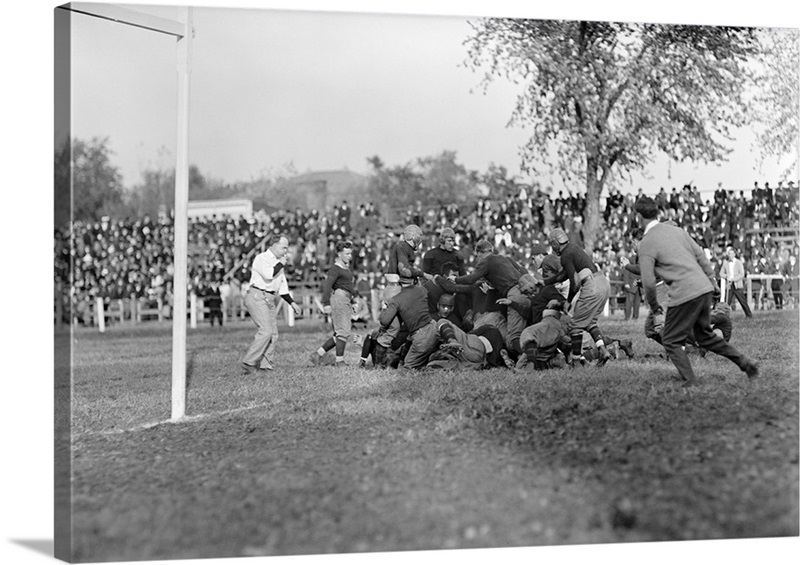
at Georgetown Field in Washington,
on October 26, 1912.
Somewhere in the middle of that is Carlisle's Jim Thorpe.
September 21, 1912: A new season begins for college football. It contains some key rule changes:
* Teams were given 4 downs, instead of 3, to gain 10 yards.
* The value of a touchdown was increased from 5 points to 6 points.
* The length of the playing field was reduced from 110 yards to 100 yards, and end zones of 10 yards were added.
* Kickoffs were to be conducted from the kicking team's 40-yard line, rather than at midfield, the 50-yard line.
It's hard to tell what kind of a difference this made, as college football had already become a big business. Certainly, over the next few years, it became a bigger one. But these rules were a major step in making American football recognizable as the game we know today.
*
September 21, 1912 was a Saturday. As for the actual games played under these new rules, on this season-opening weekend, there were only 3:
* The Carlisle Indian School, led by Jim Thorpe, beat Albright College, 50-7 at Indian Field in Carlisle, Pennsylvania, outside Harrisburg. The year before, Carlisle went to Boston and upset Harvard. Just 7 weeks after this, they would pull a bigger upset, beating Army at West Point. Despite their success, the school folded after the 1917 season.
* Cornell beat Washington & Jefferson College, 3-0 at Percy Field in Ithaca, New York.
* And Dartmouth beat Bates College, 26-0 at Alumni Oval in Hanover, New Hampshire.
Albright is in Reading, Pennsylvania; Washington & Jefferson is in Washington, Pennsylvania, outside Pittsburgh; and Bates, is in Lewiston, Maine. All of them downgraded their programs in the 1950s, and now compete in NCAA Division III.
These baseball games were played:
* The New York Highlanders lost to the Cleveland Naps, 5-4 at League Park in Cleveland. Napoleon "Nap" Lajoie, the manager and 2nd baseman for whom the home team was named, went 1-for-4. Shoeless Joe Jackson went 2-for-5. The Highlanders became the New York Yankees the next season. The Naps became the Cleveland Indians in 1915, and the Cleveland Guardians in 2022.
* The New York Giants beat the Pittsburgh Pirates, 2-1 at the Polo Grounds. Red Murray went 3-for-4 with a home run. Honus Wagner went 1-for-4.
* The Brooklyn Dodgers beat the St. Louis Cardinals, 12-0 at Washington Park in Brooklyn. George Napoleon "Nap" Rucker pitched a 7-hit shutout. The Dodgers played just 9 more games at Washington Park. The next season, they moved into Ebbets Field.
* The Boston Braves beat the Cincinnati Reds, 13-3 at the South End Grounds in Boston.
* The Philadelphia Phillies swept a doubleheader from the Chicago Cubs, 3-2 and 5-3 at National League Park (later Baker Bowl) in Philadelphia.
* The Boston Red Sox beat the Detroit Tigers, 11-4 at Navin Field (later Briggs Stadium and Tiger Stadium) in Detroit. Tris Speaker went 2-for-3 with a home runs, 2 walks and 2 RBIs. Ty Cobb went 0-for-4.
* The St. Louis Browns beat the Philadelphia Athletics, 4-3 at Sportsman's Park in St. Louis. Eddie Collins went 2-for-3 with a walk and 2 RBIs.
* And the Chicago White Sox and the Washington Senators were rained out at Comiskey Park in Chicago. The game was made up as part of a doubleheader the next day. The Senators swept, 6-3 and 4-1. Walter Johnson was the winning pitcher in the opener.
And in English soccer, Woolwich Arsenal went to Yorkshire, and beat Sheffield United, 3-1 at Bramall Lane. However, the 1912-13 season would be the worst in the team's history, as they were relegated for what remains the only time. They then moved across the River Thames, from South-East to North London, opened the stadium that became known as Highbury, and returned to Division One in 1919.


No comments:
Post a Comment