Showing posts with label red auerbach. Show all posts

Saturday, April 30, 2022

April 30, 1956: The Boston Celtics Trade for Bill Russell

April 30, 1956: The NBA Draft is held in New York. With the 1st pick, the Boston Celtics -- having just completed their 1st 10 seasons, and not yet having appeared in an NBA Finals -- selected Tommy Heinsohn, forward from the nearby College of the Holy Cross.
With the 2nd pick, the Rochester Royals selected Sihugo Green, a guard from Duquesne University in Pittsburgh. "Si" Green was a decent player, but hardly the kind of star you would expect to go as the 2nd pick overall.
With the 3rd pick, the St. Louis Hawks drafted Bill Russell, a center who had led the University of San Francisco to back-to-back National Championships. It looked like the Hawks had gotten the best player.
But later that day, the Hawks traded the rights to the as-yet-unsigned Russell to the Celtics, for center Ed Macauley and forward Cliff Hagan.
Result: Over the next 13 seasons, Russell would lead the Celtics to 12 NBA Finals, and 11 NBA Championships. The Celtics became the most dominant team in North American sports history -- not winning as many World Championships as Major League Baseball's New York Yankees or the National Hockey League's Montreal Canadiens, but winning more titles in a shorter period of time. 
Meanwhile, the Hawks won just 1 title, and were forced to move out of St. Louis, to Atlanta, where they have been a perennial letdown.
It is the biggest transactional blunder in the NBA's history. How could the Hawks have been so dumb? Well, maybe, they were not as dumb as we've been led to believe. As the biggest star coming out of college basketball, Russell was already believed to be ready to demand big money, which most NBA team owners didn't have. Hawks owner Ben Kerner didn't have it. Celtics owner Walter Brown did, because he also owned his arena, the Boston Garden, and the other team that played there, the NHL's Boston Bruins.
What's more, Brown owned the Ice Capades. At the time, it was a bigger moneymaker than the NBA or the NHL. So was the Ringling Brothers and Barnum & Bailey Circus. It came to New York every April, and so the Madison Square Garden Corporation gave them choicer dates. This forced the Rangers in 1950, and the Knicks in 1951, to play Finals games on the road, possibly costing them titles.
The Royals had a chance to select Russell, but passed on him. Why? Because Brown made a deal with Royals owner Les Harrison: Select somebody other than Russell, and I'll add Rochester to the Ice Capades' tour. It was an offer Harrison couldn't refuse. (And no heads -- human, horse, or otherwise -- were hurt in the process.)
It was a short-term fix for the Royals. But that's the way the NBA had to operate at the time. A year later, Harrison moved the Royals to Cincinnati. They won the NBA Championship in 1951. Through the 2021-22 season, 71 years later, this franchise, now known as the Sacramento Kings, has never been back to the NBA Finals. But Harrison did what he had to do to stay in business, and that meant giving up a chance at a man who could have become one of the NBA's greatest players ever, and did.
But he might not have. Until Michael Jordan led the Chicago Bulls to 6 NBA Championships -- 3 with Bill Cartwright at center, and 3 with Luc Longley -- it was generally believed that you had to have a really good center, a big man in the middle, to win an NBA Championship.
But until Russell, Mikan was the only big man who was able to lead a team to an NBA title. Until Russell, the NBA's best players had been smaller guys who were good outside shooters, guys like Joe Fulks (1947 Philadelphia Warriors), Buddy Jeannette (1948 Baltimore Bullets), Bob Davies (1951 Rochester Royals), Dolph Schayes (1955 Syracuse Nationals) and Paul Arizin and Tom Gola (1956 Philadelphia Warriors).
Before Russell, there were 3 truly great "big men" in college basketball. Mikan, from DePaul University in Chicago, was one. Another was Bob Kurland of Oklahoma A&M (now Oklahoma State). He never played pro ball, instead taking a job with Phillips Petroleum, with a great benefits package, including playing for their "semipro" team.
And the other was Clyde Lovellette of the University of Kansas. He had a good pro career, winning titles as Mikan's backup on the Lakers, and later as Russell's backup on the Celtics. But he was never a pro star: He's in the Basketball Hall of Fame, but mainly for what he did in college.
But there was, as yet, no model for what kind of college stars would become pro stars. Like I said, the NBA was only 10 years old at this point. In hindsight, Mikan was the model. Russell admitted that Mikan was his idol. Mikan enjoyed being thought of the progenitor of the NBA's big men.
But at the time, he was seen as a freak of nature, a happy accident that the Lakers had gotten their hands on. Big men were considered to be slow. Mikan was a good shooter and a strong rebounder, but he wasn't fast. Bill Mazer, the great New York sportscaster, compared him to a stampeding elephant. Bob Ryan of The Boston Globe, in a 1996 ESPN appearance celebrating the NBA's 50th Anniversary, said that, in the modern game, he would be "a good backup center. Deserved every accolade he got at the time, but he's Greg Kite with a hook shot." 
In 2021, at the NBA's 75th Anniversary; in 1996, at the 50th; in 1971, at the 25th... Russell seemed like the obvious player to both select and hang onto. In 1956, he wasn't the obvious pick to do that. Maybe he should have been, but he wasn't.
Then there's St. Louis to consider. It's not just that the Hawks were far behind baseball's Cardinals in terms of popularity in the city. It's that St. Louis was a racially segregated city, in Missouri, a racially segregated State. Cardinal stars like Bob Gibson and Curt Flood would chafe under the policies that segregation forced, until federal law broke it.
Russell -- who would eventually, very accurately, title his autobiography Memoirs of an Opinionated Man -- might not have adjusted so well, having been a boy in segregated Louisiana, and grown up in noticeably (but not completely) more racially liberal Oakland. He eventually had problems with race relations in Boston. In St. Louis, it might have been worse. As a result, he might not have won all those titles with the Hawks.
Anyway, it's not as if the Hawks blew it completely. In 1957, the Celtics and Hawks each made the NBA Finals for the 1st time. It went to double overtime of Game 7 before the Celtics won it. In 1958, both teams made it back, and Russell hurt his ankle in Game 3, and was out the rest of the way. The Hawks, led by the men traded for the rights to Russell, Hagan and St. Louis native Macauley, as well as Hall-of-Fame forward Bob Pettit, won the title in 6 games.
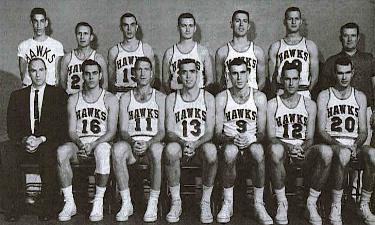
The 1958 NBA Champions.
Hagan is Number 16, Pettit 9, and Macauley 20.
In 1959, the Minneapolis Lakers won the Western Conference, and lost to the Celtics in the Finals. In 1960 and '61, the Hawks returned to the Finals, and lost to the Celtics both times. Still, at that point, the players the Hawks got for Russell had gotten them into 4 Finals, winning 1. It could have been better, but it was still better than anybody else except the Celtics were doing.
Still, it was a dumb trade.
*
April 30, 1956 was a Monday. There was only one score on this historic day, and it was in baseball: The St. Louis Cardinals beat the Milwaukee Braves, 2-0 at Milwaukee County Stadium. Warren Spahn allowed only 3 hits over 8 innings for the Braves, but 

Thursday, April 28, 2022

April 28, 1966: Eight Straight NBA Championships

Russell is already smelling Auerbach's victory cigar.

April 28, 1966: Game 7 of the NBA Finals is played at the Boston Garden. The Boston Celtics beat the Los Angeles Lakers, 95-93. It was their 9th NBA Championship, and their 8th in a row. This is easily a record for North American major league sports.

Bill Russell scored 25 points, and had 32 rebounds. Sam Jones scored 22, and John Havlicek 16. For the Lakers, Jerry West scored 36, but nobody else scored more than Elgin Baylor's 18.

The '66 Celtics included 7 eventual members of the Basketball Hall of Fame: Russell, Havlicek, Sam Jones, K.C. Jones (no relation), Tom "Satch" Sanders, and 2 men whose main contributions would come later, as coaches: Don Nelson and John Thompson. Head coach and general manager Arnold "Red" Auerbach would also be elected. Russell, Sam Jones and Havlicek were named to the NBA's 50th and 75th Anniversary Teams. So was K.C. Jones, as one of the 10 Greatest Coaches rather than as a player.

This would be Auerbach's last title as head coach: He resigned to concentrate on the front office, and named Russell as the NBA's 1st black head coach. If you don't count the early NFL as being truly "major league," a legitimate argument, thus eliminating Fritz Pollard of the 1921 Akron Pros, then Russell was the 1st black head coach in North American major league sports.

The New York Yankees won 5 straight World Series from 1949 to 1953, but no team has won 6. The Montreal Canadiens won 5 straight Stanley Cups from 1956 to 1960, but no team has won 6. The Green Bay Packers won 3 straight NFL Championships, from 1929 to 1931, and again from 1965 to 1967, but no team has won 4.

Does this make the 1959-66 Celtics the greatest dynasty in North American sports? Not really: While some of the greatest basketball players ever were then active -- including Russell, Havlicek, West, Baylor, Wilt Chamberlain and Oscar Robertson -- the NBA wasn't getting as big a share of great athletes as it could have.

The era's top 2 pitchers, Sandy Koufax and Bob Gibson, had both gone to college on basketball scholarships. And it's not hard to imagine baseball stars Willie Mays and Lou Brock as point guards, or fearsome defensive ends Gino Marchetti and Willie Davis as power forwards. Indeed, the Celtic team that won 3 out of 6 titles in the 1980s was probably better, top-to-bottom, than the team that won 8 straight titles.

The Celtics and Lakers have both won 17 NBA Championships, tied for the most of any team. However, the Lakers won 5 of those while they were in Minneapolis, from 1947 to 1960, so, in a way, the Celtics are still on top. And Auerbach was general manager for the 1st 15 of those Championships, giving up that title in 1984; and team president for the 1st 16 Championships, giving up that title in 1997. He died in 2006.

They've won the Finals over the Lakers in 1959, 1962, 1963, 1965, 1966, 1968, 1969, 1984 and 2008; the St. Louis Hawks (now the Atlanta Hawks) in 1957, 1960 and 1961; the San Francisco Warriors (now the Golden State Warriors) in 1964; the Milwaukee Bucks in 1974; the Phoenix Suns in 1976; and the Houston Rockets in 1981 and 1986.

They've also lost the Finals to the Hawks in 1958; the Lakers in 1985, 1987, and 2010; and the Warriors in 2022.

UPDATE: The Celtics won an 18th title in 2024, beating the Dallas Mavericks.

*

April 28, 1966 was a Thursday. This was the end of the NBA season. Game 3 of the Stanley Cup Finals was played at the Olympia Stadium in Detroit. The Montreal Canadiens beat the Detroit Red Wings, 4-2. The Wings had won the 1st 2 games of the series, but this game started Les Habitantes on a streak of 4 straight, to win the Cup.

Football was out of season. These baseball games were played that day:

* The Cleveland Indians beat the California Angels, 2-1 at Cleveland Municipal Stadium. The Indians were now 10-0 on the season. And still, they were only in 1st place by 1 game, because the Baltimore Orioles started out 9-1 -- extending that to 12-1. The Indians went 71-81 the rest of the way, and finished 17 games out of 1st place.

* The Detroit Tigers beat the Kansas City Athletics, 13-5 at Tiger Stadium in Detroit. Mickey Lolich outpitched a young Jim "Catfish" Hunter. Al Kaline went 2-for-4 with a home run, a walk and 3 RBIs. Jerry Lumpe and Don Wert each had 4 RBIs, in each case including a home run.

* The Pittsburgh Pirates beat the Chicago Cubs, 9-6 at Wrigley Field in Chicago. The Pirates tied the game with a run in the 9th inning, then scored 4 in the 10th, and the Cubs could only come back with 1 in their half. Roberto Clemente went 1-for-4 with a walk and 2 RBIs. Willie Stargell went 2-for-5 with a walk and an RBI. Ernie Banks did not play for the Cubs, but Ron Santo hit 2 home runs.

* The Houston Astros beat the St. Louis Cardinals, 4-2 at the Astrodome in Houston. Lou Brock went 0-for-4.

* The Los Angeles Dodgers beat the Atlanta Braves, 8-2 at Dodger Stadium in Los Angeles. Hank Aaron hit a home run off Don Drysdale, but "Big D" still went the distance, allowing 5 other hits, striking out 10 and walking none.

* The San Francisco Giants beat the Cincinnati Reds, 3-0 at Candlestick Park in San Francisco. Juan Marichal pitched a 4-hit shutout. Willie Mays did not play. Pete Rose went 1-for-4.

* The New York Yankees and the Washington Senators were rained out at Yankee Stadium. The game was made up as part of a doubleheader on July 8. The Senators won the opener, 7-6, tagging Mel Stottlemyre for 5 runs before the Yankees even came to bat. The Yankees won the nightcap, 7-5. Fritz Peterson went the distance for the win. Mickey Mantle hit a home run in each game.

* The Boston Red Sox and the Chicago White Sox were rained out at Fenway Park in Boston. The game was made up as part of a doubleheader on July 8. The Red Sox swept, 3-1 and 5-1. Carl Yastrzemski went 2-for-7 with a walk and 2 RBIs.

* The Baltimore Orioles and the Minnesota Twins were rained out at Memorial Stadium in Baltimore. The game was made up as part of a doubleheader on September 30. By that point, the O's had dethroned the Twins as American League Champions, so the games were meaningless, except to see if Frank Robinson could win the Triple Crown. The Twins swept, 10-7 and 8-2. Frank went 2-for-4 with a walk and an RBI in the 1st game. Brooks Robinson did the exact same. Both men sat out the 2nd game. Harmon Killebrew went 3-for-6 with a home run in each game, 4 walks and 3 RBIs. Frank did win the Triple Crown.

* And the New York Mets and the Philadelphia Phillies were not scheduled.

Wednesday, April 13, 2022

April 13, 1957: The Birth of the Boston Celtic Dynasty

April 13, 1957: The greatest dynasty in the history of basketball begins.

The Boston Celtics were a charter franchise in the Basketball Association of America. But their 1st decade of play gave little indication of what was to come. In the 1946-47 season, the Celtics missed the Playoffs. The lost in the 1st Round in 1948. They missed the Playoffs again in 1949 and 1950.

In 1949, the Washington Capitols reached the Finals, losing to the Minneapolis Lakers. Then the BAA merged with the National Basketball League, and the Caps' coach knew he needed reinforcements. Team owner Mike Uline refused his requests, and the coach resigned.

The Capitols folded in 1951. The NBA would not return to Washington until 1973. Titles won since 1951: Boston 17, Washington 1. Mike Uline's punishment has been to be forgotten. It should have been to be ridiculed, as the dumbest sports team owner in D.C. area history, even more than Daniel Snyder.

The coach that Uline fired was a native of Brooklyn, who had played in D.C. at George Washington University. In spite of this resignation, and all the success he had later elsewhere, he lived in D.C. for the rest of his life. His name was Arnold Jacob Auerbach. For what little hair he had left, he was called Red.

He coached the 1949-50 season with the Tri-Cities Blackhawks, and missed the Playoffs. And team owner Ben Kerner not only refused to add to his talent, but traded away John Mahnken, Auerbach's favorite player. Auerbach resigned again.

Walter Brown owned the Boston Garden, and thus was the owner of the Celtics, and the NHL's Boston Bruins. He also owned the Ice Capades. As the President of the Boston Athletic Association, he was in charge of the Boston Marathon. He knew sports in general.
The Boston Garden

But in preparation for the 1950-51 season, he admitted to a gathering of Boston sportswriters, "Boys, I don't know anything about basketball. Who would you recommend I hire as coach?" Auerbach was available, and was immediately recommended. Auerbach demanded total control over player movement -- in other words, he wanted to be the general manager as well as the head coach. Brown gave it to him.

Auerbach drafted Chuck Cooper of Duquesne University, making him the 1st black player drafted by an NBA team. The way things worked out, Nat "Sweetwater" Clifton became the 1st black player signed to an NBA contract, by the New York Knicks; and Earl Lloyd of the Capitols became the 1st black player to actually get into a game, a night before Cooper and Clifton did so.

Cooper's influence was much more off the court than on: He played just 4 seasons with the Celtics, and 6 in the NBA; but his presence on the Celtics meant that Auerbach and Brown were willing to sign anyone that they thought could help them win, regardless of race.

In 1951, the Celtics made the Playoffs, but lost in the Division Finals to a stronger Knicks team. The same thing happened in 1952. In 1953, they beat the Syracuse Nationals in the 1st round, but lost the Division Finals to the Knicks. In 1954, they lost the Division Finals to the Nationals. In 1955, for the 1st time, they beat the Knicks in the Playoffs, but lost the Division Finals to the Nationals. And in 1956, they lost the Division Semifinals to the Nationals. In other words, the Celtics were a good team, but not quite good enough.

On April 30, 1956, the NBA Draft was held in New York. With the 1st pick, the Celtics selected Tommy Heinsohn, forward from the nearby College of the Holy Cross. The team's biggest star, guard Bob Cousy, was also a Holy Cross graduate, having helped them win the 1947 NCAA Tournament.

With the 2nd pick, the Rochester Royals selected Sihugo Green, a guard from Duquesne. Green was a decent player, but hardly the kind of star you would expect to go as the 2nd pick overall.

With the 3rd pick, the St. Louis Hawks -- formerly the Tri-Cities Blackhawks -- drafted Bill Russell, a center who had led the University of San Francisco to back-to-back National Championships. It looked like the Hawks had gotten the better player.

But later that day, the Hawks traded the rights to Russell to the Celtics, for 2 All-Stars, center Ed Macauley and forward Cliff Hagan. Ben Kerner was still their owner, and was still cheap, and didn't want to pay the money he was sure that Russell would demand. (He may have had a point: After Wilt Chamberlain became the 1st NBA player to receive a contract for $100,000 a year, Russell asked Auerbach for $100,001 -- and got it.)

That explains why the Hawks traded the rights to Russell. But why didn't the Royals draft him? Walter Brown pulled a dirty trick: Knowing that Royals owner Lester Harrison needed money for the new arena he'd just opened (it's still there, under the name of the Blue Cross Arena, though the Royals moved away in 1957), Brown told Harrison that if you pass on Russell, I'll send the Ice Capades to Rochester. Thinking of the revenue that this would generate, Harrison took one of the oddest trades in NBA history.

Due to being set in the Southern Hemisphere, in Melbourne, Australia, the 1956 "Summer" Olympics were held from November 22 to December 8. Bill Russell and his USF teammate K.C. Jones led the U.S. team to the Gold Medal.

Therefore, they couldn't make their NBA debut until December 22, 1956. As things turned out, it was against the Hawks, at the Boston Garden. Russell scored only 6 points, but Heinsohn scored 19, and Cousy and Jack Nichols (not to be confused with Jack Nicholson) each scored 16, and the Celtics won, 95-93.

The Celtics finished the regular season 44-28, winning the Eastern Division, and a bye to the Eastern Division Finals, where they swept the Nationals in 3 straight. With Mikan retired, the Lakers were no match for the Hawks, who swept them. Each franchise was now in a league final for the 1st time.

Game 1 was played on March 30, at the Boston Garden. Bob Pettit, the best forward in the game at the time, scored 37 points for the Hawks. Bill Sharman, the best shooter in the game at the time, scored 36 for the Celtics. Heinsohn hit a shot to force overtime, and Cousy one to force double overtime, but the luck for which the Celtics would later become known ran out, and the Hawks won, 125-123. A classic NBA Finals was underway.

The Celtics ran away with Game 2, 119-99. The series moved west, and the Hawks held firm at the Kiel Auditorium, winning 100-98. Pettit hit the game-winning shot with 44 seconds left. But the Celtics overcame 33 from Pettit, including with 31 from Cousy, and took back the home-court advantage by winning Game 4, 123-118.

The series went back to Boston, and the Celtics won Game 5, 124-109. It went back to St. Louis, and the Hawks won Game 6, 96-94, on a buzzer-beater by Hagan. It would be decided on a Saturday afternoon at the Boston Garden, April 13, 1957, in front of a crowd officially listed as 13,909, due to Boston fire laws, but there might have been as many as 20,000 in the building.

The Hawks led 28-26 after 1 quarter, and 53-51 at the half. The Celtics jumped ahead in the 3rd quarter, taking an 83-79 lead. But Pettit hit a pair of free throws with 7 seconds left, and at the end of regulation, it was Hawks 103, Celtics 103. With 9 seconds left in overtime, the Hawks' Jack Coleman sank a shot to send the game to a 2nd overtime.

In the end, the Hawks had 39 points from Pettit, 24 from Hagan, and 23 from Slater Martin (a key figure in the early 1950s Minneapolis Laker dynasty). Only 1 Celtic scored more than Russell's 19, but that was Heinsohn with 37. After 58 minutes of play, including 2 overtimes, it was Celtics 125, Hawks 123. It remains the only NBA Finals Game 7 to go to a 2nd overtime.

The teams would play each other in 4 Finals in 5 seasons. In Game 3 of the 1958 Finals, Russell injured his ankle, and the Hawks won the franchise's only title. In 1960 and 1961, the Celtics beat the Hawks. The Hawks have not been back to the Finals since, and moved to Atlanta in 1968. The Kiel Auditorium was demolished, and the Kiel Center, the new home of the NHL's St. Louis Blues, opened on the site in 1994. It is now named the Enterprise Center.

Russell would play 13 seasons for the Celtics, make the Finals 12 times, and win 11 NBA Championships. He and Henri Richard of the Montreal Canadiens are the only people in North American major league sports with more championship rings than they have fingers to put them on.

Auerbach retired as head coach after the 1966 season, and named Russell the 1st black coach in modern major league sports. He led them to the title in 1968 and 1969, then retired as a player. Auerbach remained in charge of personnel decisions with the Celtics until 1997, winning a total of 16 NBA Championships. The Celtics (and the Bruins) moved from the Boston Garden to the next-door arena now known as the TD Garden in 1995.

Auerbach died in 2006. Russell and Cousy are the last 2 surviving players from the 1957 NBA Champions.

Russell, Cousy and Sharman were named to the NBA's 50th and 75th Anniversary Teams.

*

April 13, 1957 was a Saturday. Comedian Gary Kroeger, best known for being a castmember of Saturday Night Live in the 1980s, was born.

The Major League Baseball season was about to begin, and the NFL was out of season. The Stanley Cup Finals were underway. The Montreal Canadiens led the Boston Bruins, 3 games to none. On April 14, the Bruins won Game 4, 2-0 at the Boston Garden. But on April 16, at the Montreal Forum, the Canadiens won, 5-1, and finished the Bruins off.

This was the 1st time that the same arena had hosted the NBA Finals and the Stanley Cup Finals in the same year. The Boston Garden would host both again in 1958 and 1974. It would be done by Madison Square Garden in New York in 1972 and 1994 (the latter being the closest any building has ever come to winning both), The Spectrum in Philadelphia in 1976 and 1980, the Chicago Stadium in 1992, and the Meadowlands Arena in 2003.

Also on April 13, 1957, Arsenal travel to the North-East of England, and lose 1-0 to Sunderland at Roker Park.

December 31, 1999 & January 1, 2000: The Millennium

December 31, 1999:  The Millennium arrives. The people of planet Earth survived. At a terrible cost. But we hadn't destroyed ourselves. ...