Showing posts with label grover cleveland. Show all posts

Sunday, December 25, 2022

December 25, 1895: The Legend of Stagger Lee

Lloyd Price

December 25, 1895: The legend of "Stagger Lee" is born. Lee Shelton, a black pimp known as "Stack" or "Stacker" Lee, ran an, um, entertainment venue called the Four Hundred Club in St. Louis. He and William Lyons, also involved in the St. Louis underworld, were drinking in the Bill Curtis Saloon. They began to argue, and Lyons took Shelton's Stetson hat off his head. For this offense, Shelton shot Lyons, killing him.

Shelton was convicted, served 12 years for murder, was imprisoned again for robbery, and died in prison in 1912.

As early as 1897, during Shelton's trial, the 1st song about the murder was performed. It spread throughout American music, black and white alike, and, depending on the singer's accent, the perpetrator (and thus the title) could be "Stack-o-Lee," "Stag-o-Lee," "Stacker Lee," "Stagger Lee," and so on. The legendary New Orleans pianist Mac "Dr. John" Rebennack claimed that there were so many versions, he could sing the song for half an hour and never repeat a verse.

Eventually, "Stagger Lee" became the best-known version. But the song, as most people know it now, gets the details wrong: In most versions, "Stagger Lee" and "Billy" are shooting dice in an alley late at night, and Billy, having already won Stagger Lee's Stetson hat, tries to cheat him. So Stagger Lee goes home, gets his gun, goes to the bar, and, despite Billy pleading for his life -- "I got three little children and a very... sickly wife!" -- shoots him. (I wonder if one of the versions that Dr. John knew went, "I got three little children and a very... ugly wife!")

Fred Waring & His Pennsylvanians became the 1st white act to record it, in 1923. Lloyd Price hit Number 1 with it in 1959, but there was a problem: It was on ABC-Paramount Records, and ABC not only owned the label, but aired American Bandstand. That show couldn't have the Number 1 song in the country played for teenagers, on live national daytime television, with the words, "Stagger Lee shot Billy, oh, he shot that poor boy so bad, 'til the bullet came through Billy and it broke the bartender's glass!" (How did that couplet get past 1950s censors in the first place?)

So they had Price record a cleaned-up version, in which Billy stole Stagger Lee's girlfriend, but he feels bad about it, and gives her back, and the guys make up, and are both alive at the end. The way to tell the difference is at the beginning: In the original version, Price sings, in his New Orleans accent, "The night was Claire," while in the cleaned-up version, he sings it straight, "The night was clear." In both versions, "the Moon was yellow, and the leaves came tumbling down" -- making the opening a haiku (five syllables, then seven, then five), and also suggesting that the song takes place in  Autumn, several weeks before Christmas.

*

December 25, 1895 was a Wednesday. Baseball was out of season, hockey was all-amateur, basketball was a recent invention, and this was before college football was playing bowl games, let alone on Christmas Day.

But in England, soccer, or "football" as they call it, had a tradition: To keep traveling to a minimum, and thus families together, 2 nearby teams would play at one's home ground on Christmas Day, and at the other's on the next day, December 26, Boxing Day. This tradition began to die out in the 1950s, but Boxing Day games are still played.

On December 25, 1895, the London-based team which I would eventually support, then known as Woolwich Arsenal, played, but not against a nearby team: They hosted Burslem Port Vale, at the Manor Ground in Plumstead, Kent, later to be a part of Southeast London, and won, 2-1.

December 25, 1894: The 1st Intersectional College Football Game

Walter Camp

December 25, 1894: In a manner of speaking, the 1st holiday-season college bowl game is played on this day. Certainly, it was the 1st college football game, ever, between teams from 2 different parts of the country. And it was the 2 men most responsible for the development of American football who set it up and opposed each other in it.

Walter Camp had been one of the 1st great college football players, at Yale University in the late 1870s. In 1888, he became Yale's head coach, and one of his players on that great team was Amos Alonzo Stagg. Between them, they invented pretty much every feature that turned American football from a game resembling soccer and rugby to the game that became so popular in the 20th Century.
Amos Alonzo Stagg

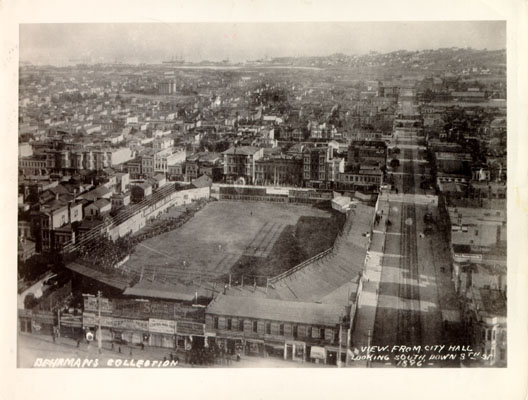
Both men went West to start college football programs, Stagg at the University of Chicago, Camp at the newly-founded Stanford University in the San Francisco Bay Area. They played at the Haight Street Grounds in San Francisco. Chicago beat Stanford 24-4.
The Haight Street Grounds stood from 1887 to 1895. It was actually not at Haight Street, but at the southeastern corner of Stanyan and Waller Streets, in the Haight-Ashbury district that would become the seat of the Hippie movement in the 1960s, at the southeastern corner of Golden Gate Park, about a block from where Kezar Stadium would later be built.

*

December 25, 1894 was a Tuesday. Baseball was out of season, hockey was all-amateur, basketball was a recent invention, and this was before college football was playing bowl games, let alone on Christmas Day.

But in England, soccer, or "football" as they call it, had a tradition: To keep traveling to a minimum, and thus families together, 2 nearby teams would play at one's home ground on Christmas Day, and at the other's on the next day, December 26, Boxing Day. This tradition began to die out in the 1950s, but Boxing Day games are still played.

On December 25, 1894, the London-based team which I would eventually support, then known as Woolwich Arsenal, played, but not against a nearby team: They hosted Burslem Port Vale, at the Manor Ground in Plumstead, Kent, later to be a part of Southeast London, and won, 7-0. Patrick O'Brien scored 3 goals -- not yet known as a "hat trick" in either ice hockey or association football.

Friday, December 23, 2022

December 24, 1895: The Biltmore Estate Opens

December 24, 1895: The Biltmore Estate opens, in Asheville, North Carolina. It goes on to become a major tourist attraction in the Great Smoky Mountains, which straddle the State Line between western North Carolina and eastern Tennessee.

George Washington Vanderbilt II -- sometimes listed as "George Washington Vanderbilt III," and the Estate recognizes him as such today -- was 1 of 9 children born to William Henry Vanderbilt, who not only became the richest man in America upon the death of his father, "Commodore" Cornelius Vanderbilt, but ran his father's railroad holdings well enough to doubled his fortune.
George Washington Vanderbilt II

George II and his mother, the former Maria Louisa Kissam, began to make regular visits to the Asheville area in the 1880s. He loved the scenery and climate so much that he decided to build a Summer house in the area, which he called his "little mountain escape." He wanted his own getaway from New York City, as his older brothers and sisters had built in such places as the Gold Coast of Long Island, New York, near the Oyster Bay home of Theodore Roosevelt); in Hyde Park, Dutchess County, New York, near the home of James and Sara Delano Roosevelt, who were raising young Franklin there at the time; and in Newport, Rhode Island.

Vanderbilt named his estate Biltmore, combining De Bilthis ancestors' place of origin in the Netherlands, with more, an open, rolling land. He eventually bought 125,000 acres of land. A spokesman for the estate said that much of the land had been "in very poor condition, and many of the farmers and other landowners were glad to sell." It took from 1889 to 1895 to finish the estate to his specifications, costing him about $5 million (about $174 million in 2022 money), and he opened it with a lavish party on Christmas Eve.

Vanderbilt died in 1914, the result of an appendectomy gone wrong, only 51 years old. He left behind a wife, Edith; a daughter, Cornelia, only 14; and the Estate, including a massive art collection. Cornelia married and had 2 sons, and she opened the Estate to the public in 1930, hoping to boost tourism to the Asheville area in the face of the Great Depression.

Cornelia died in 1976, leaving the Estate to her son, William Amherst Vanderbilt Cecil. He had previously formed the Biltmore Company to run the Estate as a hotel and resort. He died in 2017, and the Cecil family still runs the Estate. Its artworks, gardens and conservatory are still open to public tours.

The estate has been used on numerous occasions as a filming location for movies and television shows including Being There in 1979, Mr. Destiny in 1990, Forrest Gump in 1994, and My Fellow Americans in 1996. And it still hosts a Christmas festival every year.

UPDATE: In 2023, A Biltmore Christmas aired on The Hallmark Channel, the first movie to actually be set at the Estate. Jonathan Frakes, one of the stars of Star Trek: The Next Generation, directed, and plays the Estate's caretaker. The film tells of an earlier movie filmed there, the Christmas-themed His Merry Wife, and surviving artifacts of that movie on display.

Bethany Joy Lenz, who's starred in several of those charming, cheesy and oh-so-predictable Hallmark Christmas Movies, plays a screenwriter who inadvertently uses a magical hourglass to travel back to the filming of the movie in 1947. She knows that one of the movie's stars, who played a guardian angel, similar to Clarence in the contemporary It's a Wonderful Life, died of a heart attack on Christmas Eve 1948, only 35 years old. He left no survivors. But when they meet on the set, they fall in love. She tells him about the hourglass. She decides she can't stay, and gets back to the present.

One year later, the Christmas movie she's written is a hit, and, on Christmas Eve, she can't help but think about the doomed actor. He appears, having set it up with the movie's male lead to cover for him, so that the world will think he died suddenly, and he used the hourglass to travel to his future and meet the writer, so they can live happily ever after, just like in a movie.

*

December 24, 1895 was a Tuesday. There were no scores on this day: Baseball was out of season, football usually didn't play on Christmas Eve, basketball barely existed, and hockey was all-amateur, with none of what then passed for "major leagues" having any games on this day.

Thursday, December 15, 2022

December 16, 1893: Antonín Dvořák's "New World Symphony"

December 16, 1893: Antonín Dvořák's Symphony No. 9 "From the New World" receives its première at Carnegie Hall in New York.

Antonín Leopold Dvořák was born on September 8, 1941 in Nelahozeves, in Bohemia, in what was then the Austrian Empire, now in Czechia or "the Czech Republic." A talented violinist as a boy, by 1873 he was regarded as one of the best in the world.

He began submitting the scores of symphonies and other works to German and Austrian competitions. In 1874, he won the Austrian State Competition, with Johannes Brahms on the jury of the Austrian State Competition. In 1877, Brahms recommended Dvořák to his publisher, Simrock, who commissioned what became the Slavonic Dances, Opus 46. This led to commissions that spread his fame to Britain and America in the 1880s, and Russia in 1890.

In 1892, he was appointed the director of the National Conservatory of Music of America in New York. While there, he wrote his 2 most successful orchestral works: His Symphony No. 9, titled From the New Worldwhich spread his reputation worldwide; and his Cello Concerto, one of the most highly regarded ever written.

But he was a patriot, for a country that was then subsumed by another, and wrote many pieces extolling what was then called "Czechoslovakia." Homesickness led him to return to Prague, the Czech capital, in 1895. He died on May 1, 1904, at the age of 62.

*

December 16, 1893 was a Saturday. There was 1 score on this historic day, a football game between schools 21 miles apart: The University of Chicago beat Northwestern University, 22-14, in a then-rare indoor football game, at Tattersall's Pavilion, at 17th and Dearborn Streets on the southern edge of downtown Chicago.

Tuesday, December 13, 2022

December 14, 1894: The Consolidation of "Greater New York"

December 14, 1894: The New York State Board of Canvassers releases the official tally of the referendums on creating "The City of Greater New York." Most of the constituencies approved it.

Up to this point, the City of New York consisted of Manhattan Island and part of what became known as The Bronx. But Brooklyn was a separate city, and there were other separate cities around both, which is why the westernmost neighborhood in Queens is called Long Island City.

Queens County then consisted of Long Island City, and the Towns of Elmhurst, Flushing and Jamaica, and what are now called "The Rockaways," then part of the Town of Hempstead. Richmond County, making up the entirety of Staten Island, consisted of the Towns of Castleton, Middletown, Northfield, Southfield and Westfield.

The building of the Brooklyn Bridge in 1883, and the idea of building other bridges and a subway system connecting the two cities, replacing the old ferry boat system, helped put forward the idea of a single city that would be home to about 4 million people.

But Brooklyn, in particular, didn't want to do it: They liked their independence, and didn't want Manhattan telling them what to do. They'd already endured the heavy-handed control of the Manhattan-based Tammany Hall political machine dominating the State legislature, not to mention professional baseball teams calling themselves "New York" while playing at Brooklyn facilities such as the Union Grounds in Williamsburg and the Capitoline Grounds in Bedford-Stuyvesant. (Both had since been demolished.)

Nevertheless, the vote was taken, with a "Yes" vote meaning "For Consolidation," and a "No" vote meaning "Against Consolidation." Here were the results:

* Richmond County (Staten Island): 78.61 percent Yes. Over time, Staten Island would become the Borough the least satisfied with the setup, and has voted at least once to secede from the City, but this has not been permitted by the State government.
* Town of Pelham (in Bronx County): 62.13 percent Yes.
* Queens County: 61.93 percent Yes.
* New York County (Manhattan): 61.78 percent Yes.
* Town of East Chester (in Bronx County): 58.99 percent Yes. Eastchester (usually written as one word since then) has always been part of Bronx County, never Westchester County.
* Kings County (Brooklyn): 50.11 percent Yes. The winning margin was just 277 votes.
* Town of Westchester (in Westchester County): 50.04 percent No. The margin of victory was, literally, one single vote, 621 to 620.
* City of Mount Vernon (in Westchester County): 64.74 percent No. They remained separate, not joining Bronx County.

And so, on January 1, 1898, the Counties of New York, Bronx, Queens, Kings and Richmond became, respectively, the Boroughs of Manhattan, Bronx, Queens, Brooklyn and Staten Island; and, collectively, the City of New York. Westchester and Mount Vernon remained separate, and Mount Vernon became the seat of the new version of Westchester County.

The term "City of Greater New York" was never a legal or official designation; both the original Charter of 1898 and the newer one of 1938 use the name "City of New York." It is used today only to refer to the time period when the consolidation took place.

*

December 14, 1894 was a Friday. There were no scores on this historic day: Baseball was out of season, college football's regular season was over with only 4 postseason games (not yet called "bowl games") remaining to be played, hockey was all-amateur, and basketball was a new invention.

Saturday, December 10, 2022

December 11, 1886: The 1st Arsenal Match

Not quite the 1st Arsenal team, but perhaps the earliest known team photo,
1888, including some of the original players.

December 11, 1886: The Arsenal Football Club played its 1st game. It was on the Isle of Dogs, at a ground recently occupied by Millwall Football Club, against a team named Eastern Wanderers, which went out of business a few years later. The new club won, 6-0.

They were originally a works team -- what we in the U.S. would call a company team, as both the Chicago Bears and Green Bay Packers began -- at the Royal Arsenal (hence the nickname "The Gunners," which led to their fans later being tagged "The Gooners") in Woolwich (the 2nd W is silent), in what was then the county of Kent, but is now part of Southeast London (SE16).

They called themselves Dial Square Football Club, after the section of the Arsenal where they worked. On Christmas Day, December 25, 1886, they met at the nearby Royal Oak pub, to make things more official, and changed their name to the Royal Arsenal Football Club.

The 1st game under the new name, and the 1st game that could be called a "home game" for them, was on January 8, 1887, at Plumstead Common, 2 miles away, against a nearby club called Erith, and Royal Arsenal won, 6-1.
The Royal Arsenal at Woolwich. Photo dated 1960.

In 1893, they turned professional, and were admitted to England's Football League, but had to change their name, as Queen Victoria had signed a law that prohibited any professional sports team from having "Royal" in its name. (This is not the case in Spain, where there are professional soccer teams named Real Madrid, Real Mallorca, Real Betis, etc.)

And, of course, being professional, they had ceased to be a "club," even though the word remains part of the organization's name, and the fans continue to call their team "my club."

So they took on the name of their locality, and were Woolwich Arsenal from then until 1913, when they moved to a new stadium at Highbury in North London, "The Arsenal" until 1919 and "Arsenal Football Club" since, although "The Arsenal," Capital T, Capital A, is frequently still used, especially by the club's fans.

They could have changed their name to "Highbury Arsenal," or "Islington Arsenal," even though neither the Borough of Islington nor the Highbury neighborhood had any connection to the Royal Arsenal, aside from the club. As a result, Arsenal are 1 of only 2 professional clubs in England without a locality as part of their official name. The other is Port Vale, located in Stoke-on-Trent, Staffordshire.

Herbert Chapman was signed to manage Arsenal in 1925. He led them to win the Football Association Cup in 1930, and the Football League Division One in 1931 and 1933, before his death midway through the 1933-34 season. Under Joe Shaw, and then George Allison, the team he built went on to win the League again in 1934, 1935 and 1938, and the FA Cup in 1936. A rebuild after World War II, under manager Tom Whittaker, resulted in League titles in 1948 and 1953, and an FA Cup in 1950.

Like Chapman, Whittaker died in office, in 1956, and a down period resulted. The team's fortunes were turned around under Bertie Mee. In 1970, he guided the team to the Inter-Cities Fairs Cup, the tournament now known as the UEFA Europa League. In 1971, Arsenal took both the League and the FA Cup, "The Double." A mid-1970s rebuild under Terry Neill led to an FA Cup win in 1979.

In 1986, George Graham, one of the players from the '71 Double was named manager. He led the team to the 1987 League Cup, the 1989 and 1991 League titles, the 1st-ever English domestic "cup double" (the League Cup and the FA Cup) in 1993, and the European Cup Winners' Cup (a tournament that no longer exists) in 1994.

In 1996, Arsène Wenger was named the team's 1st manager not a native of the British Isles, and he revamped everything, from tactics to exercise to diet. In 1998, now in the era of the Premier League, he took Arsenal to another Double. He did it again in 2002. He led them to another FA Cup in 2003. And he led them through the entire 2003-04 Premier League season without losing a game: Played 38, won 26, drawn 2, lost exactly none. It had never been done before, and it hasn't been done since. The unbeaten string eventually reached 49 games.

(The 1st season of the Football League was in 1888-89, and Lancashire team Preston North End went through the 22-game season unbeaten, and also won the FA Cup. But 38 is a lot more games than 22.)

After another FA Cup win in 2005, Arsenal advanced to the Final of the UEFA Champions League in 2006, their last season at Highbury. With the opening of the new 60,000-seat Emirates Stadium, the construction debt had to be paid off, and Wenger had less of a budget than before. Still, he managed to keep the team in the Champions League places.

A small but loud and angry section of the fanbase began to demand that Wenger spend more money on "world-class players," because they believed that winning the League title was all that mattered. When Wenger ended a 9-year trophy drought by winning the 2014 FA Cup, this small but loud and angry section decided that it wasn't enough.

Nor was it enough when he did it again in 2015 and 2017. They demanded that he be fired for not giving them another League title -- as if he hadn't already given them 3, as many as any other Arsenal manager had ever done. (Allison had won 3; Chapman, Whittaker and Graham had each won 2, Shaw 1.)

By 2017, Arsenal had been surpassed by bigger-spending teams run by billionaire owners, and fell out of the Champions League places. Late in the 2018 season, Wenger announced he was leaving. It is still debated whether he was fired, or he quit due to even his great patience finally being worn out by the whiners.

New manager Unai Emery turned out to be a poor replacement, and was fired in favor of Mikel Arteta, the Spanish midfielder who had captained the 2014 and '15 Cup wins. His leadership led to victory in the 2020 FA Cup, and a 2nd-place finish and a return to Champions League qualification in 2022.

The Arsenal have a great past, and a promising future. The hope is that the team can, within a short time, return to its former heights.

Good old Arsenal, we're proud to say your name.
While we sing this song, we'll win the game!

There are no other scores on this historic day. England's Football League wouldn't be founded for another 2 years, and, given the distances involved in the pre-automobile era, scheduling was risky. In America, the baseball season was over, the college football season was also over, basketball hadn't been invented yet, and hockey hardly had been.

Tuesday, December 6, 2022

December 6, 1904: The Roosevelt Corollary to the Monroe Doctrine

"Speak softly and carry a big stick."

December 6, 1904: President Theodore Roosevelt issues a re-interpretation of the Monroe Doctrine, a re-interpretation which becomes known as the Roosevelt Corollary.

NOTE: My cutoff date for this project is 1869, the year of the completion of the Transcontinental Railroad, the 1st openly professional baseball team, and the 1st American football game. I had managed to work in references to most pre-1869 Presidents. This was the only way I could think of to do it for Monroe.

The Monroe Doctrine -- the name wouldn't be used until 1850, after the deaths of those involved -- was included in the annual message to Congress by President James Monroe on December 2, 1823. Such messages were written and delivered by hand in lieu of what would later be called the State of the Union Address. Over the last few years, following the American Revolution, France selling the Louisiana Territory to America, France losing Haiti in a revolution, and Spain's empire collapsing, especially with Mexico finally winning its struggle to break away in 1821, "the Old World" was losing its grip on "the New World."
It was written with Monroe's approval by his Secretary of State -- and, as it turned out, his successor, John Quincy Adams:

The occasion has been judged proper for asserting, as a principle in which the rights and interests of the United States are involved, that the American continents, by the free and independent condition which they have assumed and maintain, are henceforth not to be considered as subjects for future colonization by any European powers.

We owe it, therefore, to candor and to the amicable relations existing between the United States and those powers to declare that we should consider any attempt on their part to extend their system to any portion of this hemisphere as dangerous to our peace and safety. With the existing colonies or dependencies of any European power, we have not interfered and shall not interfere. But with the Governments who have declared their independence and maintained it, and whose independence we have, on great consideration and on just principles, acknowledged, we could not view any interposition for the purpose of oppressing them, or controlling in any other manner their destiny, by any European power in any other light than as the manifestation of an unfriendly disposition toward the United States.

In other words, America was saying, "Europe, those colonies that you have in our Hemisphere now, we will leave them alone. But don't try to establish any new ones. And we won't try to establish any on your side of the world."

At the time, America didn't have the Navy to back that up. And, with some irony, its next war was with one of those new nations in the Western Hemisphere, Mexico, in 1846 and 1847. In 1861, France began a takeover of Mexico, which took 2 years, and then failed 4 years later. America couldn't do anything about it, because of its own Civil War.

Other than that, though, America didn't have to do much about it. While tensions with Britain had been near-continuous, even after the War of 1812, it was in Britain's best interest to have its Royal Navy enforce a Pax Britannica on the world. And they still had territory in the New World, including Canada, though it granted Canada a form of independence in 1867. So, essentially, by doing their own job, they were doing America's job, too.

Things changed in 1895, when the South American nation of Venezuela claimed Essequibo and Guyana Esequiba as part of their country, while Britain claimed them as part of their colony of British Guyana. President Grover Cleveland intervened, and offered to have America mediate the dispute. Both countries accepted. In the end, the agreed-upon Paris tribunal awarded most of the territory to Britain. But Venezuela and the other countries in Latin America saw that the United States was willing to stand up for them to a European power, and relations between them and the U.S. improved.

In 1898, America won the Spanish-American War, taking Puerto Rico, Cuba and the Philippines from Spain -- the Philippines suggesting that the promise of American non-expansion was gone.

Then came another crisis in Venezuela. In 1902, Britain, Germany and Italy imposed a naval blockade on Venezuela, after their President Cipriano Castro (no relation to later Cuban dictator Fidel) refused to pay his country's foreign debts. He was counting on America to invoke the Monroe Doctrine, and bail his country out diplomatically, as it had 7 years earlier. If not, then to defend his nation militarily.

Theodore Roosevelt was President now. He had commanded American troops in the Battle of San Juan Hill in the Spanish-American War, and rode that fame to the Presidency. But he refused to intervene: He saw the Monroe Doctrine as applying only to European seizure of territory, rather than intervention per se. With prior promises that no such seizure would occur, the U.S. was officially neutral, and allowed the action to go ahead without objection. The blockade saw Venezuela's small navy quickly disabled, but Castro refused to give in, and instead agreed in principle to submit some of the claims to international arbitration, which he had previously rejected.

Roosevelt wanted to avoid any future crises like the 2 recent ones in Venezuela. So he instituted what became known as the Roosevelt Corollary to the Monroe Doctrine: It asserted the right of the U.S. to intervene in Latin America in cases of "flagrant and chronic wrongdoing by a Latin American Nation" to preempt intervention by European creditors.

This re-interpretation of the Monroe Doctrine went on to be a useful tool to take economic benefits by force when Latin American nations failed to pay their debts to European and U.S. banks and business interests. It provoked outrage across Latin America.

This was one of the actions of TR's that backed up what he called an old African proverb, which he liked to quote: "Speak softly, and carry a big stick: You will go far."

The Monroe Doctrine and the Roosevelt Corollary were used to invoke U.S. intervention in Latin America in Guatemala in 1954, in Cuba in 1962, in the Dominican Republic in 1965, in Chile in 1973, in El Salvador and Nicaragua in the 1980s, in Panama in 1989, in Haiti in 1994, and, lo and behold, in Venezuela again in the 2010s.

Monroe had quite a career before he was President. Along with Alexander Hamilton, he was with George Washington when he crossed the Delaware River on Christmas Night 1776, to surprise the Hessians at Trenton. He served Virginia as U.S. Senator and Governor. A protégé of both Thomas Jefferson and James Madison, he served as U.S. Minister to France, then to Britain. 

During the War of 1812, he served as Secretary of State and Secretary of War (the post now called Secretary of Defense) at the same time. He was elected President in a landslide in 1816, and almost unanimously in 1820. He was the last President to dress in what we now consider the Revolutionary style: Tricornered hat, powdered wig, ruffled shirt, long coat and knee breeches. He was the last President not to have a photograph taken of him.

The capital of the Africa nation of Liberia is named Monrovia in his honor. Also named for him were the now-closed Fort Monroe army base in Portsmouth, Virginia; 17 Counties, and towns in 28 States, including 23 in Ohio, 18 in Indiana, 12 in Iowa, 9 in Pennsylvania, 8 in Missouri, 5 in Michigan, 3 each in North Carolina and Wisconsin; and 2 each in New York, New Jersey, Arkansas, Louisiana, Nebraska and South Dakota.

There are high schools named for him in New York City, in the Borough of The Bronx; Rochester, in Monroe County, New York; Fredericksburg, Virginia, which is also where his law office was converted into an unofficial Presidential Library, opening on November 13, 1966; Lindside, Monroe County, West Virginia; and in the North Hills neighborhood of Los Angeles. A submarine, the USS James Monroe, served the U.S. Navy from 1963 to 1990.
James Monroe statue, College of William & Mary,
Williamsburg, Virginia

He has been played by Morgan Wallace in the 1931 film Alexander Hamilton, John Elliott in the 1936 film Hearts Divided, Charles Waldron in the 1939 film The Monroe Doctrine, Henry Butler in the 1976 TV-movie The Adams Chronicles, and Robert Kelly in the 1986 TV-movie George Washington II: The Forging of a Nation.

The last surviving member of Monroe's Cabinet was Richard Rush, who served as Secretary of State, and lived until 1859. He also turned out to be the last surviving member of James Madison's Cabinet.

*

December 6, 1904 was a Tuesday. Ève Curie, daughter of scientists Pierre and Marie "Madame" Curie, was born. She became a journalist and writer, and lived until 2007, nearly 103 years old.

Baseball was out of season. The football season had ended 2 days earlier. Hockey had not yet turned professional, and basketball barely had. So there were no scores on this historic day.

Tuesday, November 29, 2022

November 29, 1894: William Penn, On Top of the World

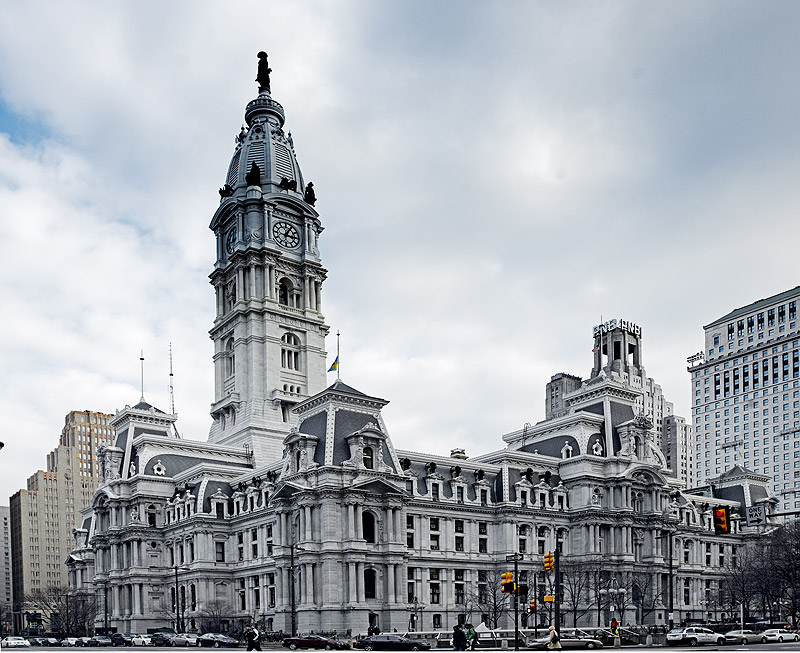
November 29, 1894: A 37-foot-high statue of William Penn, founder of the City of Philadelphia and the British Province that became the State of Pennsylvania (or, officially, "The Commonwealth of Pennsylvania"), is raised to the top of the City Hall that had been under construction in the French-inspired "Second Empire" style since 1871, and would continued to be worked on until being declared complete in 1901.

William Penn (1644-1718) was a writer, religious thinker, and influential Quaker from London, who founded the Province of Pennsylvania, receiving a charter from King Charles II on October 27, 1682. Penn was an advocate of democracy and religious freedom, known for his amicable relations and successful treaties with the Lenape tribe of Native Americans who had resided in present-day Pennsylvania prior to European settlements in the State.
The hat on Penn's statue is 548 feet above street level. This makes City Hall the tallest building in the world, surpassing the New York World Building in New York City, until the opening of the Singer Building in New York in 1908.
(Note: The Council on Tall Buildings and Urban Habitat (CTBUH) maintains a set of criteria for determining the height of tall buildings, and defines a "building" as "a structure that is designed for residential, business or manufacturing purposes" and that "has floors." Although the Eiffel Tower, which had opened in Paris in 1889, was considerably taller, less than half of it was habitable; therefore, while it was classified as the world's tallest structure, it was not a "building" at all.)

It remains the tallest City Hall in the country. Its location, at the junction of Broad Street and Market Street, at the center of Center City Philadelphia, makes it the transfer point for the City's 2 main Subway lines, the Broad Street Line (north-to-south) and the Market-Frankford Line (east-to-west). And, as the City of Philadelphia and the County of Philadelphia are contiguous, it also serves as the Philadelphia County Courthouse.

While many American cities embraced the concept of the skyscraper, a "gentlemen's agreement" forbade any structure from rising above the hat on the Penn statue. The idea was that Penn could look out over his city, in any direction, without his view being blocked. (The statue, of course, is in a fixed position, facing northeast.)

With that agreement in place, the World Series was won by the Philadelphia Athletics in 1910, 1911, 1913, 1929 and 1930, and the Philadelphia Phillies in 1980; the NFL Championship was won by the Frankford Yellow Jackets in 1926, and the Philadelphia Eagles in 1948, 1949 and 1960; the NBA Championship was won by the Philadelphia Warriors in 1947 and 1956, and the Philadelphia 76ers in 1967 and 1983; and the Stanley Cup was won by the Philadelphia Flyers in 1974 and 1975.

On May 27, 1987, One Liberty Place broke the gentleman's agreement, rising to 945 feet. For the first time, something in the city could "block Billy Penn's view." And, apparently, he didn't like this. Just 4 days after One Liberty Place opened, the Flyers lost Game 7 of the Stanley Cup Finals to the Edmonton Oilers.

In 1993, the Phillies lost the World Series. This included blowing a 14-9 lead in the 8th inning of Game 4, at home, before Joe Carter of the Toronto Blue Jays hit a Series-winning home run in Game 6. In 1995, the Flyers were tied 2-2 with the New Jersey Devils in the NHL Eastern Conference Finals, but lost Game 5 in the last minute of regulation, and then lost Game 6. In 1997, the Flyers were swept by the Detroit Red Wings in the Stanley Cup Finals. In 2000, the Flyers led the Devils 3-1 in the Eastern Conference Finals, and lost 3 straight, including losing Eric Lindros to a concussion. In 2001, the 76ers won the NBA Eastern Conference title, but lost the Finals to the Lakers. This remains their only Finals appearance since 1983.

In 2002, the Eagles lost the NFC Championship Game to the St. Louis Rams. In 2003, in their last game at Veterans Stadium, before moving into Lincoln Financial Field, the Eagles lost the NFC Championship Game to the Tampa Bay Buccaneers. Since entering the NFL in 1976, the Bucs had never won a Playoff game on the road, and had never won when the temperature was less than 32 degrees Fahrenheit. With this game, they had done both. If that could happen, and it could happen to the Eagles, then, it was reasoned, larger forces could be at work. This is when the idea of a "curse" began to be discussed. People looked to the last title won by a Philly team, and it was the 1983 76ers, so it had to be something after that.

Between that title and the rise of Liberty Place, the Flyers had lost the 1985 Stanley Cup Finals, but that was while Liberty Place was still under construction, so it's not counted. Nor was the death, early the next season, of Flyer goaltender Pelle Lindbergh, from drunk driving. There was the 76ers' 1986 Draft Day debacle, but that was also before Liberty Place was topped off. So a Curse of Howard Katz, or a Curse of Pelle Lindbergh, was possible. The city's media decided, instead, on Penn, for "blocking his view." (The fact that the two Liberty Place skyscrapers are behind his back, and weren't in his line of sight, seems not to have occurred to them.)

In 2004, the Eagles made it 3 straight NFC Championship Game losses, 2 straight at home, losing to the Carolina Panthers. That same year, it appeared that the curse even extended to horse racing. Smarty Jones, a horse bred and trained in suburban Chester County, Pennsylvania, won the Kentucky Derby and the Preakness Stakes, but fell short of the Triple Crown when he lost the Belmont Stakes by blowing a late lead. In 2005, finally winning an NFC Championship Game on their 4th straight try, the Eagles beat the Atlanta Falcons. But, despite threatening late, they could not beat the New England Patriots in Super Bowl XXXIX.

Someone must have decided that enough was enough. On June 18, 2007, ironworkers helped raise the final beam in the construction of the 974-foot Comcast Center. In addition to the Philadelphia tradition of finishing a building with an American flag and a small evergreen tree, they attached a statue of William Penn. Now, atop the new tallest building in town, his view was, again, unblocked.

Did it work? Not yet: Three months later, the Phillies came from 7 games back in the National League Eastern Division with 17 games to go, surged past the New York Mets, and won the Division title. But lost the NL Division Series to the Colorado Rockies -- the 1st postseason series win for the Rockies, who began play in 1993, the year of the Phillies' most recent Pennant.

But it all came together in 2008. The Phillies beat the Mets out for the Division again, beat the Milwaukee Brewers in the NLDS, and then beat the Los Angeles Dodgers in the NL Championship Series for their 1st Pennant in 15 years. It was on to the World Series, with a first: A father and son broadcasting for the opposing teams, Harry Kalas for the Phils, and Todd Kalas for the Tampa Bay Rays.

The Phillies won Game 1 in St. Petersburg, 3-2, before losing Game 2, 4-2. Coming home to Citizens Bank Park, they won Game 3, 5-4; and Game 4, 10-2. Game 5 began on Monday, October 27, but it rained throughout. The Phillies led 2-1 after 5 innings. Under normal conditions, games are considered to be official games after 5 innings, or 4 1/2 if the home team is leading at that point. However, both Rays and Phillies management knew before the first pitch that Commissioner Bud Selig, who was responsible for the scheduling of post-season games, would not allow a team to clinch the Series by winning a rain-shortened game.

The umpires let the game continue, and the Rays tied the game in the top of the 6th. When that half-inning ended, as Phils 2nd baseman Chase Utley remembered, "The infield was basically underwater." The umpires suspended the game. Rain continued to fall in Philadelphia on Tuesday, October 28, further postponing the game to Wednesday, October 29.

Game 5 was resumed in the bottom of the 6th, with the Philadelphia Phillies batting, and needing 1 run plus 9 outs to win the World Series. Geoff Jenkins doubled, was bunted to 3rd by Jimmy Rollins, and was driven in by a Jayson Werth single.

Rocco Baldelli tied the game with a home run in the 7th. Later in the inning, Utley took a grounder, faked a throw to 1stn base, then threw Jason Bartlett out at home for the 3rd out in a play later described as having saved the Series for the Phillies.

In the bottom of the 7th, Pat Burrell led off with a double. Eric Bruntlett, pinch-running for Burrell, scored on a single by Pedro Feliz to put the Phillies up by a run again, 4–3.

In the 2004 NLCS, pitching for the Houston Astros, Brad Lidge had given up a tremendous home run to Albert Pujols of the St. Louis Cardinals, to lose a game. It was said that he was never the same after that. That wasn't true: The Astros won the Pennant the next year. In 2008, Lidge was the Phillies' closer, and, going into Game 5, was 47-for-47 in save opportunities over the season. For fans still traumatized by the 1993 World Series, he was no Mitch Williams.

In the top of the 9th, Lidge gave up a single and a stolen base, but faced Eric Hinske with the chance to give the city its 1st World Series win since 1980, and its 1st World Championship in any sport since the 1983 76ers. Harry Kalas, the Hall of Fame voice of the Phils, had the call:

One strike away, nothing-and-two to Hinske. Fans on their feet. Brad Lidge stretches. The oh-two pitch: Swing and a miss! Struck him out! The Philadelphia Phillies are 2008 World Champions of baseball!

Brad Lidge does it again, and stays perfect for the 2008 season, 48-for-48 in save opportunities! And let the city celebrate! Don't let the 48-hour wait diminish the euphoria of this moment and celebration! Twenty-five years in this city that a team has enjoyed a World Championship, and the fans are ready to celebrate. What a night! Phils winning, 4–3, Brad Lidge gets the job done once again!

Harry would die early the next season. He deserved that title.

Three months later, the Eagles reached the NFC Championship Game, with a shot at Super Bowl XLIII, but lost to the Arizona Cardinals, a team that hadn't reached an NFL Championship Game, under any name, since 1948. That was embarrassing. 

The Phils won the Pennant again in 2009, but lost the World Series to the New York Yankees. They won the NL East again in 2010 and 2011, then fell apart for a few years. The Flyers reached the Stanley Cup Finals in 2010, but lost to the Chicago Blackhawks. It was beginning to look like the Phillies had broken a curse that had been put on them sometime after 1980, and the other teams in town were under seaprate curses. But in 2018, the Eagles broke a 57-year drought, beating the New England Patriots in Super Bowl LII.

Also in 2018, a new tallest building in the city opened: The Comcast Technology Center, at 1,121 feet, making it the tallest building in America not in either New York City or Chicago. As with its predecessor and sort-of namesake, a small statue of William Penn was put on top, just in case.

*

November 29, 1894, was a Thursday. Under the law of the time, being the last Thursday in November, it was Thanksgiving Day. Not until 1942 was it changed to the 4th Thursday in November, regardless of whether that was the last one. As a result of being Thanksgiving, before the era of professional football, the only sport played was college football, but there were 9 games, including 1 in Philadelphia:

* The University of Pennsylvania beat Harvard, 18-4 at the University Grounds in Philadelphia, 2 miles west of City Hall. Decades later, Penn would be retroactively awarded this season's National Championship.

* The Chicago Athletic Club beat Dartmouth, 4-0 at the Alumni Oval in Hanover, New Hampshire.

* Tufts beat Andover, 6-4 at Andover, Massachusetts.

* Brown beat MIT (Massachusetts Institute of Technology), 16-4 at Lincoln Field in Providence, Rhode Island.

* Cornell beat Lehigh, 10-6 at Percy Field in Ithaca, New York.

* Lafayette beat Bucknell, 44-0 at March Field in Easton, Pennsylvania.

* Purdue beat DePauw University (of Greencastle, Indiana, not DePaul of Chicago), 28-0 at the Fair Grounds in Indianapolis.

* Michigan beat the University of Chicago, 6-4 at Marshall Field in Chicago.

* And Illinois beat the Pastime Athletic Club of St. Louis, 10-0 at Sportsman's Park in St. Louis.

Saturday, November 26, 2022

November 27, 1896: Richard Strauss Premieres "Also Sprach Zarathustra"

November 27, 1896: Composer Richard Strauss premieres his "tone poem" Also sprach Zarathustra, inspired by Friedrich Nietzsche's 1883 novel of the same title, translated into English as Thus Spoke Zarathustra.

Born in Munich in 1864, Strauss was not related to the composing Strauss family of Vienna, Austria. He had previously composed tone poems about Don Juan and Macbeth, and would later do so for Don Quixote. He lived until 1949, and Also sprach Zarathustra remains easily his most familiar composition.

Strauss conducted the premiere himself, at the Saalbau der Museums-Gesellschaft in Frankfurt, Germany. A typical performance lasts 33 minutes. Its opening fanfare, titled "Sunrise," was used by director Stanley Kubrick as the theme song for the 1968 film 2001: A Space Odyssey.

That use led Elvis Presley to use it as the opening theme for his concerts from the start of his Las Vegas run in 1969 until his death in 1977. I'm guessing that Elvis wasn't aware of Nietzsche's statement in the novel, "God is dead," it, or else he probably would not have used the fanfare.

By the time Strauss' composition premiered, Nietzsche was too ill to attend, and no recording of it was made until 1935, when Serge Koussevitzky conducted the Boston Symphony Orchestra in it. So it is likely that Nietzsche never expressed an opinion on it.

The Saalbau der Museums-Gesellschaft, site of the premiere, opened in 1861, and was destroyed by Allied bombing in 1944.

*

November 27, 1896 was a Friday. There were no scores on this historic day: Baseball was out of season, there were college football games played the day before (Thanksgiving) but not the day after, professional hockey did not yet exist, and basketball was still a brand-new sport.

Thursday, November 24, 2022

November 25, 1885: Vice President Thomas Hendricks Dies

November 25, 1885: Thomas Andrews Hendricks, Vice President of the United States, dies in Indianapolis. He was 66 years old.

He was born on September 7, 1819, in Fultonham, Ohio. The family moved to Indiana at the urging of an uncle, William Hendricks, who served that State in both houses of Congress, and eventually as Governor. His father, John Hendricks, became a success in farming, then in running a general store, and moved into politics, where his support for President Andrew Jackson earned him a political appointment. Young Thomas got to meet nearly every prominent Democrat in Indiana at the family home in Shelbyville.

He married Eliza Morgan, the daughter of a judge, and they had a son named Morgan, who died at age 3. He was elected to the General Assembly in 1847, to the U.S. House of Representatives in 1850, was appointed Commissioner of the U.S. General Land Office by President Franklin Pierce in 1855, and was elected to the U.S. Senate in 1862.

Three times, he ran for Governor, and lost twice, going back to the practice of law in the State capital of Indianapolis, before finally being elected in a squeaker in 1872. He did well enough there that he was nominated for Vice President on the ticket of Governor Samuel J. Tilden of New York. Although they got the most popular votes and the most Electoral Votes, they didn't not get the required majority of the latter, and a Commission to settle the issue did so in favor of the Republican nominee, Governor Rutherford B. Hayes of Ohio.

He fell into ill health, but this was not widely known, and, in 1884, he was again nominated as the 2nd half of a ticket whose 1st half was the Governor of New York, in this case Grover Cleveland.

His father-in-law, Judge Morgan, had lived outside Cincinnati, in North Bend, Ohio, next-door to President William Henry Harrison, the hero of the Battle of Tippecanoe. Running on the Whig Party ticket in 1840, with John Tyler, there came the 1st rhyming slogan in Presidential history: "Tippecanoe and Tyler, too!"

In 1844, the Whigs had, "Hurrah! Hurrah! The Country's risin', for Henry Clay and Frelinghuysen!" In 1876, the Republicans had "Hayes the True and Wheeler, too!" In 1884, the Democrats may have tried too hard, with:

We'll shout for our man and his important appendix!
We'll whoop 'er up lively for Cleveland and Hendricks!

(There haven't been too many rhyming Presidential slogans since. In 1936, the Republicans had "Off the rocks with Landon and Knox," and lost 46 out of 48 States. In 1952 and 1956, instead of trying to rhyme something with "Eisenhower and Nixon," the Republicans simply used Dwight D. Eisenhower's nickname: "I like Ike." In 1960, the Democrats had "All the way with JFK" and "K-E-Double-N-E-D-Y, Jack's the nation's favorite guy," and followed it in 1964 with "All the way with LBJ.")

The 1884 election between Cleveland and the Republican nominee, former Secretary of State James G. Blaine, was nasty by the standards of the time -- although Donald Trump might have called it "low-energy." The Cleveland-Hendricks ticket won in a very close race. Taking office on March 4, 1885, the 2 men maintained a strong working relationship. Hendricks spoke highly of Cleveland's character, and described him as "courteous and affable."

But Hendricks' poor health caught up with him. In November, he went home to Indianapolis. On the morning of November 24, he complained about feeling ill. He suffered a heart attack the next day, and was dead. 

There being no Constitutional mechanism for filling a vacancy in the Vice Presidency at the time, the office remained vacant until the following Inauguration Day, March 4, 1889, when Levi P. Morton took the office, on a ticket with Benjamin Harrison (William Henry's grandson), who had defeated Cleveland and his new running mate, Allen Thurman.

And with Congress not convening until December, the office of the next man in line for the Presidency, after Cleveland, the President Pro Tempore of the Senate, was vacant as well. This was the 7th time in 44 years that the Vice Presidency had become vacant, and it was decided to do something about it.

Congress convened on December 7, 1885, and John Sherman of Ohio, brother of General William Tecumseh Sherman, was sworn in as President Pro Tempore of the Senate. A new Presidential Succession Act was passed on January 19, 1886. From then onward, the net man in line was the Secretary of State, Thomas F. Bayard. Since it was believed that the office of Secretary of State would always be filled, the issue was thought settled. But it was adjusted by a new Presidential Succession Act in 1947, putting the Speaker of the House and then President Pro Tempore of the Senate between the Vice President and the Cabinet.

Hendricks was buried in Crown Point Cemetery in Indianapolis. Harrison would also be buried there, as would Theodore Roosevelt's Vice President, Charles W. Fairbanks; Woodrow Wilson's Vice President, Thomas R. Marshall; authors James Whitcomb Riley and Booth Tarkington; bank robber John Dillinger, pharmaceutical magnate Eli Lilly; and Indianapolis Colts owner Bob Irsay.

Eliza Hendricks lived on until 1903.

*

November 25, 1885 was a Wednesday. There were no scores on this historic day: No college football games were scheduled, baseball was out of season, hockey was in its infancy, and basketball hadn't yet been invented. 

Wednesday, November 23, 2022

November 24, 1887: Sherlock Holmes Debuts

Jeremy Brett as Holmes, in the PBS
anthology series Mystery!, sometime in the 1980s

November 24, 1887: The British magazine Beeton's Christmas Annual is published. It sells out before Christmas, largely on the strength of a novel whose text it contains: A Study in Scarlet, by Dr. Arthur Conan Doyle. The story introduces the character of consulting detective Sherlock Holmes, and his assistant, Dr. John H. Watson.

Watson was based on Conan Doyle himself. (He used "Conan Doyle" as a compound surname, but Britain's list of knighthoods, and most libraries, list him alphabetically under D for "Doyle.") Born on May 22, 1859 in Edinburgh, Scotland, as Arthur Ignatius Conan Doyle, his mother was Irish Catholic, and his father's parents were as well, but he left the Church as a young man and became an agnostic.

He attended the University of Edinburgh Medical School, and studied botany at the Royal Botanical Garden there. He would have Holmes frequently rely on his knowledge of botany, particularly in how some plants are poisonous.

One of his professors was Dr. Joseph Bell (1837-1911), and it was on him that Conan Doyle based Holmes, writing to him in 1892, "It is most certainly to you that I owe Sherlock Holmes... Round the centre of deduction and inference and observation which I have heard you inculcate I have tried to build up a man."

Another University of Edinburgh graduate (though not of its medical school) who turned to writing, Robert Louis Stevenson, used Holmes-like deduction to figure it out, writing to Conan Doyle, "My compliments on your very ingenious and very interesting adventures of Sherlock Holmes... Can this be my old friend Joe Bell?"

In September 1879, Conan Doyle was published for the first time, both with an academic article and a short story. And -- relevant to the 2020s -- he was a staunch supporter of early vaccination and a denouncer of anti-vaccinators.

In 1885, he married Louisa Hawkins, and they had a daughter named Mary Louise and a son named Arthur Kingsley. Known as "Kingsley," he was wounded in World War I, and died of pneumonia just 14 days before the Armistice. Louisa died of tuberculosis in 1906. The following year, he married Jean Leckie, and they had a son named Denis, a son named Malcolm, and a daughter named Jean.

He earned his medical doctorate, but was unsuccessful in the practice of medicine. In 1886, he wrote A Study in Scarlet, and it was accepted for publication by Ward Lock & Co., although they waited an entire year to print it in their Beeton's Christmas Annual. It got excellent reviews, and Ward Lock commissioned a sequel, which became The Sign of the Four.

In 1890, having fulfilled this commitment, and not liking the way he was being exploited, Conan Doyle stuck to writing short Holmes stories for The Strand magazine, and it through these stories that Holmes is best remembered.
Conan Doyle took the name and profession, but nothing else, from Dr. James Watson, once a colleague in Portsmouth, Hampshire, England. Dr. John H. Watson narrated most of Holmes' stories. There was a Chief Inspector William Sherlock whose name was frequently  in the London newspapers, and Conan Doyle was find of the poetry of American writer Oliver Wendell Holmes.

It has been suggested that there was then a popular cricket player named Sherlock who inspired the detective's name, but this idea is usually dismissed. Nevertheless, Conan Doyle was a keen sportsman, and loved cricket, playing 10 first-class matches for the Marylebone Cricket Club at Lords. He played for an Authors XI alongside James M. Barrie (creator of Peter Pan), P.G. Wodehouse (Jeeves and Wooster) and A.A. Milne (Winnie the Pooh). As a bowler (equivalent in baseball to the pitcher), he had one first-class wicket (major league strikeout): W.G. Grace, a fellow physician, who was then regarded as the greatest batsman the sport had ever known.

He previously played as a goalkeeper for Portsmouth Association Football Club, while practicing medicine in the city. (That team went out of business in 1896, and the current Portsmouth Football Club -- "Play up, Pompey!" -- was formed 2 years later.) In 1901, he was 1 of 3 judges for the world's 1st major bodybuilding competition.  In 1908, he was a judge for the Olympic Games held in London, and was one of the judges who assisted Dorando Pietri after he fell on the final lap of the marathon, leading to Pietri's disqualification.

He had been an amateur boxer and, while on a lecture tour of America in 1910, was invited by boxing promoter Tex Rickard to referee the Heavyweight Championship fight between Jack Johnson and Jim Jeffries. He declined, citing the distance and his schedule. (Rickard ended up refereeing the fight himself, which Johnson won by a 15th round knockout.) That same year, he was elected captain of the Crowborough Beacon Golf Club in Sussex. He entered the English Amateur billiards championship in 1913. And some time that he spent in Switzerland, before creating Holmes, led to a love of skiing.

But his time spent in Switzerland also inspired the "death" of Holmes. He wanted to write about other things. Inspired by the  "scientific novels" of Jules Verne -- H.G. Wells had not yet tried the genre, and Hugo Gernsback had not yet coined the phrase "science fiction" -- he created the scientist Professor Challenger, including The Lost World, one of the 1st pieces of fiction to incorporate dinosaurs. He created Brigadier Gerard, an officer in Napoleon's Grand Armée. He created Sir Nigel Loring, a knight in the Hundred Years War.

His scientific and historical fiction got him the best reviews of his career. But the general public wanted more and more of Holmes. Conan Doyle couldn't take it anymore: In 1893, he published The Final Problem. He created a villainous equal for Holmes, Professor James Moriarty. Though Moriarty appeared in only this story, Holmes told Watson that they had been in a battle of wits for years.

They made their way to the Reichenbach Falls, a real place in the Bernese Oberland of Switzerland. There, according to the story, on May 4, 1891, 10 years after Holmes and Watson first met, Holmes and Moriarty fight, and tumble over a protective fence to their deaths. From such a height, neither could have possibly survived.

Holmes fans were furious! How dare the man who created their hero kill him! Conan Doyle got death threats in the mail. He was attacked on the street, by men with umbrellas and women with purses. It was the first "toxic fandom" in the history of popular culture.

It also produced some of the earliest "fanfiction," as people began writing their own Holmes stories, not considering copyright laws. As you might guess, this included some pornographic stories, some involving Holmes and Irene Adler, and some even involving a homosexual relationship between Holmes and Watson, thus inventing what came to be known -- after similar "Kirk/Spock" stories by whacked-out female Star Trek fans -- in the 1970s as "slash fiction."

Irene Adler, like Moriarty, canonically appeared only once, in A Scandal in Bohemia, but to Holmes would always be "the woman," though Watson specifically said that Holmes held only respect for her: "It was not that he felt any emotion akin to love for Irene Adler." Later film adaptations of Holmes would romantically link them, however. And author William S. Baring-Gould, a Holmes expert, suggested that Rex Stout's fictional private detective, Nero Wolfe, was the illegitimate son of Sherlock and Irene, the result of an affair after meeting again sometime after the incident at the Reichenbach Falls.

Bowing to pressure, in 1901, Conan Doyle published a full-length novel, The Hound of the Baskervilles, obviously taking place before Holmes' death. This only increased the demand for more Holmes stories. In 1903, Conan Doyle gave in, writing The Empty House, and explaining how Holmes survived the Reichenbach Falls. Fandom had its 1st victory over the "cancellation" of a popular series. It would not happen again until the aforementioned Star Trek, 65 years later.

Though associated with the Victorian era, and (within his fictional world) known all over Europe for his detective work, the character of Holmes was never knighted by Queen Victoria. Nor was he knighted by her son, King Edward VII; nor by his son, King George V. But in 1902, King Edward did knight Conan Doyle -- not for his Holmes stories, but for his recent writings supporting the country, its government, and its Army in the Boer War.

In 1917, Conan Doyle published His Last Bow, which depicts Holmes and Watson, by then in their 60s, aiding the British government against the German Empire in the Summer of 1914, on the eve of World War I. As late as 1927, he was publishing Holmes stories, taking place between The Empty House and His Last Bow, and having Watson assure readers that Holmes, who had taken to beekeeping, "is long retired from his profession of detective but is still alive and well, albeit suffering from a touch of rheumatism."

Conan Doyle died on July 7, 1930, at 71, from a heart attack, at Windlesham Manor, his house in Crowborough, Sussex, about 40 miles south of London. He was buried in Minstead Churchyard in New Forest, Hampshire. His wife Jean died in 1940. None of his 5 children had children of their own, so, with his daughter Jean's death in 1997, the bloodline of Arthur Conan Doyle died out.

Baring-Gould, who placed Holmes' birth in 1854, considered the date of the creator's death to also be that of the creation. But Holmes lives on. His best known portrayal remains that of Basil Rathbone, in 14 films between 1939 and 1946. Some were set in Holmes' original period, but some were set in the present, and featured Holmes and Watson riding in automobiles and fighting Nazis, with Holmes wearing a fedora hat instead of a deerstalker cap. Nigel Bruce's portrayal rendered Watson as something of a bumbler, unworthy of standing alongside Holmes, for a generation of fans.

From 1970 to 2012, PBS' Sesame Street featured a Muppet named Sherlock Hemlock, voiced by Jerry Nelson, better known as the voice of The Count. Jeremy Brett played Holmes in 41 episodes of a Granada TV series from 1984 to 1994, which were broadcast in America as part of PBS' anthology series Mystery! Dr. Watson was played by David Burke in the 1st season, and Edward Hardwicke thereafter.

In 1987, the CBS movie The Return of Sherlock Holmes told the story of Jane Watson (Margaret Colin), the Doctor's great-granddaughter, a private detective living in present-day Boston, inheriting her family's English property, which included a cryogenic chamber in which Holmes (Michael Pennington) had frozen himself after being infected with plague. After getting him cured, he sees that modern London is no place for him, so she takes him home, his first experience on an airplane. Together, they solve a murder as he adjusts to the late 20th Century.

I was working at a movie theater in 1988 when Without a Clue was shown there. Ben Kingsley played Watson, and his creation, Holmes, had proven so popular that he hires an actor, Reginald Kincaid, played by Michael Caine, to play Holmes for the public. Together, they -- actually, just Watson, as Kincaid is called by Watson "You idiot!" to his face and, correctly, "a gambler, a womanizer, and a drunkard!" to others -- solve crimes, but Holmes gets the public credit. When Watson is kidnapped by Moriarty, Kincaid must take the lead for the first time, and be a real Holmes for the first time. With help from Mrs. Hudson, the landlady at 221b Baker Street, and a kid from the Baker Street Irregulars, he defeats Moriarty and closes the case.

More recently, 2 Holmes films have been made with Robert Downey Jr.; the TV series Sherlock, starring Benedict Cumberbatch as a present-day Holmes, also shown on PBS' Mystery!; and the CBS series Elementary, with Jonny Lee Miller as a present-day Holmes moving from London to New York, where he meets Dr. Joan Watson, a divorcée born Joan Yun (Lucy Liu). Despite Watson now being a woman, the series never made them a romantic couple.

That show's title brings up an important point. Arthur Conan Doyle never, not even once, had Sherlock Holmes say to his partner the words, "Elementary, my dear Watson." Rathbone used it, making it forever identified with the character, but Conan Doyle didn't. He did have Holmes use the word "elementary" a few times, and call his partner "my dear Watson" a few times (other times, "my dear fellow"), but never paired them up.

In the Marvel Cinematic Universe, Cumberbatch played Dr. Strange, while Downey played Iron Man. I think the Marvel writers missed an opportunity: Neither actor had the chance in any Marvel film to say to the other, "No shit, Sherlock!"

As for the world's most famous address: During Conan Doyle's lifetime, addresses on London's Baker Street did not go as high as 221, but the street was later extended. In 1932, the Abbey National Building Society moved into a complex at 219 to 229 Baker Street. Abbey National employed a full-time secretary to answer mail that came to 221b, addressed to Holmes. Abbey House closed in 2005. Since then, the Sherlock Holmes Museum, at 237 to 241 Baker Street, NW1 6XE, has had legal ownership of the building at 221b.

In a 2012 episode of the YouTube series Epic Rap Battles of Historyrapper-comedian Zach Sherwin played Sherlock Holmes, and Saturday Night Live castmember Kyle Mooney played Dr. John Watson, against "Nice" Peter Shukoff as the Christian Bale version of Batman, with "Epic" Lloyd Ahlquist, incongruously, as the Burt Ward version of Robin.

*

November 24, 1887 was a Thursday. Erich von Manstein was born on this day. He became a Field Marshal of the Wehrmacht, Nazi Germany's army, and was convicted of war crimes. He served 4 years in prison, and, under NATO supervision, led the rebuilding of West Germany's armed forces.

In America, it was Thanksgiving Day. So, while baseball season was over, hockey hadn't yet come over the Canadian border, basketball hadn't yet been invented, and football hadn't yet gone professional, there was college football played that day:

* Yale beat Harvard in "The Game," 17-8 at the original Polo Grounds, at 111th Street and 5th Avenue in Manhattan. Effectively, this was the National Championship Game, as both teams came in undefeated. Harvard had outscored its opponents 652-0; Yale, 509-4. Led by quarterback Harry Beecher, who became the 1st football player to appear on what would later come to be called baseball cards, Yale won the game.

* That game at the Polo Grounds was the 2nd game of a doubleheader. In the 1st game, Wesleyan University beat the University of Pennsylvania, 10-4. Yale, Harvard and Penn, as Ivy League schools, now compete in the NCAA's Football Championship Subdivision (FCS, formerly Division I-AA); while Wesleyan, in Middletown, Connecticut, competes in NCAA Division III.

* The U.S. Naval Academy beat Johns Hopkins, 8-0 on the Academy grounds in Annapolis, Maryland. Hopkins, the Baltimore university famous for its medical school, now competes in Division III.

* The University of Richmond beat Randolph-Macon College, 14-13 in Richmond, Virginia. Richmond now compete in the FCS. Randolph-Macon, in Ashland, Virginia, compete in Division III.

* And the University of Michigan beat the Chicago Harvard School, 26-0 on a mudpatch of a field at the Wanderer Cricket Ground, at 37th Street and Indiana Avenue on the South Side of Chicago.

Michigan had intended to play Northwestern University on the day, but Northwestern backed out after the Michigan team had already arrived in Chicago. It was suggested to them that the CHS team was better than Northwestern, anyway, so the game was set up. It rained, and instead of being "the great equalizer," the rain held CHS back, and allowed Michigan to dominate.

The Chicago Harvard School was basically a private high school, intended to prepare its students for schools like Harvard and the University of Chicago, and did not play a major college in football again. It closed in 1962.

December 31, 1999 & January 1, 2000: The Millennium

December 31, 1999:  The Millennium arrives. The people of planet Earth survived. At a terrible cost. But we hadn't destroyed ourselves. ...