Showing posts with label boston college. Show all posts

Sunday, December 11, 2022

December 11, 1978: The Lufthansa Heist

December 11, 1978: The largest robbery on American soil to that point is committed at John F. Kennedy International Airport in Queens, New York City. 

Members of the Lucchese crime family robbed Lufthansa Cargo Building 261, belonging to Lufthansa, the largest airline in Germany, taking $5 million in cash and $875,000 worth of jewelry. The $5,875,000 heist would be worth about $26.4 million in 2022 money. The story was told in the film Goodfellas, but, with most of the names changed, the story is true.

Organized crime in New York is led by the so-called Five Families: Lucchese, Gambino, Genovese, Colombo and Bonanno. Jimmy "the Gent" Burke was a Lucchese associate, but, being of Irish descent, he could never be a "soldier," or a "made man," in the "family." But, as the top hijacker of trucks and their cargo in New York in the 1960s and '70s, he sure made them a lot of money. He had previously done so at JFK Airport, at the Air France terminal on April 7, 1967, netting $420,000 worth of cash and cargo (about $3.7 million today).

Having succeeded in the Lufthansa heist, Burke was paranoid about it. He was afraid that, if his guys spent too much of the loot too soon, it would attract the attention of the Federal Bureau of Investigation. (As the crime was on the grounds of an airport, it was in the FBI's jurisdiction, not the New York Police Department's.)

But it was 2 weeks before Christmas, and, in anticipation of getting their share of the loot, some of the guys in Burke's crew began spending like crazy, especially on their wives and/or mistresses. One of them bought a brand-new top-of-the-line Cadillac, which, parked in front of a known Lucchese Family hideout in Queens, might as well have been spray-painted with the words "UNMARKED MOB CAR." And some of them were getting antsy, and demanded their share before Burke was ready to give the shares out.

So all through 1979, members of Burke's crew started dying. The guy who bought the car, and his wife, were found shot to death inside the car. One member of the crew, Henry Hill, got busted for cocaine trafficking in 1980, and it may have saved his life, because Jimmy had told him to go down to Florida to perform a contract killing. That made Henry suspicious, because Jimmy had never asked him to do a "hit" before. He was sure that if he went down, he would never come back up alive. So he made preparations to go into hiding, but the Feds got him first.

The first time Henry got arrested, as a teenager, he kept his mouth shut, earning the respect of Burke, Burke's boss Paul Vario, and everybody else who called Vario his boss. This time, with a wife and 2 kids to think about, he spilled his guts.

Ironically, most of the guys he ratted on were charged with things other than the Lufthansa heist. Burke, the mastermind, was charged for his role in the 1978-79 Boston College basketball point-shaving scandal. While serving time for that, he was convicted of a murder, and that had nothing to do with the Lufthansa heist or its aftermath, either. He was doomed to die in prison, and did, in 1996. So did Paul Vario, in 1988.

Hill was involved in the planning of the Lufthansa heist, but did not actually participate in it, only finding out it was successful by listening to the radio the next morning. (He did participate in the Air France robbery at JFK in 1967.)

He and his family went into the FBI's Witness Protection Program, going from the life of a millionaire gangster to, as he put it, "living like a schnook." Nicholas Pileggi wrote the book Wiseguy based on Hill's story, and quoted Hill, half-Italian and half-Irish (and thus also ineligible to be a made man, as you have to be full Italian, preferably full Sicilian but that's negotiable), as having to endure indignities like ordering spaghetti marinara and getting egg noodles with ketchup.

In 1990, Martin Scorsese released the film Goodfellas, based on Pileggi's book. The two of them wrote the screenplay together, and it has been hailed as one of the best movies ever made, not just one of the best gangster movies. Hill was played by Ray Liotta. Hill and his wife Karen, played by Lorraine Bracco, were the only people whose names weren't changed for the movie. (Although the guy who bought the Cadillac, and paid for it with his life and his wife's? He was played by a guy named Johnny Williams, and his nickname was Johnny Roastbeef. Scorcese liked the nickname so much, he named the character "Johnny Roastbeef," too.) As of December 11, 2022, Williams is still alive.

Jimmy Burke, who was still alive but in prison when the movie came out, became Jimmy Conway, and was played by Robert De Niro. Vario became Paul Cicero, and was played by Paul Sorvino. Tommy DeSimone, involved in both heists, became Tommy DeVito, and was played by Joe Pesci. In real life, DeSimone was not funny. In fact, Pesci may have toned the character down.

The real Hill couldn't stay out of trouble, and was busted for drugs again, and served time, and was kicked out of the Witness Protection Program. Karen divorced him, and she and their kids were allowed to stay in the Program.

Henry Hill was a schnook. Still, the Mob never did kill him. He did that to himself: He may have gotten off drugs, but he continued to drink like there was no tomorrow, and died in 2012, a day after his 69th birthday.

The money and the jewels from the Lufthansa heist have never been found.

One more thing: That great single-shot sequence of Henry and Karen going through the kitchen to the main room of New York's legendary Copacabana Club, to the tune of "Then He Kissed Me" by The Crystals? Well, the Copa has since been moved to new addresses, but is still in business. The original building, at 10 East 60th Street, is still there, and Scorcese had the interior made up to look like it did in 1963 when that song came out.

And I wish somebody had done a similar filming sequence at the old Yankee Stadium, from Subway tunnel to gate to seat, before it was torn down.

*

December 11, 1978 was a Monday. It was the off-season for baseball, and there were no games played that night in the NBA, the NHL or the WHA. But, that night, on ABC's Monday Night Football, the Cincinnati Bengals beat the Los Angeles Rams, 20-19 at the Los Angeles Memorial Coliseum.

Monday, November 28, 2022

November 28, 1942: The Cocoanut Grove Fire

November 28, 1942: One of the worst fires in American history struck the Cocoanut Grove in Boston.

The Grove was located at 17 Piedmont Street, a few blocks south of Boston Common, and was one of the Hub City's most popular nightspots. It hosted Big Band music, and was basically Boston's version of New York's Copacabana Club. Mayor Maurice Tobin was a frequent visitor.
Maurice J. Tobin

The downside was that it was Mobbed up. Barney Welansky, a lawyer who inherited ownership of the club from a former client, bootlegger Charlie "King" Solomon, used his connections, both with the law (he and Tobin were friends) and outside the law to stay open. He was breaking fire laws left-and-right: Some exit doors were locked to prevent unpaid entry (or leaving without paying your tab), the palm-tree decor was flammable, and, with freon rationed for the war effort, the air-conditioning used flammable methyl chloride gas.

November 28 was the Saturday of Thanksgiving weekend, and a lot of servicemen who hadn't yet gone overseas had passes and had gone home. The Grove's headliner that night was Arthur Blake, a popular comedian known for his impersonations, especially of women. (Actress Bette Davis, singer Carmen Miranda, and First Lady Eleanor Roosevelt were specialties.) It was a barely-kept secret that he was gay, and he was so good a performer that nobody who watched him seemed to care. Basically, he was a drag queen who still wore a tuxedo.
"To Stuart and the Great dancers, great people,
great guys, great wardrobe, great guns
& all a haul Love -- Arthur Blake"

So the capacity of 460 people was easily surpassed, possibly even doubled to more than 1,000. Ironically, Welansky was not among them: He was recovering from a heart attack at Massachusetts General Hospital, where he would be joined by some of the surviving victims.

The fire started at 10:15 PM. The official cause was never determined: The Boston Fire Department decided that the leading theory, that a busboy lighting a match to give himself more light to replace a light bulb, and insufficiently extinguishing it, was probably not the cause. Nevertheless, a drape caught fire, and with all the flammable material in the place, the fire spread very quickly.

Being an Atlantic port city, and thus considered a possible target for Nazi sabotage, Boston had been heavily preparing for what would now be called a "mass casualty event," repeatedly rehearsing emergency drills. A city of many renowned hospitals, including Massachusetts General, had its ambulances, blood banks and burn treatment centers on alert, which probably saved some lives and made some recoveries quicker.

But there were 492 deaths. It was the 2nd-deadliest single-building fire in American history. In 1903, the Iroquois Theatre in Chicago burned and killed 602. Technically, those are still the 2 worst: More of the victims of the World Trade Center attack died as a result of the buildings collapsing than from the fires inside.

One of the Cocoanut Grove victims was Buck Jones, an actor known for his Western movie roles, who allegedly pulled someone out of the burning building, rushed back in to see if he could save anyone else, did save a second person, went back in to see if he could save a third, and never made it out. He died from his burns 2 days later, at the age of 50.
The story that Jones went back to save someone was spread by John Wayne, who called Jones his role model for Western acting, but it has never been proven. One legend that is true is that, in his last film, Dawn on the Great Divide, he sang the hymn "Rock of Ages" over an open grave, providing some unintentional foreshadowing.

The tragedy could have been far worse. Boston College began the day as the Number 1-ranked football team in the country. Coached by Denny Myers, led by running back Mike Holovak, who finished 4th in the voting for the Heisman Trophy, and playing all their games at Fenway Park, they were 8-2.
Mike Holovak

They played the team that was then their arch-rival, The College of the Holy Cross, of nearby Worcester, Massachusetts, at Fenway. They were expecting to be invited to the Sugar Bowl to play for the National Championship. And BC had scheduled a victory party at the Grove.

But Holy Cross crushed the Eagles, 55-12. Mayor Tobin, a BC graduate, canceled the party, so the BC players didn't show up. He was so disgusted, he didn't even go himself. Had he gone, he might have been among the victims.

BC dropped to Number 8 in the next poll, but were still invited to the Orange Bowl in Miami. They lost to Alabama, 37-21. After winning their 1st 8 games by an average score of 32-3, they lost their last 2 by an average of 46-16. They would be a college football afterthought for the next 40 years, until Doug Flutie arrived.

The Suffolk County District Attorney randomly selected 19 victims, and charged Welansky with 19 counts of manslaughter. He was convicted on all counts the next year, and was sentenced to 12 to 15 years in prison. Tobin, who had been elected Governor of Massachusetts in 1944, learned in 1946 that Welansky was dying of cancer, and commuted his sentence, so his old friend could die as a free man. Welansky told reporters, "I wish I'd died with the others in the fire." He joined the victims a few weeks later.

The remnants of the Cocoanut Grove were torn down in 1944. Urban renewal has changed the former Bay Village neighborhood tremendously. Part of the footprint of the Grove is now under the Revere Hotel. The rest is covered by condominiums, with an address of 25 Piedmont Street.

Maurice Tobin served as U.S. Secretary of Labor in President Harry Truman's 2nd term. He died in 1953, just 6 months after leaving office. In 1967, the Mystic River Bridge, connecting Charlestown with downtown Boston, was renamed the Maurice J. Tobin Memorial Bridge.

Arthur Blake lived until 1985, having outlived his stardom, but still had a successful nightclub act until the end.

Denny Myers remained head coach at Boston College until 1950, and died in 1957. Mike Holovak went off to World War II, then played for the Los Angeles Rams in 1946, and the Chicago Bears in 1947 and '48. He succeeded Myers as BC's head coach, leading them from 1951 to 1959. When the American Football League was founded in 1960, he was named running backs coach for the Boston Patriots under head coach Lou Saban, father of Nick Saban. Lou left in the middle of the next season, and Holovak served as the Patriots' head coach until 1968, getting them into the 1963 AFL Championship Game.

He continued to work in the NFL, including serving as the New York Jets' interim head coach at the end of the 1976 season, after the disastrous hiring of Lou Holtz. From 1981 onward, he worked in the front office of the Houston Oilers/Tennessee Titans franchise, building the "House of Pain" Playoff team of the late 1980s and early '90s, and the team that won the 1999 AFC Championship. He died in 2008.

Only 2 people who were inside the Grove that day, 80 years ago, are known to still be alive. Both are now 98 years old: Joyce Spector, then attending a secretarial school; and Robert Shumway, then a student at a nearby prep school. Shumway had gone to the BC-Holy Cross game at Fenway Park.

*

November 28, 1942 was a Saturday. Eric Shinseki, a 4-star General in the U.S. Army who served as Secretary of Veterans Affairs under President Barack Obama, was born on this day.

Most college football teams had already finished their seasons, but not all:

* Number 5 Georgia beat Number 2 Georgia Tech, 34-0 at Sanford Stadium in Athens, Georgia.

* Number 10 Tennessee beat Vanderbilt, 19-7 at Dudley Field (now FirstBank Stadium) in Nashville.

* Number 16 Mississippi State beat Mississippi (Ole Miss), 34-13 at Scott Field in Starkville, Mississippi.

* Number 17 Auburn beat Clemson, 41-13 at Auburn Stadium (later renamed Jordan-Hare Stadium) in Auburn, Alabama.

* Michigan State played Oregon State to a 7-7 tie, at Macklin Field (later Spartan Stadium) in East Lansing, Michigan.

* Kansas State beat Nebraska, 19-0 at Memorial Stadium in Lincoln, Nebraska.

* Rice beat Baylor, 20-0 at Municipal Stadium in Waco, Texas.

* Washington and Washington State played to a 0-0 tie at Husky Stadium in Seattle.

* And Navy beat Army, 14-0 at Thompson Stadium on the campus of the Naval Academy in Annapolis, Maryland.

Ohio State went 9-1, but, until the 1946 season, the Big Ten Conference Champion was not guaranteed a place in the Rose Bowl, or any other bowl game. Georgia won the Southeastern Conference Championship, and won the Rose Bowl to complete an undefeated season. The national polls were divided between Ohio State and Georgia for the National Championship.

Baseball was out of season. There was no NBA yet. But there were 2 games played in the NHL that day. The New York Rangers lost to the Toronto Maple Leafs, 8-6 at Maple Leaf Gardens in Toronto. And the Boston Bruins beat the Montreal Canadiens, 6-2 at the Montreal Forum.

Also, Arsenal defeated Charlton Athletic, 3-0 at White Hart Lane. During World War II, Highbury, Arsenal's stadium in North London, was appropriated for the war effort, so they played their home games at The Lane, home of their arch-rivals, Tottenham Hotspur.

Wednesday, November 23, 2022

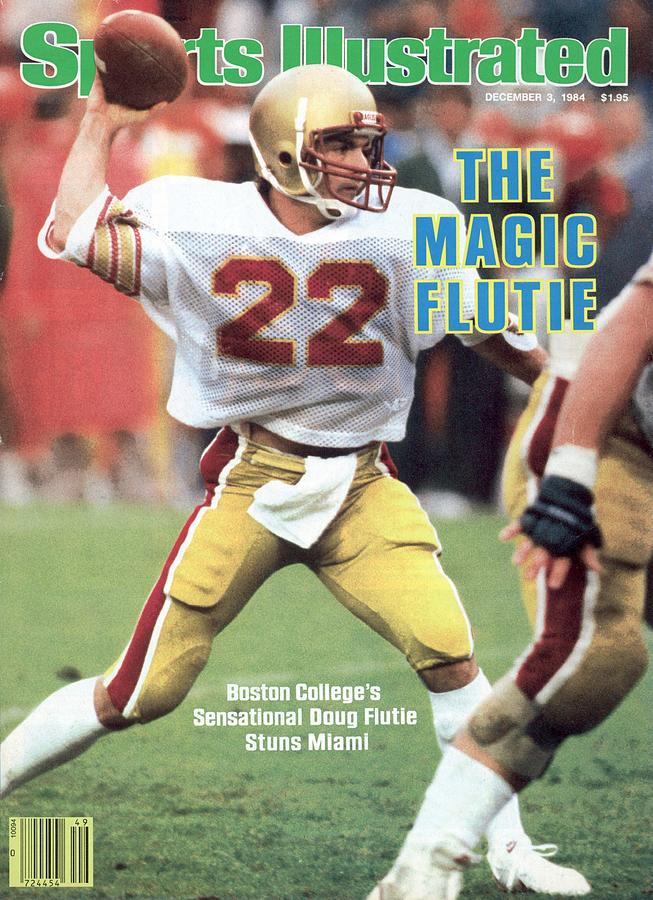
November 23, 1984: Doug Flutie's Miracle In Miami

November 23, 1984: It is the day after Thanksgiving, and this was the early days of retail treating it as "Black Friday," the biggest shopping day of the year, which has come to, traditionally, set the tone for the Christmas season: Either they will make big profits, and be "in the black"; or they will be wearing black for mourning.

Thanksgiving weekend is also a time for football. The day before, many high school games were played, much more so than are played today. I was a sophomore at East Brunswick High School in Central New Jersey, and my Bears came back from a 27-13 deficit to beat Colonia High School of Woodbridge, 33-27, and clinch the Championship of the Middlesex County Athletic Conference and an undefeated regular season. It's often regarded as the greatest football game in the school's history. Unfortunately, we lost the Central Jersey Group IV Final, costing us a "State Championship" and an undefeated full season, something, to this day, we've never had.

There was only one college football game that Thanksgiving Day, a minor rivalry to everyone but those connected to the schools playing: Miami University of Ohio beat the University of Cincinnati, 31-26 at Nippert Stadium in Cincinnati. Miami University, in Oxford, Ohio, was founded in 1809, 8 years before Ohio gained Statehood. In contrast, the University of Miami, in suburban Coral Gables, Florida, wasn't founded until 1925.

In the NFL, both of the traditional home teams won: The Detroit Lions beat the Green Bay Packers, 31-28 at the Silverdome in Pontiac, Michigan; and the Dallas Cowboys beat the New England Patriots, 20-17 at Texas Stadium in Irving.

There was only one college game played on the day after Thanksgiving, on CBS. So anybody who wanted to watch a football game at that point was watching it. At the time, there was a Big East Conference, but they did not sponsor a football competition. If they did, this game would have decided its Championship. The fact that both teams involved have since moved to the Atlantic Coast Conference (ACC) should not attract from what that meant.

The University of Miami were the defending National Champions, having shocked the University of Nebraska in the previous season's Orange Bowl game, in the stadium of the same name, which was the Hurricanes' usual home field.

Bernie Kosar quarterbacked them as a freshman, and now, as a sophomore, had led them to an 8-3 record. They had won the Kickoff Classic at the Meadowlands, beating then-Number 1 Auburn. They beat Number 17 Florida on neutral ground in Tampa. They beat Number 16 Notre Dame away. But they had lost to Number 14 Michigan away, losing the Number 1 ranking in the process. They had lost to Number 15 Florida State at home.

And, in their last game before this one (they had a week off in between), they lost an embarrassing one: They led Maryland 31-0 at the half, and lost, 42-40. For many years thereafter, it was the biggest comeback in NCAA Division I-A (now FBS, the Football Bowl Subdivision) history. The Maryland quarterback was Frank Reich, substituting for the injured Boomer Esiason. In the 1992 NFL Playoffs, subbing for the injured Jim Kelly -- who had played at Miami -- Reich led the Buffalo Bills to what is still the biggest comeback in NFL history, from 35-3 down to beat the Houston Oilers, 41-38 in overtime.

Their opponents for this game would be Boston College. BC had some good teams in the 1930s and '40s, but hadn't done much since. In 1981, they were struggling, losing to the University of Pittsburgh, ranked Number 2 in the country, and coach Jack Bicknell turned to a 5-foot-9 3/4-inch freshman quarterback from nearby Natick, Massachusetts, and said, "Okay, Flutie, see what you can do."

And Doug Flutie went in, and nearly pulled the upset. They ended the season 5-6. The next season, Sports Illustrated noted that Flutie would be the starting quarterback, and whoever was writing the article finished with, "Good luck, Flutie."

Flutie made his own luck, leading BC to an 8-3-1 record. Their non-wins were all against then-ranked teams: A tie away to Number 16 Clemson, and losses away to Number 16 West Virginia, home to Number 8 Penn State, and to Number 18 Auburn in the Citrus Bowl. It was their 1st bowl game in 39 years.

As a junior in 1983, Flutie led them to a 9-3 season, losing at home to Number 12 West Virginia, away to unranked Syracuse, and in the Liberty Bowl to Notre Dame. On October 29, in a game too big for their 32,000-seat on-campus Alumni Stadium, they played defending National Champion (but, at the time, unranked) Penn State at Sullivan Stadium, home of the NFL's New England Patriots (later renamed Foxborough Stadium). Before a crowd of 56,605, and millions more watching on ABC, the Eagles beat the Nittany Lions, 27-17. Flutie, already the classic "local boy makes good," became a national star.

BC were 7-2 going into their game with Miami. They had beaten Number 9 Alabama in Birmingham, but had lost 2 games, away to Number 20 West Virginia and away to Penn State -- by a combined 8 points. BC were ranked Number 10, Miami Number 12. In spite of these rankings, Miami were a 6-point betting favorite. (Keep in mind: In football, home-field advantage is traditionally said to be worth 3 points.) Flutie was the favorite for the Heisman Trophy, although Kosar was also a contender for it. The winning quarterback would get his Heisman vote totals boosted significantly.

The game was played at the Orange Bowl, in a driving rainstorm throughout. It was almost as if there was a real hurricane going on. It kicked off at 2:30 PM Eastern Time, and BC jumped out to a 14-0 lead. Miami scored a touchdown before the 1st quarter ran out, and tied the game with a touchdown early in the 2nd quarter.

BC scored on a run by Flutie, then Miami scored on a Kosar touchdown pass, then BC did so on a touchdown pass from Flutie to his college roommate, Gerard Phelan. At halftime, the score was Boston College 28, Miami 21. So there had already been as much action as in most full games.

In the 3rd quarter, Miami scored another touchdown, and the teams traded field goals. The quarter ended with the game tied, 31-31. BC kicked another field goal to make it 34-31, but Melvin Bratton broke off a 52-yard run to make it 38-34 Miami. It seemed like Miami had the game won. Flutie led a drive that ended with a touchdown, and it was 41-38 BC. But Kosar led a drive that ended with another touchdown run by Bratton, and it was 45-41 Miami.

BC got the ball back with 28 seconds left in regulation, on their own 20 yard line. Flutie got the Eagles to the Hurricanes' 48-yard line. There were 6 seconds left. Time for one more play. A field goal wouldn't have helped, it would have been 65 yards anyway, and the weather and the wet grass would have made it a tricky proposition regardless of how close it was. There was no choice: The play had to result in a touchdown.

Before the play, CBS announcer Brent Musberger said, "One thing is certain: Those brave folks who sat out here in the Orange Bowl, and put up with this terrible weather, saw a whale of a football game, and they should give both teams a rousing ovation when this one is over." His broadcast partner, former Notre Dame coach Ara Parseghian, whose career included a 10-10 tie with Michigan State in 1966, known as "The Game of the Century," followed this with, "This is one of the better ones that I've seen."

Flutie called "55 Flood Tip": No running backs, and all eligible receivers run straight routes to the end zone. He was flushed out of the pocket by the Miami defense, and had to scramble. He had to attempt his 46th pass of the game, on the run, throwing from his own 37-yard line, meaning the ball had to fly at least 63 yards, into a 30-mile-per-hour wind, and through the rain.

Flutie heaved the ball. Since a Roger Staubach to Drew Pearson play in the 1975 NFL Playoffs, such a pass had been known as a "Hail Mary." Some Catholics find the expression offensive. In this case, given that Boston College is a Catholic school -- specifically, Jesuit -- it might have been appropriate.

Three Miami defensive backs blanketed receiver Kelvin Martin. There would be no way he could catch the ball. Phelan was behind them. It would require perfect placement of both man and ball for him to catch it. He did. Boston College 47, Miami 45. Ballgame. No chance to try for an extra point, with everyone running onto the field, and no need for it.

"Caught by Boston College!" Musberger yelled. "I don't believe it! It's a touchdown! The Eagles win it! I don't believe it! Phelan is at the bottom of that pile!" The entire team piled onto Phelan. As Musberger noted, "Jack Bicknell is the only person over there on the sidelines! He couldn't get the headset off fast enough! Doug Flutie has done it! And your heart goes out to Bernie Kosar. He did everything he could."

Kosar had passed for 447 yards, then a school record, with 2 touchdowns. And Bratton had run for 4 touchdowns. It was all for naught, as Flutie passed for 472 yards, becoming the 1st major college quarterback with 10,000 career passing yards. He also threw for 3 touchdowns. Miami punted only once all game; BC, just 3 times.

The game became known as the Miracle in Miami, and if there was any doubt before the game that Flutie would win the Heisman Trophy, that doubt disappeared into Phelan's hands. Ohio State running back Keith Byars finished 2nd. Robbie Bosco, who quarterbacked Brigham Young University to a controversial National Championship, finished 3rd. Kosar was 4th. Jerry Rice of Mississippi Valley State, who went on to become the greatest receiver in football history, finished 9th. Bo Jackson of Auburn, who would win it the next season, did not finish in the Top 10 this season.

Miami went on to lose the Fiesta Bowl to UCLA. Kosar would have a good pro career with the Cleveland Browns, before winning a Super Bowl ring as Troy Aikman's backup on the Dallas Cowboys.

Flutie's last college game was in the Cotton Bowl, and BC beat the University of Houston. But NFL teams passed on him due to his lack of height. This was so dumb. How dumb was it? Well, let's absolve the following teams, because they drafted Hall-of-Famers: The San Francisco 49ers, Rice; the Buffalo Bills, Bruce Smith; and the Minnesota Vikings, Chris Doleman. And, besides, the 49ers had Joe Montana, while the Bills had the rights to Jim Kelly. And several other teams drafted All-Pros. But lots of teams needed a quarterback, and didn't draft Flutie, and struggled for years to come.

Flutie signed with the New Jersey Generals of the United States Football League, and led them to the Playoffs. When the USFL folded, the Chicago Bears signed him, against the wishes of head coach Mike Ditka. Ditka refused to start him over an already-injured Jim McMahon, and the Bears haven't won a Super Bowl since. In 1987, the Bears traded Flutie to his hometown New England Patriots, but they kept him as a backup to Tony Eason, and didn't get too far, and released him after the 1989 season, and got even worse.

Flutie signed with the Vancouver-based BC Lions of the Canadian Football League. In 1992, he was traded to the Calgary Stampeders, and he led them to the CFL Championship, the Grey Cup. He did the same for the Toronto Argonauts in 1996 and '97. All 3 times, he was named the game's Most Valuable Player. He was named the CFL's Most Outstanding Player 6 times in 7 years from 1991 to 1997.

Finally, at the age of 36, the NFL could ignore him no longer. With Kelly having retired after the 1996 season, the Bills signed Flutie, and he led them to the Playoffs, made the Pro Bowl, and was named the NFL Comeback Player of the Year. He got them back into the Playoffs in 1999, but coach Wade Phillips benched him for the Playoff game against the Tennessee Titans, in favor of Rob Johnson. The Bills lost, and didn't make the Playoffs again for 18 years.

Flutie played 4 years for the San Diego Chargers, and closed his career with the Patriots, as a backup to Tom Brady. In his last game, against the Miami Dolphins, on New Year's Day 2006, he did something no NFL player had done since 1941: He converted a dropkick. It was good for a point-after-touchdown, and the Patriots won.

Doug Flutie is not in the Pro Football Hall of Fame. It is, quite specifically, not "The National Football League Hall of Fame." It includes a few players who would not have made it if not for their performances in the All-America Football Conference (1946-49) and the 1960s version of the American Football League, including Billy Shaw, who played 9 seasons for the Bills, all in the AFL, and never played a down in the NFL.

Still, voters for it tend not to consider CFL statistics. There are really only 2 NFL players who are not in the Hall whose qualifications would be noticeably boosted if their CFL tenures were included, and they're both quarterbacks: Joe Theismann and Doug Flutie. Another quarterback, Warren Moon, is the only player in the Hall with significant CFL performance, although Bud Grant won 4 Grey Cups as a coach in Winnipeg before becoming a Hall of Fame coach in Minnesota.

Oddly, for all the exposure BC got from the Flutie years, their Alumni Stadium wasn't expanded to its present 44,500 seats until the 1994 season.

*

November 23, 1984 was a Friday. As I said, this was the only college game played that day. No pro games were played. Baseball was out of season, although future player Justin Turner was born. There were 7 games played in the NBA:

* The New York Knicks beat the Detroit Pistons, 120-97 at the Silverdome in the Detroit suburb of Pontiac, Michigan. Bernard King led all scorers on the day with 45 points.

* The Boston Celtics beat the Washington Bullets, 118-110 at the Boston Garden. Larry Bird scored 29 points. So it was a good day for Boston sports.

* The Golden State Warriors beat the Cleveland Cavaliers, 107-106 at The Coliseum in the Cleveland suburb of Richfield, Ohio.

* The Kansas City Kings beat the Indiana Pacers, 122-105 at the Market Square Arena in Indianapolis.

* The Utah Jazz beat the Houston Rockets, 111-98 at the Salt Palace in Salt Lake City.

* The Philadelphia 76ers beat the Phoenix Suns, 119-107 in overtime at the Arizona Veterans Memorial Coliseum. Julius "Dr. J" Erving had 31 points. Moses Malone had 23 points. A rookie named Charles Barkley came off the bench to score 17 points and grab 19 rebounds.

* And the Chicago Bulls beat the Seattle SuperSonics, 113-94 at the Seattle Center Coliseum. A rookie named Michael Jordan led all scorers in this game with 23 points.

And there were 6 games played in the NHL:

* The New York Islanders beat the Washington Capitals, 5-1 at the Capital Centre in the Washington suburb of Landover, Maryland.

* The Philadelphia Flyers beat the Buffalo Sabres, 4-2 at the Buffalo Memorial Auditorium.

* In an "Original Six" matchup, the Detroit Red Wings beat the Toronto Maple Leafs, 6-5 at the Joe Louis Arena in Detroit.

* The New Jersey Devils lost to the Minnesota North Stars, 5-4 at the Metropolitan Sports Center in the Minneapolis suburb of Bloomington, Minnesota. Craig Hartsburg scored the winning goal with 1:25 left in overtime.

* The St. Louis Blues beat the Calgary Flames, 3-1 at the Saddledome in Calgary.

* And the Winnipeg Jets beat the Vancouver Canucks, 5-1 at the Pacific Coliseum in Vancouver.

November 11, 1938: The Truth of the Nazis' Gun Control Law

November 11, 1938: You may have heard, from American "gun rights" advocates, that the Nazis passed a gun control law. That is a lie: Here is the truth of the law passed on this date:

The 1938 German Weapons Act superseded a 1928 law. As under the 1928 law, citizens were required to have a permit to carry a firearm and a separate permit to acquire a firearm. But under the new law:

Gun restriction laws applied only to handguns, not to long guns or ammunition. The 1938 revisions completely deregulated the acquisition and transfer of rifles and shotguns, and the possession of ammunition.

The legal age at which guns could be purchased was lowered from 20 to 18.

Permits were valid for three years, rather than one year.

Holders of annual hunting permits, government workers, and NSDAP members (the National Socialist German Workers' Party, or "Nazis") were no longer subject to gun ownership restrictions. Prior to the 1938 law, only officials of the central government, the states, and employees of the German Reichsbahn Railways were exempted.

* The manufacture of arms and ammunition continued to require a permit, with the proviso that such permits would no longer be issued to any company even partly owned by Jews. Jews could not manufacture or deal in firearms or ammunition.

In other words, this law made it easier to get guns -- and it didn't prohibit Jews from owning them.

Also, if the Jews of Germany – or any other country – had guns, they would not have defeated the Nazis, as we saw when they fought back in Berlin in 1938, in Prague in 1942, and in Warsaw in 1944.

*

November 11, 1938 was a Friday. Baseball was out of season. The NBA hadn't been founded yet. The NHL season was underway, but no games were scheduled.

There were 9 college football games, but none was between 2 teams that would now be considered major. New York University (NYU) beat Colgate, 13-7 at Yankee Stadium. And Boston College beat Boston University, 21-14 at Fenway Park.

December 31, 1999 & January 1, 2000: The Millennium

December 31, 1999:  The Millennium arrives. The people of planet Earth survived. At a terrible cost. But we hadn't destroyed ourselves. ...