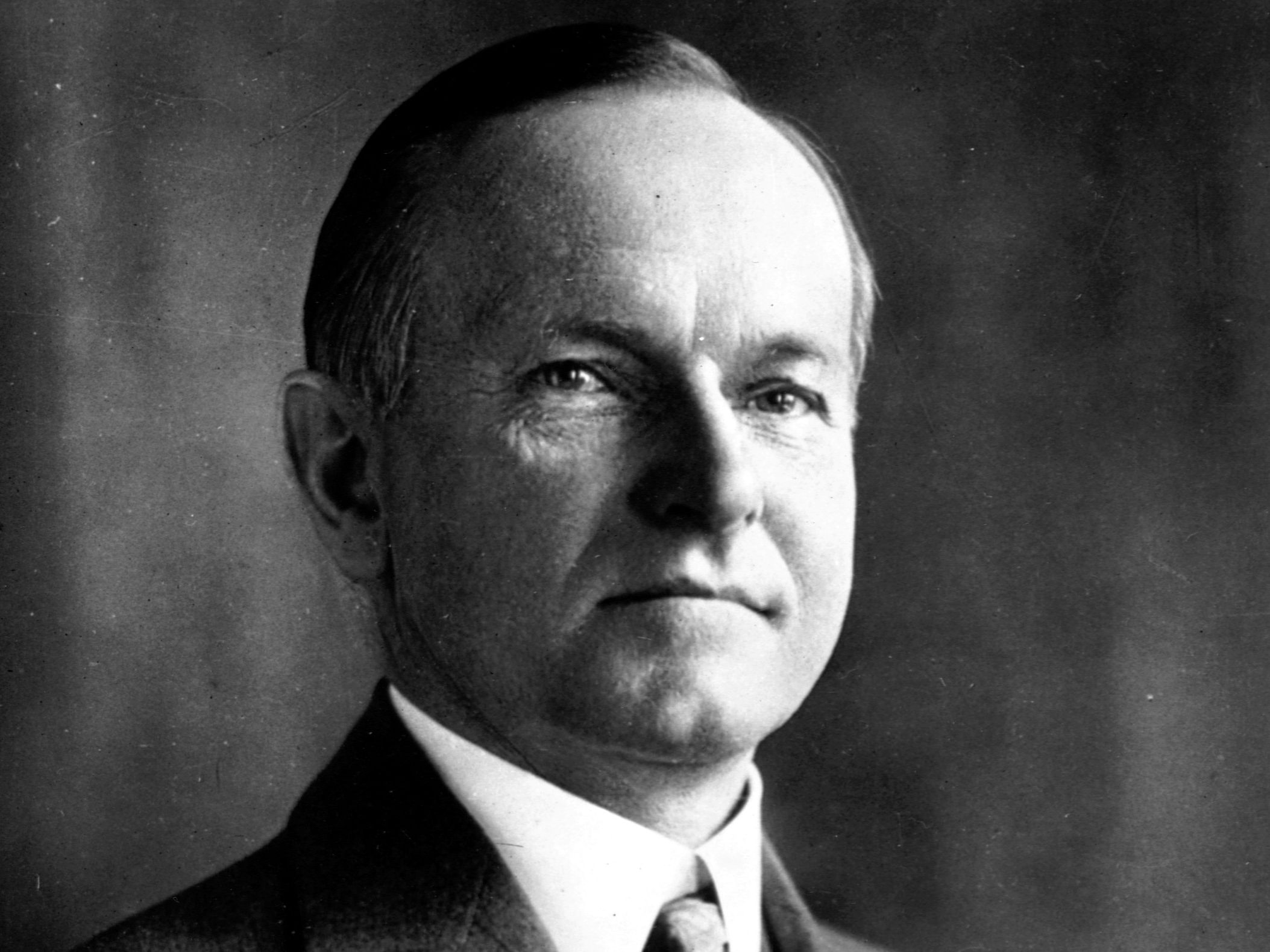
November 4, 1924: President Calvin Coolidge, who took the office on the death of Warren Harding the year before, is elected to a full term in his own right. The Republican, who had been Governor of Massachusetts before being Vice President, took advantage of a split in the Democratic Party that nullified a split in the Republican ranks.
The slogan was "Keep Cool with Coolidge" -- alternately, "Keep Cool and Keep Coolidge" -- and the nation agreed. He won 382 Electoral Votes, and 54 percent of the popular vote. John W. Davis, a former Congressman from West Virginia and U.S. Ambassador to Britain, won 136 Electoral Votes, but his 29 percent represents the lowest popular-vote percentage in the history of the Democratic Party. Senator Robert La Follette of Wisconsin, formerly a Republican but now the leader of the Progressive Party, won his home State for 13 Electoral Votes, and took 16 percent of the vote.

The slogan was "Keep Cool with Coolidge" -- alternately, "Keep Cool and Keep Coolidge" -- and the nation agreed. He won 382 Electoral Votes, and 54 percent of the popular vote. John W. Davis, a former Congressman from West Virginia and U.S. Ambassador to Britain, won 136 Electoral Votes, but his 29 percent represents the lowest popular-vote percentage in the history of the Democratic Party. Senator Robert La Follette of Wisconsin, formerly a Republican but now the leader of the Progressive Party, won his home State for 13 Electoral Votes, and took 16 percent of the vote.

Charles G. Dawes was elected to fill the vacancy in the Vice Presidency, caused by Coolidge's ascendancy. A Mayflower descendant, and also a descendant of William Dawes, one of Paul Revere's co-riders, a Chicago utilities executive who had served as Harding's Budget Director.
The following year, his Dawes Plan for easing the payment of war reparations won him the Nobel Peace Prize. He was also a musical composer, and his "Melody in A Major" became popular upon publication in 1912. In 1951, Carl Sigman added lyrics to it, and it became "It's All In the Game." In 1958, black singer Tommy Edwards had a Number 1 hit with it. Dawes is the highest-ranking government official ever to have had a Number 1 hit.
Coolidge had recently lost his 16-year-old son John to an infection that could have been easily treated had antibiotics been invented. He had also recently watched the Washington Senators win the World Series. He did not like baseball, but his wife Grace did.
He was known as "Silent Cal" for his reticence. Legend has it that 2 women, seeing him at a party, made a bet. So one walked up to him and said, "I made a bet with my friend that I could get you to say 3 words to me." And Coolidge said, "You lose."Even when he decided not to run for a 2nd full term, he was brief: He told the press simply, "I do not choose to run for President in 1928," and walked away. He may have seen the Crash of 1929 coming, and didn't want to get blamed for it. He should be, but he left his successor, Herbert Hoover, holding the bag.
Interestingly, Coolidge and Dawes did not get along, and when it was suggested at the 1928 Republican Convention that Dawes be nominated for a 2nd term as Vice President, along with Hoover, Coolidge stepped in and prevented it, and Senator Charles Curtis of Kansas was nominated instead, a choice both Coolidge and Hoover could live with.

As a consolation prize, Hoover appointed Dawes to be U.S. Ambassador to Britain. He didn't get along well with King George V, but the Prince of Wales, later King Edward VIII and the Duke of Windsor, liked him. As the Depression kept going, Hoover asked Dawes to come home, and run the Reconstruction Finance Corporation (RFC), which he did for the remainder of the term. He was offered the Vice Presidential nomination in 1932 and the Presidential nomination in 1936, as a reminder of the "good" Coolidge years, but declined both times. He died in 1951.
La Follette had been a Republican, serving Wisconsin in the House of Representatives from 1885 to 1891, as Governor from 1901 to 1906, and as U.S. Senator ever since. He was a supporter of Theodore Roosevelt, who split from the Republican Party and ran as the Presidential nominee of the new Progressive Party in 1912, finishing 2nd.
TR's Progressive Party fell apart, so when he ran in 1924, "Fightin' Bob" La Follette formed a new one, but it did no good, as he won only his home State. He died on June 18, 1925, 7 months after the election, and 4 days after his 70th birthday. His son, Robert Jr., was appointed to his seat, and members of the La Follette family continue to serve the State of Wisconsin to this day. The Progressive Party that nominated Henry Wallace for President in 1948 shared little but name with the parties of 1912 and 1924.
In 1957, future President John F. Kennedy, then a Senator from Massachusetts, headed a committee to name the 5 greatest Senators in history, and La Follette was chosen. The others were another from the 20th Century, Robert Taft of Ohio; and 3 leading Senators of the pre-Civil War era: Henry Clay of Kentucky, John C. Calhoun of South Carolina, and Daniel Webster of Massachusetts. Portraits of these "Famous Five" were hung in the Senate Reception Room.
*
November 4, 1924 was, like all modern American Election Days, a Tuesday. Despite Coolidge's landslide, Nellie Tayloe Ross, a Democrat, was elected Governor of Wyoming, to replace her late husband, William B. Ross. I have a separate entry for that occurrence.
The World Series had ended 25 days before, with the Washington Senators winning, as it turned out, their only World Championship. As I mentioned, Calvin and Grace Coolidge were in attendance. Football was in midweek. The NHL season was 25 days away. And professional basketball barely existed. So there were no scores on this historic day.


