Showing posts with label texas longhorns. Show all posts

Tuesday, December 27, 2022

December 27, 2007: The Assassination of Benazir Bhutto

December 27, 2007: Benazir Bhutto, twice Prime Minister of Pakistan, and for 25 years the leader of the Pakistan People's Party, is assassinated by a suicide bomber in Rawalpindi. She was 54.

Her father, Zulfikar Bhutto, the party’s founder, had also served as Prime Minister, and had also been assassinated in Rawalpindi, in 1979. She became Chairperson of the Pakistan Peoples Party in 1982, and held that post for the rest of her life. She served as Prime Minister from December 2, 1988, becoming the 1st democratically-elected woman to be a mostly-Muslim nation's head of government, until August 6, 1990; and again from October 18, 1993 to November 5, 1996.

As is frequently the case, the other major party, the Pakistan Muslim League, accused Bhutto and her party of corruption, most likely because they opposed her efforts at modernizing the country. Most of the accusations were about not her, but her husband, businessman Asif Ali Zardari.

They had 3 children, and she was pregnant with her son, Bilawal Bhutto Zardari, when she won her 1st election, making her the 1st elected head of government to give birth while in office. She later had 2 daughters, Bakhtawar and Aseefa. A joke arose that "PPP" stood for "Perpetually Pregnant Prime Minister."

Brooke Allen, in her 2016 biography of her, wrote, "The Benazir Bhutto of 1988 was a uniting figure for her country; that of twenty years later, a divisive one. In retrospect, her best and worst qualities seem so intimately linked that the course of her career might almost have been predicted."

On the morning of December 27, 2007, Bhutto met with Afghan President Hamid Karzai. In the afternoon, she gave a speech at a PPP rally held in Rawalpindi's Liaquat National Bagh. On leaving in a bulletproof vehicle, she opened the car's escape hatch and stood up to wave to the surrounding crowds. A man standing within 6 to 10 feet of the car fired 3 gunshots at her, and detonated a suicide vest packed with ball bearings.

Bhutto was fatally injured, but reports differ as to whether she was hit by bullets or by shrapnel from the explosion. There were 22 others who died in the attack. The following day, she was buried next to her father in the family mausoleum near Larkana. PPP supporters rioted in various parts of Pakistan, leading to at least 50 deaths.

It wasn't clear who was responsible. Pakistani authorities claimed to have proof that the attack was masterminded by Baitullah Mehsud, leader of the Pakistani branch of the Taliban. The CIA officially agreed with them. Mehsud, however, denied it. He was killed in a U.S. missile strike in 2009. Mustafa Abu al-Yazid, a.k.a. Saeed al-Masri, leader of al-Qaeda in Pakistan, did claim responsibility, saying, 
"We terminated the most precious American asset which vowed to defeat the mujahideen." He was killed in a U.S. missile strike in 2010.

Likewise, it's unclear with either Mehsud or al-Masri that their responsibility, if any, for Bhutto's assassination had anything to do with the U.S. targeting them, as they had committed other terrorist acts against Americans.

Benazir's son, Bilawal Bhutto Zardari, was immediately elected the PPP's leader, though he was only 19 years old and a student at the University of Oxford at the time. Upon his appointment, he said, "My mother always said that democracy is the best revenge." He was mainly a ceremonial figure until becoming the Party's spokesman in the 2018 elections, winning a seat in the National Assembly at age 30. On April 27, 2022, he was named the country's Foreign Minister.

UPDATE: He lost that office and his seat on August 10, 2023, when his party lost the next election. He remains Party Chairman, and won a by-election for a new Assembly seat on February 8, 2024.

*

December 27, 2007 was a Thursday. Baseball was out of season. The NFL was between its regular season and its Playoffs. There was a college bowl game: Number 17 Texas pulled off a mild upset, beating Number 12 Arizona State, 52-34, in the Holiday Bowl, at Qualcomm Stadium (formerly San Diego Stadium and Jack Murphy Stadium).

There were 3 games in the NBA:

* The Cleveland Cavaliers beat the Dallas Mavericks, 88-81 at the American Airlines Center in Dallas.

* The Phoenix Suns beat the Los Angele Clippers, 108-88 at the Staples Center (now the Crypto.com Arena) in Los Angeles.

* And the Boston Celtics beat the Seattle Seahawks, 104-96 at the KeyArena in Seattle. Paul Pierce scored 37 points for the Celtics. This would be the Sonics' last season in Seattle, as they were being moved to become the Oklahoma City Thunder.

There were 10 games played in the NHL:

* The New York Islanders lost to the Ottawa Senators, 5-2 at Scotiabank Place (now the Canadian Tire Centre) in Ottawa.

* The Philadelphia Flyers beat the Toronto Maple Leafs, 4-1 at the Wells Fargo Center (now the Xfinity Mobile Arena) in Philadelphia.

* The Florida Panthers beat the Atlanta Thrashers, 5-3 at the Philips Arena (now the State Farm Arena) in Atlanta.

* The Montreal Canadiens beat the Tampa Bay Lightning, 5-2 at the St. Pete Times Forum (now the Benchmark International Arena) in Tampa.

* The Nashville Predators beat the Columbus Blue Jackets, 4-3 at the Sommet Center (now the Bridgestone Arena) in Nashville.

* The Pittsburgh Penguins beat the Washington Capitals, 4-3 at the Mellon Arena (as the Civic Arena was then known) in Pittsburgh. Former Capital Sergei Gonchar scored the winning goal with 3:27 left in overtime.

* The Detroit Red Wings beat the Colorado Avalanche, 4-2 at the Pepsi Center (now the Ball Arena) in Denver.

* The Anaheim Ducks beat the Edmonton Oilers, 2-1 at Rexall Place (as the Northlands Coliseum was then known) in Edmonton.

* The Minnesota Wild beat the Phoenix Coyotes, 3-2 at the Jobing.com Arena (now the Desert Diamond Arena) in the Phoenix suburb of Glendale, California.

* And the Vancouver Canucks beat the Calgary Flames, 5-3 at General Motors Place (now the Rogers Arena) in Vancouver.

Thursday, December 8, 2022

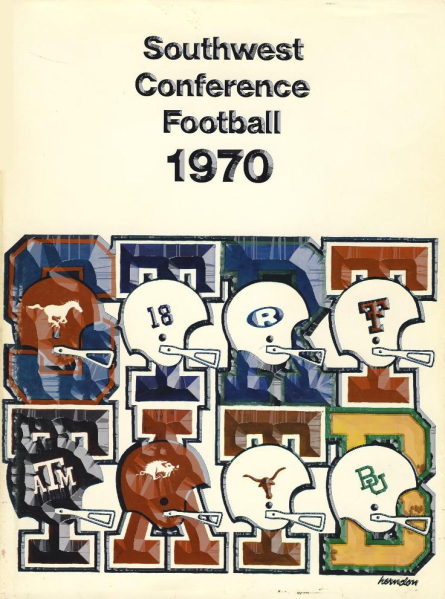
December 8, 1914: The Southwest Conference Is Founded

December 8, 1914: The Southwest Intercollegiate Athletic Conference is founded at the Rice Hotel in Houston, Texas, after previous organizing meetings in May at the Oriental Hotel in Dallas. L. Theo Bellmont, the athletic director at the University of Texas, convened the meetings that led to the league's foundation. 

The 8 original members were the University of Arkansas, in Fayetteville; Baylor University, of Waco, Texas; the University of Oklahoma, in Norman; Oklahoma A&M University, of Stillwater; Rice University, of Houston; Southwestern University; of Georgetown, Texas; the University of Texas, in Austin; and Texas A&M University, in College Station.

Southwestern dropped out in 1917. Southern Methodist University, a.k.a. SMU, of Dallas, joined in 1918. Oklahoma left for the league that became the Big Eight Conference in 1919, and Oklahoma A&M followed them in 1925, becoming Oklahoma State in 1958. Phillips University, of Enid, Oklahoma, was a member only for the 1920-21 schoolyear. Texas Christian University, a.k.a. TCU, of Fort Worth, joined in 1923.

That membership remained steady until 1956, when Texas Tech University, of Lubbock, were admitted. The University of Houston joined in 1972. So it was a 9-team league, with Arkansas and 8 Texas-based teams.

From its founding in 1937 to 1995, the Cotton Bowl Classic in Dallas usually invited the SWC football champion to participate. Of those 59 appearances: Texas made 16, Texas A&M 9, Arkansas 8, TCU 6, SMU 4, Rice 4, Houston 4, and Baylor and Texas Tech 2 each. There was no SWC team in the 1940 Cotton Bowl.

The Texas Longhorns dominated in football, and so every other school in the league hated them. Their rivalry with Texas A&M, usually on Thanksgiving Weekend, sometimes on Thanksgiving Day, inspired the saying, "If football is a religion in Texas, then this game is a holy war." The Longhorns also built a significant rivalry with Arkansas, culminating in the 1969 "Game of the Century." But many Texas fans consider Oklahoma, then of the Big 8, to be their biggest rival.

The intra-"Metroplex" rivalry of SMU in Dallas and TCU in Fort Worth is pretty intense, and resulted in an earlier "Game of the Century" in 1935. And intra-city rivals Houston and Rice can get pretty heated.

Houston made a pair of NCAA Final Fours before joining the SWC, and then became the league's premier basketball school. Texas, Texas A&M and Rice became great baseball schools, while Arkansas became one of the country's greatest track programs.

In 1991, Arkansas announced it was leaving the SWC for the Southeastern Conference (SEC). That left the SWC with only the 8 Texas schools. They could have added another school from the Lone Star State, possibly the University of Texas at El Paso: UTEP were then a member of the Western Athletic Conference, and their (relative) proximity to New Mexico and New Mexico State made for easier and cheaper travel.

Instead, in the 1995-96 schoolyear, Texas, Texas A&M, Texas Tech and Baylor applied for, and received, membership to the Big 8. The 4 remaining SWC schools -- Texas Christian, Southern Methodist, Houston and its crosstown rival Rice -- joined other leagues: Houston joined Conference USA, and the other 3 joined the WAC, though all would join C-USA at some point.

Thus did 2 of the great college sports leagues, the Big 8 and the SWC, come to an end, but a better league, the Big Twelve Conference, was formed. The 4 Texas schools and the 2 Oklahoma schools formed the South Division, the other teams the North Division.

But that league did not hold: Nebraska went to the Big Ten, Colorado went to the Pac-10, and Texas, Texas A&M and Oklahoma all left for the Southeastern Conference. The Big 12 had a connection to the old SWC, but little remains of that Texas (and Arkansas) collegiate sports tradition.

*

December 8, 1914 was a Tuesday. Baseball season was over. Football was in midweek. Professional basketball barely existed. There was professional hockey, in the forms of Eastern Canada's National Hockey Association, and Western Canada's Pacific Coast Hockey Association.

The NHA season didn't begin until December 26, but the PCHA season opened on December 8, with 1 game: The Vancouver Millionaires beat the Portland Rosebuds, 6-3 at the Portland Ice Arena. The Millionaires would win the PCHA title, and beat the NHA Champion Ottawa Senators for the Stanley Cup. No Vancouver team has won the Cup since.

This was also the day that Philadelphia Athletics manager Connie Mack, needing a quick infusion of cash, sold his best player, 2nd baseman Eddie Collins, ending his 1st dynasty, and beginning the A's tradition of "fire sales." I have a separate entry for that event.

Tuesday, December 6, 2022

December 6, 1969: The Altamont Disaster

Mick Jagger in cape. Note the Hell's Angel behind him.

December 6, 1969: The Altamont Free Concert is held at the Altamont Speedway in Tracy, California. After seeing the 500,000 or so people who had come to the Woodstock Music & Art Fair in New York's Catskill Mountains in August, with several West Coast acts performing, including Jefferson Airplane, that band's drummer, Spencer Dryden, suggested a "Woodstock West."

As with Woodstock, the hard part turned out to be securing a location. Finally, Altamont was suggested. The concert's poster says it's in Livermore, but current sources say it's in Tracy. Regardless, it's at the eastern edge of the San Francisco Bay Area's East Bay region. Opened in 1966, the facility last known as Altamont Raceway Park hosted auto racing until it was closed in 2008. The 7,500-seat main structure still stands, 56 miles east of San Francisco, 45 miles east of Oakland, 49 miles northeast of San Jose, and 78 miles south of Sacramento.

The initial plan was to have the Airplane, their San Francisco and Woodstock compatriots The Grateful Dead, and the band that, with The Beatles having retreated from live performing, were now the biggest live rock and roll band in the world, The Rolling Stones. Anybody else they could get would have been considered gravy.

Well, 5 bands performed, but The Dead wouldn't be one of them. In order of their taking the stage: Santana, also San Franciscans who had been at Woodstock; The Jefferson Airplane; The Flying Burrito Brothers, based in Los Angeles, including former members of The Byrds Gram Parsons and Chris Hillman; David Crosby, Stephen Stills, Graham Nash & Neil Young, who had also been at Woodstock, and Crosby had also been a Byrd; and The Rolling Stones.

The day before, The Stones had released a new album, titled Let It Bleed. Lead singer Mick Jagger would later call it his favorite Stones album. But on December 6, he got the title's wish -- which contradicted a line from the album's closing song: "You can't always get what you want, but if you try sometimes, you just might find you get what you need." What everybody got at Altamont, nobody wanted or needed.

Airplane lead singer Grace Slick was interviewed for Rolling Stone magazine 20 years later. (While the band was named for "Rollin' Stone," a blues song by Muddy Waters, the magazine was named for Bob Dylan's song "Like a Rolling Stone.") She was one of several performers who said that Woodstock was the worst performance of her career, and added that the music was better at Altamont.

But everything else was wrong. She said, "The vibes were bad. Something was very peculiar, not particularly bad, just real peculiar. It was that kind of hazy, abrasive and unsure day. I had expected the loving vibes of Woodstock, but that wasn't coming at me. This was a whole different thing."

On July 5, the Stones had given a concert at Hyde Park in London, in memory of bandmate Brian Jones, who had died of a drug-related drowning 2 days earlier. (After being kicked out of the band for his drug use, something no other member of that famously druggy band was.) Like Woodstock, it was said to have attracted 500,000 fans.

The security at that concert was run by the London chapter of the Hell's Angels Motorcycle Club. There were no security issues there. So Stones lead singer Mick Jagger suggested the Hell's Angels as security for Altamont. Unfortunately, no one counted on the fact that the Hell's Angels weren't just a motorcycle club: They were a gang, involved in organized crime, a Mafia on two wheels. And they would be operating out of the East Bay, their home territory.

At Woodstock, out of 500,000 people, there were 3 deaths, all accidental: A drug overdose, a burst appendix, and a kid who made the mistake of trying to sleep under a tractor on a hill. At Altamont, out of 300,000 people, there were 4 deaths. Three were accidental: Two in a hit-and-run car accident, and one kid high on LSD who fell into an irrigation canal and drowned.

One death at Altamont was no accident. As can be seen in Gimme Shelter, the documentary film made by Albert and David Maysles, during the performance of "Sympathy for the Devil," the Stones had to stop, because there were fights near the stage. While playing "Under My Thumb," they had to stop for a medical emergency.

Just as The Who, 10 years later to the week, didn't know until they had finished a concert in Cincinnati that 11 fans had been killed in an accident before the show, the Stones didn't know what the emergency was. If they did, they might have stopped the show entirely. Certainly, they would've closed with a song other than "Street Fighting Man," their song inspired by the Paris demonstrations of the year before.

The Hell's Angels guarding the stage were mean, and they were drunk. Meredith Hunter, an 18-year-old black man from Alameda, climbed onto a speaker. He had been told that, the further east you got from Oakland and Berkeley, the worse the racism got. This was a reasonable claim: Inland, California can be just as hicky as The South, just as New York State is the further you get from the City, and Pennsylvania is the further you get from Philadelphia and Pittsburgh.

Hunter had heard this, so he packed a gun. He wasn't using it when he stood on the speaker. But the Angels grabbed him, started punching him, and, discovering the gun, stabbed him. The Angel who did the stabbing would be charged with murder, but was acquitted on self-defense grounds.

Afterward, the Maysles Brothers showed Jagger their footage of what happened, and filmed him watching it. Mick, who has so often embraced his devilish image -- before taking the title role in "Sympathy for the Devil," he titled a Stones album Their Satanic Majesties Request -- is not a man known for attacks of conscience. On the film, he appears genuinely shocked and scared.

Not enough to change his ways, though. He was still 26 years old, and the leader of what was already being called "The World's Greatest Rock and Roll Band." He thought he could do anything, and get away with it. And he has gotten away with a lot. The shock is not that Jagger's excesses of the 1960s led to the disaster at Altamont, 25 days before the decade's end. It's that he, or the Stones as a whole, haven't had another incident like Altamont -- or worse.

Rolling Stone soon called Altamont "Rock and roll's all-time worst day, December 6th, a day when everything went perfectly wrong." Shades of Franklin Roosevelt calling December 7th, 1941, the day of the attack on Pearl Harbor, "a date which will live in infamy." And in 1990, writer A.E. Hotchner would publish a book about the Stones, Jones' death, and Altamont, titled Blown Away: The Rolling Stones and the Death of the Sixties.

Of course, worse was to come: The rest of December 1969 -- I was born 12 days after Altamont -- and the 1st half of 1970 would see the breakup of The Beatles, Diana Ross leaving the Supremes, President Richard Nixon extending the Vietnam War into Cambodia, the Kent State Massacre, and the Hard Hat Demonstration that essentially supported the 2 previous occurrences.

As the poet William Butler Yeats wrote half a century earlier, "Things fall apart. The center cannot hold."

*

December 6, 1969 was a Saturday. "Na Na Hey Hey Kiss Him Goodbye," by the "studio group" Steam, hit Number 1. I have a separate entry for this event.

It was the off-season for baseball. There was 1 game played in the NFL that day, and it was also in the Bay Area: The San Francisco 49ers beat the Chicago Bears, 42-21 at Kezar Stadium in San Francisco. And there was 1 game played in the AFL: The New York Jets beat the Houston Oilers, 34-26 at the Astrodome in Houston.

The big story in America that day was not expected to be Altamont. It was expected to be a college football game that was moved to the Saturday after the intended last week of the regular season, because it looked like the teams involved would be ranked the top two in the nation. In this "Game of the Century," Number 1 Texas beat Number 2 Arkansas, 15-14 at Razorback Stadium in Fayetteville, Arkansas. I have a separate entry for this event.

There was 1 other college football game played that day: The Pasadena Bowl, held at the Rose Bowl stadium in Pasadena. San Diego State beat Boston University, 28-7.

Also that day, there were 5 games played in the NBA: 

* The New York Knicks beat the Milwaukee Bucks, 124-99 at what was still being called "The New Madison Square Garden Center." Walt Frazier and Bill Bradley each scored 29 points for the Knickerbockers, who advanced to 26-2 on the season that would end with their 1st NBA title. In a losing cause, Lew Alcindor (he changed his name to Kareem Abdul-Jabbar in 1972) scored 26, and Len Chappell scored 24.

* The Philadelphia 76ers beat the Cincinnati Royals, 120-102 at The Spectrum in Philadelphia.

* The Seattle SuperSonics beat the Baltimore Bullets, 132-129 in overtime at the Baltimore Civic Center (now the CFG Bank Arena).

* The Chicago Bulls beat the Boston Celtics, 116-114 in overtime at the Chicago Stadium.

* And the Los Angeles Lakers beat the San Diego Rockets, 128-115 at the San Diego Sports Arena. Wilt Chamberlain did not play for L.A., but Jerry West scored 30, and Elgin Baylor 25. Elvin Hayes scored 40 in a losing effort. The Rockets moved to Houston in 1971, and the arena is now named the Pechanga Arena.

Two games were played in the American Basketball Association:

* The Denver Rockets beat the Washington Caps, 108-97 at the Washington Coliseum. The Rockets would become the Denver Nuggets in 1974, renaming themselves for the city's 1st NBA team, which were founded in 1935, joined the NBA in 1948, and folded in 1950. After the 1969-70 season, the Caps moved to Norfolk, and became the Virginia Squires. The Nuggets, the New York Nets, the Indiana Pacers and the San Antonio Spurs were merged from the crumbling ABA into the NBA in 1976. The Squires were not.

* And the New Orleans Buccaneers beat the Miami Floridians, 112-104 at the Miami Beach Convention Hall.

* Five games were played in the NHL. The New York Rangers, the only NHL team in the Tri-State Area at the time, were not involved in any of them:

* The Minnesota North Stars beat the Montreal Canadiens, 4-3 at the Montreal Forum.

* The Boston Bruins beat the Chicago Black Hawks, 6-1 at the Boston Garden.

* The Toronto Maple Leafs beat the Pittsburgh Penguins, 5-0 at Maple Leaf Gardens.

* The Detroit Red Wings beat the St. Louis Blues, 5-1 at the St. Louis Arena.

* And the Los Angeles Kings beat the Oakland Seals, 5-3 at The Forum in the Los Angeles suburb of Inglewood, California.

Also, Arsenal drew with Southampton, 2-2 at Highbury in North London.

December 6, 1969: Texas vs. Arkansas, "The Game of the Century"

December 6, 1969: One of college football's occasional "Games of the Century" is played.

They seemed to be coming every year. 1966 saw Michigan State vs. Notre Dame, in the Big Ten region if not a Big Ten game in its own right. 1967 saw USC vs. UCLA, in the league now known as the Pac-12. Now, it was Texas vs. Arkansas, for the Championship of the Southwest Conference.

Darrell Royal had been a quarterback under Bud Wilkinson at the University of Oklahoma. He never played pro football, but went into coaching. His 1st head coaching job was with the Edmonton Eskimos of the Canadian Football League of 1953. He must have gotten tired of the cold, because he went to Mississippi State University in 1954, and the University of Washington in 1956.

In 1957, he was hired at the University of Texas, one of Oklahoma's main rivals. By 1963, he had made Texas National Champions. In 1968, he installed the wishbone offense, and made his team nearly unstoppable. They won or shared the SWC title in 1959, 1961, 1962, 1963 and 1968.
They roared through the 1969 season, hanging 69 points on Texas Christian (TCU), 56 each on Navy and Baylor, 49 each on Texas A&M and Texas Tech, and 45 on Southern Methodist (SMU). But they only played 1 ranked team all season, beating Number 8 Oklahoma, 27-17 at the Cotton Bowl in Dallas. After beating A&M away on Thanksgiving Day, they were 9-0, and ranked Number 1 in the nation. They went into the game with an 18-game winning streak, their last loss to Texas Tech early in the 1968 season.

Frank Broyles had also been a college quarterback, at Georgia Tech, but not a pro one. He got his 1st head coaching job in 1957, at the University of Missouri. After just 1 year, the University of Arkansas was impressed enough to hire him away.

At the time, the Southwest Conference had 9 teams, and Arkansas, in Fayetteville, was the only 1 of them not in the State of Texas. The others were: Texas, in Austin; Texas A&M, in College Station; Texas Tech, in Lubbock; Texas Christian University (TCU), in Fort Worth; Southern Methodist University (SMU), in Dallas; Baylor, in Waco; and 2 schools in Houston, Rice University and the University of Houston.

But Broyles' Razorbacks held their own, winning the SWC title in 1959, 1960, 1961, 1964, 1965 and 1968, and taking the National Championship in a split poll in 1964. (Alabama won the other poll.) Future Dallas Cowboys head coach Jimmy Johnson and owner Jerry Jones played on his '64 National Champions.
Arkansas also had a fabulous season in 1969. Its offense wasn't as high-powered, but they scored 55 points on the University of Tulsa, 52 on Wichita State, 39 on Oklahoma State, 35 on Texas A&M, 33 on Texas Tech, and 30 on Rice. After beating Texas Tech on Thanksgiving, they were 9-0, and ranked Number 2, behind only Texas. They went into the game with a 15-game winning streak, their last loss being to Texas the season before.

The 1969 season marked the 100th Anniversary of college football, with Rutgers having beaten Princeton in the first game in 1869. Beano Cook, then an executive with ABC Sports, suggested moving the Texas-Arkansas game, normally played in October, to the 1st weekend in December, a week after most other teams had finished playing. The teams agreed, because it meant the entire country would be focused on their game, not on another.

And moving the game turned out to be a lucky break. Because, on November 22, Ohio State, defending National Champions and ranked Number 1, were upset by their arch-rivals, Michigan, handing Michigan the Big 10 title. That moved Texas up to Number 1 and Arkansas up to Number 2, without either of them even playing. All each team had to do was win their respective game on Thanksgiving, which they did: The 'Horns beat A&M 49-12, and the Hogs beat Texas Tech 33-0.

And so, on Saturday, December 6, 47,500 people shoehorned themselves into Razorback Stadium in Fayetteville. That was about 5,000 above normal capacity at the time, and later expansions have made it now a 76,000-seat facility.
Razorback Stadium, 1969. The practice fields in the upper left corner
are where Marine One landed, depositing Nixon.

Among those 47,500 fans, his Marine One helicopter landing on an adjacent practice field a few minutes before the scheduled kickoff, was the nation's Number 1 football fan, a former offensive lineman at Whittier College outside Los Angeles, the President of the United States, Richard Nixon. He had said that week that he would give a plaque to the winning coach, declaring them the National Champions. Of course, this was before the New Year's Day bowl games could have messed that up. 

Also among the fans was the Rev. Billy Graham, who delivered a pregame prayer over the public address system. Graham had a degree from Wheaton College, in Wheaton, Illinois, hometown of football legend Red Grange, although Grange went to the University of Illinois.

Not among the fans was Bill Clinton, then 23 years old, himself a future President, and a future Governor of Arkansas. At some point during his political career, a rumor got out that he had watched the game for free from a tree. The rumor grew, until it involved him flashing Nixon, or holding up an antiwar sign in front of Nixon. But he was then a Rhodes scholar at Oxford University in England, left to listen to the game on the Armed Forces Radio Network.

One time, while he was Governor, a man asked him if it was true he had heckled Nixon that day. Clinton told the truth, and denied it. Disappointed, the man said, "That's one of the reasons I voted for you!"

At the time, both schools had racially integrated student bodies, but all-white football team rosters, all-white bands, and all-white cheerleading corps. How many black fans were in the stands is unknown, but the number probably wasn't very large. In 2002, Terry Frei, who has written many books about football, published one about this game, fittingly titled Horns, Hogs, and Nixon Coming: Texas vs. Arkansas in Dixie's Last Stand, pointing out that, the last month of the 1960s, this was the last major all-white sporting event in America.

It was only 38 degrees at kickoff, and there was still some fog after an early morning rain when the game kicked off at 12:00 noon Central Time (1:00 PM Eastern Time). The game had to be held that early, because Razorback Stadium didn't yet have lights.

Broyles offered to move the game to War Memorial Stadium in Little Rock, which was a secondary home for the Razorbacks, did have lights, was a larger stadium, was in the central part of the State and thus closer to most people in Arkansas, and was closer to Austin, thus making it an easier roadtrip for the Texas fans. But ABC rejected this idea, dismissing that stadium's lights as not bright enough.

Arkansas, in red, kicked off, and benefited from Texas, wearing white, fumbling the ball away on their 2nd play from scrimmage. The Razorbacks converted that into a touchdown run by Bill Burnett. Their 7-0 lead held through halftime.

(If you get a chance to see this game, on a nostalgia network or online, you'll miss the 1st Arkansas touchdown: ABC only managed to save the last 3 quarters of their broadcast. The full game should be available on film.)

The Hogs started the 2nd half by driving through the Longhorn defense, resulting in a 29-yard touchdown pass from Bill Montgomery to Chuck Dicus. With 9:06 left in the 3rd quarter, it was Arkansas 14, Texas 0. And the Longhorns hadn't yet looked like scoring on the afternoon. This "Game of the Century" was not yet living up to the hype.

On the 1st play of the 4th quarter, Texas quarterback James Street made a 42-yard dash for a touchdown. Now, it was 14-6 Razorbacks. Royal, remembering the 1966 "Game of the Century" between Michigan State and Notre Dame that ended in a 10-10 tie, chose to go for a 2-point conversion. Street got over the goal line, to make it 14-8.

The Hogs were not fazed. On their next drive, Montgomery took them down to the Texas 7-yard line. But on 3rd and goal, his pass was intercepted in the end zone by Danny Lester. Had it merely been incomplete, a chip-shot field goal would have made it 17-8, a 2-score game, and probably cinched it for Arkansas.

Instead, it was still 14-8, and, with 4:47 left, Royal rolled the dice again, going for it on 4th and 3 from his own 43. Street threw to Randy Peschel, who caught it and took it deep, to the Arkansas 13. Two plays later, Jim Bertelsen scored a touchdown. The extra point by James "Happy" Feller gave the Longhorns a 15-14 lead. Now, with 3:58 left, the game was living up to the hype.

Arkansas refused to fold. They got to the Texas 40, and Campbell let a pass loose, but it was intercepted by Tom Campbell on the Texas 21 with under a minute to go. The Longhorns ran out the clock, and were 15-14 victors.

In the Longhorn locker room, ABC cameras captured Nixon's presentation of his National Championship plaque to Royal. But the bowl games were still left to play. Texas still had to beat Notre Dame in the Cotton Bowl in Dallas to truly be National Champions. They did, coming back from 10-0 down to win 21-17.
Nixon gives Royal the plaque. Number 24 is tailback Ted Koy.
Number 16 is quarterback James Street.

Arkansas went to the Sugar Bowl in New Orleans, and lost again, to Mississippi, 27-22. USC, undefeated at 9-0-1, beat Michigan in the Rose Bowl in the Los Angeles suburb of Pasadena, California. Undefeated and untied Penn State rose to Number 2 after Arkansas' loss to Texas, and won the Orange Bowl in Miami, 10-3 over Missouri, the Big 8 Champions and previously undefeated and untied.

Being undefeated, but with a tie, USC did not claim to be the National Champions over Texas. Undefeated and untied Penn State did, and felt robbed when both the AP and UPI published final polls listed Texas at Number 1 and Penn State at Number 2.

Penn State have no case. They had their chance. The Cotton Bowl committee invited Penn State, hoping Michigan would upset Ohio State, and thus make the Cotton Bowl to set up a Number 1 vs. Number 2 matchup with the SWC Champion, regardless of whether it turned out to be Texas or Arkansas. But Joe Paterno figured it wouldn't be Number 1 vs. Number 2, because he figured Ohio State would beat Michigan, and would still Number 1, and turned them down.

Paterno later said, "I've wondered how President Nixon could know so little about Watergate in 1973, and so much about college football in 1969." Nixon died in 1994, before everyone found out that Joe Paterno was a lesser human being, and presided over more felonies, than Tricky Dick.

James Street was also a pitcher on the Longhorn baseball team, and pitched a perfect game. He was drafted by the Cleveland Indians, but got hurt, and never played in the major leagues, nor in professional football. He became a successful settlement planner. He died in 2013, having lived to see his son, Huston Street, become a star major league reliever.

Happy Feller kicked in the NFL for Philadelphia in 1971 and New Orleans in 1972 and '73. As of December 6, 2022, he is still alive.

In 1970, Julius Whittier became the 1st black football player at the University of Texas. In 1972, the Longhorns had 1 touchdown pass all season long. Whittier caught it, in their Thanksgiving Day win over Texas A&M. He became a lawyer, and died in 2018.

Darrell Brown had tried to be the 1st black player at Arkansas, and played for their freshman team in 1965, but broke his ankle, and was unable to play a varsity down. Like Whittier, he became a lawyer, and died in 2015.

Due to Brown's injury, Arkansas didn't integrate its football team until 1974, after every other school in both the SWC and the Southeastern Conference had already done so. Leotis Harris was a guard, and played for their 1977 team that nearly won the National Championship. He played 6 seasons for the Green Bay Packers, and is still alive.

"A lot of other coaches from other schools used to talk about that Coach Broyles wouldn't have a black player on his team," Harris said. He found otherwise: "He was a fair guy. Some people said some things about him, about the black-white thing, but he was just a great man."
This game would soon have a profound effect on not just Texas, but two other "blue blood" college football programs. (Three, if you count Penn State not getting a piece of the National Championship.) In 1970, Oklahoma unveiled its own wishbone offense in their rivalry game with Texas. Texas won the game, 41-9, and remained undefeated until losing the Cotton Bowl to Notre Dame, ending their winning streak at 30 games. But Oklahoma kept with the wishbone, and became one of the dominant college football teams of the next 20 years, continuing to run the formation into the 1990s.
And at the end of that 1970 season, Oklahoma and Alabama played to a 24-24 tie in the Bluebonnet Bowl in the Astrodome in Houston. 'Bama coach Paul "Bear" Bryant was so impressed with the wishbone, he installed it as his own offense the next season, and the Crimson Tide were also one of the top teams of the 1970s.
Broyles and Royal both retired as head coach after the 1976 season. Royal remained the Longhorns' athletic director until 1980. Broyles remained the Razorbacks' athletic director until 2007. Both men became broadcasters for ABC Sports. Royal lived until 2012; Broyles, until 2017.
And that plaque that Nixon gave Royal? Well, as it turned out, Nixon only posed with Royal and the plaque. He didn't give it to Royal. He said he would take it back to Washington, and have "TEXAS LONGHORNS" engraved above the words "NATIONAL CHAMPIONS."
After that, the plaque disappeared. No one knows where it is. The UT athletic department denies that it has possession. No player on the 1969 Longhorn team claims to have it, either. Nor does Royal's widow, Edith. Nor does the Nixon Presidential Library. Nor does the Lyndon B. Johnson Presidential Library, which was then being built across from Texas' Memorial Stadium in Austin. Nor does the White House. Nor does the National Archives. Nor does the Smithsonian Institution. Nor does the College Football Hall of Fame. Nor does the Texas Sports Hall of Fame, which is in Waco. Nor does the Texas State Capitol building, also in Austin.
Bill Little, the Texas football program's official historian, said on the game's 50th Anniversary in 2019, "No one's seen it in 50 years." Cotton Speyrer, a receiver on that Texas team, suggested, "Some Penn State fan had probably gotten the plaque and thrown it into Lake Erie." (Hayden Fox and Jack Geller, noted fictional throwers of football-related things into lakes, couldn't be reached for comment.)
In 2019, to celebrate the 50th Anniversary of the game, a replica of the plaque was made, and put on display at the Longhorn Hall of Fame, in the north end zone of what's now named Darrell K. Royal Texas Memorial Stadium.
*
December 6, 1969 was a Saturday. This was the day of the disastrous rock music festival at the Altamont Speedway in the San Francisco Bay Area. And "Na Na Hey Hey Kiss Him Goodbye," by the "studio group" Steam, hit Number 1. I have separate entries for these events.
There was 1 other college football game played that day: The Pasadena Bowl, held at the Rose Bowl stadium in Pasadena. San Diego State beat Boston University, 28-7.
There were 5 games played in the NBA:
* The New York Knicks beat the Milwaukee Bucks, 124-99 at Madison Square Garden. Rookie Lew Alcindor, later to become Kareem Abdul-Jabbar, scored 26 for the Bucks. But Willis Reed and Bill Bradley each scored 29 for the Knickerbockers.
* The Philadelphia 76ers beat the Cincinnati Royals, 120-102 at The Spectrum in Philadelphia.
* The Seattle SuperSonics beat the Baltimore Bullets, 132-129 in overtime at the Baltimore Civic Center (now the CFG Bank Arena). Bob "Golden" Rule scored 40 for the Sonics.
* The Chicago Bulls beat the Boston Celtics, 116-114 in overtime at the Chicago Stadium.
* And the Los Angeles Lakers beat the San Diego Rockets, 128-115 at the San Diego Sports Arena (now the Pechanga Arena). Elvin Hayes had 40 points and 20 rebounds in a losing effort. The Rockets moved to Houston in 1971.
There were 2 games played in the American Basketball Association. The Denver Rockets beat the Washington Capitols, 108-97 at the Washington Coliseum. (The Rockets became the Denver Nuggets in 1974.) And the New Orleans Buccaneers beat the Miami Floridians, 112-104 at the Miami Beach Convention Center.
There were 5 games played in the NHL:
* The Minnesota North Stars beat the Montreal Canadiens, 4-3 at the Montreal Forum.
* The Boston Bruins beat the Chicago Black Hawks, 6-1 at the Boston Garden.
* The Toronto Maple Leafs beat the Pittsburgh Penguins, 5-0 at Maple Leaf Gardens in Toronto.
* The Detroit Red Wings beat the St. Louis Blues, 5-1 at the St. Louis Arena.
* The Los Angeles Kings beat the Oakland Seals, 5-3 at The Forum outside Los Angeles in Inglewood, California.
* And the New York Rangers and the Philadelphia Flyers were not scheduled.
Also, Arsenal drew 2-2 with Southampton at Highbury in North London.

Sunday, December 4, 2022

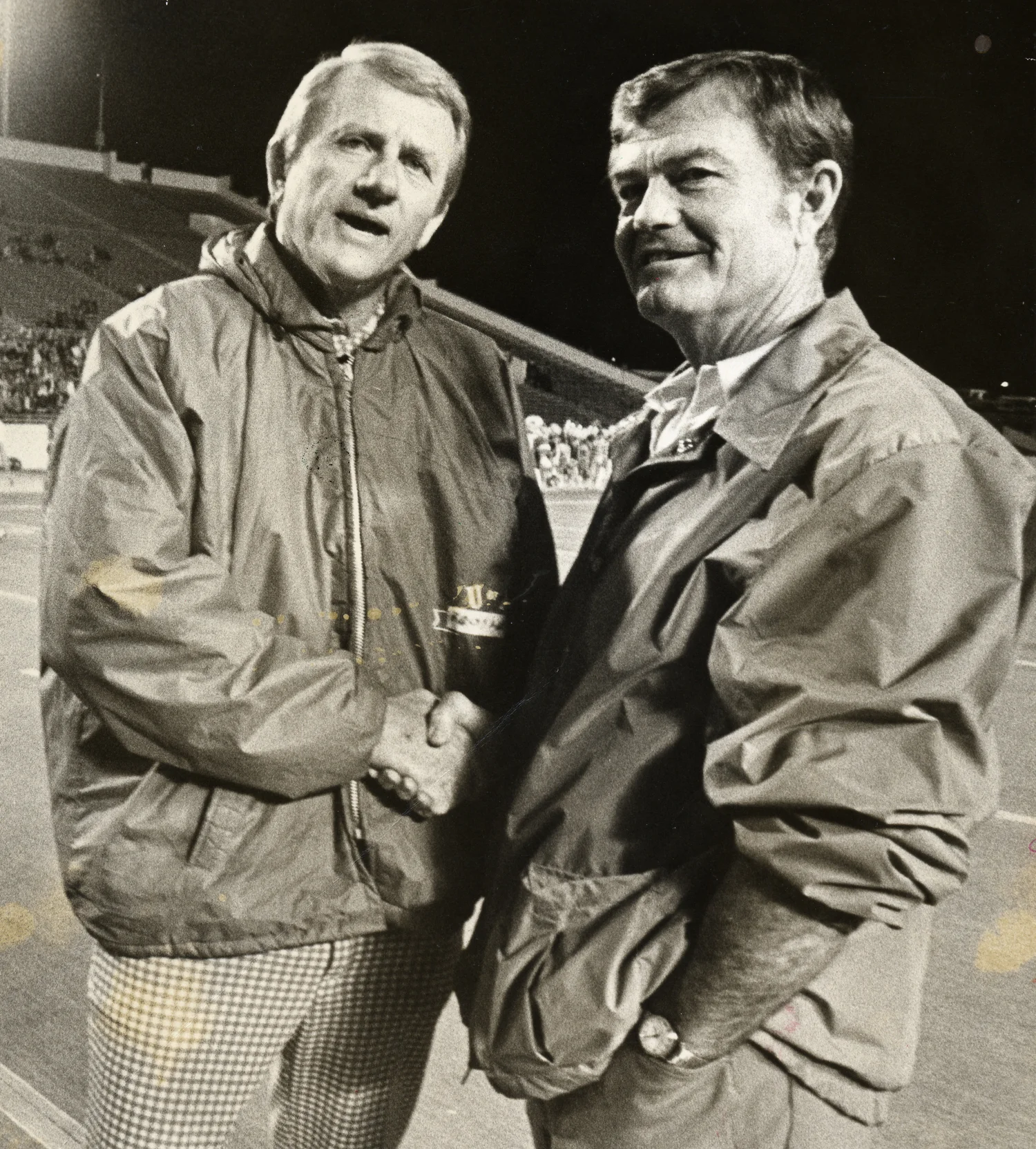
December 4, 1976: Royal & Broyles Hang Up Their Whistles

Frank Broyles (left) and Darrell Royal,
Memorial Stadium, Austin, 1976

December 4, 1976: In front of a national television audience on ABC, the University of Texas football team defeats the University of Arkansas, 29-12 at Memorial Stadium in Austin, Texas. The stadium will later be renamed for Texas' head coach, Darrell Royal.

It was the last game for Royal as the Longhorns' coach. Hired in 1957, he had won National Championships for them in 1963 and 1969, and 11 Southwest Conference Championships. But they finished the season 5-5-1, and it felt like other teams were catching up to his. Even though he was just 52 years old, he felt it was time to move on -- and a lot of Longhorn fans came to that conclusion before he did.

It was also the last game for Frank Broyles as head coach at Arkansas. Hired in 1958, he had won a share of the National Championship in 1964, and 7 Southwest Conference titles. Officially, Broyles led the Razorbacks to the SWC title outright in 1960, 1964 and 1965; Royal led the Longhorns to i outright in 1962, 1969, 1970, 1971, 1972 and 1973; they shared the SWC title in 1959, 1961, 1968 and 1975.

Razorback Stadium in Fayetteville, seat of the UA system, is 525 miles northeast of what's now named Darrell K Royal-Memorial Stadium in Austin, UT's seat. (Like President Harry S Truman, Royal's middle name was just an initial, without a period after it.) Texas won the game between them in 1959, 1961, 1962, 1963, 1967, 1968, 1969, 1970, 1972, 1973, 1974, 1975 and 1976. Arkansas won in 1960, 1964, 1965, 1966 and 1971, giving Royal a 13-5 advantage. Overall, through the 2022 season, Texas leads, 56-23. (UPDATE: Through 2025, the Longhorns lead, 58-23.)

Despite their on-field rivalry, Royal and Broyles were close friends, probably due to their similarities. They were born 6 months apart in 1924. Both were Southerners, but not from the State where they would do their most famous coaching: Royal from Hollis, Oklahoma, Broyles from Decatur, Georgia. Both were quarterbacks in college, themselves trained by a Hall of Fame coach, but not at a school they would later coach: Royal by Bud Wilkinson at Oklahoma (another major rival for Texas, along with Texas A&M), Broyles by Bobby Dodd at Georgia Tech.

They famously agreed to move their 1969 game to the last week of the regular season, to get a national audience on ABC. When Number 1 Ohio State were upset by Michigan 2 weeks earlier, that made Texas Number 1 and Arkansas Number 2, and their game, for the SWC title, a berth in the Cotton Bowl, and the inside track to the National Championship, became one of a few college football games to gain the headline "Game of the Century." Texas came from 14-0 down to win, 15-14, and beat Notre Dame in the Cotton Bowl to win the National Championship.

Both men continued to serve as their school's athletic director for a while: Royal until 1980, Broyles until 2007. Royal lived until 2012, Broyles until 2017.
Frank Broyles (left) and Darrell Royal,
Darrel K Royal Memorial Stadium, Austin, 2008

Arkansas left the Southwest Conference for the Southeastern Conference in 1990. In 1996, the SWC folded, and Texas joined the Big 12 Conference. In 2021, Texas made a deal to join the SEC for the 2024 season.

*

December 4, 1976 was a Saturday. Betty Lennox, the basketball player known as "Betty Big Buckets" for her baskets that helped the Seattle Storm win the 2004 WNBA Championship, was born.

There were 3 other college football games that day. Unlike Texas vs. Arkansas, where, unusually, neither team was nationally ranked, at least 1 team was in each of the other games, including 3 other Texas teams then in the SWC:

* Number 6 University of Houston beat the University of Miami, 21-16 at the Astrodome in Houston. UH had lost to Arkansas, but beaten Texas, and won the SWC title. Despite this, only 20,849 fans came to see this game. Coach Bill Yeoman's Cougars stayed Number 6, and beat Number 4 Maryland in the Cotton Bowl, to finish 10-2 and ranked Number 4.

* Number 9 Texas Tech beat Number 18 Baylor, 24-21 at Clifford B. and Audrey Jones Stadium (now Galaxy Stadium) in Lubbock, Texas. Officially, Tech tied Houston for the SWC title, Technically (pun intended, UH won it by beating Tech in Lubbock 2 weeks earlier.

* And Number 13 Nebraska beat Hawaii, 68-3 at Aloha Stadium in Honolulu. Only 33,737 saw that game, unlike in 1982, when Nebraska brought 16,000 fans to Aloha Stadium, and boosted the attendance to 46,876. Nebraska went on to beat Texas Tech in the Bluebonnet Bowl at the Astrodome. (It's 539 miles from the Tech campus to the Astrodome, so it's not like being in the same State gave Tech any real home-field advantage.)

There were 2 NFL games on the day. The football version of the St. Louis Cardinals beat the Baltimore Colts, 24-17 at Busch Memorial Stadium in St. Louis. And the Los Angeles Rams beat the Atlanta Falcons, 59-0 at the Los Angeles Memorial Coliseum. The Falcons finished 4-10, fired head coach Marion Campbell, then hired Leeman Bennett. With his "Gritz Blitz" defense, they improved to 7-7 in 1977, and made the Playoffs in 3 of the next 5 years.

Baseball was out of season. There were 7 games in the NBA:

* The New York Knicks beat the Seattle SuperSonics, 103-96 at Madison Square Garden.

* The New York Nets beat the Atlanta Hawks, 107-105 at The Omni in Atlanta.

* The Washington Bullets beat the Denver Nuggets, 100-95 at the Capital Centre in the Washington suburb of Landover, Maryland.

* The Houston Rockets beat the Indiana Pacers, 120-108 at The Summit in Houston. It's now the Central Campus of televangelist Joel Osteen's Lakewood Church.

* The Chicago Bulls beat the New Orleans Jazz, 107-99 at the Chicago Stadium. As usual, the Jazz were a one-man show: "Pistol" Pete Maravich scored 34 points, but no other player scored more than 16.

* The Golden State Warriors beat their arch-rivals, the Los Angeles Lakers, 116-114 at the Oakland Coliseum Arena. Jamaal Wilkes scored 31 points. Having already won an NBA Championship with the Warriors, he would win 3 more with the Lakers.

* And the Portland Trail Blazers beat the Milwaukee Bucks, 112-108 at the Portland Memorial Coliseum.

There were 6 games in the NHL:

* The New York Rangers beat the Minnesota North Stars, 11-4 at the Metropolitan Sports Center in the Minneapolis suburb of Bloomington, Minnesota. It was actually only 2-2 until 5:13 left in the 1st period, but the Broadway Blues took off from there. Rod Gilbert had 2 goals and 3 assists. Don Murdoch had 2 goals and 2 assists. Ken Hodge had a goal and 3 assists. Wayne Dillon had 3 assists. Even North Star legend Bill Goldsworthy had a goal for the Rangers.

* The New York Islanders beat the Buffalo Sabres, 3-0 at the Nassau Coliseum.

* The Montreal Canadiens beat the Pittsburgh Penguins, 3-1 at the Montreal Forum.

* The Chicago Black Hawks and the Toronto Maple Leafs played to a tie, 2-2 at Maple Leaf Gardens in Toronto.

* The Atlanta Flames beat the St. Louis Blues, 1-0 at the St. Louis Arena.

* And the Los Angeles Kings beat the Detroit Red Wings, 4-1 at The Forum outside Los Angeles in Inglewood, California.

There were 3 games in the World Hockey Association:

* The Winnipeg Jets beat the New England Whalers, 6-2 at the Hartford Civic Center (now the PeoplesBank Arena) in Hartford, Connecticut.

* The Indianapolis Racers beat the Edmonton Oilers, 5-3 at the Market Square Arena in Indianapolis.

* And the San Diego Mariners beat the Phoenix Roadrunners, 4-3 at the Arizona Veterans Memorial Coliseum in Phoenix.

And in English soccer, Arsenal defeated Newcastle United, 5-3 at the Arsenal Stadium, nicknamed Highbury for its North London neighborhood. Arsenal had just signed Malcolm Macdonald from Newcastle, and on a frozen field following a snowstorm that week, he scored 3 goals against his former team. He hadn't wanted to leave, and Newcastle fans knew that, so when he ran over to their traveling support after the game, they cheered him as much as the Arsenal fans did. 

Friday, December 2, 2022

December 2, 1995: The End of the Southwest Conference

December 2, 1995: The University of Texas, the nation's Number 9-ranked college football team, defeats their arch-rivals, Texas A&M University, ranked Number 16. The score is Longhorns 16, Aggies 6, at A&M's home, Kyle Field in College Station.

Elsewhere in Texas, the University of Houston beat crosstown rival Rice University, 18-17 at Rice Stadium. These would be the last 2 football games ever played in the Southwest Conference.

It was appropriate that the SWC's finale was between the two biggest teams in its now one-and-only State. Someone once said that, if football is a religion in Texas, then Longhorns vs. Aggies is a holy war.

The SWC was founded in 1914, and played its 1st football season in 1915, with these founding members: The University of Arkansas, Baylor University, the University of Oklahoma, Oklahoma A&M University, Rice University, Southwestern University, the University of Texas, and Texas A&M University.

Southwestern University, in Georgetown, Texas, left after only 2 seasons. Oklahoma left after the 1919 season. Oklahoma A&M left after 1925, and changed their name to Oklahoma State in 1958.

Southern Methodist University (SMU), in Dallas, joined in 1918. Their Fort Worth rivals, Texas Christian University (TCU), joined in 1923. Texas Tech University joined in 1956, and the University of Houston joined in 1972. 

Arkansas left after the 1991 season, leaving the SWC as a Texas-only league. They joined the Southeastern Conference, in what turned out to be a foreshadowing of the SWC's end.

In 1994, Texas, Texas A&M, Texas Tech and Baylor reached a deal to join the Big Eight Conference, to form the Big Twelver Conference. Oklahoma and Oklahoma State would join them in a South Division, while the remaining Big Eight teams would form the North Division: Nebraska, Kansas, Kansas State, Missouri, Iowa State and Colorado. The remaining SWC teams -- SMU, TCU, Houston and Rice -- joined other leagues.

Texas A&M left the Big 12 for the SEC in 2011. Texas no longer had the revenue from that rivalry, but didn't want to give up the revenue from their rivalry with Oklahoma. So the Longhorns talked the Sooners into joining the SEC with them, and they will do so for the 2024 season.

*

December 2, 1995 was a Saturday. These other college football games were played that day:

* Number 2 Florida beat Number 23 Arkansas, 34-3, at the Georgia Dome in Atlanta, in the Southeastern Conference Championship Game.

* Army beat Navy, 14-13 at Veterans Stadium in Philadelphia.

* And Oklahoma State beat the University of Hawaii, 24-20 at Aloha Stadium in Honolulu.

Nebraska won the National Championship defeating Florida in the Fiesta Bowl. Texas lost the Sugar Bowl to Virginia Tech. Texas A&M beat Michigan in the Alamo Bowl in San Antonio. The last Cotton Bowl of the SWC era had no Texas-based team: Colorado beat Oregon, 38-6. Southern California beat Northwestern in the Rose Bowl, and Florida State beat Notre Dame in the Orange Bowl.

Baseball was out of season. There were 10 NBA games on this day:

* The New York Knicks beat the Philadelphia 76ers, 94-85 at Madison Square Garden.

* The New Jersey Nets beat the Cleveland Cavaliers, 79-78 at the Brendan Byrne Arena at the Meadowlands.

* The Washington Bullets beat the Boston Celtics, 135-107 at the USAir Arena (formerly the Capital Centre) in the Washington suburb of Landover, Maryland.

* The Detroit Pistons beat the Atlanta Hawks, 104-96 at The Palace in the Detroit suburb of Auburn Hills, Michigan.

* The Houston Rockets beat the Charlotte Hornets, 113-98 at The Summit in Houston. (The arena has since been converted into the Central Campus of the Lakewood Church, Dr. Joel Osteen's "megachurch.") Clyde Drexler scored 41 points. 

* The San Antonio Spurs beat the Phoenix Suns, 101-93 at the Alamodome in San Antonio. David Robinson scored 37 points.

* The Denver Nuggets beat the Minnesota Timberwolves, 109-105 at the McNichols Area in Denver.

* The Chicago Bulls beat the Los Angeles Clippers, 104-98 at the Los Angeles Memorial Sports Arena. Michael Jordan scored 37 points.

* The Golden State Warriors beat the Indiana Pacers, 100-97 at the Oakland Coliseum Arena.

* The Sacramento Kings beat the Orlando Magic, 109-106 at the Arco Arena in Sacramento.

There were 10 games played in the NHL:

* The New York Rangers beat the Ottawa Senators, 4-2 at the Ottawa Civic Centre (now the TD Place Arena).

* The New York Islanders beat the New Jersey Devils, 4-1 at the Nassau Coliseum.

* In an "Original Six" matchup, the Detroit Red Wings beat the Montreal Canadiens, 11-1 at the Montreal Forum. Vyacheslav Kozlov scored 4 of those Detroit goals. Mark Recchi had the lone tally for the Habs.

This was the game in which Canadiens' goalie Patrick Roy was infamously hung out to dry by Canadiens management, leading to him being traded 4 days later, leading to "The Curse of St. Patrick.," I have a separate entry for that event.

* The Boston Bruins beat the Buffalo Sabres, 6-4 at the FleetCenter (now the TD Garden) in Boston.

* The Florida Panthers beat the Hartford Whalers, 5-3 at the Hartford Civic Center (now the PeoplesBank Arena).

* The Toronto Maple Leafs and the Mighty Ducks of Anaheim played to a tie, 4-4 at Maple Leaf Gardens in Toronto.

* The Chicago Blackhawks and the Winnipeg Jets played to a tie, 2-2 at the Winnipeg Arena.

* The St. Louis Blues beat the Edmonton Oilers, 7-3 at the Edmonton Coliseum (formerly the Northlands Coliseum).

* The Dallas Stars and the Los Angeles Kings played to a tie, 2-2 at The Forum outside Los Angeles in Inglewood, California.

* The San Jose Sharks beat the Washington Capitals, 5-3 at the San Jose Arena (now the SAP Center).

* And the Philadelphia Flyers, the Pittsburgh Penguins, the Vancouver Canucks, the Calgary Flames, the Colorado Avalanche and the Tampa Bay Lightning were not scheduled.

And in English soccer, North London team Arsenal went to Birmingham, and played Aston Villa to a 1-1 draw at Villa Park.

Tuesday, November 29, 2022

November 29, 1945: "The Lost Weekend" Premieres

November 29, 1945: The Lost Weekend premieres, based on the novel by Charles R. Jackson, and directed by Billy Wilder. It is Hollywood's classic portrayal of alcoholism. And the title is a little misleading: Although it wraps around a weekend, it runs from Thursday afternoon to Tuesday morning, so The Lost Week might have been a better title.

Ray Milland plays Don Birnam, an alcoholic writer from New York, preparing for a weekend vacation with his brother Wick. Jane Wyman plays his girlfriend, Helen. He goes out for a drink, but, as so often happens, one drink becomes many, and he misses the train for his vacation.

Don tells Helen that he's 2 different people: "Don the Writer" and "Don the Drunk." He's lying, both to her and to himself, proving it by pawning his typewriter on Saturday so he can buy more booze. He wakes up in the alcoholics' ward of a hospital on Sunday. On Monday, he falls victim to delirium tremens, a.k.a. "The D.T.'s." His screams alert a neighbor, who calls Helen, who nurses him through the night. He commits to being Don the Writer, and begins to write his novel based on the events of the "weekend."

Milland won the Academy Award for Best Actor, preceding Richard Burton as the 1st actor from Wales to win one. He later appeared in Dial M for Murder and Love Story, directed for television, and became one of TV's finest character actors. He died in 1986, as a result of substance abuse -- not alcohol, but tobacco.

Wyman later won the Academy Award for Best Actress for Johnny Belinda. She was married to Ronald Reagan from 1940 to 1949, and was the mother of his daughter Maureen. Together, they adopted a son, Michael. She was already a Republican, so his political switch, from liberal to conservative, was not one of the reasons they split. She later remarried, and starred on the TV series Falcon Crest. She lived until 2007.

*

November 29, 1945 was a Thursday. Baseball was out of season. The NBA hadn't been founded yet. No games were scheduled for the NHL.

There were 2 games in college football. Number 10 Texas beat their arch-rivals, Texas A&M, 20-10 at Kyle Field in College Station. And the University of Chattanooga (now the University of Tennessee at Chattanooga) beat the University of Mississippi (a.k.a. Ole Miss), 31-6 at Chamberlain Field in Chattanooga, Tennessee.

Friday, November 18, 2022

November 18, 1999: The Aggie Bonfire Collapse

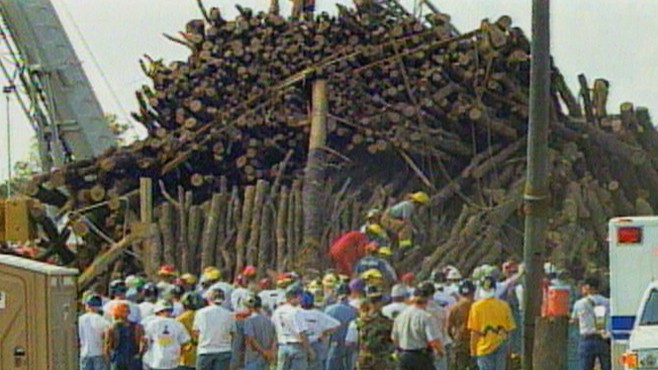
November 18, 1999: The annual Aggie Bonfire, under construction at Texas A&M University in College Station, Texas, collapses, killing 12 people and injuring 27 others.

The Bonfire was a long-standing tradition at A&M, as part of their rivalry with the University of Texas. They started it in 1907, and, since the Texas Longhorns and the Texas A&M Aggies have played each other every year since 1915, they've done it every year since 1915, regardless of whether the game is at home in College Station or away in Austin. The game has been played on Thanksgiving Day in 1901, '02, '04, '07, '09, 1918-21, 1924-27, 1929-32, 1935-38, 1940-43, 1946-49, 1952-55, 1957-73, 1976, 1981-82, 1985-88, 1991-3, and 2008-11.

In the musical The Best Little Whorehouse in Texas, and in its 1982 film adaptation with Burt Reynolds and Dolly Parton, the titular, or so to speak, establishment gives freebies to the players on the game's winning team. This doesn't happen in real life -- as far as I know. In the show, it's A&M that wins, and the results produce the story's main conflict.

In 1942, the Bonfire took on a form similar to a teepee: Logs placed at an angle between 23 and 30 degrees, allowing it to grow to a cone over 50 feet high. It symbolizes their "burning desire to beat the hell outta T.U." It's been said that, in Texas, football is a religion, and 'Horns vs. Aggies is its holy war. So the Bonfire is A&M's ritual sacrifice.

It was never a safe idea. Bonfires have been banned in many places, including some entire States. But not Texas. In 1955, a student carrying one of the logs was killed -- not by getting hit with another log, or by a premature burning of a log, but by getting hit by a car. In 1957, the structure collapsed 2 days before it was supposed to be lit. Fortunately, that time, no one was injured, and they were able to rebuild it in time for its scheduled lighting.

In 1978, the design was changed again, to a "wedding-cake" style: Smaller stacks of logs on top of bigger stacks, with a fortified center pole. The design was intended to collapse on itself in a twisting motion, making it safer to remove.

According to tradition, the bonfire would be lit on the night before the game, which would usually be on Thanksgiving Day (to get a national TV audience), and if it burned without falling past midnight, A&M would win. However, the wedding-cake design ended up reducing the time it burned without falling, sometimes for as little as half an hour. But the tradition turned out to be mere superstition: From 1942 to 1977, with the teepee design, 30-5-1. But from 1978 to 1997, with the wedding-cake design, A&M led, 12-7, including an 11-1 stretch from 1984 to 1994.

It was probably largely about coaching and recruiting: Darrell Royal, who led the Longhorns to the National Championship in 1963, 1969 and 1970, retired after the 1976 season; and Fred Akers kept the winning going for a while, nearly winning the National Championship in 1977 and 1983; but R.C. Slocum led the Aggies to 3 straight Southwest Conference titles in 1991, '92 and '93, and, after the death of the SWC and both schools' 1996 move to the Big Eight, making it the Big Twelve, winning that in 1998.

The 1999 game, with the Longhorns 9-2, ranked Number 7, and already Champions of the Big 12 West Division, and the Aggies 7-3 and ranked Number 24, was set for November 26, the day after Thanksgiving. So the intention was to light the Bonfire on the night of Thanksgiving Day, November 25.

But a week before, on November 18, at 2:42 AM, already 59 feet high, the stack collapsed. Remember: It wasn't yet on fire, it was just a lot of heavy wood. But of the 58 people working on it, students and former students, some with previous Bonfire-building experience, 39 were injured, and 12 of those ultimately died. The fact that A&M is known for its "12th Man" tradition made the number of deaths even more poignant.

Upon learning of the disaster, A&M players rushed to the site, and helped remove the debris to look for survivors. Slocum suspended practice for 2 days. In solidarity, the Longhorn football staff held a blood drive to benefit the victims. UT officials also canceled their own annual pregame tradition, the "Hex Rally," in favor of a unity rally that also included hundreds of A&M students. A&M receiver Greg Porter told a sportswriter, "It was a weird time, you know? You're getting ready to play a football game, and the team on the other side is actually being nice."

And when the game was played at A&M's Kyle Field, it attracted a crowd of 86,128, the largest ever to attend a football game in the State of Texas to that point. (Both Kyle Field and Memorial Stadium, and also the Cotton Bowl, now exceed that capacity by thousands.) Thousands of maroon balloons filled the sky, followed by the pregame release of 12 white doves, one for each of the 12 current and former A&M students who were killed in the bonfire collapse. Four F-16 fighters flew overhead in the "missing man formation," a tribute usually saved for pilots killed in the line of duty.

The Longhorns, quarterbacked by freshman Chris Simms, son of New York Giants legend Phil Simms, because usual starter Marshall Applewhite had a stomach ailment, led 16-6 at the half. In another gesture of unity, both bands played together, and at the end of "Amazing Grace," both bands removed their hats, remained silent for a moment, and then marched off the field in silence.

The show seemed to inspire the Aggie crowd, who seemed to inspire the Aggie players, who mounted a comeback. With 5:02 left in regulation, and the ball on the Longhorn 14-yard-line, Randy McCown threw a pass into the end zone. It was caught by his roommate, Matt Bumgardner, and the Aggies won, 20-16.
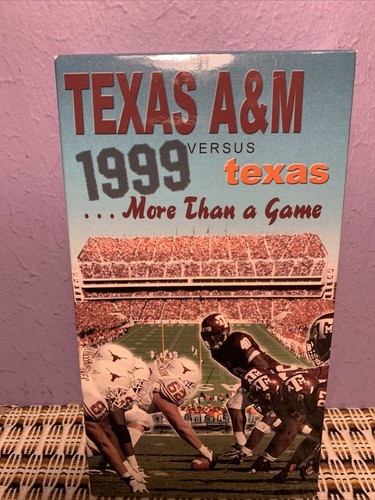
A VHS cassette of the game

Both teams used up all their emotion in those days, and lost their bowl games: The Longhorns lost the Big 12 Championship Game to Nebraska, and lost the Cotton Bowl to another of its old rivals, Arkansas; while the Aggies lost the Alamo Bowl to Penn State.

A&M has never held another official Bonfire. But, since 2002, a student-sponsored coalition has constructed an annual unsanctioned, off-campus "Student Bonfire" in the spirit of its predecessor.

After the 2011 season, Texas A&M left the Big 12 for the Southeastern Conference, ending the rivalry, at least as far as football is concerned. The Longhorns lead it, 76-37-5. In 2021, Texas, along with their other big rival, Oklahoma, announced it would leave the Big 12, and seek admission to the SEC. The SEC unanimously voted to invite both the Longhorns and the Sooners. This will allow them to become SEC members by the 2025 season, opening the door for a resumption of the Longhorn-Aggie football rivalry. (UPDATE: They made an agreement to join in 2024, restarting the rivalry a year earlier.)

*

November 18, 1999 was a Thursday. Baseball season was over. The NFL was in midweek. One college football game was played that day: Colorado State beat the Air Force Academy, 41-21 at Hughes Stadium in Fort Collins, Colorado.

There were 5 games played in the NBA:

* The Washington Wizards beat the Toronto Raptors, 92-81 at the MCI Center (now the Capital One Arena) in Washington.

* The Milwaukee Bucks beat the San Antonio Spurs, 99-88 at the Bradly Center in Milwaukee.

* The Sacramento Kings beat the Houston Rockets, 128-110 at The Summit in Houston. (The arena has since been converted into the Central Campus of the Lakewood Church, Dr. Joel Osteen's "megachurch.")

* The Denver Nuggets beat the Los Angeles Lakers, 93-82 at the new Pepsi Center (now the Ball Arena) in Denver. Shaquille O'Neal scored 36 points in defeat.

* And the Seattle SuperSonics beat the Vancouver Grizzlies, 110-108 at General Motors Place (now the Rogers Arena) in Vancouver.

And there were 7 games in the NHL:

* In an "Original Six" matchup, the New York Rangers lost to the Boston Bruins, 5-3 at the FleetCenter (now the TD Garden) in Boston.

* The Dallas Stars and the Philadelphia Flyers played to a tie, 1-1 at the First Union Center (now the Xfinity Mobile Arena) in Philadelphia.

* The Tampa Bay Lightning beat the Pittsburgh Penguins, 2-1 at the Ice Palace (now the Benchmark International Arena) in Tampa.

* The San Jose Sharks beat the Ottawa Senators, 4-1 at the Corel Centre in the Ottawa suburb of Kanata, Ontario. (It's now the Canadian Tire Centre. The town was absorbed into Ottawa proper in 2001.)

* The Nashville Predators beat the Montreal Canadiens, 6-1 at the Gaylord Entertainment Center (now the Bridgestone Arena) in Nashville.

* The St. Louis Blues beat the Florida Panthers, 3-0 at the Kiel Center (now the Enterprise Center) in St. Louis.

* And the Phoenix Coyotes beat the Los Angeles Kings, 3-2 at the new Staples Center (now the Crypto.com Arena) in Los Angeles.

December 31, 1999 & January 1, 2000: The Millennium

December 31, 1999:  The Millennium arrives. The people of planet Earth survived. At a terrible cost. But we hadn't destroyed ourselves. ...