Showing posts with label rick sutcliffe. Show all posts

Friday, October 7, 2022

October 7, 1984: Gatorade On the Glove

October 7, 1984: Game 5 of the National League Championship Series. Winner takes the Pennant. The San Diego Padres are in their 16th season, and have never won one. The Cubs haven't won one in 39 years victims of the so-called Curse of the Billy Goat during the 1945 World Series. Something has to give, as they begin play at San Diego's Jack Murphy Stadium.

The Cubs lead 3-0 going into the bottom of the 6th, but the Padres score 2 runs. Eventual NL Cy Young Award winner Rick Sutcliffe begins the bottom of the 7th by walking Carmelo Martinez. Garry Templeton bunts him over to 2nd.

The batter is Tim Flannery, pinch-hitting for pitcher Craig Lefferts. He was a good-fielding 2nd baseman, but not much of an upgrade at the plate. He hits a dribbler to 1st base, and Leon Durham lets it go through his legs -- much as the man he replaced as Cub 1st baseman, Bill Buckner, will do in the World Series 2 years later. Martinez scores the tying run.

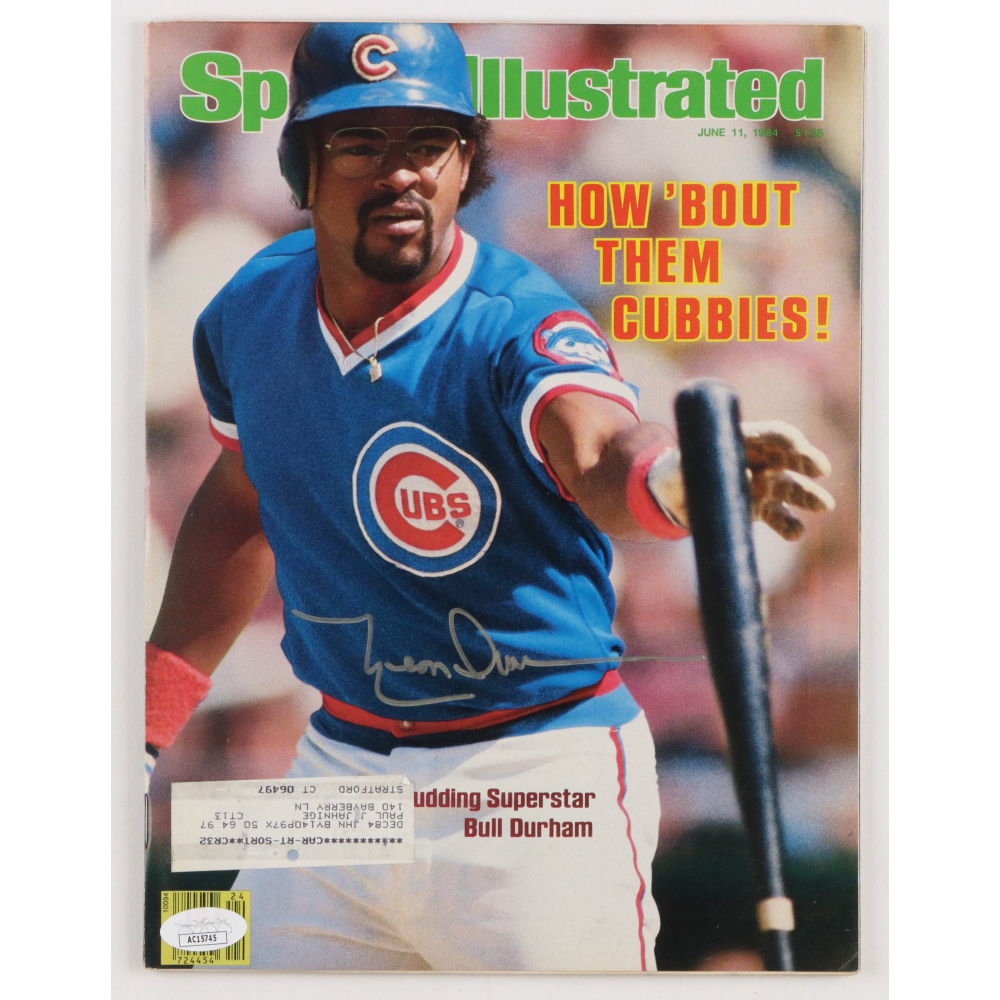
Earlier in the season, Durham had been on the cover of Sports Illustrated. Could he, and the Cubs, have been hit by "The Dreaded SI Cover Jinx" and the Curse of the Billy Goat?
The play became known as "Gatorade On the Glove," because someone allegedly spilled some Gatorade on Durham's glove. That shouldn't have mattered: Durham didn't get his glove in the right spot. It's not as if the ball bounced off a Gatorade spot on his glove, it never even touched the glove.

Then the Padres pile it on. Alan Wiggins singles. Tony Gwynn doubles Flannery home with the go-ahead run. Wiggins also scores on the play. And last night's Padre hero, Steve Garvey, singles home Gwynn. The score is 6-3, and it stays that way.

Because of their games airing on cable-TV "SuperStation" WGN, broadcast nationally out of Chicago. the Cubs had caught the attention of fans who were nowhere near the City of the Big Shoulders. Their move to end a 39-year drought of Pennants, and a 76-year drought of World Series wins, fired people's imagination.

This included me, then a 14-year-old Yankee Fan, who enjoyed that they beat out the New York Mets for the NL Eastern Division title, getting revenge for 1969. There were 3 members of the Yankees' 1981 Pennant-winners on the Padres: Graig Nettles, Goose Gossage, and outfielder Bobby Brown (no connection to the earlier Yankee 3rd baseman of the same name). It had only been 3 years, but, for Yankee Fans, that 1981 Pennant now seemed very far away. Unlike the '81 Yanks, the Cubs couldn't win the Pennant.

For Padre fans, it is their 1st Pennant, and the biggest moment in San Diego sports since the Chargers won the 1963 AFL Championship. For Cub fans, it is a bigger heartbreak than 1969. In 1969, it took them an entire month to melt down; in 1984, it takes less than 24 hours. (They hadn't seen nothin' yet: In 2003, it would take them 15 minutes.)

UPDATE: The Padres have a team Hall of Fame. From the 1970s, they have inducted 1st baseman Nate Colbert, right fielder Dave Winfield, pitcher Randy Jones, owner Ray Kroc, and team president Emil "Buzzie" Bavasi. From the 1980s, they have inducted right fielder Tony Gwynn, shortstop Garry Templeton, catcher Benito Santiago, manager Dick Williams and general manager Jack McKeon.

From the 1990s, they have inducted Gwynn, 3rd baseman Ken Caminiti, pitcher Trevor Hoffman, team owner John Moores, general manager Kevin Towers, and team president Larry Lucchino. From the 2000s, they have inducted Hoffman, Moores, Towers, and pitcher Jake Peavy. They have also elected longtime broadcasters Jerry Coleman and Ted Leitner.

Bavasi, Coleman, Winfield, Jones, Fingers, Templeton, Gwynn and Hoffman have also been inducted into the San Diego Hall of Champions. So have Goose Gossage, Graig Nettles and David Wells, although Nettles and Wells were inducted mainly because they are San Diego natives who excelled elsewhere more than for the Padres.

*

October 7, 1984 was a Sunday. While the Detroit Tigers had wrapped up the American League Championship Series 2 days earlier, there was NFL action. Most notably, Walter Payton of the Chicago Bears breaks Jim Brown's career rushing record of 12,312 yards. The Bears beat the New Orleans Saints 20-7 at Soldier Field. Payton would eventually be surpassed by Emmitt Smith, who still holds the record.

Other games played that day:

* The New York Jets beat the Kansas City Chiefs, 17-16 at Arrowhead Stadium in Kansas City.

* The Tampa Bay Buccaneers beat the Minnesota Vikings, 35-31 at Tampa Stadium.

* The Philadelphia Eagles beat the Buffalo Bills, 27-17 at Rich Stadium (later Ralph Wilson Stadium) in the Buffalo suburb of Orchard Park, New York.

* The Miami Dolphins beat the Pittsburgh Steelers, 31-7 at Three Rivers Stadium in Pittsburgh. This matchup would be revisited in the AFC Championship Game, where the Dolphins again won at Three Rivers.

* The New England Patriots beat the Cleveland Browns, 17-16 at Cleveland Municipal Stadium.

* The Cincinnati Bengals beat the Houston Oilers, 13-3 at Riverfront Stadium in Cincinnati.

* The Washington Redskins beat the Indianapolis Colts, 35-7 at the Hoosier Dome in Indianapolis.

* The Denver Broncos beat the Detroit Lions, 28-7 at the Silverdome in the Detroit suburb of Pontiac, Michigan.

* The San Diego Chargers beat the Green Bay Packers, 34-28 at Lambeau Field in Green Bay.

* The football version of the St. Louis Cardinals beat the Dallas Cowboys, 31-20 at Texas Stadium in the Dallas suburb of Irving, Texas.

* The Atlanta Falcons beat the Los Angeles Rams, 30-28 at Anaheim Stadium (now Angel Stadium of Anaheim).

* The Los Angeles Raiders beat the Seattle Seahawks, 28-14 at the Los Angeles Memorial Coliseum.

* And the next day, on ABC Monday Night Football, the San Francisco 49ers beat the New York Giants, 31-10 at Giants Stadium in the Meadowlands. The 49ers went on to win Super Bowl XIX, beating the Dolphins.

Wednesday, April 6, 2022

April 6, 1992: Camden Yards Rewrites the Rules

April 6, 1992: It is Opening Day of a new season in Major League Baseball. Oriole Park at Camden Yards opens, in the Inner Harbor section of Baltimore. The Baltimore Orioles move in, after 37 seasons at Memorial Stadium, and after a threat of moving down the Parkway to Washington.

Two days earlier, they had played in Washington, losing an exhibition game to the Boston Red Sox, 4-3 at Robert F. Kennedy Memorial Stadium. I was at that game, and had a horrible hot dog, the worst food I've ever had at a sporting event above the high school level. So I wasn't surprised to learn the next day that 6 Oriole players had gotten food poisoning that day -- including Rick Sutcliffe, the recently-acquired former Cy Young Award winner for the Chicago Cubs, who was scheduled to be the Camden Yards opener's starting pitcher.

From 1910 until 1969, it was a tradition for the President of the United States to throw out the ceremonial first ball at the Washington Senators' home opener. In 1979, with the Senators having moved, and the Orioles becoming the closest MLB team to the nation's capital, Jimmy Carter threw out the first ball before Game 7 of the World Series. In 1984, Ronald Reagan revived the annual tradition.

In 1991, George H.W. Bush, who had been an All-American 1st baseman at Yale University in 1948, couldn't make it to the final Oriole opener at Memorial Stadium, so he sent Vice President Dan Quayle, admittedly a bigger basketball fan (as one would expect from a man from Indiana), in his place. Quayle threw a strike.

In 1992, running for re-election with a recession raging, Bush threw out the first ball at the Camden Yards opener, and fell well short of the plate. He hid his head in his hands, and was badly booed. He lost, and, the following year, the new President, Bill Clinton, threw out the first ball, getting it to the catcher on the fly, if not over the plate.

The Orioles seemed to show no ill effects from their affliction. With 1 out in the bottom of the 5th, Sam Horn drew a walk, Leo Gomez singled, Chris Hoiles hit a ground-rule double to score Horn, and Billy Ripken, got Gomez home on a suicide squeeze bunt. (Billy's brother, Cal Ripken Jr., went 1-for-3.) That was all that Sutcliffe would need: The last of his 110 pitches was a strikeout of Paul Sorrento, and the Orioles won, 2-0.

Besides having one of the few names -- or shortening of names -- that made it sound like the name of an English soccer stadium -- sorry, forgot to speak English there, "football ground" -- Camden Yards had several interesting features. It was built next-door to Camden Station, former headquarters of the Baltimore & Ohio Railroad, whose warehouse, in between, was converted into the team's offices, including a team store.

Between the right-field fence and the Warehouse was a pedestrian walkway, an extension of Eutaw Street, which included the Orioles' team Hall of Fame, and a barbecue stand run by former slugging 1st baseman John "Boog" Powell -- a good guard against additional food poisonings.

At the center field gate, leading to that walkway, there was a statue of a teenage Babe Ruth, the Baltimore native who went on to revolutionize the game. Not only was Ruth born at a rowhouse, 4 blocks away, that had been converted into a museum, but his father, George Ruth Sr., had run a bar that was later torn down, and stood in what was now center field. Some of his plates and silverware were found when digging for the ballpark.

At the right field gate, leading to the other end of the walkway, was the lettering at the bottom of the home plate facade at Memorial Stadium, a dedicated to veterans of both World Wars: "TIME WILL NOT DIM THE GLORY OF THEIR DEEDS." The home plate and right field foul pole from Memorial Stadium were also transferred to Camden Yards.

With its construction designed to look like an old ballpark -- as if it had already been there since the early 20th Century -- Camden Yards started the "retro ballpark" craze that would come, over the next few years, to Cleveland, Dallas, Denver, Colorado, Atlanta, Seattle, San Francisco, Detroit, Houston, Pittsburgh, Cincinnati, Philadelphia, San Diego, St. Louis, a restored Washington, Minnesota, and both New York teams.

But it also had increased legroom, wider concourses, more concession stands, more bathrooms, and, considerably more important for the teams owning them -- a change from when city or county governments built and owned the stadiums -- more luxury boxes and office space.

Suddenly, the 3 MLB stadiums that had opened in the last 10 years -- the Metrodome in Minneapolis, the SkyDome (Rogers Centre) in Toronto, and the new Comiskey Park (now Rate Field) in Chicago, were hopelessly obsolete. If their teams' owners had waited just a little longer, they could have had similar retro designs, and not only made more money, but gotten better fan reviews.

The NBA and NHL arenas that opened in the 1980s also now seemed obsolete. Building a new arena that looked like an old one didn't happen very often -- what's now named Gainbridge Fieldhouse in Indianapolis is an exception -- but the teams that started building new arenas after 1992 were better off than those that did so in the decade before.

The design issue was most keenly felt in Italy. In the late 1980s, nearly every major stadium in the country was either modernized, or completely torn down and rebuilt, so as to be ready for the 1990 World Cup. Within 20 years, attendance dropped precipitously, as many fans decided that it was no longer worth it to go to stadiums that either were, or felt like they were, built in the 1930s. (Italy had first held the World Cup in 1934.)

Not every new MLB stadium followed the Camden Yards model. But no one wanted to follow the Toronto model. Some teams tried to have it both ways, with the old-time look and the retractable roof. It worked in Seattle and Houston. It did not work in Phoenix and Milwaukee. Tampa Bay was stuck with the fixed-roof stadium they'd opened in 1990.

Finally, in 2012, with the opening of Marlins Park (now LoanDepot Park), the Retro Age ended. After just 20 years, Atlanta replaced Turner Field with Truist Park, out in the suburbs but still retro. But the Dallas area's team, the Texas Rangers, opened Globe Life Field in 2020, with a retractable roof and no nods to yesterday.

*

April 6, 1992 was a Monday. This was also the day that the NCAA Tournament Final was played, with Duke beating Michigan, 71-51. I have a separate entry for that event, not because Duke went back-to-back, or because it featured Michigan's "Fab Five," but because it concluded a unique confluence of events: The Metrodome hosted the World Series, the Super Bowl, and the Final Four, all within a span of 160 days.

This was also the day that Barney & Friends premiered on PBS. I have a separate entry for that event.

And American soccer player Julie Ertz, a 2-time winner of the Women's World Cup, was born on this day.

The NBA didn't schedule any games for the night of the NCAA Final. The NHL was in the middle of its 1st players' strike, which ended up lasting 10 days. So there were no scores in that League.

And these other Major League Baseball games were played:

* The New York Mets beat the St. Louis Cardinals, 4-2 at Busch Memorial Stadium in St. Louis. Bobby Bonilla hit a home run in the top of the 10th inning. It would be the highlight of the season for the 1992 Mets, which local sportswriter Bob Klapisch would call, in the title of his book about them, The Worst Team Money Could Buy. Bonilla, in particular, did not appreciate it.

* The Pittsburgh Pirates beat the Montreal Expos, 2-0 at Three Rivers Stadium in Pittsburgh. Doug Drabek pitched 8 innings of 5-hit shutout ball, with Roger Mason completing a 6-hit shutout. Barry Bonds went 1-for-3.

* The San Diego Padres beat the Cincinnati Reds, 4-3 at Riverfront Stadium in Cincinnati. Tony Gwynn went 2-for-4 with an RBI.

* The Toronto Blue Jays beat the Detroit Tigers, 4-2 at Tiger Stadium in Detroit.

* The Minnesota Twins beat the Milwaukee Brewers, 4-2 at Milwaukee County Stadium. Kirby Puckett hit a home run. Chuck Knoblauch went 4-for-5 with an RBI. Robin Yount went 2-for-3 with a walk. Paul Molitor went 0-for-4.

* The San Francisco Giants beat their arch-rivals, the Los Angeles Dodgers, 8-1 at Dodger Stadium in Los Angeles.

* The Oakland Athletics beat the Kansas City Royals, 5-3 at the Oakland Coliseum. Rickey Henderson went 1-for-4 with a walk and a stolen base. George Brett did not play.

* And the Texas Rangers beat the Seattle Mariners, 12-10 at the Kingdome in Seattle. In spite of the big score, it was a bad day for legends, old and young. Nolan Ryan didn't make it out of the 5th inning, and Randy Johnson didn't get out of the 6th. Ken Griffey Jr. went 0-for-4. 

December 31, 1999 & January 1, 2000: The Millennium

December 31, 1999:  The Millennium arrives. The people of planet Earth survived. At a terrible cost. But we hadn't destroyed ourselves. ...