Showing posts with label heavyweight champion of the world. Show all posts

Sunday, December 25, 2022

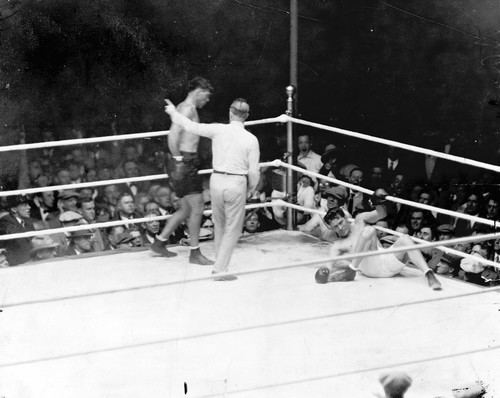
December 26, 1908: The Shocking Triumph of Jack Johnson

December 26, 1908: Jack Johnson, a 30-year-old black man from Texas, known as the Galveston Giant, knocks out Canadian fighter Tommy Burns at Sydney Stadium in Sydney, Australia. This makes Johnson the 1st black man to win the Heavyweight Championship of the World.

(Johnson wasn't really a giant: He was 6 feet even, but a solid 200 pounds at his peak fighting condition.)

It was what we would now call a technical knockout: It was stopped after the 14th round, because Burns, considerably lighter and possibly ill with the flu, was totally outmatched.

Ironically, Burns might well be totally forgotten today had he won the fight. After all, who remembers who he beat for the title? (It was Marvin Hart.)

This "conquest of the white man," and his flamboyant lifestyle, made Johnson the most hated man in America. Even many black people hated him, for making them look bad. He didn't care: He was still going to be Jack Johnson.

So America's white establishment looked for a "Great White Hope" who could beat Johnson. Four times in 1909, a fighter was put up against Johnson:

* Philadelphia Jack O'Brien, the Light Heavyweight Champion, fought him in Philadelphia. It was a draw, but O'Brien didn't want a rematch.

* Tony Ross fought him in Pittsburgh, and Johnson beat him.

* Al Kaufman fought him in San Francisco, and Johnson beat him.

* Stanley Ketchel, the Middleweight Champion, a vicious fighter known as the Michigan Assassin, made a deal with Johnson, the same deal that O'Brien had made with him: They would fight to a draw, and thus split the proceeds from the film rights. It was a good plan. Except Ketchel got greedy, for the title and the money, and knocked Johnson down. All that did was make Johnson mad, and he not only knocked Ketchel out, he knocked out a bunch of his teeth. The film of the fight is clear enough to see Johnson brushing Ketchel's teeth out of his glove.

Now, the search for a Great White Hope became truly intense. Novelist Jack London, tapping into the racism of the time, had a nationally syndicated newspaper column, and used it to address Jim Jeffries, who had been Heavyweight Champion from 1899 to 1904, and retired undefeated to an alfalfa farm outside Los Angeles. London wrote, "Jeff, it's up to you."

Johnson was willing to fight Jeffries. Having waited so long for his shot at the title, he knew he had no right to duck anybody. Jeffries had gotten fat in his retirement. He went on a crash diet and exercise program, and actually got back down to his usual fighting weight. But losing so much weight so soon weakened him. And the fight was the middle of the desert, in Reno, Nevada. Jeffries was used to California heat, but not this kind of heat, and the South Texas native Johnson was used to it. And Johnson was in peak physical condition.

So the fight was a mismatch. It was scheduled for a maximum of 45 rounds, which sounds brutal for the modern era, where the norm became 15, and eventually 12 by the 1980s. Jeffries hung on for 12 rounds, but in the 13th, Johnson did what (it was said -- the records may be wrong) no other fighter had ever done: He knocked Jeffries down. Jeffries got up. He shouldn't have, because Johnson knocked him out in the 15th.

In 1912, Johnson was arrested for violating the Mann Act, which forbade "transporting women across State lines for immoral purposes." The woman in question was Lucille Cameron. Contrary to what is often reported, Cameron was not already Johnson's wife, which would have made the charge impossible to prove in court -- not that an all-white jury would have cared. But she refused to cooperate, and soon married Johnson.

In 1913, Johnson was arrested on the Mann Act again. This time, in a Chicago courtroom presided over by Judge Kenesaw Mountain Landis, later to become the 1st Commissioner of Baseball and the perpetuator of the sport's "color line," Johnson was convicted by an all-white jury, and sentenced to a year and a day in prison.

He skipped bail, and escaped first to Canada, then to France. Having only defended his title once since the Jeffries fight, he could now only do so abroad. On December 19, 1913, in Paris, in the 1st-ever Heavyweight Championship fight between 2 black men, he may have recognized the significance, and held back a little, as he fought Battling Jim Johnson (no relation) to a rather lackluster draw. In 1914, he defeated Frank Moran in Paris. In early 1915, he knocked Jack Murray out in Buenos Aires, Argentina.

Finally, it all caught up with him. Jess Willard, a 6-foot-6 Kansan, became the latest "Great White Hope." On April 5, 1915, at Oriental Park, a horse racing track in Havana, Cuba, in a fight scheduled for 45 rounds, and held in heat even worse than in Reno 4 years earlier, perhaps he finally got tired of being Jack Johnson, and threw the fight. Or maybe, at 37, the oldest Heavyweight Champion ever (and he would remain so until Jersey Joe Walcott in 1951), he just wasn't in shape anymore. Willard knocked him out in the 26th round.

Jack and Lucille Johnson continued to live abroad. Finally, on July 20, 1920, Jack crossed the border from Mexico to America, and surrendered to federal agents. He was taken to the federal penitentiary at Leavenworth, Kansas (with some irony, in Willard's home State), and began serving his sentence. He was released early, on July 9, 1921.

Lucille was the 3rd of what turned out to be 4 wives for Jack Johnson. Only the 1st was black. On June 10, 1946, he was driving on U.S. Route 1 near Franklinton, North Carolina, when he crashed into a telegraph pole, and died. He was 68 years old.

*

December 26, 1908 was a Saturday. Baseball was out of season. Football season had ended. Professional basketball did not exist. And the biggest hockey league of the time, the Eastern Canada Amateur Hockey Association, didn't start its season for another 11 days.

But there were scores. It was Boxing Day, and, in Britain, there was a tradition of soccer teams playing each other on back-to-back days, a home-and-home series on Christmas Day and Boxing Day. On the 25th, Woolwich Arsenal and Leicester Fosse played each other to a 1-1 draw at the Filbert Street stadium in Leicester. On the 26th, they played at The Arsenal's home, the Manor Ground, in Plumstead, South-East London, and Arsenal won, 2-1. Eventually, Woolwich Arsenal would move to North London, and become simply Arsenal Football Club; while Leicester Fosse became Leicester City.

Monday, December 5, 2022

December 5, 1947: The 1st Louis vs. Walcott Fight

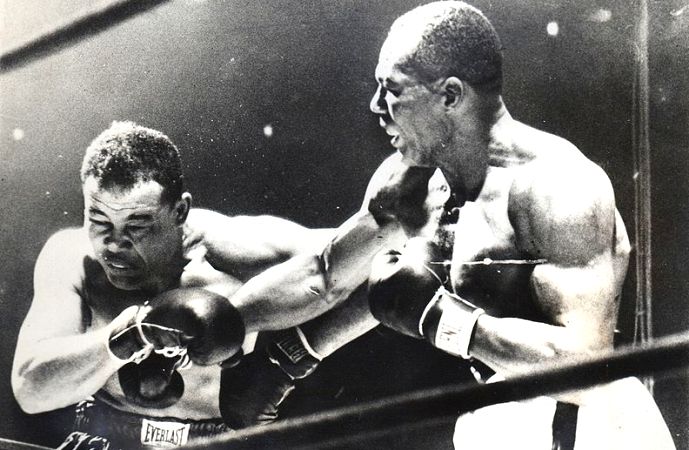
December 5, 1947: Joe Louis defends the Heavyweight Championship of the World against Jersey Joe Walcott, at the old Madison Square Garden. Joseph Louis Barrow had held the title for 10 years. Arnold Raymond Cream, a son of an immigrant from the U.S. Virgin Islands, had named himself after Joe Walcott, from the Caribbean island of Barbados, who held the Welterweight Championship from 1901 to 1906. Jersey Joe, from Pennsauken, across the Delaware River from Philadelphia, was 33, and was thus becoming the oldest man ever to fight for the heavyweight title to that point.

Louis, 56-1 going into the fight, has been called the greatest Heavyweight Champion ever. Those who disagree cite his fighting of what came to be called "The Bum-of-the-Month Club." Most of his opponents were not on his level, although a few were, including Max Schmeling and Billy Conn.

But Louis had trouble with mobile boxers, and Walcott, 42-13-1, was one of them. He knocked Louis down in the 1st round, stunning the live crowd and a nationwide radio audience. He knocked Louis down again in the 4th. As the fight went on, it looked like the twilight of a god: Louis, only 4 months younger than Walcott, looked done.

The fight went the distance, and many observers believed Walcott deserved to be named the winner. But Louis was given a split decision. It was a very controversial decision, even mentioned on an episode of M*A*S*H, 35 years later.

The decision wasn't based on race, as Walcott was also black. It was almost certainly based on money: A rematch could be held in warm weather, outdoors, at the enormous Yankee Stadium, and make more money. Louis won that fight by knockout, on June 25, 1948.

Walcott finally won the title on July 18, 1951, by beating Ezzard Charles. He and Walcott fought 4 times, Charles winning the 1st 2, Walcott the last 2. At 37, he was the oldest man ever to win the title. He lost the title a year later, to Rocky Marciano.

He later refereed the 2nd Muhammad Ali-Sonny Liston fight. In 1971, he was elected Sheriff of his native Camden County, the 1st black Sheriff in New Jersey, serving for 3 years. From 1975 to 1984, he was the Chairman of the New Jersey State Athletic Commission. He died in 1994, 10 months before George Foreman replaced him as the oldest Heavyweight Champion ever. He had outlived Louis by 13 years.

*

December 5, 1947 was a Friday. Baseball was out of season. Football was in midweek: Neither the college ranks, nor the NFL, nor the rebel All-America Football Conference played any games that night. And there were no games scheduled in the NHL.

One game was played in the Basketball Association of America, the league that became the NBA 2 years later: The Boston Celtics beat the Providence Steam Rollers, 73-69 at the Boston Garden.

Saturday, November 26, 2022

November 26, 1982: Holmes vs. Cobb: The Bloodbath That Changed Boxing

November 26, 1982: Larry Holmes wins a unanimous decision over Randall "Tex" Cobb at the Astrodome in Houston, and retains the Heavyweight Championship of the World.

This fight was broadcast live on ABC on the night after Thanksgiving, meaning families may have been watching it together. It was 13 days after Korean boxer Kim Duk-koo was fatally injured in a live televised fight with Lightweight Champion Ray "Boom-Boom" Mancini.

Between them, these 2 fights led to changes in boxing. The maximum of 15 rounds was reduced to 12. A standing eight-count for any knockdown was required. And any fighter knocked out automatically had his license suspended for 45 days, for his own safety.

Howard Cosell, for years ABC's lead boxing announcer, called the Holmes-Cobb fight. He was so appalled by the beating the Cobb took that he vowed never to broadcast another professional prizefight. He kept that vow, as the only fights he broadcast thereafter were the amateur ones, with tighter rules, in the 1984 Olympics in Los Angeles. Upon hearing that Cosell was quitting boxing, Cobb said, "I can do my sport no greater service."

As of November 26, 2022, Holmes and Cobb are both still alive. As far as I know, neither has been mentally impaired due to boxing.

*

November 26, 1982 was a Friday: As I said, the day after Thanksgiving. Baseball was out of season. The NFL was in midweek. There were 2 college football games that day, both of them major rivalries, and both clashes between highly-ranked teams. Number 2 Penn State beat Number 5 University of Pittsburgh, 19-10 at Beaver Stadium in State College, Pennsylvania. And Number 3 Nebraska beat Number 11 Oklahoma at Memorial Stadium in Lincoln, Nebraska.

Penn State was then an independent, and thus had no Conference Championship to win. Nebraska clinched the Big Eight Conference title. Penn State went to the Sugar Bowl in New Orleans, which became a de facto National Championship game, because they were playing the Southeastern Conference Champions, Number 1 Georgia. Nebraska went to the Orange Bowl in Miami, and played Number 13 Louisiana State University.

The games were being played at the same time, the Orange Bowl on NBC and the Sugar Bowl on ABC, and Nebraska's only hope of winning the National Championship was to blow LSU out, and hope that Penn State beat previously undefeated Georgia in a dull game. Instead, it was a very good game, although for those of us who don't like Penn State, it was a bad result: The Nittany Lions won, 27-23. And the Tigers held the Cornhuskers to another classic, with Nebraska winning, 21-20. So Penn State got the National Championship.

There were 8 games in the NBA:

* The New Jersey Nets lost to the Phoenix Suns, 110-99 at the Arizona Veterans Memorial Coliseum.

* The Boston Celtics beat the Utah Jazz, 137-103 at the Boston Garden.

* The Philadelphia 76ers beat the Cleveland Cavaliers, 120-102 at The Coliseum in the Cleveland suburb of Richfield, Ohio.

* The Detroit Pistons beat the Portland Trail Blazers, 132-118 in overtime at the Silverdome in the Detroit suburb of Pontiac, Michigan.

* The Washington Bullets beat the Indiana Pacers, 87-85 at the Market Square Arena in Indianapolis.

* The San Antonio Spurs beat the Chicago Bulls, 122-120 at the HemisFair Arena in San Antonio. George Gervin led all scorers on the day with 44 points.

* The Los Angeles Lakers beat the San Diego Clippers, 117-115 at the San Diego Sports Arena (now the Pechanga Arena). Magic Johnson scored 32 points.

* And the Seattle SuperSonics beat the Denver Nuggets, 127-106 at the Seattle Center Coliseum.

And there were 6 games in the NHL:

* The New Jersey Devils and the Vancouver Canucks played to a tie, 4-4 at the Pacific Coliseum in Vancouver.

* The Chicago Black Hawks beat the Hartford Whalers, 4-3 at the Hartford Civic Center (now the PeoplesBank Arena).

* The Washington Capitals beat the Toronto Maple Leafs, 5-3 at the Capital Centre in the Washington suburb of Landcover, Maryland.

* The Buffalo Sabres beat the St. Louis Blues, 8-6 at the Buffalo Memorial Auditorium.

* The Pittsburgh Penguins and the Minnesota North Stars played to a tie, 6-6 at the Metropolitan Sports Center in the Minneapolis suburb of Bloomington, Minnesota.

* And the Edmonton Oilers beat the Winnipeg Jets, 6-5 at the Winnipeg Arena.

Saturday, November 5, 2022

November 5, 1994: George Foreman Regains the Heavyweight Title

November 5, 1994: A 45-year-old overweight minister wins the Heavyweight Championship of the World. It doesn't sound possible. It is, when it's George Foreman.

Wearing the same trunks he wore 20 years minus a week earlier, when he lost the title to Muhammad Ali, Big George knocks Michael Moorer out in the 10th round at the MGM Grand Garden in Las Vegas. He thus breaks Jersey Joe Walcott's record as oldest Heavyweight Champion. (Walcott was 38 when he lost the title to Rocky Marciano in 1952).

He doesn't hold the title for long, as organizational shenanigans beyond his control forced him to give it up. But he had made his point. Today, who remembers the guys who made George Foreman give up the title (except for Ali)? Ah, but everybody remembers George, and everybody likes George. Which was not the case the first time around: After retiring from boxing for the 1st time in 1977, he totally changed his life, and became a different and better person. His last fight was a loss to Shannon Briggs in 1997. His final record was 76-5 -- 31-3 after his comeback.

*

November 5, 1994 was a Saturday. Among the college football games played that day were these:

* Number 1 Nebraska beat Kansas, 45-17 at Memorial Stadium in Lincoln, Nebraska. Nebraska won the Big Eight Conference title.

* Number 2 Penn State beat Indiana, 35-29 at Memorial Stadium in Bloomington, Indiana. Penn State won the Big Ten Conference title, in only their 2nd season in the league.

* Number 3 Auburn beat East Carolina, 38-21 at Jordan-Hare Stadium in Auburn, Alabama.

* Number 4 Florida beat Southern Mississippi, 55-17 at Ben Hill Griffin Stadium in Gainesville, Florida. Florida won the Southeastern Conference title.

* Number 5 Miami beat Number 10 Syracuse, 27-6 at the Carrier Dome (now the JMA Wireless Dome) in Syracuse, New York. Miami won the Big East Conference title, but Nebraska beat them in the Orange Bowl, avenging their 1984 Orange Bowl defeat, and finally winning Coach Tom Osborne his 1st National Championship.

* Number 6 Alabama beat Louisiana State, 35-17 at Tiger Stadium in Baton Rouge, Louisiana.

* Number 7 Colorado beat Oklahoma State, 17-3 at Folsom Field in the Denver suburb of Boulder, Colorado.

* Number 8 Florida State beat Georgia Tech, 41-10 at Bobby Dodd Stadium in Atlanta. Florida State won the Atlantic Coast Conference title. Then, in their last regular-season game, came from 31-3 down to tie, 31-31 at Doak Campbell Stadium in Tallahassee, a game known as the Choke at Doak. A rematch was ordered for the Sugar Bowl, as the SEC Champion always received a bid, while the ACC Champion was not locked into a bowl. Florida State won it, 23-17.

* Number 9 Utah were upset by New Mexico, 23-21 at University Stadium in Albuquerque, New Mexico.

* Number 10 Colorado beat Oklahoma State, 45-32 at Lewis Field (now Boone Pickens Stadium) in Stillwater, Oklahoma. Colorado beat Notre Dame in the Fiesta Bowl. Notre Dame had the week of November 5 off.

* Number 11 Texas A&M beat their arch-rivals, Texas, 34-10 at Memorial Stadium in Austin, Texas.

* Number 12 Washington were upset by Stanford, 46-28 at the old Stanford Stadium in the San Francisco suburb of Palo Alto, California.

* Number 13 Virginia were upset by Number 23 Duke, 28-25 at Wallace Wade Stadium in Durham, North Carolina.

* Number 16 Washington State were upset by Number 22 Southern California, 23-10 at Martin Stadium in Pullman, Washington. USC did not win the Pacific-Ten Conference title, but did receive a bid to the Cotton Bowl, where they beat Texas Tech, the Southwest Conference Champions.

* Number 19 North Carolina were upset by Clemson, 28-17 at Kenan Stadium in Chapel Hill, North Carolina.

* Number 21 Oregon beat Arizona State, 34-10 at Autzen Stadium in Eugene, Oregon. Oregon won the Pac-10 title, but lost the Rose Bowl to Penn State. Despite finishing undefeated, Penn State finished Number 2 in the last poll, behind Nebraska. They needed to worry less about who was winning the National Championship, and what defensive coordinator Jerry Sandusky was doing.

* Among the service academies, Air Force beat Army, 10-6 at Michie Stadium in West Point, New York; and Navy beat Tulane, 17-15 at the Superdome in New Orleans.

* And Rutgers beat Temple, 38-21 at the new Rutgers Stadium (now SHI Stadium) in Piscataway, New Jersey.

The baseball players were on strike, and the season would have been over by this point, anyway. The NHL players were locked out, meaning that 2 of the "Big Four" sports in North America were stopped cold due to management's unfairness to the players.

There were 11 games in the NBA:

* The New Jersey Nets lost to the Dallas Mavericks, 112-103 at the Reunion Arena in Dallas.

* The Cleveland Cavaliers beat the Charlotte Hornets, 115-107 at the Charlotte Coliseum.

* The Detroit Tigers beat the Atlanta Hawks, 114-109 in overtime at The Omni in Atlanta.

* The Orlando Magic beat the Philadelphia 76ers, 122-107 at the Orlando Arena.

* The Indiana Pacers beat the Boston Celtics, 112-103 at the Market Square Arena in Indianapolis.

* The Washington Bullets beat the Chicago Bulls, 100-99 in overtime at the United Center in Chicago.

* The Milwaukee Bucks beat the Los Angeles Lakers, 97-96 at the Bradley Center in Milwaukee.

* The Houston Rockets beat the Minnesota Timberwolves, 115-85 at the Target Center in Minneapolis.

* The Golden State Warriors beat the Denver Nuggets, 108-104 at the McNichols Arena in Denver.

* The Portland Trail Blazers beat the Los Angeles Clippers, 112-95 at the Portland Memorial Coliseum. Clyde Drexler scored 41 points.

* And the Seattle SuperSonics beat the Utah Jazz, 110-103 at the Tacoma Dome. The Sonics played the 1994-95 season there while the Seattle Center Coliseum was being rebuilt as the KeyArena.

Sunday, October 30, 2022

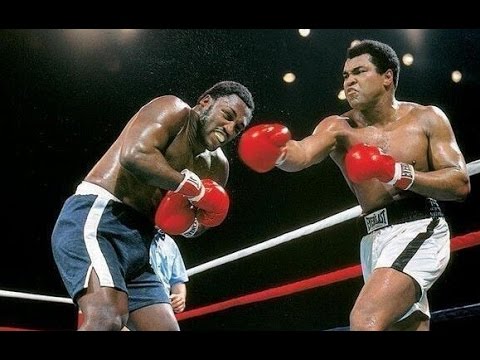
October 30, 1974: The Rumble In the Jungle

October 30, 1974: "The Rumble in the Jungle" is held in Kinshasa, in the former colony of Belgian Congo, at this point called Zaire, and since 1997 called the Democratic Republic of the Congo.

George Foreman was the undefeated, undisputed Heavyweight Champion of the World, 40-0,  and heavily favored to defeat former champion Muhammad Ali, 44-2. Ali was talking his usual trash, but most people thought Ali would lose. Indeed, there were some who feared that Ali would be killed in the ring.
The referee was Zack Clayton, who had played in baseball's Negro Leagues, and for one of the great pre-NBA all-black teams, the New York Renaissance Five.
Ali fooled them all. People who say Ali just leaned against the ropes in his "rope-a-dope" strategy and let Foreman tire himself out with punches are fools. I've seen the tape of the fight: Ali got in a lot of punches, enough to win every round except for the 2nd and the 6th.

Foreman would later tell an interviewer that, at the end of the 6th, Ali yelled at him, "Is that all you got, George?" And Foreman had to admit, "Yup, that's about it."

Through a months-long psychological campaign, including practically the entire black population of the continent of Africa in his favor and against the equally black Foreman – he had done something similar to Joe Frazier, who was puzzled by it: "I'm darker than he is!" – Ali had gotten into Foreman's head, just as he had done to Sonny Liston, Floyd Patterson, and just about everybody else he'd ever fought.

In the 8th round, backed up against the ropes, Ali managed to turn an exhausted Foreman around, toss a few jabs, and knock him on his can. Foreman tried to get up, but he ran out of time, and Ali was the winner by a knockout.

When David Frost went to interview him for the BBC after the fight, he pointed at the camera and said, "Is this thing on? I told you all that I was the greatest of all time when I beat Sonny Liston! I am still the greatest of all time! Never again doubt me! Never again make me an underdog until I'm about 50 years old!"

He was off a bit, as he probably should have quit at 36, after losing the title to Leon Spinks and then regaining it from him. But, by far more than his boxing prowess, by the force of his personality, and by the example he set as a man of (at least, in America) a minority race and a minority religion, making him, somewhat contradictorily, the champion of the underdog, he proved that he really was The Greatest... Of All Tiiiiiiiime!
He still is. He appeared on the cover of Sports Illustrated 40 times, more than any person before him, including its 1974 Sportsman of the Year issue. Only Michael Jordan, with 50 covers, has surpassed him as of October 30, 2022. No, not Tom Brady, not LeBron James, not even Tiger Woods. And "The Dreaded SI Cover Jinx" never seemed to affect him, until his 1980 comeback attempt against Larry Holmes. Given every factor that was against Ali, it's hard to say the jinx mattered.
Built in 1952 under Belgian rule as the Stade Roi Baudouin, the site of the fight was renamed Stade du 20 Mai (for May 20, the anniversary of the founding of Zaire's ruling party) in 1967, and Stade Tata Raphaël (Father Raphael Stadium) in 1997, after the death of dictator Mobutu Sese Seko.
*

October 30, 1974 was a Wednesday. The baseball season had been over for 2 weeks, as the Oakland Athletics had beaten the Los Angeles Dodgers in the World Series. And it was the middle of the wee, so there were no NFL games played.

But there were 7 games played in the NBA that night:

* The New York Knicks lost to the Washington Bullets, 94-86 at the Capital Centre in the Washington suburb of Landover, Maryland. Walt Frazier scored 24 points, but it wasn't enough for the Knickerbockers.

* The Chicago Bulls beat the Boston Celtics, 105-104 at the Boston Garden.

* The Phoenix Suns beat the Philadelphia 76ers, 104-99 at The Spectrum in Philadelphia.

* The Atlanta Hawks beat the Detroit Pistons, 104-96 at Cobo Hall in Detroit.

* The Houston Rockets beat the New Orleans Jazz, 113-100 at the Municipal Auditorium in New Orleans.

* The Kansas City-Omaha Kings beat the Milwaukee Bucks, 99-97 at the Kemper Arena in Kansas City.

* And the Seattle SuperSonics beat the Los Angeles Lakers, 117-97 at the Seattle Center Coliseum.

There were also 5 games played that night in the American Basketball Association:

* The New York Nets beat the Utah Stars, 95-91 at the Salt Palace in Salt Lake City. Julius "Dr. J" Erving scored 36 for the Nets.

* The Virginia Squires beat the Indiana Pacers, 114-111 at the Scope in Norfolk, Virginia.

* The Kentucky Colonels beat the San Diego Conquistadors, 97-94 at Freedom Hall in Louisville.

* The Denver Nuggets beat the Memphis Sounds, 105-95 at the Mid-South Coliseum in Memphis.

* And the San Antonio Spurs beat the Spirits of St. Louis, 135-98 at the HemisFair Arena in San Antonio.

There were 4 games played in the NHL that night:

* The New York Rangers and the New York Islanders played to a tie, 1-1 at Madison Square Garden. 

* The Chicago Black Hawks and the Montreal Canadiens played to a tie, 4-4 at the Montreal Forum.

* The Atlanta Flames beat the California Golden Seals, 4-1 at The Omni in Atlanta.

* The Boston Bruins and the Minnesota North Stars played to a tie, 3-3 at the Metropolitan Sports Center in the Minneapolis suburb of Bloomington, Minnesota.

And there were 4 games played in the World Hockey Association:

* The New England Whalers beat the Toronto Toros, 5-2 at the Eastern States Coliseum, a.k.a. the Big E Coliseum, in Springfield, Massachusetts.

* The Houston Aeros beat the Chicago Cougars, 1-0 at the Sam Houston Coliseum in Houston.

* The Winnipeg Jets beat the Phoenix Roadrunners, 6-5 in overtime at the Winnipeg Arena.

* And the Vancouver Blazers beat the Edmonton Oilers, 8-6 at the Pacific Coliseum in Vancouver. 

Saturday, October 1, 2022

October 1, 1975: The Thrilla In Manila

October 1, 1975: Heavyweight Champion Muhammad Ali fights former Heavyweight Champion Joe Frazier for the 3rd time, at the Araneta Coliseum in Quezon City, the capital of the Philippines. Quezon City is the national capital, and the arena is located about 5 miles east of the country's largest city, Manila.

Ali, under his birth name Cassius Clay, was an Olympic Gold Medalist in boxing, in 1960 in Rome. Frazier was as well, in 1964 in Tokyo. A man they would both memorably fight, George Foreman, followed them, in 1968 in Mexico City.

Ali first won the title in 1964 by knocking out Sonny Liston. He held it until he was stripped of it in 1967, for refusing to accept the U.S. military draft. Foreman won what was essentially a tournament for the title, ending in 1970 with a win over top contender Jimmy Ellis.

Ali got his conviction overturned by the Supreme Court, and his boxing license restored -- but not his title. That, he would have to win back. When he and Frazier met for "The Fight of the Century" at Madison Square Garden in 1971, it was the 1st time 2 undefeated Heavyweight Champions had ever met in the ring. It was a hard, even fight until the 15th and final round, when a classic Philly left hook floored the Louisvillian, and Ali received his first-ever knockdown, from which he got up to finish the fight, and his first-ever professional loss.

Ali got revenge in 1974, also at The Garden, although neither man was champion at the time. Frazier had lost the title in 1973 to Foreman, whom Ali subsequently beat to regain the title in Kinshasa, Zaire (now the Democratic Republic of the Congo), the fight known as "The Rumble In the Jungle."

Ali mocked Frazier for his fighting ability and his looks, saying, "It'll be a thrilla and a chilla and a killa, when I get the Gorilla in Manila!"

But it was intensely hot inside the Coliseum when "The Thrilla In Manila" was fought. Still, like the other 2 Ali-Frazier fights, it lived up to the hype. Ali led in the early rounds, but in the 5th round, Frazier began to turn the tide. At the end of the 6th, Ali, who'd been trash-talking (as we would say today) all the way, yelled, "They told me Joe Frazier was washed up!" Frazier yelled back, "They lied!"

Ali won the 8th round, but Frazier clobbered him in the 9th, leading him to go back to his corner and tell his trainer, Angelo Dundee, "Man, this is the closest I've ever been to dying." But Ali had landed so many punches that Frazier's face was swelling, and he was having trouble seeing.

Early in the 13th round, Ali hit Frazier in the jaw with a thunderous right hook, sending Frazier's mouthpiece flying out of his mouth and out of the ring. Ali dominated the 14th as well, because Frazier was too tired and having too much difficulty seeing. Ali was hitting Frazier with the same kind of punches that knocked out Foreman a year earlier. Except, when Ali knocked Foreman out, it took just a few seconds. He had been throwing these things at Frazier for the last 2 rounds, and Frazier simply would not go down.

Frazier had more courage and endurance than sense, and refused to go down, and refused to quit. As the 15th and final round approached, Frazier wanted to continue. His trainer, Eddie Futch, told him that he was going to stop the fight. Frazier said no: "I want him, boss." He was unable to talk Futch out of it: "The fight's over, Joe. No one will forget what you did here today." And he told the referee, Carlos Padilla, to stop the fight. Padilla did so.

Ali retained the crown, the belt, the title, whatever you want to call it. He got up off his stool, raised his right arm in victory... and collapsed. He had nothing left to give. If Futch had let Frazier fight the 15th round, he would have knocked Ali out.

It's been called the greatest prizefight in history. Today, most people know the name Manila for 3 things: The brown office folders that bear its name, its role in the Pacific Theater of World War II, and Ali-Frazier III.

Howard Cosell, who covered the fight for ABC Wide World of Sports, later said, "A big piece of Ali remained in that ring." Indeed, at age 33, with nothing left to prove, Ali probably should have retired right there. Instead, he kept fighting for 6 more years. So did Frazier. Both men would have their moments, but neither was ever so good again.
"The Greatest of All Time" developed Parkinson's disease as a result of his taking so many blows to the head. The big mouth that got him the early nickname "The Louisville Lip" was rendered mostly silent by the turn of the 21st Century. He died on June 3, 2016, at age 74.

"Smokin' Joe" would continue to alternately feud with Ali and reconcile with him, restart the feud, and reconcile again. Joe died of liver cancer on November 7, 2011, at age 67, after 30 years of training fighters at his gym in North Philadelphia.

One of the fighters he trained was his son Marvis, who, like Ali on that awful night in 1980, would get slaughtered by Larry Holmes in Las Vegas. His daughter Jackie Frazier-Lyde also fought professionally, as has Ali's daughter Laila Ali. (She went 24-0 with 21 knockouts, and won a majority decision against Frazier-Lyde in Verona, New York in 2001.) Another daughter of Ali's, Maryum, is a rapper using the name May May.

Opened in 1960, the Araneta Coliseum is still used for sporting events and concerts. A shopping center 2 blocks away is named Ali Mall.

*

October 1, 1975 was a Wednesday. Baseball was between the regular season and the Playoffs. The 1975-76 basketball and hockey seasons hadn't started yet. And the NFL was in midweek. But there was one score on this historic day, in the Canadian Football League: The Ottawa Rough Riders beat the Hamilton Tiger-Cats, 16-11 at Ivor Wynne Stadium in Hamilton, Ontario.


Sunday, September 25, 2022

September 25, 1962: Sonny Liston Knocks Floyd Patterson Out

September 26, 1962: Sonny Liston knocks Floyd Patterson out in the 1st round at Comiskey Park in Chicago, to become the Heavyweight Champion of the World.

Very few people are happy about this.

The State of Arkansas did not make birth certificates mandatory until 1965. Tobe and Helen Liston were both listed as living as sharecroppers on Morledge Plantation in Johnson Township, St. Francis County, Arkansas in the 1930 U.S. Census. They had several children who were listed in that Census, but a boy named Charles was not among them. Their son Charles was listed in the 1940 Census, as being 10 years old.

When the man eventually known as "Charles (Sonny) Liston" applied for a boxing license, he listed his date of birth as May 8, 1932. But, as with another great boxer, Archie Moore, rumors abounded that he was older than he said, perhaps much older. A later biographer concluded, based on the available evidence, that he was actually born on July 22, 1930.

Being sharecroppers, the family was poor. Sonny said, "The only thing my old man ever gave him was a beating," and he wasn't joking: He bore scars from whippings. At age 14, he ran away to St. Louis, turned to a life of crime, and served 2 years in prison for armed robbery. In prison, he learned how to properly box, instead of just beating people senseless.

He won a Golden Gloves title in 1953, turned pro, won his 1st 7 fights, avenged his 1st pro defeat with a ferocious technical knockout, and began to beat better fighters. He beat Cleveland Williams in 1959 and 1960; Williams would lose to Muhammad Ali in 1966. He beat Zora Folley in 1960; Folley would lose to Ali in 1967. He beat Eddie Machen in 1960; Machen never faced Ali, but lost to Floyd Patterson in 1964 and to Joe Frazier in 1966.

By the end of 1961, Liston was 33-1, with 23 fights ending in knockouts, technical knockouts, or his opponents simply quitting. Of those 23, 13 went no more than 3 rounds; 5 were in the 1st round. Liston was considered, big, bad and unbeatable. Rumors that he had been a "legbreaker" for organized crime, and that he still had the Mob warning fighters that they better not put up much of a fight against him, made him even scarier.

A lot of boxing observers didn't want him to get a shot at the Heavyweight Championship of the World, but, by the end of 1961, he could no longer be ignored. His title shot was set for September 25, 1962, at Comiskey Park.

Floyd Patterson, "The Gentleman of Boxing," had fought bigger and tougher men before, and won, due to great speed and a solid left hook. This time, Liston's size, strength and reach overcame whatever advantages Patterson may have had: Sonny backed Floyd up to the ropes, and knocked him out, just 2 minutes and 6 seconds into the fight. The man who few people wanted to be the Champ was the Champ.

A rematch was held on July 22, 1963, at the Las Vegas Convention Center. This time, Patterson lasted longer: 2 minutes and 10 seconds. Liston knocked him out in the 1st round again. Liston looked unbeatable.

Well, one younger man said, "I'm young, I'm handsome, I'm fast, I'm pretty, and can't possibly be beat!" His name, at the time, was Cassius Clay. He got into Liston's head, taunting him for his appearances, calling him "that big ugly bear"; for his age, saying, "You're 40 years old, if a day! And you don't belong in the ring with Cassius Clay!"; for his ability, telling fans, "If you'd like to lose your money, be a fool and bet on Sonny!"; and for his courage, or lack thereof, saying, "The odds should be three and a half to one that you won't show up for the fight!"

Instead, going into the fight at the Miami Beach Convention Center, on February 25, 1964, the odds were 8-1 in Liston's favor. People were sure that, after all the taunting, Liston would literally kill Clay in the ring, as had happened to some prominent fighters in the last few years.

But boxing historian Bert Sugar later pointed out that there was one thing that Liston couldn't handle: People he thought were crazy. "And Clay, then his name," Sugar said, "struck Liston as a crazy person."

A lot of people thought Clay was crazy. Rumors that he was backed by the Nation of Islam (which turned out to be true) didn't help. Would the fight be followed by one between the Chicago Outfit and the NOI? (Both were based in Chicago, and both had influence in Miami.) To many people, there was no one to root for.

Clay himself was asked what percentage of the fans were coming to see him, as opposed to Liston. He said, "Well, 100 percent are coming to see me, but 99 percent are coming to see me get beat, 'cause they think I talk too much."

In the ring, Clay spoke loud and clear with his fists. Any talk that Liston threw the fight was from people who didn't see how badly Clay had messed Liston's face up. Liston didn't throw the fight, but, just before the bell rang for the 7th round, he did quit on his stool. Clay was the new Champion. Shortly thereafter, he announced his religious conversion, and his new name: Muhammad Ali.

Ali said he "saved boxing" by taking the title away from Liston. They fought again in 1965, and this time, Ali knocked Liston out in the 1st round. Did he throw that fight? More likely is that, again, he saw he wasn't going to win, and he just stayed down.

Liston moved to Las Vegas, and kept fighting. On June 29, 1970, he knocked out Chuck Wepner, who would lose to Ali in 1975. That left his record at 50-4.

He never fought again. On January 5, 1971, his wife, Geraldine, returned to their Las Vegas home from a two-week trip to a foul odor coming from the main bedroom. Upon entering the room, she saw Sonny slumped up against the bed, and a broken foot bench on the floor. Authorities theorized that he was undressing for bed when he fell over backward with such force that he broke the rail of the bench.

Officially, Liston died of lung congestion and heart failure, though a heroin overdose has been alleged. The date of death listed on his death certificate is December 30, 1970, which police estimated by judging the number of milk bottles and newspapers around the front door of the property. But he could have died after the New Year.

Charles "Sonny" Liston, Heavyweight Champion of the World from September 25, 1962 to February 25, 1964, is almost certainly the most recent famous person for whom we know neither the year of his birth nor the year of his death with any certainty.

*

September 25, 1962 was a Tuesday. These baseball games were played:

* The New York Yankees beat the Washington Senators, 8-3 at Yankee Stadium. Whitey Ford went the distance for the win. Mickey Mantle went 4-for-4 with a walk and 2 RBIs. Moose Skowron hit a home run.

* The New York Mets lost to the Milwaukee Braves, 7-3 at Milwaukee County Stadium. Warren Spahn went the distance for the win. Hank Aaron hit his 297th career home run.

* The Boston Red Sox beat the Chicago White Sox, 4-0 at Fenway Park in Boston. Bill Monbouquette pitched a 5-hit shutout. Carl Yastrzemski went 2-for-4 with an RBI.

* The Cleveland Indians beat the Minnesota Twins, 5-1 at Cleveland Municipal Stadium. Harmon Killebrew hit a home run.

* The Cincinnati Reds beat the Pittsburgh Pirates, 2-1 at Crosley Field in Cincinnati. Frank Robinson went 1-for-2, had an RBI on a sacrifice fly, and was hit by a pitch.

* The Detroit Tigers beat the Los Angeles Angels, 3-2 at Tiger Stadium in Detroit. Al Kaline went 2-for-5 with 2 RBIs.

* The Houston Colt .45s beat the Los Angeles Dodgers, 3-2 at Dodger Stadium in Los Angeles. Al Spangler hit a home run in the top of the 10th inning for the team that would become the Houston Astros in 1965. Richard "Turk" Farrell went all 10 innings for the win.

* The San Francisco Giants beat the St. Louis Cardinals, 4-2 at Candlestick Park in San Francisco. Willie Mays went 2-for-3 with a walk and an RBI. Stan Musial went 0-for-4.

* The Baltimore Orioles and the Kansas City Athletics were rained out at Memorial Stadium, Baltimore. It was made up as part of a doubleheader the next day. The O's won the opener, 3-0. Dave McNally pitched a 2-hit shutout. The A's won the nightcap, 6-2. Over the 2 games, Brooks Robinson went 3-for-8.

* And the Chicago Cubs and the Philadelphia Phillies were rained out at Connie Mack Stadium in Philadelphia. The game was never made up.

Friday, September 23, 2022

September 23, 1952: Rocky Marciano Knocks Out Jersey Joe Walcott

September 23, 1952: The Heavyweight Championship of the World is contested at Municipal Stadium in South Philadelphia. The title had changed hands there before, in 1926, when, with the stadium brand-new, Gene Tunney won it on a decision over Jack Dempsey.

Jersey Joe Walcott, from Pennsauken, New Jersey, right across the Delaware River from Philadelphia, was 38 years old, making him, at the time, the oldest Heavyweight Champion ever. It had been a long struggle to the top, including avenging a defeat to future Light Heavyweight Champion Joey Maxim; 2 title fights against Joe Louis, with many observers saying he had been robbed of the title in the 1st; and 4 title fights against Ezzard Charles, winning the last 2. He went into this fight with a record of 49-18-1 -- an excellent ratio, but a large number of losses for a champion.

His opponent had no losses. Rocky Marciano, from Brockton, Massachusetts, outside Boston,  was 29, and came in at 42-0. But as impressive as that looked, he had beaten only one big name, and that was Louis, a year earlier.

And, as Marciano admitted, "This is the last guy I want to fight." Louis was a hero, but he was also absolutely finished as a fighter. But he needed money badly, and so he got into the ring with Marciano. It was over in the 8th around, and a lot of people inside Madison Square Garden, including Marciano himself, were crying after the fight. But he had earned his shot at the title.
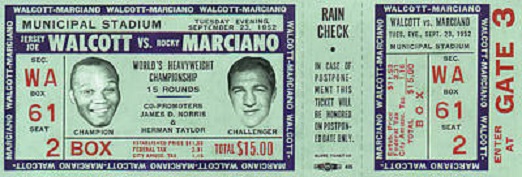
$15.00 in 1952 works out to about $166.75 in 2022.

It was a contrast of styles, "puncher vs. boxer" -- that is, Marciano just plain hit guys as hard as he could, while Walcott, while certainly strong enough to do that, preferred to wear his opponents down. Many old-time boxing fans liked such combinations.
At first, it looked like the fans weren't going to get their money's worth: Walcott knocked Marciano down in the 1st round, the 1st of only 2 times in Rocky’s career that he was knocked off his feet. From there, Walcott put up a comfortable lead over the challenger, although Marciano kept constant pressure on the champion, scoring heavy blows through the fight.
Walcott spent most of the fight using his superior boxing skills and his longer reach to keep the Marciano on the outside, where he could more easily pick his shots and effectively counter Marciano's punches. Marciano attempted to close the distance, hoping to wear the champion down with constant punching.
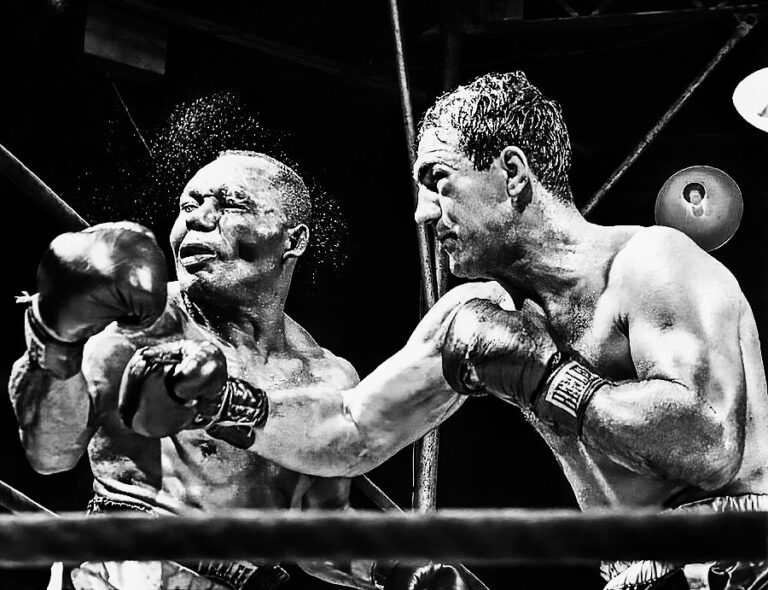
Going into the 13th round, Walcott was ahead on all scorecards -- 8-4 and 7-5 by the judges and 7-4 by referee Charley Daggert -- and seemed poised to win the fight by a decision. But less than a minute into the round, Marciano landed a short but devastating right hook.
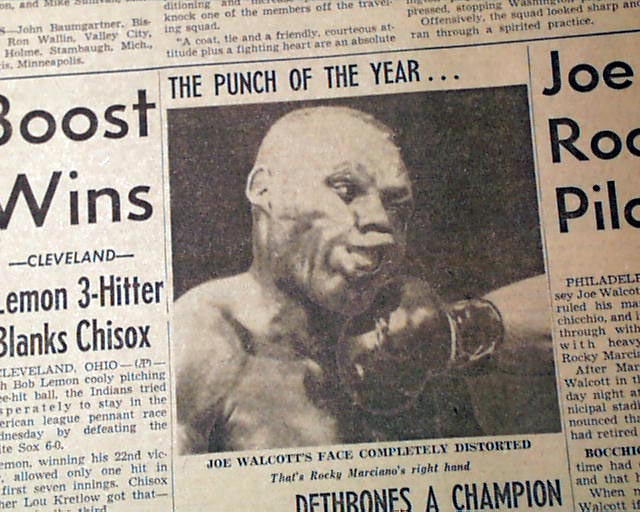
All by itself, this punch produced 2 of the most iconic photographs in boxing history. One, by Herbert Scharfman, at the point of impact, showed Walcott's face distorted by the punch. The other, taken by Al Fenn half a second later, showed beads of sweat popping out of Walcott's bald head.
Walcott went down 43 seconds into the round, and Daggert counted him out. Marciano was the new Champion.

The Ring magazine certainly thought the fans got their money's worth. They named this fight the Fight of the Year, the 13th round the Round of the Year; and, in 1996, the 16th Greatest Title Fight of All-Time.

There was a rematch on May 15, 1953, at Chicago Stadium. This time, it was no contest: Marciano knocked Walcott out at 2;25 of the 1st round. Walcott never fought again, and became a referee. Unfortunately, that part of his career is best known for him losing control of the 2nd fight between Muhammad Ali and Sonny Liston in 1965.

In 1970, Walcott was elected Sheriff of his native Camden County. In 1975, he was named Chairman of the New Jersey State Athletic Commission. He held the post until 1984, and was responsible for establishing Atlantic City as a major prizefighting venue after casino gambling was legalized effective in 1978. He lived until 1994.

*

September 23, 1952 was a Tuesday. Jim Morrison was born that day. No, not the lead singer for The Doors. This Jim Morrison was a major league infielder, usually a backup, from 1977 to 1988. Also born that day was major league pitcher Dennis Lamp. And this was the day that Richard Nixon, running for Vice President under Dwight D. Eisenhower, defended himself against corruption charges on national television with what became known as the Checkers Speech. I have a separate entry for that event.

Only 10 Major League Baseball teams were in action that day:

* A doubleheader was split at Ebbets Field. The Brooklyn Dodgers beat the Philadelphia Phillies in the opener, 5-4. Johnny Rutheford outpitched Karl Drews. George "Shotgun" Shuba hit a home run. This game clinched the National League Pennant for "Dem Bums."

The Phillies won the nightcap, 1-0. Billy Loes pitched 10 shutout innings, and Curt Simmons pitched 11. Johnny Wyrostek doubled home Eddie Waitkus in the top of the 12th, making a winning pitcher out of Kent Peterson, and a losing pitcher out of Jim Hughes.

In the 1st game, Jackie Robinson went 1-for-4 with an RBI; and Duke Snider went 1-for-3 with a walk and 2 RBIs. Both went 0-for-1 in the 2nd game, and then were rested the rest of the way.

* The Philadelphia Athletics beat the Washington Senators, 4-3 at Shibe Park in Philadelphia.

* The Chicago White Sox beat the Cleveland Indians, 10-1 at Cleveland Municipal Stadium.

* The St. Louis Browns beat the Detroit Tigers, 3-1 at Briggs Stadium in Detroit. (It was renamed Tiger Stadium in 1961.)

* And the St. Louis Cardinals beat the Cincinnati Reds, 4-3 at Sportsman's Park in St. Louis. Stan Musial doubled home the winning run in the bottom of the 10th inning. 

September 23, 1926: Tunney Defeats Dempsey

September 23, 1926: Jack Dempsey, Heavyweight Champion of the World, defends his title against Gene Tunney at Sesquicentennial Stadium, the centerpiece of Philadelphia's World's Fair celebrating the 150th Anniversary of American independence. The huge horseshoe was packed with 120,557 fans, the largest crowd in boxing history to that point.

Dempsey hadn't fought in 3 years, and it showed. Once the most fearsome puncher ever, the Manassa Mauler couldn't handle the quickness of Tunney, who learned what he called "scientific pugilism" while serving in the U.S. Marine Corps in World War I.

It didn't help that this fight was outdoors, and it rained. By the 10th and final round, it was pouring, and Dempsey could do little to hurt Tunney.

For the 1st time ever, the Heavyweight Championship changed hands on a decision, rather than a knockout. Previously, decisions were considered unsatisfying, and judges were reluctant to take the title away from the Champion unless the challenger had knocked him out.

But this decision was an obvious one, and nobody objected at the time. Dempsey knew he had been fairly beaten: When his wife asked him what happened, he said, "Honey, I forgot to duck." A 15-year-old Illinois kid named Ronald Reagan read this in the newspaper, and, 55 years later, said it to Nancy after he was shot.

Ironically, being dethroned made Dempsey more popular, as he had previously been called a "slacker" and a "draft dodger" for his avoidance of service in World War I. And Tunney, though the more skilled boxer, never developed the same kind of popularity as Dempsey.

Even after Tunney won by decision again a year later, in what became known as "The Long Count Fight," Dempsey's popularity grew, as some people thought he was robbed, not that they considered it Tunney's fault. Tunney, who retired as Champion rather than lose his title in the ring, was respected, but he was never truly loved.

In 1931, the 105,000-seat Sesquicentennial Stadium was renamed Municipal Stadium, and became famous as the neutral site of the Army-Navy Game. It hosted the 1952 fight where Rocky Marciano knocked out Jersey Joe Walcott to take the title.

In 1964, it was renamed John F. Kennedy Stadium. In 1966, it hosted the Beatles. In 1967, The Spectrum was built across the street; in 1971, Veterans Stadium to the north of the Spectrum, creating the South Philly sports complex. In 1985, it hosted the U.S. half of Live Aid. It was demolished in 1992, and the 76ers & Flyers arena now named the Xfinity Mobile Arena was built on the site.

*

September 23, 1926 was a Thursday. Jazz icon John Coltrane was born that day, and would later establish his home in Philadelphia, the city where Dempsey-Tunney I was held.

There were 2 games played in major league baseball that day. The Boston Braves beat the Pittsburgh Pirates, 2-1 at Braves Field in Boston. And the Cincinnati Reds played the Philadelphia Phillies to a 6-6 tie at Baker Bowl in Philadelphia, before it was called due to darkness after 15 innings.

Thursday, September 22, 2022

September 22, 1927: The Long Count Fight

September 22, 1927: One of the most legendary prizefights ever takes place at Soldier Field in Chicago. The crowd has been listed at as high as 150,000, but was, officially, 104,943.

Jack Dempsey became Heavyweight Champion of the World on July 4, 1919, right after World War I. He was a polarizing figure, a devastating puncher known for his early knockouts, but also for being called a "slacker," because he had worked in a shipyard and continued to box during the war. 

Gene Tunney, grew up a poor Irish-American kid as well. That aside, he couldn't have been much more different from Dempsey: Instead of a rural area, he grew up in Manhattan, and was a highly intelligent, very cultured, well-read man. He enlisted in the U.S. Marine Corps, and that's where he learned to box, earning him the rather redundant nickname "The Fighting Marine."

He was no stereotypical gruff "leatherneck" (an old term for Marines). He decided to treat boxing as a science. The term "the sweet science" had not yet been used, but Tunney treated it as such. He even preferred to call it "pugilism" rather than "boxing" or even "prizefighting."

On September 23, 1926, Dempsey got into the ring with Tunney, at the 105,000-seat Municipal Stadium in Philadelphia, later renamed John F. Kennedy Stadium. The crowd was listed at 120,557, which is still the highest official total for a prizefight, ever, anywhere in the world. Dempsey was not in shape, and was incredibly rusty. Tunney sensed this before the fight, and saw his suspicions confirmed during it. Tunney won the fight on a decision.

A rematch was set for Soldier Field in Chicago a year later, on September 22, 1927, in front of 104,000 people. Tunney led for the 1st 6 rounds. But in the 7th, Dempsey made a breakthrough, and knocked Tunney down. against the ropes. The Mauler smashed 2 right hands and 2 lefts into Tunney's chin, and he was staggered. Four punches later, and Tunney's knee had hit the canvas. For the 1st time in his boxing career, Gene Tunney had been knocked down.

People listening on the radio reported that they couldn't hear any of what happened next, such was the noise from the crowd in the stadium. Talk about the "Roaring Twenties": That term first came about in regard to the rising stock market, but the decade may never have had a louder roar than this one.

But Dempsey did not immediately go to his corner when Tunney went down. As he had usually done in his previous fights, he just stood there. Referee Dave Barry remembered the new rule, and told Dempsey to get to a neutral corner. Dempsey still didn't do so: He just stood there, watching Tunney, waiting for him to get up.

Finally, Barry seemed to give Dempsey a little push, and point, and Dempsey got the hint. Only then did Barry turn back to Tunney, and swing his arm down, with his index finger pointed, and yell, "One!"

The fight was filmed, and, at some point, an early expert in film graphics put a graphic of a stopwatch in the corner of the screen. From the moment Tunney's knee hit the floor until Barry counted, "One!" it was a full 5 seconds. In other words, Tunney got 4 seconds more than he should have.

Tunney was clear-headed and clear-eyed, and he was going to stay down until the count of, "Nine!" so that he could get all the rest to which he was legally entitled. Having done exactly that, Tunney got up before Barry could bring his arm back down and yell, "Ten!" He had spent a total of 14 seconds down, 4 more than the usual limit.

In the 8th round, Tunney managed to knock Dempsey down. Interestingly, Barry began counting without checking that Tunney had reached a neutral corner -- and he hadn't gotten there yet. Dempsey got up, and finished the round and the fight, but it was no contest. When the bell rang to end the 10th and final round, Dempsey knew he'd lost. 

Dempsey's fans, and people who may not have liked him much but bet money on him, were furious. It became known as "The Long Count Fight." At the time, there was a federal law prohibiting the transportation of boxing movies across State Lines, meaning that most people never actually saw the fight until years later. People who heard the legend of the Long Count presumed it was true, based solely on hearsay, not on seeing the film.

And people who didn't previously like Dempsey began to sympathize with him. The sense that he may have been treated unfairly actually helped him: He had lost the fight, but won over a lot of fans, many of whom began appreciating him more in hindsight than they did when he was knocking out Jess Willard, Georges Carpentier and Luis Firpo.

Tunney defended his title once more, and retired as Champion, never making a comeback. He and Dempsey, like many other pairs of boxing rivals, became and remained good friends. Tunney lived until 1978, Dempsey until 1983.

In 1950, the Associated Press named Dempsey the greatest boxer of the 1st half of the 20th Century. Their other honorees: Babe Ruth for baseball, George Mikan for basketball, Howie Morenz for hockey, Bill Tilden -- despite his recent scandal -- for men's tennis, Suzanne Lenglen for women's tennis, Man o' War as the greatest racehorse; and Jim Thorpe for football and track and field, and as greatest athlete overall.

*

September 22, 1927 was a Thursday. Tommy Lasorda, the Hall of Fame manager of the Los Angeles Dodgers, was born.

Often a travel day in Major League Baseball, this time, there was a full slate of games:

* The New York Yankees beat the Detroit Tigers, 8-7 at Yankee Stadium -- the old one, but still new. The Yankees led 6-4 going into the 9th inning. The Tigers took a 7-6 lead. Cliché Alert: Walks can kill you, especially the leadoff variety. Mark Koenig drew a walk to lead off the bottom of the 9th, and Babe Ruth hit a walkoff home run.

Herb Pennock was the winning pitcher, in relief of Wilcy Moore. The other way around was much more common. The home run was Ruth's 56th home run of the season. A new record of 60 was within reach.

* The New York Giants split a doubleheader with the Pittsburgh Pirates at Forbes Field. The Pirates won the 1st game, 5-2; and the Giants won the 2nd game, 7-1.

* The Brooklyn Dodgers were swept by the Cincinnati Reds, in a doubleheader at Crosley Field in Cincinnati. In the opener, Chuck Dressen, later to manage the Dodgers to 2 Pennants, and Pid Purdy hit back-to-back doubles to give the Reds a 2-1 win in 12 innings. The Reds won the nightcap, 4-3.

* The Boston Red Sox beat the Chicago White Sox, 2-1 at Fenway Park in Boston. Cleo Carlyle's single won it for the BoSox in the bottom of the 10th.

* The Philadelphia Athletics swept a doubleheader with the Cleveland Indians at Shibe Park in Philadelphia. The A's won the 1st game 4-3, when Jimmie Foxx singled home a run in the bottom of the 13th inning. The A's won the 2nd game 5-2.

* The Washington Senators beat the St. Louis Browns, 10-7 at Griffith Stadium in Washington.

* The Chicago Cubs beat the Philadelphia Phillies, 8-4 at Wrigley Field in Chicago.

* And the St. Louis Cardinals beat the Boston Braves, 6-5 at Sportsman's Park in St. Louis.

Wednesday, September 21, 2022

September 21, 1955: Rocky Marciano vs. Archie Moore

September 21, 1955: Rocky Marciano defends the Heavyweight Championship of the World against the reigning Light Heavyweight Champion, Archie Moore. The fight turns out to be worthy of both men.

Marciano was born as Rocco Francis Marchegiano on September 1, 1923, in Brockton, Massachusetts, outside Boston, had become champion 3 years earlier, on September 23, 1952, at Municipal (later John F. Kennedy) Stadium in Philadelphia, knocking out Jersey Joe Walcott in the 13th round after surviving a 1st-round knockdown himself. He came into this fight with a career record of 48-0, with 42 knockouts. He won a rematch with Walcott, knocking him out in the 1st round. He knocked out Roland La Starza, then won 2 decisions against former Champion Ezzard Charles. His last fight before this one was a technical knockout of Don Cockell.

Like a lot of great fighters, he won some fights he probably should have lost, finding some inner reserve of courage that allowed him to overcome an opponent who looked better for most of the night. His 2nd fight with Charles was an example: In the 6th round, Charles split Marciano's nose at the nostril. Charles quickly realized what he'd done, and pounded away at the nose.

Between the 7th and 8th rounds, Marciano's trainer, Charley Goldman, told him he couldn't stop the bleeding. Ruby Goldstein, one of boxing's top referees, told them that if the bleeding weren't stopped at the end of the 8th, he would call the fight off and award Charles the win. Marciano knocked Charles out in that round.

Like later boxer Sonny Liston, and baseball pitchers Satchel Paige and Dizzy Dean, Moore's origins are in dispute. His birth name is not: Archibald Lee Wright. He always insisted that he was born on December 16, 1916 in Collinsville, Illinois, outside St. Louis. His mother, Lorena Wright, who would have known, said it was December 13, 1913 in Benoit, Mississippi, in the Delta. Some people came to believe he was even older than that. Wikipedia accepts the 1913 date as correct, so I'm going to go with that.

At any rate, he and his mother were abandoned by his father, Thomas Wright, so Lorena sent him to live with an aunt and uncle in St. Louis, Cleveland and Willie Pearl Moore. He took their name because, in his words, "It was less questions to be Moore."

"The Old Mongoose" grew up in St. Louis, and and learned to box while serving in the New Deal's Civilian Conservation Corps. He was undefeated in his 1st 17 professional fights. In 1943, at 29, he won the California State Middleweight Championship. His career record was 54-5-5: He had already fought professionally 64 times. In 1947, he won the State's Light Heavyweight title. He was now 87-13-7.

Finally, on December 17, 1952, right after his 39th (or 36th) birthday, he went into the St. Louis Arena, and defeated Joey Maxim in a unanimous decision, to win the Light Heavyweight Championship of the World. This made him one of the oldest first-time champions in any weight class, but, of course, no record could be authenticated. His record was now 134-19-8. Six months later, he won a rematch with Maxim -- having fought 6 times in between. Six months after that, having won 2 fights in Argentina, he fought Maxim a 3rd time, and won again.

On June 22, 1955, at the Polo Grounds in New York, he defended the title against Carl "Bobo" Olson, then the Middleweight Champion of the World. This should have been a good fight. It wasn't: Moore, presumably 41, took Olson, 26, out in the 3rd round. It was now clear that Moore, at 149-19-8, should have a shot at Marciano. Like Marciano's 2 fights with Charles, the fight with Moore would be at Yankee Stadium. It was originally scheduled for September 20, while the Yankees were on the road, but, due to concerns over Hurricane Ione, it was postponed for one night. Marciano was 32 years old, while Moore was 41, or maybe 38.

Watching Rocky on film led Archie to believe that he would be vulnerable to a left hook. When the fight began, Archie learned that, due to the angle of Rocky's defensive crouch, he could hit Rocky with a hook only if he placed himself in position to be hit back. And in the 2nd round, it was a right hand, rather than a left, that knocked Rocky down, only the 2nd knockdown of his career, after Walcott had done it. But, as Walcott found out 12 rounds later, that was not a good sign.

Rocky got up at the count of 2. But referee Harry Kessler gave him a standing 8-count -- probably a good idea, but, under the rules of the time, not mandatory in championship fights. Archie admitted in his memoir that he went "blind and stupid with rage," going for the knockout.

And that was his mistake. Rocky pounded away, knocking Archie down 4 times. Archie stubbornly kept getting back up. Finally, in the 9th round, Rocky floored Archie for a 5th time, and he couldn't get up. Rocky Marciano was 49-0.
Speculation grew as to who Marciano would fight next, to go for 50-0. The answer turned out to be no one: On April 27, 1956, he announced his retirement from boxing. And, unlike so many other champions, he stayed retired: He never fought again.

In 1961, he hosted The Main Event, a syndicated TV show, where he would interview a celebrity, and then show a famous fight, sometimes one of his own. He was killed in a plane crash on August 31, 1969, a day short of his 46th birthday.

Moore kept fighting, and, in 1956, got a shot at filling the vacancy in the Heavyweight Championship caused by Marciano's retirement. But he lost to Olympic Champion Floyd Patterson, and that would be his last shot at the Heavyweight title.

In 1962, approaching what may have been his 49th birthday, and still officially the Light Heavyweight Champion of the World, he fought a non-title bout against 20-year-old Olympic Champion Cassius Clay, and was knocked out in the 4th round. He fought once more, won, and retired with a record of 186-23-10. That's one hundred eighty-six wins, twenty-three losses and 10 draws.

Like many boxers, he became an actor. Like many boxers, he became a boxing trainer. He was in George Foreman's corner in Zaire in 1974 when Foreman fought the man who nearly ended his own career in 1962, now, of course, known as Muhammad Ali.

Archie Moore died on December 9, 1998. He was just short of turning 85. Or 82. A year later, the Associated Press named him the greatest light heavyweight boxer of all time.

*

September 21, 1955 was a Wednesday. These baseball games were played:

* The New York Yankees beat the Washington Senators, 7-3 at Griffith Stadium in Washington. Bob Turley outpitched Chuck Stobbs. Yogi Berra went 1-for-5 with an RBI. Mickey Mantle did not play. The Yankees did get a home run, from an unlikely source: Billy Martin.

* The New York Giants swept a doubleheader from the Pittsburgh Pirates, 7-2 and 7-3 at the Polo Grounds. In the opener, Willie Mays went 3-for-4 with 2 RBIs, while Roberto Clemente went 1-for-4. Clemente didn't play in the nightcap, and Mays had to leave it early due to an injury. He was replaced by Dusty Rhodes, who went 2-for-5 with a home run and 2 RBIs.

* The Baltimore Orioles beat the Boston Red Sox, 8-7 at Fenway Park in Boston. Willy Miranda singled home the winning run in the top of the 13th inning. A rookie 3rd baseman named Brooks Robinson went 0-for-3 for the Orioles. A veteran left fielder named Ted Williams pinch-hit for the Red Sox, and drove in a run with a sacrifice fly.

* The Cincinnati Redlegs (as the Reds were known from 1954 to 1958) beat the Milwaukee Braves, 14-5 at Crosley Field in Cincinnati. Hank Aaron went 1-for-4.

* The Detroit Tigers beat the Kansas City Athletics, 10-1 at Briggs Stadium (later Tiger Stadium) in Detroit. Al Kaline went 2-for-5 with an RBI, to help nail down his distinction as the youngest batting champion in American League history, breaking the record of an earlier Tiger star, Ty Cobb.

* The Chicago White Sox beat the Cleveland Indians, 7-2 at Comiskey Park in Chicago.

* The Chicago Cubs beat their arch-rivals, the St. Louis Cardinals, 7-5 at the 1st Busch Stadium (formerly the last Sportsman's Park) in St. Louis. Randy Jackson's triple led a 4-run top of the 13th for the Cubs. The Cards scored 2 in the bottom of the 13th, but fell short. Ernie Banks went 0-for-3, but drew 3 walks. Stan Musial went 3-for-5 with a home run and 2 RBIs.

* And the Brooklyn Dodgers and the Philadelphia Phillies were not scheduled.

December 31, 1999 & January 1, 2000: The Millennium

December 31, 1999:  The Millennium arrives. The people of planet Earth survived. At a terrible cost. But we hadn't destroyed ourselves. ...