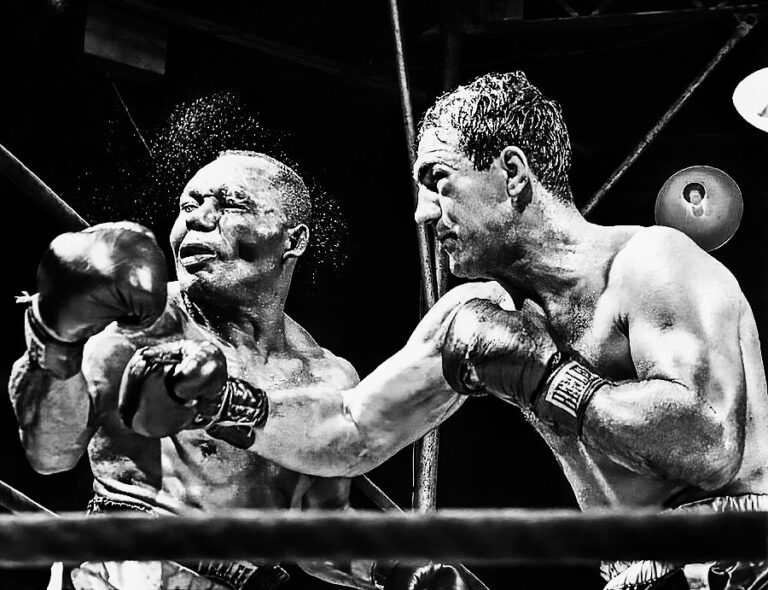
September 23, 1952: The Heavyweight Championship of the World is contested at Municipal Stadium in South Philadelphia. The title had changed hands there before, in 1926, when, with the stadium brand-new, Gene Tunney won it on a decision over Jack Dempsey.
Jersey Joe Walcott, from Pennsauken, New Jersey, right across the Delaware River from Philadelphia, was 38 years old, making him, at the time, the oldest Heavyweight Champion ever. It had been a long struggle to the top, including avenging a defeat to future Light Heavyweight Champion Joey Maxim; 2 title fights against Joe Louis, with many observers saying he had been robbed of the title in the 1st; and 4 title fights against Ezzard Charles, winning the last 2. He went into this fight with a record of 49-18-1 -- an excellent ratio, but a large number of losses for a champion.
His opponent had no losses. Rocky Marciano, from Brockton, Massachusetts, outside Boston, was 29, and came in at 42-0. But as impressive as that looked, he had beaten only one big name, and that was Louis, a year earlier.
And, as Marciano admitted, "This is the last guy I want to fight." Louis was a hero, but he was also absolutely finished as a fighter. But he needed money badly, and so he got into the ring with Marciano. It was over in the 8th around, and a lot of people inside Madison Square Garden, including Marciano himself, were crying after the fight. But he had earned his shot at the title.
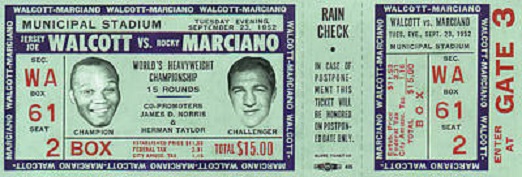
$15.00 in 1952 works out to about $166.75 in 2022.
It was a contrast of styles, "puncher vs. boxer" -- that is, Marciano just plain hit guys as hard as he could, while Walcott, while certainly strong enough to do that, preferred to wear his opponents down. Many old-time boxing fans liked such combinations.

Sesquicentennial/Municipal/John F. Kennedy Stadium
At first, it looked like the fans weren't going to get their money's worth: Walcott knocked Marciano down in the 1st round, the 1st of only 2 times in Rocky’s career that he was knocked off his feet. From there, Walcott put up a comfortable lead over the challenger, although Marciano kept constant pressure on the champion, scoring heavy blows through the fight.
Walcott spent most of the fight using his superior boxing skills and his longer reach to keep the Marciano on the outside, where he could more easily pick his shots and effectively counter Marciano's punches. Marciano attempted to close the distance, hoping to wear the champion down with constant punching.
Going into the 13th round, Walcott was ahead on all scorecards -- 8-4 and 7-5 by the judges and 7-4 by referee Charley Daggert -- and seemed poised to win the fight by a decision. But less than a minute into the round, Marciano landed a short but devastating right hook.
All by itself, this punch produced 2 of the most iconic photographs in boxing history. One, by Herbert Scharfman, at the point of impact, showed Walcott's face distorted by the punch. The other, taken by Al Fenn half a second later, showed beads of sweat popping out of Walcott's bald head.
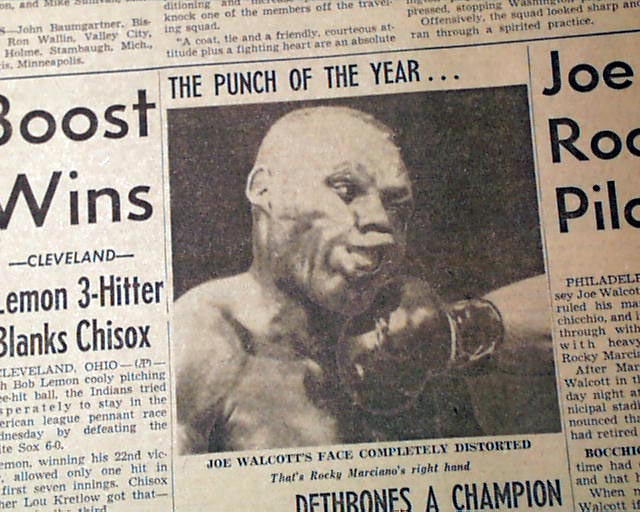
The Ring magazine certainly thought the fans got their money's worth. They named this fight the Fight of the Year, the 13th round the Round of the Year; and, in 1996, the 16th Greatest Title Fight of All-Time.
There was a rematch on May 15, 1953, at Chicago Stadium. This time, it was no contest: Marciano knocked Walcott out at 2;25 of the 1st round. Walcott never fought again, and became a referee. Unfortunately, that part of his career is best known for him losing control of the 2nd fight between Muhammad Ali and Sonny Liston in 1965.
In 1970, Walcott was elected Sheriff of his native Camden County. In 1975, he was named Chairman of the New Jersey State Athletic Commission. He held the post until 1984, and was responsible for establishing Atlantic City as a major prizefighting venue after casino gambling was legalized effective in 1978. He lived until 1994.
*
September 23, 1952 was a Tuesday. Jim Morrison was born that day. No, not the lead singer for The Doors. This Jim Morrison was a major league infielder, usually a backup, from 1977 to 1988. Also born that day was major league pitcher Dennis Lamp. And this was the day that Richard Nixon, running for Vice President under Dwight D. Eisenhower, defended himself against corruption charges on national television with what became known as the Checkers Speech. I have a separate entry for that event.
Only 10 Major League Baseball teams were in action that day:
* A doubleheader was split at Ebbets Field. The Brooklyn Dodgers beat the Philadelphia Phillies in the opener, 5-4. Johnny Rutheford outpitched Karl Drews. George "Shotgun" Shuba hit a home run. This game clinched the National League Pennant for "Dem Bums."
The Phillies won the nightcap, 1-0. Billy Loes pitched 10 shutout innings, and Curt Simmons pitched 11. Johnny Wyrostek doubled home Eddie Waitkus in the top of the 12th, making a winning pitcher out of Kent Peterson, and a losing pitcher out of Jim Hughes.
In the 1st game, Jackie Robinson went 1-for-4 with an RBI; and Duke Snider went 1-for-3 with a walk and 2 RBIs. Both went 0-for-1 in the 2nd game, and then were rested the rest of the way.
* The Philadelphia Athletics beat the Washington Senators, 4-3 at Shibe Park in Philadelphia.
* The Chicago White Sox beat the Cleveland Indians, 10-1 at Cleveland Municipal Stadium.
* The St. Louis Browns beat the Detroit Tigers, 3-1 at Briggs Stadium in Detroit. (It was renamed Tiger Stadium in 1961.)
* And the St. Louis Cardinals beat the Cincinnati Reds, 4-3 at Sportsman's Park in St. Louis. Stan Musial doubled home the winning run in the bottom of the 10th inning.


No comments:
Post a Comment