Showing posts with label u.s. air force. Show all posts

Tuesday, December 20, 2022

December 21, 1918: The Death of Hobey Baker

December 21, 1918: Hobey Baker, America's 1st great hockey player, is killed in a plane crash. He was only 26 years old.

Hobart Amory Hare Baker was born on January 15, 1892 outside Philadelphia in Bala Cynwyd, Pennsylvania. His family was rich, and could have gotten him into any college he wanted. Instead of the nearby University of Pennsylvania, he chose Princeton University, helping them win National Championships in football in 1911, and in hockey in 1912 and 1914.

He graduated in 1914, and moved to New York where he went to work for J.P. Morgan Bank and helped the St. Nicholas Hockey Club win the national amateur championship in 1915.

In 1917, he enlisted in the U.S. Army Air Service, a precursor of the U.S. Air Force. By the time the Armistice was signed on November 11, 1918, he held the rank of Captain, and was commander of the 141st Aero Squadron.

On December 21, 1918, 40 days after the Armistice, and the day before he was set to return to America, he was test-piloting a plane in Toul, France, when the engine failed, and crashed nose-first. He was pulled out of the wreckage, but died in the ambulance.

In 1921, Princeton opened the Hobey Baker Memorial Rink. He was the only American among the 1st 9 inductees into the Hockey Hall of Fame in 1945. In 1975, he was elected to the College Football Hall of Fame. In 1980, the Hobey Baker Award was introduced, a hockey version of the Heisman Trophy.

*

December 21, 1918 was a Saturday. Born on this day were Kurt Waldheim, the Austrian diplomat who served as Secretary-General of the United Nations 1972 to 1981, and President of Austria from 1986 to 1992, but was later exposed as having committed war crimes during World War II; and Donald Regan, who served President Ronald Reagan as Secretary of the Treasury during his 1st term and White House Chief of Staff for the 1st half of his 2nd, before his resignation over the Iran-Contra scandal.

Baseball was in the off-season. Football season was also over, except for the Rose Bowl, which was an all-military affair: George Halas led the Great Lake Naval Training Station, north of Chicago, to a 17-0 win over the Mare Island Marines, based outside San Francisco, led by former Washington State quarterback Dick Hanley. Both teams went into the game undefeated. Hanley would coach Marine teams in World War II. Halas, of course, went on to found the team that became the Chicago Bears, and co-found the NFL.

There was no serious professional basketball league. But the NHL season opened on this date, with 1 game: The Ottawa Senators beat the Montreal Canadiens, 5-2 at the Jubilee Arena in Montreal.

Thursday, December 8, 2022

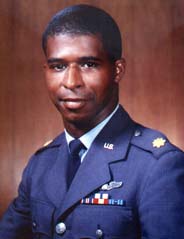
December 8, 1967: The Death of the Would-Be 1st Black Astronaut

December 8, 1967: Major Robert Henry Lawrence Jr., U.S. Air Force, is killed at Edwards Air Force Base in Southern California. He was 32, and left behind a wife, but no children.

Born on October 2, 1935 in Chicago, he graduated from high school at the age of 16, and from Bradley University of Peoria, Illinois at 20. Lawrence became one of the best training pilots in the Air Force, and had a Ph.D. in chemistry from Ohio State University.

NASA and the Air Force hired him to observe the X-15 "rocket-plane," and his notes later contributed heavily to their development of the Space Shuttle fleet. He was selected as an astronaut in June 1967, and, had he lived, he likely would have become the 1st black person to fly in space.

He was the backseat pilot in an F-104, instructing another pilot. The pilot made a mistake, and the plane crashed. The pilot was able to eject, but was badly hurt, and his name has never been publicly revealed. In order to avoid hitting the ejecting pilot, the back seat of the F-104 was designed to eject a full second later. Lawrence's ejection failed.

On September 18, 1980, Colonel Arnaldo Tamayo Méndez of the Cuban Air Force became the 1st black person in space, aboard the Soviet mission Soyuz 38. On September 5, 1983, Colonel Guion "Guy" Bluford, U.S. Air Force, became the 1st black American to fly in space, aboard the Space Shuttle Challenger.

*

December 8, 1967 was a Friday. Future NFL quarterback Jeff George was born.

Baseball was out of season. Football was in midweek. There were 6 games played in the NBA:

* The New York Knicks lost to the Philadelphia 76ers, 117-109 at The Spectrum in Philadelphia.

* The Boston Celtics beat the Baltimore Bullets, 123-108 at the Boston Garden.

* The Los Angeles Lakers beat the Detroit Pistons, 116-103 at Cobo Hall (now Huntington Place) in Detroit.

* The St. Louis Hawks beat the Cincinnati Royals, 101-95 at the Kiel Auditorium in St. Louis.

* The San Diego Rockets beat the San Francisco Warriors, 137-107 at the Oakland Coliseum Arena. The Warriors had split their games between the Civic Auditorium (now named for rock music promoter Bill Graham) and the University of San Francisco's Memorial Gym (now the Sobrato Gym). This game in Oakland was an experiment. In 1971, they changed their name to the Golden State Warriors, and moved to Oakland on a seemingly permanent basis. In 2019, they moved back across San Francisco Bay, into the Chase Center in San Francisco.

* And the Chicago Bulls beat the Seattle SuperSonics, 115-114 at the Seattle Center Coliseum.

And there were 2 games in the brand-new American Basketball Association. The Pittsburgh Pipers beat the Kentucky Colonels, 93-89 at the Louisville Convention Center (now named the Louisville Gardens). And the Dallas Chaparrals beat the Anaheim Amigos, 123-110 at the Dallas Memorial Auditorium.

There was 1 game played in the NHL: The Philadelphia Flyers beat the Los Angeles Kings, 3-0. Since their home, The Forum in Inglewood, hadn't opened yet, the game was played at the Long Beach Convention Center.

Friday, November 11, 2022

November 11, 1921: The Tomb of the Unknown Soldier

November 11, 1921: The Tomb of the Unknown Soldier is dedicated at Arlington National Cemetery, in Arlington, Virginia, across the Potomac River from Washington, D.C. The Tomb faces east, overlooking the national capital.

It is 3 years to the day after the Armistice that ended World War I. An unidentified soldier from World War I is buried there on the day. Every day since, regardless of weather, a team of U.S. Army Sergeants, in dress uniform, known as "Sentinels," has walked a guard along a black mat in front of the Tomb, one at a time until relieved by another. The Sentinel does the following:

  1. Marches 21 steps south down the 21-yard-long black mat laid across the Tomb.
  2. Turns and faces east, toward the Tomb, for 21 seconds.
  3. Turns and faces north, changes weapon to the outside shoulder, and waits 21 seconds.
  4. Marches 21 steps up the mat.
  5. Turns and faces east for 21 seconds.
  6. Turns and faces south, changes weapon to the outside shoulder, and waits 21 seconds.
  7. Repeats the routine until the soldier is relieved of duty at the Changing of the Guard.

The temporary Tomb was replaced by the permanent design in 1932, with a Memorial Amphitheater around it. People are asked to view with quiet and respect. The Sentinel will remind the audience of this if there is noise.

In 1958, coffins containing unidentified remains of soldiers killed in World War II and the Korean War were added. In 1984, one from the Vietnam War was added. In 1998, a reporter looked at evidence and decided he had identified the Vietnam "Unknown" as Air Force 1st Lt. Michael Blassie. The remains were exhumed, tested, and his identity confirmed. Blassie’s coffin was taken back to his hometown of St. Louis, where he was buried with full honors.

Rather than fill the space at Arlington where Blassie had rested with another "Unknown" from the Vietnam era, the space has been left empty, as an official tribute to those who never made it home, alive or dead.

Each day, on November 11, the President of the United States, or the Vice President if the President is unavailable due to a foreign trip or illness, lays a wreath at the Tomb, with assistance from a member of the Sentinel corps not walking the guard.
President Barack Obama, November 11, 2013

And all active-duty military personnel salute the Tomb, because they don't know the men's ranks: Each of the three remaining "Unknowns" could be a buck private, or a General, although the likelihood of a General having been unaccounted for, in any war, is slim. While they are all definitely men, no one knows their ranks, their races, their religions, their places of origin, or their branches of the service. The idea is that each could be anyone, and could have been anyone -- including veterans or future servicepeople.

*

November 11, 1921 was a Friday. Baseball was out of season. Professional basketball barely existed. The start of the NHL season was over a month away. And no games were played in the NFL. But there were 8 college football games played that day:

* Virginia Tech beat North Carolina State, 7-3 on (mostly) neutral ground at League Park in Norfolk, Virginia.

* Trinity College beat Wake Forest, 17-0 at Riddick Field in Raleigh, North Carolina. Trinity was renamed Duke University in 1925.

* Birmingham-Southern beat Chattanooga, 14-7 at Rickwood Field in Birmingham, Alabama. Despite being the team that opened the city's famed Legion Field in 1929, and winning 3 Southern Conference titles in the 1930s, Birmingham-Southern College discovered that they couldn't compete with Alabama, Auburn, or even the University of Alabama at Birmingham, and so they dropped their program in 1939. They returned in 2007, playing in NCAA Division III, but folded the program again in 2023.

The University of Chattanooga was absorbed into the University of Tennessee system in 1969, and was renamed the University of Tennessee at Chattanooga. They began playing a small-college schedule in 1956, were assigned to NCAA Division II in 1973, were promoted to Division I-A in 1977, but were dropped to Division I-AA, since renamed the Football Championship Subdivision (FCS), where they remain.

* Florida beat Alabama, 9-2 at Denny Field in Tuscaloosa, Alabama.

* Texas beat Mississippi A&M, 54-7 at Clark Field in Austin, Texas. The Agricultural and Mechanical College of the State of Mississippi was renamed Mississippi State College in 1932, and Mississippi State University in 1958.

* Texas A&M and Rice played to a tie, 7-7 at Rice Field in Houston.

* Iowa State beat Kansas State, 7-0 at Ahearn Field in Manhattan, Kansas.

* And Idaho beat Wyoming, 31-3 on (mostly) neutral ground at Public School Field in Boise, Idaho.

Friday, October 14, 2022

October 14, 1947: Chuck Yeager Breaks the Sound Barrier

October 14, 1947: Captain Charles E. Yeager, U.S. Air Force, pilots a Bell X-1 plane he named Glamorous Glennis, after his wife, to a speed of 700 miles per hour, over the Rogers Dry Lake in the Mojave Desert of California. At his altitude, 45,000 feet (about 8 1/2 miles above sea level), that was faster than the speed of sound, making Chuck Yeager the 1st human to travel faster than sound.
He named the plane after his wife because, "You're my good-luck charm, Hon. Any plane I name after you always brings me home."
Yeager served in World War II, Korea and Vietnam, earning 3 Distinguished Flying Crosses, 2 Silver Stars, a Bronze Star and a Purple Heart. He continued to serve in the Air Force until 1975, retiring with the rank of Brigadier General (1 star). That year, Congress awarded him a special silver medal, which it called "equivalent to a non-combat Medal of Honor."
He later served on the commission investigating the explosion of the Space Shuttle Challenger, and as a consultant for flight simulator video games. In 1997, on the 50th Anniversary of the event, he broke the sound barrier again. In 2012, on the 65th Anniversary, at the age of 89, he broke the sound barrier one last time.
In 2013, Flying magazine named 51 Heroes and Heroines of Aviation. Yeager was ranked 5th, the 2nd-highest-ranking living person, behind Paul Poberezny, who soon died, making Yeager the highest-ranking living one. Poberezny was a champion of home-built aircraft, including making a replica of Charles Lindbergh's Spirit of St. Louis. Lindbergh was ranked 3rd, Orville and Wilbur Wright were a joint entry at 2nd, and Neil Armstrong -- a fighter pilot in the Korean War before he was the 1st man to walk on the Moon -- 1st. (John Glenn, also a fighter pilot in Korea, was only ranked 25th.)
A cousin of baseball player Steve Yeager, Chuck Yeager lived until December 7, 2020, age 97. He lived long enough to see the start of the Space Age, the 1st Moon landing, the speed of sound surpassed by a land vehicle; and a man jumping off a platform in the atmosphere, breaking the sound barrier without a vehicle, and parachuting safely to the Earth. Glennis died in 1990.
The Glamorous Glennis is now at the Smithsonian Institution's National Air and Space Museum in Washington.
On May 18, 1953, Jacqueline Cochran, who served as a WAAC and a WASP in World War II, became the 1st woman to break the sound barrier, flying an F-86 Sabrejet. She was older than Yeager, and was 74 when she died in 1980.
*
October 14, 1947 was a Tuesday. Baseball season was over. Football was in midweek. The NHL season started the next day. And the NBA season didn't start for another month. So there were no scores on this historic day.
Josip Hrvoje Peruzović, the Croatian professional wrestler who portrayed the Soviet wrestler Nikolai Volkoff, was born on this day.

Monday, August 8, 2022

August 8, 1952: Bob Neighbors Is Killed In Action


August 8, 1952: Major Robert Neighbors, U.S. Air Force, is shot down over North Korea. He is believed to be the only major league athlete to have been killed in action in the Korean War. He was 34 years old.

Robert Otis Neighbors was born on November 9, 1917 in Talihina, Oklahoma. After playing baseball for a season at Oklahoma Baptist University, he signed with the St. Louis Browns, who had a farm team in the area. He moved up through their system as a power-hitting shortstop, a rarity in those days.

On September 16, 1939, Bob Neighbors made his major league debut. He entered the game as a late-inning defensive replacement, and the Browns lost to the Washington Senators, 4-0 at Griffith Stadium in Washington. (By a twist of fate, his uniform number has been lost to history: Neither Baseball-Reference.com nor Baseball-Almanac.com nor Wikipedia have it recorded, and no surviving photographs reveal it.)

Neighbors played 7 of the Browns' last 17 games, 5 at shortstop and 2 as a pinch-runner. He fielded 12 chances, with 6 assists, 5 putouts, participating in 1 double play, and making only 1 error. He got 2 hits in 11 at-bats, one of them a home run off Denny Galehouse in a 6-2 Browns loss to the Boston Red Sox at Fenway Park. The Browns finished 43-111, the rock-bottom worst finish for the worst franchise in American League history.

(Galehouse would later help the Browns win their only Pennant in 1944, then go back to the Red Sox, and start and lose their 1948 Playoff for the Pennant with the Cleveland Indians. The Browns became the Baltimore Orioles in 1954, and found some success, but their 111 losses as the '39 Browns remained the worst in the franchise's history, until, in 2018, they lost 115. )

Neighbors never played another major league game. He played for the Toledo Mud Hens in the American Association in 1940. In 1941, he married Winifred Wilcox, and played for the San Antonio Missions in the Texas League. That Summer, while the Missions were on the road, "Winnie" was hit by a car and killed.

"It had a bad effect on Bob," his younger brother Morris said later. "Bob was on the road, and Winnie back home in San Antonio when it happened. He felt that if he had been there, if he had a job where he wasn't traveling, it wouldn't have happened." His hitting also seemed to die, as he fell to a .216 batting average. When Pearl Harbor was bombed at the end of the year, he felt he had enough reason to quit baseball, and joined what was then called the U.S. Army Air Corps.

While serving at Maxwell Field in Montgomery, Alabama, he met Katherine "Kitty" Burke, and she became his 2nd wife. He didn't quit baseball entirely, playing for base teams. But when World War II ended, he decided to keep the military as his career, including as player-manager for the Maxwell Field team. In 1947, the Army Air Corps was separated from the Army to become its own branch of the armed forces, the U.S. Air Force. In 1950, Bob became the father of Robert Cameron Neighbors. All seemed well.

Then North Korea invaded South Korea, and President Harry S Truman rallied the United Nations to South Korea's aid. Major Neighbors flew a Douglas Invader with the 13th Bomb Squadron of the 3rd Bomb Group.

On August 8, 1952, he and his crew, also including 1st Lieutenant William Holcom and Staff Sergeant Grady Weeks, flew a night mission over North Korea. They reported being hit by enemy fire, and said they were bailing out. There was no further contact, and they failed to return. They were reported as "Missing In Action" (MIA). After the Truce of Panmunjom ended the war, and all prisoners of war were repatriated, Neighbors, Holcom and Weeks were not among them. It became accepted that they had died in action.

The Browns moved to Baltimore after the 1953 season. The Orioles make no mention of Neighbors in their historical displays at Oriole Park at Camden Yards. Although the St. Louis Cardinals have honored Browns legend George Sisler with a statue outside the new Busch Stadium, and have some Browns memorabilia in their in-park Hall of Fame Museum, they make no mention of Neighbors, either.

By a macabre coincidence, like Neighbors, the only Major League Baseball Player who died in the Korean War, the 2 Major League Baseball players to die in combat in World War II also played very briefly, just in the 1939 season, for teams that no longer exist under the names they used at the time.

Elmer Gedeon, a multi-sport star athlete at the University of Michigan, played 5 games in the outfield for the Washington Senators, and was shot down over France in 1944. Harry O'Neill made 1 appearance as a catcher for the Philadelphia Athletics, and died on Iwo Jima in early 1945.

*

August 8, 1952 was a Friday. These baseball games were played that day:

* The New York Giants lost to the Boston Braves, 2-0 at Braves Field in Boston. Max Surkont pitched a 4-hit shutout, and Bob Thorpe went 3-for-4 with an RBI. Willie Mays was serving in the Korean War, and unavailable to the Giants.

* The Brooklyn Dodgers beat the Philadelphia Phillies, 6-3 at Shibe Park in Philadelphia. Andy Pafko went 2-for-5 with 5 RBIs, including a 3-run home run in the top of the 10th inning, to make a winning pitcher out of Preacher Roe. Jackie Robinson went 1-for-4. Richie Ashburn went 3-for-4 for the Phillies.

* The Pittsburgh Pirates beat the Chicago Cubs, 1-0 at Forbes Field in Pittsburgh. Murry Dickson went the distance and beyond for the Pirates, winning his own game with a single in the bottom of the 10th inning, allowing just 6 hits in his extra-inning shutout.

* The Cincinnati Reds beat the St. Louis Cardinals, 8-5 at Crosley Field in Cincinnati. Stan Musial went 1-for-4.

* The Chicago White Sox swept a doubleheader from the Detroit Tigers, 4-3 and 2-1 at Comiskey Park in Chicago.

* The Cleveland Indians beat the St. Louis Browns, 10-9 at Sportsman's Park in St. Louis. Bob Feller had the worst performance of his Hall of Fame career, getting knocked out of the box in the 1st inning, allowing 6 runs without getting an out. But the Indians came back from an 8-0 2nd inning deficit, as Bill Glynn won it with a home run leading off the top of the 12th inning, to make a winner in relief out of Early Wynn. That's the kind of franchise the Browns were.

* The New York Yankees and the Boston Red Sox were rained out at Yankee Stadium. The game was made up on August 11, and the Yankees won, 7-0. Allie Reynolds pitched a 2-hit shutout. Mickey Mantle hit 2 home runs. Ted Williams was serving in the Korean War, and unavailable to the Red Sox.

* And the Philadelphia Athletics and the Washington Senators were rained out at Griffith Stadium in Washington. The game was made up as part of a doubleheader on September 2, and the Senators swept, 3-2 and 5-0. Jackie Jensen won the opener with a bases-loaded walk in the bottom of the 10th. Mike Fornieles pitched a 1-hit shutout in the nightcap.

Saturday, August 6, 2022

August 6, 1945: The Atomic Bomb

Actual color photo of Hiroshima after the bombing

August 6, 1945: For the 1st time, an atomic bomb is used in warfare.

It is World War II. Nazi Germany has already been defeated. The Empire of Japan, however, is holding out. American forces have reached Okinawa, just 400 miles from the Japanese home Islands. 

President Harry S Truman has demanded that Japan surrender. They have refused. So, at 8:15 AM local time -- 6:15 PM on August 5, U.S. Eastern Time -- the Enola Gay, a B-29 Superfortress, dropped a uranium bomb codenamed Little Boy on the port city of Hiroshima, about 500 miles west of Tokyo. It was a tactical choice that would not only kill as many people as possible, but hurt Japan's war effort.

The bomb had roughly the force of 15,000 tons of TNT -- 15 kilotons. It is estimated that 66,000 people were killed instantly, and another 100,000 or so may have died of radiation poisoning within the next year. 

Despite this destruction, Japan still did not surrender. So a 2nd bomb, a 21-kiloton plutonium bomb codenamed Fat Man, was dropped on Nagasaki on August 9. As a smaller city to begin with, about 40,000 were killed at once, and at least that many through radiation sickness.

Finally, on August 14, fearful that the capital of Tokyo, which had already sustained terrible damage as a result of incendiary bombs, would be next, Japan surrendered.

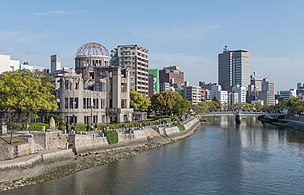
As part of the U.S. occupation of Japan, both cities were rebuilt. Today, Hiroshima is a thriving city of about 1.2 million. Nagasaki is now home to about 400,000.
Hiroshima, 2019. The domed building at left
is the city's official memorial to the bombing.

Truman knew that the bombings were necessary. Had they not happened, the Allies were scheduled to invade the home islands on November 1. The estimates Truman had received from the Department of War suggested that the invasion, and subsequent fighting, would kill 500,000 to 1 million Allied troops, and at least that many Japanese troops, and that victory might not be achieved until well into 1946. So, as horrific as the bombings were, they saved lives, and shortened the war.

In spite of a few close calls between America and the Soviet Union, atomic bombs have never been used in warfare again. May that remain so.

*

August 6, 1945 was a Monday. Andy Messersmith, the All-Star pitcher who helped break baseball's reserve clause, was born on this day.

It was the offseason for the NFL and the NHL, and the NBA wouldn't be founded for another year. Monday is often a travel day in baseball, and only 4 teams were in action, with the 3 teams then in New York City not among them. However, Harrah's of teams that did play played doubleheaders.

* One was played at Comiskey Park in Chicago. The Detroit Tigers, who would go on to win the World Series that year, won the opener over the Chicago White Sox, 6-2. The Pale Hose would rebound in the nightcap, winning 7-0.

* The other was played at Sportsman's Park in St. Louis. Despite being the defending American League Champions for the only season in their history (until moving to become the Baltimore Orioles in 1954), on this day, the St. Louis Browns got swept by the Cleveland Indians. The Tribe win the 1st game 9-7, and the 2nd game 8-4. 

Thursday, August 4, 2022

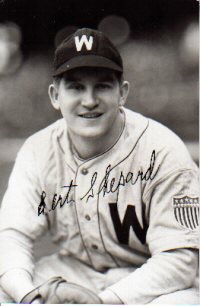
August 4, 1945: The Bert Shepard Game

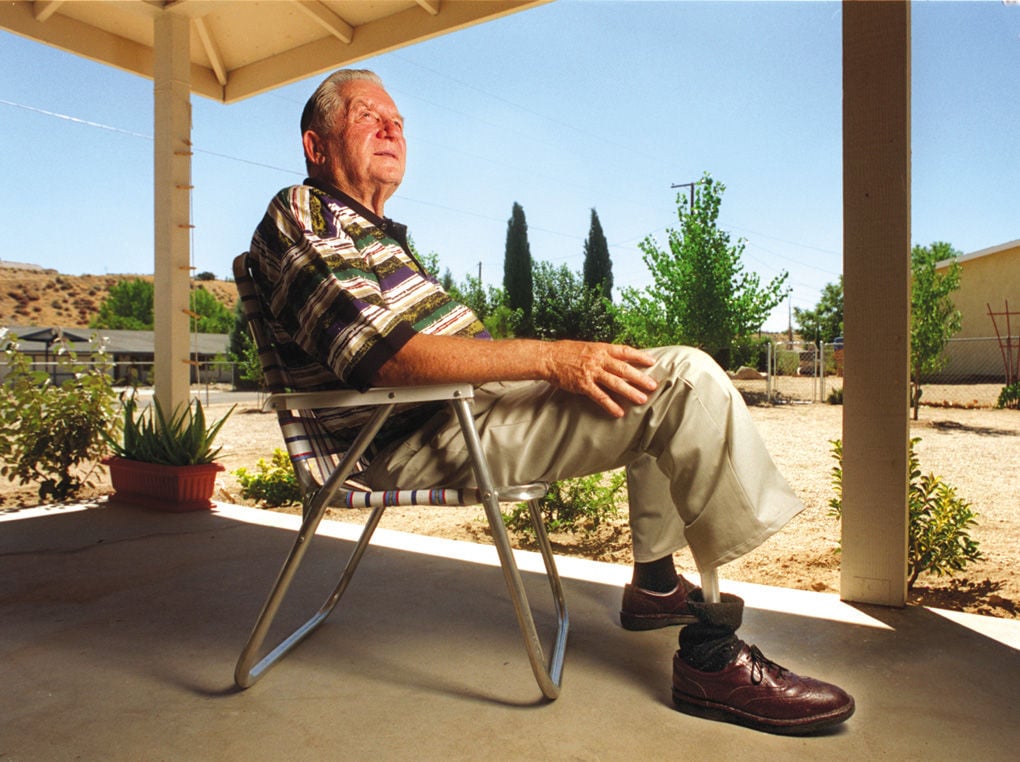
August 4, 1945: Bert Shepard pitches in a game in what would later be called Major League Baseball. This was incredibly unlikely, because he had only one leg.

Bert Robert Shepard was born on June 28, 1920 in Dana, Indiana, hard by the Illinois State Line, and home to a museum dedicated to another native who became a hero of World War II, journalist Ernie Pyle. A lefthanded pitcher, Shepard grew up in nearby Clifton, Indiana, and made his professional debut in the Detroit Tigers' organization in 1939. But by the conclusion of the 1942 season, he hadn't risen above Class C ball (roughly equivalent to "Long A" today).

He enlisted in the U.S. Army Air Forces in World War II, became a pilot, and achieved the rank of 1st Lieutenant. On May 21, 1944, his fighter group was strafing a German airfield northwest of Berlin, when his plane, a Lockheed P-38 Lightning, was hit. He crashed, and was thrown clear, saving his life, as the plane exploded in flames.

He was found by 1st Lieutenant Ladislaus Loidl, an Austrian doctor in the Nazis' air force, the Luftwaffe. Although Shepard's right foot had already been severed, Loidl managed to save his life. Although the Nazis were the enemy, Shepard would always be grateful for the medical services the Germans provided him, even as he recovered in a prisoner-of-war camp.

He was released in a prisoner exchange in February 1945, and he was determined to resume his baseball career. Part of his rehabilitation was spent at the Walter Reed Army Medical Center in Washington. There, he met Under Secretary of War Robert Patterson, and told him of his desire to keep playing baseball despite needing an prosthesis for his right leg. Patterson told Clark Griffith, owner of the Washington Senators, and himself a Hall of Fame pitcher.

On March 29, Griffith signed Shepard, then only 24 years old, as a pitching coach, thinking it would be good publicity. All season long, with his prosthesis being the leg on which he landed in his pitching motion, he pitched batting practice, and visited veterans' hospitals, offering encouragement to other wounded soldiers. On July 10, he pitched 4 innings against the Brooklyn Dodgers in an exhibition game for the War Relief Fund.

However, the Senators couldn't simply put him in a game just for the publicity. Despite their reputation as legendary losers -- the saying was, "Washington: First in war, first in peace, and last in the American League" -- this was a rare season in which they were in the Pennant race. When dawn arrived on August 4, 1945, the Detroit Tigers led the American League, the Senators were only 3 games behind, the New York Yankees were 4 back, and every other team except the Philadelphia Athletics was within 9 1/2 games. The AL race was still anybody's ballgame, and the Senators had as good a chance at the Pennant as anybody.

But despite World War II winding down -- V-E Day was 3 months earlier, and, while no one yet knew it, V-J Day would come in 10 days -- wartime travel restrictions, designed to save fuel for the war effort, were very much in place, to the point where that season's All-Star Game had been canceled, the only time since the game was founded in 1933 that it happened until the COVID epidemic in 2020. This led to teams staying in place longer than usual.

And, in early August, the Senators had a run of 5 straight days of doubleheaders, with the 4th being the 4th of them. Throw in the war's "manpower drain," and finding "warm bodies" was difficult, especially to flesh out a pitching staff. Shepard's time had come.

The 1st game that day was a 4-0 Senators win over the Boston Red Sox. Wally Holborow did the best thing he could for his team: He went the distance, and allowed just 2 hits. In the 2nd game, the Senators wouldn't be so lucky: Even with such talent as Ted Williams, Bobby Doerr, Dom DiMaggio and Johnny Pesky all in the service, the Sox knocked starting pitcher Sandy Ullrich out of the box in the 4th inning.

Senators manager Ossie Bluege brought in Joe Cleary, who was another player who was only playing due to The War's manpower drain. It was his only big-league appearance as well, and he only got 1 batter out, allowing 7 runs on 5 hits and 3 walks. There are pitchers who allowed baserunners and didn't get anybody out, thus having an earned run average of infinity. Cleary has the highest career ERA of anybody who did actually get someone out: 189.00. The Red Sox scored 12 runs in the top of the 4th, and were up 14-2. Tom McBride tied a major league record for most RBIs in an inning: 6, in the 4th, all off Cleary.

So Bluege brought in Shepard, wearing Number 34. There is a sad connection here: Elmer Gedeon, 1 of the 2 MLB players who ended up being killed in World War II (Harry O'Neill of the 1939 Athletics was the other), had also worn 34 for the Senators, playing 5 games in the outfield in 1939. Shepard being assigned 34 was probably a coincidence.

The 1st batter that Shepard faced was George "Catfish" Metkovich, a center fielder who had a decent 10-season career in the majors. Shepard struck him out. He pitched the rest of the way, going 5 1/3rd innings, allowing 1 run on 3 hits, walking 1 and striking out 2. The Red Sox won, 15-4.

The Senators remained in the race until the final day of the season, and finished 1 game behind the Tigers, who then beat the Chicago Cubs to win the World Series. Bluege never brought Shepard into another game. Who knows, that may have cost the Senators the Pennant. They hadn't won one since 1933, they left town in 1971, and no Washington team would win another major league Pennant until the 2019 Nationals.

In 1946, the veteran players returned home, and, war hero or no, there was no place for Shepard on the major league roster. He pitched in the minors that season, and was released by the Senators afterward. He pitched semi-pro ball in 1947, but needed further surgery on his leg, causing him to miss the 1948 season. In 1949, he was a player-manager in Class B ball, going 5-6.

He became a typewriter salesman, making brief comebacks in 1952 and 1955. Then he got back into aeronautics, becoming a safety engineer for Hughes Aircraft, one of Howard Hughes' companies. He won competitions for amputees in both running and golf, even in his 70s.
In 1993, This Week In Baseball did a piece on him, nearly half a century after the fact, covering his trip back to Europe, following his return to the site of his crash, and to a reunion with Dr. Loidl again, where he thanked him for saving his life, and (if only for 1 game) his baseball career.

Bert Shepard died on June 16, 2008 in Highland, California, outside San Bernardino. He was 87 years old, and was survived by his wife and their 2 daughters. Senators center fielder José Zardón was the last surviving player from his lone big-league appearance, living until 2017. I can find no record of how long Loidl lived, beyond 1993; as of August 4, 2022, there are hundreds thousands of World War II veterans, from all countries, still alive, and it is possible that he is one of them.

*

August 4, 1945 was a Saturday. In addition to the Senators-Red Sox doubleheader, these games were played that day:

* The New York Yankees beat the Philadelphia Athletics, 5-1 at Shibe Park in Philadelphia.

* The New York Giants beat the Philadelphia Phillies, 5-4 at the Polo Grounds. The Phillies took a 4-3 lead in the top of the 10th inning. But in the bottom of the 10th, Clyde Kluttz tied it with a home run, and then the Giants loaded the bases, and Whitey Lockman drew a walk to force the winning run home.

* The Brooklyn Dodgers lost to the Boston Braves, 1-0 at Braves Field in Boston. Bill Lee (no relation to the later Red Sox pitcher of the same name) pitched a 6-hit shutout.

* The St. Louis Cardinals beat the Pittsburgh Pirates, 6-5 at Forbes Field in Pittsburgh.

* The Cincinnati Reds beat the Chicago Cubs, 4-3 at Crosley Field in Cincinnati.

* The Chicago White Sox beat the Detroit Tigers, 3-2 at Comiskey Park in Chicago.

* And the St. Louis Browns beat the Cleveland Indians, 8-2 at Sportsman's Park in St. Louis.

Tuesday, July 26, 2022

July 26, 1948: President Truman Desegregates the Armed Forces

July 26, 1948: President Harry S Truman signs Executive Order 9981, abolishing discrimination "on the basis of race, color, religion or national origin" in the United States Armed Forces.

Black men had served in the U.S. military going all the way back to the founding of the U.S. Army in 1775, in the War of the American Revolution. Units such as the 54th Massachusetts Infantry Regiment in the American Civil War, the Harlem Hellfighters (the 369th Infantry Regiment) in World War I, and the 761st Tank Battalion and the units that made up the Tuskegee Airmen (the 332nd Fighter Group and the 477th Bombardment Group) in World War II had all distinguished themselves, and written their names into America's military history as all-black units.

Still, black veterans returned, and found that it didn't matter that they had fought bigotry in Europe or in the Pacific: They were still treated like garbage at home. Asian veterans faced this, too: Senator Daniel Inouye of Hawaii recalled returning home, with a medal pinning the sleeve of his lost right arm to his jacket, and being denied service in a restaurant.

Part of the argument for desegregation in baseball was, "If we can stop bullets, why not balls?" And so, in 1947, former U.S. Army Lieutenant Jackie Robinson became the 1st black player in modern baseball. His example made civil rights activists turn the argument around, and recommend the desegregation of the armed forces. Truman agreed, had the Order written up, and signed it.

The adjustment wasn't easy. The TV show M*A*S*H, set during the next war with American involvement, the Korean War, showed that some Army commanders resisted, with the idea of that the Army could order them to have black men serving under them, but that it couldn't tell them what to do with them, leading to higher casualty rates than among white soldiers.

When the question of whether to allow gay servicemen and -women was first seriously made in the 1990s, the supporting point was that many of the same points made against it were previously made against black soldiers. Those opposed argued that it wasn't the same thing at all. And they looked like idiots.

A 2000 episode of the TV show The West Wing, set in the White House, showed a discussion of the issue, joined by the show's fictional Chairman of the Joint Chiefs of Staff, Admiral Percy Fitzwallace, played by John Amos:

Major Tate (played by Ted Marcoux): Sir, we're not prejudiced toward homosexuals.
Fitzwallace: You just don't want to see them serving in the Armed Forces.
Tate: No sir, I don't.
Fitzwallace: 'Cause they impose a threat to unit discipline and cohesion.
Tate: Yes, sir.
Fitzwallace:That's what I think, too. I also think the military wasn't designed to be an instrument of social change.
Tate: Yes, sir.
Fitzwallace: The problem with that is, that's what they were saying about me 50 years ago: "Blacks shouldn't serve with whites." It would "disrupt the unit." You know what? It did disrupt the unit. The unit got over it. The unit changed. I'm an Admiral in the U.S. Navy, and Chairman of the Joint Chiefs of Staff. Beat that with a stick.

In real life, on October 1, 1989, General Colin Powell, U.S. Army, was named the 1st nonwhite Chairman of the Joint Chiefs of Staff.

*

July 26, 1948 was a Tuesday. There was only one score on this historic day, but it was in, at the time, the biggest rivalry in baseball: The New York Giants beat the Brooklyn Dodgers, 13-4 at Ebbets Field. Sheldon Jones went the distance for the win. Elwyn "Preacher" Roe, in his 1st season with the Dodgers, didn't get out of the 1st inning. He would get considerably better for them. Johnny Mize and, with some foreshadowing, Bobby Thomson hit home runs for the Giants against the Dodgers. Jackie Robinson went 2-for-4 with 2 RBIs.

July 26, 1947: The National Security Act

July 26, 1947: President Harry S Truman signs the National Security Act into law. It turns the Department of War into the Department of the Army. It separates the U.S. Air Force from the U.S. Army, and gives it its own Department. It protects the U.S. Marine Corps as an independent service under the Department of the Navy.

And it puts all 4 departments under the new Department of Defense (DOD), headed by a Secretary of Defense. James Forrestal was confirmed as the 1st "SecDef" on September 18, 1947.

The Act also creates the U.S. National Security Council, run by the President, which includes the Vice President, the Secretary of State, the Secretary of Defense, the Secretary of the Treasury, the Attorney General, and the Chairman of the Joint Chiefs of Staff (the nation's top active-duty military officer).

Later added to it have been the National Security Advisor (a post created in 1953), the White House Chief of Staff, the U.S. Ambassador to the United Nations, the Secretary of Energy, the Secretary of Homeland Security, the Director National Intelligence, the Administrator of the Agency for International Development, and the Director of National Drug Control Policy. On occasion, other officials, whose expertise may apply to a situation, may be asked to attend: The White House Counsel, the U.S. Trade Representative, medical advisors, and so on.

The National Security Act also establishes the Central Intelligence Agency. This turns out to be beneficial in some cases, problematic in others, as later Presidents used the CIA to help organize coups in various countries, to topple governments seen as too friendly to the Soviet Union. Roscoe H. Hillenkoetter was appointed as the 1st Director of Central Intelligence.

The legislation creating the Act was already going through Congress when the Roswell incident happened earlier in July.

The current headquarters of the U.S. Department of State, built in 1941, was named the Harry S Truman Building in 2000. Its address is 2201 C Street NW. The CIA's headquarters, now named for the 41st President and the only one to be a former CIA Director, the George Bush Center for Intelligence, is in Langley, Virginia (and is sometimes nicknamed "Langley"), 10 miles northwest of downtown Washington.

*

July 26, 1947 was a Saturday. These baseball games were played that day:

* The New York Yankees lost to the Chicago White Sox, 2-1 at Yankee Stadium. Eddie Lopat outpitches Bill Bevens, and helps his own cause with an RBI single. He impresses the Yankees so much that they trade for him the next year. Tommy Henrich hit a home run, but Joe DiMaggio went 0-for-4.

* The New York Giants beat the Chicago Cubs, 7-3 at Wrigley Field in Chicago.

* The Brooklyn Dodgers beat the Pittsburgh Pirates, 6-4 at Forbes Field in Pittsburgh. Jackie Robinson went 2-for-4 with a 2-run homer. Hank Greenberg, in his final season, went 0-for-3 with a walk. Earlier in the season, he crashed into Robinson at first base, helped him up, apologized, and, as the man who had faced more prejudice than any player until Robinson, told him he was doing all right and that he supported him all the way.

* The Boston Red Sox beat the St. Louis Browns, 12-1 at Fenway Park in Boston. Ted Williams hit 2 home runs.

* The Detroit Tigers beat the Philadelphia Athletics, 13-0 at Shibe Park in Philadelphia. I guess 84-year-old Connie Mack forgot to tell his A's that you have to come out of the clubhouse to play the ballgame. George Kell and Eddie Lake hit home runs for the Tigers, while center fielder Roger "Doc" Cramer, a native of New Jersey's Long Beach Island, went 3-for-5 with 6 RBIs. Virgil Trucks pitched a 6-hit shutout.

* The Washington Senators beat the Cleveland Indians, 8-4 at Griffith Stadium in Washington.

* The Cincinnati Reds beat the Philadelphia Phillies, 1-0 at Crosley Field in Cincinnati. Bucky Walters pitched a 2-hit shutout.

* And the St. Louis Cardinals beat the Boston Braves, 9-5 at Sportsman's Park in St. Louis. Stan Musial went 1-for-4 with an RBI.

Thursday, July 21, 2022

July 21, 1961: The Unsinkable Gus Grissom

July 21, 1961: Project Mercury launches America's 2nd manned space mission, a capsule called Liberty Bell 7. Aboard is Lieutenant Colonel Gus Grissom of the U.S. Air Force.

Born in 1926 in Indiana, he was an aviation cadet in World War II and a fighter pilot in the Korean War. He was chosen as one of America's original astronauts, "The Mercury Seven," all of whom -- except for Donald "Deke" Slayton, who was initially grounded for a medical reason -- would fly aboard Mercury capsules with the number 7 on their missions.

Some people at NASA weren't happy that Grissom went by his nickname, Gus. But his real first name was Virgil, and that seemed a big too nerdy. So they asked him what his middle name was. It was Ivan. That wasn't going to work at the height of the Cold War. So they allowed Virgil Ivan Grissom to be listed as "Gus Grissom."

Like his only American predecessor, Alan Shepard aboard Freedom 7, Grissom's flight was only meant to be suborbital: Up, then down, taking about 15 minutes. The flight went as expected until just after splashdown in the Atlantic Ocean, when the hatch cover, designed to release explosively in the event of an emergency, accidentally blew. Grissom was at risk of drowning, but was recovered safely via a U.S. Navy helicopter. The spacecraft sank into the Atlantic and was not recovered until 1999.

Before airplane flights that crossed the "Karman Line" were retroactively listed as "spaceflights," Grissom was the 1st American astronaut to be given a 2nd spaceflight. It was aboard Gemini 3, the 1st manned flight of Project Gemini, so named because it would have 2 men aboard.

On March 23, 1965, Grissom and John Young made 3 orbits of the Earth aboard a capsule that was nicknamed Molly Brown, after the heroic socialite who saved some of the Titanic's passengers in 1912, and lived to be called "The Unsinkable Molly Brown." The idea was, this capsule wouldn't sink after splashdown, and it didn't. The mission was a complete success. (In another odd connection with Grissom, "Molly" was a nickname: Her real name was Margaret.)

Grissom was meant to fly a 3rd time, aboard the 1st Apollo mission. But in 1967, he, Ed White and Roger Chaffee were killed during an engine test for Apollo 1. It was the world's 1st space program tragedy. Grissom was 40 years old, and died not by water, as had once been feared, but by fire.

In the 1983 film The Right Stuff, he was played by Fred Ward.

*

July 21, 1961 was a Friday. These baseball games were played:

* The New York Yankees beat the Boston Red Sox, 11-8 at Fenway Park in Boston. The Yankees scored 5 runs in the top of the 9th inning to win it, including a grand slam by Johnny Blanchard, making Luis Arroyo a winning pitcher in relief of Whitey Ford. Ford went 25-4 that season, winning the Cy Young Award, but, on this day, allowing 7 runs in 4 innings, this may have been his worst start of the season.

Roger Maris hit his 36th home run of the season, Mickey Mantle his 37th, and Yogi Berra his 12th. Blanchard's slam was his 10th homer. Maris would end the season with 61, Mantle with 54, Berra with 22 and Blanchard with 21.

* The Philadelphia Phillies beat the Chicago Cubs, 4-3 at Connie Mack Stadium in Philadelphia. Tony González hit a home run to win it in the bottom of the 10th inning. Ernie Banks did not play for the Cubs, but Billy Williams hit a home run.

* The Milwaukee Braves beat the Pittsburgh Pirates, 5-3 at Forbes Field in Pittsburgh. Hank Aaron hit 2 home runs. Roberto Clemente went 1-for-5.

* The Minnesota Twins beat the Cleveland Indians, 4-3 at Metropolitan Stadium in the Minneapolis suburb of Bloomington, Minnesota. Harmon Killebrew went 1-for-4.

* The St. Louis Cardinals beat the Los Angeles Dodgers, 10-1 at the 1st Busch Stadium (formerly the last Sportsman's Park) in St. Louis.

* The Kansas City Athletics beat the Detroit Tigers, 3-2 at Kansas City Municipal Stadium. Al Kaline went 1-for-4.

* The Los Angeles Angels beat the Washington Senators, 16-5 at the Los Angeles version of Wrigley Field.

* The Baltimore Orioles and the Chicago White Sox were rained out at Comiskey Park in Chicago. The game was made up as part of a doubleheader the next day. The White Sox swept, 7-4 and 11-4. Brooks Robinson went 2-for-5 in each game.

* And the Cincinnati Reds and the San Francisco Giants were rained out at Crosley Field in Cincinnati. The game was made up as part of a doubleheader on August 22. The Giants swept, 12-2 and 5-3. Over the 2 games, Willie Mays went 6-for-10 with a home run and 4 RBIs, and Willie McCovey went 5-for-10 with 2 home runs and 3 RBIs. Frank Robinson went 0-for-3 with a walk in the opener, and appeared only as a pinch-hitter in the nightcap, not reaching base.

Wednesday, July 20, 2022

July 20, 1967: Don Steinbrunner Is Killed In Action

July 20, 1967: Major Don Steinbrunner, a U.S. Air Force pilot, is shot down over Kontum, Vietnam. He was 35 years old.

A native of Bellingham, Washington, he was a tackle, on both offense and defense, at Washington State University, before playing 8 regular-season games, starting 3 of them, with the Cleveland Browns in 1953. He also played in that season's NFL Championship Game, which the Browns lost to the Detroit Lions.

He had been in the Reserve Officers Training Corps (ROTC) at Washington State, and left the Browns after the 1953 season to complete his military commitment. This included serving as an assistant coach at the newly-established U.S. Air Force Academy in Colorado Springs, Colorado. He rose to become a pilot, and his plane was spraying the defoliant Agent Orange, designed to eliminate the Viet Cong's jungle hiding places -- with the side effect of causing cancer in the sprayees as well -- when it was shot down.

The Korean War took a lot of athletes away from their teams. The Vietnam War was another matter. There were 3.4 million American men who served in the armed forces during the Vietnam era – depending on whose figures you believe, starting in either 1954, 1959, 1961 or 1964, and ending in 1973 or 1975. This included several athletes, including New York Yankees Tony Kubek and Bobby Murcer, who missed time due to military service, but never went into combat. Jim Lonborg served in the Army Reserve, and all through the Boston Red Sox' 1967 "Impossible Dream" season, could have been called up. He wasn't.

The only big-league baseball player who served in combat was Roy Gleason. The native of Temecula, California appeared in 8 games in 1963 for the Los Angeles Dodgers, his "hometown team," mostly as a pinch-runner. But it was enough for the team, which won the World Series that year, to give him a World Series ring. He had one at-bat, and doubled. He wore Number 36, the same number that Korean War vet Don Newcombe wore for the Brooklyn edition of the Dodgers.

Gleason never got back to the majors, and was drafted in 1967. Sergeant Gleason was wounded in 1968, and, sometime between the shot that hit him and the hospital that saved him, he lost his World Series ring. In 2003, as part of a veterans' celebration at Dodger Stadium, then-manager Jim Tracy gave him a replacement ring.

Pro football wasn't so lucky: The game lost 2 players in Vietnam. For a long time, it was believed to be 1. On July 21, 1970, Lieutenant Bob Kalsu, an All-American guard at the University of Oklahoma who played for the Buffalo Bills in 1968 before being drafted, was killed at Base Ripcord.

After NFL Films did a piece on him, someone wrote to them and informed them that there was another: Don Steinbrunner. (Not "Steinbrenner," though he did play for George Steinbrenner's hometown team.) It's likely that his NFL tenure, which was during the Korean War rather than Vietnam, confused the researchers.

Kalsu wore Number 51, but although the Bills have elected Kalsu to their Wall of Fame, they tend not to retire uniform numbers, and his 51 remains in circulation. So does the 56 worn with the Browns by Steinbrunner. Washington State have not retired the 84 that Steinbrunner wore with them, either.

Other NFLers who served in Vietnam include Hall-of-Famers Ray Nitschke, Roger Staubach and Charlie Joiner. The Naval Academy produced Heisman winners Staubach and Joe Bellino; the Army's Military Academy produced Pete Dawkins, and while he chose to stay in the service, he was a genuine combat hero and rose to the rank of General. Rocky Bleier nearly lost his leg in Vietnam, but came back to help the Pittsburgh Steelers win 4 Super Bowls.

*

July 20, 1967 was a Thursday. These baseball games were played that day:

* The New York Yankees lost to the Cleveland Indians, 4-0 at Cleveland Municipal Stadium. Sam McDowell pitched a 6-hit shutout, while Fritz Peterson lasted only 4 innings. Mickey Mantle went 0-for-2 with 2 walks.

* The New York Mets lost to the Houston Astros, 7-0 at Shea Stadium. Don Wilson allowed only 2 hits: Single by Ed Charles in the 1st inning and Larry Stahl in the 9th. In between, he pitched 23 no-hit outs. He also walked Ed Kranepool in the 2nd. In the 6th, he walked Stahl and hit Bud Harrelson with a pitch, but induced a double play to get out of it.

* The Philadelphia Phillies beat the Los Angeles Dodgers, 10-4 at Connie Mack Stadium in Philadelphia.

* The San Francisco Giants beat the Pittsburgh Pirates, 6-1 at Forbes Field in Pittsburgh. Willie Mays did not play, but Willie McCovey hit a home run. Roberto Clemente also did not play.

* The St. Louis Cardinals beat the Cincinnati Reds, 7-3 at Crosley Field in Cincinnati. Orlando Cepeda, Bobby Tolan and Julián Javier hit home runs. Lou Brock went 1-for-5. Roger Maris went 1-for-3 with a walk and an RBI. Pete Rose went 2-for-5.

* The Detroit Tigers beat the Washington Senators, 8-4 at Tiger Stadium in Detroit. Al Kaline did not play.

* The Atlanta Braves beat the Chicago Cubs, 2-1 at Wrigley Field in Chicago. Hank Aaron went 2-for-4. Ernie Banks went 0-for-4.

* The Baltimore Orioles and the Boston Red Sox were rained out at Memorial Stadium in Baltimore. The game was made up as part of a doubleheader on September 22. The Orioles won the opener, 10-0. Jim Hardin pitched a 5-hit shutout. The Red Sox won the nightcap, 10-3. Over the 2 games, Brooks Robinson went 2-for-9 with 2 RBIs, Frank Robinson went 2-for-7 with a walk and an RBI, and Carl Yastrzemski went 2-for-7 with 2 walks and an RBI.

* And the California Angels, the Chicago White Sox, the Kansas City Athletics, the Minnesota Twins were not scheduled.

Tuesday, July 19, 2022

July 19, 1993: "Don't Ask, Don't Tell" Becomes Law

July 19, 1993: President Bill Clinton signs into law his measure allowing gay people to serve in America's armed forces, known as "Don't ask, don't tell." In other words, gay people could serve in the U.S. Army, the U.S. Navy, the U.S. Air Force, the U.S. Marine Corps, and the U.S. Coast Guard, and couldn't be dishonorably discharged just for being gay. No person, officer or enlisted, could ask any other person if they were gay.

The reason gay people were not allowed to serve is that a closeted gay person could be compromised by being "outed," and thus become a security risk. As long as there was a military draft, people would tell their draft board that they were gay, and would be exempted -- but this would then be publicly revealed, and, under the laws of the time, they could be fired from their civilian jobs and find it hard to find new ones.

At the time, liberals called "DADT" a huge step forward by a great progressive new President, while conservatives called it an abomination. After the Republicans swept the 1994 Congressional and gubernatorial elections, many observers on both sides blamed the Democrats' defeat on Clinton focusing on "gays in the military" so early in his Administration. Paul Shanklin, a comedian who did impressions on The Rush Limbaugh Show on radio, did a version of The Beatles' "Yesterday" by singing, as Clinton, "Yesterday, all my troubles started with the gays."

By the time Clinton left office in 2001, liberals were still calling DADT a good idea, but progressives were denouncing it as just another one of Clinton's half-a-loaf measures, since he was too chicken to go after the full load. Conservatives were still calling it an abomination.

In 2011, President Barack Obama provided the other half of the loaf, removing all restrictions against gay and transgender military personnel. Conservatives called that an abomination.

*

July 19, 1993 was a Monday. These Major League Baseball games were played:

* The New York Yankees beat the Seattle Mariners, 8-2 at Yankee Stadium. Scott Kamieniecki went the distance for the win, while former Yankee Tim Leary didn't get out of the 2nd inning. Bernie Williams and Pat Kelly hit home runs. Ken Griffey Jr. went 1-for-4.

* The New York Mets beat the San Diego Padres, 2-1 at Jack Murphy Stadium in San Diego. This was in the middle of the Padres' "fire sale." Charlie O'Brien led off the top of the 10th inning with a home run. Tony Gwynn went 1-for-4 with the Padres' only RBI.

* The Boston Red Sox beat the California Angels, 8-6 at Fenway Park in Boston.

* The Baltimore Orioles beat the Kansas City Royals, 6-5 at Camden Yards in Baltimore. Cal Ripken went 1-for-3 with an RBI. George Brett, in his final season, had an RBI single as a pinch-hitter.

* The St. Louis Cardinals beat the Atlanta Braves, 4-0 at Atlanta-Fulton County Stadium. The Cards got 2 home runs from Brian Jordan, and 1 from Mark Whiten.

* The Florida Marlins beat the Colorado Rockies, 3-1 at Joe Robbie Stadium (now Hard Rock Stadium) in Miami Gardens, Florida.

* The Houston Astros beat the Pittsburgh Pirates, 4-2 at Three Rivers Stadium in Pittsburgh.

* The Cleveland Indians beat the Oakland Athletics, 4-2 at Cleveland Municipal Stadium. Rickey Henderson went 1-for-3 with an RBI.

* The Chicago Cubs beat the Cincinnati Reds, 6-4 at Riverfront Stadium in Cincinnati.

* The Minnesota Twins beat the Detroit Tigers, 4-2 at Tiger Stadium in Detroit.

* The Toronto Blue Jays beat the Chicago White Sox, 15-7 at the new Comiskey Park (now Rate Field) in Chicago.

* The Texas Rangers beat the Milwaukee Brewers, 5-3 at Arlington Stadium in the Dallas suburb of Arlington, Texas. Nolan Ryan gained the 321st win of his career. He would have 3 more. Robin Yount, also in his final season, went 2-for-4, including his 249th career home run. He would have 2 more.

* The Philadelphia Phillies beat the Los Angeles Dodgers, 7-5 at Dodger Stadium in Los Angeles.

* And the San Francisco Giants beat the Montreal Expos, 6-2 at Candlestick Park in San Francisco. Barry Bonds went 2-for-3 with an RBI.

Thursday, July 7, 2022

July 7, 1946: The Crash That Ruined Howard Hughes

July 7, 1946: Howard Hughes crashes his Hughes XF-11 airplane. The plane is destroyed. So were four houses. Hughes himself was never the same.

Howard Robard Hughes Jr. was born on a Christmas Eve, December 24, 1905, in Houston, Texas. His father was an inventor, and the owner of a tool company. On his mother's side, he was a distant cousin of airplane inventors Orville and Wilbur Wright.

As a boy, he showed an affinity for technology, and built Houston's 1st "wireless" radio transmitter when he was only 11 years old. He soon became one of the earliest "ham radio" operators in the city. At 12, he had taken parts from a steam engine his father had built, and given himself a "motorized bicycle." At 14, he took his 1st flying lesson.

His parents both died before he turned 20, and, inheriting 75 percent of the family fortune, he established a medical research laboratory in their memories. It is now known as the Howard Hughes Medical Institute, and operates in the Washington, D.C. suburb of Chevy Chase, Maryland.

In 1925, he dropped out of Houston's Rice University, and married Ella Botts Rice, a member of the university's founding family. They moved into the Ambassador Hotel in Los Angeles -- where Robert Kennedy would be assassinated in 1968 -- and he went into the film production business.

He found success with the films Two Arabian Knights (1927), The Racket (1928), Hell's Angels (1930, a film about pilots), The Front Page (1931), and the original version of Scarface (1932). While some producers, directors and actors were fazed by the switch from silent films to "talking pictures," Hughes, as ever, reveled in a new technology.

The film with which Hughes is most identified, however, came a few years later: The Outlaw, made in 1943 but not released until 1946, loosely based on the story of Wild West figure William H. Bonney, a.k.a. Billy the Kid. All anybody remembers is Jane Russell, whose clothes were considered too tight for the puritanical Hays Code. Hughes' solution spoke to both his love of technology and his love of women: He designed a better bra for her.

Ella divorced him in 1929, freeing him to date anybody in Hollywood he could get his hands on. Russell and Gene Tierney both turned him down. While Jean Harlow was his date to the premiere of Hell's Angels, their relationship went no further than that. But among the women who said yes to him were both Joan Crawford and Bette Davis.

(Hughes was not the source of their famous feud. Actor Franchot Tone was: Davis starred with him in Dangerous, and she fell in love with him, but he married Crawford.)

He also dated Olivia de Havilland, possibly due to her family's involvement in the British aviation industry. And he dated Hedy Lamarr, the Austrian bombshell who was as brilliant as he was, developing a patent for an early radar system. Tierney was quoted as saying, "I don't think Howard could love anything that did not have a motor in it." Nevertheless, he also dated Ginger Rogers, Katharine Hepburn, Ava Gardner, Debra Paget, Yvonne De Carlo, Gloria Vanderbilt and Mamie Van Doren.

On July 14, 1938, Hughes took off from New York City in a Lockheed 14 Super Electra, with Harry Connor, a co-pilot; Thomas Thurlow, a navigator; Richard Stoddart, an engineer; and Ed Lund, a mechanic. He wanted to show that long-distance air travel was not only possible, but safe.

He landed, and refueled, in Paris; in the Soviet cities of Moscow, Omsk and Yakutsk; in Fairbanks, Alaska; and Minneapolis, before returning to New York. He completed this around-the-world flight in 3 days, 19 hours and 17 minutes, cutting the existing record, set by Wiley Post in 1933, in half. For this achievement, New York City gave him a ticker-tape parade up Broadway.

Through his Hughes Aircraft Corporation, he continued to design planes for the U.S. government, proving valuable during World War II. Even after the war, he kept at it. But this proved to be harmful to him in the long run.

On July 7, 1946 -- the day after future President George W. Bush, future actor Sylvester Stallone, and future football player-turned-actor Fred Dryer were born -- Hughes himself piloted a plane of his own design, the XF-11, taking off from his company's airfield outside Los Angeles, in Culver City, California at 5:25 PM Pacific Time (8:25 Eastern). Immediately, he violated U.S. Army Air Force protocol: He retracted the landing gear -- and it didn't retract properly.
Only 2 XF-11s were ever built.
This is the 2nd plane's 1st flight.

It was the plane's maiden flight, and it was supposed to last 45 minutes. Hughes flew the plane in circles over Culver City for an hour and 15 minutes, until an engine gave out. He aimed the plane at the closest thing he could find to a flat piece of ground where there was unlikely to be any people: The Los Angeles Country Club.

He didn't make it. He clipped houses on Linden Drive in Beverly Hills, before his plane burst into flames as it sliced through 808 and 810 Whittier Drive, and crashing onto the lawn of 810 Whittier, at 6:47 PM. Despite extensive injuries, he managed to get out of the plane, and was dragged to safety by 2 military men: Marine Master Sergeant William L. Durkin and Army Captain James Guston, one of the residents at 810 Whittier, before the plane blew up completely.
The crash site is literally around the corner from 810 North Linden Drive, where Mob figure Benjamin "Bugsy" Siegel would get rubbed out nearly a year later; and both are half a mile south of Maltz Park, where Sunset Boulevard makes what became known as "Dead Man's Curve," made famous in a 1964 drag-racing song by rock duo Jan & Dean -- and, for Jan Berry, art would imitate life, and he would nearly die in a crash there 2 years after that.

Hughes was 40 years old, and had already lived the lives of several men. He was taken to the Beverly Hills Emergency Hospital, and given a 50-50 chance to live. He had a crushed collarbone, several cracked ribs, a collapsed left lung, and several 3rd-degree burns.

He did survive, and even piloted the 2nd XF-11 that was built on its maiden flight, the following year. Also in 1947, he built, and piloted on its one and only flight, the largest airplane ever built to that point, the Hughes H-4, known as the Spruce Goose. He bought RKO Pictures, and consolidated several smaller airlines into the larger Trans World Airlines (TWA). So his business acumen seemed unaffected.

But Hughes was left with permanent injuries. He grew a mustache to hide a scar on his lip. He had developed an addiction to painkillers, and sustained a concussion and brain damage. He developed obsessive-compulsive disorder, and became a germophobe. And yet, the few people who saw him in his last few years maintained that he would frequently go for weeks without bathing, shaving, or getting his hair or fingernails cut.
As far as can be authenticated,
this is the last known photo of Hughes.
The year was 1961. He was 55 years old.
He looks a lot older than that.

On Thanksgiving Day 1966, he moved into the Desert Inn in Las Vegas. Apparently, he got disruptive, and the owners tried to kick him out. So he bought them out. He made the 9th floor penthouse his personal residence, and the 8th floor his business headquarters. He bought a hotel across the street, simply to have the legal right to dismantle a neon sign that shone into his bedroom and disturbed him. (That's not crazy: If I had the money to eliminate something that was upsetting me, without hurting anybody, I would. It's not like he dismantled the hotel and put people out of work. In fact, there was an episode of Seinfeld with echoes of this story.)

In 1957, Hughes married actress Jean Peters. But she divorced him in 1971. He is not known to have had any children. And so, when he died on April 5, 1976, at 70 -- he was so unkempt that fingerprints had to be used to conclusively identify the body -- his estate, worth $2.5 billion (about $12.8 billion in 2022 money), was divided among 22 cousins, with one William Lummis receiving $625 million to endow the Howard Hughes Medical Institute. Each of his ex-wives received $156 million, and $470 million was divided among some of his corporate executives.

Actress Terry Moore, who married 5 times, the 1st time to football star Glenn Davis, claimed to have married Hughes in 1949, separating from him in 1956, but never divorcing him -- which, if true, would have made both of them bigamists. She contested the will on the basis of that marriage, but no available documentation could prove her claim. She settled with the Hughes estate, receiving $350,000.

The characters of Jonas Cord (played by George Peppard) in the 1964 film The Carpetbaggers, Willard Whyte in the 1971 James Bond film Diamonds Are Forever, a reclusive millionaire played by John Astin on a 1973 episode of The Partridge Family, and Mr. Bigweld (voiced by Mel Brooks) in the 2005 animated film Robots, were based on Hughes. He was a friend of the Bond films' co-producer, Albert R. "Cubby" Broccoli, so not only did Hughes not object to the homage to him in Diamonds Are Forever, he actually allowed filming in the Landmark Hotel, which he owned.

A 1985 episode of the ABC sitcom Benson featured the title character (Robert Guillaume), by this point a State's Lieutenant Governor, inheriting the assets of Hugh Howard, a pastiche of Howard Hughes and Hugh Hefner (who was still alive at that point), including his Playboy-like magazine and private club, which becomes embarrassing for him, Governor Gene Gatling (James Noble), and the Governor's staff.

At one point, Benson tells the Governor that the details of the will state that he can't give the assets away unless he dies. The Governor, not quite understanding, says, "That could take months!" His problem was solved when, in a mirror of the Terry Moore case, Hughes' business manager/mistress sued him. Legally, Benson couldn't give her the assets by settling, so he had to tank the court case.

Hughes has been played by Tommy Lee Jones in the 1977 CBS TV-movie The Amazing Howard Hughes, Jason Robards in the 1980 film Melvin and Howard, Dean Stockwell in the 1988 film Tucker: The Man and His Dream, Terry O'Quinn in the 1991 superhero film The Rocketeer, Leonardo DiCaprio in the 2004 film The Aviator (which spectacularly staged the '46 crash, and won 5 Academy Awards, as many as all of the films that Hughes ever produced, combined), and Warren Beatty in the 2016 film Rules Don't Apply.

The superheroes Bruce Wayne, DC Comics' Batman, and Tony Stark, Marvel Comics' Iron Man (as the character's co-creator, Marvel boss Stan Lee, admitted), were both based in part on Hughes, to the point where, when Stark's backstory was fleshed out, his father was named Howard. That character was played as a young man by Dominic Cooper in the film Captain America: The First Avenger and the TV show Agent Carter; and as an older man by John Slattery in the Marvel Cinematic Universe scenes taking place from 1970 to 1991.

Howard Hughes was a scientist, a filmmaker, a pilot, a business lord, and a nut. He was, to borrow the words of an old song, "Something appealing, something appalling."

*

July 7, 1946 was a Sunday. As was often the case in that era, baseball teams frequently played doubleheaders on Sunday. On this day, 12 of the 16 teams did:

* The New York Yankees split with the Philadelphia Athletics at Shibe Park in Philadelphia. The Yankees won the opener, 7-3. Aaron Robinson and Tommy Henrich hit home runs, in support of Bill Bevens. Joe DiMaggio got a hit in his 1st at-bat, then left the game due to injury, and did not play in the nightcap, which the A's won, 4-1. Bob Savage outpitched Spurgeon "Spud" Chandler.

* The New York Giants swept the Philadelphia Phillies, 2-1 and 10-2 at the Polo Grounds.

* There was a split at Braves Field in Boston. The Boston Braves won the 1st game, 3-2. The Brooklyn Dodgers won the 2nd game, 4-2. 

* The Boston Red Sox swept the Washington Senators, 11-1 and 9-4 at Griffith Stadium. Over the 2 games, Ted Williams went 4-for-6 with a home run, 5 walks and 3 RBIs.

* There was a split at Cleveland Municipal Stadium. The Cleveland Indians won the 1st game, 3-2. Bob Feller was the winning pitcher. The Chicago White Sox won the 2nd game, 5-0. Future Yankee Eddie Lopat pitched a 2-hit shutout.

* The Cincinnati Reds beat the Chicago Cubs, 6-2 at Wrigley Field in Chicago.

* The Detroit Tigers Beat the St. Louis Browns, 3-0 at Briggs Stadium (later Tiger Stadium) in Detroit. Hal Newhouser pitched a 5-hit shutout.

* And the St. Louis Cardinals swept the Pittsburgh Pirates, 4-3 and 6-0 at Sportsman's Park in St. Louis. Howie Pollet pitched a 3-hit shutout in the 2nd game.

December 31, 1999 & January 1, 2000: The Millennium

December 31, 1999:  The Millennium arrives. The people of planet Earth survived. At a terrible cost. But we hadn't destroyed ourselves. ...